Timothy Williamson is the author of
Model Logic as Metaphysics (2013),
Vagueness,
The Philosophy of Philosophy,
Knowledge and its Limits, and
Identity and Discrimination. In this interview with 3:am Magazine's Richard Marshall, Williamson discusses a lot of topics and ideas I had to research a bit in order to grok even a wee bit
Be that as it may, this is a cool interview with an influential philosopher most of us have never read and are likely not familiar.
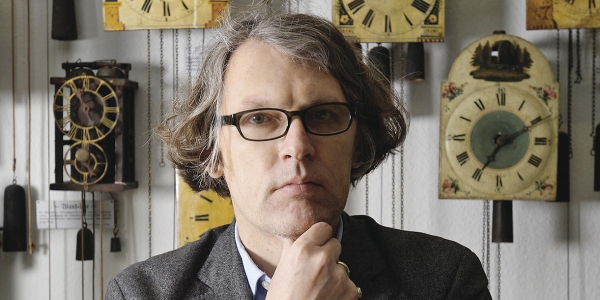
Timothy Williamson interviewed by Richard Marshall.

Best known as the Ace Ventura of Vagueness, the Fu Fighter of the Philosophy of Philosophy, the Nightwing of Knowledge and its Limits and the Iceman of Identity and Discrimination, Timothy Williamson is no less the Marvel Man of Modality and Metaphysics. His first interview with 3ammagazine pioneered the End Times series. He’s invited back with a new book to join the series he inspired and broods to the depths on why naturalism is an unhelpful term, why ‘mad dog naturalist’ Alex Rosenberg is brave but wrong, why Paul Horwich’s Wittgensteinianism is also deeply mistaken, about why there’s a need to dirty one’s hands on technicalities if you want to be able to choose between competing theories, about necessitism vs contingentism, permanentism vs temporaryism, an aside about death, about Ruth Barcan Marcus’s key axiom, about his deepened respect for Rudolph Carnap,about Kripke’s fantastic success story, and Bob Stalnaker’s and Kit Fine’s contributions too, and about higher order modal logic being an alternative paradigm for core metaphysical theories. Like the Hulk, this one’s so kickin’ it needs a cage in high atmosphere. Smashed It!
3:AM: Since your last interview here you’ve got a new book out regarding modal logic and metaphysics. But before turning to that, you’ve continued to defend a particular vision of philosophy and there have been two prominent challenges that you’ve faced down on behalf of analytic philosophy. The first of these is a Quinean philosophical naturalism and the other, much more recently, is the Wittgensteinian challenge to what Paul Horwich has called Traditional philosophy. So we can start with the first of these. In your arguments against the naturalist case are you batting for analytic metaphysics and what are the reasons for this?
Timothy Williamson: I’ve been trying to wake people up to the confusion in the current use of the word ‘naturalism’. That isn’t a matter of being anti-naturalist or naturalist but of refusing to define one’s position in such naïve terms. The word ‘naturalism’ is used to bundle together various different ideas, some good, some bad. I’m sometimes called a naturalist, sometimes an anti-naturalist, because I accept some of those ideas and reject others.
A good idea associated with the phrase ‘Quinean philosophical naturalism’ is a holistic one: although we can divide human inquiry into different disciplines (physics, biology, mathematics, philosophy, history, economics, …) for organizational purposes, they are all interconnected, and the results of any one of them are in principle relevant to the results of any other. For example, history and astronomy interact because historical documents contain reports of comets: sometimes they help astronomers establish the period of the comet, sometimes they help historians date ancient events. Philosophy is and always has been deeply engaged in that holistic interaction. It is much more similar to the rest of human inquiry than some philosophers like to think. For example, it is hopeless to pretend that the results of natural science are in principle irrelevant to philosophy on the grounds that philosophical questions are ‘purely conceptual’. In my previous book The Philosophy of Philosophy I defended such anti-exceptionalism about philosophy, and it is of course an idea that Quine defended too.
But some bad ideas are also associated with the phrase ‘Quinean philosophical naturalism’, which can be roughly summed up by the terms ‘reductionism’ and ‘scientism’. Quine privileged natural science, and in particular physics, over all other forms of inquiry, to the point of not taking very seriously any theory that couldn’t be reduced to part of natural science. The methodology of the natural sciences is obviously by far the best way we have of answering the sort of questions those sciences ask, and I’ve already said that the answers are relevant in principle to any other branch of human inquiry. Equally obviously, it does not follow that natural science is the best way of answering the questions that those other branches ask. If your question is about physics, ask a physicist; if your question is about history, ask an historian. A decent working assumption (not an exceptionless sacrosanct principle) is that the practitioners of any well-established intellectual discipline tend to use the most suitable methodology available for answering its questions. Philosophy is no exception. So another thing I did in The Philosophy of Philosophy was to explain the rationale for the standard ‘armchair’ methodology of contemporary analytic philosophy, in particular for its use of thought experiments and for the very minor role that experimentation plays.
You mentioned analytic metaphysics, although it’s only one example amongst many. Analytic metaphysicians don’t ignore natural science: for example, they treat Einsteinian special relativity as an extremely serious threat to a traditional or common sense conception of time. But it’s true that much of analytic metaphysics consists of theorizing that is only very loosely constrained by natural science. In most cases, it would be pointless to tell those analytic metaphysicians to pay more attention to natural science, or to do some experiments, because it’s utterly unclear how doing so would help them answer their questions.
The central figure in analytic metaphysics over recent decades was undoubtedly David Lewis, who was strongly influenced by Quine. He is notorious for his theory of modal realism, according to which other possible worlds are spacetime systems disjoint from ours but equally real and concrete. Lewis justifies his modal realism using a methodology drawn from Quinean philosophical naturalism. He argues in effect that modal realism yields the best systematization of various phenomena in the clear, simple terms of standard first-order logic, to which Quine assigned a privileged status, and an ontology of concrete objects. Lewis’s argument is abductive, an inference to the best explanation, which is a style of argument typical of the natural sciences. So it’s a mistake to regard analytic metaphysics and Quinean philosophical naturalism as automatically opposed, unless Quinean philosophical naturalism is internally inconsistent, because it gives rise to analytic metaphysics. Of course, Quine didn’t accept Lewis’s modal realism. Nor do I. But such theoretical disagreements are quite different from the idea that there is no room in principle for analytic metaphysics, and that we should leave metaphysics to the natural scientists. If you look at Quine’s own work, you see that he paid very little attention to post-1930 physics. Physicists are simply not trained to deal with many of the questions that metaphysicians ask, and are just as liable to embarrass themselves if they try to sort out metaphysics as metaphysicians are if they try to sort out physics, although I should emphasize that very productive dialogue is possible when both sides have a sense of their own limitations. There is a significant overlap between philosophy of physics and theoretical physics.
My own view is that the affinities between metaphysics and mathematics are just as important as those between metaphysics and physics. Mathematics is the most rigorous form of human inquiry there is, and also the one least sensitive to the results of observation and experiment. You shouldn’t just think of mathematicians as proving theorems. You must remember that their proofs depend on first principles, axioms, which have to come from somewhere. Set theorists search for new axioms to resolve problems such as Cantor’s continuum hypothesis, which are undecidable on the basis of the current axioms. Their search uses an abductive methodology that has much in common with the methodology of analytic metaphysics. They are looking for strong, simple, elegant axioms that have unifying power and are consistent with everything we already know.
3:AM: Alex Rosenberg thinks that understanding the nature of maths will rest on the success that science has had so far in making sense of everything else. He bets that an epistemology explaining how we know a priori synthetic truths will come from science not analytic philosophy. And he also points out that even if you’re right that naturalists have no handle on mathematical truths, neither do non-naturalists. How do you respond?
TW: Alex bravely defends what I think of as the worst beliefs associated with the word ‘naturalism’, the scientism and the reductionism. He claims that only the methodology of natural science produces genuine knowledge. I pointed to mathematics as a glaring counterexample. He admits that it’s a problem for his view, but has faith that somehow or other, he has no idea how, the methodology of natural science will solve the problem and show that mathematics isn’t really a counterexample after all. There is no symmetry between his view and mine with respect to mathematics. On the face of it, mathematics is a massive counterexample to his view. On the face of it, mathematics is perfectly consistent with my view. His view requires mathematics to be either reduced to natural science or ditched. He can’t ditch it, because natural science itself uses mathematics all the time, and he has no idea how to reduce it to natural science. My view involves no such dilemma. Mathematics is fine as it is, without being reduced to anything else. He can’t find the sort of handle on mathematics his view says he needs. My view says no such handle is needed.
Furthermore, it’s not even approximately true that natural science has had success in making sense of everything but mathematics, if that involves showing that other forms of genuine human knowledge resulted from the methodology of the natural sciences. We have massive knowledge of history that doesn’t come from that methodology. Of course, some naturalists in a watered-down sense would stretch their understanding of the methodology to cover past and present historical scholarship. But Alex Rosenberg doesn’t do that, he just dismisses history as a source of genuine knowledge. If he wants to enact a reductio ad absurdum of his own extremist brand of naturalism, that’s fine by me.
3:AM: Paul Horwich’s Wittgensteinian challenge basically called out Traditional Theoretical philosophy (‘T-philosophy’) as being irrationalist. You mounted a very vigorous defence. You disputed many of the claims that were supposed to damn T-philosophy and concluded that if this was Wittgenstein then Wittgenstein was pretty unimpressive and inconsistent. Can you summarise the dispute?

TW: I’ll start with the point about inconsistency. Wittgenstein’s metaphilosophy has long been accused of being self-refuting, because it condemns the very activity it’s engaged in. The problem sticks out a mile in Paul’s recent book on the subject, in part because he writes so clearly and directly. Roughly, the characteristic of T-philosophy as Paul defines it is that it gives a priori informal arguments for deeply non-obvious conclusions. The book gives a priori informal arguments for the deeply non-obvious conclusion that it is irrational to do T-philosophy, i.e. to give a priori informal arguments for deeply non-obvious conclusions, i.e. to argue in the very way he’s arguing. In that sense, the book is rather clearly self-refuting. In effect, Paul’s reply is that the conclusion that it is irrational to do T-philosophy isn’t deeply non-obvious, because his arguments render it potentially obvious, but of course the T-philosophers he’s criticizing might say the same thing.
In the long run, what matters is the quality of Horwich’s Wittgenstein’s arguments compared to the best arguments in T-philosophy. If one could argue by the highest standards of T-philosophy that T-philosophy is irrational, that would be a serious strike against T-philosophy. Fortunately, the arguments that T-philosophy is irrational don’t meet the highest standards of T-philosophy. The part of Paul’s critique most likely to worry a contemporary T-philosopher is the least Wittgensteinian bit, which is the historical charge that T-philosophy has a poor track record of solving its own problems. It would be idle to pretend that such a charge is entirely baseless, although it is somewhat exaggerated. Arguably, Plato in his Sophist solved a problem about how one can speak falsely that had plagued his predecessors. Through the development of modal logic, we know far more about the basic principles governing possibility and necessity than was known a century ago—and I’m not talking here about the purely mathematical side of modal logic, but about principles interpreted in terms of a genuinely metaphysical understanding of possibility and necessity. Philosophy’s less than shining track record is above all evidence that philosophical problems are often very, very hard. It’s not as though Horwich’s Wittgenstein or anyone else has a very promising strategy for solving them other than by doing T-philosophy, perhaps in a refined form. To his credit, Horwich’s Wittgenstein doesn’t take the implausible line of arguing that T-philosophical questions are meaningless (which would involve self-refuting T-philosophical arguments about the nature of meaning).
As for the relation between Horwich’s Wittgenstein and the historical Wittgenstein, that isn’t the issue that mainly exercises either Paul or me, although Paul claims that an examination of Wittgenstein’s texts will in fact show his interpretation to be accurate. I’m no Wittgenstein scholar, but my own guess is that the historical Wittgenstein’s metaphilosophy was rooted in his theoretical ideas about meaning in a way that Horwich denies. However, I don’t think that T-philosophy has any more to fear from the historical Wittgenstein than it has from Horwich’s version.
3:AM: One of the many things you challenge is Horwich’s attack on the use of thought experiments and idealization and imagination for epistemology. He allows model building in science but not in epistemology. Why is he wrong?
TW: I’m not sure how far Paul would go on those issues, or how far he has thought through his position on them. He himself has used a Bayesian probabilistic framework to clarify some questions in epistemology, which I doubt Wittgenstein would have been happy to do. I guess he thinks that such clarifications will never lead to a good T-philosophical epistemology. My view is that formal methods based on the probability calculus and models of epistemic logic have already cast significant light on epistemology, even though formal epistemology and general epistemology are too often pursued in mutual ignorance and suspicion. For example, it is virtually impossible in practice to think through tricky issues concerning evidence about one’s own evidence accurately without the guidance of formal models. Those models involve idealizations similar to those in science. For example, treating agents as logically perfect (as formal models typically do) is similar to treating planets as point masses. I find no good reason in Horwich’s work or Wittgenstein’s for pessimism about the value of idealized formal models in epistemology or any other branch of philosophy.
As for thought experiments and imagination, I don’t think Paul regards their use in epistemology or elsewhere in philosophy as illegitimate. He doubts that they will lead to good systematic theories. The best response for T-philosophers is just to build such theories, which is what I have tried to do.
3:AM: Horwich’s position went a little further than most in terms of its impact on philosophy because it would recommend that we no longer fund T-philosophy. Why should we be hostile to anything along these lines? It seems odd that at a time when the humanities are under pressure from the money men running universities these days, philosophers are digging their own graves.
TW: Horwich didn’t explicitly call for T-philosophy not to be funded. I pointed out that if the picture of philosophy in his book were accurate, philosophy should be abolished. The reader encounters just two sorts of philosophy: irrational T-philosophy, and level-headed Wittgensteinian debunkers of T-philosophers. Philosophy is presented as an activity in which some people make a mess and others clear it up. Why on earth should taxpayers fund that? It looks as though we’d be better off simply abolishing the activity altogether. A more common line amongst Wittgensteinians is that all sorts of intellectual activity outside philosophy give rise to conceptual confusions that philosophers are best equipped to clear up, so our culture as a whole would be worse off if philosophy were abolished. For example, you get Wittgensteinian philosophers of mind impatiently dismissing large chunks of cognitive science which attribute thoughts to modules in the brain rather than to the whole person. But Horwich didn’t take that line in his book. He’s at a rich private university, New York University, where’s he’s more protected from financial pressures than those working in publicly funded universities. It’s other philosophers’ graves he’s digging, not his own. Once one understands how deeply integrated philosophy is with the rest of human inquiry, the foolishness of not funding it becomes evident.

3:AM: Your new book, Model Logic as Metaphysics, sets a special problem for an interview in that you started wanting to do a book about modal logic as metaphysics with little technical stuff in it but as you worked at it you concluded that only through a pretty formidable armoury of technical logic would you be able to do this. How far can we get on your approach to metaphysics without the technical stuff? And do you think metaphysics without this apparatus is seriously oversimplified, too informal and possibly redundant?
TW: In writing the book, I decided that the task for the first chapter would be to get as far as possible without technicalities. I banned all formulas from that chapter. What I did in it was to explain and develop two opposed metaphysical views, and why each of them is internally coherent and can be reconciled with the phenomena. What I couldn’t do was to explain in detail what I regard as the strongest reasons for preferring one of them over the other. Those reasons have to do with what happens when one embeds those views in modal logics appropriate to them. Under the relevant interpretation, those modal logics constitute opposed metaphysical theories. When one compares those theories by normal standards for theory choice in science—using criteria such as strength, simplicity, elegance, unifying power, and consistency with independently verified facts—one of them does significantly better than the other. One just can’t make that comparison without dirtying one’s hands on technicalities.
I don’t want to insist in advance that all metaphysical issues require such technically high-powered treatment, although my suspicion is that many of them do. There is a tendency in contemporary metaphysics to stick a label on a couple of examples and call it a theory. In such cases it’s very hard to say what the theory implies and what it doesn’t. Once you have theories set out as explicit universal generalizations with a clear content, you are already quite some way towards formal theories. It’s not obvious just how far metaphysics lends itself to such theory-building. But where we can get clear, powerful, simple metaphysical theories that can be reconciled with the phenomena, they will tend to beat metaphysical theories that lack those virtues. Leibniz would have found such a methodology quite congenial.
3:AM: Let’s see how far we can get with just words! Your new book starts with the statements: ‘Things could have been otherwise. It is contingent how they are. Although the coin comes up heads, it could have come up tails.’ But then you ask the question ‘Is it also contingent what things there are?’ You come up with the rather surprising answer ‘No’. Are you saying that it is necessary what there is? And does this position have a history that goes back before Frank Ramsey and his reading of Wittgenstein’s Tractatus?
TW: And before the Tractatus itself. Anyway, I am indeed saying that it is necessary what there is. Necessarily everything is necessarily something. There could not have been more or fewer things than there actually are, and which particular things there are could not have been different. What is contingent is only what properties those things have, and what relations they have to each other. I call that view necessitism. Its denial is contingentism.
Who knows how far back necessitism goes? Maybe Parmenides was some sort of necessitist. In modal logic, necessitism corresponds to something known as the Barcan formula and its converse, a form of which can already be found in the work of the great Persian philosopher Avicenna. Benjamin Schnieder has provided strong evidence that the way in which I argue necessitists should understand possible objects was anticipated by Bolzano.
3:AM: Does this position deny that it’s contingent what kinds of things are instantiated? Couldn’t Wittgenstein have had a daughter?
TW: Wittgenstein could indeed have had a daughter. But no past, present, or future person could have been a daughter of Wittgenstein, at least not in the biological sense (obviously he could have adopted many actual women). Nor could any actual sum of atoms have been identical with a daughter of Wittgenstein, it could only have constituted such a daughter, and constitution isn’t identity. Rather, for a necessitist, something that could have been a daughter of Wittgenstein is a merely possible person, and a merely possible concrete object. It is neither concrete, a person, nor a daughter of Wittgenstein, but it could have been all three. Similarly, there could have been no tigers, if evolution had taken a different turn. In those counterfactual circumstances, all the actual tigers would have been merely possible tigers—non-concrete non-tigers that could have been concrete tigers. So it is contingent what kinds of thing are instantiated.
3:AM: The contrast between necessitism and contingentism is what you explain in the book and there are subtleties in both positions that if we overlook we’ll misunderstand your claim supporting necessitism. The last two responses show some of the subtleties. Can you summarise what is at stake in this dispute and who ought to take note?
TW: What’s at stake is the appropriate framework for thinking about being and non-being, and about what could or could not have been otherwise. That’s pretty fundamental to metaphysics. I argue in the book that to understand the implications of necessitism and contingentism properly, we also have to consider how they combine with theories about whether it’s contingent what properties and relations there are, including properties and relations of properties and relations. Once we start formulating rigorous, systematic theories of these matters at an appropriate level of generality, the language we need is that of what’s called higher-order modal logic. That’s also the language we can use to formulate a vast range of claims in metaphysics, so by studying its logic we gain much greater knowledge of the logical relations and status of all sorts of metaphysical ideas, not just those directly connected to the dispute between necessitism and contingentism.
I’ll mention three examples of less obvious connections.
First: One of the early pioneers of higher-order modal logic was Richard Montague, who used it as a framework for the formal semantics of natural languages. It lends itself to a rigorous semantic analysis that provides appropriate semantic values for expressions of an extremely wide range of grammatical categories, and therefore to generalizations over those semantic values. Montague’s ideas continue to be influential in semantics as a branch of linguistics. Thus there is a natural link between higher-order modal logic and the semantic study of natural languages.
Second: A crucial problem in the philosophy of mathematics is how to deal with apparently unrestricted generality. In standard set theory, there is no set of all sets, because the assumption that there is one generates a contradiction, via Russell’s paradox of the set of all sets that are not members of themselves. So when we say ‘all sets’, we are generalizing in a way that apparently can’t be captured within set theory itself: there is no set whose members are what we are generalizing over. Or can we somehow always broaden our horizon to include a set of all those sets that were within the previous, narrower horizon? Now the language of pure mathematics itself isn’t essentially modal; standard mathematical theorems and proofs can all be formulated without terms for possibility or necessity. Nevertheless, an increasing number of philosophers of mathematics are using modal language to formulate theories about generality, sets, and pluralities. For example, they want to try out the theories on which any things could form a set, even if they don’t form a set. A higher-order modal language is just what they need to formulate such theories. So higher-order modal logic is relevant to fundamental questions about the interpretation of mathematics.
Third: The dispute between necessitism and contingentism is relevant to some problems in moral philosophy and value theory. For example, some choices may involve us in comparing the value of the actual state of affairs with the value of a counterfactual state of affairs in which there would be people who are never actually conceived (think of a couple deciding whether to have another child). For a contingentist those comparisons are logically very tricky, because they involve one situation in which an individual has a given level of wellbeing with another situation from which that individual is totally absent, and so presumably there is no corresponding level of wellbeing. Necessitism avoids those logical problems.
3:AM: So what are the reasons for defending necessitism? Can they be stated or at least gestured at without the technical machinery? And can we avoid muddled debates and distinctions elsewhere if we get this one straightened out and is cleaning out muddle part of the aim of your book?
TW: Necessitism has a head-start over contingentism because it is a much simpler, more unified, stronger theory. That advantage increases once one considers their links to higher-order necessitism (roughly, necessitism about properties and relations) and higher-order contingentism respectively. The most unified, principled positions look like necessitism plus higher-order necessitism and contingentism plus higher-order contingentism. By contrast, necessitism plus higher-order contingentism and contingentism plus higher-order necessitism look like messy, ad hoc hybrids. For example, one would expect that it is contingent that there is such a thing as me if and only if it is contingent that there is such a property as being identical with me (or such a property as being distinct from me). Some of the most technical parts of the book go into exhibiting the disadvantages of higher-order contingentism. One of the main tasks of higher-order logic is to serve as an appropriate background logic for mathematical theories of arithmetic and set theory. In order to capture the intended generality of the principle of mathematical induction and of some axioms of set theory one needs to formulate them as axioms in second-order logic rather than as axiom schemas in first-order logic. One can show that higher-order contingentist modal logic, unlike higher-order necessitist modal logic, is inadequate for the intended applications of the modal analogues of such principles. So that’s another advantage of necessitism plus higher-order necessitism over contingentism plus higher-order contingentism. Another advantage of necessitism is that, in a sense that can with hard work be made precise, it draws useful distinctions that contingentism apparently can’t capture. For example, the necessitist can ask how many possible stars there are, i.e. how many things that could be stars. That’s different from asking how many stars there could be. For example, even if it’s necessary that there are only finitely many stars, there may still be infinitely many possible stars (from a necessitist perspective) because different things may be stars in different possible situations even if there’s no one possible situation in which all of them are stars. It turns out that in first-order modal logic (where one can generalize over individual things but not over their properties and relations) the contingentist can in a precise sense simulate all the necessitist’s distinctions, and vice versa, so in that respect neither side has an advantage over the other. But in higher-order modal logic, while the necessitist can still simulate all the contingentist’s distinctions, the contingentist can’t simulate all the necessitist’s distinctions (without cheating). Moreover, for specific reasons it is quite implausible for the contingentist to dismiss those necessitist distinctions as spurious. So that’s another strike in favour of necessitism. I hope this vague sketch of the arguments gives some idea of both the nature of the arguments and why they can only be properly formulated and assessed in a rigorous, explicit formal framework.
The book does sort out some muddles in passing, for example about the ambiguity in phrases like ‘a possible person’ (between ‘something that could be a person’ and ‘a person that could exist’). It also aims to replace some confused disputes with clearer ones. An example is the supposed dispute between ‘actualism’ and ‘possibilism’. The latter dispute is desperately unclear, because the actualist principle is supposed to be something like ‘Everything is actual’, which turns out to be utterly trivial in modal logic. People sometimes treat ‘actualism’ as just code for the denial of Lewis’s modal realism, but if one wants to debate Lewis’s views one should do so directly. His modal realism is marginal to the issues that should be central if one takes modal logic more seriously than he took it. It’s time to reorient modal metaphysics towards the latter issues. The central aim of my book is not sorting out muddles but getting on with the constructive theorizing. Of course, you’d better not be too muddled when you do the theorizing, otherwise you’ll mess it up.
3:AM: What are the controversial by-products of necessitism and why don’t you find them so problematic as to indicate that there’s a flaw somewhere?
TW: When contingentists try to articulate what they regard as the most problematic consequences of necessitism, they usually start using the word ‘exist’. They formulate necessitism as the claim that necessarily everything has necessary existence, and then argue that if my actual parents had never met I would not have existed. Therefore, since it could have happened that my actual parents never met, it could have happened that I did not exist, so my existence is contingent. When I formulate necessitism I don’t use the word ‘exist’, because I regard it as too slippery. I formulate necessitism as the principle that necessarily everything is necessarily something, where ‘everything’ and ‘something’ are totally unrestricted. If using ‘exist’ were just a harmless reformulation, then the contingentist objection should sound just as good when posed in my original terms. The crucial premise would then be that if my actual parents had never met I would not have been anything. Put that way, it starts to become clear that the premise is a highly theoretical one, over which common sense has no special authority. Thus contingentists’ clinging to the word ‘exist’ strongly suggests that they are building some extra restriction into it. Let’s abstractly say that they are using it to mean ‘be something substantial’. Then their reformulation of necessitism in terms of ‘exist’ becomes the principle that necessarily everything is necessarily something substantial, which in no way follows from necessitism as formulated properly. Thus contingentists’ biggest grouse against necessitism depends on misrepresenting its meaning.

Contingentists have other complaints too. For example, necessitism forces some essentialist claims to be qualified. I’m not essentially a human, for if I hadn’t been concrete I wouldn’t have been a human. I’m just essentially a human-if-concrete. Necessitism also involves a massive multiplication of contingently nonconcrete entities, and raises issues about how they are individuated. While such consequences involve some genuine theoretical costs, they are massively outweighed by its theoretical benefits. Once we are alert to fancy footwork with the word ‘exist’, we have no good reason to regard necessitism as inconsistent with anything we already know.
3:AM: You reorientate metaphysics of quantified modal logic around this necessitism-contingentism debate and the metaphysics of quantified temporal logic around another debate, one between permanentism and temporaryism. You’ve told us about the main features of the former; can you now summarise what this second dispute is about, what’s at stake and which side we should be on?
TW: Permanentism stands to time as necessitism stands to possibility. Just as necessitism says that necessarily everything is necessarily something, so permanentism says that always everything is always something. Thus necessitism is the view that ontology is necessary and permanentism is the view that ontology is permanent. Just as contingentism is the denial of necessitism, so temporaryism is the denial of permanentism. Just as necessitism can be misrepresented as the view that necessarily everything has necessary existence, in conflict with our contingency, so permanentism can be misrepresented as the view that always everything has permanent existence, in conflict with our mortality (in both cases, once something substantial has been read into ‘exist’). From the point of view of technical logic, the arguments for permanentism parallel the arguments for necessitism more or less exactly. The biggest difference between the two disputes is that in the case of time arguments from physics—specifically, from special relativity—may undermine temporaryism, by forcing unrestricted generalizations to range over the whole of spacetime (though I think the jury’s still out on that). In the case of possibility, there is no correspondingly serious threat to contingentism from natural science (I don’t count modal realism). Thus the case for permanentism is even stronger than the case for necessitism. In the book I concentrate mainly on the modal issues, with occasional looks at the temporal ones for purposes of comparison.
There’s a brief section on the significance of death. Permanentism itself is no consolation for mortality. Although it entails that after death you remain something, it holds out no better prospect than becoming a former living being: a painless state, but no fun at all. Indeed, far from making death less bad, permanentism excludes one way of trying to remove its sting: the argument that being dead is no misfortune because nothing has the property of being dead. That argument depends on the temporaryist assumption that the dead are literally nothing (an assumption that also makes our ability to pick out and refer to particular dead people quite problematic). Permanentists may find some other way of consoling themselves for their mortality, but not that way.
3:AM: What do Ruth Barcan Marcus and Saul Kripke contribute to your approach? Are they—and Stalnaker too—the go-to guys in the formal semantics for modal languages that pick up the tradition of Carnap that you argue contrasts with alternative Quine/Lewis approaches to possible worlds?
TW: It’s not as simple as a Carnapian tradition versus a Quine/Lewis tradition. For example, Lewis published work in a tradition of possible worlds semantics that goes back to Carnap, and was influenced by him in other ways too. Kripke and Stalnaker have a metaphysical conception of necessity quite alien to Carnap. But Quine and Lewis do share a fundamentally non-modal way of thinking about modality, which differentiates them from the others you mention.
Ruth Barcan Marcus was the first to publish (in 1946) a developed technical treatment of quantified modal logic within the framework of modern logic—of course the study of modal syllogisms goes back to Aristotle and was refined in the middle ages, but modern logic set new standards of rigour. In her work the Barcan formula emerges as a key axiom governing the interaction of modality and generality. Roughly, it says that if there could be something that meets a given condition then there is something that could meet that condition. For example, if there could be something that is a daughter of Wittgenstein, then there is something that could be a daughter of Wittgenstein. At first neither Barcan Marcus nor anyone else appreciated the metaphysical interest of the formula, in part because they were understanding possibility in a logical rather than metaphysical sense. Later, when Arthur Prior was working on quantified temporal logic, he saw the permanentism built into the Barcan formula and its converse in the temporal case, because there the intended readings of the modal operators were always metaphysical—in terms of past and future—rather than austerely logical. Once the metaphysical interest had been understood in the temporal case, that provided a template for understanding it in the modal case too, although that also required the development of a metaphysical conception of possibility and necessity. In her later work, Barcan Marcus makes some intriguing comments in that direction, but doesn’t develop them very far. Her technical work on quantified modal logic is proof-theoretic: she’s concerned to show what can (or occasionally can’t) be proved in a given axiomatic system. She doesn’t provide a semantics.
For the semantics of modal logic, at the time one had to go to Carnap, and in particular to his book Meaning and Necessity - A Study in Semantics and Modal Logic, which appeared in 1947.

Writing my book deepened my respect for Carnap. He’s easy to underestimate, because he writes in such an understated, unemphatic, colourless style, in which no hint of a literary flourish is allowed, as if his main purpose were to convince the reader that nothing of much interest is going on. I guess he regarded such a boring style as scientific. Nevertheless, he is in fact doing something very exciting, presenting a deeply considered formal semantics for a quantified modal language, way ahead of its time in its systematicity and rigour. He introduces an apparatus of possible worlds and individual concepts, inspired by Leibniz. Carnap points out that his semantics validates both the Barcan formula and its converse. Quine and his associates made some technical criticisms of Carnap’s approach, but they just don’t work. From a modern perspective, however, Carnap’s approach has turned out not to be terribly fruitful. His purely logical understanding of modal operators goes against the grain from a technical point of view, and his treatment of generalizations as ranging over concepts of individuals rather than individuals themselves left out many of the most interesting modal generalizations. In a sense, therefore, his work on the semantics of modal logic was something of a dead end, but it was a dead end that needed to be explored, given the state of knowledge at the time, and Meaning and Necessity set standards for later work on the semantics of modal logic to live up to.
The modern approach to modal logic first appears in a really clear form in the works of Saul Kripke around 1960. The way he presented matters then is much closer to the way they are presented now, fifty years later, than it is to the way Barcan Marcus or Carnap presented them fifteen years earlier. One thing Kripke did was to distinguish clearly between semantic models and the worlds within a given model, which formally speaking can be the members of any arbitrarily chosen set. That generality turned out to be exactly what was needed for the fruitful development of the model theory of modal logic as a technical discipline, basically a branch of mathematical logic. It has been a fantastic success story, with all sorts of applications outside philosophy as well as within, for example to linguistics and computer science. In my view, the achievements of the possible worlds approach in semantic model theory are vastly more impressive than its achievements in metaphysics. That raises an obvious question: what is the philosophical significance of possible worlds model theory? The question is surprisingly neglected, because philosophical discussion of possible worlds tends to take place at a rather ill-defined level, less abstract than model theory but more abstract than metaphysics. It’s another case in which skating over technicalities has in practice led to confusion rather than lucidity. In the book, I develop some precise connections between the model theory and the metaphysics. Kripke himself has been very sober about the philosophical significance of possible worlds, warning philosophers not to overestimate it. As well as finding the most fruitful approach to the model theory of modal logic, Kripke made another crucial contribution by distinguishing the sort of necessity that really matters for metaphysics from ideas like analyticity, logical truth, and a priori knowability. It is metaphysically necessary that Plato wasn’t Aristotle, because it could not have been otherwise, even though it isn’t analytic, logically true, or knowable a priori. Kripke’s model theory made room for the distinction. Because he separated generalizing over possible worlds in a model from generalizing over models themselves, unlike Carnap, he allowed models in which there are no worlds corresponding to logically consistent but metaphysically impossible scenarios such as ‘Plato = Aristotle’, and so didn’t have to model necessity as purely logical as Carnap had done.
As for Bob Stalnaker, two of his contributions are particularly relevant here. One is that he gave the classic statement of a metaphysical view of possible worlds that avoids Lewis’s modal realism and treats them as abstract rather than concrete. Another is that he recently published a considered defence of the combination of contingentism with higher-order contingentism that I mentioned earlier.
Someone else I should mention here is Kit Fine, who has done an enormous amount to work out the technical and philosophical underpinnings of different views of the metaphysics of modality. Once you start looking into the history, you realize just how many people have made significant contributions to the development of the subject. Obviously some contribute more than others, but it really is a collective enterprise.
3:AM: As an overview to your project, would it be fair to say that why you prefer the Carnapian approach is that it avoids straying like Lewis did into the territory of cosmology and the physicists? As such, is this your counterblast to the Quinean naturalist camp in philosophy, and a new line being drawn in the sand defending analytic metaphysics and showing why T-philosophy can answer those who would bury it?
TW: I start the preface to Modal Logic as Metaphysics by saying that the title will sound to some people like Good as Evil. Carnap would be a prime example. He was a pioneer of the semantics of modal logic, as I explained before, who wanted to keep metaphysics out of serious inquiry. I’m concerned with interpreting systems of modal logic as metaphysical theories. So I can hardly call my approach Carnapian. My objection to Lewis’s modal realism is not that it has connections with cosmology and physics, but that it is inconsistent with standard cosmological and physical theories, because it entails that there are parts of physical reality in which their principles fail. There’s nothing anti-naturalistic about that criticism of Lewis. Although Quine may have thought his aversion to modal thinking was naturalistic, it has no clear basis in scientific practice. Scientists who use the modal term ‘soluble’ don’t seem thereby to betray their calling. Indeed, one might think that part of the point of science is to gain knowledge of what is or isn’t physically possible for various things. Quine preferred first-order non-modal logic for logical reasons, not naturalistic ones. Lewis’s modal realism involved a reduction of modal logic to first-order non-modal logic.
But you’re right, I am proposing suitably interpreted systems of higher-order modal logic as an alternative paradigm for core metaphysical theories, with implications for the methodology of metaphysics. The appropriate methodology for choosing between such theories combines abduction and deduction, as with fundamental theories in mathematics, in a way I’ve already explained. If naturalists say that we should decide between modal logics on experimental grounds, I ask them what experiments would be relevant. I guess they could do surveys, asking people which principles of higher-order modal logic they accept. That would be as sensible as settling the axioms of set theory by opinion poll. I’m not drawing a line in the sand, though. I’m just pointing to an on-going enterprise in logic qua metaphysics and asking self-described naturalists how they would do better.
3:AM: And finally, for the metaphysically inclined readers here at 3:AM, are there five books you could recommend (other than your own) to help us go deeper into this philosophical territory?
TW: I’ll simply list the most relevant book by each of the five philosophers who play the largest roles in my story. They are: Rudolf Carnap, Meaning and Necessity: A Study in Semantics and Modal Logic; Saul Kripke, Naming and Necessity; Ruth Barcan Marcus, Modalities: Philosophical Essays; Kit Fine, Modality and Tense: Philosophical Papers; Robert Stalnaker, Mere Possibilities: Metaphysical Foundations of Modal Semantics.

ABOUT THE INTERVIEWER
Richard Marshall is still biding his time.