Showing posts with label Marxism. Show all posts

Thursday, March 13, 2014

Omnivore - Kill the Philosopher in Your Head

From Bookforum's Omnivore blog, another collection of philosophy links for your consumption. 

Release of Heidegger’s 
‘Black Notebooks’ Reignites Debate Over Nazi Ideology 1
“We knew that he had expressed anti-Semitism as private insights, but this shows anti-Semitism tied in to his philosophy,” says Peter Trawny, director of the Martin Heidegger Institute at the U. of Wuppertal. - Jens Grossmann/Laif for The Chronicle
Of particular note here is a review of the new Black Notebooks from Martin Heidegger. These notebooks show the real, very angry Heidegger from the 1930s and 40s, and it shows him as an anti-Semite once and for all.
"In the late 1930s and early 1940s, Heidegger was very angry," says Mr. Trawny. By then, he says, the philosopher realized that both Nazi ideology and his own philosophical mission, which was predicated on a national revolution and Germany’s dominance in Europe, were going to fail. "In this anger, he makes reference to Jews, including some passages that are extremely hostile. We knew that he had expressed anti-Semitism as private insights, but this shows anti-Semitism tied in to his philosophy," says Mr. Trawny.

The editor says Heidegger’s references to a controlling "world Jewry" and to a collusion of "rootless" Jews in both international capitalism and communism are essentially the logic that informs the Protocols of the Elders of Zion, the infamous, early 20th-century, anti-Semitic forgery that claims to show a Jewish conspiracy for global domination. "He doesn’t say he’s read The Protocols," says Mr. Trawny, "but that’s not necessary to share a certain kind of anti-Semitism with the Protocols. Nazi propaganda was full of exactly this kind of anti-Semitism."
Of course, there are other good links below, but that one stood out.

Kill the philosopher in your head


Mar 12 2014
3:00PM

Friday, April 19, 2013

Martin Heidegger Talks About Language, Being, Marx & Religion in Vintage 1960s Interviews


Martin Heidegger is one of the great and most influential philosophers of the 20th century - and he is also one of the most divisive figures in philosophy due to his service to the Nazi party during the 1930s and through 1945. He later explained his affiliation with the Nazis as a matter of circumstances - he did what he had to do in that particular atmosphere.

It's hard to buy that explanation. For a few decades, Heidegger's long-time lover and intellectual defender Hannah Arendt, "helped usher Heidegger back into the intellectual version of polite society, indeed assisted in preventing his ostracism as a Hitlerite, at least by those who considered his notoriously opaque use of philosophical language to offer something of value beneath it—apart from further opacity."

Arendt was 18 when she became Heidegger's lover, and even after the war they maintained a "warm" relationship with him, as the above quote reveals.
As the extent of Heidegger's enthusiastic embrace of Nazism becomes more apparent, and as it becomes ever clearer that the allegiance was not merely opportunistic and careerist but derived from a philosophical affinity with his Fuhrer's effusions, it becomes impossible not to reexamine certain questions. Such as: How much did Arendt know about the depth of Heidegger's allegiance? Did Heidegger lie to her? Did she believe him the way she believed Eichmann? Did she assume his complicity with the genocidaires was something careerist and banal? Or worse, did she know? And did she disingenuously (or self-deceptively) construct her false banal Eichmann from her false banal Heidegger?
Despite all of this, Heidegger remains a major figure in European philosophy, and there are few contemporary philosophers who do not owe him some intellectual dept.

Martin Heidegger Talks About Language, Being, Marx & Religion in Vintage 1960s Interviews


April 18th, 2013


German philosopher Martin Heidegger, whom readers of post-structuralist theory have to thank for popularizing the ubiquitous phrase “always already,” was a very labored writer who coined much of his own terminology and gave many a translator migraines. His prose betrays an obsession with the power of language that many of his students and successors, such as Jacques Derrida and Michel Foucault, inherited in the construction of their own elaborate theories. While Heidegger’s first book Being and Time (1927) had enormous influence on Existentialist and Phenomenological thought, he also wrote extensively on technology, theology, and art and poetics, engaging with the ideas of Edmund Husserl, Kierkegaard, Nietzsche, and the romantic German poet Friedrich Hӧlderlin.

In the short film above, see the man himself in excerpts from a lecture and three different interviews. The footage comes from a 1975 documentary called Heidegger’s Speeches. Heidegger first discusses some theory of language, quoting Goethe, then, in an interview, talks about how he came to the central preoccupation of his philosophical career: the “question of being,” or Dasein. The third interview concerns Heidegger’s thoughts on Karl Marx. He quotes Marx’s radical dictum, “philosophers have only interpreted the world; the point is to change it,” and offers a critical perspective based in hermeneutics. In the fourth and final interview segment, Heidegger proffers some thoughts on religion and communism.


For a much fuller picture of Heidegger’s life and work, watch the BBC documentary above, from their Existentialist series “Human All Too Human” that begins with Nietzsche and ends with Sartre. And this page also has video of a number of philosophers discussing Heidegger’s work, which left such a lasting impression on the character of late modern and postmodern thought that it’s hard to find a contemporary philosopher who doesn’t owe some sort of debt to him.

It may be impossible to overstate Heidegger’s importance to twentieth century European philosophy in general, and upon several prominent Jewish thinkers in particular like his former student and lover Hannah Arendt and ethicist Emmanuel Levinas. But it also must be said that Heidegger’s legacy is tainted with controversy. While it’s typically good form to separate a thinker’s work from his or her personal lapses, Heidegger’s lapses of judgment, if that’s what they were, are not so easy to ignore. As the documentary above informs us, Heidegger was a Nazi. A reviewer of a recent biography colorfully sums up the case this way:
Let’s be clear about this: Martin Heidegger, a thinker many regard as the most important philosopher of the twentieth century, was indeed a bona-fide, arm-aloft, palm-outstretched Nazi. Zealously renewing his party membership every year between 1933 and 1945, his commitment to the National Socialist cause was unstinting. Nowhere was this more in evidence than in his public role as rector of Freiburg University, where he praised ‘the inner truth and greatness’ of Nazism in his 1933 rectoral address, and later penned a paean to murdered Nazi thug Leo Schlageter. Heidegger was no token fascist; he was jack-booted and ready. Wearing a swastika on his lapel at all times he, alongside his proud, virulently anti-Semitic wife, also practised private discrimination against Jews, from fellow existentialist philosopher Karl Jaspers to his one-time mentor Edmund Husserl. Not that he was without friends. In fact his friendship with Eugene Fischer, director of Berlin Institute for Racial Hygiene, lasted years.
Heidegger’s Nazi sympathies are hardly evident in his philosophical work, yet it is still difficult for many readers to reconcile these facts about his life. Some refer to a 1966 Der Spiegel interview in which the philosopher explained away his Nazism as exigent circumstances. Sort of what we call today a non-apology apology. Others, like onetime admirer Levinas, don’t find the task so easy. In a commentary on forgiveness, Levinas once wrote, “One can forgive many Germans, but there are some Germans it is difficult to forgive. It is difficult to forgive Heidegger.”

You can find more resources on Heidegger in our archive of free online philosophy courses.

Related Content:

Josh Jones is a writer and musician based in Washington, DC. Follow him @jdmagness

Monday, July 30, 2012

Bookforum Omnivore - Why Marxism Is Making a Comeback

Another interesting set of links form Bookforum's Omnivore column (now appearing multiple times a day, instead of only three times), this time on the resurgence of Marxism in recent years.


Thursday, July 05, 2012

The Spiritual Crisis of Capitalism - What would the Buddha do?

This is a cool article from Adbusters - A previous version of this article appeared in Tricycle: The Buddhist Review. When the Dalai Lama admitted his Marxist perspective on the socio-political realm, a lot of people were surprised. "Wasn't Marx opposed to religion?" A question that seems relevant for a man who is so committed to religion.

And the Dalai Lama is clearly well-versed in in Marxist philosophy as it really is, not as it is portrayed in the media. He responded that Marx was not against religion or religious philosophy in and of itself - Marx was “against religious institutions that were allied, during Marx’s time, with the European ruling class.” Basically, Marx opposed the union of religion and capitalism that both worked to keep the working classes subservient and repressed.

The Spiritual Crisis of Capitalism


JAN MICHAEL IHL

When the Dalai Lama announced his Marxist leanings last summer in Minneapolis, the only surprise was how surprising it was. The blogosphere was once again stirred up by this non-revelation. Tsering Namgyal, an Indian-born Tibetan journalist who lives and studies in the US, was tagging along when the Dalai Lama met with 150 Chinese students for a three-hour conference in Minneapolis in June 2011. Writing for the online magazine Religion Dispatches, Namgyal posted that the Dalai Lama surprised the students when he volunteered, “as far as socio-political beliefs are concerned, I consider myself a Marxist.” And he went on to clarify that he was “not a Leninist.” Namgyal’s post reported that a student asked about the apparent contradiction in the Dalai Lama’s economic philosophy and Marx’s critique of religion. The Dalai Lama’s understanding was more nuanced than most of the bloggers who jumped on the story: he suggested that Marx was not actually against religion or religious philosophy per se, but “against religious institutions that were allied, during Marx’s time, with the European ruling class.” (That would be the capitalist class.) The three-hour exchange was probably not designed for political sound-bites.

The year before he gave a series of talks in New York at the Radio City Music Hall. The Dalai Lama’s news office included the following report in their summary:
His Holiness said when he was in China in 1954–55, the Communist Party of China was really wonderful, and the Party members were really dedicated to the service of the people. His Holiness said he was very much impressed and told Chinese officials about his desire to join the Party. His Holiness said he still is a Marxist (although some of his friends ask him not to mention that) and he admired its objective of equal distribution (“this is moral ethics”). His Holiness however talked about the clampdown after the [1957] Hundred Flowers Campaign in China itself and said any authoritarian system always subdues any force that has the potential to stand up to it.
You might think he had his thoughts on the 99% and the pulse of an emerging international indignation/indignado movement soon to be focused on issues of inequality and wealth distribution, but the Dalai Lama has said the same thing many times before – including in a 1999 TIME Magazine interview and this 1996 passage from Beyond Dogma: Dialogues and Discourses in 1996:
Of all the modern economic theories, the economic system of Marxism is founded on moral principles, while capitalism is concerned with only with gain and profitability. Marxism is concerned with the distribution of wealth on an equal basis and the equitable utilization of the means of production. It is also concerned with the fate of the working classes – that is the majority – as well as with the fate of those who are underprivileged and in need, and Marxism cares about the victims of minority-imposed exploitation. For those reasons the system appeals to me, and it seems fair … The failure of the regime in the Soviet Union was, for me not the failure of Marxism but the failure of totalitarianism. For this reason I think of myself as half-Marxist, half-Buddhist.
So what’s all the fuss? Marx might still be an inspirational hero for the odd revolutionary in Peru or Nepal, but communism is generally summarized as a failed system that crashed and burned. So why this repeated hysteria about Marx? And why now?

While Joe McCarthy was holding Senate hearings in 1954 and fueling fear of a threatening and subversive communist underground that never really materialized, the Dalai Lama was studying Marx with Mao. Before actually studying Marx, the Dalai Lama was also taught to fear “communists” and representations of communism, with little knowledge of Marx or how China’s communist movement related to Marx’s theories. In the 1999 TIME interview, the Dalai Lama reflects on these nuanced differences and possibilities of a “genuine communist movement” in Tibet:
I was very young when I first heard the word communist. The 13th Dalai Lama (1876–1933) had left a testament that I read. Also, some of the monks who were helping my studies had been in monasteries with Mongolians. They had talked about the destruction that had taken place since the communists came to Mongolia. We did not know anything about Marxist ideology. But we all feared destruction and thought of communists with terror. It was only when I went to China in 1954–55 that I actually studied Marxist ideology and learned the history of the Chinese revolution. Once I understood Marxism, my attitude changed completely. I was so attracted to Marxism, I even expressed my wish to become a Communist Party member. Tibet at that time was very, very backward. The ruling class did not seem to care, and there was much inequality. Marxism talked about an equal and just distribution of wealth. I was very much in favor of this. Then there was the concept of self-creation. Marxism talked about self-reliance, without depending on a creator or a God. That was very attractive. I had tried to do some things for my people, but I did not have enough time. I still think that if a genuine communist movement had come to Tibet, there would have been much benefit to the people.
Everyone seems to have an opinion about Marx, communism, or capitalism (and sometimes a strong opinion), but whenever I have been able to have a sustained conversation about Marxism with friends or students they usually admit how little they know about Marx’s thought, while falling back on the view that Marx was an advocate of communism (true), and Marxism – understood as “communism” – represents a discredited and disgraced economic paradigm (sort of not quite true). In the unlikely event that a friend or student had actually read Marx, it was usually Marx and Engels’ very slim thirty-page treatise, The Communist Manifesto. Buddhists in this late stage of global capital might want to get up to speed on Marx.

Marx’s most important contribution was not a revolutionary labor movement, but his monumental 18-year study of the capitalist economic system eventually published in three volumes as Capital (Das Kapital). Anyone interested in working through the text should start young – the three volumes weigh in at about 2,500 pages. Most people know the ending anyway: Marx was less than optimistic about capitalism’s long-term prospects, but how he gets there is why scholars and writers of all stripes have continually returned to his dense, difficult, logical, detached analysis of the world’s dominant economic system. What is perhaps most surprising in the text is the discovery that Marx’s cool and methodical deconstruction of capitalism is almost entirely void of moral argumentation or appeals to conscience. And readers hoping to understand or critique the communist mode that will finally appear when capitalism reaches its conclusion will also find a remarkable absence of detailed discussion about our future world beyond capitalism.

There have been few silver linings to the Great Recession and America’s own “jobless” recovery, but Marx’s return is certainly one of them. Marxists are stepping out of the academic closet in greater numbers, and new life is being breathed into his ideas. Capital is a dish best served cold.

Getting to Know TINA

It was either Fredric Jameson or Slavoj Žižek (nobody seems totally clear on the point) who first suggested that it’s easier for people to imagine the end of the world than it is to imagine the end of capitalism. It was definitely Margaret Thatcher as Prime Minister of Britain who insisted that the world needed to realize that THERE IS NO ALTERNATIVE (TINA) to capitalism.

The current version of Marxist amnesia stems partly from the sudden demise of the Soviet Union in 1991 and the remarkable transformation of the economic culture in China. As the Soviet Union was collapsing, Margaret Thatcher repeatedly declared that liberal democracy and capitalism had triumphed over communism and the historical struggle between the two political systems was over –capitalism, as the last man standing, was the only viable ideology.

But the declared death of Marxism and communism – and the eternal triumph of capital – was perhaps just a wee bit premature. Those who nodded passively to Tina’s declarations (Thatcher was actually referred to as “Tina” by members of her staff and cabinet – but not to her face!) were not unlike the young Dalai Lama before his Marxist tutorials in Beijing. Today the Dalai Lama distinguishes Marx from forms of communism. There are many ways to critique the failed regimes of the USSR and China, but the main Marxist critique simply observes that neither of those historical situations actually fulfilled the conditions of a capitalist phase in which a bourgeois class established its power and control. Some identify the USSR as a brutal form of socialism, while both states seem to be what Marx described as forms of “crude communism.”

Tina was ahead of herself. The world didn’t need the Great Recession to see that structural problems in the economy were becoming more evident, but it didn’t hurt: countries like Spain are currently at about 25 percent unemployment (with youth unemployment at a terrifying 50.5 percent!) Still, the misery generated by the collapse is impressive and continues to unfold, the most dramatic and desperate response being the significant increase in suicides in Europe. For those who have read Marx, the conditions of collapse are a predictable precondition for the cyclical crises that capitalism creates and depends on. But that matters little to those who are left behind. As Marx wrote in Capital (Vol. 1):
In every stockjobbing swindle everyone knows that some time or other the crash must come, but everyone hopes that it may fall on the head of his neighbor, after he himself has caught the shower of gold and placed it in safety. Après moi le déluge! is the watchword of every capitalist and of every capitalist nation. Hence Capital is reckless of the health or length of life of the laborer, unless under compulsion from society.

A World Without Work: Nirvana or a Nervous Breakdown?

I recently asked students in one of my classes if any of them had worked in cubicles and if so, how many hours they’d worked on an average day. The results weren’t surprising: First, there was a little guilt and unease about making public confessions – after all, this is America, the most work-centric country in the world. Then, one bright, industrious, and cheerfully determined student reported that the first few days of her job she proudly reported to her supervisor that she had finished all of her work before lunch and asked for more. After a few days she realized that her supervisor was far from pleased with her efficiency and that she was putting her supervisor in an awkward position, forcing her to find more work when there already wasn’t enough to go around. The student scaled back and fell in line with her peers, working about two hours (or 25 percent of an 8-hour business day); the rest was spent on the internet or reading novels. All was well and everyone understood the drill.

Something structural seems to be happening around the problem of work and unemployment that is not necessarily cyclical. Capital is all about leaner and meaner efficiency, and the one area where profit is reliably extracted is through “increased productivity” – producing more with less (labor). So why has corporate capital allowed these inefficiencies to continue? A completely untestable theory might argue that this irrational activity might be the subconscious wisdom of “the Market.” Imagine if 75 percent of cubicle workers were laid off. (I know this is an exaggerated premise, but I’m trying to make a simple point.) What would they do? Would they be passively herded into unemployment lines? Would they wait their turn to be re-schooled in order to be more efficient workers in a new role?

No, I don’t think so. Regardless of the mechanisms behind the action, if too many more people become unemployed, underemployed, and unemployable, some might begin to wonder if they were just unlucky or if the system is actually flawed, if the promise of capitalism and the free market is a rigged game. The secret might get out: capitalism certainly creates jobs, but it also creates unemployment, and in its late stages capitalism produces the unemployed as a new class.

One of the important points made by Marx was that we have every reason to believe that capitalism will succeed in one of its most important goals: lowering labor costs. Capitalism has made extraordinary gains in technology and has applied new technological advances to the means of production. When the media reports that there has been a rise in “productivity” and stock markets cheer the success, one should understand that it basically means that more work has been done by fewer workers, that more profit will be extracted by reducing labor costs – usually by eliminating jobs or driving down labor costs in various ways.

Marx imagined that there would come a time when productivity would reach a point that our needs could be met with much less labor. One aspect of the crisis of capital was to imagine how we would live in a world without work, how would we occupy ourselves when society had advanced beyond the most pressing economic needs.

John Maynard Keynes (no Marxist himself) made much the same point about 80 years after Marx. In an essay, “Economic Possibilities for Our Grandchildren,” written in 1930 at the time of the Great Depression, Keynes tried to imagine the world of his grandchildren in 2030. He drew the startling conclusion, “assuming no important wars and no important increase in population,” that the struggle for subsistence would be solved by economic development, and what had been thought to be humankind’s permanent problem would disappear.

This wasn’t a necessarily happy event, for he speculated that the “psychological threat of a world without work” would deprive most people of their traditional sense of purpose:
I think with dread of the readjustment of the habits and instincts of the ordinary man, bred into him for countless generations, which he may be asked to discard within a few decades. To use the language of today – must we not expect a general “nervous breakdown?”
To ease the transition Keynes recommended that we spread the remaining work around, so that everybody might have 20 hours work per week and that way maintain some sense of our traditional purpose as workers as we adjust to the new world and try to deal with our freedom.

One truth that history right up to the Great Recession has made clear is how utterly wrong Adam Smith was when he speculated that if the markets were allowed to operate freely and unregulated, then capitalism’s “invisible hand” would take care of everything and most everyone would be happy. As one of my colleagues observed, when there is a hole in your theory, the tendency is to fill it with “God” or some other vague and unproven helper, such as Smith’s “invisible hand of the market.”
Nirvana or nervous breakdown, we’re headed to a world without work, and the capitalist system doesn’t have a solution to the growing number of unneeded workers.

Waking Up to Capital: Buddhist Insurrection

What do Marx and the Occupy movement and the Arab Spring and the indignados in Spain and the suffering surplus poor and the unemployed and the debt-ridden college graduates living at home and the consolidation of wealth and the destruction of middle class wealth and the subprime collapse and bail-out of banks “too big to fail” and the working conditions at the Foxconn Apple factory in China have to do with BUDDHISM?

In my classes, at conferences, and in conversation with friends, we have tried to imagine a world without capitalism. We are all swimming in the world of capital. Capitalism is not just an economic system, it is the dominant world culture. Buddhism, then, lives in the culture of capital too.
History has provided numerous examples of political, economic and cultural collapse, including many societies that were in denial about what was happening during the shift. In 1932 the 13th Dalai Lama made a political prediction that proved fairly accurate:
Fighting and conflict have become part of the very fabric of human society. If we do not make preparations to defend ourselves from the overflow of violence, we will have very little chance of survival.
In particular, we must guard ourselves against the barbaric red communists who carry terror and destruction with them wherever they go. They are the worst of the worst. Already they have consumed much of Mongolia, where they have outlawed the search for the reincarnation of Jetsun Dampa, the incarnate head of the country. They have robbed and destroyed monasteries, forcing the monks to join their armies or else killing them outright. They have destroyed religion wherever they’ve encountered it …
While the power to do something about the situation is still in our hands, we should make every effort to safeguard ourselves against this impending disaster. Use peaceful methods where they are appropriate; but where they are not appropriate, do not hesitate to resort to more forceful means. Work diligently now, while there is still time. Then there will be no regrets.
We are beginning to live between two worlds, in an intermediate cultural state. And the point should be made that we need to start imagining a new world, thinking of alternatives to this world, or we will very likely end up with something “very unpleasant”: An alliance of police, military and security interests with the 1% in possession of consolidated wealth. Unholy alliances, like when JPMorgan Chase contributed $4.6 million to the New York Police Department to “strengthen security” in New York just months before the Occupy Movement targeted 1 Chase Plaza as the site for occupation might be foreshadowing our future. No surprise, then, when NYPD protected and fenced off Chase Plaza just days before the occupation. For some reason, NYPD could accept millions from JPMorgan Chase, but not donuts from the OWS protestors.

Income inequality and the consolidation of wealth is also the consolidation of power, and the threat of violence against the people when the people don’t obey. The consolidation of economic power displayed in capitalism is not necessarily a benign event. The “invisible hand” of the market hasn’t benefitted all peoples. Capital, according to Marx, has replaced organic and traditional relations between people with “naked self-interest,” with “naked, shameless, direct, brutal exploitation.” And the people doing the exploiting don’t seem much better off than the exploited. In the 70s Lobsang Lhalungpa (a scholar and translator whose father was the State Oracle of Tibet) stopped mid-conversation while walking with people in San Francisco’s financial district. He surveyed the busy lunchtime scene, looking up, then down California Street, and finally observed: “I don’t see any humans here.” Roaming the streets of the financial districts, it is sometimes hard to escape the feeling that we live in a land of well-dressed hungry ghosts.

My favorite image of Buddhism’s modern challenge as a revolutionary force appears somewhere in Choygam Trungpa’s autobiography when he recounts an important lesson about the subtle seduction of the force of materialism that he received from his guru, Khenpo Gangshar. Escaping Tibet following the Chinese invasion in the 1950s, Trungpa was about to climb into the back of a truck – his first experience with a motorized vehicle – when Gangshar grabbed him and warned, “You know how strong material forces are: Now you are having one of your first direct encounters with them. Study what you are; don’t lose yourself. If you simply get excited about the journey, you will never find out what we are really up against.”

What are we really up against? Cars and trucks are nothing now; faxing is an antique operation. What is the speed and seductive force of a Chinese truck bouncing along a dirt road at 15 miles an hour compared to the internet, smartphones, and the LCD TV? Many teachers and adepts have exposed some of the cultural overlays of imported Buddhism and simultaneously unearthed aspects of the essential teachings. But we need to ask the same questions about Western culture if we wish to “see beyond cultures.” In many respects it is easier for us to see the Tibetan or Japanese cultural components of Buddhism than it is to see the American capitalist realities at work.

No Regrets

Some of the Dalai Lama’s friends asked him not to mention that he is a Marxist. Why?

Regardless of the answer, there is something threatening and potentially discomforting about mixing Buddhism with discussions of money and politics. For some Buddhists the conversation is too profane, while others think it is impolite: They would prefer not to, borrowing the phrase from Melville’s Bartleby. They would prefer not to talk about property, income inequality, structural poverty, permanent unemployment and the structural weaknesses of capital.

For a long time now Wall Street, politicians, and the media have preferred not to talk about these issues. But that wall seems to be breaking down. Republican presidential candidates were especially anxious during the last primary cycle to label any discussion of wealth inequality as “class warfare,” thinking people would drop the issue. But it didn’t work. Even Warren Buffett famously declared: “There’s class warfare, all right, but it’s my class, the rich class, that’s making war, and we’re winning.”

The Dalai Lama’s friends would prefer he didn’t, but year after year he reminds us of his Marxist leanings and his apprehensions about capitalism. Buddhists seem to have preferred not to hear him.
Like the Dalai Lama, Occupy’s refusal represents the true spirit of Melville’s Wall Street scribe, Bartleby: Inexplicably, they refuse to do what they are told, they refuse to go away, but appear again and again to the frustration of Wall Street and the mayors and police who represent the non-rocking boat of the status quo.

Americans and Buddhists might want to think about capitalism. It’s difficult, to be sure, and gets very emotional for some. It might seem scary to think about its future, but that’s probably a good reason we should look at it: Why is it scary to think about capitalism? It is as if Occupy has taken on the role of society’s collective therapist, patiently waiting and witnessing the tortured machinations of a society that tries to finally come to grips with its own state of denial.

The movement of the real, the self-liberation of society towards a revealing ideal, presents one option for synthesizing Marxism and Buddhism to realize resistance. The movement of the real appears in the emerging sangha, a secret movement of eros and unification that can only appear in the action of the collective. The action of the collective is to be collected, to come together and deal with whatever arises from this being together. The potential of the collective has always been more mysterious and difficult. Liberty and equality still hold a more central place in France and the United States than fraternity, and the individualism of western Buddhism is a reflection of that reality. Buddhist insurgency might look like a shift to a new leaderless sangha, or a new type of leader and teacher who discovers and understands the vast unrecognized potential of the collective movement of the real. And if the movement of the real lives, it must constantly escape the known, the easily reproduced form:
A general uprising, as we see it, should be nebulous and elusive; its resistance should never materialize as a concrete body, otherwise the enemy can direct sufficient force at its core, crush it, and take many prisoners. When that happens, the people will lose heart and, believing that the issue has been decided and further efforts would be useless … On the other hand, there must be some concentration at certain points: The fog must thicken and form a dark and menacing cloud out of which a bolt of lightning will may strike at any time. (Clausewitz, On War).
This is an image of Buddhist insurgency, of the future sangha. The bolt of en-lightning energy, the sincerity of search for the real, could appear at any moment and from anyone, not just a sanctioned or authorized leader. The dark and menacing cloud is only menacing to the old order, to ignorance and forces of manipulation. The awakening energy of the lightning bolt is nearly invisible in its decent, but becomes visible on the uprising as what is called the “return stroke”: Lightning strikes from the ground up. The thickening collective of the group is the ground for the movement of the real. The new sangha will be nebulous and elusive, but it will appear in moments when the movement of the real is especially concentrated in an individual; at that moment the group will know the presence of the real.

The Dalai Lama lamented that there had not been enough time for a transition to genuine communism. Maybe the time has come to ask him what he thinks genuine communism looks like. Events are happening now that signal, for some, the end of capitalism as we know it. Several critics have suggested that we need to start thinking now about what alternatives we might work toward. We need to remember Khenpo Gangshar’s warning him: Study what you are, don’t lose yourself. The challenge is probably greater than we think. We are facing the same challenge today, even more intensely: We need to study ourselves, and not lose ourselves in the rebellious excitement of capitalism’s undoing.

Wall Street wasn’t built in a day, and its undoing won’t happen in a day either. But as the 13th Dalai Lama recommended in his own period of radical transition, we should make every effort we can “while the power to do something about the situation is still in our hands”:
Work diligently now, while there is still time. Then there will be no regrets.
~ Stuart Smithers is chair of the Religion Department at the University of Puget Sound where he teaches Buddhism and cultural studies. He also directs the Smoke Farm Summer Institute, an art and culture collective in the North Cascades. A version of this article also appeared in Tricycle: The Buddhist Review.

Wednesday, January 26, 2011

Ivonaldo Leite - Individual and Society: The Dialectical Conception of History

Communism as a political structure was a complete failure. Marxism, however, lives on and is regaining relevance as a social philosophy. As the gap between the Haves and the Have-Nots continues to widen, class conflict assumes a central role in social discourse - especially in terms of economics. One of the better sources of information on this perspective is Political Affairs: Fresh. Marxism. Daily.

Individual and Society: The Dialectical Conception of History

362937046c2b6b8841eo2

Human beings and the process of production

The premise of all human society is the existence of living human individuals. The first fact to be established, therefore, is the physical constitution of individuals and their consequent relation to the rest of Nature. All historiography must begin from these natural bases and this modification in the course of history by human activity.

According to Marx in his critique of political economy, the conception of history rests on the exposition of the real process of production. It starts from the simple material production of life and the form of intercourse, created by this mode of production, i. e., at civil society in its various stages as the basis of all history. Life involves before anything else – eating and drinking, a habitation, clothing and many other things. So, the first historical act is the production of material life itself.

Work is humanity’s basic form of self realization. We cannot live without work. The way in which human's produce their means of subsistence depends in the first place on the nature of existing means which they have to reproduce. It is a definite form of activity of these individuals, a definite way of expressing their life, a definite mode of life.

According to that perspective, history may be divided roughly into several periods, for example, ancient civilization, feudalism and capitalism. Each of these periods is characterized by a predominant mode of production and based upon it a class structure consisting of a ruling and oppressed class. The struggle between these classes, determines the social action and relation among the human beings. In particular, the ruling class which owes its position to the ownership and control of means of productions, controls also the whole moral and intellectual life of the people.

As the materialist dialectic affirms, people enter into definite relations that are independent of their will. In other words, we can follow the movement of history by analyzing the structure of societies, the forces of production, and the relations of production, and not by basing our interpretation on people’s ways of thinking about themselves. Secondly, in every society there can be distinguished the economic base or infra-structured as it has come to be called, and the superstructure within which figures the legal and political institutions as well as ways of thinking, ideologies and philosophies. Thirdly, the mechanism of the historical movement is the contradiction, at certain movements in evolution, between the forces and relations of production. The forces of production seem to be essentially a given society’s capacity to produce, a capacity which is a function of scientific knowledge, technological equipment and the organization of collective behavior or labor.

Society and social classes


The relations of production which are not too precisely defined seem to be essentially distinguished by relations of property. However, relations of production need not be identified with relations of property; or at any rate relations of production may include in addition to property relations, distribution of national income which is itself more or less strictly determined by property relations.

Now it is easy to introduction the class struggle. A social class in Marx’s terms is any aggregate of persons who perform the same function in the organization of production. For instance, free person and slave, oppressor and oppressed. These classes are distinguished from each other by the difference of their perspective positions in the economy. A social class is constituted by the function, which its members perform in the process of production.

The position which the individual occupies in the social organization of production, indicates the class to which he or she belongs. The fundamental determinant of class is the way in which the individual cooperates with others in the satisfaction of his basic needs of food, clothing and shelter. Other index such as income, consumption, occupation are so many clues of his prestige symbols. Hence, according to Marx, the income or occupation of an individual is not an indication of his class-position i.e., of his or her role in the production process. The separate individual forms a class only in no so far as others have to carry on a common battle against another class; otherwise they are on hostile terms with each other as competitors. On the other hand, the class in its turn achieves an independent existence.

The development process of a social class depends upon the development of common conditions and upon the realization of common interests. Only when the members of a potential class enter into an association for the organized pursuit of their common aims, does a class in Marx’s sense exist. Economic conditions had first transformed the mass of the people of the country into workers. The determination of capital has created for this mass a common situation and common interests. This makes it already a class as against capital, but hot yet for itself. In this struggle this mass becomes united and constitutes itself as a class for itself. The interests it defends become class interests.

So, in that vision of history, revolutions are not political accidents, but the expression of historical necessity. Revolutions perform necessary functions and they occur when conditions for them are given. Capitalists relations of productions were first developed in the womb of feudal society. The French Revolution occurred when the new capitalists relations of production had attained a certain degree of maturity.

Dialectic and social change

It is not my consciousness that determines reality. On the contrary, it is the social reality that determines their consciousness. But the dialectical conception of history affirms that the law of reality is the law of change. There is a constant transformation in inorganic nature as well as in the human world. There is no eternal principle. Human and moral conceptions change from one age the next. Natural and social change occurs in accordance with certain abstract law. Beyond a certain point, quantitative changes become qualitative. The transformations do not occur imperceptibly a little a time, but at a given moment there is a violent, revolutionary shift.

As Marx wrote in his preface to Contribution to the Critique of Political Economy, at a certain stage of their development, the material productive forces of society come in conflict with the exiting relations of production within which they have been work hitherto. From forms of development of the productive forces these relations turn into their fetters. Then begins an epoch of revolution social.

The dialectic conception of history comprehend the changes in the scope and social structure of advanced capitalism and the new forms of the contradictions characteristics of the latest stage of capitalism in its global framework.


Tuesday, July 13, 2010

Slavoj Zizek: The World’s Hippest Philosopher

http://farm4.static.flickr.com/3089/2548730415_86eec7556c_o.jpg

Another festival of Slavoj Zizek articles appeared this weekend, all of it from Europe, where people actually read philosophy. Oh yeah, he's a Marxist, sort of - with a heavy dose of Lacanian psychoanalysis and Hegelian philosophy - so that explains why no one on this continent is paying any attention to him.

Apparently Zizek's 'the world's hippest philosopher,' as the Telegraph UK suggests - or as Der Spiegel claims, 'The Most Dangerous Philosopher in the West.' I get the sense that the person who wrote the Der Speigel article is not a fan.

Here are a few lines from entry at Wikipedia, which I quite like:
  • Žižek maintains that dominant ideologies wholly structure the subject's senses of reality
  • Žižek proposes that the cogito (Descartes's self) is an empty space, what is left when the rest of the world is expelled from itself
  • For Žižek, the fundamental insight of German idealism is that the truth of something is always outside it (which is contrary to how German idealism is generally conceived)
  • So the truth of our experience lies outside ourselves, in the Symbolic and the Real, rather than being buried deep within us. We cannot look into our selves and find out who we truly are, because who we truly are is always elsewhere
And yet . . .
  • Post-ideological postmodern "knowingness"—the cynicism and irony of postmodern cultural production—does not reveal the truth, the real, the hard kernel
  • The postmodern cultural artifact—the "critique," the "incredulity"—is itself merely a symptom/commodity fetish
  • The cynics and ironists, not to mention the deconstructionists et al., may know that reality is an "ideological construction"—some have even read their Lacan and Derrida—but in their daily practice, caught up in an apparently unalterable world of exchange-values (capital), they do their part to sustain that construction
So, from what I can tell (I really need to read some of his books/articles), Zizek is a social constructionist, and a constructivist - but the construction of self is an empty space, with identity always located somewhere else. And knowing this, as many postmodernists do, their deconstructions and "critiques" of capitalism and society are simply another commodity in the marketplace of ideas.

Anyway, all three articles are in support of Zizek's newest book, Living in the End Times.

Slavoj Zizek: the world’s hippest philosopher

Slavoj Žižek has got an opinion on every subject from decaffeinated coffee to sex, from seagulls and swearing to the end of the world. He talks to Helen Brown.

Slavoj Zizek
In thrall to paradox: Slavoj Zizek

Flapping his elbows and lathered in sweat, Slavoj Žižek looks like a man in the final throes of radiation sickness doing the birdy dance. But the world’s hippest philosopher is actually miming what he imagines it would feel like to be trapped inside an all-body condom.

“I saw this thing in an American store!” he explodes, lurching towards me in the quiet conservatory of a Bloomsbury hotel. “A total mask for the body! The ultimate in safe sex! So obscene! My God! But I do believe that by analysing this sort of phenomena you learn a lot about where we are. We want coffee without caffeine! Cake without sugar! And this is decaffeinated sex!”

The 61-year-old Slovenian who is headlining this year’s London Literature Festival is a Tasmanian Devil of a talker. Spluttering, lisping and pawing frantically at his face, he can spin you from Heidegger to Hershey bars (by way of Hitchcock and Hizbollah) in synapse-shortcircuiting seconds. He is, by turns, a brilliant and buffoonish critic of global capitalism. Once he winds himself into an intellectual whirlwind you just have to sit back and wait while he sucks up and spits out 21st century culture.

In the hour we talk topics include his “growing admiration for the works of Agatha Christie — she worked through every formula!” and his condemnation of the 3D blockbuster Avatar as “racist”. He locates “a wandering Jew” at the centre of Wagner’s work and hears a beautiful, minimalist communism in the music of Eric Satie. He points out that the “close doors” button in a lift doesn’t speed the closing of the doors, it is just there to give the user the illusion of action. Voting in a modern Western democracy, he feels, is much the same. He pauses to pant, sigh and throw up his palms. But he is not pausing now. A provocateur whose work inhabits the place where Lacanian psychoanalysis meets Marxist philosophy is going to have something to say about sex.

And it is to alert us that “something weird is going on in Hollywood. Did you see the film of Dan Brown’s novel, Angels and Demons? There is sex in the book. They erasedit from the movie! What is going on? It used to be the other way around. Hollywood inserted the sex. This is something, no? I agree with [French philosopher] Alain Badiou, who has a nice theory that with all this internet dating we are returning to premodern procedures of arranged marriage. He found in France a dating agency advertisement which promised 'We will enable you to be in love sans tomber — without falling’. It is a wonderful metaphor. Because this is love, no? A dramatic, traumatic, moment. But this is too dangerous for us now. We are too narcissistic to risk any kind of accidental trip or fall. Even into love!”

Such passion, in a man whose work forms a shaky, cartoon rope-bridge between the minutiae of popular culture and the big abstract problems of existence, is invigorating, entertaining and expanding enquiring minds around the world. Žižek (pronounced Gee-gek, with two soft g’s, as in “regime”) has now written more than 50 books and seen his work translated into 20 languages. His lectures rack up hundreds of thousands of YouTube views.

A master of counterintuitive thinking and a man in thrall to paradox, he has been attacked for being a crypto-Stalinist defending terror and for spreading bourgeois lies about communism, for being both anti-Semitic and spreading Zionist lies. He is both a serious revolutionary and an absurdist prankster. An atheist who has made a spirited case for Christianity. His work has been published in serious Leftist journals and in a catalogue for US fashion retailers Abercrombie & Fitch.

Although he tells me “I hate students. They want to ask a question? ---- off!”, he holds two academic posts – as president of the Society for Theoretical Analysis of Ljubljana and as international director of the Birkbeck Institute of Humanities in London – and has starred in two documentaries: Žižek! (2005) and The Pervert’s Guide to the Cinema (2006).

But Žižek dismisses those who dub him “The Elvis of Philosophy” with a brisk: “To the gulag! All of them!” And he hasn’t seen either film. “It is too traumatic for me to see myself. Whenever I see such a thing, my reaction is to ask: 'Would a woman allow me to take her daughter to the cinema?’ My God! Of course not! I don’t want to deal with myself. I don’t want to exist. I just want to think.”

But whether he wanted to or not, Slavoj Žižek came into independent existence in March 1949, in the then-Yugoslav republic of Slovenia. His father was an economist and civil servant and his mother was an accountant.

“My life is straightforward,” he says. “Nothing happened. At 15, I wanted to be a movie director. But I saw some really good European films and I accepted that I couldn’t do that. Then, at 17, I decided to become a philosopher.”

I try to suggest that all children are philosophers. That perhaps he was just one of those people who never got tired of asking “why?”. But he waves me away with a swift: “No, I don’t think so. It wasn’t any of this existential bullshit — it wasn’t that I felt that life has no sense and all that adolescent stuff. But in the former Yugoslavia philosophy had a certain dissident charm and I was intrigued by the beauty of the arguments. Our communism was a little more open than it was elsewhere. We could go to London, Paris and Berlin to buy books and so on. So we didn’t have any illusions about communism. We didn’t buy their bullshit. We were well located to see what was going on and had no illusions about the East or the West.”

Žižek started out as a Heideggerian, but changed his position as soon as he found a way to get more irritatingly under the skin of the authorities. “In Slovenia the 'official’ philosophy was a kind of Frankfurt School Marxism,” he explains. “Heideggerians were the dissidents. But in the late Sixties there was an explosion of so-called structuralism in France – Foucault, Lacan, you know? – and both the Heideggarians and the Frankfurt School Marxists brutally attacked it. Rejected it in the same terms. And this was the enigma to me. It is always interesting when old enemies unite. So I decided to become Lacanian.”

He had been in line for a professorship at Ljubljana University until there was “an Indian summer of communist oppression”. His masters thesis was rejected for being “non-Marxist” and he was thrown out in the cold.

“And this was a blessing in disguise. After a period of unemployment I got a post at an out-of-the-way university. I was able to survive and I had the freedom to develop my own ideas. Without that communist oppression I honestly believe I would be a stupid professor in Ljubljana. I am very lucky!”

The paradoxically freeing potential of such open oppression forms a key plank in Žižek’s philosophical rope bridge. It sends him spiralling back to the subject of sex.

“My psychoanalytical friends are always telling me that we once needed classical therapy to free us from internalised repression so we could do it. But today you feel guilty if you do not have wide-ranging sexual desire and experience. Once enjoyment becomes permitted it slides imperceptibly toward the obligatory. You have to do it and you have to enjoy it. Think about extremely hedonistic gay communities in America: life there is totally regimented. They eat the same food, take vitamins, watch the same films. We live in a permissive society but the price we pay is that there never was so much anxiety, depression, impotence and frigidity.”

Waving his pasty arms and tugging at increasingly soggy, proletarian grey T-shirt, Žižek tells me a favourite parable about “the falsity of permissivity”: “Say you are a little girl and I am a totalitarian father. It is Saturday afternoon. I say, 'I don’t care what you want to do, you have to visit your grandmother.’ You go but you secretly hate me and try to revolt and that is OK. That is good. But the monstrous permissive father will say: 'You know how much your grandmother loves you, but visit her only if you really want to.’ Beneath the appearance of a choice is a much more severe order. Not only must you visit grandma but you must want to and like it. I had such a father, which is why I hate him.”

Žižek has two sons (from different marriages — he is in the process of an “amicable divorce” from an Argentinian lingerie model 30 years his junior) aged 35 and 10. Is he stricter than his own dad? “I am worse! I am a catastrophe! I teach them all the dirty words. The only thing I insist is that they learn to work and don’t be evil to others.”

Suspicious of simplicity, Žižek believes in complicating the answers to even the most basic of questions. But it does seem that one aspect of his paternal ban on “evil” means he expects his boys to tolerate the beliefs and lifestyles of others to some extent. And yet he points out that the notion of tolerance in liberal democracies is a joke.

“One of my formative experiences occurred in Belgrade in the mid-Nineties. I was there secretly to see a friend who was dying and I happened to meet in a cafeteria some people who were murderers, ethnic cleansers. And they totally undermined the assumption that people like them would think that what was wrong with modern society was too many choices, the need for an order. No. For them modern society was too regimented. They said '---- it! In modern society I am not free to rape, to kill, to tell racist jokes.’” He turns this idea on me. “You are a feminist? Yes? Good. You don’t want your feminism to be only 'tolerated’, do you? No!”

It follows that 21st-century fundamentalists do not want their beliefs “tolerated” by a liberalism they want to destroy. “Can we even imagine the change in the Western 'collective psyche’ when (not if but precisely when) some 'rogue nation’ or group obtains a nuclear device, or powerful biological or chemical weapon, and declares its 'irrational’ readiness to risk all in using it?” he writes in Living in End Times. The premise of this wide-ranging, often revelatory, frequently bewildering work is that the global capitalist system is approaching an apocalyptic zero-point.

“Its four riders,” he writes, “are comprised of the ecological crisis, the consequences of the biogenetic revolution, imbalances within the system itself (problems with intellectual property; forthcoming struggles over raw materials, food and water), and the explosive growth of social divisions and exclusions.”

From the ashes, he argues, we should be able to build a new communism. “The standard liberal-conservative argument against communism is that, since it wants to impose on reality an impossible dream, it necessarily ends in terror. What, however, if one should nonetheless insist on taking the risk of enforcing the Impossible onto reality? Even if, in this way, we do not get what we wanted and/or expected, we none the less change the coordinates of what appears as 'possible’ and give birth to something genuinely new.”

But the book offers no clear idea of how its readers might begin to go about doing this. When I ask Zˇizˇek if there are any pointers I’ve missed, he explodes one final time: “I despise the kind of book which tells you how to live, how to make yourself happy! Philosophers have no good news for you at this level! I believe the first duty of philosophy is making you understand what deep s--- you are in!”

Noting with relief that our hour is up, he tells me he must to get back to work on his “megabook” on Hegel. “Because time is running out. I am 61, I have diabetes.”

He holds out a slippery paw and shakes my hand with warmth and vigour. “This is all? My God! Good. Goodbye!”

^^^^^^^^^^

^^^^^^^^^^

'The Most Dangerous Philosopher in the West'

Welcome to the Slavoj Zizek Show

By Philipp Oehmke

In the midst of a crisis of capitalism, the Western underground is rediscovering communism. Its star is the Slovenian philosopher Slavoj Zizek, who mixes Marxism with pop culture and psychoanalysis. His appearances offer stand-up comedy for a radical leftist avant-garde.

It is five a.m. on a Friday morning, and Slavoj Zizek is on his way to the Idea of Communism Conference, traveling from Ljubljana to Berlin via Zurich. He finds it irritating that Alain Badiou, the French Maoist, will be making the introductory remarks.

And is it true, he wonders, that Toni -- Antonio Negri, a former sympathizer with the Red Brigades terrorist group -- is also coming, even though he is always at odds with Alain? When would Negri speak, what might he talk about and -- above all -- why has he, Slavoj Zizek, not been kept in the loop?

But Zizek doesn't have time to waste pondering these minor irritations. He's brought a few stacks of notes, which he must now use to write a one-and-a-half hour presentation during his two short flights. A bit about Marx, a lot about Hegel, something about Badiou's "communist hypothesis" (which, he reasons, he could criticize a little) and something about Negri's concept of the "multitude" (which he could even criticize sharply).

He can't find his notes. But it doesn't matter, because he is so full of thoughts that are just waiting to bubble out of him. He's packed an extra T-shirt for tomorrow or the next day. It's hot in Ljubljana, even at this early hour. Zizek is already sweating. The conference on communism begins in a few hours.

The Big Three

The Big Three, the great thinkers of the new left, will be speaking at the event, held at Berlin's Volksbühne Theater on a weekend in late June: Antonio Negri, an Italian in his late 70s, is a former political prisoner and the author of "Empire," the best known neo-Marxist bestseller of the last 10 years; Alain Badiou, a philosophy professor in Paris, is in his early 70s, very abstract, a Maoist and a universalist, and is searching for a new "communist hypothesis"; and Zizek, a Slovenian psychoanalyst in his early 60s who teaches philosophy in Ljubljana and is a visiting professor in London and Saas Fe, Switzerland, the "Elvis of Cultural Theory" (as he is referred to in a film). One of his bitterest opponents once called Zizek "the most dangerous philosopher in the West." It wasn't meant as a compliment, which is precisely why Zizek likes the nickname so much.

The three men are intellectuals, but they are also stars, like the existentialists Jean-Paul Sartre, Albert Camus and, more recently, the post-structuralists Michel Foucault, Gilles Deleuze and Jacques Derrida. But ever since the height of the post-structuralists' popularity, almost 20 years ago now, this position has remained unoccupied, with the possible exception of Bernard Henri-Levy, whom Zizek despises mainly because of his tendency to show too much chest hair.

It was Negri who revived radical leftist theory 10 years ago. The socialism of the Eastern Bloc had failed, and American political scientist Francis Fukuyama had proclaimed the eternal victory of capitalism and, with it, "the end of history." Then came Negri. He was steeped in theory, but he was also a credible class warrior. He'd been in prison because the authorities believed he was the brain behind the Red Brigades. Michael Hardt, an American literature professor, helped him summarize his thoughts in three books. They became global bestsellers, the most successful of which was the first one, "Empire," a sort of new Mao bible for a young, hip, anti-G8 left.

Zizek, Badiou and Negri have known each other for years. Sometimes they work together, but each of them is more apt to take note of what the others are doing, what they are saying or what they are writing about, even if they have more than likely not read the others' books. Negri is not aloof enough and too much of a class warrior for Zizek and Badiou. Badiou is too rarefied for Negri, and Zizek publishes so many books that even he probably doesn't have time to read them all.

The New 'Communist Hypothesis'

It is early in the afternoon, and Zizek is sitting in the first row in the large hall of the Volksbühne, forced to remain silent for an hour. He has many talents, but keeping still is not one of them. Next to his chair is a plastic shopping bag that contains everything he needs during the three days of the conference. The room is full, and some of the roughly 1,000 members of the audience are sitting on the steps. They are young people, most of them under 30, a panopticon of leftist subcultures. Some are dressed like Brecht, others like Sartre, and many of them look as if they were backpacking through Southeast Asia and were about to start juggling with flaming sticks. All wear headphones, so they can listen to simultaneous translations of Badiou's presentation in French, Negri's in Italian and Zizek's and the other speakers' in strongly accented English. Zizek, who is fluent in six languages, including German, is the only one not wearing headphones.

Most of the presentations are difficult enough to understand in their original languages. Translated, they become virtually unintelligible. But the point is not to provide easy or concrete answers, which are readily available from the Left Party or the unions. The conference is also not about looking back into history, back into the gloomy 20th century, with the catastrophes that occurred in the name of communism and the more than 30 million people who were murdered under Stalin and Pol Pot; the labor camps, the police states. This conference is about theory. It's about a new "communist hypothesis," as Badiou calls it, about universalism, the subject in history, events of truth, Hegel and psychoanalysis after Jacques Lacan.

The word "communism" is printed in large letters on the roof of the theater on Rosa Luxemburg Square. But what are all these people doing here? Outside, in the streets of Berlin, summer has finally arrived. The attendees could just as well be drinking beer and watching one of the World Cup matches being broadcast on large screens.

Pop-Star Philosophers

Some 20 years after the tentative end of the communist experiment, and exactly 21 months after the near-collapse of the capitalist status quo, there is apparently a new yearning -- not for leftist policy, but for leftist theory. As practical problems become more pressing, our democracy becomes weary, the euro seems headed for failure, Germany's coalition government becomes less and less effective, and the banks more and more unmanageable, the more abstract does the search for truth and the practice of philosophy become.

Philosophy no longer moves society the way it did until the end of the 1960s, writes Karl Heinz Bohrer in the current issue of the magazine Merkur. But thinking has changed in the last few decades. Philosophy has become cultural criticism, more essayistic, more volatile, more anecdotal and more literary -- in the vein of the French philosophers Deleuze, Foucault and Roland Barthes, and of people like Peter Sloterdijk.

This brand of theory also has to be consistently sexy. It has to entertain, provoke and be easily quotable in the form of sound bites and physically palpable like rock music. Zizek delivers all of the above. One could say that he's reinvented the profession. Some would say he's defiled the profession.

Badiou gives the introduction, and Zizek, sitting in the first row, can hardly remain in his seat. He moves his lips as if he were giving the talk himself. Badiou is an affable, well-dressed elderly gentleman. He doesn't look like an enemy of the state, but more like an easy-going East German pensioner. Negri, who is also sitting on the stage, looks like Badiou's polar opposite. He seems emaciated, as if he had just been released from prison, and not nine years ago. Badiou quotes Mao in his introduction: "Be resolute, fear no sacrifice and surmount every difficulty to win victory."

And just as the audience looks ready to cringe, Zizek interrupts Badiou to quote Samuel Beckett instead: "Try again. Fail again. Fail better." He laughs and looks around to see if anyone is laughing with him.

He can speak more quickly than he can think. He's like a jackhammer. He has published more than 50 books, which have been translated into more than 20 languages. His most recent book, "Living in the End Times," is a 400-page treatise on the demise of the liberal democracy.

He gives more than 200 lectures a year and has held visiting professorships at elite American universities. He recently spoke to an audience of 2,000 people in Buenos Aires. He is the subject of two documentary films, and in another film he interprets movies from a psychoanalytical point of view as he speeds across the ocean in a motorboat. There are Zizek T-shirts and Zizek records, and there is a Zizek club and an international Zizek journal.

Part 2: 'He'll Have to be Sent to the Gulag'

His repertoire is a mix of Lacanian psychoanalysis and Hegel's idealist philosophy -- of film analysis, criticism of democracy, capitalism and ideology, and an occasionally authoritarian Marxism paired with everyday observations. He explains the ontological essence of the Germans, French and Americans on the basis of their toilet habits and the resulting relationship with their fecal matter, and he initially reacts to criticism with a cheerful "Fuck you!" -- pronounced in hard Slavic consonants. He tells colleagues he values but who advocate theories contrary to his own that they should prepare to enter the gulag when he, Zizek, comes into power. He relishes the shudder that the word gulag elicits.

"Take my friend Peter, for example, fucking Sloterdijk. I like him a lot, but he'll obviously have to be sent to the gulag. He'll be in a slightly better position there. Perhaps he could work as a cook."

One could say it's funny, especially the way Zizek delivers it, in his exaggerated and emphatic way. But one could also think of the more than 30 million people who fell victim to Soviet terror. Those who find Zizek's remarks amusing could just as easily be telling jokes about concentration camps.

"But you know?" Zizek says in response to such criticism. "The best, most impressive films about the Holocaust are comedies."

Two Posters of Stalin

Zizek loves to correct viewpoints when precisely the opposite is considered correct. He calls this counterintuitive observation. His favorite thought form is the paradox. Using his psychoanalytical skills, he attempts to demonstrate how liberal democracy manipulates people. One of his famous everyday observations on this subject relates to the buttons used to close the door in elevators. He has discovered that they are placebos. The doors don't close a second faster when one presses the button, but they don't have to. It's sufficient that the person pressing the button has the illusion that he is able to influence something. The political illusion machine that calls itself Western democracy functions in exactly the same way, says Zizek.

His detractors accuse him of fighting liberal democracy and of wanting to replace it with authoritarian Marxism, even Stalinism. They say he is particularly dangerous because he cloaks his totalitarianism in pop culture. The jacket of his book "In Defense of Lost Causes" depicts a guillotine, the symbol of leftist terror decreed from above -- "good terror," as Zizek has been known to say. The Suhrkamp publishing house removed passages from the German edition of the book which reportedly toyed with totalitarianism.

There are two posters of Josef Stalin on the wall in Zizek's apartment in a new building in downtown Ljubljana.

"It doesn't mean anything! It's just a joke," Zizek is quick to point out.

He says that he'll be happy to remove the posters of Stalin from the wall if they offend his visitors. And he says that he is tired of being characterized as a Stalinist. He has been sharply criticized in recent weeks in publications like the liberal, left-leaning US magazine The New Republic, Germany's Merkur and the German weekly newspaper Die Zeit. His critics write that Zizek's thoughts on communism ignore history and are insufficiently serious, and that his theory of revolution is downright fascist. And now he has even been accused, once again, of anti-Semitism. Even Suhrkamp decided not to publish some of his writings, arguing that they could -- maliciously -- be interpreted as anti-Semitic. These accusations are opprobrious, but Zizek knows he isn't entirely innocent. His constant drilling, poking and questioning is truly subversive, but sometimes it makes him extremely vulnerable. He says that those who attack him in this way have rarely comprehended his thoughts.

For Zizek, philosophy means thinking out of bounds -- far removed from practical execution, as opposed to reality-based political science, which must have its limits. When American leftist liberals accuse him of making a case for a new leftist dictatorship, Zizek points out that it was he, not they, who lived under (former Yugoslav dictator Josip) Tito and, as a young professor, was barred from teaching.

The Itinerant Intellectual

Zizek's roughly 600-square-foot apartment looks as though Tito were still in power. It consists of three rooms and is carelessly furnished. A poster from a Mark Rothko exhibition hangs on the wall above the sofa in Soviet-era colors; otherwise, the furnishings consist of a rack of DVDs, bookshelves, mountains of "Star Wars" Legos and his laundry, which he keeps in his kitchen cabinets. He serves iced tea in Disney cups.

He lives alone in the apartment, except when his son from his second marriage stays with him. He also has a son from his first marriage. His last wife was an Argentine lingerie model, 30 years his junior, the daughter of a student of Lacan who, ironically enough, is named Analia.

Zizek wears jeans and a T-shirt, blue sandals from the Adlon Hotel in Berlin and socks from Lufthansa's Business Class. "I haven't bought any socks in years," he says. He stays in the best hotels, and he has just returned from a trip to China and Los Angeles. He spoke about Mao in China and Richard Wagner in Los Angeles. The Chinese had invited him because of his status as a communist thought leader, but he doesn't believe that they understand his theories.

"They translated 10 of my books, the idiots," says Zizek. The Chinese translated the books as poetry and not as philosophical and political works. The translators had supposedly never heard of Hegel and had no idea what they were actually translating. To make up for these deficiencies, they tried to make his words sound appealing.

The experience of meeting Zizek is initially fascinating for everyone (for the first hour), then frustrating (it's impossible to get a word in edgewise) and, finally, cathartic (the conversation does, eventually, come to an end). Zizek begins to talk within the first few seconds, and in his case talking means screaming, gesticulating, spitting and sweating. He has a speech defect known as sigmatism, and when he pronounces the letter "s" it sounds like a bicycle pump. He usually begins his discourse with the words "Did you know…," and then he jumps from topic to topic, like a thinking machine that's been stuffed with coins and from then on doesn't stop spitting out words.

Empty Battery

Zizek has created an artificial character. His appearances are performances, something between art and comedy. He says that he wants to get away from these standup comedy appearances, and that he wants to give a serious lecture in Berlin, mostly about Georg Wilhelm Friedrich Hegel, the subject of his new book. He says that he has already written 700 pages. It would take a normal person 10 years to write 700 pages about the man who may have been the most difficult thinker in the history of philosophy. Zizek wrote his 700 pages on airplanes in the last few months.

A comforting thing happens after exactly three hours in Zizek time. Suddenly his battery seems to have run empty, and the machine stops. Zizek has diabetes. His blood sugar is much too high, he says, or maybe it's much too low. The symptoms seem to be particularly severe at the moment. But Slavoj Zizek would not be Slavoj Zizek if he were to describe such a thing in such banal terms. Instead, he says: "You know, my diabetes has now become a self-perpetuating system, completely independent of external influences! It does what it pleases. And now I have to go to sleep."

On the way to Berlin, Zizek has not managed to put together his talk on the plane, as he had expected. While the speaker preceding him at the Volksbühne, a short man from Turkey with long hair and a long beard, is still speaking, Zizek is shifting papers from one stack to the next, searching, writing things down and furiously reading his notes. Strands of hair are pasted to his forehead. Zizek doesn't just sweat while speaking, but also while thinking.

It is now the second day of the conference, and so far Zizek has had to content himself by merely asking the speakers questions. Now, he immediately attacks Negri who, on the previous day, had accused him and Badiou of neglecting the class struggle. Negri's theory of the "multitude," that is, his concept of a revolutionary subject that sees commonality in the differences among individuals, assumes that late capitalism eliminated itself, and that this alone is the source of a revolutionary situation. This is far too concrete and pragmatic for Zizek and Badiou. Zizek arms himself with Hegel's concept of totality, with Plato's concept of truth and Heidegger's concept of the event. He argues that to one has to be outside the state to abolish it, but that Negri remains within the system, which is why his "multitude" can never start a revolution.

'Think I'm an Idiot'

Negri, furrowing his leathery brow, reacts testily. Zizek, he says, has lost the revolutionary subject, but without a revolutionary subject there can be no resistance. Badiou observes the argument with the face of an old turtle, as if he were wondering which of the two he would like to send to a labor camp first. The moderator asks Badiou whether he would like to comment. Badiou waves aside the question, flashes a wolfish grin, and says that he intends to comment on Negri, and perhaps on Zizek, as well, the next day. It sounds like a threat.

At the end of Zizek's lecture, an audience member asks a complicated and unintelligible question. "You made a good point," says Zizek, and continues to talk about Hegel. His response has nothing to do with the question, which in turn has nothing to do with the lecture. The game could continue endlessly in the same vein. Suddenly Zizek pushes aside the cardboard screen and interrupts his Hegel lecture. "Okay! It doesn't matter. As I said already, you made quite a good point. And the truth is that I have no response. In fact, my long-winded talk was also just an attempt to cover up that fact!" The audience seems grateful, now that Zizek has said that it's okay to say that you don't understand something and don't have a clue as to what something is talking about. Even Zizek does it.

"I know that people often think I'm an idiot," he says that evening, "that nostalgic Leninist. But I'm not crazy. I'm much more modest and much more pessimistic."

Why pessimistic? In fact, it isn't absurd at all to assume that capitalism and democracy have reached a dead end. "That's true," says Zizek, "but I believe that the left is, tragically, bereft of any vision to be taken seriously. We all wish for a real, authentic revolution! But it has take place far away, preferably in Cuba, Vietnam, China or Nicaragua. The advantage of that is that it allows us to continue with our careers here." He ends the conversation by saying that it's time for him to return to his hotel -- you know, the diabetes, he says.

'See You Tomorrow!'

Late Saturday evening, just as the US and Ghana World Cup match is in overtime, Zizek calls again. He sounds excited. "Did you watch my clash with Negri today? Unbelievable! What is he talking about! That late capitalism is doing away with itself?"

Zizek says that the revolution can never function without an authority, without control, and that this was already the case during the French Revolution and with the Jacobins.

He pauses. Zizek rarely pauses when he speaks, because it makes him feel self-conscious for an instant.

Finally he says: The thing about the state and revolution reminds him of women. "It's impossible to live with them, but even more impossible without them."

He seems about to talk himself into a rage again, but just as the machine is revving up he suddenly interrupts himself.

"Oh, let's forget about it. I'll see you tomorrow, my friend!"

Translated from the German by Christopher Sultan
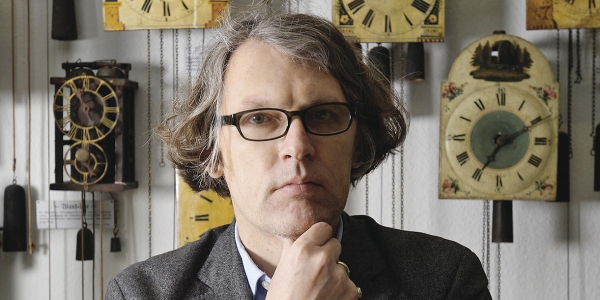
^^^^^^^^^^
End Times with Slavoj Žižek
by Seán Sheehan

Slavoj Žižek. Living in the End Times. Verso, 2010.

Reading Žižek has always been as challenging as it is enjoyable, an experience of pleasure and pain that seems at times an intellectual correlate to the operation of objet petit a (little object a). The concept of objet petit a has been a constant in Žižek's work, appearing in his trailblazing The Sublime Object of Ideology in 1989, and turning up again in the final chapter of his latest book. In its role as a mask and a compensation for the ontological void, the profound sense of incompleteness that lies at the core of our subjectivity, objet petit a is inseparable from the sense of loss and metaphysical pain that gives rise to it but it is equally inseparable from the pleasure that accompanies its presence in our life. The result is enjoyment plus pain and, as Žižek puts it in The Plague of Fantasies, 'like the castrato's voice, the objet petit a -- the surplus enjoyment -- arises at the very place of castration'. Without wishing to suggest that reading Žižek is as discomforting an experience as this quotation might imply, there is a compelling pleasure to reading his next book despite, or maybe because of, the difficulties it is inevitably likely to produce.

Living in the End Times is no exception in this regard but Žižek's latest offering does confirm a shift of emphasis on his part, one that first became apparent with the publication of Violence in 2008. With his earlier work, before Violence, the reader has always faced the difficulty of grappling with the Lacanian concepts that Žižek is seeking to unpack and apply.

Terms like jouissance, the Real, the Thing, après-coup or the difference between desire and drive are not familiar to most readers and turning to Lacan's writings for an explanation does not provide an easy-to-comprehend solution. Hegel's dialectic might seem more familiar territory -- after all, we have all heard of the term and bring varying levels of understanding to its use -- but Žižek is informing us that the traditional interpretation of Hegel is seriously mistaken and so we are driven to unlearning what we thought we knew before embarking on Žižek's reading. When Lacanian and Hegelian ideas are densely interwoven, with a measure of Kant or other selected thinkers usually thrown into the mix, the result can be a giddying combination of exhilaration and perplexity, an addictive high-speed chase with bewildering changes in terrain that for the reader necessitate multiple gear shifts, sudden U-turns, three- and four-point turns, elegant loops and impossibly narrow angles to negotiate. And, in the midst of all this, the monster of the Real rearing up in frightening proximity.

With Violence Žižek focused in a more sober way on political theory and its application to contemporary life and this concern with political analysis informs much of Living in the End Times. The first pages look at the ideological obfuscations behind the proposed banning of the burqa in France, having a dig along the way at Michael Palin's travelogues for the BBC, and Gandhi and the Untouchables. Žižek's object of criticism is the liberal ideal, the mistaken belief that we can live without big ideas and survive merely with mechanisms for balancing a free market with free if egotistic people. It is based on a dismal view of human nature, seeking the lesser evil, and ultimately relies on the imposition of a big idea, liberalism itself, in the guise of believing that no such overriding ideas are necessary or desirable. Interlude 1, separating chapters one and two, probes the ideology of The Dark Knight, the two versions of 3.10 to Yuma and offers a lovely analysis of Kung Fu Panda.

The second chapter covers diverse ground: the way 'what if' histories are currently monopolized by right-wing academics when in fact such an 'open' understanding of history is essential to Marxism; the popularity of TV programs about the animal kingdom that project a wished-for, coherent world where even death make sense; the nature of political love, not the bogus compassion of Oriental-style wisdom but the revolutionary love that Che Guevara proclaimed, the intolerant, impossible love of Christianity that Paul called for. His 'I will destroy the wisdom of the wise' being a call to abolish the mentality that accepts the status quo and build instead something new on groundless foundations. This apocalyptic millenarianism is read as authentic communism: a new order of equality arising from the suspension of the existing network and our constituted roles within it. An example of this is found in John Ford's The Searchers: Ethan's puzzlement at the precise moment when he is able to carry out his racism-driven mission to save (by killing) the girl who had been captured by and lived with the Indians. It is not that Ethan discovers his innate goodness -- the typical humanist reading of this scene -- but rather his subjective destitution, a disengagement whereby he sees himself as a Neighbour (the neighbour embodies the monstrous, the inhuman, an order of our being that pertains to the Real) and not a part of the community to which he thought he belonged.

It is this 'out of place' space that should be the basis for political action, a starting point not to be confused with liberal sympathy for the excluded (which emanates from those who feel they are not excluded) but issuing instead from an excess of unconditional allegiance with the excluded. Žižek finds a parallel for this movement in the Christian's turning of the other cheek and it forms a part of his unorthodox and gloriously impious account of Christian emancipatory violence. There is a theological kernel to secular atheism, as opposed to the religion of capitalism and its faith in money, that Žižek returns to in the conclusion to Living in the End Times.

For Žižek anti-Semitism has always been the prime example of ideology at work in the unconscious and he returns to the topic in Interlude 2. Why, it is asked, does anti-Semitism persist? It is not enough to refer to Israel's policies because there is also Zionist anti-Semitism directed at 'rootless' Jews who don't subscribe to Israel's policies: they too are the 'part of nopart' upon which a true universality should be constructed. Žižek goes on to look at how Israel is systematically colonizing the West Bank and Jerusalem, relying on peace talks to fail or stall in the interim. China, Haiti and Congo are then looked at in terms of how their identities are being shaped by capitalist forces. Ireland is discussed over three pages; its "No" in the referendum on the Lisbon Treaty and the reaction to it by Europe's political elite illustrating the contradictions at work in liberal democracy.

Chapter three, a sustained defence of Marx, is the theoretical heart of the book and it allows the reader respite from Žižek's rapid-fire forays into diverse territories and the time to appreciate what underpins his central claim that global capitalism is fast approaching a terminal crisis. Disagreeing with Badiou, Žižek seeks a return to the economy and the rule of capital as the kernel of Marx and historical materialism. Badiou rejects the traditional orthodoxy, the Marxist grand narrative, that views the working class as the revolutionary agent of change inscribed into social reality but Žižek -- and this is the radicalism that distinguishes his work -- rejects the whole notion of social reality as any kind of positive order. The early Marx is ahistorical in simply stressing the role of human labour in creating material reality but in Capital his concern is the analysis of political economy, the commodity and its structuring role: 'A commodity appears, at first sight, a very trivial thing, and easily understood. Its analysis shows that it is, in reality, a very queer thing, abounding in metaphysical subtleties and theological niceties' (Capital Volume One). Lacan, until now mostly and surprisingly absent from Living in the End Times, makes an entry by way of the homology in logical form between Marx's account of the three functions of money (a measure of value, means of circulation and actual money) and the Imaginary, Symbolic and Real triad.

Exchange value has labour at its source and labour produces a value that is greater than the price paid for the labour that produces the commodity. At base, this is what creates the value of a commodity, not some intrinsic quality, some essence, but its appearance in the market. Its logic is what creates monopolies, requires unemployment (to keep labour costs down) and sustains capitalism's insatiable appetite and limitless self-expansion. It also creates periodic crises and the antinomy of seemingly free individuals at the mercy of 'objective' market necessities. Like Hegel's Absolute -- which, crucially for Žižek, is not some end point of self-identity -- the drive of capital, now more than ever the Real of our lives, has no end and relentlessly seeks to resolve its inherent antagonism. Class struggle is not a rhetorical call to action but the antagonism and contradiction within capitalism:

Marx reasserts the primacy of Thought: the owl of Minerva (German contemplative philosophy) should be replaced by the crowing of the Gallic rooster (French revolutionary thought) announcing the proletarian revolution. (p. 226)

Communism has to be constantly reinvented so that, for example, the ecological crisis is seen as one form of proletarianization, depriving us of the natural substance that makes us human, condemning us to global warming rather than 'dark, satanic mills'.

Interlude 3 opens new ground for Žižek with an excursion into contemporary architecture before chapter four gets underway with capitalism in India and China. Soon, though, he has returned to Marx and psychoanalysis, by way of Catherine Malabou's Les nouveaux blessés, explaining how and why we are the new proletariat, a class destined (though strictly in the après-coup sense that Žižek gives to destiny and fate) to emancipate itself. Interlude 4 brings us the Žižek we know and love, bringing together the case of Josef Fritzl in Austria and The Sound of Music and identifying the lack of civility in some of what passes for modern art as part of the moral vacuum that threatens our survival.

Different types of readers have problems with Žižek, his style as much as the content, for different types of reasons. Focusing on either the style or the content misses the point because they are related in the same way as the form of theTractatus is inseparable from what Wittgenstein is saying in it. Similarly, Žižek expresses his ideas in a form that may seem wilfully bewildering. In a conventional text, one often expects to find at the start of a chapter a modest statement of some form of a hypothesis or a statement of intent, followed by a reference to alternative accounts by other critics or an overview of the relevant material, before the development of a new or revised interpretation by way of orderly inference and consecutive arguments. A chapter in a book by Žižek is more likely to begin abruptly, in medias res, often by way of an assertive or surprising statement before spiralling away into examples designed to show that something is not what it seems to be but, more likely, quite the opposite. Living in the End Times draws to an end in this way, refusing to deliver pat conclusions because there aren't any, refusing to say what is to be done -- do nothing, engage in revolutionary struggle, intervene pragmatically in situations? -- because thinking that a pre-emptive choice has to be made is part of the problem and there are no quick-fit solutions and there is no manual instructing us how to get out of the mess. At the end of his book, Žižek takes us back to objet petit a. Why do otherwise intelligent people carry on supporting the way things are, rationalizing why they still obey and continue with jobs that perpetuate the system? Objet petit a underpins power because people obey not out of physical coercion (liberal democracy is only successful when force is not required) but from their unconscious investment in maintaining the status quo. It is the objet a, the surplus-enjoyment that secures the subject's libidinal complicity, and it requires a complicated mix of Marx, Hegel and Lacan to understand and to change the end times we are living in.

Žižek has recently said that he has written 700 pages of his next book, on Hegel. Bring it on. Lenin withdrew and turned to Hegel when, shocked by the way the Social Democrats in Germany, the largest and most important socialist party in the world, unanimously supported hostilities in World War I. We don't have to turn very far to find home-grown versions of this ability to abandon principles and embrace those who rule.

This review was first published in Irish Left Review on 7 July 2010 under a Creative Commons license.

Tags: , , , , , , , , , , , , , , , , , ,