Showing posts with label continental philosophy. Show all posts

Sunday, February 23, 2014

Omnivore - The Path of Philosophy

From Bookforum's Omnivore blog, here is another fine collection of links inspired and related to philosophy.

The path of philosophy
Feb 21 2014 
9:00AM

Thursday, September 26, 2013

Continental Philosophy in the Pellucid Register

From Bookforum's Omnivore blog, another interesting collection of philosophy links, including one to the new(ish) edition of Speculations, a special issue on Speculative Realism.


Continental philosophy in the pellucid register

Sep 25 2013
3:00PM


Saturday, July 27, 2013

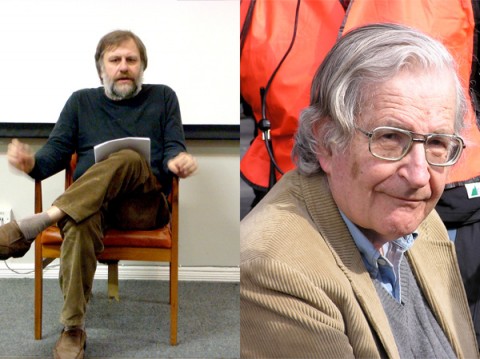
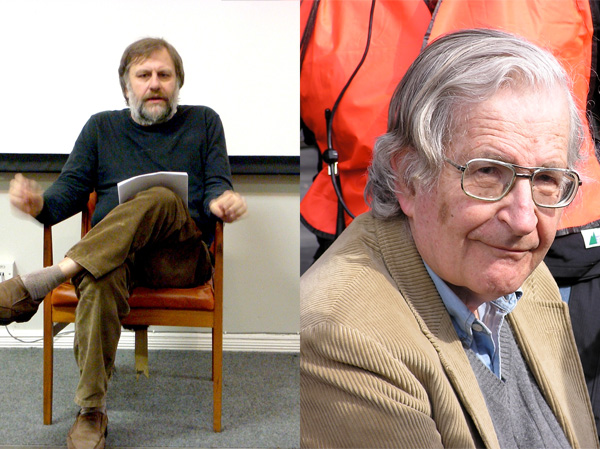
Philosophical Pissing War - Slavoj Žižek vs. Noam Chomsky

chomsky-zizek-feud-continues

I've only been following this "dialogue" between Slavoj Žižek and Noam Chomsky from the periphery, but Open Culture has assembled the various comments/responses in one post summarizing the exchange.

Here are the 4 articles about their feud, so far, as posted by Open Culture:
  1. Noam Chomsky Slams Žižek and Lacan: Empty ‘Posturing’
  2. Slavoj Žižek Responds to Noam Chomsky: ‘I Don’t Know a Guy Who Was So Often Empirically Wrong’
  3. The Feud Continues: Noam Chomsky Responds to Žižek, Describes Remarks as ‘Sheer Fantasy’
  4. Slavoj Žižek Publishes a Very Clearly Written Essay-Length Response to Chomsky’s “Brutal” Criticisms
For your entertainment, here the two latest summaries of the exchanges with links to the original articles, all of which come from Open Culture (those folks rock!):

The Feud Continues: Noam Chomsky Responds to Žižek, Describes Remarks as ‘Sheer Fantasy’


July 22nd, 2013


Noam Chomsky has issued a statement in reaction to our July 17 post, “Slavoj Žižek Responds to Noam Chomsky: ‘I Don’t Know a Guy Who Was So Often Empirically Wrong.’ In an article posted yesterday on ZNet titled “Fantasies,” Chomsky says Žižek’s criticism of him is completely ungrounded. “Žižek finds nothing, literally nothing, that is empirically wrong,” writes Chomsky. “That’s hardly a surprise.”

The rift between the two high-profile intellectuals began, as you may recall, when Chomsky criticized Žižek and other continental philosophers for essentially talking nonsense — for cloaking trivialities in fancy language and using the scientific-sounding term “theory” to describe propositions that could never be tested empirically. Žižek lashed back, saying of Chomsky, “I don’t think I know a guy who was so often empirically wrong.” He went on to criticize Chomsky’s controversial early position on American assessments of the Khmer Rouge atrocities in Cambodia. (To read Žižek’s comments, click here to open the earlier post in a new window.) In response yesterday, Chomsky said he had received numerous requests to comment on our post:
I had read it, with some interest, hoping to learn something from it, and given the title, to find some errors that should be corrected — of course they exist in virtually anything that reaches print, even technical scholarly monographs, as one can see by reading reviews in professional journals. And when I find them or am informed about them I correct them. 
But not here. Žižek finds nothing, literally nothing, that is empirically wrong. That’s hardly a surprise. Anyone who claims to find empirical errors, and is minimally serious, will at the very least provide a few particles of evidence — some quotes, references, at least something. But there is nothing here — which, I’m afraid, doesn’t surprise me either. I’ve come across instances of Žižek’s concept of empirical fact and reasoned argument.
Chomsky goes on to recount an instance when he says Žižek misattributed a “racist comment on Obama” to Chomsky, only to explain it away later and say that he had discussed the issue with Chomsky on the telephone. “Of course,” writes Chomsky, “sheer fantasy.” Chomsky then moves on to Žižek’s comments reported by Open Culture, which he says are typical of Žižek’s methods. “According to him,” writes Chomsky, “I claim that ‘we don’t need any critique of ideology’ — that is, we don’t need what I’ve devoted enormous efforts to for many years. His evidence? He heard that from some people who talked to me. Sheer fantasy again, but another indication of his concept of empirical fact and rational discussion.”

Chomsky devotes the rest of his article to defending his work with Edward Herman on the Khmer Rouge atrocities. He claims that no factual errors have been found in their work on the subject, and he draws attention to a passage in their book After the Cataclysm, quoted last week by Open Culture reader Poyâ Pâkzâd, in which they write, “our primary concern here is not to establish the facts with regard to postwar Indochina, but rather to investigate their refraction through the prism of Western ideology, a very different task.”

You can read Chomsky’s complete rebuttal to Žižek here.

* * * * * * *

Slavoj Žižek Publishes a Very Clearly Written Essay-Length Response to Chomsky’s “Brutal” Criticisms


July 26th, 2013


Fur has flown, claws and teeth were bared, and folding chairs were thrown! But of course I refer to the bristly exchange between those two stars of the academic left, Slavoj Žižek and Noam Chomsky. And yes, I’m poking fun at the way we—and the blogosphere du jour—have turned their shots at one another into some kind of celebrity slapfight or epic rap battle grudge match. We aim to entertain as well as inform, it’s true, and it’s hard to take any of this too seriously, since partisans of either thinker will tend to walk away with their previous assumptions confirmed once everyone goes back to their corners.

But despite the seeming cattiness of Chomsky and Žižek’s highly mediated exchanges (perhaps we’re drumming it up because a simple face-to-face debate has yet to occur, and probably won’t), there is a great deal of substance to their volleys and ripostes, as they butt up against critical questions about what philosophy is and what role it can and should play in political struggle. As to the former, must all philosophy emulate the sciences? Must it be empirical and consistently make transparent truth claims? Might not “theory,” for example (a word Chomsky dismisses in this context), use the forms of literature—elaborate metaphor, playful systems of reference, symbolism and analogy? Or make use of psychoanalytic and Marxian terminology in evocative and novel ways in serious attempts to engage with ideological formations that do not reveal themselves in simple terms?

Another issue raised by Chomsky’s critiques: should the work of philosophers who identify with the political left endeavor for a clarity of expression and a direct utility for those who labor under systems of oppression, lest obscurantist and jargon-laden writing become itself an oppressive tool and self-referential game played for elitist intellectuals? These are all important questions that neither Žižek nor Chomsky has yet taken on directly, but that both have obliquely addressed in testy off-the-cuff verbal interviews, and that might be pursued by more disinterested parties who could use their exchange as an exemplar of a current methodological rift that needs to be more fully explored, if never, perhaps, fully resolved. As Žižek makes quite clear in his most recent—and very clearly-written—essay-length reply to Chomsky’s latest comment on his work (published in full on the Verso Books blog), this is a very old conflict.

Žižek spends the bulk of his reply exonerating himself of the charges Chomsky levies against him, and finding much common ground with Chomsky along the way, while ultimately defending his so-called continental approach. He provides ample citations of his own work and others to support his claims, and he is detailed and specific in his historical analysis. Žižek is skeptical of Chomsky’s claims to stand up for “victims of Third World suffering,” and he makes it plain where the two disagree, noting, however, that their antagonism is mostly a territorial dispute over questions of style (with Chomsky as a slightly morose guardian of serious, scientific thought and Žižek as a sometimes buffoonish practitioner of a much more literary tradition). He ends with a dig that is sure to keep fanning the flames:
To avoid a misunderstanding, I am not advocating here the “postmodern” idea that our theories are just stories we are telling each other, stories which cannot be grounded in facts; I am also not advocating a purely neutral unbiased view. My point is that the plurality of stories and biases is itself grounded in our real struggles. With regard to Chomsky, I claim that his bias sometimes leads him to selections of facts and conclusions which obfuscate the complex reality he is trying to analyze. 
…………………. 
Consequently, what today, in the predominant Western public speech, the “Human Rights of the Third World suffering victims” effectively mean is the right of the Western powers themselves to intervene—politically, economically, culturally, militarily—in the Third World countries of their choice on behalf of the defense of Human Rights. My disagreement with Chomsky’s political analyses lies elsewhere: his neglect of how ideology works, as well as the problematic nature of his biased dealing with facts which often leads him to do what he accuses his opponents of doing. 
But I think that the differences in our political positions are so minimal that they cannot really account for the thoroughly dismissive tone of Chomsky’s attack on me. Our conflict is really about something else—it is simply a new chapter in the endless gigantomachy between so-called continental philosophy and the Anglo-Saxon empiricist tradition. There is nothing specific in Chomsky’s critique—the same accusations of irrationality, of empty posturing, of playing with fancy words, were heard hundreds of times against Hegel, against Heidegger, against Derrida, etc. What stands out is only the blind brutality of his dismissal. 
I think one can convincingly show that the continental tradition in philosophy, although often difficult to decode, and sometimes—I am the first to admit this—defiled by fancy jargon, remains in its core a mode of thinking which has its own rationality, inclusive of respect for empirical data. And I furthermore think that, in order to grasp the difficult predicament we are in today, to get an adequate cognitive mapping of our situation, one should not shirk the resorts of the continental tradition in all its guises, from the Hegelian dialectics to the French “deconstruction.” Chomsky obviously doesn’t agree with me here. So what if—just another fancy idea of mine—what if Chomsky cannot find anything in my work that goes “beyond the level of something you can explain in five minutes to a twelve-year-old” because, when he deals with continental thought, it is his mind which functions as the mind of a twelve-year-old, the mind which is unable to distinguish serious philosophical reflection from empty posturing and playing with empty words?
Josh Jones is a writer and musician based in Washington, DC. Follow him at @jdmagness

Wednesday, April 03, 2013

Contemporary Continental [Philosophical] Thought (Heavy on Deleuze)

This is an excellent collection of links on contemporary European (i.e., Continental) philosophy and thought, courtesy of Bookforum's Omnivore blog.


Contemporary continental thought

APR 2 2013 
9:00AM

  • Thomas Nail (Denver): Deleuze, Occupy, and the Actuality of Revolution.  
  • David R Cole (UWS): Traffic Jams: Analysing Everyday Life Using Deleuze and Guattari. 
  • From New Left Project, Samuel Grove interviews Andrew Robinson on the political philosophy of Gilles Deleuze (and part 2). 
  • John Protevi reviews Political Theory after Deleuze by Nathan Widder. 
  • Ashley Bohrer reviews Jacques Ranciere’s Althusser’s Lesson. 
  • Richard Fitch reviews Thinking the Impossible: French Philosophy since 1960 by Gary Gutting. 
  • Daniel Tutt reviews Difficult Atheism: Tracing the Death of God in Contemporary Continental Thought by Christopher Watkin. 
  • Slavoj Zizek on the three events of philosophy
  • Rebecca Rothfeld on why we slober over Slavoj Zizek: Or, how to be incomprehensible and relevant at the same time. 
  • You can download Everyday Life and the State by Peter Bratsis (2006).

Tuesday, August 07, 2012

Iain Thomson - Bridging Continetnal and Analytic Philosophy with a Synthetic Integration of All Philosophical Models


This is an intriguing essay - it deserves more thought than I have been able to devote to it thus far. So for now, I offer it up for your evaluation and entertainment (that is, if you, like me, find these things entertaining). The article is posted at Academia.edu, but it was published originally in the The Southern Journal of Philosophy in the June 2012 Issue.
Iain Thomson is Professor of Philosophy and Director of Graduate Studies at the University of New Mexico. He is the author of Heidegger on Ontotheology: Technology and the Politics of Education (Cambridge University Press, 2005), and Heidegger, Art, and Postmodernity (Cambridge University Press, 2011). His essays have appeared in leading scholarly journals, essay collections, and reference works, and his work has been widely reprinted and translated into seven languages. He is currently writing a philosophical biography of Heidegger as well as a study of Heidegger’s phenomenological understanding of death and its philosophical impact.
Full Citation:
Thomson, I. (2012, Jun). In the Future Philosophy Will Be Neither Continental nor Analytical but Synthetic: Toward a Promiscuous Miscegenation of (All) Philosophical Traditions and Styles. The Southern Journal of Philosophy, Volume 50, Issue 2.

IN THE FUTURE PHILOSOPHY WILL BE NEITHER CONTINENTAL NOR ANALYTIC BUT SYNTHETIC: TOWARD A PROMISCUOUS MISCEGENATION OF (ALL) PHILOSOPHICAL TRADITIONS AND STYLES
Abstract: In this paper, I suggest that the important philosophy of the future will increasingly be found neither in the “continental” nor in the “analytic” traditions but, instead, in the transcending sublation of (all) traditions I call “synthetic philosophy.” I mean “synthetic” both in a sense that encourages the bold combinatorial mélange of existing styles, traditions, and issues, and also in the Hegelian sense of sublating dichotomous oppositions, appropriating the distinctive insights of both sides while eliminating their errors and exaggerations, and thereby creating new syntheses in which the old oppositions are transcended.

“In poetry, which is all fable, truth still is the perfection.”
—Shaftesbury, Characteristics of Men, Manners, Opinions, Times(1)
For this special fiftieth anniversary issue of The Southern Journal of Philosophy, I have been invited to address the question of the future of “continental philosophy” in light of its past and present, with the suggestion that I might do so by way of the broader question: “What is philosophy?”(2) Since I must be brief, I shall spare you the standard qualifications and cautionary remarks. Of course it is difficult to make general claims about the future of philosophy from my own limited, local, and individual perspective—but where else could I make them from? The antiscientistic gamble of phenomenology is precisely that one’s own personal experience might have broader importance (and so amount to more than an arbitrary generalization from a statistically insignificant sample size). The only way to find out if such a gamble is a good one is to articulate one’s views publicly and then see how others confirm, contest, or modify them. In that spirit, then, and well aware of the dangers inherent in prognostication (the calculable and incalculable risks one inevitably takes with its performative dimension), let me share a few thoughts on a topic I have long lived with and through. I shall not pretend that these thoughts—though long written on the back of my mind, as it were—amount to more than a quick sketch meant (maieutically, poietically) to help discern the broad outlines of a philosophical future already struggling to arrive.

As one of fourteen philosophers from five continents addressing the future of continental philosophy, I will focus primarily on the philosophical scene I know best, the one where I received my own training—from such diverse teachers of “continental philosophy” as Hubert Dreyfus and Jacques Derrida. I risk the ingratitude of initially mentioning only two of my wonderful teachers because, besides being famous philosophers (and deservedly so, as two of the most brilliant hermeneuts ever to walk the earth), Dreyfus and Derrida also happened to be the leading representatives of the “analytic” and “continental” wings of “continental philosophy” in America.(3) From the perspective of a student deeply immersed in the study of Martin Heidegger, it was clear that their important work on Heidegger was complementary, and both generously encouraged my efforts to combine and build on their distinctive insights. I think the fruits of those efforts show them to have been worthwhile, yet it quickly became clear to me that the ecumenical, big-tent vision of philosophy they both encouraged was not widely shared in the profession. I remember being disillusioned, for example, by witnessing the mirror-image, allergic reactions that could be provoked by appealing sympathetically to Derrida at a meeting of the American Philosophical Association or to Dreyfus at a meeting of the Society for Phenomenology and Existential Philosophy.(4)

Indeed, my own repeated experiences (some of which I have discussed elsewhere) of being “too continental” for the proudly “analytic” and “too analytic” for the ideologically “continental” eventually taught me that the “continental philosophy” label is political: it gets used by the narrow-minded on both sides of the continental–analytic divide in order to exclude people who do not sufficiently resemble them, to rationalize largely ignorant decisions about what they will read, who they will hire, and so on.(5)

Rejecting the thoughtless exclusions of extremists on both sides of the divide, I have learned to embrace being something of a philosophical coyote—that is (in the “tri-cultural” terms of New Mexico), a border-crosser, smuggler, and trickster. For, I have become convinced that the most innovative philosophical issues and approaches will always be discovered by those who are not afraid to steal across the borders between the established territories. Today I would like to take a step toward generalizing this perspective by suggesting that the important philosophy of the future will increasingly be found neither in the “continental” nor in the “analytic” traditions but, instead, in the transcending “sublation” of (all) traditions that I shall call “synthetic philosophy.” In order to help motivate this synthesis (which is all I can really hope to do here), I shall provide a brief overview of the traditional philosophical opposition that stands in need of such dialectical resolution.

Read the whole article.