Showing posts with label women. Show all posts

Monday, October 14, 2013

Kissing Helps Us Find the Right Partner – And Keep Them


Kissing is a nearly universal trait in human cultures, but scientists have never been clear on why it is so prevalent and what role(s) it serves. A new study by Oxford University researchers (published in two separate papers, Archives of Sexual Behavior and Human Nature) suggests that kissing helps us size up potential partners and, when we are in a relationship, kissing may also be the glue that persuades a partner to stay.

While I am not convinced this study fully explains the complexity of kissing as a feature of human relationships, one of the more interesting results from this research is that frequency of kissing is a better indicator of relationship health than is frequency of sex.

Journal References:

  1. Wlodarski, R. & Dunbar, R.I.M. Examining the Possible Functions of Kissing in Romantic Relationships. Archives of Sexual Behavior, 2013 DOI: 10.1007/s10508-013-0190-1
  2. Rafael Wlodarski, Robin I. M. Dunbar. Menstrual Cycle Effects on Attitudes toward Romantic Kissing. Human Nature, 2013; DOI: 10.1007/s12110-013-9176-x

Kissing Helps Us Find the Right Partner – And Keep Them


Oct. 10, 2013 — What's in a kiss? A study by Oxford University researchers suggests kissing helps us size up potential partners and, once in a relationship, may be a way of getting a partner to stick around.


"Kissing in human sexual relationships is incredibly prevalent in various forms across just about every society and culture," says Rafael Wlodarski, the DPhil student who carried out the research in the Department of Experimental Psychology at Oxford University. "Kissing is seen in our closest primate relatives, chimps and bonobos, but it is much less intense and less commonly used.

"So here's a human courtship behavior which is incredibly widespread and common and, in extent, is quite unique. And we are still not exactly sure why it is so widespread or what purpose it serves."

To understand more, Rafael Wlodarski and Professor Robin Dunbar set up an online questionnaire in which over 900 adults answered questions about the importance of kissing in both short-term and long-term relationships.

Rafael Wlodarski explains: "There are three main theories about the role that kissing plays in sexual relationships: that it somehow helps assess the genetic quality of potential mates; that it is used to increase arousal (to initiate sex for example); and that it is useful in keeping relationships together. We wanted to see which of these theories held up under closer scrutiny."

The researchers report their findings in two papers, one in the journal Archives of Sexual Behavior and the second in the journal Human Nature, both published by Springer. They were funded by the European Research Council.

The survey responses showed that women rated kissing as generally more important in relationships than men. Furthermore, men and women who rated themselves as being attractive, or who tended to have more short-term relationships and casual encounters, also rated kissing as being more important.

In humans, as in all mammals, females must invest more time than men in having offspring - pregnancy takes nine months and breast-feeding may take up to several years. Previous studies have shown women tend to be more selective when initially choosing a partner. Men and women who are more attractive, or have more casual sex partners, have also been found to be more selective in choosing potential mates. As it is these groups which tended to value kissing more in their survey responses, it suggests that kissing helps in assessing potential mates.

It has been suggested previously that kissing may allow people to subconsciously assess a potential partner through taste or smell, picking up on biological cues for compatibility, genetic fitness or general health.

"Mate choice and courtship in humans is complex," says Professor Robin Dunbar. "It involves a series of periods of assessments where people ask themselves 'shall I carry on deeper into this relationship?' Initial attraction may include facial, body and social cues. Then assessments become more and more intimate as we go deeper into the courtship stages, and this is where kissing comes in."

He adds: "In choosing partners, we have to deal with the 'Jane Austen problem': How long do you wait for Mr Darcy to come along when you can't wait forever and there may be lots of women waiting just for him? At what point do you have to compromise for the curate?

"What Jane Austen realised is that people are extremely good at assessing where they are in the 'mating market' and pitch their demands accordingly. It depends what kind of poker hand you've been dealt. If you have a strong bidding hand, you can afford to be much more demanding and choosy when it comes to prospective mates.

"We see some of that coming out in the results of our survey, suggesting that kissing plays a role in assessing a potential partner," Professor Dunbar explains.

Past research has also found that women place greater value on activities that strengthen long-term relationships (since raising offspring is made easier with two parents present). In the current study, the team found that kissing's importance changed for people according to whether it was being done in long-term or short-term relationships. Particularly, it was rated by women as more important in long-term relationships, suggesting that kissing also plays an important role in mediating affection and attachment among established couples.

While high levels of arousal might be a consequence of kissing (particularly as a prelude to sex), the researchers say it does not appear to be a driving factor that explains why we kiss in romantic relationships.

Other findings included:
  • In short relationships, survey participants said kissing was most important before sex, less so during sex, was less important again after sex and was least important at other times. In committed relationships, where forming and maintain a lasting bond is an important goal, kissing was equally important before sex and at times not-related to sex.    
  • More frequent kissing in a relationship was linked to the quality of a relationship, while this wasn't the case for having more sex. However, people's satisfaction with the amount of both kissing and sex did tally with the quality of that relationship. 
  • In a companion paper in the journal Human Nature, the researchers report that women's attitudes to romantic kissing also depend on where in their menstrual cycle and their relationship they are. Women valued kissing most at initial stages of a relationship when they were in the part of their cycle when they are most likely to conceive. Previous studies have shown that hormonal changes associated with the menstrual cycle can change a woman's preferences for a potential mate. When chances of conceiving are highest, women seem to prefer men who display supposed signals of underlying genetic fitness, such as masculinized faces, facial symmetry, social dominance, and genetic compatibility. It appears that kissing a romantic potential partner at this time helps women assess the genetic quality of a potential mate, the researchers say.

Saturday, October 05, 2013

a kill bill philosopher - Gillian Russell interviewed by Richard Marshall (3:AM Magazine)

Cool interview with an interesting philosopher - and it's great to see a female philosopher get some attention. This comes from Richard Marshall at 3:AM Magazine.

a kill bill philosopher

Gillian Russell interviewed by Richard Marshall


Gillian Russell is literally a kick-ass philosopher of language and logic. Here she goes all Bride vs Gogo over the sexyness of philosophy of language, about not letting the analytic/synthetic distinction get left behind, about how philosophy could make more progress than it does if it had more textbooks, about why logic is not dry, about tea drinking and shooting New Zealanders, killing bulls with a single blow, about the philosophers who do martial arts, about viciousness, the awesomeness of Kill Bill and Tarantino, about not burning her armchair and why philosophers are basically omniverous. This one’s got swag.

3:AM: What made you decide to become a philosopher? Were you always worrying about logic, truth and language even when little or did something happen?

Gillian Russell: There were a lot of things. Becoming a philosopher – at least becoming a professional philosopher – takes a long time, and so there are a lot of decision points. Among other things, I really liked the fact that philosophy allowed me to combine my interests in science and mathematics with my interests in the humanities. I loved the breadth. And of course, I desperately admired many of my undergraduate philosophy teachers – David Archard, Stephen Read, Peter Clark, Fraser MacBride, Iain Law, Sarah Sawyer.

But here’s something a bit more personal: growing up in the UK I had a Saturday job as a teenager – I used to work in Boots the Chemist – and when I was in university I had a lot of summer jobs. Most of these were just fine, it’s not as if I was sent down a coal mine or anything, but they were incredibly boring. I straightened shelves, I worked tills and switchboards, I served fast food, I organised people and libraries, I did data entry and filing. I liked the people, and I worked hard, but mostly we were all just waiting for the day to end, and it impressed upon me pretty strongly the downsides of working just for the money, if you aren’t really interested in the tasks you are completing. I didn’t really have any objection to working hard, in fact, I was really looking to work hard, but I felt like, unless actively went after something better, there was a lot of boredom in my future. Those experiences meant that I was really on the look out for something that was more stimulating. 

And I found philosophy interesting. You know I was reading Caitlin Moran‘s autobiography last year – it’s called How to Be a Woman – and she says that as a teenager she finally figured out what love is when she fell in love with Buck Rogers. She says “I discovered what love is, and found that it’s just feeling very…interested. More interested than I had been about anything before.” If I were to say that I fell in love with philosophy, well, that’s what I would mean. And it was sort of a relief, I think. Because a lot of the alternatives weren’t really holding my attention. 

Anyway, once I found something interesting I was prepared to pursue it and hang on. One you start down the path to doing philosophy – as your undergrad degree, or PhD, or even once you’re a professor – there are always going to be lacklustre days, or stressful days. There will be a teacher you don’t like, or a required class you don’t want to take, a committee you don’t want to chair or a paper you’ve lost interest in, and that kind of thing can sap your motivation. But it’s that initial fascination, and the promise of it returning, that gets you though. 

3:AM: The sexy stuff in philosophy for the media seems to be freewill or whether my hands are conscious and is there a meaning to life and things like that but philosophers always seem fascinated with so much more. You work in logic and philosophy of language at lot. What’s the appeal of these realms?

GR: Ah, you know, language always seemed pretty sexy to me! But I guess one part of the appeal is that you get to use some mathematical techniques – logic and stuff like that. I enjoy that. And another thing is that I was deeply impressed by a few papers in the area while I was a student. Tarski’s “Semantic Conception of Truth“, Carnap’s “Empiricism, Semantics and Ontology” and later on things like Kaplan’s “Demonstratives“. So I guess I always dreamed of doing work like that. And of course, in the philosophy of language there’s always this thought, first, that the problems in language might be more tractable than in some other areas (free will, ethics, the meaning of life etc.) and second, that solutions to problems in the philosophy of language might be useful in solving problems elsewhere. Those two things together make the philosophy of language quite exciting; you feel like you could stumble on something that’s both really new, and really big. 


3:AM: You begin your book on the analytic/synthetic distinction (Truth in Virtue of Meaning: A Defence of the Analytic/Synthetic Distinction) with a very striking line ‘ Sometimes it seems as if the debate over the analytic/synthetic distinction didn’t get resolved, so much as left behind.’ Before we get to why you say that, could you just sketch what this distinction is supposed to be and why non-philosophers should pay attention to it.

GR: Well, I don’t know that everyone needs to pay attention to it. There’s a lot of cool stuff out there, you can’t get around to everything. But I do think it is pretty interesting. The analytic/synthetic distinction is a distinction between two kinds of true sentence. Some sentences are true in virtue of two things, what they mean, and the way the world is. “Snow is white” for example, is true in virtue of meaning what it does (if it meant what the sentence “2+2=5″ means it would be false) and the fact that snow has the colour that it does (if snow were black, that would be enough to make the sentence false too.) Sentences that are like that are called “synthetic.” The analytic sentences are meant to be different, they are true in virtue of their meaning alone. The kind of examples that people sometimes give are things like “all bachelors are unmarried” or “all squares have four sides”. To know that such a sentence is true, you don’t have to go out and do surveys, and ask the bachelors whether or not they are married, or count the sides of squares, you just need to know what the sentence means, and then you’ll see that in order to count as a bachelor, you have to be married. Similarly, to count as a square, you have to have four sides. 

Historically, the idea has been important in philosophy because it suggested an epistemology, or a methodology, for mathematics and other formal sciences, such as logic. A lot of philosophers have thought that the way that we come to know mathematical truths is different from the way we come to know truths in empirical sciences like biology and physics. That’s pretty reasonable on the face of it; in mathematics we don’t collect data, or do experiments like we do in physics, and you can’t establish that every integer is the sum of two primes by checking some sample cases and generalising from there. So one thought is that maybe mathematics proceeds by unpacking meanings, essentially, by investigating the consequences of definitions. It’s more interesting, more complicated version of the way we know the truth of something like “all bachelors are unmarried.”

3:AM: It is kind of one of those issues that gets to be involved in lots of issues isn’t it?

GR: Yes, that’s right. It’s not just mathematics, but logic, ethics, philosophy of science. Anywhere you have standard definitions, you might want to say that some of your claims are analytic. This is one of those things I meant about philosophy of language having application all over the place. We use language everywhere, so once you have an idea there, there are lots of different areas in which you can try it out. 

3:AM: A key issue is the question which has got to be mind-messing – how can a contingent sentence like Kaplan’s ‘I am here now’ be analytic whilst a necessary and true one in virtue of its meaning like ‘Hesperus is Phosphorus’ – is not?

GR: Well, yes, but you probably have to be quite involved in the philosophy of language before you get worried about that particular problem! But you’re right, traditional accounts of analytic truth hold that analytic truths have a distinctive kind of modal status, they express necessary truths, i.e. say something that is true in every possible world. It’s not too hard to see why. If a sentence is true in virtue of its meaning, then the meaning is sufficient to guarantee the truth, so no matter what the world is like, it will be true, which is just to say that it will be true in every possible world—necessary. 

“I am here now” is tricky because it’s a standard example of a sentence whose truth seems to be guaranteed by its meaning, even though what it says is not necessary. (I didn’t have to be here now – I could have been somewhere else, and there are other possible worlds where I am.)
“Hesperus is Phosphorus” is tricky because it might not seem, on the surface, to have its truth guaranteed by its meaning (it isn’t quite like “all bachelors are unmarried” for example) but most philosophers these days would say that it expresses a necessary truth. (That’s because we all read Naming and Necessity as undergrads, and Kripke is pretty convincing on the topic.)
Anyway, on the account in my book – Truth in Virtue of Meaning – “I am here now” is analytic, but “Hesperus is Phosphorus” isn’t – but you’d probably want to have a look at the book for the details. 

3:AM: So it’s an issue that involves two giants of philosophy from the last century, Quine and Carnap. They fought about this issue. Carnap defended it and Quine attacked it. Can you say something about how this went and why you think it wasn’t resolved.

GR: I think the study of language really took off after the Quine/Carnap debate had fizzled out. Lots of things that were relevant to the debate came on the scene – rigid designation, direct reference, indexicality – but the topic wasn’t really picked back up again with any seriousness. When people talked about the analytic/synthetic distinction debate they still just talked about the old papers from Quine, Carnap, Putnam, Chomsky, Katz etc. It wasn’t until Boghossian’s Nous paper that people really started seeing what would happen to analyticity given our new discoveries about language. 

3:AM: I always thought that Quine won, the distinction lost and science became a triumph.

GR: Well, all reasonable people are pro-science, but I’m not sure that has quite as much to do with Quine as you suppose! Carnap had a big role in encouraging scientific thought within philosophy, and Carnap and the Vienna Circle were a big part of what made Quine and his work possible. And you know, I’m sure I wouldn’t be able to be the kind of philosopher I am today without all of Quine’s work to get logic taken seriously in our discipline. We don’t all agree with each other, but in many ways we’re part of the same tradition, and that tradition is squarely pro-science and pro-mathematics, something that we clearly owe Carnap some thanks for. 

As to whether Quine won or lost on the analytic/synthetic distinction, I suppose that depends on what you mean by “winning.” Does it mean convincing the majority of philosophers? (Is it like winning an election?) If you look at the 2009 PhilPapers survey it says that 65% of respondents “lean towards or accept” the existence of the analytic/synthetic distinction (though I expect that those numbers would have been much higher prior to Quine.) Does it mean getting it right? I think both Quine and Carnap were onto something – some of Quine’s points are basically right – but also that they were working at a time when the study of language was quite underdeveloped. You needed better tools for resolving the debate than either of them had access to. 

3:AM: Returning to the quote from the opening of your book, are you saying that this issue is no longer being left behind?

GR: Well, I like to think of my own book as addressing the old issue with new resources, so yes, I’d say the issue is no longer being left behind. I don’t know that many people are reading my work though! It’s hard to get people to read your stuff.

3:AM: And more generally, is this a more typical process in philosophy than might be thought. It’s not so much that an issue gets resolved but rather ideas are like shape-shifters, becoming gradually uninteresting after a while but re-emerging in a new guise later as killers again. It’s a different kind of morphing than Kuhnian paradigm shifts because it’s not about incommensurates, more to do with philosophers getting bored, or happy to move on without closure or whatever? So I guess this question is about how we might think about progress in philosophy. Can you say something about all this?

GR: You know, I think philosophy could make more progress than it does. Progress needs more than just a few brilliant people, and a few great, original texts. If all you have are a few brilliant manuscripts coming out of a generation of philosophers, they’re going to be forgotten, or only read by a few specialists, who only write stuff that is read by even fewer specialists, and then all it takes is one politically expedient budget cut, or the end of a grant, or just for someone to get sick, and it is all lost again. Once you get beyond the very beginning stages, progress requires the ability to build on what has come before and that means we have to do a great job of training our students. I think one of the things that drives progress in mathematics and the sciences is the existence of good textbooks.
It really doesn’t matter, in physics say, if few working scientists, engineers or mathematicians ever read Newton’s Principia Mathematica, or Einstein’s original papers, because the key lessons have been distilled into really clear, excellent textbooks that are used to train thousands of students each year. In philosophy we have a tendency to privilege the original texts. And it’s good to read original texts, it’s part of getting a general education. But good ideas and arguments rarely appear in their clearest form first time around. So I think one thing that would really help philosophy make more progress would be the presence of more really excellent textbooks. It’s clearly something that helps in logic. Certainly my own teaching and understanding in logic has been massively helped and speeded up by the existence of great textbooks. And that means that all my students are at a better standard than they might have been otherwise. 

3:AM: Now you are a hard-core logician writing papers with titles like ‘Indexicals, context sensitivity and the failure of implication’. This at first seems mighty dry.

GR: It’s really not. I could explain it to you over a pint and it’s not like I’d be explaining Greek grammar or something. You could explain it to teenagers and they’d get it. Bright teenagers, anyway.


3:AM: Is it like in all philosophy, the initial dryness a non-logician might feel disperses once the big picture of the philosophy of logic and language is understood?

GR: I think so. Anyway, a barrier to implication – or you might call it a barrier to entailment – is a thesis that says that no set of sentences all of a certain kind X entails a conclusion of some other kind Y, or informally, that you can’t “get” a Y from an X. The most famous example in philosophy is Hume’s Law, which says that no set of purely descriptive sentences entails a normative conclusion—”you can’t get an ought from an is.” Hume’s law is really controversial. It was endorsed by (among others) the famous ethicist RM Hare, by Karl Popper, and by Frank Jackson, but rejected by Max Black, A.N. Prior and John Searle. But there are other barriers to implication in philosophy too. For example, you can’t get general claims from particular claims: no matter how many individual black ravens you observe, the general claim “all ravens are black” will never follow logically from your observations (unless you can add a general premise – maybe something like “I have now seen all the ravens”.) So there is a particular-general barrier. Another barrier that Hume talked about is the past-future barrier: no claim about the future follows logically from a set of sentences purely about the past. And there are others. There’s a modal barrier: you can’t get claims about how things must be from claims about how they actually are. And an indexical one (that’s what the paper you mention above is about.) 

These other barriers aren’t nearly so controversial, they’re kind of a part of the background picture against which a lot of philosophers work. But Hume’s Law, as I mentioned, is controversial and has often been challenged. And the way you challenge a thesis that says that no set of premises of kind X entails a sentence of kind Y, is by presenting a valid argument with premises of kind X and a conclusion of kind Y. So to challenge Hume’s Law you need an argument with all descriptive premises, but a normative conclusion:

One of AN Prior’s attempts is quite famous. It’s this:
Premise: Tea-drinking is common in England.
Conclusion: Tea-drinking is common in England OR all New Zealanders ought to be shot. 
This might look a little odd if you haven’t studied formal logic, but the conclusion is a classical consequence of the premise by the rule of disjunction introduction. One way to think about mine and Greg’s work on barriers is as using the similarity between all the different barriers to constrain conclusions in the controversial cases. The thought is that if it is sensible to give up Hume’s Law on the basis of the argument above, then it ought to also be sensible to give up the particular general barrier thesis on the basis of this analogous argument:
Premise: Raven A is black.
Conclusion: Raven A is black OR all ravens are black. 
Now, I don’t know how you’ll feel about this, but my sense is that to give up the particular-general barrier thesis on this basis would be kind of missing the point. There’s clearly something correct about the claim that you can’t get a general claim from particular ones, and we just need to refine it a bit. Maybe get a little clearer on exactly what counts as a “general” or “particular” sentence. Anyway, it turns out that once you do that you can prove the particular-general barrier thesis for first-order classical logic. So that’s kind of nice. And if this sort of refinement works in the particular-general case, why not in the more controversial Hume’s Law case?

Anyway, that’s a short introduction to the project. I’m writing a book on this right now.

3:AM: You wanted to kill a bull with one blow by the time you were fourteen. What is it with logic and martial arts?

GR: Oh I don’t know. I suppose you might think the martial arts attracts self-aggrandising assholes, and philosophy…well. 

I should point out that I only wanted to be able to kill a bull with one blow – no actual animal-killing was desired.

3:AM: Graham Priest is another top philosopher with this going on too.

GR: Yeah, actually, I’m a big fan of Graham’s. Both the martial arts and philosophy could do with more of his type. And there’s Laurie Paul, Chris Mortensen, David Velleman, Damon Young, Koji Tanaka, Audrey Yap, John Greco, Trish Peterson, Massimiliano Vignolo, Carlo Penco and John Dorris – I’m sure I’m forgetting some, it feels like I’m always running into philosophers who do martial arts. 

3:AM: You wrote a great essay ‘Epistemic Viciousness in the Martial Arts.’ You link epistemic viciousness to false belief formation. Can you say more about the link between viciousness, epistemology, logic, philosophy and kung foo?

GR: OK, so the “viciousness” in the paper title is viciousness in the slightly old-fashioned sense of “possessing of vices.” There’s a standard thought in the martial arts – certainly in the martial arts that people in the West think of as exotic, like karate or shinto muso (as opposed to archery and wrestling) that training in a martial art is supposed to make you a better person – more morally virtuous.
Lots of martial arts exalt their founders as paragons of ethical virtue, as well as great fighters, and their websites suggest you will become a better person as a result of your training, even that your kid will be less likely to take drugs if you send him to class. Anyway, my paper argues that whatever the moral virtues of training in the martial arts, it has a tendency to encourage epistemic vices such as gullibility, inappropriate epistemic deference to senior students and history, and reluctance to take a look at other sources of evidence (such as research in sports science and anatomy, emergency room and crime statistics, and even other martial arts.) 

The paper came about because I was struck by the number of smart people who picked up weird beliefs in the dojo; engineers who believe in ki or even “touchless knockouts”, university students who tell newcomers that “strength isn’t important in fighting” and over and over again people who overestimate the efficacy of years of fine-grained study in response to real world aggression. The martial arts is full of middle class professionals who hope/believe that training twice a week for two years makes them safe. They’re not stupid people, but … but humans are weird about violence. Anyway, I could go on about this stuff for hours…


3:AM: Is ‘Kill Bill’ more philosophical than we thought?

GR: I think “Kill Bill“‘s awesomeness might be independent of its philosophical content. Also of it’s martial arts content. It is pretty awesome though. I’m not really into film, but I like Tarantino.

3:AM: You reviewed Tim Williamson’s book ‘The Philosophy of Philosophy’ and wrote about the several reasons why philosophers have tended to be reluctant to engage in philosophizing philosophy. Xphi seems to be a branch of philosophy that now continually engages with raising questions about the suppositions of philosophers about many areas of thought. Have you been convinced that perhaps some of the intuitions even in logic may be less pure and rational than philosophers have taken them to be? As a logician, are there reasons for joining Josh Knobe and burning your armchair?

GR: I think philosophers are basically omnivorous. They’ll take whatever data you throw at them – from surveys, history, chemistry labs, Hadron colliders, mathematics, film studies, whatever, and run with it. And I hope I’m open to whatever comes my way. Josh has interesting and challenging results and it’s good to use that work. But as a matter of my own personal temperament, when we did physics in secondary school, and sometimes the classes were “theory” classes and other times the classes were “experiment” classes, the theory classes were always just more interesting. Theory classes were examining the relationship between energy and matter. Experiment classes were melting ice in a bucket and counting the drips and trying to get your lab partner not to fuck it up. If someone else is happy to count the drips, I’ll happily use the data. But I’d rather someone else did the experiments.

3:AM: So when you’re not philosophizing, what books, films, music do you find inspiring or enlightening? Are you a martial arts film buff?

GR: Well, I read a lot, but I’m not always looking for enlightenment. And I probably consume more martial arts books than films. Personal favourites include Gavin de Becker’s The Gift of Fear, Grossman’s On Killing, Ellis Amdur’s Duelling with O’sensei and the classic that is Jack Dempsey’s How to Fight Tough. If you don’t know it you should probably just go and order that last one right now, it’s amazing.

I’ve lived my whole life with headphones on. If I go deaf I’ll probably consider it worth it. If it killed me at 40, I might still consider it worth it. Anyway, I’m looking forward to the new Franz Ferdinand album. 

3:AM: And finally, for the 3:AM crowd, which five books (other than your own which of course we’ll be dashing away to read straight after this) would you recommend if we wanted to get further into your philosophical world?

GR: OK, I think each of these make great general reading, in no particular order. Some of them are essays, rather than books, but I hope that’s OK. Also, there are seven. 

1. Bertrand Russell – Problems of Philosophy
2. Thomas Nagel – Mortal Questions
3. “Empiricism, Semantics and Ontology” – R. Carnap
4. “If God is dead, is everything permitted?” – E. Anderson
5. “The Semantic Conception of Truth and the Foundations of Semantics” – A. Tarski
6. “Wittgenstein on Rules and Private Language” – S. Kripke
7. Adam Morton – On Evil


ABOUT THE INTERVIEWER Richard Marshall is still biding his time.

First published in 3:AM Magazine: Friday, September 27th, 2013.

Wednesday, October 02, 2013

Being Human 2013 - Human Relationships with Helen Fisher, Ph.D.


Human Relationships from Being Human on FORA.tv

Human Relationships


Sexual behavior, romance, and partnerships are among the strongest human social drives. In this session we delve into the biology of sexual behavior and such topics as love addictions, serial monogamy, clandestine adultery, hookup culture, and how human partnering psychology is reflected in our animal cousins.

Session led by: Helen Fisher, Ph.D., Professor of Anthropology, Rutgers University
Justin Garcia, Ph.D., Assistant Professor of Gender Studies, The Kinsey Institute, Indiana University
Laurie Santos, Ph.D., Professor of Psychology, Director of the Comparative Cognition Laboratory, Yale University

Helen Fisher


Helen Fisher (author of
Anatomy of Love: A Natural History of Mating, Marriage, and Why We Stray [1994] and Why We Love: The Nature and Chemistry of Romantic Love [2004], among many other books) is an anthropologist specializing in the study of interpersonal romantic attraction. Her research into love and behavior leads her to the conclusion that the desire for love is a universal human drive, stronger than even the drive for sex. She has conducted extensive research into the evolution of sex, love, marriage, gender differences, and how your personality shapes who you love. Fisher believes that there are three main systems in the brain that deal with mating and reproduction: the sex drive, romantic love, and long-term attachment. Understanding the different qualities and goals of these three systems is crucial for navigating the ins and outs of love and relationships. It’s especially important to realize that the evolutionary background of love relationships is all about reproduction of the species, which at times may conflict with our wishes and expectations. As Fisher puts it, “I don’t think we’re an animal that was built to be happy; we are an animal that was built to reproduce.”

Justin Garcia


Justin Garcia (co-author of
Evolution and Human Sexual Behavior, 2013) is an evolutionary biologist, specializing in the study of how human evolution has shaped our sexual and romantic behavior. His research focuses on the evolutionary and biocultural foundations of human behavior, particularly romantic love, intimacy, and sexuality. He is especially interested in notions of commitment and attachment in romantic and sexual relationships. Garcia has said that "the most consistent feature of human sexuality is the remarkable diversity which exists among individuals and cultures." He notes that environmental and cultural forces contextualize and shape our sexuality in unique ways; for example, his research explores the development of a new Western "hook-up culture" that is accepting of casual sex. Garcia is also a scientific advisor at the dating site Match.com.

Laurie Santos


Laurie Santos researches the evolutionary background of the human brain by studying non-human primates in her Comparative Cognition Lab at Yale. In a series of fascinating experiments, Santos’ team has investigated economic decision making in capuchin monkeys. Researchers created a form of money: tokens that the monkeys could trade for food. They found that the monkeys made consistently irrational decisions, mirroring the same bad financial choices that people make. For example, the monkeys demonstrate the same loss-aversion behavior—treating losses as more important than gains— as human beings. This suggests that some of the core biases of the brain that shape human behavior were also present in our remote pre-human ancestors, and have been maintained through evolution. Santos believes that understanding the built-in biases of the human brain is crucial to encouraging rational behavior. As she puts it, “...the irony is that it might only be in recognizing our limitations that we can really actually overcome them.” She is currently researching whether primates have a precursor to theory of mind, the ability to imagine the thoughts and feelings of others. In 2012, she spoke at the Being Human conference in San Francisco.


Monday, September 16, 2013

Brené Brown: The Journey to Worthiness (from Sounds True)

From Sounds True, this week's Producer's Pick is Brené Brown talking about The Journey to Worthiness, an excerpt from her audio course Men, Women, and Worthiness. Very cool conversation.

Brené Brown: The Journey to Worthiness


A trustworthy guide can make all the difference when we are facing the more difficult parts of our human journey. When Sounds True producer Stephen Lessard worked with Dr. Brené Brown on her audio course Men, Women, and Worthiness, he discovered a teacher who immediately created that all-important bond of trust. “Brené has a clear, simple style that makes me feel like I’m sitting across the table from a dear friend,” Stephen reports. Because of the presence she brings, Brené has a gift for helping us navigate the difficult experiences of shame and vulnerability that we often try to avoid. In this selection, she talks about why facing the swamp of our shameful feelings empowers us to live a full and wholehearted life.

Download

More from Brené Brown:

 
The Power of Vulnerability
$46.87

Men, Women, and Worthiness
$13.37

The Power of Vulnerability with Brené Brown
$49.00

Thursday, May 02, 2013

Shame - The Story of Mukhtaran Mai


Incredible courage from this Pakistani woman - this documentary, Shame (2006), tells the story of her rape and her decision to stand up and seek justice for herself, and eventually for other women as well.
 
Mukhtaran Bibi (Punjabi, Urdu: مختاراں بی بی‎, born circa 1972,[1] now known as Mukhtār Mā'ī,[1] مختار مائی) is a Pakistani woman from the village of Meerwala, in the rural tehsil (county) of Jatoi of the Muzaffargarh District of Pakistan. In June 2002, Mukhtār Mā'ī was the survivor of a gang rape as a form of honour revenge, on the orders of a tribal council of the local Mastoi Baloch clan that was richer and more powerful as opposed to her Tatla clan in that region.[2][3]

Although custom would expect her to commit suicide after being raped,[4][5][6] Mukhtaran spoke up, and pursued the case, which was picked up by both domestic and international media. On 1 September 2002, an anti-terrorism court sentenced 6 men (including the 4 rapists) to death for rape. In 2005, the Lahore High Court cited "insufficient evidence" and acquitted 5 of the 6 convicted, and commuted the punishment for the sixth man to a life sentence. Mukhtaran and the government appealed this decision, and the Supreme Court suspended the acquittal and held appeal hearings.[7] In 2011, the Supreme Court too acquitted the accused.

Though the safety of Mukhtaran, and her family and friends, has been in jeopardy[8] she remains an outspoken advocate for women's rights. She started the Mukhtar Mai Women's Welfare Organization to help support and educate Pakistani women and girls. In April 2007, Mukhtar Mai won the North-South Prize from the Council of Europe.[9] In 2005, Glamour Magazine named her "Woman of the Year".[10] According to the New York Times, "Her autobiography is the No. 3 best seller in France , and movies are being made about her. She has been praised by dignitaries like Laura Bush and the French foreign minister".[11] However, on 8 April 2007, the New York Times reported that Mukhtar Mai lives in fear for her life from the Pakistan government and local feudal lords.[12] General Pervez Musharraf, the former president of Pakistan, has admitted on his personal blog[13] that he placed restrictions on her movement in 2005, as he was fearful that her work, and the publicity it receives, hurt the international image of Pakistan.


Shame

This stun­ning Special Emmy winning doc­u­men­tary tells the true sto­ry of in­ter­na­tion­al hu­man rights icon Mukhtaran Mai, a Pak­istani peas­ant who was gang-raped and pub­licly shamed in her vil­lage, but used her trau­ma to spark a le­gal rev­o­lu­tion that ex­posed cen­turies of bru­tal trib­al con­flict and gov­ern­ment mis­man­age­ment.

Sunday, December 11, 2011

NPR - Nobel Peace Prize Accepted By 3 Women


The first Arab woman to win a Nobel Peace Prize, along with two women from Liberia who helped remove Charles Taylor from power. Very cool. The New York Times has a good story about their acceptance ceremony if you would like to read more.

Nobel Peace Prize Accepted By 3 Women

December 10, 2011
For the first time, an Arab woman has been awarded the Nobel Peace Prize. At a ceremony in Oslo, Norway, Saturday, Tawakkul Karman known as the "mother of Yemen's democratic revolution"— shared the 2011 prize with two Liberian women, President Ellen Johnson Sirleaf and Leymah Gbowee, who helped lead the protests.that ousted former Liberian President Charles Taylor.
You can read the short transcript at the NPR site.

Saturday, October 01, 2011

Dharma Quote: Death Need Not Be Approached Only as a Tragedy


BUDDHISM THROUGH
AMERICAN WOMEN'S EYES

edited by Karma Lekshe Tsomo
more...


Dharma Quote of the Week


Buddhism was extremely helpful to me during the process of my sister's lingering death two years ago. She was forty-five years old and had very few spiritual aspirations. She was actually fearful and closed to any suggestions that she might find comfort in expanding her degree of awareness and understanding. At first I was extremely upset by her attitude, but then I realized it was not for me to decide what she should or should not do with the last few months of her life. I was with her for support and comfort and not to force her to view her life in a way which was foreign and threatening to her.


Enabling a person to accomplish a sense of having lived purposefully and with significance is a major goal of caregivers and loved ones. Being able to support someone during their dying trajectory, regardless of what they are thinking or feeling is probably one of the most valuable services one person can offer to another. But, it is difficult to stay close to someone who is dying. Not trying to evade an open encounter with the intense psychic pain that usually accompanies the recognition of impending death is one of the most valuable contributions that a nurse or any other caregiver or loved one can make to the patient who wishes to discuss his or her circumstances. Facing forthrightly the situation of dying, however, requires feeling comfortable with one's own feelings about death and the frailty of being human.

Buddhism has taught me that death need not be approached only as a tragedy; it is also an event from which a profound understanding can unfold. (p.44)

--from Buddhism through American Women's Eyes edited by Karma Lekshe Tsomo, published by Snow Lion Publications

Buddhism through American Women's Eyes • Now at 5O% off
(Good until October 7th).


Tuesday, June 21, 2011

TEDxSF - Nicole Daedone - Orgasm: The Cure for Hunger in the Western Woman

http://www.vanityfair.com/online/daily/2011/05/25/Slow-Sex-Jacket.jpg

I know there are many women who read this blog - what do you all thunk about this video? Right on? Too simplistic? Some other response? And how about you men?

Daedone's book is Slow Sex: The Art and Craft of the Female Orgasm.

TEDxSF - Nicole Daedone - Orgasm: The Cure for Hunger in the Western Woman

Nicole Daedone is a sought-after speaker, author, and educator focusing on the intersection between orgasm, intimacy, and life. She is the founder of OneTaste, a cutting-edge company bringing a new definition of orgasm to women. The practice at the heart of her work is called OM or Orgasmic Meditation. OM uniquely combines the tradition of extended orgasm with Nicole's own interest in Zen Buddhism, mystical Judaism and semantics. Helping to foster a new conversation about orgasm —one that's real, relevant, and intelligent—she has inspired thousands of students to make OM a part of their everyday lives.

Nicole graduated from San Francisco State University with a degree in semantics and gender communication. She went on to found the popular avant garde art gallery 111 Minna Gallery in SoMa before moving on to OneTaste. Nicole is the author of Slow Sex: The Art and Craft of the Female Orgasm (Grand Central/Hachette, May 2011) and has appeared on ABC's Nightline. Her work has been featured in the New York Times, the New York Post, the San Francisco Chronicle, and 7x7 Magazine, among others, and her writing has appeared in Tricycle magazine. In his #1 New York Times Bestseller The 4-Hour Body Timothy Ferriss calls the OM practice "required education for every man on the planet." For more about OneTaste and OM, visit the OneTaste site or Nicole's blog. Raised in Los Gatos, CA, Nicole now lives in San Francisco.


Tuesday, March 08, 2011

So You Want a PhD in Clinical Psychology?

This little video is hilarious - and disturbing (as a psych student planning on an eventual PhD). It's been making the rounds on Facebook, so I thought I'd share it here for anyone who has not seen it. You have to watch it all the way to the end.

So You Want a PhD in Clinical Psychology?
A professor discusses the path to become a clinical psychologist with her student.


Tuesday, January 05, 2010

Buddhist Geeks - Episode 153: Feminine Zen

A nice change of pace for the Geeks, talking this week about feminine Zen. Is there such a thing, or is Zen simply Zen, no matter the gender?

Buddhist Geeks - Episode 153: Feminine Zen

Listen Now
RSS: Subscribe

Grace Schireson is a Zen master in the lineage of Shunryu Suzuki Roshi and is the abbess of the Empty Nest Zendo in northern California. She joins us today to explore some of the main themes in her recently released book, Zen Women: Beyond Tea Ladies, Iron Maidens, and Macho Masters.

Among the topics we discuss are what the traditional stereotypes of females in Zen have been, and the recently discovered literature on women in Zen who did not fit these stereotypes. We then look at the unique way these women practiced Zen and how what they learned can be applicable to us today. We finish the discussion by speaking about feminine spirituality in general, and the prevalence of the "great mother" in all of the world's wisdom traditions.

Related Links:


Tuesday, May 19, 2009

Sarah Churchwell praises Elaine Showalter's judicious study of American women authors

This is a nice literature article. What I find most interesting is the stage model offered to explain women's literature.
[S]he argued that women's writing has evolved through historical stages: from the "feminine" to the "feminist" to the "female". Now she has added a fourth stage, which she calls "free", saying that in this brave new world of the 21st century, "American women writers ... can take on any subject they want, in any form they choose".
Fascinating idea - just not sure I want to read nearly 500 pages to generate that idea.

A room of their own, at last

Sarah Churchwell praises Elaine Showalter's judicious study of American women authors

In contemporary census records, Emily Dickinson's occupation was listed as "keeping house". At the age of 20, she wrote to a friend satirising the emotional blackmail her family used to stop her writing: "My hands but two - not four, or five as they ought to be - and so many wants - and me so very handy - and my time of so little account - and my writing so very needless - and really I came to the conclusion that I should be a villain unparalleled if I took but an inch of time for so unholy a purpose as writing a friendly letter ... mind the house - and the food - sweep if the spirits were low." It is a justly famous letter, in which Dickinson goes on to reject being an Angel in the House in favour of the "Satanic" pursuit of lyrical beauty: "The path of duty looks very ugly indeed ... I don't wonder that the good angels weep - and bad ones sing songs."

A Jury of Her Peers: American Women Writers from Anne Bradstreet to Annie Proulx

Elaine Showalter

400pp, Virago, £22.50

In A Jury of Her Peers, Elaine Showalter has produced the first comprehensive overview of the achievement of American women writers from the Puritans to the (not quite) present. She claims to be surprised that it hasn't been done before, but she shouldn't be. It is a daunting task, and few could carry it off with such aplomb. What unites these writers, for Showalter, is less their anatomical sex than the shared pressure of gender roles upon their art; nearly all the women she surveys had to overcome not only the inherent obstacles of creative expression and commercial competition, but also cultural expectations of a life of pure domesticity. Lydia Maria Child, a popular and prolific 19th-century author of novels and verse, made a list at the end of 1864 of what she'd accomplished that year: "Cooked 360 dinners. Cooked 362 breakfasts. Swept and dusted sitting room & kitchen 350 times. Filled lamps 362 times ..."

In other words, the women Showalter surveys were all in need of a room of their own. In one sense, this is a familiar story, told not only by Virginia Woolf, but by Showalter herself 30 years ago, in A Literature of Their Own: British Women Novelists from Brontë to Lessing, her pioneering genealogy of British women's fiction within its social, cultural and political contexts. One of the founders of feminist literary theory, Showalter has long insisted that women writers should be taken on their own terms, and joined the chorus of her peers in the 1970s and 80s arguing that many had been unjustly neglected on the basis of their sex. Rebuttals soon followed that these writers had been justly neglected on the basis of merit, and should continue to be neglected.

This debate is a vicious circle. For centuries, women writers were sweepingly dismissed on the basis of gender, as in Nathaniel Hawthorne's notorious animadversion against the "damned mob of scribbling women" robbing him of the sales he felt he deserved. If they weren't bad writers, women were bad readers: F Scott Fitzgerald blamed them for failing to buy The Great Gatsby - based on the syllogistic logic that the book failed commercially and "women controll [sic] the fiction market at present". Both these examples point to another reason for the conventional dismissal of women's writing, which Showalter addresses only indirectly: its correlation with the popular (just think of the contempt with which the presumed female readers of the book clubs of Oprah or Richard and Judy are viewed). Continuing to define them as women first and writers second means that anatomy remains destiny. Pretending that their gender does not affect their readership and reputations will strike many - myself included - as wishful thinking at best, but gender by no means guarantees literary greatness, and quotations must be more important than quotas. These are complicated questions in any era; add the difficulty of contextualising them across nearly 400 years of social, political and literary history, and you get an idea of the challenge that Showalter has set herself. Bestriding these narrow worlds and petty men like a colossus, she magisterially offers (mostly) judicious assessment, adroit synopsis, and astonishing breadth and range of reference.

Showalter takes her title from Susan Glaspell's 1917 story "A Jury of Her Peers", in which a woman is arrested for murdering her husband. The sheriff and other officials search the house for evidence, bringing their wives along to pack clothes for the accused waiting in jail. The wives discover clues the men overlook, suggesting that the wife killed her husband following domestic abuse. The women tacitly agree to conceal this evidence and protect the wife from the forces of patriarchal law, thus constituting themselves a "jury of her peers" - peers because only they, Glaspell implies, truly understand the wife's frustration and rage. For Showalter, this story emblematises the struggles of women writers to be judged by their own peers, readers sympathetic to their work, and - perhaps most important to Showalter's project - willing "to demonstrate its continuing relevance to all readers". She concedes that some of these texts are of more historic than aesthetic importance; and she doesn't hesitate to declare when she thinks an empress has no clothes, as she somewhat vividly suggests is the case with Gertrude Stein's experimental prose, which she dismisses as overrated. (Gender politics persist, however; would she say the same about Finnegans Wake? Then again, she might.)

Showalter suggests that American women faced slightly different pressures from their European counterparts, which derive broadly from different conceptions of class and labour: in America, middle-class women were expected to engage full-time in domestic duties even if they could afford help. But from the revolutionary era forward, most American women were driven to write by the mundane pressures of ne'er-do-well or absent husbands: as Fanny Fern put it in her bestselling 1855 novel Ruth Hall, about a woman forced to earn a living when her husband dies: "No happy woman ever writes."

Showalter is quite right that it is past time for American women writers to be granted a book of their own, but she does sometimes overstate the originality of her enterprise, which lies in its scope, not in its interpretations. Most specialists will be familiar with both the writers and the necessarily abbreviated, even sketchy, interpretations Showalter discusses. If A Jury of Her Peers is less groundbreaking than her earlier work, it does extend its scope historically. In 1977 she argued that women's writing has evolved through historical stages: from the "feminine" to the "feminist" to the "female". Now she has added a fourth stage, which she calls "free", saying that in this brave new world of the 21st century, "American women writers ... can take on any subject they want, in any form they choose". This is her most arguable claim: one woman's freedom of choice is another woman's post-feminism. In one sense, the whole weight of her book argues against the idea that we have achieved this utopian, gender-free marketplace.

And, ironically, Showalter could be accused of neglecting her own peers. She does name-check a few key critics, but I suspect that the overall impression for those unfamiliar with the field will be that Showalter is personally excavating the less familiar writers, rather than synthesising prior research. At the same time, her dependence on existing scholarship means that she perpetuates current critical silences. If popular writers from Mrs Southworth to Margaret Mitchell to Jodi Picoult are worthy of mention, then where are Edna Ferber or Anita Loos? If only literary writers need apply, then where are Hortense Calisher or Paula Fox, and how did Alice Walker beat out Gayl Jones?

A few of her choices feel dated: writers such as Walker, Amy Tan and Annie Proulx received attention in the 1990s, but are falling out of critical favour. In particular, I missed a discussion of more recent, ambitious writing, from Marilynne Robinson's late apotheosis to Curtis Sittenfeld or Claire Messud. And these are just the novelists. Like most literary scholars, Showalter tacitly defines "writers" in conventional terms: prose fiction and poetry, with a smattering of autobiography. But in our age of proliferating non-fiction genres, a bit more attention, even if only gestural, to memoir, correspondence and journalism would have tested the field's boundaries, and helped justify Showalter's claims of innovation.

Showalter is professor emeritus at Princeton, where as a postgraduate (full disclosure) I both studied with her and taught for her - she wasn't teaching American women at the time, although I was studying them. She gave me the single most influential piece of professional advice I've ever received: "Write to get paid." Perhaps only fellow academics can appreciate how subversive was that advice, especially 10 years ago, but A Jury of Her Peers could be viewed, from one angle, as the 500-page history behind that distilled wisdom. It is destined to become not only the standard textbook in the field, but its gold standard; I will certainly be assigning it to my students, so that they have at their fingertips an admirably judicious and succinct contextualisation of almost any writer I'm likely to ask them to read - and a sympathetic history of why so many women writers, from Emily Dickinson to Sylvia Plath, felt, in Dickinson's words, like "Vesuvius at Home".

• Sarah Churchwell is a senior lecturer in American literature at the University of East Anglia


Thursday, February 05, 2009

Weekend America - Women Power Lifting

Very cool - women can be damn strong and still be, well, women. Very inspiring!

Women Power Lifting

Larger view
Faith Ireland
(Jeannie Yandel)
View the Slideshow

Jeannie Yandel


This weekend a woman in Seattle is trying to lift 290 pounds. She's a former Washington State Supreme Court justice. And she's also a member of the best women's masters powerlifting team in the country. Masters means over 40 years old. In two weeks, Faith and the rest of her team will defend their title at the USA Powerlifting Women's Nationals in Miami. Jeannie Yandel explains how Faith went from being one of the most important judges in Washington to one of the best powerlifters in the country.

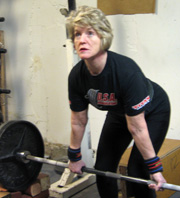
Faith Ireland's used to being a pioneer. In 1999, she was one of the first women on the Washington State Supreme Court. Before that, she was one of the first female superior court judges for King County - that's the county Seattle's in. Today, she's a different kind of trailblazer. She takes a deep breath as she lifts a 275 pound barbell off the ground and up to her hips. She exhales as she puts it back down on the ground. She's successfully completed a deadlift.

"That's the American record for women my age in weight", says Faith. "I hold that record, and I want to break it in this next meet. If I hit a personal best, you'll hear me jumping around and squeaking."

Faith Ireland is 66, about five-foot-three-inches, and 135 pounds. She looks healthy, but not overly muscular and veiny like you might expect. She discovered powerlifting by accident, literally.

"I was in a car wreck in 1983, and I spent 15 years in agony with my back," says Faith. "Then I actually had a juror talk about lifting weights to overcome back injury when he was talking with the lawyers about his back injury." Faith had tried lifting weights for her back before. But she was so inspired by what the juror said, she was determined to try again. She found a new trainer, a guy named Willie Austin. He was a powerlifting coach, so Faith hoped he'd push her to lift through her pain. Faith was 55 and in her first year on the Supreme Court when she started training with Willie. She was also 30 pounds overweight.

"Willie was the person who got me out of pain and strong and starting to lose weight, so I would do whatever he told me," Faith says.

What Willie told Faith to do was compete in a local powerlifting match. She didn't win, but she found she loved challenging her body that way. She entered women's nationals and lost again. But the experience galvanized her to get ready for next time. For many people, two losses would have been enough to make them stop powerlifting. But not Faith.

"I've never been a quitter," laughs Faith. "When I start something, I stick with it."

Sticking with it meant Faith had to perfect three moves. The deadlift, or pull, is what Faith did when she lifted that 275 pound barbell. There's also the squat, where you hold a barbell above your shoulders and slowly bend your knees until your thighs are parallel to the ground, and then you stand back up. Then there's the bench press, or the push. That's probably the most well-known of the powerlifting moves. You lie on your back on a bench and push a barbell up from your chest and back down.

None of these moves are easy to do right. But everyone in Faith's gym stops what they're doing to cheer on another lifter during a tough push or pull. The place almost feels like a secret clubhouse. The gym's in the basement of an office building in downtown Seattle. It's not visible from the street. And you can't get in unless someone lets you in. Faith is an elite member of this club.

So is her teammate, Natalie Harmon. Nat looks like Justine Bateman - if Justine Bateman could deadlift 330 pounds. Nat has an unconventional method to pump up for tough deadlifts. "I get a kick out of a smack", she divulges with a smile. "If I'm pushing I'll smack my face. I'll often leave with a handprint on my leg."

Sometimes the person who smacks Natalie is the women's masters' coach, Todd Christensen. He's been a powerlifting coach for 25 years. And he first met Faith when she needed help putting on a bench shirt. That's a tight shirt powerlifters wear for support during the bench press. He was pulling it over her head, his hand slipped, and he smacked her upside the head.

"I thought, 'That's great, my introduction to the Supreme Court justice.'" Todd shakes his head and chuckles at the memory. "Then she looked at me and said, 'Look Todd, I'm tough. I'm not a…'" He stops and looks at me. "Are you gonna edit this?" he asks. I say yes, and Todd then uses a word for wimp we can't use here. "I'm like, 'That's great, you're my kind of gal,'" Todd says with a grin.

Todd's coaching made Faith more than a stronger powerlifter. The physical discipline and the concentration the sport requires made her a more focused justice. In 2005, after six years on the Supreme Court, Faith decided to step down. Justices are elected here in Washington State, and Faith did not want to go through another campaign. She says she doesn't miss being a judge, but she misses her colleagues at the Supreme Court. She's OK with that, though.

Faith smiles as she describes life with her new colleagues, her fellow powerlifters. "We get together at holidays, we get in tiffs, we have irritations. But there is a closeness. And they're my most immediate peer group, even beyond lawyers and judges. We're like family."

This weekend is Faith's last heavy deadlift workout before Women's Nationals. Next weekend, she'll gear up and work on heavy squats and bench presses. After that, she and her second family will back off the heavy lifting to rest up and heal before heading to Miami to defend their title as the best women's masters powerlifting team in the United States.