Showing posts with label isolation. Show all posts

Thursday, August 14, 2014

Heidi Hanson - 7 PTSD Feedback Loops

This post comes from the Healing from Trauma blog by Heidi Hanson, many of whose posts are being compiled into a book tentatively called the Trauma Healing Resource Book.

This particular post, which was shared with me by some friends on Facebook, presents some of the essential experiences of PTSD within the context of feedback loops. Based on the experience of my clients, this seems quite useful.

7 PTSD Feedback Loops

by Heidi Hanson

In the book I have been working on, Trauma Healing Resource Book (tentative title), which chronicles my healing journey through PTSD, I identify 7 Feedback Loops that act like quicksand, pulling one further into PTSD even as one desires to find one’s way out. This needs further research, but feedback loops could be one reason some cases of PTSD become chronic.

Note: This article and all articles on this blog are based on my personal experience as someone recovering from PTSD. Much is theoretical material, however it is material I consider worth being studied in depth in a scientific manner at some point in time.

Excerpt from the book:

Definition: The technical definition of a feedback loop is “a system where outputs are fed back into the system as inputs, increasing or decreasing effects.” *

I would define a feedback loop related to human psychology as a group of external life circumstances and internal patterns that keep reinforcing each other, making it difficult to change either the circumstances or the patterns.

Feedback loops can be propelled by internal patterns of thoughts, perceptions, emotions, and behaviors, each element stimulating the next.

Negative feedback loops frequently lead to downward spirals, in which case some aspect of the situation worsens slightly every time one or several loops are completed.

Experiences of trauma may lead us to develop mental habits; feedback loops are mechanisms that keep maintaining and deepening these habits. One could theorize that feedback loops contribute to reinforcing specific neural pathways in the brain and to developing chronic imbalances in the nervous system and physiology.

Negative feedback loops lead to what I call a “trauma-based reality.” This is when we perceive all of our reality through a filter created from our past traumatic experiences. The “normal” reality we experienced prior to the traumatic experiences can only be sensed for brief moments.

In the following illustration, the individual is in a room dancing with trauma, and through the windows she can see momentary glimpses of the reality that exists outside of the trauma-based reality.


Book Illustration: Trauma-based Dance Floor
Sometimes, dancing, I catch hints of Life, outside

I have identified seven feedback loops based on my own experiences. I’m sure there are more; there are also variations on these seven, not included here.

* http://psychology.wikia.com/wiki/Feedback_loop

1. A Dangerous World Feedback Loop


Synonyms: Magnifying Triggers Feedback Loop, Environmental Triggers Feedback Loop

This feedback loop occurs when we have experienced trauma, and we happen to be in an environment that continuously triggers memories of the trauma. If constantly triggered, we can be reminded of the trauma and automatically feel fear over and over again, which makes the environment around us seem more frightening, and we end up imprinting the idea of trauma more and more deeply onto the environment. Seeing increasingly more danger makes us more likely to experience triggers, and makes the triggers more impactful when they come.

It’s not just the perception of the environment as more and more dangerous that increases the impact of the triggers. Being triggered a lot can gradually increase our sensitivity and raise our overall level of hyperarousal. In turn, feeling more sensitive increases the impact of the triggers.

In this scenario, all levels of danger are perceived as a red alert – there are no orange and yellow alerts; danger is stuck on High setting and only increases from there.

This feedback loop is one reason it is so important to get to an environment that gives some relief from triggers, or change the environment (get rid of furniture, redecorate, put new scents in the air etc.).

If the amount of stress puts the system into immobility more and more frequently, this feedback loop can lead to the Immobility Downward Spiral – getting increasingly immobile e.g. feeling numb, unresponsive, still, paralyzed.


I noticed this Dangerous World Feedback Loop and Immobility Downward Spiral happening early on in my experience of PTSD. This is an illustration that shows how too many triggers can feel like an invasion, or a kind of poison that is constantly being inserted into the brain and nervous system, causing the mind to go into meltdown or immobility on a regular basis.


2. Constricted Reality Feedback Loop / Downward Spiral


Synonyms: Self-isolation Feedback Loop, Resource Avoidance Downward Spiral, Resource Rejection Downward Spiral

Being extremely sensitive and being hit constantly by a wide variety of triggers can also lead to a Constricted Reality Feedback Loop. In this case, each time some life situation is associated with trauma, we may decide to avoid it as well as anything related to it. In the following illustration, we see that this individual’s hypersensitivity to triggers in his community make him cut off his connection, automatically and without thought, to resource after resource, until he is alone in his room, isolated and disconnected from the rest of the world.

Without any resources, it is unlikely he will be exposed to things that demonstrate that his triggers are false – in other words he won’t have experiences that deconstructs the triggers and rewire his brain to re-perceive reality in a new way, for example encountering someone who at first appears to be a perpetrator but is actually a friend, or an authority figure who appears to be abusive and turns out to actually be a resource. In this scenario there is no way for healing to happen because the individual is isolated from all potential resources.

This one is similar to the Dangerous World and Lack of Trust Feedback Loop (#5). They are all ways of illustrating how fear leads to fear, mistrust leads to more mistrust and isolation leads to more isolation, just with slight variations. Dangerous World has to do with one’s perception of danger, Lack of Trust is specifically in relation to other people, and Constricted Reality has to do with isolation from all types of resources in one’s community including places, events, groups, people etc.

Note: click on the image to see a larger version


3. Dissociation Feedback Loop


Being frequently dissociated means for much of the day we are not present in the body.

Some synonyms for this state of dissociation are:
  • space cadet
  • spaced out
  • absent-minded
  • head in the clouds
  • not paying attention
This could lead to accidents which may be somewhat traumatizing. If traumatic, these accidents could possibly lead to further tendency to dissociate.

The illustration for this one may be simple, but being dissociative can create messy problems. Dissociation can lead to small accidents, like stubbing one’s toe; it can also lead to worse incidents, like doing things that are dangerous without knowing it. General disorganization can lead to problems, for example, a woman who is out late and misplaced her cell phone and is looking for it and then gets mugged whereas she would have been at home by that time if she had been more organized. Dissociation is an escape from the present and it may lead to bad decisions due to lack of awareness of details. Underneath dissociation is a wound(s) that causes tentativeness or rejection in relation to being in the body. In order to heal, we need to be committed to our bodies and ourselves, aware of our surroundings and alert to who is doing what with us, to prevent more accidents.


4. Hyperarousal Feedback Loop


Synonyms: Panic Loop

If we are in hyperarousal a large percentage of the time, it means the nervous system is strung tight like a rubber band pulled almost to the breaking point. We may be jumpy, prone to panic, tend to do things too quickly, rush about in too much of a hurry, and act on impulse. Hyperarousal makes it difficult to process information well because it keeps one stuck in a survival level of thinking, preventing access to the higher mind/rational thought. If we are panicking, we are also more easily manipulated by other people. This chaotic fear state could easily lead to getting into bad situations or accidents/injuries. It is possible this could lead to another trauma, which would only increase the hyperarousal.


5. Lack of Trust Feedback Loop


Synonyms: People Avoidance Feedback Loop, Other People Rejection Feedback Loop, Help Rejection Loop

Sometimes, a traumatic experience includes a breach of trust. Trust can be broken within a close relationship, such as with a partner or parent. Trust can also be violated by an authority figure we had confidence in. Sometimes, when we try to seek help with PTSD, we encounter healing practitioners who do not understand PTSD enough to help us, and can even do or say things that re-traumatize us. So, in some cases, we will develop a lack of trust.

Due to this lack of trust we may feel more comfortable spending time alone. Spending more time alone makes us more vulnerable to the symptoms of PTSD, because there is no information coming from outside to challenge the trauma-based reality. We avoid the very people and situations that may have a positive effect on the nervous system.

Not getting the help we need can lead to issues in the following areas:
  1. Triggers automatically create hyperarousal; we do not learn ways to intervene.
  2. We experience more triggers and this leads to more disregulation and hyperarousal.
  3. Disregulation, hyperarousal, fear and anxiety cause confused information processing.
  4. Due to difficulties with processing information we can’t figure out how to escape or change the situation.
  5. Also, triggers lead us to remain in helplessness/immobility/paralysis; helplessness leads to not feeling one has the power to help themselves.
  6. Low self-esteem remains unchallenged; low self esteem from trauma can stop us from seeking help.
  7. When we perceive ourselves in a constricted reality, we may not see what exists outside it.
  8. The level of sensitivity being unintentionally maintained can lead to more experiences of being traumatized by healing practitioners and other people trying to help.
Thus, the lack of trust seems to be justified by many aspects of our experience, and we spend more time avoiding people. Being alone with our PTSD symptoms can lead to experiencing reality as harsh and other people as unhelpful; we continue to avoid people and our reality becomes more and more constricted.

The Lack of Trust Feedback Loop can lead to a Constricted Reality Feedback Loop/Downward Spiral.


6. Trauma Seeking Feedback Loop


Synonyms: Resolution Block Feedback Loop

Peter Levine has theorized that one of the key reasons human beings do not process and release trauma within minutes like animals do is because we have developed a higher brain, the neocortex. The neocortex gives us great advantages such as the ability to think rationally, but it can also suppress the pent-up trauma related energies the system needs to process and release successfully in order to heal PTSD, such as rage and terror.

In the trauma seeking feedback loop, we may get into a situation where there is the possibility for the pent-up energy to completely release once and for all. We may suddenly feel powerful, primitive uncontrollable rage, hatred, sorrow, fear, or shame. But because of the controls we maintain, we do not recognize this as the opportunity it is. Rather, we think something is terribly wrong with us and force ourselves to push the emotions back down, and thus fail to release the pent-up energy. In other words, when the reptilian brain’s instinctive manner of releasing trauma begins, the neocortex or rational mind automatically suppresses it to escape and avoid the powerful emotions. When the experience is over, we have stabilized again but nothing has changed and the system continues to unconsciously seek a way to discharge the trapped life energy and return to a truly non-traumatized state of calm alertness. The system will unconsciously seek out another situation to stir up these powerful emotions, in the hopes that they will finally be processed to completion.


7. Survival Mode Feedback Loop


Synonyms: Problematic Memory Encoding Loop, Arrested in Time Loop, Siege Mode Loop

The seventh feedback loop is the state of being immersed in survival instincts, a perpetual state in relation to the reptilian brain managing an eternal moment of shock and trauma, without ever coming out. This is most likely due to the way traumatic memories are encoded. It creates a kind of life in siege mode, a severe experience of life, a survival focused life. Even if one’s survival needs are met one may feel like life is about surviving in basic ways and not about living/thriving (the higher level needs on Maslow’s hierarchy are not in the picture).

The experience of being in shock becomes a timeless moment, a never-ending moment, from which the body does not re-enter time. It is as if the reptilian brain is telling you you are still in shock and need to survive, dominating your experience and keeping you in survival mode forever. The experience cannot be metabolized, psychologically, by the system, and until it becomes metabolized it is holding you hostage. In order for it to be metabolized, the times of the worst dissociation (shock) need to be integrated in the body and brain/memory in a different way than they were at the time of the trauma. There are theories to the effect that the memory of the trauma needs to be moved from short-term to long-term memory.

So the theory about how this one works is that because going into these memories feels too threatening, the procedure seems complex, one lacks skills and also lacks skilled help, one never figures out how to integrate the moments of the worst dissociation, and so the person remains stuck in time and in survival mode. Sorry this one is not clearer, when I understand it better I will update this section.


One feedback loop I have not included in this article is Learned Helplessness. Learned Helplessness (Seligman) is a kind of feedback loop because if we are in a situation in which we are legitimately helpless, we learn that in those kinds of situations we are helpless. Then, when in a similar situation, we behave helplessly even if we truly have power to act. This reinforces our perception of our self and internal experience (felt sense) of being helpless. And so it continues. Learned helplessness is related to depression; I am not sure the relation to PTSD. In my case, because I was injured I have felt helpless in a lot of situations and I feel much more helpless than I did before. I would have to do more research to understand if this is learned helplessness as defined by Seligman or something else.

When I first found Somatic Experiencing and realized how much of healing PTSD is just about using somatic techniques to calm the nervous system and re-enter the body, I thought it would be a clear road out. I was wrong. I am still falling into these feedback loops on a regular basis, and I’m still trying to find ways to outsmart the downward spirals.There is a lot more work to be done, and my first step is to simply acknowledge that these feedback loops are still here and still need addressing.

__________________

Heidi Hanson is an artist and writer in Asheville, North Carolina currently working on an illustrated book chronicling her journey healing from Post Traumatic Stress Disorder.

Monday, June 09, 2014

Michael Bond - How Extreme Isolation Warps the Mind


Michael Bond is the author of The Power of Others: Peer Pressure, Groupthink, and How the People Around Us Shape Everything We Do (2014). This article from the BBC is adapted from his book.

If you have ever tried a sensory deprivation tank, you have a glimpse of what isolation (from everything, including vision, sound, scent, taste, and touch) can do to the mind. In my first college stint, one of my housemates in Ashland (OR) had a sensory deprivation tank she used with massage clients. I spent as much time as possible in that tank, up to 3-4 hours, and once on a low-dose of LSD (about 100 mcgs). As much as anything else I have done in my life, including meditation and therapy, getting to know my own mind without any outside input began a process of change (and curisoity) in me that continues today. If it were feasible, I'd buy a tank.

This article looks at isolation in a bigger sense, however, including prisoners in solitary confinement and those who have participated in research that removes them from circadian rhythms of light and dark.

This is a fascinating article, so take a few minutes to check it out, then go see the other cool stuff that the BBC Future has made available (finally) to web users in the States.

How Extreme Isolation Warps the Mind

When people are isolated from human contact, their mind can do some truly bizarre things, says Michael Bond. Why does this happen?

Michael Bond | 14 May 2014

(Getty Images)

Sarah Shourd’s mind began to slip after about two months into her incarceration. She heard phantom footsteps and flashing lights, and spent most of her day crouched on all fours, listening through a gap in the door.

That summer, the 32-year-old had been hiking with two friends in the mountains of Iraqi Kurdistan when they were arrested by Iranian troops after straying onto the border with Iran. Accused of spying, they were kept in solitary confinement in Evin prison in Tehran, each in their own tiny cell. She endured almost 10,000 hours with little human contact before she was freed. One of the most disturbing effects was the hallucinations.

“In the periphery of my vision, I began to see flashing lights, only to jerk my head around to find that nothing was there,” she wrote in the New York Times in 2011. “At one point, I heard someone screaming, and it wasn’t until I felt the hands of one of the friendlier guards on my face, trying to revive me, that I realised the screams were my own.”

We all want to be alone from time to time, to escape the demands of our colleagues or the hassle of crowds. But not alone alone. For most people, prolonged social isolation is all bad, particularly mentally. We know this not only from reports by people like Shourd who have experienced it first-hand, but also from psychological experiments on the effects of isolation and sensory deprivation, some of which had to be called off due to the extreme and bizarre reactions of those involved. Why does the mind unravel so spectacularly when we’re truly on our own, and is there any way to stop it?


Inside prison walls, solitude can play disturbing tricks on the mind (Flickr/Cyri)

We’ve known for a while that isolation is physically bad for us. Chronically lonely people have higher blood pressure, are more vulnerable to infection, and are also more likely to develop Alzheimer’s disease and dementia. Loneliness also interferes with a whole range of everyday functioning, such as sleep patterns, attention and logical and verbal reasoning. The mechanisms behind these effects are still unclear, though what is known is that social isolation unleashes an extreme immune response – a cascade of stress hormones and inflammation. This may have been appropriate in our early ancestors, when being isolated from the group carried big physical risks, but for us the outcome is mostly harmful.

Yet some of the most profound effects of loneliness are on the mind. For starters, isolation messes with our sense of time. One of the strangest effects is the ‘time-shifting’ reported by those who have spent long periods living underground without daylight. In 1961, French geologist Michel Siffre led a two-week expedition to study an underground glacier beneath the French Alps and ended up staying two months, fascinated by how the darkness affected human biology. He decided to abandon his watch and “live like an animal”. While conducting tests with his team on the surface, they discovered it took him five minutes to count to what he thought was 120 seconds.

A similar pattern of ‘slowing time’ was reported by Maurizio Montalbini, a sociologist and caving enthusiast. In 1993, Montalbini spent 366 days in an underground cavern near Pesaro in Italy that had been designed with Nasa to simulate space missions, breaking his own world record for time spent underground. When he emerged, he was convinced only 219 days had passed. His sleep-wake cycles had almost doubled in length. Since then, researchers have found that in darkness most people eventually adjust to a 48-hour cycle: 36 hours of activity followed by 12 hours of sleep. The reasons are still unclear.


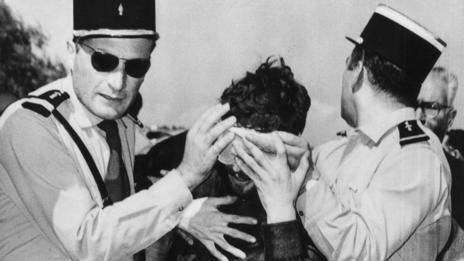
After emerging from a nine week stint in underground darkness, Michel Siffre needed to wear a blindfold to protect his eyes (Getty Images)

As well as their time-shifts, Siffre and Montalbini reported periods of mental instability too. But these experiences were nothing compared with the extreme reactions seen in notorious sensory deprivation experiments in the mid-20th Century.

In the 1950s and 1960s, China was rumoured to be using solitary confinement to “brainwash” American prisoners captured during the Korean War, and the US and Canadian governments were all too keen to try it out. Their defence departments funded a series of research programmes that might be considered ethically dubious today.

The most extensive took place at McGill University Medical Center in Montreal, led by the psychologist Donald Hebb. The McGill researchers invited paid volunteers – mainly college students – to spend days or weeks by themselves in sound-proof cubicles, deprived of meaningful human contact. Their aim was to reduce perceptual stimulation to a minimum, to see how their subjects would behave when almost nothing was happening. They minimised what they could feel, see, hear and touch, fitting them with translucent visors, cotton gloves and cardboard cuffs extending beyond the fingertips. As Scientific American magazine reported at the time, they had them lie on U-shaped foam pillows to restrict noise, and set up a continuous hum of air-conditioning units to mask small sounds.

After only a few hours, the students became acutely restless. They started to crave stimulation, talking, singing or reciting poetry to themselves to break the monotony. Later, many of them became anxious or highly emotional. Their mental performance suffered too, struggling with arithmetic and word association tests.

Sensory deprivation can cause hallucinations - sometimes starting with geometric shapes or points of light, and then getting stranger... (Akuei/Flickr)

But the most alarming effects were the hallucinations. They would start with points of light, lines or shapes, eventually evolving into bizarre scenes, such as squirrels marching with sacks over their shoulders or processions of eyeglasses filing down a street. They had no control over what they saw: one man saw only dogs; another, babies.

Some of them experienced sound hallucinations as well: a music box or a choir, for instance. Others imagined sensations of touch: one man had the sense he had been hit in the arm by pellets fired from guns. Another, reaching out to touch a doorknob, felt an electric shock.

When they emerged from the experiment they found it hard to shake this altered sense of reality, convinced that the whole room was in motion, or that objects were constantly changing shape and size.

Distressing end

The researchers had hoped to observe their subjects over several weeks, but the trial was cut short because they became too distressed to carry on. Few lasted beyond two days, and none as long as a week. Afterwards, Hebb wrote in the journal American Psychologist that the results were “very unsettling to us… It is one thing to hear that the Chinese are brainwashing their prisoners on the other side of the world; it is another to find, in your own laboratory, that merely taking away the usual sights, sounds, and bodily contacts from a healthy university student for a few days can shake him, right down to the base.”

In 2008, clinical psychologist Ian Robbins recreated Hebb’s experiment in collaboration with the BBC, isolating six volunteers for 48 hours in sound-proofed rooms in a former nuclear bunker. The results were similar. The volunteers suffered anxiety, extreme emotions, paranoia and significant deterioration in their mental functioning. They also hallucinated: a heap of 5,000 empty oyster shells; a snake; zebras; tiny cars; the room taking off; mosquitoes; fighter planes buzzing around.


A clip from BBC Horizon’s Total Isolation experiment – read more information about the programme here.

Why does the perceptually deprived brain play such tricks? Cognitive psychologists believe that the part of the brain that deals with ongoing tasks, such as sensory perception, is accustomed to dealing with a large quantity of information, such as visual, auditory and other environmental cues. But when there is a dearth of information, says Robbins, “the various nerve systems feeding in to the brain’s central processor are still firing off, but in a way that doesn’t make sense. So after a while the brain starts to make sense of them, to make them into a pattern.” It creates whole images out of partial ones. In other words, it tries to construct a reality from the scant signals available to it, yet it ends up building a fantasy world.

Such mental failures should perhaps not surprise us. For one thing, we know that other primates do not fare well in isolation. One of the most graphic examples is psychologist Harry Harlow’s experiments on rhesus macaque monkeys at the University of Wisconsin-Madison during the 1960s, in which he deprived them of social contact after birth for months or years. They became, he observed, “enormously disturbed” even after 30 days, and after a year were “obliterated” socially, incapable of interaction of any kind. (A comparable social fracturing has been observed in humans: consider the children rescued from Romanian orphanages in the early 1990s, who after being almost entirely deprived of close social contact since birth grew up with serious behavioural and attachment issues.)


We may crave solitude occasionally, but in the long term it's not good for us physically or mentally (Getty Images)

Secondly, we derive meaning from our emotional states largely through contact with others. Biologists believe that human emotions evolved because they aided co-operation among our early ancestors who benefited from living in groups. Their primary function is social. With no one to mediate our feelings of fear, anger, anxiety and sadness and help us determine their appropriateness, before long they deliver us a distorted sense of self, a perceptual fracturing or a profound irrationality. It seems that left too much to ourselves, the very system that regulates our social living can overwhelm us.

Take the 25,000 inmates held in “super-maximum security” prisons in the US today. Without social interaction, supermax prisoners have no way to test the appropriateness of their emotions or their fantastical thinking, says Terry Kupers, a forensic psychiatrist at the Wright Institute in Berkeley, California, who has interviewed thousands of supermax prisoners. This is one of the reasons many suffer anxiety, paranoia and obsessive thoughts. Craig Haney, a psychologist at the University of California, Santa Cruz, and a leading authority on the mental health of inmates in the US, believes that some of them purposefully initiate brutal confrontations with prison staff just to reaffirm their own existence – to remember who they are.

Coping strategy

Social isolation is not always debilitating, however. Are some better than others at coping? And can you train yourself to resist the worst effects? Here scientists have fewer hard answers, but we can at least look to the lessons of individuals who thrived – or floundered – under isolation.

When Shourd was imprisoned in Iran, she was arguably among the least-equipped people to cope, because her incarceration came out of the blue. People in her circumstances have their world suddenly inverted, and there is nothing in the manner of their taking – no narrative of sacrifice, or enduring for a greater good – to help them derive meaning from it. They must somehow find meaning in their predicament – or mentally detach themselves from their day-to-day reality, which is a monumental task when alone.

Hussain Al-Shahristani managed it. He was Saddam Hussein’s chief nuclear adviser before he was tortured and shut away in Abu Ghraib prison near Baghdad after refusing on moral grounds to cooperate on the development of an atomic weapon. He kept his sanity during 10 years of solitary confinement by taking refuge in a world of abstractions, making up mathematical problems which he then tried to solve. He is now deputy energy minister of Iraq. Edith Bone, a medical academic and translator, followed a similar strategy during the seven years she spent imprisoned by the Hungarian communist government after World War Two, constructing an abacus out of stale bread and counting out an inventory of her vocabulary in the six languages she spoke fluently.


Some believe a military background may help prevent the worst effects of isolation (Thinkstock)

Such experiences may be easier to take if you belong to a military organisation. Keron Fletcher, a consultant psychiatrist who has helped debrief and treat hostages, says mock detention and interrogation exercises of the kind he himself underwent while serving with the Royal Air Force are a good preparation for the shock of capture. “They teach you the basics of coping,” he says. “Also, you know your buddies will be busting a gut to get you back in one piece. I think the military are less likely to feel helpless or hopeless. Hopelessness and helplessness are horrible things to live with and they erode morale and coping ability.”

US senator John McCain is a good example of how a military mindset bestows psychological advantages. His five-and-a-half years as a prisoner of war in Vietnam, during which he refused to yield to his interrogators, actually seemed to strengthen him. Though note what he had to say about the two years he spent in isolation: “It’s an awful thing, solitary. It crushes your spirit and weakens your resistance more effectively than any other form of mistreatment… The onset of despair is immediate, and it is a formidable foe.”

Extreme reality


Psychologists who study how people cope with isolation have learnt much from solo explorers and mountaineers. For many adventurers deprived of human company – albeit voluntarily – the landscape itself can serve as an effective surrogate, drawing them out of themselves into the beauty or grandeur of their surroundings. Norwegian psychologist Gro Sandal at the University of Bergen in Norway, who has interviewed many adventurers about how they cope in extreme environments, says that transcending the reality of their situation in this way is a common coping mechanism. “It makes them feel safer. It makes them feel less alone.”

A similar psychological mechanism could explain why shipwrecked mariners marooned on islands have been known to anthropomorphise inanimate objects, in some cases creating a cabal of imaginary companions with whom to share the solitude. It sounds like madness but is likely a foil against it. Take the way sailor Ellen MacArthur nicknamed her trimaran “Mobi”, during her record-breaking solo circumnavigation of the globe in 2005. During the voyage she signed emails to her support team “love e and mobi”, and in her published account uses “we” rather than “I”.


Sailors have been known to combat the loneliness of the ocean by anthropomorphising inanimate objects (Thinkstock)

There is no more poignant illustration of the power of solitude to sink one person while lifting up another than the stories of Bernard Moitessier and Donald Crowhurst, two of the competitors in the 1968 Sunday Times Golden Globe round-the-world yacht race. The trophy, offered to the first sailor to complete a solo non-stop circumnavigation of the globe, was won in 313 days by Robin Knox-Johnston, the only one out of nine starters to finish. He seemed to relish being alone with his boat, but not as much as Moitessier, an ascetic Frenchman who practised yoga on deck and fed cheese to the shearwater birds that shadowed him. Moitessier found the experience so fulfilling, and the idea of returning to civilisation so distasteful, that he abandoned the race despite a good chance of victory and just kept on sailing, eventually landing in Tahiti after travelling more than halfway round the world again. “I continue non-stop because I am happy at sea,” he declared, “and perhaps because I want to save my soul.”

Crowhurst, meanwhile, was in trouble from the start. He left England ill-prepared and sent fake reports about his supposed progress through the southern seas while never actually leaving the Atlantic. Drifting aimlessly for months off the coast of South America, he became increasingly depressed and lonely, eventually retreating to his cabin and consolidating his fantasies in a rambling 25,000-word philosophical treatise before jumping overboard. His body was never found.

What message can we take from these stories of endurance and despair? The obvious one is that we are, as a rule, considerably diminished when disengaged from others. Isolation may very often be the “sum total of wretchedness”, as the writer Thomas Carlyle put it. However, a more upbeat assessment seems equally valid: it is possible to connect, to find solace beyond ourselves, even when we are alone. It helps to be prepared, and to be mentally resilient. But we shouldn’t underestimate the power of our imagination to knock over prison walls, penetrate icy caves or provide make-believe companions to walk with us.

This article is based on the book The Power of Others by Michael Bond (Oneworld Publications).

Sunday, December 22, 2013

How Bullied Children Grow into Wounded Adults

This is a good article from UC Berkeley's Greater Good Science Center on the long-term impact of bullying - both on the bullied and the bully. We already know that bullied children struggle with depression, suicide attempts, physical health problems, and reduced academic achievement.

Researchers began this study with 11-13 year-old children - to me this is late, since a lot of bullying occurs in 3-6 grades, as well as later.

They identified three primary groups: bullies, victims, and victim-bullies (those kids who are bullied and the pay it forward to someone lower in standing than they are). It turns out the bully-victims fare worst over the long-term in terms of physical health and were much more likely to diagnosed with a mental illness, to be regular smokers, and to take longer to heal from illness or injury.


How Bullied Children Grow into Wounded Adults


By Bianca Lorenz | December 18, 2013
Greater Good Science Center | UC Berkeley

A new longitudinal study finds children are affected by bullying throughout their lives—and reveals that even perpetrators can can struggle as adults.

Depression, suicide attempts, physical health problems, and reduced academic achievement—these are just a few of the negative effects bullying can have on children, according to many studies.

But what happens when those children grow into adults? Does childhood bullying lead to struggles in adulthood?


That’s the question tackled by researchers from the University of Warwick and Duke University Medical Center, whose results were published recently in the journal Psychological Science.

They began to follow participants in North Carolina at ages 11 to 13. The kids were assessed every year until age 16—and once again as young adults, at ages 19 to 26. All in all, 1,273 people participated in every stage of the study.

In childhood and adolescence, participants and their parents reported if they had been bullied or had bullied others in the previous three months. Researchers sorted those who experienced bullying into three categories: victims, bullies, and bully-victims—kids who had been both bullies and victims at some point in time.

As it turned out, victims outnumbered bullies in the study by three to one (305 vs. 100). But the largest portion of study participants formed a fourth category: Those who claimed to have had no experience at all with bullying (789 participants). Bullies were mostly boys, but victims could be either girls or boys.

Then, at the young adult stage, the researchers looked at factors like physical and mental health, risky behaviors, wealth, and social relationships—and they investigated whether the participants had acquired criminal records. When the researchers matched childhood bullying with adult outcomes, they discovered four key insights:
  1. Bullying is most toxic for those who were both bullies and victims. “Bully-victims in school had the worst health outcomes in adulthood,” write the researchers, “with markedly increased likelihood of having been diagnosed with a serious illness, having been diagnosed with a psychiatric disorder, regular smoking, and slow recovery from illness.”
  2. Bullies might be more likely to engage in risky or illegal behaviors in adulthood. When they grew up, bullies were more likely to have been convicted of felonies and to have abused drugs, and they actually tended to be poorer and lonelier than their former victims. However, when researchers controlled for childhood hardships like divorce or psychiatric problems, they found that a bully’s situation didn’t look quite as dim. In other words, bullies tended to have more troubled childhoods—and that may explain both their bullying and the greater likelihood of engaging in illegal behaviors down the road.
  3. Victims tended to be more successful—but less healthy—than bullies in adulthood. In general, victimized kids grew up to do better than the kids who bullied them. They made more money, had more friends, and were much, much less likely to be convicted of a crime—but they still did worse than those who weren’t bullied at all. And their mental and physical health tended to be worse than everyone else. (When researchers controlled for other childhood hardships, the risks for both victims and bully-victims did not change.)
  4. All three groups involved in bullying did worse than those who were not. Overall, kids who were touched by bullying—as bullies, victims, or bully-victims—ended up with less education and less money than those who said they had escaped bullying altogether. Kids who encountered bullying in any way also struggled more with social relationships than those were had no experience with bullying.
Thirty-eight percent of the 421 victims and bully-victims were chronically bullied—meaning that it kept happening throughout childhood. This subset often struggled the most, being poorer, less educated, and more isolated than everyone else.

Taken together, these results show how a child can be affected by bullying throughout his or her life—but also reveals that a child can suffer from bullying on both sides of the spectrum, as victim and perpetrator.

“Being bullied is not a harmless rite of passage or an inevitable part of growing up,” conclude the authors, “but throws a long shadow over affected children’s lives.”

Saturday, October 30, 2010

Mark Fairfield - It All Depends: A Position in Support of Social Engagement

In response to a post the other day on how we are wired to be social, Mark Fairfield sent me a link to his article at Let's Relate: The Relational Center Blog on the importance of social engagement. It's an elaboration on the idea that we are hard-wired to be social - and that not working with that reality is bad for our physical and mental health. [This is a cool site, but the way - check it out. It was new to me, so I'm grateful to Mark for the reference.]

This is a great article - it's long, but it's totally worth the read. Besides, he quotes Ken Gergen, and that always get's my approval. But seriously, check it out.

It All Depends: A Position in Support of Social Engagement

Isolation is corrosive. This intuition nags at us as we slather on sunscreen and reach for a cold drink; reclining in our lounge chairs and adjusting the ear buds that pipe in our epic playlists, we watch the SUVs parade by, averting our eyes from the strange but eerily familiar neighbors we pray won’t acknowledge or even notice us. We feel a vague longing to be seen, to know more about what goes on out there—where our eyes can see but our feet will never take us. But then the nervous recoil: we are busy, exhausted, brittle. What if we’re not met with warmth? What if there is too much warmth? What if we get trapped? What if we get dropped?

All wise questions, grounded in our lived experience of needing others but encountering indifference or, worse, reproach. In the background we hear the faint echo of a warning that harks back to the Pleistocene age, when being left behind meant sure death for our foraging ancestors. Death from rejection is not as sure today in our corner of the world, at least not for most Americans, not in any immediate way. But we are recognizing more and more the physical and emotional effects of feeling left behind—sometimes quite serious effects, which reveal the powerful relationships between social ties and health that linger from our foraging past. We suffer when we avoid each other, even when we do it as a protection.

Social Engagement Keeps Us Healthy
Evidence from many domains of research suggests that we are evolved to be healthiest and happiest when we are striving together—actually in close contact—and depending on each other to meet our needs. Harvard political scientist Robert Putnam’s bestselling analysis of growing isolation in American life, Bowling Alone (2000), offers sobering statistics correlating social capital with a variety of conditions widely associated with health and wellbeing, including increased immune function, longer life expectancy, more economic stability and safer neighborhoods. Putnam’s research confirms that people who are embedded in highly participatory communities—an array of civic associations, voluntary organizations, and informal networks of mutual care—enjoy healthier, happier lives.

Social capital derives its value from the trust we come to place on those in our networks cooperating with us to create sustainable benefit. In her account of the evolution of breeding and childrearing practices, the celebrated anthropologist Sarah Blather Hrdy (2009) underscores the important role that cooperation played historically in ensuring the sustainability of the human species. Hrdy traces the origins of human cooperation to new skills for mutual understanding and emotional resonance that evolved during an age when various recurring dilemmas, such as sporadic food supplies and unpredictable climate changes, demanded explicit practices that would distribute responsibility for ensuring the survival of offspring to weaning and self-feeding. The Pleistocene human child had no hope of surviving if its mother could not rely on her community to collaborate in caring for it. The demand to cooperate called forth the development of mind-reading skills, sophisticated capabilities for reading and evaluating others’ intentions. Even now, this human ability continues to sustain us by facilitating the process in which caregivers and infants engage to form the secure attachments that foster our prosocial sensibilities.

In the field of psychology, John Bowlby’s notion of attachment (1969) gets at the important role this kind of mutual understanding plays in ensuring mother and infant can work adequately well together, creating a context of care that exerts a shaping influence on the infant’s character well into adulthood. Bowlby’s theory, which has become a cornerstone in human development models, was most notably supplemented by Mary Ainsworth in the 1970s (Ainsworth et al., 1979) and by Main and Solomon a decade later (1986). Neuroscience weighed in on the topic in the mid-1990s positing mirror neurons as one physical medium by which attachment dynamics most likely take place (e.g., Gallese et al., 1996; but see also Gallese et al., 2001 and Fogassi et al., 2005 for more recent applications to empathy studies). Psychiatrist Daniel J. Siegel’s work synthesizes all these important contributions into a framework for understanding the influence the caregiving surround exerts on the human brain in early childhood in ways that influence us profoundly throughout our adult lives (Siegel, 1999 and 2009).

Yet much of this research assumes the mother/child dyad to hold sway as the singular point of entry through which this health and growth promoting attunement flows. Taking issue with this assumption, Sarah Hrdy widens the usual mother/child dyad focus of attachment theory and interpersonal neurobiology to take into account the important role that alloparents (literally, others nearby who parent) have played historically in providing a community of care for children. The village community not only complemented but actually enabled adequate mothering.

Read the whole article.


Monday, May 31, 2010

ALONE – The Brain, Sensory Deprivation and Isolation

Total Isolation

I've done a sensory deprivation tank several times over the course of a year - those experiences were very transformative in many ways - or maybe I should say that they opened parts of my psyche that have only been opened with LSD or entheogens otherwise. Seems that complete sensory deprivation opens the unconscious mind, and allows very interesting shamanic journeys.

ALONE – The Brain, Sensory Deprivation and Isolation

ALONE - The Brain, Sensory Deprivation and Isolation

BBC - For the first time in 40 years Horizon re-creates a controversial sensory deprivation experiment. Six ordinary people are taken to a nuclear bunker and left alone for 48 hours. Three subjects are left alone in dark, sound-proofed rooms, while the other three are given goggles and foam cuffs, while white noise is piped into their ears.

The original experiments carried out in the 1950s and 60s by leading psychologist Prof Donald Hebb, was thought by many in the North American political and scientific establishment to be too cruel and were discontinued.

Prof Ian Robbins, head of trauma psychology at St George's Hospital, Tooting, has been treating some of the British Guantanamo detainees and the victims of torture who come to the UK from across the world. Now he evaluates the volunteers as their brains undergo strange alterations.

Watch the full documentary now (playlist)