Wednesday, June 20, 2012

Maretha Prinsloo - Consciousness Models in Action: Comparisons


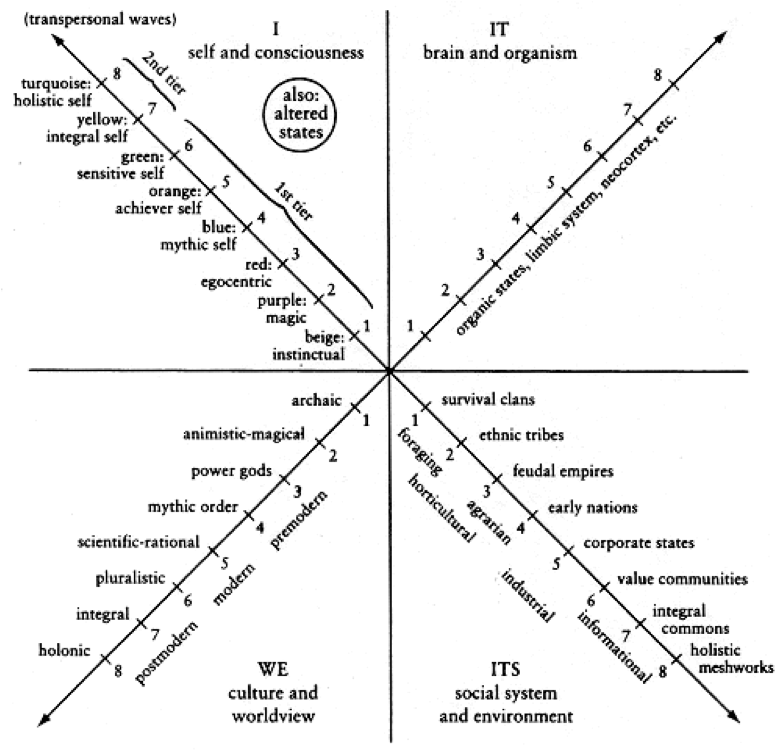
The June issue of the Integral Leadership Review has an interesting article by Maretha Prinsloo on some selected theories of consciousness - most of which are AQAL approved. For example, the usual Wilber suspects are included: Graves, Loevinger, Kegan, Gebser, Piaget, and Kohlberg. However, she also includes Karl Pribram, a brilliant mind in consciousness research who has long been an outsider in (and outspoken critic of) the academic community; and David Hawkins, a very fringe author popular with alternative medicine practitioners.

Here is her author bio:
[Prinsloo] worked in the fields of clinical and counseling psychotherapy from 1984 -1988 after which she turned her attention to research on personality and cognitive assessment. Completing her doctorate in Cognitive Psychology in 1992 (titled: “A theoretical model and empirical technique for the study of problem solving processes”) she went on to found the company Magellan Consulting (pty) Ltd. which she has led since 1994. The business is currently serving approximately 1000 corporate clients and supports many independent consulting groups in the fields of people assessment and development. Magellan has expanded to the UK where it is registered as Cognadev UK Ltd and where it operates in association with a number of consulting groups that provide training, support as well as assessment and development products to clients globally.

From my perspective - and I read a LOT of material on consciousness, much of it outside of the AQAL approved canon - there is a definite bias toward more "New Age" models in this paper (Caroline Myss, Ekhart Tolle, Sri Atmananda, J.J. Hurtak), which are presented alongside the standard developmental models in AQAL theory from Gebser, Graves, Loevinger, Kegan, and Wilber.

But where are the scientific theorists who dismantle the whole notion of a self - Thomas Metzinger, Julian Baggini, Bruce Hood - or the more renegade developmentalists - Timothy Leary, Robert Anton Wilson, Merlin Donald - or the social constructionists - Lev Vygotsky, Jerome Bruner, Kenneth Gergen - and so many others, including William Irwin Thompson, an integral theorist who rejects Wilber?

Or what about consciousness models based in psychology, such as intersubjectivity theory (Robert Stolorow, Donna Orange, George Atwood, and others), or the developmental theorists such as Allan Schore or Daniel Stern? Where do the attachment models fit into these perspectives, as we know now that those early relational experiences shape our whole lives (failing intervention).

It's always problematic when we favor those models that support our pet theories and fail to address those that offer alternate views or refute our own theories directly. I have a sense that this has long been an issue in the integral community, and this paper reflects some of that problem.

Despite all these criticisms, which are less about the paper itself than the AQAL agenda in general, this is an interesting paper from a good writer.

Consciousness Models in Action: Comparisons

 Maretha Prinsloo

Maretha Prinsloo

Abstract

This paper discusses various theoretical models of the evolution of consciousness as well as critically evaluates and integrates the models into a single organising framework, which is then applied to leadership theory.

The construct of consciousness as described by the Spiral Dynamics (SD) model of Clare Graves is linked to the work of other developmental and consciousness theorists, namely Wilber, Gebser, Piaget, May, Kohlberg, Perry, Loevinger, Maslow and Kegan. The spiritual perspectives of Wilber, Myss, Tolle, Atmananda and Hurtak as well as the work of McTaggart, Pribram and Hawkins representing a physics perspective of consciousness development, are discussed. The spiritual and scientific perspectives are addressed to contextualise the consciousness models. In addition, current leadership theory which primarily seems to focus on individual, group and organisational behaviour, is reviewed from an integral perspective to emphasise the relevance of consciousness theory within the leadership domain.

Introduction

In this paper, the construct of ”levels of consciousness” as used in psychology and consciousness theory, is closely linked to those of worldviews, perceptual frameworks, organising systems, value orientations, “intelligences” or “memes”, in terms of which people understand and respond to their worlds. It reflects levels of awareness, or the inclusiveness, extensiveness, the depth and breadth by which incoming information is interpreted. These levels of consciousness largely determine intellectual, emotional and behavioural aspects of human functioning.

The various theoretical models on the evolution of consciousness reflect common themes, principles and structures. These models have emerged from different study fields including philosophy, physics, sociology, psychology, economics and theology, and address consciousness, cognitive, moral, educational, physiological and spiritual development.

All the models that are mentioned in this paper are not discussed in detail, and the focus is primarily on the contributions of Graves, Wilber, May and Myss. Gebser’s and Piaget’s work is merely addressed in support of Wilber’s AQAL model. The views of educationalists Perry and Kohlberg are briefly discussed under the heading of intellectual, moral and ethical development (section 2.4). Psychological perspectives such as Loevinger’s model of ego-states; Maslow’s need hierarchy; and Kegan’s equilibrium stages are mentioned but not discussed in any detail. These models are, however, included in the final integrated framework as proposed in this paper (section 3). Additional views from the spiritual and physical domains are referred to in support of the general themes that characterise speculations on consciousness. The role of consciousness theory in complementing current leadership models and practices is explored in terms of an integral perspective of leadership.

Go read the whole paper.
 

Michael Dowd - The New Theism: Shedding Beliefs, Celebrating Knowledge


Metanexus is one of the really interesting online magazines - for lack of a better word, they seem to be approaching and highlighting a more integral approach to understanding the world, through a variety of lenses. They believe that Big Questions and Big Problems require a perspective from Big History.

They offer the following description of their project: "Metanexus fosters a growing international network of individuals and groups exploring the dynamic interface between cosmos, nature and culture. Membership is open to all. Join Now!"

This article examines the emergence of a new form of theism that requires evidence, which means science, for making meaning in the world, to "grow in right relationship to reality" as a spiritual path.

The New Theism: Shedding Beliefs, Celebrating Knowledge

By Michael Dowd

Since April 2002, my science-writer wife Connie Barlow and I have traveled North America virtually nonstop. We have addressed more than 1,600 secular and religious groups of all kinds. Our goal is to communicate the inspiring and empowering side of science to as many people as possible.

Whether addressing evangelicals, atheists, UUs, or gurus, our message is always the same: We show how a deeply meaningful and fully evidence-based view of big history, human nature, and death can inspire people of all backgrounds and beliefs to live in integrity and cooperate in service of a just and thriving future for all.

Over the course of the last decade, in addition to talking with folks after our programs, Connie and I have lived with hundreds of people in their homes. We’ve thus been privileged to have intellectually rich and heartful conversations with countless kindred spirits—those, like us, whose passion lies at the intersection of science, inspiration, and sustainability.

The manifesto below reflects the thinking and work of many individuals, all of whom agree that traditional labels are no longer adequate. Please consider the following but a rough first draft. Feedback is welcome. Please email me your questions, comments, criticisms, and especially your suggestions for improvement at Michael@ThankGodforEvolution.com.

A Manifesto for the New Theism
A new breed of theist is emerging in nearly every denomination and religion across the globe, and many of us are grateful to the New Atheists for calling us out of the closet.

New Theists are not believers; we’re evidentialists. We value scientific, historic, and cross-cultural evidence over ancient texts, religious dogma, or ecclesiastical authority. We also value how an evidential worldview enriches and deepens our communion with God (Reality/Ultimate Wholeness/The Great Mystery).

New Theists are not supernaturalists; we’re naturalists. We are inspired and motivated more by this world and this life than by promises of a future otherworld or afterlife. This does not, however, mean that we diss uplifting or transcendent experiences, or disvalue mystery. We don’t. But neither do we see the mystical as divorced from the natural.

As secular Jews differ from fundamentalist Jews, New Theists differ from traditional theists. While most of us value traditional religious language and rituals, and we certainly value community, we no longer interpret literally any of the otherworldly or supernatural-sounding language in our scriptures, creeds, and doctrines. Indeed, we interpret all mythic “night language” as one would interpret a dream: metaphorically, symbolically.

New Theists practice what might be called a “practical spirituality.” Indeed, spirituality for us mostly means the mindset, heart-space, and tools that assist us in growing in right relationship to reality and supporting others in doing the same.

New Theists are legion; we are diverse. Many of us continue to call ourselves Christian, Jew, Muslim, or Hindu. We may also self-identify as emergentist, evidentialist, freethinker, neo-humanist, pantheist, panentheist, or some other label.

New Theists don’t believe in God. We know that throughout human history, the word “God” has always and everywhere been a meaning-filled interpretation, a mythic and inspiring personification of forces and realities incomprehensible in a prescientific age. We also know that interpretations and personifications don’t exist or fail to exist. Rather, they are more or less helpful, more or less meaningful, more or less inspiring.

New Theists view religion and religious language through an empirical, evidential, evolutionary lens, rather than through a theological or philosophical one. Indeed, an ability to distinguish subjective and objective reality—practical truth (that which reliably produces personal wholeness and social coherence) from factual truth (that which is measurably real)—is one of the defining characteristics of New Theists.

New Theists do not have a creed (we’re not that organized). But if we did, it might simply be this:
Reality is our God, evidence is our scripture, integrity is our religion, and ensuring a healthy future for the entire body of life is our mission.

By “reality is our God” we mean that honoring and working with what is real, as evidentially and collectively discerned, and creatively imagining what could be in light of this, is our ultimate concern and commitment.

By “evidence is our scripture” we mean that scientific, historic, and cross-cultural evidence provide a better understanding and a more authoritative map of how things are and which things matter (or what’s real and what’s important) than do ancient mythic writings or handed-down wisdom.

By “integrity is our religion” we mean that living in right relationship to reality and helping others and our species do the same is our great responsibility and joy.

By “ensuring a healthy future for the entire body of life is our mission” we mean that working with people of all backgrounds and beliefs in service of a vibrant future for planet Earth and all its gloriously diverse species (including us) is our divine calling and privilege.

Why call ourselves “theists” at all if we’re not supernatural, otherworldly believers? Simply this:
All theological “isms” (e.g., theism, deism, pantheism, atheism) came into being long before we had an evolutionary understanding of emergence. Therefore, all such concepts are outdated, misleading, and unnecessarily divisive if they are not redefined and reinterpreted in an evolutionary context. Other terms that have been offered in addition to “New Theist” include “evolutionary theist,” “evolutionary humanist,” “post-theist,” “mytheist,” and “creatheist” (pronounced variously, and humorously, as “crea-theist” or “cree-atheist”).

Labels are far less important to us than celebrating the fact that we are naturalists who wish to be counted among the religious of the world—no less than all others who are devoted to something sacred and larger than themselves.

Whatever our differences, we are evidentialists, committed to living upstanding moral lives in service of a just and thriving future for humanity and the larger body of life.

We see this as Religion 2.0.

Originally published on The Advent of Evolutionary Christianity: Conversations at the Leading Edge of Faith.

Modern Masters: Watch BBC Series Featuring Warhol, Matisse, Picasso and Dali


Another great find from Open Culture. I have watched two of these so far, Matisse and Warhol, and both are excellent. The host, Alastair Sooke, clearly loves art and he shares that enthusiasm with the viewer. Good stuff.

Modern Masters: Watch BBC Series Featuring Warhol, Matisse, Picasso and Dali


June 18th, 2012


Modern art. Like it or not, it’s had a profound impact on the way our world looks. As critic Alastair Sooke explains in this four-part series from the BBC, the great artworks of the past century have exerted an influence that extends far beyond museum walls.
Modern Masters, first broadcast in 2010 on the mainstream channel BBC One, looks at the life, work, and abiding influence of Henri Matisse, Pablo Picasso, Salvador Dali and Andy Warhol. “Art during the 20th century was radical, intoxicating, and immensely influential,” says Sooke, deputy art critic of The Daily Telegraph. “Matisse, Picasso, Dali and Warhol didn’t just change art history; they changed the world.”

Episode one, Andy Warhol: For a series examining the influence of 20th century art through the prism of celebrity artists, it’s fitting that Sooke should begin with an artist obsessed with celebrity. Sooke follows Warhol (see above) from his impoverished childhood in Pittsburgh to New York City, where he struggled as a commercial artist before becoming famous as a pop artist. Along the way he shows how Warhol’s aesthetic sensibility now permeates our culture. The other three episodes proceed along similar lines. Each is just under an hour long.

Episode two, Henri Matisse:


Episode three, Pablo Picasso:


Episode four, Salvador Dali:


Related Content:

Tuesday, June 19, 2012

TEDxGrandRapids - Joan Borseynko - Resilience Now


In this TEDx Talk from Grand Rapids, Joan Borseynko (Harvard trained medical scientist, psychologist, and director of a spiritual mentor training program and expert in mind/body science, positive psychology, and spiritual exploration) speaks about the importance of resilience training for children and adults.


TEDxGrandRapids - Joan Borseynko - Resilience Now

How do we train kids and adults to face challenge with calm, creativity, kindness, and effectiveness? From the new brain science to enduring values of faith and friendship, there is an inspiring roadmap for approaching our future best self forward.

Richard Dawkins, Steven Pinker, and David Sloan Wilson Attack E.O. Wilson's The Social Conquest of Earth

It's not easy being the leading figure in a field you almost single handedly created, and that is exactly where E.O. Wilson, one of the primary architects of sociobiology, finds himself near the end of his career, with the publication of The Social Conquest of Earth. With that fame and recognition comes the inevitable attacks from those whose own work is perhaps overshadowed or even contradicted.

The latest attack comes from Steven Pinker over at Edge.

THE FALSE ALLURE OF GROUP SELECTION

An Edge Original Essay
Steven Pinker [6.18.12]

I am often asked whether I agree with the new group selectionists, and the questioners are always surprised when I say I do not. After all, group selection sounds like a reasonable extension of evolutionary theory and a plausible explanation of the social nature of humans. Also, the group selectionists tend to declare victory, and write as if their theory has already superseded a narrow, reductionist dogma that selection acts only at the level of genes. In this essay, I'll explain why I think that this reasonableness is an illusion. The more carefully you think about group selection, the less sense it makes, and the more poorly it fits the facts of human psychology and history.

Why does this matter? I'll try to show that it has everything to do with our best scientific understanding of the evolution of life and the evolution of human nature. And though I won't take up the various moral and political colorings of the debate here (I have discussed them elsewhere), it ultimately matters for understanding how best to deal with the collective action problems facing our species.
Read the whole article.

One of the first attacks, and perhaps the harshest, came from Richard Dawkins at Prospect Magazine.

The descent of Edward Wilson

by
 

A new book on evolution by a great biologist makes a slew of mistakes


The Social Conquest of Earth
By Edward O Wilson
(WW Norton, £18.99, May)


When he received the manuscript of The Origin of Species, John Murray, the publisher, sent it to a referee who suggested that Darwin should jettison all that evolution stuff and concentrate on pigeons. It’s funny in the same way as the spoof review of Lady Chatterley’s Lover, which praised its interesting “passages on pheasant raising, the apprehending of poachers, ways of controlling vermin, and other chores and duties of the professional gamekeeper” but added:

“Unfortunately one is obliged to wade through many pages of extraneous material in order to discover and savour these sidelights on the management of a Midland shooting estate, and in this reviewer’s opinion this book can not take the place of JR Miller’s Practical Gamekeeping.”

I am not being funny when I say of Edward Wilson’s latest book that there are interesting and informative chapters on human evolution, and on the ways of social insects (which he knows better than any man alive), and it was a good idea to write a book comparing these two pinnacles of social evolution, but unfortunately one is obliged to wade through many pages of erroneous and downright perverse misunderstandings of evolutionary theory. In particular, Wilson now rejects “kin selection” (I shall explain this below) and replaces it with a revival of “group selection”—the poorly defined and incoherent view that evolution is driven by the differential survival of whole groups of organisms.

Nobody doubts that some groups survive better than others. What is controversial is the idea that differential group survival drives evolution, as differential individual survival does. The American grey squirrel is driving our native red squirrel to extinction, no doubt because it happens to have certain advantages. That’s differential group survival. But you’d never say of any part of a squirrel that it evolved to promote the welfare of the grey squirrel over the red. Wilson wouldn’t say anything so silly about squirrels. He doesn’t realise that what he does say, if you examine it carefully, is as implausible and as unsupported by evidence.

Read the whole review.

Finally, David Sloan Wilson takes issue with Dawkins and Wilson - writing at This View of Life - mostly for arguing from authority and pretending that their positions are not outlier perspectives in the scientific community. Of the three critics, Wilson is most sympathetic to E.O. Wilson's positions on group selection.

Richard Dawkins, Edward O. Wilson, and the Consensus of the Many

Author: David Sloan Wilson         Source: ETVOL Exclusive

Richard Dawkins, Edward O. Wilson, and the Consensus of the Many
Appealing to authority is a risky business in science, as Dawkins appreciates, because scientific progress often involves the few prevailing against the many.

Richard Dawkins (1) begins his review of E.O. Wilson’s (2) new book The Social Conquest of Earth with an appeal to authority—namely the 137 evolutionists who co-authored a reply (3) to an article by Martin Nowak, Corina Tarnita and Wilson in Nature magazine (4). Appealing to authority is a risky business in science, as Dawkins appreciates, because scientific progress often involves the few prevailing against the many. Nevertheless, Dawkins’ appeal to authority acknowledges something that everyone should know about group selection, kin selection, and all that: Dawkins and Wilson are only two of dozens of scientists who have been working on the issues over a period of decades. This is in contrast to their outsized images on the public stage, as if they are the only two figures meriting attention and all the important ideas sprang from them.

I mean Dawkins and Wilson no disrespect by calling them two among many. I trust that they would agree and would defer to others especially when it comes to mathematical models, which is not their area of expertise. If the public is going to become literate on the issues at stake—as well they should, because they are fundamental to the study of human sociality—then they will need to realize that both Wilson and Dawkins get some things right and other things wrong. Moreover, the entire community of scientists is in more agreement than the infamous exchange in Nature seems to indicate. Taking the argument from authority seriously can lead to a breakthrough in the public’s understanding of social evolution.

Wilson has written abundantly on his rejection of kin selection in favor of group selection, as he thinks of it. Dawkins’ review is the first time he has written at length on the topics of group and kin selection in many years, as opposed to little snippets here and there. I will therefore use Dawkins’ review to outline the zone of consensus that exists among the many, which both Dawkins and Wilson should abide by unless they provide compelling arguments and evidence to the contrary. 
Read the whole review.

Authors@Google - Paul Zak on "The Moral Molecule"


Paul Zak is a name that turns up quite a bit in Julian Baggini's The Ego Trick - and now he has a new book out that is getting some good attention, The Moral Molecule: The Source of Love and Prosperity. Zak is a proponent of the oxytocin theory of human bonding and happiness.

If you pay close attention to the shot of the book cover at the beginning of the talk, you'll notice the different subtitle for the British version, The New Science of What Makes Us Good or Evil. Interesting, that - even his website (he's a Brit) now has the revised cover shot.

Anyway, if interested, his website has a lot of additional resources to explore.


Authors@Google - Paul Zak on "The Moral Molecule"

Filmed live from Google London on Thursday 31st May, 2012.

Paul Zak is the founding Director of the Centre for Neuroeconomics Studies and Professor of Economics at Claremont Graduate University. He is the proponent of the theory that oxytocin, a hormone generally associated with childbirth and present in all of us, drives our morality and is responsible for trust, empathy and other feelings that build and help maintain stable societies.

In his new book, Zak sets out to ask why are men less faithful than women? Why are some people altruists and others cold-hearted bastards? Why do some businesses succeed while others collapse?

Website: www.themoralmolecule.com

Zak offers some suggestions to help you raise your oxytocin levels at his website:
Oxytocin isn't just for giving birth and breastfeeding. As I discuss in The Moral Molecule, my research has discovered many activities that cause people's brains to release oxytocin--even the brains of complete strangers. But here's the key: oxytocin is the brain's love chemical and just like love, you have to give it to get it. By that I mean, you can do things that will cause someone else's brain to release oxytocin, but you can't do this selfishly. Give freely to others and when their brains release oxytocin they will want to reciprocate and give back to you.

Here are some of my favorite ways to cause oxytocin release in others. If you've found an activity you think releases oxytocin, add it to the list!
Give someone a hug
• Introduce yourself to someone new
• Make someone smile by being silly
• Share a meal
• Dance
• Make music with someone
• Join a choir
• Kiss
• Give someone a massage
• Go to the movies
• Ride a roller coaster
• Soak in a hot tub with a friend
• Surprise someone with a gift
• Pet a dog
• Use social media to connect to others
• Take a hike with a friend
• Write a note of thanks to a teacher or mentor
• Forgive someone who has wronged you
• Meditate or pray for 10 minutes focusing on compassion
 

Monday, June 18, 2012

Observations on The Ego Trick, Part 2

This is part 2 (Part 1 here) of many installments in my process/review of Julian Baggini's The Ego Trick: In Search of the Self. There is as much personal reflection in this as there is review of the book, and there are also philosophical reflections on the material.


I've was reading Julian Baggini's The Ego Trick during transit days on my European adventure. At first I thought maybe I was musing more philosophical due to being tired on the plane over, but it has continued since I've been here, so maybe it's the continent. Anyway, I've been jotting some random thoughts as I read the book, and here are the 2nd installment.

* * * * * * *


We visited the Tobacco Street Synagogue in Budapest a few days ago (or more correctly, the Dohány Street Synagogue), a Moorish Revival era (1850s) Temple that is beautiful inside and out. In the inner courtyard is a cemetery for some of the many, many Hungarian Jews murdered in the Holocaust.

As I walked down the path beside the cemetery, I was deeply overwhelmed by the incredible sense of loss. I found myself crying, even sobbing, in pain. Totally unexpected - there is no Jewish history in my family, and while I am more than 50% German, my family was being ostracized in Chicago during the 1930s and 1940s, not participating in Hitler's insanity.

I wonder which "Bill" felt that experience so deeply, as though my loved ones were buried in that soil. I wonder how my empathy was so easily triggered in a foreign place, for people very different from me, and by events that happened 40 years or so before I was born.

I have never really believed in past lives and reincarnation, to do so would be contrary to everything I know about the brain, about our selves, and about the laws of physics. [Author's note: My girlfriend believes in past lives and thinks that may be the source of my experience.]

Yet something about that experience feels as much "mine" as any memories of my family or knowledge of our family history. The sense of pain and loss felt very personal, very intimate.

Have I changed my mind about past lives? No . . . but I am less sure than I was before that morning in Budapest that this is the only life I have lived.

6.13.2012
__________


Reading about the self and not discussing Thomas Metzinger would be to overlook one of the leading researchers and writers in the field. This quote is from Metzinger's article on "Why are identity disorders interesting for philosophers?"

Put very shortly, possessing a globally available and integrated self-representation enables an information-processing system to stand in new kinds of relations to itself (in functionally accessing different kinds of system-related information as system-related information), and if a certain portion of this information is highly invariant, the phenomenal experience of transtemporal identity can emerge. However, we have to be careful at this point: Conceptually, indiscriminability is certainly not equivalent to identity. Identity is a transitive relation, indiscriminability is not. Indiscriminability in the self-model may just cause certain functional invariances – for example on the level of body image, background emotions, or autobiographical memory. However, a transparent representation of such functional invariances can result in the phenomenology of being identical through time, of transtemporal sameness. And this phenomenology is what, first, functionally enables us to refer to ourselves as persons and, second, constitutes the roots of our theoretical discourse on personal identity. Without this phenomenology we could not write a book like this, and you could neither read nor understand it. Conceptual self-representation is anchored in phenomenal self-representation; personal-level properties are to a considerable degree determined by subpersonal properties in the brain.

Metzinger is writing here for fellow philosophers and others who are well-versed in the study of human consciousness, not for the average non-specialist, which is  the audience for Baggini's book. The main point for me in the above passage is that identity is a "transitive relation," and it becomes "transtemporal" (persistent through time) when the information processing systems (including memory) are highly invariant (consistent).

I bring this up because Baggini cites John Locke as the first philosopher to explicitly require memory as a functional part of defining consciousness and identity.

Locke defined ‘person’ in psychological terms, as a ‘thinking intelligent being that has reflection and can consider itself as itself, the same thinking thing in different times and places’. The key to personal identity is therefore consciousness: ‘For since consciousness always accompanies thinking, and ’tis that, that makes every one to be, what he calls self; and thereby distinguishes himself from all other thinking things, in this alone consists personal Identity, i.e. the sameness of a rational Being: And as far as this consciousness can be extended backwards to any past Action or Thought, so far reaches the Identity of that Person.’
This has widely been interpreted to mean, as two recent commentators put it, that ‘a person at two different times will have the same consciousness and hence will be the same person [if] the person at a later time remembers having experienced and done what the person at the earlier time experienced and did’.

So, is memory the glue that binds us with a coherent and consistent sense of self? Probably not. Memories are not static "snapshots" from our lives, they are an active process, always in flux, and they are altered each time they are recalled.

6.14.2012
__________

Baggini looks at the famous case of H.M., a man who underwent a radical surgery in 1953 to stop epileptic seizures that removed much of his hippocampus, his amygdala, and three other small brain centers in the mid-region of the brain. The seizures stopped but so did his ability to lay down new memories.

He could, however, learn new tasks, revealing different processes for procedural memory and episodic memory. H.M. could hold information for about 20 seconds, revealing a further difference for working memory vs short-term and long-term memory.

Despite all of these issues, H.M. maintained a sense of self, although for him it was always 1953 and he was always 27 years old (the failure of new explicit memory). Years later, he could identify his mother in a current picture, but not himself. Yet he "learned" that he was aging in that he could look in the mirror and not be shocked by his gray hair (an example of implicit memory still working to some extent).

Clearly, from this example, our sense of self becomes increasingly fragile without new memories added to the narrative. But there are core traits, likes/dislikes, values and so on that remain intact.

So what would happen if there were no episodic memories from birth onward - it seems there would be no narrative and therefore no self. Baggini does not raise this issue at all, which is where the real question about memory and self becomes crucially relevant.

6.16.2012

__________


I think I was born on the wrong continent.

When I chose Budapest, Vienna, and Prague for this trip, I had no idea why I had chosen these cities and not Paris or Rome or Barcelona. Or even Berlin or Frankfurt, since I am half German by my mother's side. Why did I choose the three capitals (at various times) of the Habsburg and Austro-Hungarian Empire?

My mother's parents came from Germany as young children, but only a few decades before there was no Germany, and it's entirely possible that my heritage is something entirely unknown to me. So maybe I was responding to some deep genetic calling to return to "my land." It's possible (and I have no way of finding out at this point) that "my people" are from this region of the world. Somehow it feels like home - or at the very least I feel comfortable here.

And somehow that argument feels like another ghost in the machine.

My other half, from my father's side, is Irish, Scottish, and mutt. There is some small percentage (1/16) of Sioux blood, and that is interesting to me, but that side of my history holds no charge. I feel no connection to that lineage.

The poet and one-time Dominican monk, William Everson, saw landscape as embodiment of archetypal energies (in the Jungian sense). He wrote about those ideas in terms of the American continent in Archetype West, but I have never seen a comparable work for the European continent.

I wonder if we feel drawn to the landscape as an embodiment of an archetype, if the people who are from that land carry an almost genetic ethos - system of meaning - dictated by that archetypal landscape's influence on our biological and psychological history. It's easy to see how this manifests in biology - especially in more traditionally homogeneous cultures such as Japan or Finland. People from these homogeneous countries tend share distinct genetic patterns and often possess similar physical characteristics, from body size and shape to facial structure.

Why would it not be possible that this is also true in psychological characteristics?

When I asked my friend Tom about these ideas, he rejected the notion of tying "types" of people to genetic heritage. He feels such speculation is undermined by the incredible mixing of peoples over the whole planet (this was thought to be true in Finland, but more recent studies suggest normal genetic drift). He was particularly critical of the notion that Finland offers a homogeneous population of Fins for research purposes, although researchers have found this a still viable sample for genetic mapping.

And as a teacher of Jewish history and the history of antisemitism, he also sees a slippery slope toward eugenics in such speculation. I can understand the fear - six million dead men, women, and children all from one cultural and genetic origin is a frightening precedent. I am reminded, however, of the sports broadcaster who was fired for suggesting that, in general, African athletes had some physiological advantages over Caucasian athletes that allow them to run faster or jump higher. Nothing he said was physiologically wrong - simply saying it out loud was deemed wrong. We are uncomfortable with attributing skills or attributes to people based on genetics due to racism, genocide, or other forms of irrational hate. But this does not mean such differences do not exist.

For example, people of African heritage do not get malaria, but this immunity makes them susceptible to sickle-cell anemia, which Caucasians are not. One group of Jews, the Ashkenazi, have notoriously low levels of HDL, but this does not seem to impact their longevity.

On a more personal level, being German, Irish, and Scottish means I easily get sunburned. I have a friend whose family is from the Mediterranean region and who does not experience sunburn. We are both white/Caucasian men - it's our genetics that makes us different.

When we fear how people may use information, we tend to reject the information rather than deal with the fear or implement safeguards to prevent misuse. That does not change the reality of the information - we can deny it, negate it, or speak against it, but it goes on existing, with or without us.

6.16.2012

Big Think - Henry Rollins: The One Decision That Changed My Life Forever


This is an excellent post from my favorite punk philosopher, Henry Rollins, on taking risks to get the life we want. He risked giving up a steady job as a young man to try being a punk rock singer - the band that invited him to sing was Black Flag, and the rest is music history.

Henry Rollins is a musical icon, a speaks-his-mind philosopher, and a political progressive - I love that combination. Among his many endeavors (author, poet, comedian, DJ, musician, publisher, and actor [season two of Sons of Anarchy, a great show]), Rollins has also campaigned for various political causes in the United States, including promoting LGBT rights, World Hunger Relief, and an end to war in particular, and tours overseas with the United Service Organizations to entertain American troops.

It's never too late - until they put you in the ground - to follow our dreams in small or large ways. When I die, I don't want to regret all the risks I did not take in order to live a safe life.


Henry Rollins: The One Decision That Changed My Life Forever


What's the Big Idea? 

Black-flag1There's a lot of talk in the business-self-help sphere these days about risk and failure being essential to success. There is "fail camp." There is this book.

As Nobel Laureate psychologist Daniel Kahneman told us recently, the thing about risk is that it's risky. The economy may benefit from the handful of startups that survive their first five years, but at the level of the individual, there are a lot of casualties. This is true in the arts, too, which is another kind of entrepreneurship. According to Kahneman (warning: bummer approaching), aspiring at age 20 to be an actor is a significant predictor of unhappiness at age 40. I wonder whether aspiring to nothing at age 20 is a significant predictor of mild, glassy-eyed contentment in later life . . .

So what's a young hopeful to do? Well, there are basically two options: find a more or less "safe," all-consuming career path that you can live with (there seem to be fewer and fewer of these all the time), or accept the uncertainty, pick a direction, and charge full steam ahead. And maybe work a restaurant job or two along the way.

In the case of Henry Rollins, a serial artistic entrepreneur and iconic self-made man, the decisive moment was especially stark.


What's the Significance? 

Rollins didn't have an easy childhood. He struggled through high school with hyperactivity and extreme anger issues, dropped out of college after a year because it was too expensive, and supported himself in young adulthood by delivering livers for transplants. By 1980, at age 19, Rollins had risen to manager of Haagen Dazs, a hard-earned job he took seriously.

He was pals with the band Black Flag. At a show in New York, the band let Rollins jump in for one song. Ironically, he sang "Clocked In:"
i have this problem every morning
i gotta' face the clock;
punch in, punch out, it makes me so pissed off
one of these days i'm gonna smash it off the wall!
Unbeknownst to Rollins, Black Flag was looking for a new lead singer. A couple of days later, they phoned and asked him to audition formally for the job.
Henry Rollins: I looked at the ice cream scoop in my hand...my chocolate-bespattered apron...and my future in the world of minimum wage work...or I could go up to New York and audition for this crazy band who was my favorite. What's the worst that's gonna happen to me? I miss a day of work...ooh, there goes 21 bucks. 
In the audition, he sang every song the band had ever written, improvising most of the lyrics. Then came the scary part: he got the job.
Henry Rollins: They said 'Ok, you're in." I said "What do you mean?" They said "you're the singer in Black Flag." I said "So what do I do?" They said: "*snort* you quit your job, you pack your gear, you meet us on the road. Here's the tour itinerary. Here's the lyrics."  
That was 30 years ago. The years Rollins spent in Black Flag launched his career as a musician, writer, and performer. He seized the opportunity, ran with it, and numerous albums, books, films and tv shows later, he's still running. Rollins says of the Black Flag audition that he "won the lottery." Ok, the timing was lucky. But it was Rollins' energy as part of the DC punk scene (while working those day jobs) that earned him Black Flag's friendship, which got him the guest-spot, which got him the audition. And a less humble, hardworking guy might very well have burned out after a year on tour and ended up at rehab, then back at Haagen Dazs.

Instead, Rollins took calculated risk and decisive action at the right moment, then committed fully to making the most of the life he'd chosen for himself. And instead of resting on his laurels, he's continued to learn, grow, and reinvent himself. That's what makes him heroic. What Kahneman's studies don't tell us is which of those once-aspiring actors worked tirelessly to create, then seize opportunity, nor how many of those failed entrepreneurs picked themselves up and went on to succeed in other bold ventures.

What we do know is that more or less anybody who has ever done anything newsworthy can cite, as Rollins can, some turning point at which they made a risky decision that paid off, and a lifelong sense of mission not easily derailed by minor failures.

Follow Jason Gots (@jgots) on Twitter

Image credit: Punkstory.com

To Be Human: What Makes The Human Brain Human with Terrence Sejnowski


A cool talk from UCTV on the uniqueness of the human brain, the last lecture in the To Be Human lecture series from UC San Diego. Terrence Joseph Sejnowski is an Investigator with the Howard Hughes Medical Institute and is the Francis Crick Professor at The Salk Institute for Biological Studies where he directs the Computational Neurobiology Laboratory.

 
Books: The Computational Brain (with Patricia Churchland)

To Be Human: What Makes The Human Brain Human with Terrence Sejnowski

Terrence Sejnowski, the Francis Crick Professor at the Salk Institute of Biological Studies, addresses the uniqueness of the human brain in the last televised lecture of the "To Be Human" series, sponsored by the Making of the Modern World Program at Eleanor Roosevelt College, UC San Diego. Series: "To Be Human " [6/2012]


Wednesday, June 13, 2012

Guy Kahane - Is, Ought, and the Brain

Guy Kahane (Deputy Director & Research Fellow, Oxford Uehiro Centre for Practical Ethics, Faculty of Philosophy, University of Oxford) argues that Neuroscience, contra Sam Harris and Patricia Churchland, can play only a small role in the formation of a normative ethics.


Guy Kahane - Is, Ought, and the Brain


Abstract:

It would be nice to know more about what happens in our brains when we judge what we morally ought to do. But for normative ethics, this kind of scientific research is of interest only if it could tell us something new about what we ought to do. On this question, opinions are sharply divided. In this talk, I show how scientific claims about moral psychology can give non-trivial support to substantive claims in normative ethics. There are in fact several types of arguments that can validly take us from empirical findings to novel normative conclusions. It turns out, however, that these arguments leave only a fairly peripheral role to neuroscience.

Monday, June 11, 2012

Observations on The Ego Trick


I've been reading Julian Baggini's The Ego Trick over the past few days, since my flight over here. At first I thought maybe I was musing more philosophical due to being tired on the plane, but it has continued since I've been here, so maybe it's the continent. Anyway, I've been jotting some random thoughts as I read the book, and here are the first few.

The Ego Trick: In Search of the Self, Julian Baggini

Maybe it is my fatigue, but at the moment I do not feel as though I am a Self. I have perceptions and sensations, and there is some seeming continuity to the experiences I call my memories (although even these seem to belong to a collection of various Bills with only some common features to connect them, such as this body, my name, and some essential characteristics others may identify as Bill).

My sense is that there are multiple parts or adaptive strategies that have been created to navigate in the world, one of which is the central narrative thread that carries the name Bill as its marker. There are many others that may be identified as roles to be played, orienting principles by which this brain makes sense of the world (masculine, strong, caring, compassionate, and so on), many of which are socially embedded constructions, and identities that have been adopted and co-created through expectations, actions largely based on prior experience, and the conglomeration of "values" unique to this body-brain (these would include boyfriend, scholar, counselor, personal trainer, and once included others such as brother and son).

However, none of these feel (and of course we are dealing with subjectivities here) solid enough, if that is the correct word, to be thought of as a coherent and persistent sense of Self. For example, the sense of this body-brain embedded in temporal, physical, subjective, and interpersonal space is very different now than it was before I began school, and more so from when it came to Tucson 10 years ago, and so on, especially in relation to the alien creation that called himself Bill from the ages of 13 to 19.

6.8.2012

Now I am wondering about Ken Wilber's model of the Self, composed of the proximate self (subjective I), the distal self (objective me), and the anterior self (witness or core self). The perceived unity of these selves comprises the Self stream or line of development. Perhaps each of these is the experiential result of all the other developmental lines (affective, cognitive, interpersonal, moral, spiritual, and so on) being organized by the brain - along with previous experience (both memory and un- or pre-conscious), genetic and epigenetic influences, plus biopsychosocial and temporal-environmental context - into some sense of a coherent whole, which we call a Self?

Then there is also the issue of conscious and unconscious selves - or as Daniel Kahneman describes it, Type 1 (fast, below the threshold of awareness) and Type 2 (slow, within our awareness field) thinking. How does this fit into the existing models of how we define a Self? Do we have an unconscious self and a conscious, but with the stipulation that the unconscious self is less a Self than it is a collection of neural processes and default patterns through which the brain takes shortcuts when confronted with situations that fit previously encountered data? For example, when the visual field detects a long, cylindrical object that seems to be moving through the desert, and which the auditory network then detects to be making a rattling noise, it shortcuts immediately to flight mode, back away, DANGER, this is a rattlesnake. No conscious thought is required, before my awareness registers "rattlesnake," my body is already in action.

6.8.2012


Thinking about myself, or the person whose memories are encoded in my brain cells and who people knew as Bill, as a teenager, it (he) feels more like someone who was a friend, but not a reliable or particularly nice person, not someone with whom I now would be friends. Perhaps there is some continuity between that person and the one typing these words, but even our bodies Xerox different - this one looks similar, although leaner and more muscular, more gray hair and wrinkles, but there is not one shared cell between that 17-year-old body and this 45-year-old body. Every cell has been replaced during that time, and most many times over.

6.11.2012


Sunday, June 10, 2012

Integral Leadership Review - June 2012 Issue Now Online


The June 2012 issue of the Integral Leadership Review is now online, and as usual it contains a plethora of wonderful material. If you have limited time and would like a synopsis of this issue, then be sure to check out the current issue of Particles, the "cliff notes" for the new edition.

Documentary - A Virus Called Fear

This is an interesting documentary on the nature, and especially on how not understanding the mechanisms of fear allows it to be used as a weapon or at the very least to manipulate people.

A Virus Called Fear

2012

Fear is apparently a universal emotion; all persons, consciously or unconsciously, have fear in some sort. In short, fear is the ability to recognize danger leading to an urge to confront it or flee from it. Very few people understand the programming of fear, and why it distorts our perceptions. While fear is a program used for our survival, fear also creates irrational beliefs that cause larger systems of fear like politics, religion and the media.

A Virus Called Fear is short film about the conditioning of fear, and what irrational fears can lead to. Written and directed by Ben Fama Jr.


Watch the full documentary now