Showing posts with label socialism. Show all posts

Thursday, March 07, 2013

Hugo Chavez - Both Despot and Savior?

The reaction to the death of Hugo Chavez has generated praise for his progressive politics and condemnation for his authoritarianism. Like all socialist leaders who espouse Marxist ideals, he never saw fit to truly give power to the people - absolute power is addictive.

This article from Vice is one of the more balanced assessments I have seen.

CHAVEZ: DESPOT OR SAINT?

By Bhaskar Sunkara


Everyone else seems to be either mourning at or dancing on Hugo Chavez's grave, but I’m feeling decidedly unmoved. And not out of some deep apathy. It’s just that the Chavez being invoked by both supporters and enemies can't be dead because that man never existed.

One dead Chavez was a despot. Democratically elected over and over again, popularly reinstated after a 2002 coup, but still some sort of Stalin or mini Pol Pot. (They both had that irresistible smile.) The other dead Chavez was a saint. Some demigod sent from above to massage away our earthly suffering and sing us tender bedtime songs afterward. He could do no wrong.

These narratives are utterly incompatible, setting the showdown for a month's worth of heated Twitter sparring and inane web-comment dueling. Now, there's nothing I like more than a good fight, but I'm not picking a side. Or I guess I'm picking both.

In its 14 years in power, Chavez's administration was at once authoritarian and democratic, crudely demagogic and genuinely participatory. History is messy like that.

El Presidente was part of a long line of Latin American populists, the left-wing variety of which has always attracted cheering fanboys. And for good reason: it's the fiery rhetoric of Italian fascism tempered by the warm and fuzzy egalitarian core of Scandinavian socialism. And Chavez lived up to some of those socialist ambitions: He was more committed to redistributing wealth and power than just about any Latin American leader who came before him. His government reduced extreme poverty by 70 percent. Millions got reliable healthcare and a decent education for the first time, and attempts were made to construct community councils and other organs of direct democracy.

Fittingly for a Caudillo, Chavez's early life had a folkloric quality. Born in a mud hut in the rural state of Barinas in 1954, his family was of mixed Amerindian, Afro-Venezuelan, and European descent—a perfect reflection of Venezuela's racial mosaic. Though he was introduced to leftist ideas in his school years from a family friend, Chavez's decision to join the military was mostly borne of a desire for social advancement. Poor village kids in Venezuela didn't have many options. Grabbing a gun seemed as good a choice as any.

And even if he wanted to follow his political passions, there wasn't much to rally around. The country's leftist forces were in disarray by the 1970s. Communists—a major opposition group at the time—were part of a broad coalition opposing the military dictatorship that then ruled the country until 1958. But after the dictator was toppled, a compact between mainstream parties in the country edged independents out. Frustrated young radicals decided to follow Che's example and take to the Venezuelan countryside. They died like him, too. The Communist Party lost all influence in the country’s political life.

Without existing radical forces whose coattails he could ride to power, Chavez had to be more resourceful than future allies like Brazil's Lula or Bolivia's Morales. He aligned himself with a group of left-nationalist soldiers, gathering with them to read a mix of socialist classics and eccentric volumes like Muammar Gaddafi's inaneGreen Book. Under Chavez's leadership, the soldiers organized themselves into what they called the Movimiento Bolivariano Revolucionario.

The masses weren't ready to shake things up. They needed a push. The group tried to provide one in a 1992 coup d'état following a period of popular protest in Caracas against free-market reforms. Chavez intended to use the military as a vehicle of progressive change, a shortcut to impose reforms of his own. But his coup failed stupendously. Chavez had the support of less than 10 percent of Venezuela's military forces and his crew’s prerecorded radio broadcast intended to spur the masses to action never went out. His comrades took some key towns elsewhere, but Chavez's own forces remained held up in the Caracas Military Museum, unable to advance. They soon gave themselves up to the police and armed forces, and they all were sent to prison.

But in defeat, Chavez showed some of the savvy that would make him a political survivor. If he had been totally outmatched in armed battle, the following media war was his. As a condition of his surrender, Chavez was allowed to give an impassioned address to the Venezuelan public, saying that he had lost "for now."

And he was serious. Chavez became something of a celebrity. When he was pardoned and released from prison in 1994, he quickly moved to turn his once-illegal movement into a national election campaign. In response, the American ambassador in Venezuela told his colleagues in Washington to "watch what Chavez does, not what he says." But what he did was modest. Behind his bombastic slogans and eccentric campaign antics was a pretty generic political platform. Chavez ran as a centrist, promising an alternative to Venezuela's corrupt mainstream parties, modest constitutional reform, and some new social programs. At first, it wasn't that the people loved him—they just hated the other bastards more. And enough Venezuelans registered their protest at the ballot box. Chavez was elected president in 1999.

Everything that happened after that was unexpected, perhaps even by Chávez himself. Corporate interests, with American support and the backing of the country's private media outlets, launched their own military coupagainst Chavez in April 2002. The Venezuelan elite was too comfortable to even consider subjecting themselves to mild reforms. They wanted a government of the rich and were unabashed about it—they even immediately appointed Venezuela's Chamber of Commerce leader Pedro Carmona as interim president.

But like Perón's descamisados did in Argentina in the 1940s, a mass of Venezuelan workers rallied to support Chavez. Hundreds of thousands of people arrived outside the Miraflores Palace, and Chavez loyalists within the military seized control on the inside and resisted the putsch. Within a couple days, Chavez and the rest of his elected government were restored.

Opponents tried an oil lockout after that, which also wasn't able to unseat Chavez. With his foes discredited and riding a wave of popular support, the Bolivarian Revolution deepened. A reformed state-oil company poured money into social programs, and new experiments in participatory democracy were expanded. Abroad, Chávez pushed for Latin American unity and ramped up his anti-imperialist rhetoric.

But Chavez’s success wasn’t simply the result of the fact that he’d been freed up to pursue his every whim for a decade without effective opposition. Whatever the conservative depiction of it, Chavismo—Chavez’s political approach—wasn’t just a top-down form of patronage that gave poor voters a piece of the pie from the country’s booming crude-oil market. Change might have been sparked from on high, but Chavez was saved by mass protests in 2002 and was continually radicalized by currents on the ground. The people made Chavez, not the other way around.

Take the Communal Councils. Initially formed by the central government to oversee local social-welfare projects, they quickly turned into sites of real democratic debate, electing delegates and empowering people who previously didn’t have any say over the decisions that structured their lives.

Some "revolutionary" aspects of the Bolivarian Revolution turned out to be something of a bust, too. Labor cooperatives encouraged by the government, for example, have done little more than institutionalize underground-economy work without improving conditions. Poverty has been cut in half, but crime soars, prison conditions are deplorable, and inflation eats away at the wages and savings of ordinary Venezuelans.

But it's the extraordinary Venezuelans—not the regular Joes—who always found Chavez unbearable, and when he died yesterday, they probably all let out a collective cheer. Yet he was—and will likely continue to be—an example to his supporters of an inspiring thorn in the side of the rich. Under Chavez’s administration, the dispossessed may not have become wealthy, but they became more possessed: aspiring for more out of their lives, blaming the privileged for their lot, and building organizations to challenge their power.

When his cancer came to light two years ago, and as his health declined, many sought to make a movement that was largely dependent on Chavez's personality into something more sustainable. It may have worked. Right now, tens of thousands of his supporters are carrying his coffin on the street in a funeral procession. Few doubt, friends or foes, that Chavez's legacy won't influence the region for years. The "Che vive" graffiti scribbled on walls across Latin America will soon have company.

More on Chavez from VICE:

Monday, September 03, 2012

Labor Day - Organized Labor Has Seen Much Better Days

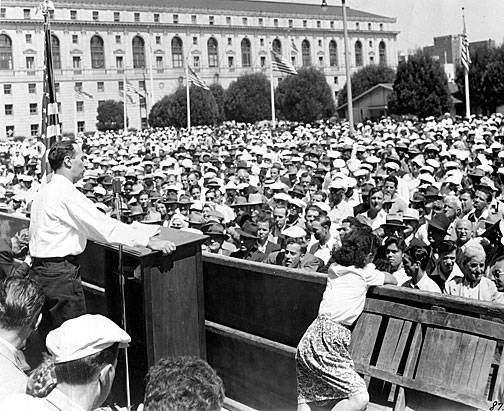
Labor Day Celebration, 1947, San Francisco

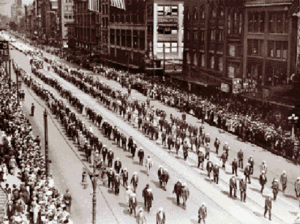
Happy Labor Day. To me this holiday seems little more than a historical anachronism - organized labor is blamed for corruption and demanding higher wages and more benefits than employers can afford. Workers are no longer praised or honored for their achievements in being the foundation of the nation's success. We ship jobs to nations with lower worker pay, little or no regulation, and do little to help the workers, mostly blue color, who are out of work.

We are no longer a nation of factories and mills - we are technological society and these jobs either require no skills (data entry), resulting in low pay, or they require advanced education, resulting in higher pay. Organized labor got fair pay for factory workers and skilled craftsmen (construction, electricians, plumbers, etc) but unions have been effectively banned from the technology world.

First Labor Day parade, 1882, New York City

While I am a supporter of organized labor (my father was a union member), I am also aware that labor leaders frequently have been corrupt, and sometimes have been unwilling to adapt their demands to realities of the workplace. I would hope to see labor make a comeback in this country, but more and more conservative states are making union organizing nearly impossible (including Arizona, where I live).

In honor of the holiday, Good Magazine takes a look at organized labor in the United States - we've seen better days.

State of the Unions: Organized Labor Has Seen Much Better Days

  • September 2, 2012

Lest we forget why we've got a three-day weekend, Labor Day is a recognition of American workers and what they've done for the country. Minyanville writes that the labor movement has seen significant decline in recent years, and checks in on a few specific labor unions. Here's an excerpt from the section on public sector workers: 
Last year the state of Wisconsin was ground zero for what many believe was the decline of American labor unions. The battle over collective bargaining between Wisconsin public sector workers and Governor Scott Walker that resulted in the passage of his anti-union “Wisconsin budget repair bill” last March didn’t just hit national headlines, it took the conversation of collective bargaining to the national stage and climaxed in the June 5 failed recall election of the governor.
The failed recall was seen by many as the beginning of the end for labor unions. On the same day, pension reforms for public sector workers were overwhelmingly favored in elections in San Jose and San Diego, supporting evidence from polls showing that public approval of unions was dropping. A 2009 Gallup poll found that only 48% of the public supported unions compared to 72% of Americans approving of unions in a 1936 Gallup poll.
Earlier this week, Business Insider's Henry Blodget posted this timely column titled "Dear American Companies: Here's How To Fix The Economy:"
In short, instead of viewing "shareholders" and "customers" as the only two corporate constituencies that matter, Ford introduced the idea that great companies should also serve a third constituency:
Employees.
And because one company's employees are another company's customers, Ford's decision (to dramatically increase wages) helped spread the country's wealth to more citizens and expand the purchasing power of the country as a whole. And, in so doing, it helped the overall economy.
So hey, while you're enjoying the weekend, remember that what you're celebrating is a major economic engine in the country, both past and present, and one that is facing quite a bit of tumult. Here's a brief primer on the history of Labor Day itself. Got any favorite labor-related reading? Share some recommendations in the comments—a few of us might celebrate by reading under a tree on Monday.

Photo, "Glass Works. Midnight," via Library of Congress.

Monday, July 30, 2012

Bookforum Omnivore - Why Marxism Is Making a Comeback

Another interesting set of links form Bookforum's Omnivore column (now appearing multiple times a day, instead of only three times), this time on the resurgence of Marxism in recent years.


Tuesday, March 20, 2012

Social Text - Special Issue on Speculation


Some interesting articles in this new issue of Social Text - all of the articles focused in some way on speculation. Here are links and abstracts for the articles.

Speculative Life: An Introduction

In our dystopian present, the term speculation is associated with an epistemology of greed, a sanctioned terrorism, and a new dimension of imperialism no longer based in production but in abstract futures. But speculation means something else for those who refuse to give its logic over to power and profit. >>
"What will you do when the apocalypse comes??" he asked me urgently. My first reaction was to laugh derisively. But a friend made me think twice. "Who knows, maybe he's right," she said. Then came the Tsunami that devastated South Asia in 2004. And the levees that breached during Hurricane Katrina in 2005. Who's to say what's real?>>
Science fictions never present the future, only "a significant distortion of the present," as Delany wrote in 1984. But they also distort the present of anyone reading at any time, even the text's own future. The contours of Dhalgren's disintegrating city belong to the wake of 1960s countercultures and social movements, to a sexual and racial moment whose history uninformed new generations of readers will learn as they read, even if they fail to recognize it. Sexual pleasure in Delany's work links the past and present and lets a different future feel possible, even when it takes place within structuring limitations. >>
Chinese-Canadian author Larissa Lai imaginatively interrogates the boundaries of the human, alchemizes myths of origin, and embraces the impurity of the cyborg while foregrounding the politics of racialization, animality, and sexuality. Lai builds on the rich tradition of women of color writing in sf/speculative fiction by splicing together cultural theory and current events with a panoply of intertexts. Traversing past, present, and future, Lai maps the permeability of the human through the vectors of animal, creator-goddess, cyborg, and transgenic procreation. Her distinctive métissage of Chinese legend, EuroAmerican culture, Orientalist archetypes, Western popular music, and science fiction disrupts cycles of institutionalized exploitation, corporatized amnesia, and multicultural assimilation.[1] Akin to the work of Octavia Butler, Karen Tei Yamashita, and Nalo Hopkinson, Lai's...>>
China Miéville is the recipient of multiple awards for his speculative/science/weird fiction novels, and the only author ever to win three Arthur C. Clarke Awards.  His most recent novel, Embassytown, came out in May 2011 and has received enthusiastic reviews. As well as writing fiction, Miéville earned his Ph.D. at London School of Economics in International Law and is the author of Between Equal Rights, A Marxist Theory of International Law (2006).      Known for his radical fictive speculation, China Miéville is also fiercely engaged with radical politics--he stood for the House of Commons as candidate for the Socialist Alliance in the 2001 UK general election--and so is often asked about the relationship between his politics and his writing. He...>>

Race for Life

The short film accompanying musician and designer M.I.A.'s (Maya Arulpragasam, who is British of Sri Lankan Tamil descent) song "Born Free" was released in April of 2010 and immediately banned from YouTube. Arulpragasam is no stranger to controversy, since she has drawn attention to the violence perpetrated against the Tamil minority in Sri Lanka, while her music and accompanying visual work is replete with references to different forms of political violence and identification with non-western persecuted populations.One of the few female artists in contemporary popular music that fuse explicit political content with cutting edge sounds, Arulpragasam has often been accused of toying with radical chic and being politically naïve, rather than associated with a long tradition of women of color...>>

So Say We All

Race is an illusion. So say we all! But what do we intend by this saying, this performative? Denise Ferreira da Silva is but the most recent of scholars to note that, in dispelling race from its improper place in the order of the human sciences, casting it into disrespectability along with sorcery, alchemy, and other bait for the credulous, we consolidate that much more firmly the protocols of scientific rationality. But the protocols of science gave us race as an invidious distinction in the first place. Reason giveth, and reason taketh away, seems to be the faith animating the claim "Race is an illusion." But what if were to suspend such faith in the subject of Enlightenment rationality? What...>>
When it comes to dealing with misfortune and injustice, the most effective tool to use if we want to make sure that troubles will persist without relief is a simple sentence: That's water under the bridge. No use crying over spilled milk. The past is over and done with. The goose is cooked. What's done is done.Whenever people have their attention called to injuries that occurred in the past, it is almost certain that someone will pipe up with a demand that everyone cut short the desire to improve the world and, instead, to defer to the water-under-the-bridge school of history.[1]There are is perhaps no better example of the water-under-the-bridge school of thought in the settler-colonial imagination, than Orson Scott...>>
The Natives should have died off by now. To still be alive is a miracle. Can you taste two billion year old air on your breath or the remnants of primordial seas in your sweat? Do you feel e-coli breaking bread in your bowels? Does your heart synch up with these words, these poetic echoes of ancient ancestors? Self and other, simultaneously...>>

Thursday, November 17, 2011

Changesurfer Radio - The Future of Democratic Equality

This is an interesting 2-part podcast from the folks at Institute for Ethics and Emerging Technologies (IEET). The host of Changesurfer Radio, Dr. James J. Hughes, speaks with Joseph Schwartz, author of The Future of Democratic Equality: Reconstructing Social Solidarity in a Fragmented United States. Yes, Schwartz is a Democratic Socialist - who knew such folks still existed in this jingoistic culture?


The Future of Democratic Equality pt1


Joseph Schwartz

Changesurfer Radio

Posted: Nov 15, 2011


Dr. J. chats with Joseph Schwartz, Professor of Political Science at Temple University and author of The Future of Democratic Equality: Reconstructing Social Solidarity in a Fragmented United States. Prof. Schwartz is a long-time leader in the Democratic Socialists of America, the largest American socialist organization. Part 1 of 2.


* * * * * * *

The Future of Democratic Equality pt2


Joseph Schwartz

Changesurfer Radio

Posted: Nov 15, 2011

Dr. J. chats with Joseph Schwartz, Professor of Political Science at Temple University and author of The Future of Democratic Equality: Reconstructing Social Solidarity in a Fragmented United States. Prof. Schwartz is a long-time leader in the Democratic Socialists of America, the largest American socialist organization. Part 2 of 2.

Saturday, October 29, 2011

Slavoj Zizek Interviewed (sort of) by Charlie Rose

Charlie Rose did the right thing for the most part and allowed the Slavoj Zizek to engage in his usual monologue - it would have been better if Rose would have simply allowed him to go - the few times Rose interrupted seemed like an effort to show his own intelligence or knowledge, which is always a bad thing in an interviewer.


Slovenian philosopher and critical theorist Slavoj Zizek on Occupy Wall Street, capitalism, Western culture and global politics - [Click the image above to go to the interview at Charlie Rose's site]

Tuesday, February 08, 2011

Notes on the Counter-Revolution by Stephen Eric Bronner

http://southtexas.tenthamendmentcenter.com/wp-content/uploads/2010/09/yin-yang.jpg

Interesting . . . .
You say you want a revolution
Well, you know
We all want to change the world
You tell me that it's evolution
Well, you know
We all want to change the world
But when you talk about destruction
Don't you know that you can count me out
Don't you know it's gonna be all right
all right, all right

~ "Revolution," The Beattles
STEPHEN ERIC BRONNER is Distinguished Professor (PII) of Political Science and the Senior Editor of Logos. His many works include Socialism Unbound (Columbia University Press) and Critical Theory: A Very Short Introduction (Oxford University Press)

Notes on the Counter-Revolution

by Stephen Eric Bronner

Counter-revolution has gripped the American imagination. Neo-Conservatism was the dominant ideological expression of the new millennium and the Tea Party is today on the march. They have roots in the beginnings of American history and, like their predecessors everywhere, they are the reaction against the prospect of radical — if not always — revolutionary change. Modernity is the crucible in which both counter-revolution and revolution were forged. Both make reference to a notion of progress that speaks not merely to the growth of capitalism but to the privileging of individuality, social equality and the liberal rule of law. There never was a true ideological consensus. Counter-revolution and revolution always provided fundamentally divergent responses to the constraint on arbitrary institutional power. The point for departure in theory and practice, indeed, was the burgeoning bourgeoisie of the 17th century that began an attack upon the ancient regime with coalitional support from other classes contemptuous of throne and altar. Partisans of this undertaking sought to substitute capitalism for feudal social relations, a republic for the monarchical state, and a new secular ideology for religious dogma. With its insistence upon individual enterprise and scientific innovation, the liberal rule of law and the assault upon traditional authority, scientific reason and moral autonomy, the Enlightenment crystallized what became known as the “age of democratic revolution.”

The crowning achievements of this enterprise were the three great democratic revolutions that occurred in England (1688), the United States (1776) and France (1789). All of them were predicated on the vision of a new constitutional order in which equal citizens of diverse background and different interests might determine their fate together peacefully under the liberal rule of law. Constitutionalism and suffrage rejected—in principle—the idea of individuals living without explicit human rights in a “community” bound together by land and custom. The principle, of course, did not instantly translate into fact and, thus, there began the long struggle for suffrage by excluded groups. All of their most important representatives -- from Mary Wollstonecraft to Martin Luther King, Jr. -- pointed to the implicit demands generated by universal ideals and the prejudiced society that denied them. It only makes sense that the formation of a liberal and secular order should have been welcomed not only by those Jews seeking entry into gentile society, but—what is so often forgotten— also by those seeking freedom from the theocracy of the provincial ghetto.

Read the whole article.


Friday, December 10, 2010

Michel Bauwens - How does the idea of p2p and the commons differ from the socialist tradition?

http://www.bsu.edu/libraries/lits/commons/digitalcommons.png

I've been meaning to post this for at least a week now - Michel Bauwens (P2P Foundation) makes a clear and important distinction between P2P/Commons and socialism - they are not the same things, even if they share some ideas and goals.

I'm sure that anyone firmly embedded in a capitalist/free market worldview would easily equate P2P/Commons thinking with socialism or communism - after all, those are seen as the only other options to capitalism.

How does the idea of p2p and the commons differ from the socialist tradition?

photo of Michel Bauwens
Michel Bauwens
30th November 2010

In the article for the Argentinian national daily “Pagina 12″, journalist Mariano Blejman writes that I equate open hardware with socialism. and this is also the message that is being retweeted.

This is not explicitely my position, so I’d like to take up the occasion to republish an earlier article on how our position is related to the historical movement of socialism.

What is the connection between the historical tradition of socialism/communism and the contemporary emergence of ideas and practices centered around p2p dynamics and the commons?

1. Let’s first tackle our understanding and interpretation of communism.

To me it is basically the idea, probably born at the same time as post-tribal class-based society, that an alternative human arrangement based on equal relationships and without the inheritance of wealth and privilege is possible. It is something that appears again and again in human history as an expression of those that are not privileged in the existing social arrangements.

A prominent example is of course the form of the Christian communities as described in the Act of the Apostles, but it is a recurring theme across history.

More importantly and recently, it became a driving idea of the labour movement that was born at the same time as industrial capitalism, and it would take various ideological and social forms, such as the utopian socialist experiments of the 19th century, the social-democratic labour movement that became dominant in Europe in the 20th century, the anarchist movements that flourished before WWII, etc …

Unfortunately, after the social revolution in Russia and its regression through isolation, it also became the ideology of a new ruling strata, which installed a new type of class society based on a managerial elite using state property, which used communism as an ideology to justify its oppression, much as the hierarchical and feudal Church would use the ideas of Christ to justify its own oppressive rule.

Today, the “idea” of communism is terminally contaminated with that historical experience of social oppression.

2. What about peer to peer?

Peer to peer is born from the generalization of the human experience of voluntary aggregation using the internet.

It is the experience of creating digital commons of knowledge, code and designs, based largely on voluntary contributions, and on making these universally available, has re-introduced the reality of communal shareholding to wide strata of the population.

But is also the particular social expression of the new condition of work under cognitive capitalism, where workers, after the long hiatus of industrial capitalism where they were totally dispossessed of access to productive resources and machinery, could again access a productive resource under their control, through computers, the socialized network that was the internet.

This generalized the experience of social practices that are characterized by open and free input, participatory processes of production, and commons-oriented output.

From the contract between this strong experience of equality and liberty (equaliberty) and the trans-individuality of being connected through affinity, the desire naturally grows to extend this experience to other areas of life.

From this, social movements are emerging that seek to extend the reach of this human experience.

The P2P Foundation, and the P2P Theory that we are trying to develop, is merely one of the expressions of this general trend, but perhaps one of the more ambitious ones since it aims not just to a partial implementation of the new value system and social practice (as the free software or free culture movements would attempt), but to its generalization across the board.

Go read the whole article - there are three more crucial points he makes.