Showing posts with label protests. Show all posts

Sunday, August 17, 2014

How Militarizing Police Can Increase Violence

http://i.dailymail.co.uk/i/pix/2014/08/12/1407835256853_Image_galleryImage_FERGUSON_MO_AUGUST_11_Pol.JPG

In Seattle, following the 1999 WTO protests, in which violence and riots were far too common, the police department increased their tactical response ability with military-style weapons, armor, and vehicles. Following the 9/11 attack in 2001, police departments, large and small, around the country were given surplus military gear to better equip them for possible future attacks.


The images above are from the last week in Ferguson, MO, where tactical officers were called in to help police clear protestors who had taken to the streets over the police shooting of Michael Brown.

Research over the years has shown that the presence of heavily armed police increases the rate of violence and the likelihood of violence:
a great deal of social-psychological research, as well as important anecdotal evidence from law-enforcement specialists themselves, suggests that militarized policing can greatly inflame situations that might otherwise end peacefully
One wonders if the events in Ferguson will be a wake-up for police departments to avoid the military and militaristic approach to protests.

How Militarizing Police Can Increase Violence

By Jesse SingalFollow @jessesingal


Long before the killing of Michael Brown and the subsequent protests in Ferguson, Missouri, which have brought with them countless images of heavily armored local authorities pointing guns at and firing tear gas and other nonlethal weapons at unarmed protesters, some were disturbed by what Washington Post journalist Radley Balko calls “the rise of the warrior cop” — that is, the increasing tendency of some local police forces to rely on military-style gear and tactics, even in situations that appear devoid of any real threat to officers’ safety.

The story of how this happened and the oftentimes tragic results have been well-told by Balko, the American Civil Liberties Union, and others. In short, there’s been a flood of drug-war and post-9/11 money that has helped outfit police departments, even towns where a single murder is an incredibly rare event, with gear that could help repel seasoned paramilitaries.

What’s less clear is how this gear changes the psychological dynamics of policing and crowd control. Is it true, as many people are arguing online, that “When you have a hammer, everything looks like a nail” — that is, that simply having military gear will make police more likely to act in an aggressive manner toward civilians? How does this change the relationship between police and civilians?

At the most specific level, these questions haven’t been studied empirically. But a great deal of social-psychological research, as well as important anecdotal evidence from law-enforcement specialists themselves, suggests that militarized policing can greatly inflame situations that might otherwise end peacefully.

The so-called “weapons effect” can partly explain what’s going on in Ferguson and elsewhere. The mere presence of weapons, in short, appears to prime more aggressive behavior. This has been shown in a variety of experiments in different lab and real-world settings.

“Theory underlying the weapons effect or similar kinds of phenomena would suggest that the more you fill the environment with stimuli that are associated with violence, the more likely violence is to occur,” said Bruce Bartholow, a University of Missouri social psychologist who has studied the weapons effect. Brad Bushman, a psychologist at Ohio State, agreed. “I would expect a bigger effect if you see military weapons than if you see normal weapons,” he said.

This isn’t just about a link between visual stimuli like guns and violence, however. It also has to do with the roles people adopt, with how they respond to the presence of others who may — or may not — mean them harm. To a certain extent, if you dress and treat people like soldiers facing a deadly enemy, they’ll act like it.

“This process isn't necessarily good or bad, but depends on the extent to which the more militaristic role fits the situation,” said Craig Anderson, a psychologist at Iowa State, in an email. “When it doesn't fit well, it is likely to lead to more judgment and behavior errors.” Maria Haberfeld, a professor at the John Jay College of Criminal Justice who has studied how police departments outfit themselves, said the dynamic could be particularly dangerous in the context of nonviolent protests like Ferguson (there was rioting and looting earlier this week, but there have also been widespread reports of nonviolent protests being broken up by police aggression).

“Military equipment is used against an enemy,” said Haberfeld. “So if you give the same equipment to local police, by default you create an environment in which the public is perceived as an enemy.” On the other side of these confrontations, this could have a negative effect on protesters. “We live in a democratic country, and we believe that this is our right to go out and exercise the right to [free speech],” she said. “And when you go out there and exercise that right and suddenly you are faced with soldiers — even though these are not soldiers, but police officers looking like soldiers — then something is triggered, definitely.”

Bushman said that meeting nonviolent protests with a militarized response is “really a bad idea. I can’t believe they’re doing it.” “It’s just really bad for the officers because they feel more powerful, more invincible, more militaristic, ready to attack,” he said. “And also, I think it elicits a response from the observers that, hey, this is war, and people become defensive and they have a fight/flight response.” The adoption of masks themselves in a militarized setting, on the part of police or protesters, can also contribute to violence by triggering senses of anonymity and what psychologists call deindividuation. "There's all kinds of evidence in social psychology that that will lead people to do things that they wouldn't do if they could be identified," said Bartholow.

All this militarization, said Bartholow, can be contrasted “against the old kind of beat-cop model where people in the neighborhood know the police officers’ name and he’s kind of everybody’s buddy in a sense.”

Gil Kerlikowske, the head of U.S. Customs and Border Protection and former police chief of Seattle, drew out this distinction in a striking recent interview with NPR’s Steve Inskeep. He explained that at the one-year anniversary of the damaging 1999 World Trade Organization riots, he took conscious steps to have his officers dressed like police rather than a counterinsurgency unit, which he said made it easier to deal with potentially dangerous crowds. But the police guild didn’t approve of this approach — its members wanted him to give the officers as much armor as possible.
INSKEEP: Kerlikowski paid attention [to the guild]. Though he came to wish he hadn't. The next time there were troublesome crowds it was Mardi Gras. Police did not go out in soft gear, they went out heavily protected. So, the cops felt safer but somehow the crowd became harder to control. Scores of people were injured as violence spread. Women were sexually assaulted. One man was killed as police watched.

KERLIKOWSKI: Well, to tell you the truth it makes it pretty difficult when you're talking from behind a face shield with a gas mask, to engage with the public and say, look let's tone this down, let's calm things down, let's make sure that those people that need to be apprehended are arrested because of their intoxicated state, their level of violence etc. It's pretty hard to engage in those discussions when you're hardened up. I regret that - today. I should've stuck by my decision earlier, I didn't.
Kerlikowski, Haberfeld, and other law enforcement seem to have developed an intuitive understanding of the psychological effects of police militarization. But that may not matter, because all this surplus military gear isn’t going away — $450 million of it was distributed to police in 2013 alone. So even after things calm down in Ferguson, we’ll still be in the midst of a sweeping, potentially dangerous experiment in social psychology and criminology.

“Even in my small midwestern town, the police no longer drive a standard police cruiser,” Bartholow said. “They drive these kind of big SUVs — they almost look like military humvees, and they’re more intimidating looking.”

Tuesday, November 06, 2012

We Are Legion: The Story of the Hacktivists


Here is a little alternative viewing for this election day, courtesy of Documentary Heaven.


We Are Legion: The Story of the Hacktivists

"We Are Legion: The Story of the Hacktivists” is a documentary that takes us inside the world of Anonymous, the radical “hacktivist” collective that has redefined civil disobedience for the digital age. The film explores the historical roots of early hacktivist groups like Cult of the Dead Cow and Electronic Disturbance Theater and then follows Anonymous from 4chan to a full-blown movement with a global reach, one of the most transformative of our time.

Saturday, January 21, 2012

Bookforum - What Has Happened to Occupy Wall Street?


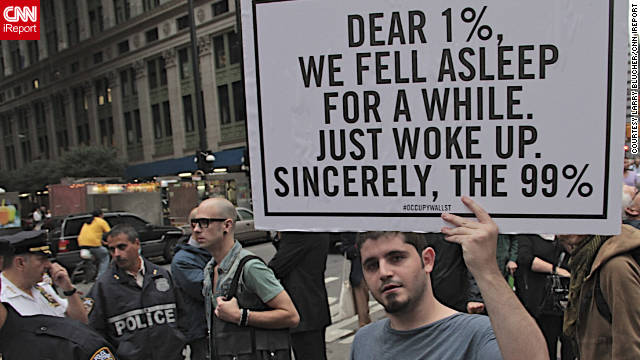
Occupy Wall Street, and all its local manifestations, has fallen off the media radar in recent weeks and months. America's short attention span is partly to blame (or at least the media's encouragement of it), but there was also the movement's own tendency toward hippie extravagance (hacky sack, Frisbee, drugs, and other nonsense).

But the people who really care about change, who want to make a more equitable system, have been continuing the work behind the scenes. This collection of articles - assembled by Bookforum - checks in with where the movement is now.

What has happened to Occupy Wall Street?

JAN 19 2012 9:00AM


Wednesday, December 14, 2011

Time's Person of the Year: The Protester

Time magazine has named it's annual person of the year, and after the Arab Spring and the Occupy movements, they have chosen The Protester as the Person of the Year for 2011.

The Protester


"Mohammed suffered a lot. He worked hard. But when he set fire to himself, it wasn't about his scales being confiscated. It was about his dignity." —Mannoubia Bouazizi, Tunisia
Photograph by Peter Hapak for TIME

Once upon a time, when major news events were chronicled strictly by professionals and printed on paper or transmitted through the air by the few for the masses, protesters were prime makers of history. Back then, when citizen multitudes took to the streets without weapons to declare themselves opposed, it was the very definition of news — vivid, important, often consequential. In the 1960s in America they marched for civil rights and against the Vietnam War; in the '70s, they rose up in Iran and Portugal; in the '80s, they spoke out against nuclear weapons in the U.S. and Europe, against Israeli occupation of the West Bank and Gaza, against communist tyranny in Tiananmen Square and Eastern Europe. Protest was the natural continuation of politics by other means.

And then came the End of History, summed up by Francis Fukuyama's influential 1989 essay declaring that mankind had arrived at the "end point of ... ideological evolution" in globally triumphant "Western liberalism." The two decades beginning in 1991 witnessed the greatest rise in living standards that the world has ever known. Credit was easy, complacency and apathy were rife, and street protests looked like pointless emotional sideshows — obsolete, quaint, the equivalent of cavalry to mid-20th-century war. The rare large demonstrations in the rich world seemed ineffectual and irrelevant. (See the Battle of Seattle, 1999.)

There were a few exceptions, like the protests that, along with sanctions, helped end apartheid in South Africa in 1994. But for young people, radical critiques and protests against the system were mostly confined to pop-culture fantasy: "Fight the Power" was a song on a platinum-selling album, Rage Against the Machine was a platinum-selling band, and the beloved brave rebels fighting the all-encompassing global oppressors were just a bunch of characters in The Matrix.

(See pictures of protesters around the world.)

"Massive and effective street protest" was a global oxymoron until — suddenly, shockingly — starting exactly a year ago, it became the defining trope of our times. And the protester once again became a maker of history.

Prelude to the Revolutions
It began in Tunisia, where the dictator's power grabbing and high living crossed a line of shamelessness, and a commonplace bit of government callousness against an ordinary citizen — a 26-year-old street vendor named Mohamed Bouazizi — became the final straw. Bouazizi lived in the charmless Tunisian town of Sidi Bouzid, 125 miles south of Tunis. On a Friday morning almost exactly a year ago, he set out for work, selling produce from a cart. Police had hassled Bouazizi routinely for years, his family says, fining him, making him jump through bureaucratic hoops. On Dec. 17, 2010, a cop started giving him grief yet again. She confiscated his scale and allegedly slapped him. He walked straight to the provincial-capital building to complain and got no response. At the gate, he drenched himself in paint thinner and lit a match.

(See pictures of Sidi Bouzid.)

"My son set himself on fire for dignity," Mannoubia Bouazizi told me when I visited her.

"In Tunisia," added her 16-year-old daughter Basma, "dignity is more important than bread."

In Egypt the incitements were a preposterously fraudulent 2010 national election and, as in Tunisia, a not uncommon act of unforgivable brutality by security agents. In the U.S., three acute and overlapping money crises — tanked economy, systemic financial recklessness, gigantic public debt — along with ongoing revelations of double dealing by banks, new state laws making certain public-employee-union demands illegal and the refusal of Congress to consider even slightly higher taxes on the very highest incomes mobilized Occupy Wall Street and its millions of supporters. In Russia it was the realization that another six (or 12) years of Vladimir Putin might not lead to greater prosperity and democratic normality.

In Sidi Bouzid and Tunis, in Alexandria and Cairo; in Arab cities and towns across the 6,000 miles from the Persian Gulf to the Atlantic Ocean; in Madrid and Athens and London and Tel Aviv; in Mexico and India and Chile, where citizens mobilized against crime and corruption; in New York and Moscow and dozens of other U.S. and Russian cities, the loathing and anger at governments and their cronies became uncontainable and fed on itself.

The stakes are very different in different places. In North America and most of Europe, there are no dictators, and dissidents don't get tortured. Any day that Tunisians, Egyptians or Syrians occupy streets and squares, they know that some of them might be beaten or shot, not just pepper-sprayed or flex-cuffed. The protesters in the Middle East and North Africa are literally dying to get political systems that roughly resemble the ones that seem intolerably undemocratic to protesters in Madrid, Athens, London and New York City. "I think other parts of the world," says Frank Castro, 53, a Teamster who drives a cement mixer for a living and helped occupy Oakland, Calif., "have more balls than we do."

In Egypt and Tunisia, I talked with revolutionaries who were M.B.A.s, physicians and filmmakers as well as the young daughters of a provincial olive picker and a supergeeky 29-year-old Muslim Brotherhood member carrying a Tigger notebook. The Occupy movement in the U.S. was set in motion by a couple of magazine editors — a 69-year-old Canadian, a 29-year-old African American — and a 50-year-old anthropologist, but airline pilots and grandmas and shop clerks and dishwashers have been part of the throngs.
Read more: There are many more pages in the story.

Thursday, November 17, 2011

Chris Hedges - This Is What Revolution Looks Like

From Truthout, Chris Hedges gets up on his soapbox and preaches to the (liberal) masses who are watching the #OWS crowds and wondering what all the fuss is about. After all, they are all mostly boomers now and they had REAL protests back in the 1960s, about wars and shit.

Okay, so maybe that is just my "reframe" of his article . . . .

This Is What Revolution Looks Like

Posted on Nov 15, 2011
AP / Seth Wenig

Occupy Wall Street protesters rally in a small park on Canal Street in New York on Tuesday.

Welcome to the revolution. Our elites have exposed their hand. They have nothing to offer. They can destroy but they cannot build. They can repress but they cannot lead. They can steal but they cannot share. They can talk but they cannot speak. They are as dead and useless to us as the water-soaked books, tents, sleeping bags, suitcases, food boxes and clothes that were tossed by sanitation workers Tuesday morning into garbage trucks in New York City. They have no ideas, no plans and no vision for the future.

Our decaying corporate regime has strutted in Portland, Oakland and New York with their baton-wielding cops into a fool’s paradise. They think they can clean up “the mess”—always employing the language of personal hygiene and public security—by making us disappear. They think we will all go home and accept their corporate nation, a nation where crime and government policy have become indistinguishable, where nothing in America, including the ordinary citizen, is deemed by those in power worth protecting or preserving, where corporate oligarchs awash in hundreds of millions of dollars are permitted to loot and pillage the last shreds of collective wealth, human capital and natural resources, a nation where the poor do not eat and workers do not work, a nation where the sick die and children go hungry, a nation where the consent of the governed and the voice of the people is a cruel joke.

Get back into your cages, they are telling us. Return to watching the lies, absurdities, trivia and celebrity gossip we feed you in 24-hour cycles on television. Invest your emotional energy in the vast system of popular entertainment. Run up your credit card debt. Pay your loans. Be thankful for the scraps we toss. Chant back to us our phrases about democracy, greatness and freedom. Vote in our rigged political theater. Send your young men and women to fight and die in useless, unwinnable wars that provide corporations with huge profits. Stand by mutely as our bipartisan congressional supercommittee, either through consensus or cynical dysfunction, plunges you into a society without basic social services including unemployment benefits. Pay for the crimes of Wall Street.

The rogues’ gallery of Wall Street crooks, such as Lloyd Blankfein at Goldman Sachs, Howard Milstein at New York Private Bank & Trust, the media tycoon Rupert Murdoch, the Koch brothers and Jamie Dimon at JPMorgan Chase & Co., no doubt think it’s over. They think it is back to the business of harvesting what is left of America to swell their personal and corporate fortunes. But they no longer have any concept of what is happening around them. They are as mystified and clueless about these uprisings as the courtiers at Versailles or in the Forbidden City who never understood until the very end that their world was collapsing. The billionaire mayor of New York, enriched by a deregulated Wall Street, is unable to grasp why people would spend two months sleeping in an open park and marching on banks. He says he understands that the Occupy protests are “cathartic” and “entertaining,” as if demonstrating against the pain of being homeless and unemployed is a form of therapy or diversion, but that it is time to let the adults handle the affairs of state. Democratic and Republican mayors, along with their parties, have sold us out. But for them this is the beginning of the end.

The historian Crane Brinton in his book “Anatomy of a Revolution” laid out the common route to revolution. The preconditions for successful revolution, Brinton argued, are discontent that affects nearly all social classes, widespread feelings of entrapment and despair, unfulfilled expectations, a unified solidarity in opposition to a tiny power elite, a refusal by scholars and thinkers to continue to defend the actions of the ruling class, an inability of government to respond to the basic needs of citizens, a steady loss of will within the power elite itself and defections from the inner circle, a crippling isolation that leaves the power elite without any allies or outside support and, finally, a financial crisis. Our corporate elite, as far as Brinton was concerned, has amply fulfilled these preconditions. But it is Brinton’s next observation that is most worth remembering. Revolutions always begin, he wrote, by making impossible demands that if the government met would mean the end of the old configurations of power. The second stage, the one we have entered now, is the unsuccessful attempt by the power elite to quell the unrest and discontent through physical acts of repression.

I have seen my share of revolts, insurgencies and revolutions, from the guerrilla conflicts in the 1980s in Central America to the civil wars in Algeria, the Sudan and Yemen, to the Palestinian uprising to the revolutions in East Germany, Czechoslovakia and Romania as well as the wars in the former Yugoslavia. George Orwell wrote that all tyrannies rule through fraud and force, but that once the fraud is exposed they must rely exclusively on force. We have now entered the era of naked force. The vast million-person bureaucracy of the internal security and surveillance state will not be used to stop terrorism but to try and stop us.

Despotic regimes in the end collapse internally. Once the foot soldiers who are ordered to carry out acts of repression, such as the clearing of parks or arresting or even shooting demonstrators, no longer obey orders, the old regime swiftly crumbles. When the aging East German dictator Erich Honecker was unable to get paratroopers to fire on protesting crowds in Leipzig, the regime was finished. The same refusal to employ violence doomed the communist governments in Prague and Bucharest. I watched in December 1989 as the army general that the dictator Nicolae Ceausescu had depended on to crush protests condemned him to death on Christmas Day. Tunisia’s Ben Ali and Egypt’s Hosni Mubarak lost power once they could no longer count on the security forces to fire into crowds.

The process of defection among the ruling class and security forces is slow and often imperceptible. These defections are advanced through a rigid adherence to nonviolence, a refusal to respond to police provocation and a verbal respect for the blue-uniformed police, no matter how awful they can be while wading into a crowd and using batons as battering rams against human bodies. The resignations of Oakland Mayor Jean Quan’s deputy, Sharon Cornu, and the mayor’s legal adviser and longtime friend, Dan Siegel, in protest over the clearing of the Oakland encampment are some of the first cracks in the edifice. “Support Occupy Oakland, not the 1% and its government facilitators,” Siegel tweeted after his resignation.

There were times when I entered the ring as a boxer and knew, as did the spectators, that I was woefully mismatched. Ringers, experienced boxers in need of a tuneup or a little practice, would go to the clubs where semi-pros fought, lie about their long professional fight records, and toy with us. Those fights became about something other than winning. They became about dignity and self-respect. You fought to say something about who you were as a human being. These bouts were punishing, physically brutal and demoralizing. You would get knocked down and stagger back up. You would reel backward from a blow that felt like a cement block. You would taste the saltiness of your blood on your lips. Your vision would blur. Your ribs, the back of your neck and your abdomen would ache. Your legs would feel like lead. But the longer you held on, the more the crowd in the club turned in your favor. No one, even you, thought you could win. But then, every once in a while, the ringer would get overconfident. He would get careless. He would become a victim of his own hubris. And you would find deep within yourself some new burst of energy, some untapped strength and, with the fury of the dispossessed, bring him down. I have not put on a pair of boxing gloves for 30 years. But I felt this twinge of euphoria again in my stomach this morning, this utter certainty that the impossible is possible, this realization that the mighty will fall.


Tuesday, November 15, 2011

Bookforum - Occupying the Nation

Just in case you have not been exposed to enough different perspectives on the #OWS movement, here are some more, via Bookforum. I'm curious to see if this will turn into an action other than protesting - but I don't see big business caving to few thousand protesters, especially with the police and the government mostly siding with Wall Street and the status quo. But, I am a pessimist when it comes to meaningful change.

Occupying the nation


From the latest issue of Logos, Christine Kelly on Generation Threat: Why the youth of America are occupying the nation; and a special section on the Occupy Wall Street movement, with essays by Stanley AronowitzBenjamin Barber,Stephen Eric BronnerJeff MadrickRichard Wolin, and more. From Harper's, an interview with Slavoj Zizek. What would Emma do? An interview with Vivian Gornick, author of Emma Goldman: Revolution As a Way of Life, on the psychology of radicals and the OWS protests. From the John Birch Society's The New American, Jack Kerwick on two libertarianisms and OWS. Is the Vatican about to Occupy Wall Street? Peter Berger wonders. Jeff Sharlet on how the OWS movement discovered its bliss. The all-consuming presidential election season looms — how will Occupy respond? Tom Joad on why the 100% should support the Occupy movement. Sarah Leonard on OWS and the downfall of the smartest guys in the room. Whatever happened to discipline and hard work? America’s traditional, pro-wealth cultural vision is showing wear and tear, which may explain why criticisms made by OWS protesters have resonance. Kids Today: OWS is part of a major shift in ethical behavior among young people. Occupy Your Block: Protest without ever stepping foot in Zuccotti Park. A look at how the Occupy movement is inspiring unions to embrace bold tactics. Jeffrey Sachs on the new progressive movement: As before in history, the moment has arrived when people just can’t take it anymore. Will Occupy Wall Street lead to a new culture war? Arthur Brisbane on how OWS has proved to be a difficult, sprawling story to report. An article on Occupy Wall Street as a source of diverse editorial content. The branding of OWS: The director of the first Occupy TV ads talks to Salon about the battle over the protest movement's brand. Meet the ad men behind Occupy Wall Street.

Saturday, November 12, 2011

#OWS Teach-In with Douglas Rushkoff

Rushkoff seems to be transforming from a popular author to an activism leader - a Gen X Ralph Nader, only smarter and more aware. Glad to see it, we need someone like him.

OWS Teach-In with Douglas Rushkoff
by Douglas Rushkoff


OWS Teach-In with Douglas Rushkoff from Douglas Rushkoff on Vimeo.


Footage by the Life Inc. media crew.

Wednesday, November 09, 2011

Ian Leslie Argues that Crowds Can Bring Out the Best in People

Popular wisdom, and a series of social psychology studies from the 1960s and 1970s, has it that good people can do seriously bad things when caught up in a crowd mentality. There is some truth to that - we've seen it riots and Oakland Raiders football fans.

But Ian Leslie argues, in this article from More Intelligent Life, that crowds are not always bad - the nonviolent protests in Egypt that brought down an authoritarian government are evidence that nonviolent crowds are possible and that they can bring change.

CROWDS R US

crowds.jpg
After this summer’s riots in England, crowd behaviour got a kicking. Ian Leslie argues that it was undeserved ...
From INTELLIGENT LIFE magazine, November/December 2011
Shortly after the popular uprising that led to the establishment of the Paris Commune in 1871, the politician Georges Clemenceau recalled witnessing a riot: “Suddenly a terrific noise broke out, and the mob which filled the courtyard burst into the street in the grip of some kind of frenzy…All were shrieking like wild beasts without realising what they were doing.” For those who followed the English riots of 2011, the terms are familiar. On television, in newspapers and comment threads, the rioters were repeatedly likened to animals in the grip of a primitive frenzy, induced not by drink or drugs but by another culprit: the crowd.
Crowds, we are often told, are dumb. They obliterate reason, sentience and accountability, turning individuals into helpless copycats. Commentators on the riots offered different explanations but most agreed that crowd psychology was part of the problem. “The dominant trait of the crowd is to reduce its myriad individuals to a single, dysfunctional persona,” wrote the novelist Will Self in theNew Statesman. “The crowd is stupider than the averaging of its component minds.” The violence was said to have spread like a “contagion” through the crowd, facilitated by social media. For those who wanted to sound scientific, the term to drop was “deindividuation”: the loss of identity and moral responsibility that can occur in a group. But do crowds really make us more stupid?
Earlier this year, the world watched a crowd bring down an autocratic government, by the simple act of coming together in one place, day after day, night after night. Egyptian protesters created a micro-society in Tahrir Square, organising garbage collection, defending themselves when they needed to, but otherwise ensuring the protest remained peaceful. As well as courage, this took intelligence, discipline and restraint. Few international observers accused the crowd in Tahrir Square of being dysfunctional, or of turning its members into animals. The Tahrir protesters also used social media, but rather than calling for a ban, as some in Britain did after the riots, people wrote eulogies to the liberating potential of Twitter. It seems that not all crowds are bad. But when bad things happen, the crowd gets the blame.
Consciously or otherwise, Self and others are echoing the French intellectual, and contemporary of Clemenceau, Gustave Le Bon. In 1896 Le Bon published the most influential book ever written about crowds, “The Crowd: A Study of the Popular Mind”. “By the mere fact that he forms part of an organised crowd,” Le Bon argued, “a man descends several rungs in the ladder of civilisation. Isolated, he may be a cultivated individual; in a crowd, he is a barbarian.” Le Bon was the Malcolm Gladwell of his day, a populariser of scientific thought with an acute feel for the Zeitgeist. His equivalent of Gladwell’s “tipping point” was “the law of the mental unity of crowds”. It was a scientific-sounding articulation of an old idea: crowds have a mind of their own, under which individuality is submerged and rationality destroyed.
Le Bon’s book hit a cultural nerve: a phrase of his, the “era of crowds”, stuck to the late 19th century. Europe’s cities had grown and industrialised fast, creating a vast and unruly class of people who had a nasty habit of coming together in public places to demand things. In Paris riots had threatened and sometimes overturned the established order for the last hundred years. Le Bon was a conservative, distrustful of fashionable democratic ideas. Like other members of the French middle class, when he saw a crowd he smelt only trouble. It’s hardly surprising that he would characterise the people in them as sub-human.
What is surprising is that we seem to have inherited his prejudices. John Drury, a psychologist at Sussex university who studies crowd behaviour, believes that the idea that crowds induce irrational behaviour and erase individuality just isn’t supported by the evidence. First, most crowds aren’t violent. The crowd in the shopping mall or at a music festival is usually calm and ordered. Even crowds that include conflicting groups, as at football matches, are more likely to be peaceful than not. Second, even when crowds do turn violent, they aren’t necessarily irrational. In the 18th century England was afflicted by food riots. If ever there was an atavistic reason to riot, that was surely it. But the historian E.P. Thompson showed that the riots took place not when food was at its most scarce but when people saw merchants selling grain at a steep profit; the rioters were motivated by a rational sense of injustice rather than the “animal” drive of hunger.
The Le Bon way of thinking about crowds matches the popular perception of crowd disasters, too—we tend to assume the worst of those involved. The people of Liverpool have spent years correcting the unfounded characterisation of those involved in the Hillsborough disaster as mindless thugs. In 1979, at a concert in Cincinnati headlined by The Who, 11 people were crushed to death as fans lined up to enter the stadium. The press described a “surging, primitive mob” comprised of “barbarians” and quoted a security guard who said, “These kids were acting like animals.” But a subsequent study based on other eyewitness interviews found that, rather than engaging in a crazed stampede to get the best seats, crowd members had attempted to help each other escape the crush as soon as they realised it was happening. In fact, the problem in such situations is almost always one of physics, rather than morality; a little pushing can create shock waves that ripple through a crowd, exerting ferocious pressure on those unfortunate enough to be caught in the most tightly packed areas or up against a hard object, like the Who fans closest to the locked doors, or the Liverpool supporters nearest the barrier.
Crowds can change the way people behave. There is a difference between what you might call an accidental crowd, as in a railway station, and an organised crowd: people brought together by a shared purpose—supporting a team, overthrowing a despot. Being a part of such a crowd can lead you to do things you wouldn’t normally do and might even disapprove of in normal circumstances: chant, swear at a referee, bellow the chorus to Robbie Williams’s “Angels”. But that’s not to say that the persona you adopt in this context isn’t “you” or that it’s irrational to take part in crowd rituals (in a crowd of Barcelona supporters, the irrational thing to do would be to cheer on Real Madrid). When an accountant plays air guitar at a concert, he isn’t giving up his identity so much as finding a neglected corner of it. Above all, he is enjoying the glorious sensation of feeling part of something bigger than himself.
An accidental crowd can become an organised one in response to an external threat. Passengers on the Piccadilly line who left King’s Cross at 8.50am on July 7th 2005 would have felt little in common with each other, bar the tetchiness of the commuter. But when the carriage exploded and the survivors realised they had been attacked, they performed heroic acts to save the lives of strangers they had just been ignoring. The Tahrir Square crowd included supporters from Cairo’s leading soccer teams, Al-Ahly and Al-Zamalek. The two groups have a longstanding post-match tradition of vicious fighting. Yet in Tahrir Square they stood together against Mubarak’s thugs. Crowds are as likely to bring out the best in us as the worst.
Ian Leslie juggles two careers: advertising and writing. His most recent book is "Born Liars". His last piece for More Intelligent Life was "Are artists liars?"
Picture credit: Lorianne DiSabato (via Flickr)

Tuesday, November 01, 2011

Of American Revolutionaries and American Occupiers - Or . . . We Are All Occupiers Now

Bookforum posted two big collections of links yesterday on the #occupy movements - from a wide spectrum of perspectives. Some of it is not new here (Zizek on Charlie Rose), but much of it is new. Enjoy picking through the links to find the good stuff.

Everything you need to know about Occupy Wall Street: David Weigel and Lauren Hepler on a timeline of the movement, from February to today. David Graeber, the anti-leader of Occupy Wall Street: How the anthropologist, activist, and anarchist helped transform a hapless rally into a global protest movement. Dahlia Lithwick on how OWS confuses and ignores Fox News and the pundit class. Occupy and Evolve: Kelly Heresy has been with OWS since Day 1 and was part of the first group to live and work in Liberty Plaza. Matt Taibbi on how Wall Street isn't winning — it's cheating. We are all Occupiers now: Katha Pollitt on the mainstreaming of OWS. Alex Aums and James Broulard on the strange case of #OccupyPhoenix and the search for civic life in the exurbs. The newspaper of Occupy London, The Occupied Times of London, has been launched. Meet the 0.01 Percent: War profiteers. It really, really is 99 vs. 1. Charlie Rose interviews Slavoj Zizek. Democracy is the enemy: Slavoj Zizek on how, so far, the protesters have done well to avoid exposing themselves to the criticism that Lacan levelled at the students of '68 (and more). The stunning victory that OWS has already achieved: In just one month, the protesters have shifted the national dialogue from a relentless focus on the deficit to a discussion of the real issues facing Main Street. How Paul Ryan tried to answer the supercommittee and OWS protesters at the same time. An interview with Doug Henwood on the socially useless Wall Street class. David Harvey on how the party of Wall Street meets its nemesis. "I Am Wall Street": Here is a samizdat anti-Occupy one-pager, first found at Occupy Chicago. Gotcha interviewer portrays OWS as drug-addled farce. Don't diss the drum circles: Danny Goldberg writes in defense of hippies. We’re hoping General Assembly votes MC Moneypenney’s hot new single to be the official anthem of Occupy Wall Street. Here is sex advice from Occupy Wall Street protesters.

* * * * * * *

The latest issue of The Occupied Wall Street Journal is out. Justin Elliot on the future of Occupy: Four key questions. Amy Dean on OWS and America’s democratic tradition. Objecting or objectified? At Occupy Wall Street women get attention, but not always for their message. Jonathan Topaz on why Occupy Wall Street isn’t particularly revolutionary. What would James Madison do: Would the framers support the OWS movement? How to deal with the police is a point of dispute between Social Democratic Anarchists and Communist Anarchists. Occupy Judaism: The Jews who held a Yom Kippur service at OWS were upholding an American tradition of invoking religion to spur progressive action. The Occupy movement is the latest example of the impact radical action and ideas can have when the system is weak. A look at what the #OccupyTogether encampments can teach society about sustainability. It’s not a hippie thing: Don’t be fooled by the drum circles — today’s protests have more in common with the anti-Hoover 1930s than the antiwar ’60s and ’70s (and more). Jennifer Mercieca writes of American revolutionaries and American occupiers. It has been quite some time after Georges Sorel has proposed the idea of General Strike: Irakli Zurab Kakabadze on OWS and a polyphonic general strike. The 99 Percenters have brought their protest to the Navy. The Vatican confounds conservatives: Will we soon see a distinguished-looking older man in long white robes walking among the OWS demonstrators in Zuccotti Park? From Tea Party Review, here is a conservative lesson from Occupy Wall Street. The American Society for the Defense of Tradition, Family and Property “occupies” 7,500 public squares — and goes unreported; and John Ritchie on what he saw at Occupy Wall Street. From the Mises Institute, George Reisman writes in praise of the capitalist 1 percent; and Llewellyn Rockwell on how the state is the 1 percent. Get a Job! Working is (usually) more admirable than protesting.

Saturday, October 29, 2011

Slavoj Zizek Interviewed (sort of) by Charlie Rose

Charlie Rose did the right thing for the most part and allowed the Slavoj Zizek to engage in his usual monologue - it would have been better if Rose would have simply allowed him to go - the few times Rose interrupted seemed like an effort to show his own intelligence or knowledge, which is always a bad thing in an interviewer.


Slovenian philosopher and critical theorist Slavoj Zizek on Occupy Wall Street, capitalism, Western culture and global politics - [Click the image above to go to the interview at Charlie Rose's site]

Friday, October 28, 2011

Slavoj Žižek - Occupy first. Demands come later

In The Guardian UK, philosopher and social critic Slavoj Žižek offers some advice for the #occupywallstreet movement - he advises them (us) not to fall into some quick definition of purpose, citing Bill Clinton's suggestion that the #OWS movement get behind Obama's job plan so as to be for something rather than against the system as it currently operates.

He also addresses and refutes the conservative attacks on the protesters as un-American, as violent, as communists, as dreamers, as losers - all simple-minded ways to discredit the sense of fairness that gave rise to the cause.

And returning to the main point, they should also be wary of false friends who will try to dilute their motives and energy:
What one should resist at this stage is precisely such a quick translation of the energy of the protest into a set of concrete pragmatic demands. Yes, the protests did create a vacuum – a vacuum in the field of hegemonic ideology, and time is needed to fill this vacuum in a proper way, as it is a pregnant vacuum, an opening for the truly new.
Here is the whole article:

Occupy first. Demands come later

Critics say the Occupy cause is nebulous. Protesters will need to address what comes next – but beware a debate on enemy turf
Occupy protester
'The protesters should fall in love with hard and patient work – they are the beginning, not the end.' Photograph: Timothy A Clary/AFP/Getty Images
What to do after the occupations of Wall Street and beyond – the protests that started far away, reached the centre and are now, reinforced, rolling back around the world? One of the great dangers the protesters face is that they will fall in love with themselves. In a San Francisco echo of the Wall Street occupation this week, a man addressed the crowd with an invitation to participate as if it was a happening in the hippy style of the 60s: "They are asking us what is our programme. We have no programme. We are here to have a good time."
Carnivals come cheap – the true test of their worth is what remains the day after, how our normal daily life will be changed. The protesters should fall in love with hard and patient work – they are the beginning, not the end. Their basic message is: the taboo is broken; we do not live in the best possible world; we are allowed, obliged even, to think about alternatives.
In a kind of Hegelian triad, the western left has come full circle: after abandoning the so-called "class struggle essentialism" for the plurality of anti-racist, feminist, and other struggles, capitalism is now clearly re-emerging as the name of the problem. So the first lesson to be taken is: do not blame people and their attitudes. The problem is not corruption or greed, the problem is the system that pushes you to be corrupt. The solution is not "Main Street, not Wall Street", but to change the system where Main Street cannot function without Wall Street.
There is a long road ahead, and soon we will have to address the truly difficult questions – not questions of what we do not want, but about what we do want. What social organisation can replace the existing capitalism? What type of new leaders do we need? What organs, including those of control and repression? The 20th-century alternatives obviously did not work.
While it is thrilling to enjoy the pleasures of the "horizontal organisation" of protesting crowds with egalitarian solidarity and open-ended free debates, we should also bear in mind what GK Chesterton wrote: "Merely having an open mind is nothing; the object of opening the mind, as of opening the mouth, is to shut it again on something solid." This holds also for politics in times of uncertainty: the open-ended debates will have to coalesce not only in some new master-signifiers, but also in concrete answers to the old Leninist question, "What is to be done?"
The direct conservative attacks are easy to answer. Are the protests un-American? When conservative fundamentalists claim that America is a Christian nation, one should remember what Christianity is: the Holy Spirit, the free egalitarian community of believers united by love. It is the protesters who are the Holy Spirit, while on Wall Street pagans worship false idols.
Are the protesters violent? True, their very language may appear violent (occupation, and so on), but they are violent only in the sense in which Mahatma Gandhi was violent. They are violent because they want to put a stop to the way things are – but what is this violence compared with the violence needed to sustain the smooth functioning of the global capitalist system?
They are called losers – but are the true losers not there on Wall Street, who received massive bailouts? They are called socialists – but in the US, there already is socialism for the rich. They are accused of not respecting private property – but the Wall Street speculations that led to the crash of 2008 erased more hard-earned private property than if the protesters were to be destroying it night and day – just think of thousands of homes repossessed.
They are not communists, if communism means the system that deservedly collapsed in 1990 – and remember that communists who are still in power run today the most ruthless capitalism. The success of Chinese communist-run capitalism is an ominous sign that the marriage between capitalism and democracy is approaching a divorce. The only sense in which the protesters are communists is that they care for the commons – the commons of nature, of knowledge – which are threatened by the system.
They are dismissed as dreamers, but the true dreamers are those who think things can go on indefinitely the way they are, just with some cosmetic changes. They are not dreamers; they are the awakening from a dream that is turning into a nightmare. They are not destroying anything, but reacting to how the system is gradually destroying itself. We all know the classic scene from cartoons: the cat reaches a precipice but goes on walking; it starts to fall only when it looks down and notices the abyss. The protesters are just reminding those in power to look down.
This is the easy part. The protesters should beware not only of enemies, but also of false friends who pretend to support them but are already working hard to dilute the protest. In the same way we get coffee without caffeine, beer without alcohol, ice-cream without fat, those in power will try to make the protests into a harmless moralistic gesture.
In boxing, to clinch means to hold the opponent's body with one or both arms in order to prevent or hinder punches. Bill Clinton's reaction to the Wall Street protests is a perfect case of political clinching. Clinton thinks that the protests are "on balance … a positive thing", but he is worried about the nebulousness of the cause: "They need to be for something specific, and not just against something because if you're just against something, someone else will fill the vacuum you create," he said. Clinton suggested the protesters get behind President Obama's jobs plan, which he claimed would create "a couple million jobs in the next year and a half".
What one should resist at this stage is precisely such a quick translation of the energy of the protest into a set of concrete pragmatic demands. Yes, the protests did create a vacuum – a vacuum in the field of hegemonic ideology, and time is needed to fill this vacuum in a proper way, as it is a pregnant vacuum, an opening for the truly new.
The reason protesters went out is that they had enough of the world where recycling your Coke cans, giving a couple of dollars to charity, or buying a cappuccino where 1% goes towards developing world troubles, is enough to make them feel good. After outsourcing work and torture, after the marriage agencies started to outsource even our dating, they saw that for a long time they were also allowing their political engagements to be outsourced – and they want them back.
The art of politics is also to insist on a particular demand that, while thoroughly "realist", disturbs the very core of the hegemonic ideology: ie one that, while definitely feasible and legitimate, is de facto impossible (universal healthcare in the US was such a case). In the aftermath of the Wall Street protests, we should definitely mobilise people to make such demands – however, it is no less important to simultaneously remain subtracted from the pragmatic field of negotiations and "realist" proposals.
What one should always bear in mind is that any debate here and now necessarily remains a debate on enemy's turf; time is needed to deploy the new content. All we say now can be taken from us – everything except our silence. This silence, this rejection of dialogue, of all forms of clinching, is our "terror", ominous and threatening as it should be.