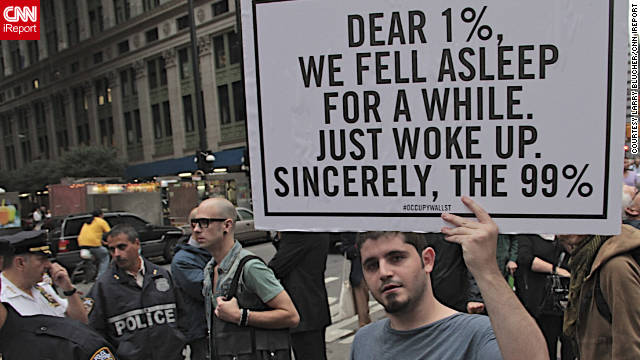
From Truthout, Chris Hedges gets up on his soapbox and preaches to the (liberal) masses who are watching the #OWS crowds and wondering what all the fuss is about. After all, they are all mostly boomers now and they had REAL protests back in the 1960s, about wars and shit.
Okay, so maybe that is just my "reframe" of his article . . . .
Posted on Nov 15, 2011
 |
| AP / Seth Wenig |
Occupy Wall Street protesters rally in a small park on Canal Street in New York on Tuesday.
|
Welcome to the revolution. Our elites have exposed their hand. They have nothing to offer. They can destroy but they cannot build. They can repress but they cannot lead. They can steal but they cannot share. They can talk but they cannot speak. They are as dead and useless to us as the water-soaked books, tents, sleeping bags, suitcases, food boxes and clothes that were tossed by sanitation workers Tuesday morning into garbage trucks in New York City. They have no ideas, no plans and no vision for the future.
Our decaying corporate regime has strutted in Portland, Oakland and New York with their baton-wielding cops into a fool’s paradise. They think they can clean up “the mess”—always employing the language of personal hygiene and public security—by making us disappear. They think we will all go home and accept their corporate nation, a nation where crime and government policy have become indistinguishable, where nothing in America, including the ordinary citizen, is deemed by those in power worth protecting or preserving, where corporate oligarchs awash in hundreds of millions of dollars are permitted to loot and pillage the last shreds of collective wealth, human capital and natural resources, a nation where the poor do not eat and workers do not work, a nation where the sick die and children go hungry, a nation where the consent of the governed and the voice of the people is a cruel joke.
Get back into your cages, they are telling us. Return to watching the lies, absurdities, trivia and celebrity gossip we feed you in 24-hour cycles on television. Invest your emotional energy in the vast system of popular entertainment. Run up your credit card debt. Pay your loans. Be thankful for the scraps we toss. Chant back to us our phrases about democracy, greatness and freedom. Vote in our rigged political theater. Send your young men and women to fight and die in useless, unwinnable wars that provide corporations with huge profits. Stand by mutely as our bipartisan congressional supercommittee, either through consensus or cynical dysfunction, plunges you into a society without basic social services including unemployment benefits. Pay for the crimes of Wall Street.
The rogues’ gallery of Wall Street crooks, such as Lloyd Blankfein at Goldman Sachs, Howard Milstein at New York Private Bank & Trust, the media tycoon Rupert Murdoch, the Koch brothers and Jamie Dimon at JPMorgan Chase & Co., no doubt think it’s over. They think it is back to the business of harvesting what is left of America to swell their personal and corporate fortunes. But they no longer have any concept of what is happening around them. They are as mystified and clueless about these uprisings as the courtiers at Versailles or in the Forbidden City who never understood until the very end that their world was collapsing. The billionaire mayor of New York, enriched by a deregulated Wall Street, is unable to grasp why people would spend two months sleeping in an open park and marching on banks. He says he understands that the Occupy protests are “cathartic” and “entertaining,” as if demonstrating against the pain of being homeless and unemployed is a form of therapy or diversion, but that it is time to let the adults handle the affairs of state. Democratic and Republican mayors, along with their parties, have sold us out. But for them this is the beginning of the end.
The historian Crane Brinton in his book “Anatomy of a Revolution” laid out the common route to revolution. The preconditions for successful revolution, Brinton argued, are discontent that affects nearly all social classes, widespread feelings of entrapment and despair, unfulfilled expectations, a unified solidarity in opposition to a tiny power elite, a refusal by scholars and thinkers to continue to defend the actions of the ruling class, an inability of government to respond to the basic needs of citizens, a steady loss of will within the power elite itself and defections from the inner circle, a crippling isolation that leaves the power elite without any allies or outside support and, finally, a financial crisis. Our corporate elite, as far as Brinton was concerned, has amply fulfilled these preconditions. But it is Brinton’s next observation that is most worth remembering. Revolutions always begin, he wrote, by making impossible demands that if the government met would mean the end of the old configurations of power. The second stage, the one we have entered now, is the unsuccessful attempt by the power elite to quell the unrest and discontent through physical acts of repression.
I have seen my share of revolts, insurgencies and revolutions, from the guerrilla conflicts in the 1980s in Central America to the civil wars in Algeria, the Sudan and Yemen, to the Palestinian uprising to the revolutions in East Germany, Czechoslovakia and Romania as well as the wars in the former Yugoslavia. George Orwell wrote that all tyrannies rule through fraud and force, but that once the fraud is exposed they must rely exclusively on force. We have now entered the era of naked force. The vast million-person bureaucracy of the internal security and surveillance state will not be used to stop terrorism but to try and stop us.
Despotic regimes in the end collapse internally. Once the foot soldiers who are ordered to carry out acts of repression, such as the clearing of parks or arresting or even shooting demonstrators, no longer obey orders, the old regime swiftly crumbles. When the aging East German dictator Erich Honecker was unable to get paratroopers to fire on protesting crowds in Leipzig, the regime was finished. The same refusal to employ violence doomed the communist governments in Prague and Bucharest. I watched in December 1989 as the army general that the dictator Nicolae Ceausescu had depended on to crush protests condemned him to death on Christmas Day. Tunisia’s Ben Ali and Egypt’s Hosni Mubarak lost power once they could no longer count on the security forces to fire into crowds.
The process of defection among the ruling class and security forces is slow and often imperceptible. These defections are advanced through a rigid adherence to nonviolence, a refusal to respond to police provocation and a verbal respect for the blue-uniformed police, no matter how awful they can be while wading into a crowd and using batons as battering rams against human bodies. The resignations of Oakland Mayor Jean Quan’s deputy, Sharon Cornu, and the mayor’s legal adviser and longtime friend, Dan Siegel, in protest over the clearing of the Oakland encampment are some of the first cracks in the edifice. “Support Occupy Oakland, not the 1% and its government facilitators,” Siegel tweeted after his resignation.
There were times when I entered the ring as a boxer and knew, as did the spectators, that I was woefully mismatched. Ringers, experienced boxers in need of a tuneup or a little practice, would go to the clubs where semi-pros fought, lie about their long professional fight records, and toy with us. Those fights became about something other than winning. They became about dignity and self-respect. You fought to say something about who you were as a human being. These bouts were punishing, physically brutal and demoralizing. You would get knocked down and stagger back up. You would reel backward from a blow that felt like a cement block. You would taste the saltiness of your blood on your lips. Your vision would blur. Your ribs, the back of your neck and your abdomen would ache. Your legs would feel like lead. But the longer you held on, the more the crowd in the club turned in your favor. No one, even you, thought you could win. But then, every once in a while, the ringer would get overconfident. He would get careless. He would become a victim of his own hubris. And you would find deep within yourself some new burst of energy, some untapped strength and, with the fury of the dispossessed, bring him down. I have not put on a pair of boxing gloves for 30 years. But I felt this twinge of euphoria again in my stomach this morning, this utter certainty that the impossible is possible, this realization that the mighty will fall.