Showing posts with label sensation. Show all posts

Wednesday, August 13, 2014

J. Kevin O’Regan - Why Things Feel the Way They Do?

http://ecx.images-amazon.com/images/I/41ptqkwzAqL._SY344_BO1,204,203,200_.jpg

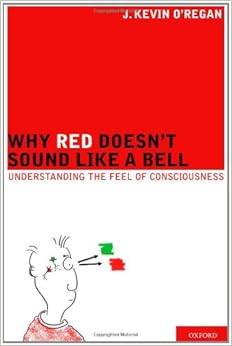
This is an interesting talk from J. Kevin O'Regan, former director of the Laboratoire Psychologie de la Perception (LPP), which specializes in human visual and auditory perception both in babies and adults. He is currently, since June 2013, working on a 5-year European Research Council Advanced project (FEEL) on the sensorimotor approach to consciousness and "feel," which I am currently pursuing at the LPP. This talk, and the 2011 book, Why Red Doesn't Sound Like a Bell: Understanding the feel of consciousness, are related to that project.

J. Kevin O’Regan - Why Things Feel the Way They Do?

Published on Aug 7, 2014


Why things feel the way they do: the sensorimotor approach to understanding phenomenal consciousness, J. Kevin O’Regan (Laboratoire Psychologie de la Perception, Université Paris Descartes, France)

Why does red not look green? Why does it not sound like a bell? Why does pain hurt rather than just provoking pain behavior and avoidance reactions? These are the questions of “qualia” or “phenomenal consciousness”, which the philosophers consider to be a “hard” problem.

The sensorimotor approach provides a way to make the hard problem easy. It suggests that we have been thinking about phenomenal consciousness the wrong way. Instead of thinking of it as being something that is generated by the brain, we should think about it as being a way of interacting with the world. Taking this stance provides simple explanations of why sensations are the way they are, and why there is “something it’s like” to have a sensation. Taking this stance also makes interesting scientific predictions and opens new experimental paradigms which I shall describe in change blindness, color psychophysics, sensory substitution, the rubber hand illusion and spatial cognition.

The talk is a précis of the book: J.K. O’Regan, Why Red Doesn't Sound Like a Bell: Understanding the feel of consciousness, OUP, 2011.

Saturday, November 09, 2013

David Eagleman: Brain Plasticity & Sensory Substitution


Dr. Eagleman has written several neuroscience books, including Incognito: The Secret Lives of the Brain and Wednesday Is Indigo Blue: Discovering the Brain of Synesthesia. He has also written an internationally bestselling book of literary fiction, Sum: Forty Tales from the Afterlives, which has been translated into 27 languages and was named a Best Book of the Year by Barnes and Noble, New Scientist, and the Chicago Tribune. Dr. Eagleman has written for the Atlantic, New York Times, Discover, Slate, Wired, and New Scientist, and has been profiled in The New Yorker. He appears regularly on National Public Radio and BBC to discuss both science and literature.


Here is a summary of the work he discusses in this talk.


Plasticity and Sensory Substitution


Can sensory data be fed through unusual sensory channels? And can the brain learn to extract the meaning of such information streams?

Yes and yes. Sensory substitution is a non-invasive technique for circumventing the loss of one sense by feeding its information through another channel. We are leveraging this technique to develop a non-invasive, low-cost vibratory vest to allow those with deafness or severe hearing impairments to perceive auditory information through small vibrations on their torso.
(Figure from Scott Novich and David Eagleman)

To make this work, we are capitalizing on recent advances in audio codecs and digital signal processing. In parallel, we are forging new research paths to maximize the information capacity of skin--for example, by using small 'sweeps' of vibratory motors rather than a single motor that turns on and off. As it turns out, people are much better at detecting these sweeps (green data points, below):
(Data from Novich and Eagleman, under review)
 So that sets up this 22 minute talk from the recent UP Experience.
 

David Eagleman: Brain Plasticity & Sensory Substitution


In his talk, Eagleman talks about his latest study in sensory substitution and its related experiments.


David Eagleman: Brain Plasticity & Sensory Substitution from The UP Experience on FORA.tv

David Eagleman is a neuroscientist, New York Times bestselling author, and Guggenheim Fellow who holds joint appointments in the Departments of Neuroscience and Psychiatry at Baylor College of Medicine in Houston, Texas. Dr. Eagleman's areas of research include time perception, vision, synesthesia, and the intersection of neuroscience with the legal system. He directs the Laboratory for Perception and Action, and is the Founder and Director of Baylor College of Medicine's Initiative on Neuroscience and Law.


Dr. Eagleman has written several neuroscience books, including Incognito: The Secret Lives of the Brain and Wednesday Is Indigo Blue: Discovering the Brain of Synesthesia. He has also written an internationally bestselling book of literary fiction, Sum: Forty Tales from the Afterlives, which has been translated into 27 languages and was named a Best Book of the Year by Barnes and Noble, New Scientist, and the Chicago Tribune. Dr. Eagleman has written for the Atlantic, New York Times, Discover, Slate, Wired, and New Scientist, and has been profiled in The New Yorker. He appears regularly on National Public Radio and BBC to discuss both science and literature.

Friday, November 30, 2012

Peter Meineck - Cognitive Science and Ancient Greek Drama


From Stanford University, this is a very interesting lecture by Peter Meineck on how cognitive science can enhance or shape our understanding of Greek drama. This is the autumn quarter 2012 Lorenz Eitner Lecture on Classical Art and Culture sponsored by the Classics Department.

Cognitive Science and Ancient Greek Drama

(November 8, 2012) In this illustrated talk incorporating live demonstrations, Peter Meineck will suggest a new method for approaching ancient drama using research drawn from the cognitive sciences. Can neuroscientific studies and modern cognitive theories be applied to the ancient Athenian brain? Can recent advances from the affective sciences offer us an array of new tools for better understanding the experience of ancient performance? This talk will suggest that the dramatic mask operating in a multisensory dynamic environment provided a deeply personal emotional anchor to music, narrative and movement of ancient drama and that new research in face recognition, neuroaesthetics, eye-tracking, human proprioception, and sensory processing can indeed illuminate important aspects of the ancient world. 
This is the autumn quarter 2012 Lorenz Eitner Lecture on Classical Art and Culture sponsored by the Classics Department. 
Dr. Peter Meineck is Clinical Associate Professor of Classics at New York University, Honorary Professor of Classics at the University of Nottingham and Founder on Aquila Theatre (www.aquilatheatre.com). He has published several translations of ancient plays with Hackett and is currently completing a new book on cognitive science and Greek drama. He has directed and produced over 60 professional theatre productions and written several stage adaptations of classical works from Homer to Rostand.