Showing posts with label physicalism. Show all posts

Wednesday, August 13, 2014

Yohan J John - The Mind Matters


This interesting article comes from 3 Quarks Daily, one of the coolest magazines on the net. Here is a cool quote to whet your appetite:
The body is not a biomechanical vehicle, and medical practitioners are not mechanics. More importantly, the mind is not a passive detector of signals from the body and the world. The mind actively integrates these signals, and the results of this integration spread out into the body and from there into the world. But a mind cannot access all its powers in isolation, because it cannot generate all the signals that it integrates. A solitary mind is just one node in a network of other minds, bodies, objects and forces. The health of each individual node depends at least in part on the health of the network as a whole.
This is an excellent essay - give it a read.

The Mind Matters

by Yohan J. John
August 11, 2014

What is the mind? And what is its relationship with the body? Philosophers, psychologists, cognitive scientists and neuroscientists have all attempted to bring their professional heft to bear on the "mind-body problem”, but consensus remains elusive. At best, mainstream academics and researchers share a metaphysical commitment: the belief that the seemingly immaterial mind emerges from ordinary matter, specifically the brain. This position — known as materialism or physicalism — has replaced mind-body dualism as the mainstream academic position on the mind-body problem. According to dualism, mind and matter are completely separate substances, and mind (or soul, or spirit) merely inhabits matter. Dualism is a problematic position because it doesn’t offer a clear explanation of how the immaterial mind can causally interact with the material body. How can the immaterial soul push the buttons in the body’s control room… if it doesn’t have hands?


Materialism avoids this issue by denying the existence of two separate substances — mind is matter too, and is therefore perfectly capable of influencing the body. But having made this claim, many materialists promptly forget about the influence of the mind on the body. There seems to be a temptation to skip the difficult step of linking complex mental phenomena with neural processes. Many people think this step is just a matter of working out the details, and they readily replace mental terms like ‘intention’, ‘attitude’, or ‘mood’, with terms that seem more solid, like ‘pleasure chemical’, ‘depression gene’, or ‘empathy neuron’. But these concepts have thus far proved woefully inadequate for constructing a mechanistic theory of how the mind works. Rather than explaining the mind, this kind of premature reductionism seems to explain the mind away. While we work out the details of how exactly the brain gives rise to intentions, attitudes, and moods, we should not lose sight of the fact that these kinds of mental phenomena have measurable influences on the body.

Recent studies linking epigenetics, neuroscience, and medicine reveal that subjective experience can have a profound impact on our physical and mental well-being. Mounting evidence is telling us something that was often neglected in the incomplete transition from dualism to materialism — that the mind is a crucial material force that influences the body, and by extension, the world outside the body.

Even a committed reductionist shouldn’t have to wait around to find microscopic neural correlates for every mental phenomenon in order to take the mind seriously. We can know that something happens without knowing how it happens. Right now I think it is important for people to realize that the mind matters, even though we don’t know exactly how, just yet.

“Your subjective experience carries more power than your objective situation.” This is the conclusion of UCLA researcher Steve Cole, interviewed by David Dobbs in his masterful essay on stress, social isolation, and health [1]. The article deals with the various ways in which stress and social isolation can lead to poor health outcomes, including increased susceptibility to cancer, depression, AIDS and other diseases. Cole tells us that "Social isolation is the best-established, most robust social or psychological risk factor for disease out there. Nothing can compete.” However, social isolation does not seal your fate. How you respond to social isolation — in other words, your attitude towards what is happening to you — is a bigger factor in many situations than your “objective” genetic or environmental circumstances. This is not the same as asserting magical “mind over matter” powers. Your attitude is unlikely to save you from Ebola. But in borderline situations, your body’s ability to fight disease and decay seems to be invigorated by the power of the mind.

If the phrase “the power of the mind” makes you uncomfortable, you need only examine the intricate causal web that links the brain with the rest of the body. The prefrontal cortex is frequently described as the brain’s "executive" or "higher cognitive" area; it is widely believed to be the neural substrate of conscious mental processing. A journal article once symbolized prefrontal functionality with a jaunty drawing of an orchestra conductor. Several crucial sub-regions of the prefrontal cortex have strong anatomical links with emotion-related subcortical areas, including the amygdala, the nucleus accumbens, and the hippocampus. This cognitive-emotional network is connected with the hypothalamic-pituitary-adrenal axis of the endocrine system, which modulates the body’s response to stress — also known as the fight-or-flight response. Signals from the hypothalamus trigger activity in the pituitary gland, which in turn sends signals to the adrenal glands, which sit on top of the kidneys. In response to signals from the pituitary gland the adrenal glands release the stress hormones cortisol, adrenaline and noradrenaline. The stress hormones enter the bloodstream, where they can influence a whole host of processes in the body and the brain. Cortisol, for instance, can increase blood sugar levels, suppress the immune system, and enhance the breakdown of fat. Cortisol also has pronounced effects on the hippocampus, a part of the brain involved in memory, navigation, and emotional processing. It can cause the dendrites of neurons to shrink, reduce the rate of birth of new neurons, and even enhance the rate of neuron death.

The network linking higher brain areas with the immune system and with metabolic processes is just one mechanism through which mental phenomena can influence basic bodily function. Through this complex web of causes, something as ephemeral as an idea or a mood can trigger physical changes in the body — changes that have real consequences for the health and well-being of the person. Importantly, the way in which a stress hormone like cortisol affects the brain can depend on higher mental processes. As it turns out, stress can sometimes be beneficial. Mild stress may contribute to increased longevity [2]. Stress hormones are also released during periods of excitement. There appear to be two kinds of stress: distress, which is a free-floating anxiety, and eustress, which is a form of motivated arousal that may improve performance on goal-directed tasks. Cortisol is released during both kinds of stress, but its levels rapidly drop if you’re enjoying yourself, or achieving a specific goal. Concepts like excitement and enjoyment depend on your higher mental processes. After all, what is exciting for you may be distressing for someone else. Similarly, your attitude towards goals depends on a variety of factors including your upbringing and your socioeconomic context. Mental processes in the brain are like lenses that magnify, shrink, reflect and refract signals from the outside world, influencing how the rest of the body reacts.

The impact of the mind on the body is vividly revealed by the placebo effect. A placebo is supposed to be an ineffective but harmless medical treatment, like a cleverly disguised sugar pill, used to deceive a patient into thinking she has been treated. One of the earliest definitions of the placebo described it as “any medicine adopted more to please than to benefit the patient” [3]. Any improvement shown by a patient given a placebo is attributed to the patient’s imagination — in other words, to her mind. When a new medical treatment is being clinically tested, patients given a placebo treatment serve as controls that are compared to patients given the real treatment. The new treatment is deemed ineffective if its effects are no better than a placebo. The underlying assumption here is that the placebo effect is the same as no effect. But right from its discovery in the 18th century, placebos were recognized to be powerful. In 1799, the British physician John Haygarth, one of the first to study the placebo effect, wrote that his findings "prove to a degree which has never been suspected, what powerful influence upon diseases is produced by mere Imagination" [4].

This attitude — how can mere imagination do all this? — has been carried forward through two centuries of medical and psychological advancement; our astonishment at the power of the placebo effect seems undiminished in the 21st century. Part of our continued bewilderment comes from the peculiar details that emerges when we examine the effect closely. A 2009 article in Wired magazine documents some of these peculiarities [5]. Research suggests that the shape, size, color and branding can all impact the effectiveness of a placebo pill. Drug companies may have used some of these insights in the design and marketing of their (ostensibly non-placebo) medications, and this may be one of the reasons that the placebo effect seems to have gotten stronger in recent years. The drug companies seem to have convinced us of the effectiveness of their pills, strengthening the ability of our minds to synergize with the drugs. But they may be victims of their own success: since the placebo effect is used as a baseline against which to compare a treatment’s efficacy, an enhanced placebo effect makes it harder for these same drug companies to get approval for new drugs.

The power of the mind, as revealed by the placebo effect, is a limited power that seems often to be outside our control. We cannot invent placebos for ourselves, because we would know that they were placebos. The mind is not like Baron Münchhausen — it cannot always pull itself out of the swamps it finds itself in. The mind’s power is strengthened by the society it is part of. Integrating the strangeness of the placebo effect with the lessons from stress and social isolation, a somewhat sobering picture emerges. In order to have a sound mind and body you might need to know that the people around you are willing to intervene. Stress is most taxing on people who are socially isolated [1]. Conversely, people with strong social support networks are better able to deal with stress and recover from its ill effects. Perhaps the placebo effect reflects some deep need on the part of those who suffer be taken seriously enough for medical attention. The body can take care of itself in many situations, but in order to recruit the healing power of the mind, there must be some sign that someone out there cares. Perhaps the size, shape and branding of a pill convey its expense, and therefore, in our money-denominated value system, the degree of concern offered by the person administering the drug. Perhaps we can alleviate a great deal of suffering without new wonder-drugs. Perhaps there is a renewable resource at our disposal that we have barely made use of: empathy.

This line of thinking is speculative, but I think it can only contribute positively to the way we treat the sick and the distressed [6]. The body is not a biomechanical vehicle, and medical practitioners are not mechanics. More importantly, the mind is not a passive detector of signals from the body and the world. The mind actively integrates these signals, and the results of this integration spread out into the body and from there into the world. But a mind cannot access all its powers in isolation, because it cannot generate all the signals that it integrates. A solitary mind is just one node in a network of other minds, bodies, objects and forces. The health of each individual node depends at least in part on the health of the network as a whole. And perhaps our social networks need to take up more responsibility for the mental and physical health of each of their nodes. A society that leaves huge numbers of its most weak and disadvantaged to fend for themselves is truly a sick society. The power of the mind suggests that we should care about it, even though we don't completely understand how it works. But its vulnerability in the face of isolation and disregard suggests that we should care about each other’s minds too. If the mind matters, then surely compassion matters too.
_________

References:

[1] Dobbs, David (2013), The Social Life of Genes, Pacific Standard.
[2] Minois, Nadège. (2000), Longevity and aging: beneficial effects of exposure to mild stress. Biogerontology.
[3] Shapiro, Arthur (1968), Semantics of the Placebo, Psychiatric Quarterly.
[4] Wikipedia entry on Placebo.
[5] Silberman, Steve (2009), Placebos Are Getting More Effective. Drugmakers Are Desperate to Know Why. Wired.
[6] As I was finalizing this essay I chanced upon a Wired article that suggests that the idea of empathy being crucial to health outcomes may not be so speculative after all! "What Kaptchuk demonstrated is what some medical thinkers have begun to call the “care effect” — the idea that the opportunity for patients to feel heard and cared for can improve their health. [...] Suffering people reflexively seek care, but in mainstream medicine, “care” tends to mean treatment and nothing more. Many patients who really need empathy and advice are instead given drugs and surgery." - Johnson, Nathaniel (2013), Forget the Placebo Effect: It’s the ‘Care Effect’ That Matters. Wired.

Sunday, June 15, 2014

The Philosopher's Zone - Mind the Brain

This is last week's episode of The Philosopher's Zone podcast, with guest Daivd Papineau, professor at King's College in London. Papineau has worked in metaphysics, epistemology, and the philosophies of science, mind, and mathematics. His overall stance is naturalist and realist. He is one of the originators of the teleosemantic theory of mental representation, a solution to the problem of intentionality which derives the intentional content of our beliefs from their biological purpose. He is also a defender of the a posteriori physicalist solution to the mind-body problem.

Here is a lengthy explanation of teleosemantic theories in philosophy from the Stanford Encyclopedia of Philosophy:
What all teleological (or “teleosemantic”) theories of mental content have in common is the idea that psycho-semantic norms are ultimately derivable from functional norms. Beyond saying this, it is hard to give a neat definition of the group of theories that qualify.

Consider, for instance, some theories that are clearly intended as alternatives to teleosemantics, such as Fodor's (1990b) asymmetric dependency theory or theories that appeal to convergence under ideal epistemic conditions (see Rey 1997 for an outline). Elaboration of these theories is beyond the scope of this entry but we can note that they both seem to need a notion of normal or proper functioning. Fodor's theory adverts to the “intact” perceiver and thinker. Presumably this is someone whose perceptual and cognitive systems are functioning properly (this is covered under the ceterus paribus part of the laws to which Fodor's theory refers). The idea of convergence under ideal epistemic conditions also involves a notion of normal functioning, for epistemic conditions are not ideal if perceivers and thinkers are abnormal in certain respects, such as if they are blind or psychotic. If normal or proper functioning is analyzed in terms of an etiological theory, which says that a system functions normally or properly only if all of its parts possess the dispositions for which they were selected, then these theories would qualify as teleological theories of mental content under the characterization provided in the first paragraph of this section. Those who propose these theories might reject an etiological theory of functions, but they need some analysis of them. There could anyway be etiological or teleological versions of theories of this sort.

An appeal to teleological functions can also be combined with a variety of other ideas about how content is determined. For example, there can be both isomorphic and informational versions of teleosemantics. In the former case, the proposal might be that the relevant isomorphism is one that cognitive systems were adapted to exploit. An alternative idea is that the isomorphism does not need to be specified given that the targets of representations are determined by teleological functions. This appears to be the view of Cummins (1996, see esp. p.120) although Cummins is generally critical of teleological functions in biology. A teleological version of an informational theory is given when content is said to depend on information carrying, storing or processing functions of mechanisms. The relevant notion of information is variously defined but (roughly speaking) a type of state (event, etc.) is said to carry natural information about some other state (event, etc.) when it is caused by it or corresponds to it. 

It is sometimes said that the role of functions in a teleological theory of content is to explain how error is possible, rather than to explain how content is determined, but the two go hand in hand. To see this, it helps to start with the crude causal theory of content and to see how the problem of error arises for it. According to the crude causal theory, a mental representation represents whatever causes representations of the type; Rs represent Cs if and only if Cs cause Rs. One problem with this simple proposal is its failure to provide for the possibility of misrepresentation, as Fodor (1987, 101–104) points out. To see the problem, recall the occasion on which crumpled paper is seen as a cat. The crude causal theory does not permit this characterization of the event because, if crumpled paper caused a tokening of CAT then crumpled paper is in the extension of CAT, according to the crude causal theory. Since cats also sometimes cause CATs, cats are in the extension too. However, the problem is that crumpled paper is included in the extension as soon as it causes a CAT to be tokened and so, on this theory, there is no logical space for the possibility of error since candidate errors are transformed into non-errors by their very occurrence. Note that the problem is simultaneously one of ruling in the right causes without also ruling in the wrong ones. CAT cannot have the content cat unless non-cats (including crumpled paper) are excluded from its content. So explaining how content is determined and how the possibility of error are accommodated are not separate tasks.

The error problem is an aspect of what (after Fodor) is often called “the disjunction problem.” With respect to the crude causal theory, the name applies because the theory entails disjunctive contents when it should not. For example, it entails that CATs have the content cats or crumpled paper in the case just considered. The disjunction problem is larger than the problem of error, however, because it is not only in cases of error that mental representations are caused by things that are not in their extensions (Fodor, 1990c). Suppose, for example, that Mick's talking about his childhood pet dog reminds Scott of his childhood pet cat. In this case no misrepresentation is involved but the crude causal theory again entails inappropriate disjunctive contents. Now it entails that Scott's CATs has a content along the lines of cats or talk of pet dogs. This last aspect of the disjunction problem might be called the problem of representation in absentia: how do we explain our capacity to think about absent things? How do mental representations retain or obtain their contents outside of perceptual contexts? 

Asking how to alter the crude causal theory to allow for error is one place to begin looking for a more adequate proposal. One approach would be to try to describe certain situations in which only the right causes can produce the representation in question and to maintain that the content of the representation is whatever can cause the representation in such situations. This is sometimes referred to as a “type 1 theory.” A type 1 theory distinguishes between two types of situations, ones in which only the right causes can cause a representation and ones in which other things can too. A type-1 theory says that the first type of situation is content-determining. A type 1 teleological theory might state, for example, that the content of a perceptual representation is whatever can cause it when the perceptual system is performing its proper function, or when conditions are optimal for the proper performance of its function. The content of representations in abstract thought might then, it might be proposed, be derived from their role in perception. Not all teleological theories of content are type 1 theories, however. The theory described in the next section is arguably a variant of a type 1 theory but some of the theories described in later sections are not.
And here is a specific account of Papineau's teleosemantic model - this also comes from the Stanford Encyclopedia of Philosophy:
A further way in which teleological theories of content can differ is with respect to the contents that they aim to explain. David Papineau's theory, developed at the same time as Millikan's, will help illustrate this point. Papineau (1984, 1987, 1990 and 1993) develops a theory that is top-down, or non-combinatorial, insofar as the representational states to which his theory most directly applies are whole propositional attitudes (e.g., beliefs and desires). In early writings, Millikan sometimes seems to hold a similar view and some objections initially raised against her theory are based on this interpretation of her view (see, e.g., Fodor 1990b, 64–69, where he raises some of the following points).

In Papineau's theory, the contents of desires are primary and those of beliefs are secondary in terms of their derivation. According to Papineau, a desire's “real satisfaction condition” is “… that effect which it is the desire's biological purpose to produce” (1993, 58–59), by which he means that “[s]ome past selection mechanism has favored that desire — or, more precisely, the ability to form that type of desire — in virtue of that desire producing that effect” (1993, 59). So desires have the function of causing us, in collaboration with our beliefs, to bring about certain conditions, conditions that enhanced the fitness of people in the past who had these desires. Desires, in general, were selected for causing us to bring about conditions that contributed to our fitness, and particular desires were selected for causing us to bring about particular conditions. These conditions are referred to as their satisfaction conditions and they are the contents of desires.

The “real truth condition” of a belief, Papineau tells us, is the condition that must obtain if the desire with which it collaborates in producing an action is to be satisfied by the condition brought about by that action. A desire that has the function of bringing it about that we have food has the content that we have food, since it was selected for bringing it about that we have food, and if this desire collaborates with a belief to cause us to go to the fridge, the content of the belief is that there is food in the fridge if our desire for food would only be satisfied by our doing so if it is true that there is food in the fridge (Papineau's example).

This seems to reject the Language of Thought hypothesis, according to which thought employs a combinatorial semantics. Language is combinatorial to the extent that the meaning of a sentence is a function of the meanings of the words in the sentence and their syntactic relations. “Rover attacked Fluff” has a combinatorial meaning if its meaning is a function of the meaning of “Rover”, the meaning of “attacked” and the meaning of “Fluff”, along with their syntactic relations (so that “Rover attacked Fluff” differs in meaning from “Fluff attacked Rover”). According to some philosophers (see esp. Fodor 1975) the content of propositional attitudes is combinatorial in an analogous sense. That is, for instance, the content of a belief is a function of the contents of the component concepts employed in the proposition believed, along with their syntactic relations. A teleological theory of content can be combinatorial, for it can maintain that the content of a representation that expresses a proposition is determined by the separate histories of the representations for the conceptual constituents of the proposition (and, perhaps, by the selection history of the syntactic rules that apply to their syntactic relations). Papineau's theory is not combinatorial, at least for some propositional attitudes. Instead, the proposal is that the contents of concepts are a function of their role in the beliefs and desires in which they participate.

Papineau's theory is a benefit-based theory, and some issues discussed in the previous sub-section are relevant to an assessment of it. For instance, it is unclear that what we desire is always what is beneficial to fitness. One might want sex, not babies or bonding, and yet it might be the babies and the bonding that are crucial for fitness. However, this section will not attempt an overview of the strengths and weaknesses of this theory but will focus on issues peculiar to non-combinatorial accounts.

Any non-combinatorial theory must face certain general objections to non-combinatorial theories, such as the objection that it cannot account for the productivity and systematicity of thought (Fodor 1981, 1987). This entry will not rehearse that argument (see the entry on the language of thought hypothesis) but special problems for a teleological version of a non-combinatorial theory need to be mentioned. Consider, for example, the desire to dance around a magnolia tree when the stars are bright, while wearing two carrots for horns and two half cabbages for breasts. Probably no-one has wanted to do this. But now suppose that someone does develop this desire (to prove Papineau wrong, say) so that it is desired for the first time. We cannot characterize the situation in this way, according to a non-combinatorial teleological theory. Since it has never been desired before, it has no history of selection and so no content on its first occurrence, on that style of theory. It is also a problem for this kind of theory that some desires do not or cannot contribute to their own satisfaction (e.g., the desire for rain tomorrow or the desire to be immortal) and that some desires that do contribute to their own satisfaction will not be selected for doing so (e.g., the desire to smoke or to kill one's children). In contrast, teleological theories that are combinatorial have no special problem with novel desires, desires that cannot contribute to bringing about their own satisfaction conditions or desires that have satisfaction conditions that do not enhance fitness, as long as their constitutive concepts have appropriate selection histories or are somehow built up from simpler concepts that have appropriate selection histories.

Papineau can respond by agreeing that some concessions to a combinatorial semantics have to be made. Once some desires and beliefs have content, the concepts involved acquire content from their role in these and they can be used to produce further novel, or self-destructive or causally impotent desires. However, it needs to be shown that such a concession is not ad hoc. The problem is to justify the claim that the desire to blow up a plane with a shoe explosive is combinatorial, whereas the belief that there is food in the fridge is not.
Here is a selection of his papers available online through his personal website.
Forthcoming

"Choking and the Yips" Phenomenology and the Cognitive Sciences forthcoming
"Sensory Experience and Representational Properties" Procedings of the Aristotelian Society forthcoming
"A Priori Philosophical Intuitions: Analytic or Synthetic?" in E Fischer and J Collins eds Philosophical Insights forthcoming
"Recanati On Mental Files" Disputatio forthcoming
"Can We Really See a Million Colours?" in P Coates (ed) Phenomenal Qualities forthcoming

2010-13

What Is Wrong With Strong Necessities?” (with Philip Goff) Philosophical Studies 2013
"In The Zone" in A O'Hear (ed) Philosophy of Sport 2013
"The Poverty of Conceptual Analysis" in M Haug (ed) Philosophical Methodology 2013 (this is a revised version of "The Poverty of Analysis" 2009)
"Causation is Macroscopic but not Irreducible" in S Gibb and E Lowe (eds) The Ontology of Mental Causation 2013
"There Are No Norms of Belief" in T Chan (ed) The Aim of Belief 2013
"Phenomenal Concepts and the Private Language Argument" American Philosophical Quarterly 2011
"Realism, Ramsey Sentences and the Pessimistic Meta-Induction" Studies in History and Philosophy of Science  2011
"The Philosophical Insignificance of A Priori Knowledge" in M Shaffer and M Veber (eds) New Essays on the A Priori 2011
"What Exactly is the Explanatory Gap?" Philosophia 2010
"A Fair Deal for Everettians" in J Barrett, A Kent, S Saunders, and D Wallace (eds) Many Worlds? 2010
"Can any Sciences be Special?" in C Macdonald and G Macdonald (eds) Emergence in Mind 2010
Shorter Pieces Online

"Interview" in 3:AM Magazine 2013
"Can We be Harmed After We are Dead?" Journal of the Evaluation of Clinical Practice 2013
"What is X-Phi Good For?" The Philosophers' Magazine April 2010
Five Philosophy of Science Answers” R. Rosenberger (ed) Philosophy of Science: Five Questions 2010
"Top Universities: Only the Rich Need Apply" The Times 13 August 2009
The Causal Closure of the Physical and Naturalism” B. McLaughlin, A. Beckermann and S. Walter (eds) Oxford Handbook of the Philosophy of Mind 2009
Reply to Lewis: Metaphysics versus Epistemology” (withVictor Durà-Vilà) Analysis 2009
"Explanatory Gaps and Dualist Intuitions" in L. Weiskrantz and M. Davies (eds) Frontiers of Consciousness 2008
 “Five Philosophy of Social Science Answers” in D. Rios and C. Schmidt-Petri (eds) Philosophy of the Social Sciences: Five Questions 2008
A Thirder and an Everettian: Reply to Lewis’s ‘Quantum Sleeping Beauty" (with Victor Durà-Vilà) Analysis 2008
NaturalismThe Stanford Encyclopedia of Philosophy 2007
Three Scenes and a Moral: My Philosophical DevelopmentThe Philosopher’s Magazine 2007
"Review article of Gary Marcus's The Birth of the Mind" (with Matteo Mameli)  Biology and Philosophy 2006
The Tyranny of Common SenseThe Philosopher’s Magazine 2006
Naturalist Theories of Meaning” E. Lepore and B. Smith (eds) Oxford Handbook of the Philosophy of Language 2006
"Reply to Robert Kirk's and Andrew Melnyk's comments on my Thinking about Consciousness" SWIF Online Philosophy Forum 2003
Wow, that is a LOT of information.

Enjoy!

Mind the brain

Sunday 8 June 2014

Listen now
Download audio


Consciousness in a material world: Putting the mind back into the brain (Don Farrall/Getty Images)

Neuroscience might have banished dualist notions of mind and body but it seems that M. Descartes’ 350 year-old hunch will not go away. What hasn’t helped is the log-jam of schemes trying to explain the dreaded ‘c’ word. The race is on to build a brain, but the deeper neuroscientists dig into the soggy grey matter the more elusive consciousness becomes. It needn’t be according to leading philosopher of mind David Papineau. If only we could accept some deceptively simple advice.
Guests 
Daivd Papineau - Professor of Philosophy of Science, King's College London

Monday, August 19, 2013

Richard Brown's Course on Consciousness and Its Place in Physical Reality


Richard Brown, who blogs at Philosophy Sucks! and Associate Professor at LaGuardia College, CUNY, recently posted the course outline and readings for a class he taught at LaGuardia that had the theme Cosmology, Consciousness, and Computation.

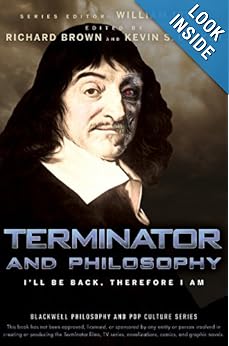
Aside from one book, his own Terminator and Philosophy: I'll Be Back, Therefore I Am, all of the readings are from online sources, particularly the outstanding Stanford Encyclopedia of Philosophy and YouTube.

Here is his course outline and the links to the readings:

Consciousness and its Place in Physical Reality

Posted on August 17, 2013 by Richard Brown

In the Spring 2013 semester I initiated a new course at LaGuardia that had the theme Cosmology, Consciousness, and Computation. The basic idea was to explore issues relating to physicalism. Intuitively, physicalism is the view that everything that exists is physical but what is the nature of physical reality? The idea I had was to have the course divided into three sections. In the first section we would do a conceptual physics course talking about the development of physics from the ancient world to the present day. Then we would turn to issues about consciousness and mind and where they fit in the physical picture we have so far developed. After that we turn to issues about computation; Is the universe computable? Or perhaps does it instantiate some computation? Is consciousness computational? Are we living in a simulation? Is the universe a hologram?

In my quest to have low cost book options for students I have adopted the Terminator book I co-edited and have supplemented that with readings from the Stanford Encyclopedia of Philosophy and other online material. The reception to the course was very good and I am really looking forward to doing it a second time in Fall 2013. I have updated the syllabus and, as usual, would welcome any suggestions or feedback.

Week I: Introduction
• →Richard Brown on What is Philosophy? – http://www.youtube.com/watch?v=ySS0bNeWZOg

Week 2: Early Attempts to Understand Mind and Physical Reality
• →Terminator Ch 10: The Nature of Time and the Universe
• Time- http://plato.stanford.edu/entries/time/
• Richard Brown on Pre-Socratic Philosophy- http://www.youtube.com/watch?v=zfLgRotdcKI&list=PLfR0qhtOKP6eYkUoW7DH8qdjwEyQnsbPJ&index=2
• Pre-Socratic Philosophy- http://plato.stanford.edu/entries/presocratics/
• Ancient Theories of the Soul- http://plato.stanford.edu/entries/ancient-soul/
• Parmenides- http://plato.stanford.edu/entries/parmenides/
• Zeno’s Paradoxes- http://plato.stanford.edu/entries/paradox-zeno/
• Ancient Atomism- http://plato.stanford.edu/entries/atomism-ancient/
• Democritus- http://plato.stanford.edu/entries/democritus/
• Intentionality in Ancient Philosophy- http://plato.stanford.edu/entries/intentionality-ancient/
• Time- http://plato.stanford.edu/entries/time/

Week 3: Modern Philosophy and Modern Science
• →Terminator Ch 2 –Animal consciousness, Descartes, and Emotions
• Descartes’ Physics- http://plato.stanford.edu/entries/descartes-physics/
• Descartes’ Epistemology- http://plato.stanford.edu/entries/descartes-epistemology/
• Descartes’ Theory of Ideas- http://plato.stanford.edu/entries/descartes-ideas/
• Other Minds- http://plato.stanford.edu/entries/other-minds/
• Animal Consciousness- http://plato.stanford.edu/entries/consciousness-animal/
• Locke on Real Essence- http://plato.stanford.edu/entries/real-essence/
• Locke’s Philosophy of Science- http://plato.stanford.edu/entries/locke-philosophy-science/
• Newton’s Philosophy- http://plato.stanford.edu/entries/newton-philosophy/
• Isaac Newton- http://plato.stanford.edu/entries/newton/
• Newton’s Views on Space, Time, and Motion-http://plato.stanford.edu/entries/newton-stm/
• The Contents of Perception- http://plato.stanford.edu/entries/perception-contents/
• The Problem of Perception- http://plato.stanford.edu/entries/perception-problem/

Week 4: Relativity Physics
• →Terminator Ch 8: paradoxes of time travel
• Einstein for Everyone:http://www.pitt.edu/~jdnorton/teaching/HPS_0410/chapters/index.html
• Brian Greene’s The Elegant Universe on NOVA-http://www.pbs.org/wgbh/nova/physics/elegant-universe.html#elegant-universe-einstein.html
• Time Travel and Modern Physics- http://plato.stanford.edu/entries/time-travel-phys/
• Time Machines- http://plato.stanford.edu/entries/time-machine/
• The Equivalence of Mass and Energy- http://plato.stanford.edu/entries/equivME/
• The Hole Argument- http://plato.stanford.edu/entries/spacetime-holearg/
• David Lewis’ The Paradoxes of Time Travel-http://www.csus.edu/indiv/m/merlinos/Paradoxes%20of%20Time%20Travel.pdf

Week 5: Quantum Mechanics
• Brian Greene’s The Fabric of the Cosmos on NOVA-http://www.pbs.org/wgbh/nova/physics/fabric-of-cosmos.html
• Copenhagen Interpretation of Quantum Mechanics:http://plato.stanford.edu/entries/qm-copenhagen/
• Many Worlds Interpretation of Quantum Mechanics-http://plato.stanford.edu/entries/qm-manyworlds/
• The Uncertainty Principle: http://plato.stanford.edu/entries/qt-uncertainty/
• Quantum Entanglement and Information: http://plato.stanford.edu/entries/qt-entangle/
• The Einstein-Podolsky-Rosen Argument in Quantum Theory-http://plato.stanford.edu/entries/qt-epr/
• Measurement in Quantum Theory: http://plato.stanford.edu/entries/qt-measurement/
• Quantum Mechanics- http://plato.stanford.edu/entries/qm/
• Richard Feynman on Double Slit Experiment- http://www.youtube.com/watch?v=hUJfjRoxCbk&list=PLfR0qhtOKP6eYkUoW7DH8qdjwEyQnsbPJ&index=3

Week 6: The Nature and Origin of the Universe
• →The Scale of the Universe- http://htwins.net/scale2/
• Hubble Deep Field: http://hubblesite.org/hubble_discoveries/hubble_deep_field/
• Cosmology and Theology- http://plato.stanford.edu/entries/cosmology-theology/
• Atheism and Agnosticism- http://plato.stanford.edu/entries/atheism-agnosticism/
• Religion and Science- http://plato.stanford.edu/entries/religion-science/
• Teleological Arguments for God’s Existence-http://plato.stanford.edu/entries/teleological-arguments/
• Cosmological Argument- http://plato.stanford.edu/entries/cosmological-argument/
• The Possible Parallel Universe of Dark Matter-http://discovermagazine.com/2013/julyaug/21-the-possible-parallel-universe-of-dark-matter#.UhDhPRbtaz6

Week 7: The Possibility of Life Beyond Earth
• Life- http://plato.stanford.edu/entries/life/
• Molecular Biology- http://plato.stanford.edu/entries/molecular-biology/
• Finding Life Beyond Earth- http://www.youtube.com/watch?v=FVzmGaGCqP8

Week 8: Consciousness in the Physical World?
• Consciousness- http://plato.stanford.edu/entries/consciousness/
• Representational Theories of Consciousness-http://plato.stanford.edu/entries/consciousness-representational/
• Functionalism- http://plato.stanford.edu/entries/functionalism/
• The Mind/Brain Identity Theory- http://plato.stanford.edu/entries/mind-identity/
• Dualism- http://plato.stanford.edu/entries/dualism/
• Zombies- http://plato.stanford.edu/entries/zombies/

Week 9: Beyond Physicalism?
• Eliminative Materialism- http://plato.stanford.edu/entries/materialism-eliminative/
• Folk Psychology as a Theory- http://plato.stanford.edu/entries/folkpsych-theory/
• The Philosophy of Neuroscience- http://plato.stanford.edu/entries/neuroscience/
• Panpsychism- http://plato.stanford.edu/entries/panpsychism/

Week 10: Transhumanism
• →Terminator Ch 4: Extended Mind, Transhumanism
• A History of Transhumanist Thought-http://www.fhi.ox.ac.uk/documents/journal_publications/al/nick_bostrom
• Biohackers: A Journey into Cyborg America- http://www.youtube.com/watch?v=K0WIgU7LRcI&list=PLfR0qhtOKP6eYkUoW7DH8qdjwEyQnsbPJ&index=48
• Tim Cannon on Potential Benefits of Sensory Augmentation-http://www.youtube.com/watch?v=KZ1KCpSL51E&list=PLfR0qhtOKP6eYkUoW7DH8qdjwEyQnsbPJ&index=46
• Aubrey de Grey on Defeating Aging- http://www.youtube.com/watch?v=d1FBJGl2c-Y&list=PLfR0qhtOKP6eYkUoW7DH8qdjwEyQnsbPJ&index=17

Week 11: A.I. and The Singularity
• →Terminator Ch 1: A.I., Chinese Room, Transhumanism
• →Terminator Ch 3: Why always with the killing?
• The Chinese Room Argument- http://plato.stanford.edu/entries/chinese-room/
• The Turing Test- http://plato.stanford.edu/entries/turing-test/
• The Frame Problem- http://plato.stanford.edu/entries/frame-problem/
• David Chalmers’ The Singularity: A Philosophical Analysis-http://consc.net/papers/singularity.pdf
• David Chalmers on Simulation and Singularity- http://www.youtube.com/watch?v=FafHdF_D8gA&list=PLfR0qhtOKP6eYkUoW7DH8qdjwEyQnsbPJ&index=13

Week 12: The Simulation Argument & The Holographic Hypothesis
• Nick Bostrom’s Simulation Argument Website- http://www.simulation-argument.com
• Nick Bostrom on The Simulation Argument- http://www.youtube.com/watch?v=nnl6nY8YKHs&list=PLfR0qhtOKP6eYkUoW7DH8qdjwEyQnsbPJ&index=24
• David Chalmers’ The Matrix as Metaphysics- http://consc.net/papers/matrix.html
• Leonard Susskind on The World as a Hologram- http://www.youtube.com/watch?v=2DIl3Hfh9tY&list=PLfR0qhtOKP6eYkUoW7DH8qdjwEyQnsbPJ&index=16