Showing posts with label faces. Show all posts

Saturday, April 26, 2014

How the Brain Pays Attention: Identifying Regions of the Brain Dealing with Object-Based, Spacial Attention

New research has identified a brain circuit that is key to shifting attention from one object to another. The researchers found that there is object-based attention and spatial attention, each of which is centered in different parts of the brain.

The prefrontal cortex ("inferior frontal junction (IFJ), which controls visual processing areas that are tuned to recognize a specific category of objects") is where the brain is able to switch attention from one target to another.

How the brain pays attention: Identifying regions of the brain dealing with object-based, spacial attention

Date: April 10, 2014
Source: Massachusetts Institute of Technology

Summary:
A brain circuit that's key to shifting our focus from one object to another has been identified by neuroscientists. The new findings suggest that there are two types of attention that have similar mechanisms involving related brain regions: object-based attention, and spatial attention. In both cases, the prefrontal cortex -- the control center for most cognitive functions -- appears to take charge of the brain's attention and control relevant parts of the visual cortex, which receives sensory input.


Picking out a face in the crowd is a complicated task: Your brain has to retrieve the memory of the face you're seeking, then hold it in place while scanning the crowd, paying special attention to finding a match.

A new study by MIT neuroscientists reveals how the brain achieves this type of focused attention on faces or other objects: A part of the prefrontal cortex known as the inferior frontal junction (IFJ) controls visual processing areas that are tuned to recognize a specific category of objects, the researchers report in the April 10 online edition of Science.

Scientists know much less about this type of attention, known as object-based attention, than spatial attention, which involves focusing on what's happening in a particular location. However, the new findings suggest that these two types of attention have similar mechanisms involving related brain regions, says Robert Desimone, the Doris and Don Berkey Professor of Neuroscience, director of MIT's McGovern Institute for Brain Research, and senior author of the paper.

"The interactions are surprisingly similar to those seen in spatial attention," Desimone says. "It seems like it's a parallel process involving different areas."

In both cases, the prefrontal cortex -- the control center for most cognitive functions -- appears to take charge of the brain's attention and control relevant parts of the visual cortex, which receives sensory input. For spatial attention, that involves regions of the visual cortex that map to a particular area within the visual field.

In the new study, the researchers found that IFJ coordinates with a brain region that processes faces, known as the fusiform face area (FFA), and a region that interprets information about places, known as the parahippocampal place area (PPA). The FFA and PPA were first identified in the human cortex by Nancy Kanwisher, the Walter A. Rosenblith Professor of Cognitive Neuroscience at MIT.

The IFJ has previously been implicated in a cognitive ability known as working memory, which is what allows us to gather and coordinate information while performing a task -- such as remembering and dialing a phone number, or doing a math problem.

For this study, the researchers used magnetoencephalography (MEG) to scan human subjects as they viewed a series of overlapping images of faces and houses. Unlike functional magnetic resonance imaging (fMRI), which is commonly used to measure brain activity, MEG can reveal the precise timing of neural activity, down to the millisecond. The researchers presented the overlapping streams at two different rhythms -- two images per second and 1.5 images per second -- allowing them to identify brain regions responding to those stimuli.

"We wanted to frequency-tag each stimulus with different rhythms. When you look at all of the brain activity, you can tell apart signals that are engaged in processing each stimulus," says Daniel Baldauf, a postdoc at the McGovern Institute and the lead author of the paper.

Each subject was told to pay attention to either faces or houses; because the houses and faces were in the same spot, the brain could not use spatial information to distinguish them. When the subjects were told to look for faces, activity in the FFA and the IFJ became synchronized, suggesting that they were communicating with each other. When the subjects paid attention to houses, the IFJ synchronized instead with the PPA.

The researchers also found that the communication was initiated by the IFJ and the activity was staggered by 20 milliseconds -- about the amount of time it would take for neurons to electrically convey information from the IFJ to either the FFA or PPA. The researchers believe that the IFJ holds onto the idea of the object that the brain is looking for and directs the correct part of the brain to look for it.

Further bolstering this idea, the researchers used an MRI-based method to measure the white matter that connects different brain regions and found that the IFJ is highly connected with both the FFA and PPA.

Members of Desimone's lab are now studying how the brain shifts its focus between different types of sensory input, such as vision and hearing. They are also investigating whether it might be possible to train people to better focus their attention by controlling the brain interactions involved in this process.

"You have to identify the basic neural mechanisms and do basic research studies, which sometimes generate ideas for things that could be of practical benefit," Desimone says. "It's too early to say whether this training is even going to work at all, but it's something that we're actively pursuing."


Story Source:
The above story is based on materials provided by Massachusetts Institute of Technology. The original article was written by Anne Trafton. Note: Materials may be edited for content and length.

Journal Reference:
Baldauf, D, and Desimone, R. (2014, Apr 25). Neural Mechanisms of Object-Based Attention. Science; 344 (6182): 424-427.  DOI: 10.1126/science.1247003
* * * * *

Neural Mechanisms of Object-Based Attention

Daniel Baldauf, Robert Desimone

Abstract 


How we attend to objects and their features that cannot be separated by location is not understood. We presented two temporally and spatially overlapping streams of objects, faces versus houses, and used magnetoencephalography and functional magnetic resonance imaging to separate neuronal responses to attended and unattended objects. Attention to faces versus houses enhanced the sensory responses in the fusiform face area (FFA) and parahippocampal place area (PPA), respectively. The increases in sensory responses were accompanied by induced gamma synchrony between the inferior frontal junction, IFJ, and either FFA or PPA, depending on which object was attended. The IFJ appeared to be the driver of the synchrony, as gamma phases were advanced by 20 ms in IFJ compared to FFA or PPA. Thus, the IFJ may direct the flow of visual processing during object-based attention, at least in part through coupled oscillations with specialized areas such as FFA and PPA. 

Editor's Summary


House or Face?

The neural mechanisms of spatial attention are well known, unlike nonspatial attention. Baldauf and Desimone (p. 424, published online 10 April) combined several technologies to identify a fronto-temporal network in humans that mediates nonspatial object-based attention. There is a clear top-down directionality of these oscillatory interactions, establishing the inferior-frontal cortex as a key source of nonspatial attentional inputs to the inferior-temporal cortex. Surprisingly, the mechanisms for nonspatial attention are strikingly parallel to the mechanisms of spatial attention.

Tuesday, September 18, 2012

Corvid Brains - Crows and Jays Show Human Traits

There were two very cool stories about corvids in the press last week, one from the University of Washington in Seattle on how crows can remember faces (confirming previous studies) and another from the University of California Davis on the fact that scrub jays mourn their dead, not just individually but as a group.

The cool thing about the crow study was that the researchers developed a less invasive and traumatizing method for conducting the research. Anything that can be done to reduce the trauma is good in my book.

Both of these studies reaffirm the intelligence of corvids in particular and birds/animals in general.

Crows recall faces with human-like brain activity

U. WASHINGTON (US) — Like humans, crows recognize faces and form associations with them—and to accomplish this, the two species’ brains appear to work in similar ways.

Posted by Sandra Hines-UW on Wednesday, September 12, 2012


The findings reveal that similar processes take place in the brains of crows and humans, both of which recognize faces and form positive and associations with them based on experience. "Our approach has wide applicability and potential to improve our understanding of the neural basis for animal behavior," write the University of Washington researchers.

“The regions of the crow brain that work together are not unlike those that work together in mammals, including humans,” says John Marzluff, University of Washington professor of environmental and forest sciences. “These regions were suspected to work in birds but not documented until now.

“For example it appears that birds have a region of their brain that is analogous to the amygdala of mammals,” he says. “The amygdala is the region of the vertebrate brain where negative associations are stored as memories. Previous work primarily concerned its function in mammals while our work shows that a similar system is at work in birds.

“Our approach could be used in other animals—such as lizards and frogs—to see if the process is similar in those vertebrates as well.”


The “caring” and “threatening” masks both have neutral expressions, so the researchers could be sure the crows were remembering and responding to positive or negative associations. 


Marzluff is the lead author of a paper published this week in the online edition of the Proceedings of the National Academy of Sciences.

Previous research on the neural circuitry of animal behavior has been conducted using well-studied, often domesticated, species like rats, chickens, zebra finches, pigeons, and rhesus macaques—but not wild animals like the 12 adult male crows in this study.

The crows were captured by investigators all wearing masks that the researchers referred to as “the threatening face.” The crows were never treated in a threatening way, but the fact they’d been captured created a negative association with the mask they saw.

Then, for the four weeks they were in captivity, they were fed by people wearing a mask different from the first—this one called “the caring face.” The masks were based on actual people’s faces and both bore neutral expressions so the associations made by the crows was based on their treatment.

Awake and active
In most previous neurological studies of animals, the work usually starts by sedating the animals, Marzluff says. Instead, the new approach involved injecting a glucose fluid commonly used in brain imaging into the bodies of fully alert crows that then went back to moving freely about their cages.
The fluid flooded to the parts of the crow brains that were most active as they were exposed for about 15 minutes to someone wearing either the threatening or caring mask.

Then the birds were sedated and scans made of their brains. All the birds were returned to the wild once all the work was completed.

“Our approach has wide applicability and potential to improve our understanding of the neural basis for animal behavior,” write Marzluff and co-authors Donna Cross, Robert Miyaoka, and Satoshi Minoshima, all faculty members with the radiology department. The department funded the preliminary work while the main project was conducted using money from the University’s Royalty Research Fund.

Most neurological studies to date in birds have concerned their songs—how their brain registers what they hear, how they learn and come up with songs of their own. This new approach enables researchers to study the visual system of birds and how the brain integrates visual sensation into behavioral action, Marzluff says.

Stress reduction
Among other things the findings have implications for lowering the stress of captive animals, he says.

“By feeding and caring for birds in captivity their brain activity suggests that the birds view their keepers as valued social partners, rather than animals that must be feared. So, to keep captive animals happy we need to treat them well and do so consistently,” he says.

Intriguingly, Marzluff says the findings might also offer a way to reduce conflict between birds and endangered species on which they might be feeding. In the Mojave Desert, for instance, ravens prey on endangered desert tortoises. And on the West and East coasts, crows and ravens prey on threatened snowy plovers.

“Our studies suggest that we can train these birds to do the right thing,” Marzluff says. “By pairing a negative experience with eating a tortoise or a plover, the brain of the birds quickly learns the association. To reduce predation in a specific area we could train birds to avoid that area or that particular prey by catching them as they attempt to prey on the rare species.”

Collaborative work among neuroscientists and ecologists could be used to better understand the neural basis of cognition in widely diverse animals, says co-author Cross. For example, her suggestion to use the glucose technique prior to brain scans, so the crows could be fully awake, could be used for other animals.
A researchers wore the “caring mask” to feed the crows. (Credit: Jack DeLap/U of Washington)

Source: University of Washington
* * * * * * *

Scrub jays react to their dead

Posted On: September 11, 2012

Western scrub jays summon others to screech over the body of a dead jay, according to new research from the University of California, Davis. The birds' cacophonous "funerals" can last for up to half an hour.

Anecdotal reports have suggested that other animals, including elephants, chimpanzees and birds in the crow family, react to dead of their species, said Teresa Iglesias, the UC Davis graduate student who carried out the work. But few experimental studies have explored this behavior.

The new research by Iglesias and her colleagues appears in the Aug. 27 issue of the journal Animal Behaviour.

Western scrub jays live in breeding pairs and are not particularly social birds.

"They're really territorial and not at all friendly with other scrub-jays," Iglesias said.

Working in the backyards of homes in Davis, Calif., Iglesias set up feeding tables to encourage visits from the jays. Then she videotaped their behavior when she placed a dead jay on the ground. She compared these reactions with the birds' behavior when confronted with a dead jay that had been stuffed and mounted on a perch, a stuffed horned owl, and wood painted to represent jay feathers.

On encountering a dead jay, prostrate on the ground, jays flew into a tree and began a series of loud, screeching calls that attracted other jays. The summoned birds perched on trees and fences around the body and joined in the calling. These cacophonous gatherings could last from a few seconds to as long as 30 minutes.

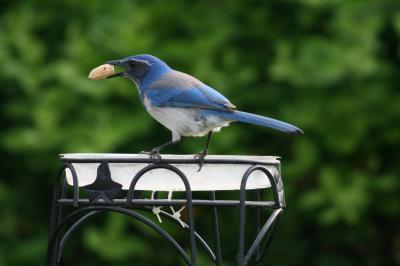
Western scrub-jay at a backyard bird feeder in Davis, CA. UC Davis researchers found the birds gather for noisy "funerals" when they encounter a dead jay. (Photo Credit: Stephanie Macey-Gallow, UC Davis.)
Jays formed similar cacophonous gatherings in response to a mounted owl, but ignored painted wood. When confronted with a mounted jay, the birds swooped in on it as if it were an intruder.

Jays typically gathered within seconds of the first bird calling, Iglesias said. If they did not, the first jay would often fly higher into a tree, apparently to call more widely.

"It looked like they were actively trying to attract attention," she said.

The purpose of the calls seems to be to alert other birds of danger, Iglesias said. But why the calls summon others, rather than warning them off, is unclear. Having more jays present might mean more eyes to locate a predator, or more numbers to drive it away, she speculates.

There might also be a learning component to the gatherings, if they help teach young jays about dangers in the environment, Iglesias said.

While reactions of animals to their dead are sometimes called "funerals," that does not imply that there is an emotional or ritual element to the behavior, Iglesias said. We simply don't know enough about the emotional life of animals to understand that.

But Iglesias isn't ruling it out. "I think there's a huge possibility that there is much more to learn about the social and emotional lives of birds," she said.


Thursday, May 24, 2012

Professor Marcus Munafo - Do I Look Happy to You?


Professor Marcus Munafo speaks at Authors at Google about recognition and interpretation of emotions in faces. Dr. Munafo is Professor of Biological Psychology in the School of Experimental Psychology at the University of Bristol (UK). Most of his research has been in the area of addiction and its association with the dopamine systems in the brain.


His books include Key Concepts in Health Psychology and Cognition and Addiction, among others.

Do I Look Happy to You?