Showing posts with label comedy. Show all posts

Tuesday, January 21, 2014

Comedians@Google: Eddie Izzard


This is a cool interview with my favorite comedian, Eddie Izzard. It's fun to hear a little of his background with wanting it all right now as a young man, then putting in the work and finding amazing success.

Comedians@Google: Eddie Izzard

Uploaded on Aug 18, 2011


Eddie Izzard stops by Google for a conversation about his life, his influences, and comedy. The interview was conducted by Mark Day.

Saturday, May 25, 2013

I Love ‘The Big Bang Theory.’ And You Should, Too


This article (by Rob Hoerburger at the New York Times) pretty much sums up my affection for The Big Bang Theory, the only network show I have been hooked on in recent years (with the ocassional exception of Criminal Minds - profiling serial killers is so much fun!).

The Big Bang Theory, despite its brilliance in acting and writing (some of the most sophisticated humor I have ever seen on television, which is juxtaposed with some of the base humor one expects for a Chuck Lorre show [he is responsible for Two and Half Men]), has never really been embraced by the society as a whole - not the way have Seinfeld or, currently, Modern Family.

Viewers who love the show, however, spread the word to friends, family, acquaintences who might also like the show. The word-of-mouth approach has moved the show into the top 20 in the ratings wars. Deservedly.

I Love ‘The Big Bang Theory.’ And You Should, Too

Illustration by Tom Gauld


By ROB HOERBURGER
Published: May 24, 2013

There is probably no more grievous transgression in the current culture wars than being a late adopter, missing the boat, signing on to something that the rest of the plugged-in world absorbed, analyzed, digitized and deleted last year, last month, five minutes ago. Even though the avalanche of movies, TV shows, music, e-books, apps, social media, gadgets, etc., has made it impossible for anyone to be a prescient expert on everything — even everything good.

Such a surplus of options can lead to a kind of cultural snobbery, the denigration of an artist or art form simply because you missed it the first time around. More than one prominent music critic, for instance, didn’t anticipate the fireball that was Adele in 2011 and then, several platinum certifications later, wrote begrudging mea culpas that basically said, “I guess she’s O.K.”

I was guilty of this kind of critical elitism. Until a year and a half ago, I had never seen an episode of “The Big Bang Theory.” Yes, that “Big Bang Theory.”

The show, which seemed to be a fairly traditional sitcom about four scientists at a Pasadena university and their quest to navigate the world from a book-smart yet socially addled perspective, with the help of their street-smart waitress-actress neighbor, had been on the air for four years, and my avoidance of it was textbook snob. It was a prime-time network show, and I hadn’t been beholden to anything prime-time and network since “Seinfeld” ended its run in 1998. And “The Big Bang Theory” was on CBS, long seen as “the old-people network.” Moreover, one of its creators was Chuck Lorre, who was partly responsible for another CBS sitcom, “Two and a Half Men,” that seemed one-jokey and never really held my attention for more than two and a half minutes. When “The Big Bang Theory” appeared in 2007 alongside “Two and a Half Men,” I figured it would be a cheap grab at ratings from the undiscerning set.

Even when Jim Parsons, who plays the Nobel-craving, coitus-avoiding, Purell-packing, sarcasm-challenged, boy-man genius Sheldon Cooper, won an Emmy after the third season, the show still wasn’t generating much buzz in any of the oh-so-hip Web forums I visited or at my weekly happy hour, where more than half the discussion is usually about TV. In the back of my mind I was thinking, Eh, it’s O.K., even though I still had not seen a single episode.

Then Parsons won a second Emmy. The ratings steadily ticked up to the Top 20 from No. 68 in the first season. The show was moved to Thursday night, where it proved stiff competition for “American Idol.” Somebody, or rather, lots of somebodies, knew something was going on. In the fall of 2011, with the show now in inescapable syndication, I decided to actually watch an episode.

It took roughly a week of nightly viewing before I realized how impoverished my life had been for the four years that I was oblivious to “The Big Bang Theory.”

The touchstone, the lodestar, the flypaper for me at first was, predictably, Parsons. In his dervishy nerdiness, he seemed to evoke any number of classic TV neurotics or fussbudgets: Paul Lynde, Tony Randall, Pee-wee Herman. Watching Parsons’s every twitch, wiggle, full-body smirk or social paroxysm — his O.C.D. knocking on friends’ doors (three knocks/name, three knocks/name, three knocks/name), his recurring line about “I’m not crazy, my mother had me tested,” his litany of his “61 mortal enemies,” his continued rebuffing of the advances of his girlfriend, Amy Farrah Fowler (Mayim Bialik) — is alone worth any half-hour spent on the show.

But as the weeks went by, the show’s many other virtues unfurled (by the end of 2011, I had seen almost all the older episodes more than once and started collecting the DVDs; some nights I would wake up after midnight just to watch the most recent episode as soon as it became available on demand). Here was a popular prime-time sitcom in which five of the seven main characters were Ph.D.’s and another had “only” a master’s from M.I.T., a hit show that regularly referenced bosons and derivatives and string theory, a show in which there were running gags about Madame Curie and Schrödinger’s cat.

The real behind-the-scenes heroes, though, are not the science advisers but the geek experts. The accuracy of the nerd oeuvre — the obsession with superheroes, “Star Trek” and “Star Wars” (before their umpteenth viewing of the movie, Howard, the M.I.T. engineer, says to Sheldon, “If we don’t start soon, George Lucas is going to change it again”), comic books and video games — is sometimes so eerie that I feel as if I’m watching a high- (or low-) light reel of my own life. In one episode, Sheldon goes to a computer store and is soon being asked for advice from tech-illiterate customers, to the point where he hacks into the store’s mainframe to check on the availability of an item. (“O.K., we don’t have that in stock,” he says to a customer, “but I can special-order it for you.”) He stops only when a real salesclerk reminds him that he doesn’t actually work there. Change the date to 1971, the computer store to a record store and the item in question to Judy Collins’s version of “Amazing Grace,” and that could have been me.

Beyond any navel-gazing thrill for me or other current or former nerds, the masterminds of the show — Lorre, Bill Prady, the showrunner Steven Molaro and others — have dared to produce a TV program that plays not a whit to the aspirations of its audience. You might laugh at the characters, pity them or love them, but you don’t want to be them (especially because you might already be them). There are a good amount of pre- and postcoital scenes, but they’re not especially sexy. These are not especially pretty people. A friend of mine who’s also a recent convert to the show says that she has a problem with Howard (Simon Helberg), the gnomish, dickie-sporting mama’s boy. “I can’t look at him,” she says. Even Penny (Kaley Cuoco), the bombshell across the hall, often appears rumpled or with a bottle of cheap wine hanging from her like an extra limb.

By the end of the sixth season, which wrapped last week, the characters had started to mature, while remaining true to their essence. Howard has been somewhat redeemed by living the ultimate nerd fantasy — becoming an astronaut — but even more by the love of a good woman, Bernadette (Melissa Rauch), whose oft-remarked-upon “ample bosom” is overshadowed by the fact that she’s smarter than he is and makes more money. Raj (Kunal Nayyar) finally seemed on the verge of a real relationship with a new character named Lucy (until she dumped him in the season finale last week), even as his sublimated love for Howard continues to surface in spontaneous belches. (In Raj and Amy, “The Big Bang Theory” could very well have two bona fide bisexuals among its characters.) Sheldon appears headed for some kind of revelation — either a Nobel-worthy discovery, his first real sexual experience or a nervous breakdown. The on-again-off-again (currently on) romance between Penny and Leonard (Johnny Galecki) may reach some resolution, but it almost certainly won’t have the fairy-tale ending of Ross and Rachel on “Friends” or Carrie and Big on “Sex and the City.” If they ever do marry, Leonard will most likely have one hand on his asthma inhaler at the ceremony and Penny will have one hand on a bottle of chardonnay. (Or a basic physics text; one roadblock to their relationship has been her concern that she’s not smart enough for him.)

The main direction that all of these characters continue to head in, though, is toward one another. With their social “shields” down (as one character puts it), they have direct access to their own and one another’s feelings — and buttons, especially when formulating the perfect insult. The intimacy that they achieve, and the chemistry among the actors, is certainly on a par with that of long-running sitcoms like “Cheers” or “Will and Grace” and is approaching the territory of maybe the greatest TV ensemble cast of all time, from the show about the Minneapolis TV-news producer and her coterie of kooky, lovable friends and co-workers, people whom you didn’t necessarily want to be but whom you always wanted to be around.

Unlike “The Mary Tyler Moore Show” (29 Emmys in its seven years on the air), “The Big Bang Theory” is a bit underdecorated. Parsons has his two Emmys, but he should have easily won a third for his work in the fifth season, if for nothing else than playing the bongos and singing about the subjunctive mood. Galecki and Bialik have received single Emmy nominations, but the show has never won for best comedy series, and its writing and directing have never even been nominated, having most recently run up against the awards juggernaut of “Modern Family,” an altogether hipper, sexier (if not necessarily funnier or smarter) show.

And while my own proselytizing about “The Big Bang Theory” has earned it a few new fans, many of my would-be converts remain unconvinced. When at one happy hour I lauded the guest appearances of Christine Baranski as Leonard’s mother, one of my buddies sneered, “She’s too good for that show.” When I praised the show in passing in a previous column, one of my editors strongly urged me to reconsider (“Replace it with anything else,” he said). And this from my haircutter: “But isn’t it about . . . nerds?” (She eventually came around.) So even though the show has lately been earning its highest ratings (20 million viewers for one episode in January) and has been regularly finishing at No. 1 on the Nielsen list, it has remained something of a guilty pleasure, an affection that you don’t broadcast too loudly. It’s still a little lonely at the top.

For me, though, true validation came last summer when I was on vacation, walking up a darkened hill in the kind of resort town where the smart TV talk veers toward shows like “Girls” and “Mad Men.” I was wearing a T-shirt emblazoned with the word “bazinga,” Sheldon’s self-satisfied exclamation whenever he thinks he’s got the better of one of his pals. A car crept toward me, a window rolled down and my shields went up: Uh-oh, I thought, here comes some snarky comment. Instead the driver just said the word, Sheldon-like, quietly but rascally: “ba-ZING-a,” and then moved on. It was an acknowledgment of a shared secret, a coded utterance of the sentence that some people wait a lifetime to hear: How cool are we!

Twenty million nerds can’t be wrong.


A version of this article appeared in print on May 26, 2013, on page MM44 of the Sunday Magazine with the headline: ‘Somebody, or Rather, Lots of Somebodies, Knew Something Was Going On’.

Saturday, December 15, 2012

Stephen Colbert | "America Again: Re-Becoming the Greatness We Never Weren't"


A few days ago I posted a short preview video of this Stephen Colbert talk at Authors@Google - and now the whole hour long interview is available, so here it is. Seems a little laughter today might take our (my) minds off of yesterday's tragedy.

The interview/talk is part of the publicity tour for Colbert's new book, America Again: Re-Becoming the Greatness We Never Weren't.


Stephen Colbert | "America Again: Re-Becoming the Greatness We Never Weren't"

The uncut interview of Stephen Colbert's visit to the Google New York offices.

America Again: Re-Becoming the Greatness We Never Weren't is more of a coffee-table book, with large color pictures, and chapter photos that require the use of included 3-D glasses. It falls somewhere between I Am America and the Daily Show faux-textbooks America (The Book) and Earth (The Book), which used that organizing principle to their advantage. The premise follows the many apocalyptic views of the past four years, claiming America has gone off the rails and completely lost its way, and that only this book offers the true path to restore America's greatness. Which was never really gone, because it's America.

The best idea America Again mocks is the one contained in its title. In particular, it skewers Newt Gingrich's 2011 book A Nation Like No Other, which claimed, "America's exceptional greatness is not based on that fact that we are the most powerful, most prosperous—and most generous—nation on earth. Rather, those things are the result of American Exceptionalism." That is one preposterously arrogant whopper, which America Again exploits as an illogical chicken/egg position. The subtle difference between a beneficial amount of pride and the unchecked belief in exceptionalism is ripe for mockery.

Stephen Colbert has been playing Stephen T. Colbert since 2005. In those seven years, he's built an impressive mythology to his character, a funhouse mirror held up to shame all other egomaniacal pundits for their hubris. But while the shtick is still reliably funny on television, it doesn't translate as well into print, because a book doesn't have television's immediacy. There's no Super PAC plotline, just a bunch of chapters that respond to issues a bit too late. Colbert and his staff are still extraordinarily funny, but in reaching for a middle-of-the-road coffee table humor book, America Again finds the limits of their comedic talent.

Hosted by Eric Schmidt
Directed by Lee Stimmel

Monday, November 19, 2012

Russell Brand Interviews Two Members of the Westboro Baptist Church


Uh, well, um . . . what the f*ck? There is nothing to be said about this interview except WHY in bloody hell those people would consent to be interviewed by Russell Brand and then act out the stereotype they have earned instead of trying to present their views honestly and calmly?

Sunday, April 01, 2012

NPR - Christopher Moore's New Novel, Sacré Bleu

Sacre Bleu
Christopher Moore is one of my favorite fiction authors - not because he is literary and profound, but because he is irreverent and profoundly funny. I began reading his stuff with his very first book, Practical Demonkeeping (the struggles of taking care of human-eating demon who bestows eternal life), and his second book, Coyote Blue (Old Man Coyote comes calling on half native/half white man who has lost the native part of his soul), is an all-time favorite of mine. 

I haven't kept up with Moore since his 4th or 5th books - and with Sacré Bleu: A Comedy d'Art (April 3rd release date), he is now up to 13.
March 31, 2012
 
Novelist Christopher Moore says he isn't very good at giving elevator speeches — those quick pitches on your latest project that Hollywood screenwriters are so good at.

"[That's] one of the reasons I probably don't work in Hollywood," Moore tells NPR's Scott Simon. But if he had to give a brief rundown of his latest novel, Sacre Bleu: A Comedy d'Art, he says, "I'd talk about it being a book about the color blue, and about solving the murder of Vincent van Gogh and the sort of mystical quality of making art. And it's funny."

The narrative winds all around late 19th century Paris through artists' homes, cafes and brothels. But it begins and ends with a meditation on blue.

Early in the book, van Gogh shoots himself in a field in Auvers. This sets the novel's two main characters — Henri de Toulouse-Lautrec and a fictional baker and aspiring painter Lucien Lessard, eventually joined by some of the most noted artists of their time — on a quest to solve a multilayered mystery combining art, suicide and maybe murder.

"The murder mystery is what's compelling to Lucien and Henri," says Moore. "That relationship is, 'What happened to our friend?' He was getting better. He was at the height of his powers. And no one shoots himself in the abdomen in a cornfield in Auvers and walks a mile to the doctor for help. And it just didn't seem right. And gradually the circumstances of this rather mystical shade of blue starts to manifest in the story."

These days you can walk into any drugstore and buy a cheap pack of markers in all the colors of the rainbow. That makes it hard to appreciate just how rare and precious blue pigment was, not so long ago.

"The translation of sacre bleu is sacred blue," says Moore. "In medieval times, the church said that if you are going to portray the Virgin Mary's cloak, it has to be in a certain shade of blue. And that blue must be ultramarine, because ultramarine blue is permanent. It doesn't go black or fade as organic colors do. And that is made essentially from crushed lapis lazuli, which is only available in Afghanistan. If you think about the 11th and 12th century, trying to get a stone from Afghanistan to Europe, for years and right up into the 19th century, was more valuable, weight for weight, than gold."

Christopher Moore is the author of A Dirty Job, Fool and Lamb: The Gospel According to Biff, Christ's Childhood Pal. Sacre Bleu is his 13th novel. 
Garry Kravit/HarperCollins
Christopher Moore is the author of A Dirty Job, Fool and Lamb: The Gospel According to Biff, Christ's Childhood Pal. Sacre Bleu is his 13th novel.

Moore's novel introduces readers to the bygone figure of the color man. The pigments that went into paint came from all over the world, and painters in Europe depended on these itinerant merchants to supply them with rare pigments from far-flung locations.

"We all think that Michelangelo and da Vinci all went out to the hills of Italy and dug ochres out of the hills. Some colors you just couldn't get. I mean, purple would come from snails off of Syria. And the cochineal beetles that came from what is now Hungary, they made red out of. And so a colorman provided these pigments. And they sort of had a route. They'd travel all over the world trading and collecting sometimes rare pigments and getting them to the people that could use them."

Moore says his novel dwells on the period of French painting beginning in 1863, when Manet unveiled his seminal painting, Le dejeuner sur l'herbe. "That sort of kicks off what we know as Impressionism," says Moore. "And it takes us up through 1891. Renoir had moved back to Paris in the 1890s when Toulouse-Lautrec was on Montmartre. And they knew him as 'the little gentleman' in those days."

Henri de Toulouse-Lautrec is one of Moore's most vivid characters. In researching the real Toulouse-Lautrec, Moore says that the painter's journals and letters proved strangely unhelpful — they were stilted, earnest accounts of his life written mostly to his relatives with the aim of getting a little money. "And at the same time we know from accounts of his friends that he was living for weeks at a time in brothels. So you just sort of have to put it together from what is written about him by his contemporaries," Moore says.
As the story progresses, it becomes apparent that Moore's artist-detectives want to figure out what happened to van Gogh in order to figure out what will eventually happen to them.

"I think that they are modeling themselves after this generation of revolutionaries that came before them," says Moore. "But I think that they're looking for some clue in what they will become, and Vincent sort of throws a wrench into their works."

Van Gogh's self-destructiveness disturbs their idea of how a revolutionary painter should be. But as they dig deeper into the past, they find that nearly every artist that they know has had a self-destructive streak.

"All of the ones that I account are actually based in reality, from James Whistler to Monet himself to Cezanne," says Moore. "I think that punctuates beyond wanting to find out what happened to their friend and this sort of mystical color blue that was involved in it. They are looking for some clue for what they will be."

Saturday, September 17, 2011

NPR - Jane Lynch: A Life Of 'Happy Accidents'


I wonder if Jami would mind me having a crush on a lesbian? Every since Best in Show, and especially with her guest appearances on Two and a Half Men as Charlie's psychotherapist (above), I have seriously liked this woman and her talent.

This is a fun interview from NPR on the occasion of her new memoir, Happy Accidents. You can read an excerpt by following the link at the bottom of the article.

Jane Lynch: A Life Of 'Happy Accidents'


It's a big week for Jane Lynch. Her memoir, Happy Accidents, was released on Tuesday, and this Sunday night, she'll be hosting the Primetime Emmy Awards. And she's a reasonably good bet to pick one up, too: her second in a row for playing the scheming cheerleading coach Sue Sylvester on Fox'sGlee. On Friday's Morning Edition, she talks to David Greene about her career, her book, and the difficult process of telling her parents she was gay.
Lynch learned perseverance early after she quit a school play in which she'd been cast because she was afraid of making mistakes. Despite the fact that wanting to be an actress was her "first conscious memory," she became so afraid of failing that she walked away from the project. "That is the last time I walked away from anything," she says. "I've been a yes person now for a long time."
Jane Lynch plays the nasty Sue Sylvester on Fox's Glee, for which she won an Emmy Award in 2010.
Adam Rose/Fox
Jane Lynch plays the nasty Sue Sylvester on Fox's Glee, for which she won an Emmy Award in 2010.
One person to whom she eagerly said yes was director Christopher Guest, whose work on so-called "mockumentaries" like This Is Spinal Tap andWaiting For Guffman she already admired when she met him when he directed her in a commercial for Frosted Flakes. Lynch and Guest ran into each other again later, and he cast her in his 2000 film Best In Show, where she played one-half of a dog-showing couple opposite Jennifer Coolidge. She went on to appear in Guest's A Mighty Wind and For Your Consideration, as well as Judd Apatow's wildly popular The 40 Year Old Virgin, where she played Steve Carell's sexually accommodating boss who sings him what she says is a Guatemalan love song. As Lynch explains, though, the words come from a Spanish textbook and in fact vow to blame her mother for cleaning her room.
Jane Lynch and her wife Lara Embry were married in 2010.
Frazer Harrison/Getty Images
Jane Lynch and her wife Lara Embry were married in 2010.
But in spite of her many successes, Lynch says it wasn't easy for her when she told her parents she was gay. "I went to see a therapist," she says, "because I was just suffering so much over this alienation I felt from my family." The therapist convinced her to try writing her parents a letter, with the understanding that, of course, she didn't have to send it. But when she wrote it and the words came easily, she sent it after all — which, she says, was undoubtedly the point of the exercise.
As she cruises into her high-profile hosting gig this weekend, Lynch says she's learned a lot about how to approach her own limitations: "I think the most important thing is that it's not like I'm done growing and evolving, but I certainly have so much more compassion and kindness for myself, and I have cut myself some slack."

Wednesday, September 07, 2011

Comedians@Google: Eddie Izzard


Awesome - Eddie Izzard is one of my favorite comedians ever. He may be the first postmodern, self-referential, and multi-perspectival comedian.

Comedians@Google: Eddie Izzard
Eddie Izzard stops by Google for a conversation about his life, his influences, and comedy. The interview was conducted by Mark Day.


For the uninitiated, here is an old video of one of his shows - one of the classics that made him famous.

Eddie Izzard Dress To Kill (1999)


Thursday, February 24, 2011

Musicians@Google: Reggie Watts

BIG Thanks to Casey Capshaw for this -he described Reggie Watts as taking "postmodern comedy, like 5 levels up." The beatbox stuff is pretty damn cool, too. This is from last summer.

Musicians@Google: Reggie Watts


AtGoogleTalks | Jun 1, 2010

If you don't already know who Reggie Watts is, he won't take offense, but after seeing him once, you'll never forget him. Hand-picked by Conan O'Brian as the opening act for his nationwide comedy tour, Reggie is a tour de force of cutting edge entertainment. He is part musician, part comedian, part tech geek, and 100% unlike anything you've ever seen or heard before.

A master at beat-box and looping, he is probably best known for his music, however his unique style blends familiar elements with novel sounds and allows Reggie to explore unknown territory. His comedy, on the other hand, is a bit harder to explain... let's just say he's a comedian's comedian... trust me, you're gonna love 'em.


He reminds me a bit of Steven Wright back in the 1980s when he's appear on Letterman and the audience would be silent in incomprehension. Good stuff - requires functional brain cells - very intellectual humor, very erudite humor.


Wednesday, February 23, 2011

Outlaw Comic: The Censoring of Bill Hicks [NSFW]

Bill Hicks is more infamous than famous - he is the comedian George Carlin was becoming when he died a few years back - angry, mean, and defiant. This is an excellent look at his life and career, narrated unobtrusively by Janeane Garofalo (who generally annoys the hell out of me).

It's too bad Hicks died so young - I suspect he was beginning to figure out his niche once he got off drugs and alcohol.

The embedded clip should have all seven parts - of not, just go back to the Documentary Heaven site linked to in the title below.

A biographical documentary on the late great comedian Bill Hicks and his career; in particular the censorship by Letterman that scarred it.

Hosted by Janeane Garofalo, this documentary tells the story of Bill’s transition from a non-drinking, non-smoking, straight laced funny man, to a hard drinking, hard smoking, drug taking angry ranter, to the happy and finally, peaceful and insightful man of much wisdom.

A rare insight into the battle against censorship that the great Bill Hicks waged against corporate America and it’s mainstream media for the better part of 15 years.

After 11 successful appearances on The Tonight Show with David Lettermen, the ‘powers that be’ axed Bill’s final performance from the show. 4 months later, Bill would tragically die from pancreatic cancer at the age of 32.


Tags: , , , , , , , , , , , , , , ,

Monday, July 05, 2010

76 Minutes With Eddie Izzard

Eddie Izzard is the funniest man on the planet. New York Magazine spends a little time - 76 minutes to be precise - talking with him. I'll include a video at the end for those who are not familiar with his postmodern comic brilliance.

76 Minutes With Eddie Izzard

Firmly in “boy mode,” the actor and comedian takes on Mamet, chicken salad, and BP’s critics.

By Jada Yuan
Published Jul 4, 2010

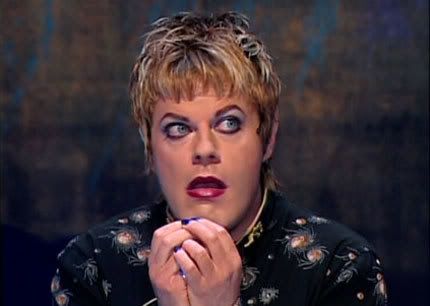
While he tries to embody Jack Lawson—a macho, rather soulless lawyer endeavoring to defend a rich white man who almost certainly raped a black woman, in David Mamet’s Race on Broadway—Eddie Izzard needs to maintain, as he calls it, “boy mode.” Which means the dresses and heels are on hiatus. Boy mode was not necessary during his stand-up tour in Canada, which he concluded the day before the start of Race rehearsals. “I spent the first half of the tour in boy mode, and then I swapped to girl mode.” Izzard’s “girl off, girl on” existence, he clarifies, is “the inverse of drag.” (Izzard, who’s straight, is big on semantics.) “Drag is about costumers. I’m just trying to wear a dress. I’m a straight action-executive transvestite. Action is, ‘I’ll beat the crap out of you if you give me a hard time.’ Executive is, ‘I travel first class.’ That’s just the genetic gift I was given. When you’re born they go, ‘Okay, that one’s gay, that one’s straight, straight transvestite, bi, good at swimming, crap at swimming, good with hedgehogs, likes pictures, eats fish fingers.’ ” He doubts that the dress-wearing mixes with playing Lawson. “You try to hug that character to you.”

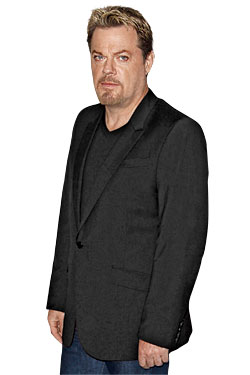
At Angus McIndoe, Izzard munches on a chicken salad, which, he says, he shouldn’t be eating anyway. “I don’t need food. I think I’m not designed for it. I really have come to that conclusion. I’ve heard of people in the mountains who live on berries and stuff, and I think that’s what I’m supposed to do.” He is very girl off in a Savile Row suit. Izzard comes to Race as a replacement for James Spader, who does nothing if not play skeezy lawyers well. “People don’t necessarily see me that way,” Izzard concedes, “but my brain does work in a very logical, military way. I could have been that lawyer; I would have been happy to study that at university. I did accounting and financial management, in fact.” Reviews for Race came out July 1, and the critics weren’t as convinced. There are mentions of tentativeness and botched lines, almost certainly owed to Izzard’s having just three weeks of rehearsals and one week of previews. “What do they expect? I came in very fast. Do they think that no one ever gets a line wrong on Broadway, ever? They should come and try and do it for a weekend.”

But he’s sure he’ll get it. “I’m a determined bugger,” he says. “I’m a transvestite with a career, and I ran 43 marathons in 51 days.” He’s referring to a challenge he gave himself last September to run around the U.K. with only five weeks of training (still a bit more than he had for Race). “There’s no learning how to run, I don’t think,” he says. “There’s just deciding that you want to run. This”—he points to his head—“controls it all.” He ran to raise money for the charity Sport Relief. But the run was also a journey to places from childhood, including the home in Wales where his mother died of cancer when he was 6. That early loss is what Izzard thinks drove him to seek the love of an audience. Also on the itinerary was a facility where his father worked for British Petroleum.

“We grew up with BP,” Izzard says, rather wistfully. “They are an oil company and they are what they are, but I’ve had this relationship with them that’s a sort of rich uncle, because that’s sort of what they were to our family situation. BP transferred us from refinery to refinery.” Izzard finds it hard to suppress his affection for the company, even now. “It’s a calamitous thing,” he says, “but there’s a part of me that just wants BP to do good. I need to follow more closely, but my understanding is it’s a deep well. The top casing, which was subcontracted out, has blown up, and this is all due to relaxing in the laws that came from a Bush-Cheney administration, right? And they’ve never had a breach like this before … I want the problem to go away, and I want BP to get to a better place. And in the end, if blame has to be apportioned, it should go to the right people. All you hear is BP, BP, BP. In the end, the subcontractor, they’re going to go away scot-free and BP will be blamed for everything.” I mention that BP’s had 760 OSHA violations to Exxon’s 1. “Wow,” says Izzard, reconsidering. “Then they deserve the blame.”

If he sounds like a politician—sure with the narrative if not always the facts—it’s because he plans on being one. Earlier this year, Izzard campaigned for the Labour Party in 25 cities and towns. The timing is incidental, but he sees campaigning as good practice for playing a Mamet lawyer, and vice-versa. “I think people in law get into politics because of the precision of language and precision of thought,” he says. “If people are shoving cameras in your face and saying, ‘Why do you feel Gordon Brown said this?’ or ‘What does this mean for the economy?’ you try to get some ideas out that can grab some of their imaginations or make them think at least.” He’s thinking maybe mayor of London or representative to the European Union. “I’ve already told everyone I’m a transvestite, so that should immediately stop me from going into politics, but I don’t think so.”

This is the full-length video from the DVD Definite Article.


Wednesday, May 12, 2010

Denis Leary - I Feel Good


Denis Leary is one of my favorite comedians and actors. I did not know he wrote for Huffington Post, so this column is a fun find.

Even better is that he is riffing on America's fascination and obsession with "magic pill," the miracle fix for all of our problems. As long as you don't mind the side effects.

I Feel Good

Denis Leary

Posted: May 11, 2010 09:14 AM

I am of Irish descent.

We have two traditional drugs: alcohol and religion. Both of which produce the same eventual side effects: dropping to your knees and feeling guilty.

When it comes to prescription drugs, for me - it's all about the side effects.

Nausea, anal leakage, dysplasia, and temporary blindness are not just great name choices for late 80's heavy metal bands -- they are but a few of the little prices Americans are willing to pay each time they swallow a magic pill designed to help them lose weight, gain confidence, stop shaking or become the proud owners of medically-induced erections.

I was raised by illegal-alien Irish immigrants who taught me that anything worth having is worth suffering for so the desire to clear up a heavy bout of back pain by ingesting a handful of Vitamin A (known as Advil to the occasional user) is well-worth whatever possible future damage it may do to my liver, brain or eyeballs (I'm not exactly sure of what side effects Advil may produce because I've never bothered to read the warnings on the label -- the print is too small and I can never find my glasses).

Which reminds me - if there were a pill that instantly increased your vision and meant you could throw away your reading glasses -- I would take it immediately. As would more than 100 million other Americans. Even if the main side effects sounded like things you might need to treat with other drugs.

Apparently all we care about is getting rid of the problem that currently seems to be bugging us.

Adderall is used to treat narcolepsy and Attention Deficit Disorder, both of which it makes go away. However, the side effects that may occur include confusion, vomiting, severe weight loss (possibly redundant), chest pain, swelling of the mouth, face, lips and tongue, and loss of appetite -- along with about 37 other items I don't have the time or space to list here. So narcoleptics and hyperactive kids may be willing to suffer through an enlarged face, slurred speech and puking in order not to fall asleep during their final exams. And if they wanna lose weight at the same time? Bingo.

You may be a wide-awake mess who hasn't had a nap in a week and a half - but you won't be a fat-assed wide-awake mess.

Cymbalta is used to treat depression and anxiety but its particular side effects include pale stools, dark urine, agitation, hostility, impulsiveness, inability to sit still, ringing in the ears, and red, blistered and/or peeling skin. Not to mention -- and I'm not making this up -- 'vomit that looks like coffee grounds'.

Now first of all -- I saw Pale Stools and Dark Urine live once at CBGB and I spat up some puke that looked like coffee grounds, but that was only because I'd actually eaten some coffee grounds before the show. Hey, it was the punk rock era, I was broke and hungry AND I wanted to make sure I was awake during the show.

Second of all -- how depressed do you have to be when in order to feel better, you're walking around like a naked grape with a head full of bells and a sudden desire to punch a stranger in the throat?

This is America I guess. The land of 8-minute abs, 6-minute facelifts and 10 plastic surgery procedures in one day (Heidi Montag's current pace -- some experts believe if she stays healthy she may pass Melissa Rivers by the All-Star break).

This is the land where Restless Leg Syndrome is cured by a drug that can cause an uncontrollable urge to gamble (who developed the drug -- a Native American tribe that owns a casino?).

This is the land where we now have an affliction called S.A.D. -- Seasonal Affected Disorder -- which means when the leaves fall off the trees you begin to get lonely and depressed and anxious. It's called winter, folks. It comes right after autumn. And you are SUPPOSED to get depressed. Which is why we have Christmas right in the middle of it. God has a master plan and it involves his son being born right as the snow begins to fall just as a reminder of why we are all here. Feeling depressed and anxious? Go outside, grab a shovel and start digging. Once your feet and fingers freeze up - go back inside where it's warm -- that oughta cure your case of the blues. Literally and figuratively.

Last week Dr. Nick finally came to the conclusion that Elvis Presley died of constipation. Never mind the fact that his favorite foods included a fried bacon, banana and peanut butter sandwich or that he had opened a Rite-Aid pharmacy in his colon. Nope. He was constipated. Now I'm sure if Elvis had been warned that one of the side effects of his prescription drug abuse could be the need to sit on the toilet for seven hours at a stretch while reading the Bible and simultaneously putting enough pressure on his posterior to give birth to a baby Elvis - he may have decided to instead seek out an enema.

But he didn't. Because he wanted to feel better.

Listen: I believe in prescription drugs. I believe in feeling better. But I also believe if you're sitting at the blackjack table wearing an adult diaper with a face the size of Elvis's ass and a four-hour erection -- maybe it's time to slow the process down a little bit.

I am a doctor, after all.

So take two bottles of Advil and call me in the morning.


Don't miss the season premiere "Rescue Me" on Tuesday, June 29 at 10pm on FX.

See Denis Leary live on the Rescue Me Comedy Tour:

May 22 Atlantic City, NJ Borgata Hotel Casino and Spa

June 2 Washington DC Warner Theatre

June 5 Uncasville, CT Mohegan Sun Arena

June 8 San Diego Humphrey's Concerts By The Bay

June 10 Los Angeles Club Nokia

June 12 Las Vegas Hard Rock Hotel - The Joint

June 15 Minneapolis State Theatre

June 17 Milwaukee Riverside Theatre

June 19 Chicago The Chicago Theatre

June 26 New York City Town Hall

June 27 New York City Town Hall

Purchase Tickets: http://www.denisleary.com/page/rescue-me-comedy-tour

Join me online:

Official Website: www.denisleary.com

Twitter: www.twitter.com/denisleary

Facebook: www.facebook.com/denisleary

Follow Denis Leary on Twitter: www.twitter.com/denisleary


Monday, September 21, 2009

Short Film - Validation

Cool. Very, very cool.

"Validation" is a fable about the magic of free parking. Starring TJ Thyne & Vicki Davis. Writer/Director/Composer - Kurt Kuenne. Winner - Best Narrative Short, Cleveland Int'l Film Festival, Winner - Jury Award, Gen Art Chicago Film Festival, Winner - Audience Award, Hawaii Int'l Film Festival, Winner - Best Short Comedy, Breckenridge Festival of Film, Winner - Crystal Heart Award, Best Short Film & Audience Award, Heartland Film Festival, Winner - Christopher & Dana Reeve Audience Award, Williamstown Film Festival, Winner - Best Comedy, Dam Short Film Festival, Winner - Best Short Film, Sedona Int'l Film Festival.


Friday, April 10, 2009

TED Talks - Emily Levine: A trickster's theory of everything

Hilarious and cool.
Philosopher-comedian Emily Levine talks (hilariously) about science, math, society and the way everything connects. She's a brilliant trickster, poking holes in our fixed ideas and bringing hidden truths to light. Settle in and let her ping your brain.


The TED blog offered some more info.

More on "Trickster Makes This World"

trickster_book.jpgEmily Levine's TEDTalk this morning references Trickster Makes This World, Lewis Hyde's 1998 book about the trickster figure -- who crosses continents and centuries to appear in almost all recorded mythologies. The book is also, it turns out, a cult favorite at the TED offices. TED's media production specialist, Angela Cheng, a writer and filmmaker, tells the TED Blog why Trickster Makes This World means so much to her. Here's a snippet; for the full story, hit the jump:

The trickster is anybody who's a bit of an outsider. They're the ones who make change. They're not thinking about making change; they're almost doing it in a selfish way. But because they're working outside the rules, they change the rules. Everything around them is always new, everything is an opportunity.

It's important to honor mischief-making, in a constructive and creative way, because that's how we effect change. And it's so important that we figure out our inner mischief maker. That's the creative part of us. And everybody's capable of it.

Read the full commentary, after the jump >>

More on Trickster Makes This World:

The trickster, in all mythology that features a trickster, they always have a bottomless hunger. They work from the outside and mess with the system in order to fill their bottomless hunger, and they constantly learn more and more sophisticated ways to steal from the gods. The gods get angry, but the trickster is so charming they'll make the gods laugh.

When you apply this to math and science and art, the trickster is anybody who's a bit of an outsider. They're the ones who make change. They're not thinking about making changes, they're almost doing it in a selfish way. But because they're working outside the rules, they change the rules. Everything around them is always new, everything is an opportunity.

I feel like lots of TEDsters and TED speakers -- they got to the place where they are because they worked outside the system. They do mischievous things, but they're extremely disciplined. Because that's the other thing about tricksters: They're never lazy. They're very industrious. Kary Mullis reminds me of a trickster. He really just likes to blow things up. But he's creating chaos in order to get to the truth

It's important to honor mischief-making, in a constructive and creative way, because that's how we effect change. And it's so important that we figure out our inner mischief maker. That's the creative part of us. And everybody's capable of it.

Trickster Makes This World is also about the immigrant experience, because immigrants are, at first, outside the system, and figure out how to work with the system. And they end up changing the system.

Trickster Makes This World is so much about art and science and music and immigration -- it's like a weird amalgam of all these things. It's a really good structure that holds all the different narratives of my life and brings them all together. TEDTalks is part of the narrative. It's my job to sit and watch TEDTalks, to make sure that they look good and sound good for the world to see. So I get to be an admirer and get to oversee them all at once, which is sort of like being a listener of stories and a teller of stories at the same time. (Emily Levine is the one who got me into this book, actually, when I was digitizing her talk.) It seems to work with the story of my existence.

More: Read the first chapter of Trickster Makes This World >>


Thursday, April 02, 2009

Stephen Colbert Takes Down Glenn Beck

Glenn Beck is such a blowhard, and a thinly veiled racist. It's fun to watch Colbert destroy him. His 9/12 project is a cynical attempt to build a career on the backs of those who really suffered on 9/11 and in the years after.

I have to admit that watching him makes me laugh hysterically, especially when he whips out the fake tears.

The Colbert ReportMon - Thurs 11:30pm / 10:30c
The 10/31 Project
comedycentral.com
Colbert Report Full EpisodesPolitical HumorNASA Name Contest