Showing posts with label censorship. Show all posts

Sunday, December 08, 2013

Project Censored - Top 25 Censored Stories from 2012-2013


Here is the list of censored and under-reported news stories from the last year from Project Censored - an effort that began in 1976 at Sonoma State College. Among the low-lights, Monsanto's GMO conspiracy, the impact of fracking on the food supply, 10 years of the Creative Commons, the "culture of cruelty" along the U.S.-Mexico border, the increasing wealth gap, the rise in hate groups, and Obama's war on whistle-blowers.

Top 25 Censored Stories from 2012-2013


The presentation of this year’s Top 25 stories extends the tradition originated by Professor Carl Jensen and his Sonoma State students in 1976, while reflecting how the expansion of the Project to include affiliate faculty and students from campuses across the country and around the world—initiated several years ago as outgoing director Peter Phillips passed the reins to current director Mickey Huff—has made the Project even more diverse and robust. During this year’s cycle, Project Censored reviewed 233 Validated Independent News stories (VINs) representing the collective efforts of 219 college students and 56 professors from 18 college and university campuses that participate in our affiliate program and 13 additional community evaluators.

25. Israel Gave Birth Control to Ethiopian Immigrants Without Their Consent


In January 2013, Israel acknowledged that medical authorities have been giving Ethiopian immigrants long-term birth-control injections, often without their knowledge or consent. Continue Reading…


24. Widespread GMO Contamination: Did Monsanto Plant GMOs Before USDA Approval?


Monsanto introduced genetically modified alfalfa in 2003—a full two years before it was deregulated, according to recently released evidence... Continue Reading…


23. Transaction Tax Helps Civilize Wall Street and Lower the National Debt


In February 2013, United States senators Tom Harkin (D-Iowa) and Peter DeFazio (D-Oregon) introduced a bill to implement a new tax of three basis points (that is, three pennies for every hundred dollars) on most nonconsumer stock trades. Continue Reading…


22. Pennsylvania Law Gags Doctors to Protect Big Oil’s “Proprietary Secrets”


In communities affected by hydraulic fracturing, or “fracking,” people understand that this process of drilling for natural gases puts the environment and their health at risk Continue Reading…


21. Monsanto and India’s “Suicide Economy”


Monsanto has a long history of contamination and cover-up and in India another Monsanto cover-up is ongoing Continue Reading…


20. Israel Counted Minimum Calorie Needs in Gaza Blockade


Declassified documents reveal that the Israeli military calculated how many calories a typical Gazan would need to survive, in order to determine how much food to supply the Gaza Strip during the 2007–2010 blockade. Continue Reading…


19. The Power of Peaceful Revolution in Iceland


After privatization of the national banking sector, private bankers borrowed billions of dollars or (ten times the size of Iceland’s economy), creating a huge economic bubble that doubled housing prices and made a small percentage of the population exceedingly wealthy Continue Reading…


18. Fracking Our Food Supply


The effects of hydraulic fracturing (or “fracking”) on food supply and the environment are slowly emerging Continue Reading…


17. The Creative Commons Celebrates Ten Years of Sharing and Cultural Creation


Creative Commons (CC) is celebrating ten years of helping writers, artists, technologists, and other creators share their knowledge and creativity with the world Continue Reading…


16. Journalism Under Attack Around the Globe


Journalists are increasingly at risk of being killed or imprisoned for doing their jobs, a situation that imperils press freedom. Continue Reading…


15. Food Riots: The New Normal?


Reduced land productivity, combined with elevated oil costs and population growth, threaten a systemic, global food crisis Continue Reading…


14. Wireless Technology a Looming Health Crisis


As a multitude of hazardous wireless technologies are deployed in homes, schools, and workplaces, government officials and industry representatives continue to insist on their safety despite growing evidence to the contrary. Continue Reading…


13. A Fifth of Americans Go Hungry


An August 2012 Gallup poll showed that 18.2 percent of Americans lacked sufficient money for needed food at least once over the previous year. Continue Reading…


12. The US Has Left Iraq with an Epidemic of Cancers and Birth Defects


High levels of lead, mercury, and depleted uranium are believed to be causing birth defects, miscarriages, and cancer for people living in the Iraqi cities of Basra and Fallujah. Continue Reading…


11. Bush Blocked Iran Nuclear Deal


According to a former top Iranian negotiator, Seyed Hossein Mousavian, in 2005 Iran offered a deal to the United States, France, Germany, and the United Kingdom that would have made it impossible for Iran to build nuclear weapons. Continue Reading…


10. A “Culture of Cruelty” along Mexico–US Border


Migrants crossing the Mexico–US border not only face dangers posed by an unforgiving desert but also abuse at the hands of the US Border Patrol Continue Reading…


9. Icelanders Vote to Include Commons in Their Constitution


In October 2012, Icelanders voted in an advisory referendum regarding six proposed policy changes to the 1944 Constitution Continue Reading…


8. Bank Interests Inflate Global Prices by 35 to 40 Percent


A stunning thirty-five to forty percent of everything we buy goes to interest. Continue Reading…


7. Merchants of Death and Nuclear Weapons


The Physicians for Social Responsibility released a study estimating that one billion people—one-seventh of the human race—could starve over the decade following a single nuclear detonation Continue Reading…


6. Billionaires’ Rising Wealth Intensifies Poverty and Inequality


As a direct result of existing financial policies, the world’s one hundred richest people grew to be $241 billion richer in 2012. Continue Reading…


5. Hate Groups and Antigovernment Groups on Rise across US


The Southern Poverty Law Center (SPLC), which monitors hate groups and antigovernment groups, released a report showing that 1,360 radical, antigovernment “patriot” groups and 321 militias actively operate within the United States Continue Reading…


4. Obama’s War on Whistleblowers


Obama signed both the Whistleblower Protection Enhancement Act, expanding whistleblower protections, in November 2012, and the National Defense Authorization Act (NDAA) furthering these protections in January 2013 Continue Reading…


3. Trans-Pacific Partnership Threatens a Regime of Corporate Global Governance


The Trans-Pacific Partnership (TPP), branded as a trade agreement and negotiated in unprecedented secrecy, is actually an enforceable transfer of sovereignty from nations and their people to foreign corporations. Continue Reading…


2. Richest Global 1 Percent Hide Trillions in Tax Havens


The global 1 percent hold twenty-one to thirty-two trillion dollars in offshore havens in order to evade taxes, according to James S. Henry, the former chief economist at the global management consulting firm, McKinsey & Company. Continue Reading…
 

1. Bradley Manning and the Failure of Corporate Media


In February 2013, United States military intelligence analyst Bradley Manning confessed in court to providing vast archives of military and diplomatic files to the anti-secrecy group WikiLeaks, saying he wanted the information to become public “to make the world a better place” and that he hoped to “spark a domestic debate on the role of the military in (US) foreign policy. Continue Reading…

Wednesday, June 12, 2013

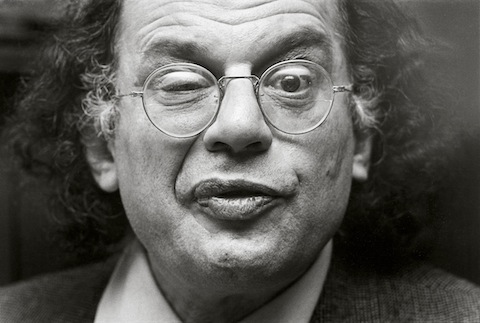
Hear the Very First Recording of Allen Ginsberg Reading His Epic Poem “Howl” (1956)


Allen Ginsberg's great American poem, "Howl," was for me (like so many others before and after) a pivotal moment in my understanding of poetry, of art, and of America. Before reading "Howl," I had help William Carlos Williams (Ginsberg's mentor) and Robinson Jeffers as the poets I from whom I tried to learn the craft of poetry. Ginsberg changed that.

Here is some biography from The Academy of American Poets:
He was admitted to Columbia University, and as a student there in the 1940s, he began close friendships with William S. Burroughs, Neal Cassady, and Jack Kerouac, all of whom later became leading figures of the Beat movement. The group led Ginsberg to a "New Vision," which he defined in his journal: "Since art is merely and ultimately self-expressive, we conclude that the fullest art, the most individual, uninfluenced, unrepressed, uninhibited expression of art is true expression and the true art."

Around this time, Ginsberg also had what he referred to as his "Blake vision," an auditory hallucination of William Blake reading his poems "Ah Sunflower," "The Sick Rose," and "Little Girl Lost." Ginsberg noted the occurrence several times as a pivotal moment for him in his comprehension of the universe, affecting fundamental beliefs about his life and his work. While Ginsberg claimed that no drugs were involved, he later stated that he used various drugs in an attempt to recapture the feelings inspired by the vision.

In 1954, Ginsberg moved to San Francisco. His mentor, William Carlos Williams, introduced him to key figures in the San Francisco poetry scene, including Kenneth Rexroth. He also met Michael McClure, who handed off the duties of curating a reading for the newly-established "6" Gallery. With the help of Rexroth, the result was "The '6' Gallery Reading" which took place on October 7, 1955. The event has been hailed as the birth of the Beat Generation, in no small part because it was also the first public reading of Ginsberg's "Howl," a poem which garnered world-wide attention for him and the poets he associated with.

In response to Ginsberg's reading, McClure wrote: "Ginsberg read on to the end of the poem, which left us standing in wonder, or cheering and wondering, but knowing at the deepest level that a barrier had been broken, that a human voice and body had been hurled against the harsh wall of America..."

Shortly after Howl and Other Poems was published in 1956 by City Lights Bookstore, it was banned for obscenity. The work overcame censorship trials, however, and became one of the most widely read poems of the century, translated into more than twenty-two languages.
Below is the first ever recorded reading of "Howl," a major find for lovers of poetry, especially Beat poetry.

Hear the Very First Recording of Allen Ginsberg Reading His Epic Poem “Howl” (1956)


June 12th, 2013


Occasionally I slip into an ivory tower mentality in which the idea of a banned book seems quaint—associated with silly scandals over the tame sex in James Joyce or D.H. Lawrence, or more recent, misguided dust-ups over Huckleberry Finn. After all, I think, we live in an age when bestseller lists are topped (no pun) by tawdry fan fiction like Fifty Shades of Grey. Nothing’s sacred. But this notion is a massive blind spot on my part; the whole awareness-raising mission of the annual Banned Books Week seeks to dispel such complacency. Books are challenged, suppressed, and banned all the time in public schools and libraries, even if we’ve moved past outright government censorship of the publishing industry.

It’s also easy to forget that Allen Ginsberg’s generation-defining poem “Howl” was once almost a casualty of censorship. The most likely successor to Walt Whitman’s vision, Ginsberg’s oracular utterances did not sit well with U.S. Customs, who in 1957 tried to seize every copy of the British second printing. When that failed, police arrested the poem’s publisher, Lawrence Ferlinghetti, and he and Ginsberg’s “Howl” were put on trial for obscenity. Apparently, phrases like “cock and endless balls” did not sit well with the authorities. But the court vindicated them all.


The story of Howl’s publication begins in 1955, when 29-year-old Ginsberg read part of the poem at the Six Gallery, where Ferlinghetti—owner of San Francisco’s City Lights bookstore—sat in attendance. Deciding that Ginsberg’s epic lament “knocked the sides out of things,” Ferlinghetti offered to publish “Howl” and brought out the first edition in 1956. Prior to this reading, “Howl” existed in the form of an earlier poem called “Dream Record, 1955,” which poet Kenneth Rexroth told Ginsberg sounded “too formal… like you’re wearing Columbia University Brooks Brothers ties.” Ginsberg’s rewrite jettisoned the ivy league propriety.

Unfortunately, no audio exists of that first reading, but above (or via these links: StreamiTunes ) you can hear the first recorded reading of “Howl,” from February, 1956 at Portland’s Reed College. The recording sat dormant in Reed’s archives for over fifty years until scholar John Suiter rediscovered it in 2008. In it, Ginsberg reads his great prophetic work, not with the cadences of a street preacher or jazzman—both of which he had in his repertoire—but in an almost robotic monotone with an undertone of manic urgency. Ginsberg’s reading, before an intimate group of students in a dormitory lounge, took place only just before the first printing of the poem in the City Lights edition.

The recordings listed above all appear in our collection of 525 Free Audio Books. Just look for the Poetry section.

Related Content:


Josh Jones is a writer and musician based in Washington, DC. Follow him at @jdmagness

Wednesday, February 23, 2011

Outlaw Comic: The Censoring of Bill Hicks [NSFW]

Bill Hicks is more infamous than famous - he is the comedian George Carlin was becoming when he died a few years back - angry, mean, and defiant. This is an excellent look at his life and career, narrated unobtrusively by Janeane Garofalo (who generally annoys the hell out of me).

It's too bad Hicks died so young - I suspect he was beginning to figure out his niche once he got off drugs and alcohol.

The embedded clip should have all seven parts - of not, just go back to the Documentary Heaven site linked to in the title below.

A biographical documentary on the late great comedian Bill Hicks and his career; in particular the censorship by Letterman that scarred it.

Hosted by Janeane Garofalo, this documentary tells the story of Bill’s transition from a non-drinking, non-smoking, straight laced funny man, to a hard drinking, hard smoking, drug taking angry ranter, to the happy and finally, peaceful and insightful man of much wisdom.

A rare insight into the battle against censorship that the great Bill Hicks waged against corporate America and it’s mainstream media for the better part of 15 years.

After 11 successful appearances on The Tonight Show with David Lettermen, the ‘powers that be’ axed Bill’s final performance from the show. 4 months later, Bill would tragically die from pancreatic cancer at the age of 32.


Tags: , , , , , , , , , , , , , , ,

Wednesday, February 02, 2011

Watch Al Jazeera English TV Despite Nearly Nationwide Blackout

Blackout? Censorship? You decide.

The best coverage of the situation in Egypt has been from on-the-ground correspondents from Al Jazeera English in Egypt. For most Americans, however, this coverage is not available because none of the major cable networks have made it widely available (some exceptions include Ohio, Vermont and Washington, D.C).

Huffington Post had reported on this issue:

Al Jazeera English Blacked Out Across Most Of U.S

Al Jazeera English

First Posted: 01/30/11 05:00 PM Updated: 02/ 1/11 08:39 AM

WASHINGTON - Canadian television viewers looking for the most thorough and in-depth coverage of the uprising in Egypt have the option of tuning into Al Jazeera English, whose on-the-ground coverage of the turmoil is unmatched by any other outlet. American viewers, meanwhile, have little choice but to wait until one of the U.S. cable-company-approved networks broadcasts footage from AJE, which the company makes publicly available. What they can't do is watch the network directly.

Other than in a handful of pockets across the U.S. - including Ohio, Vermont and Washington, D.C. - cable carriers do not give viewers the choice of watching Al Jazeera. That corporate censorship comes as American diplomats harshly criticize the Egyptian government for blocking Internet communication inside the country and as Egypt attempts to block Al Jazeera from broadcasting.

The result of the Al Jazeera English blackout in the United States has been a surge in traffic to the media outlet's website, where footage can be seen streaming live. The last 24 hours have seen a two-and-a-half thousand percent increase in web traffic, Tony Burman, head of North American strategies for Al Jazeera English, told HuffPost. Sixty percent of that traffic, he said, has come from the United States.

Al Jazeera English launched in the fall of 2006, opening a large bureau on K Street in downtown Washington, but has made little progress in persuading cable companies to offer the channel to its customers.

The objections from the cable companies have come for both political and commercial reasons, said Burman, the former editor-in-chief of the Canadian Broadcasting Corporation. "In 2006, pre-Obama, the experience was a challenging one. Essentially this was a period when a lot of negative stereotypes were associated with Al Jazeera. The effort was a difficult one," he said, citing the Bush administration's public hostility to the network.

Read the whole post.

Because of the amount of traffic going to their site now, it has been hard to access it there. But I have found a good quality broadcast from Live Station - Al Jazeera English. Check it out - it's chaos now that the pro-Mubarak protesters have instigated violence today.


Tuesday, December 28, 2010

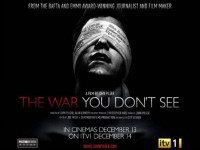
The War You Don’t See

This is what our government has prevented our media from showing us. There are seven parts to this video, but they all should be in this embed - if not, click on the video to go to YouTube and watch it there?

The War You Don’t See

The War You Don’t See

A powerful and timely investigation into the media’s role in war, tracing the history of ‘embedded’ and independent reporting from the carnage of World War One to the destruction of Hiroshima, and from the invasion of Vietnam to the current war in Afghanistan and disaster in Iraq. As weapons and propaganda become even more sophisticated, the nature of war is developing into an ‘electronic battlefield’ in which journalists play a key role, and civilians are the victims. But who is the real enemy?

John Pilger says in the film: “We journalists… have to be brave enough to defy those who seek our collusion in selling their latest bloody adventure in someone else’s country… That means always challenging the official story, however patriotic that story may appear, however seductive and insidious it is. For propaganda relies on us in the media to aim its deceptions not at a far away country but at you at home… In this age of endless imperial war, the lives of countless men, women and children depend on the truth or their blood is on us… Those whose job it is to keep the record straight ought to be the voice of people, not power.”