Showing posts with label academics. Show all posts

Friday, April 26, 2013

World Thinkers 2013 - Intellectuals Who Shape Our Thinking

This is clearly a British list, or at least the people who assembled it seem to be - it was commissioned and published by Prospect Magazine, from the UK. The placing of Richard Dawkins as the top thinker is a bit more than slightly disconcerting. Dawkins is a close-minded reductionist ideologue, and these are not traits I  find useful in a public intellectual.

The absence of E.O. Wilson (or Noam Chomsky) from the list was explained by The Guardian as due to his lack of influence in the last twelve months:
To qualify for this year's world thinkers rankings, it was not enough to have written a seminal book, inspired an intellectual movement or won a Nobel prize several years ago (hence the absence from the 65-strong long list of ageing titans such as Noam Chomsky or Edward O Wilson); the selectors' remit ruthlessly insisted on "influence over the past 12 months" and "significance to the year's biggest questions".
It's also a little disappointing to see Steven Pinker at #3 and Slavoj Žižek at #6. However, it is heartening to see Daniel Kahneman at #10. I would have expected to see Thomas Nagel (Mind and Cosmos: Why the Materialist Neo-Darwinian Conception of Nature Is Almost Certainly False) on this list somewhere - his latest book created a lot of serious discussion about the ability of science to provide answers in every realm of our lives.

World Thinkers 2013

by Prospect / APRIL 24, 2013

The results of Prospect’s world thinkers poll

Left to right: Ashraf Ghani, Richard Dawkins, Steven Pinker 
After more than 10,000 votes from over 100 countries, the results of Prospect’s world thinkers 2013 poll are in. Online polls often throw up curious results, but this top 10 offers a snapshot of the intellectual trends that dominate our age.

THE WINNERS

1. Richard Dawkins
When Richard Dawkins, the Oxford evolutionary biologist, coined the term “meme” in The Selfish Gene 37 years ago, he can’t have anticipated its current popularity as a word to describe internet fads. But this is only one of the ways in which he thrives as an intellectual in the internet age. He is also prolific on Twitter, with more than half a million followers—and his success in this poll attests to his popularity online. He uses this platform to attack his old foe, religion, and to promote science and rationalism. Uncompromising as his message may be, he’s not averse to poking fun at himself: in March he made a guest appearance on The Simpsons, lending his voice to a demon version of himself.

2. Ashraf Ghani
Few academics get the chance to put their ideas into practice. But after decades of research into building states at Columbia, Berkeley and Johns Hopkins, followed by a stint at the World Bank, Ashraf Ghani returned to his native Afghanistan to do just that. He served as the country’s finance minister and advised the UN on the transfer of power to the Afghans. He is now in charge of the Afghan Transition Coordination Commission and the Institute for State Effectiveness, applying his experience in Afghanistan elsewhere. He is already looking beyond the current crisis in Syria, raising important questions about what kind of state it will eventually become.

3. Steven Pinker
Long admired for his work on language and cognition, the latest book by the Harvard professor Steven Pinker, The Better Angels of Our Nature, was a panoramic sweep through history. Marshalling a huge range of evidence, Pinker argued that humanity has become less violent over time. As with Pinker’s previous books, it sparked fierce debate. Whether writing about evolutionary psychology, linguistics or history, what unites Pinker’s work is a fascination with human nature and an enthusiasm for sharing new discoveries in accessible, elegant prose.

4. Ali Allawi
Ali Allawi began his career in 1971 at the World Bank before moving into academia and finally politics, as Iraq’s minister of trade, finance and defence after the fall of Saddam Hussein. Since then he has written a pair of acclaimed books, most recently The Crisis of Islamic Civilisation, and he is currently a senior visiting fellow at Princeton. “His scholarly work on post-Saddam Iraq went further than anyone else has yet done in helping us understand the complex reality of that country,” says Clare Lockhart, co-author (with Ashraf Ghani) of Fixing Failed States. “His continuing work on the Iraqi economy—and that of the broader region—is meanwhile helping to illuminate its potential, as well as pathways to a more stable and productive future.”

5. Paul Krugman
As a fierce critic of the economic policies of the right, Paul Krugman has become something like the global opposition to fiscal austerity. A tireless advocate of Keynesian economics, he has been repeatedly attacked for his insistence that government spending is critical to ending the recession. But as he told Prospect last year, “we’ve just conducted what amounts to a massive experiment on pretty much the entire OECD [the industrialised world]. It’s been as slam-dunk a victory for a more or less Keynesian view as one can possibly imagine.” His New York Times columns are so widely discussed that it is easy to overlook his academic work, which has won him a Nobel prize and made him one of the world’s most cited economists.

6. Slavoj Žižek
Slavoj Žižek’s critics seem unsure whether to dismiss him as a buffoon or a villain. The New Republic has called him “the most despicable philosopher in the west,” but the Slovenian’s legion of fans continues to grow. He has been giving them plenty to chew on—in the past year alone he has produced a 1,200-page study of Hegel, a book, The Year of Dreaming Dangerously, analysing the Arab Spring and other recent events, and a documentary called The Pervert’s Guide to Ideology. And he has done all this while occupying academic posts at universities in Slovenia, Switzerland and London. His trademark pop culture references (“If you ask me for really dangerous ideological films, I’d say Kung Fu Panda,” he told one interviewer in 2008) may have lost their novelty, but they remain a gentle entry point to his studies of Lacanian psychoanalysis and left-wing ideology.

7. Amartya Sen
Amartya Sen will turn 80 in November—making him the fourth oldest thinker on our list—but he remains one of the world’s most active public intellectuals. He rose to prominence in the early 1980s with his studies of famine. Since then he has gone on to make major contributions to developmental economics, social choice theory and political philosophy. Receiving the Nobel prize for economics in 1998, he was praised for having “restored an ethical dimension to the discussion of vital economic problems.” The author of Prospect’s first cover story in 1995, Sen continues to write influential essays and columns, in the past year arguing against European austerity. And he shows no sign of slowing down or narrowing his focus—his latest book (with Jean Drèze), An Uncertain Glory: India and its Contradictions, will be published in July.

8. Peter Higgs
The English physicist Peter Higgs lent his name to the Higgs boson, the subatomic particle discovered last year at Cern that gives mass to other elementary particles. Although Higgs is always quick to point out that others were involved in early work on the existence of the particle, he was central to the first descriptions of the boson in 1964. “Of the various people who contributed to that piece of theory,” Higgs told Prospect in 2011, “I was the only one who pointed to this particle as something that would be… of interest for experimentalists.” Higgs is expected to receive a Nobel prize this year for his achievements.

9. Mohamed ElBaradei
The former director general of the UN’s international atomic energy agency and winner of the 2005 Nobel peace prize, Mohamed ElBaradei has become one of the most prominent advocates of democracy in Egyptian politics over the past two years. Since December, ElBaradei has been the coordinator of the National Salvation Front, a coalition of political parties dedicated to opposing what they see as President Mohamed Morsi’s attempts to secure power for himself and impose a new constitution favouring Islamist parties. Reflecting widespread concern about Morsi’s actions, ElBaradei has accused the president of appointing himself “Egypt’s new pharaoh.”

10. Daniel Kahneman
Since the publication of Thinking, Fast and Slow in 2011, Daniel Kahneman has become an unlikely resident at the top of the bestseller lists. His face has even appeared on posters on the London Underground, with only two words of explanation: “Thinking Kahneman.” Although he is a psychologist by training, his work on our capacity for making irrational decisions helped create the field of behavioural economics, and he was awarded the Nobel prize for economics in 2002. His book has now brought these insights to a wider audience, making them more influential than ever.

Biographies by Daniel Cohen, Jay Elwes and David Wolf. Additional research by Luke Neima and Lucy Webster

RANKINGS 11 TO 65

11. Steven Weinberg, physicist
12. Jared Diamond, anthropolgist
13. Oliver Sacks, psychologist
14. Ai Weiwei, artist
15. Arundhati Roy, writer
16. Nate Silver, statistician
17. Asgar Farhadi, filmmaker
18. Ha-Joon Chang, economist
19. Martha Nussbaum, philosopher
20. Elon Musk, businessman
21. Michael Sandel, philosopher (see below)
22. Niall Ferguson, historian
23. Hans Rosling, statistician
24 = Anne Applebaum, journalist
24 = Craig Venter, biologist
26. Shinya Yamanaka, biologist
27. Jonathan Haidt, psychologist
28. George Soros, philanthropist
29. Francis Fukuyama, political scientist
30. James Robinson and Daron Acemoglu, political scientist and economist
31. Mario Draghi, economist
32. Ramachandra Guha, historian
33. Hilary Mantel, novelist
34. Sebastian Thrun, computer scientist
35. Zadie Smith, novelist
36 = Hernando de Soto, economist
36 = Raghuram Rajan, economist
38. James Hansen, climate scientist
39. Christine Lagarde, economist
40. Roberto Unger, philosopher
41. Moisés Naím, political scientist
42. David Grossman, novelist
43. Andrew Solomon, writer
44. Esther Duflo, economist
45. Eric Schmidt, businessman
46. Wang Hui, political scientist
47. Fernando Savater, philosopher
48. Alexei Navalny, activist
49. Katherine Boo, journalist
50. Anne-Marie Slaughter, political scientist
51. Paul Collier, development economist
52. Margaret Chan, health policy expert
53. Sheryl Sandberg, businesswoman
54. Chen Guangcheng, activist
55. Robert Shiller, economist
56 = Ivan Krastev, political scientist
56 = Nicholas Stern, economist
58. Theda Skocpol, sociologist
59 = Carmen Reinhart, economist
59 = Ngozi Okonjo-Iweala, economist
61. Jeremy Grantham, investment strategist
62. Thomas Piketty and Emmanuel Saez, economists
63. Jessica Tuchman Mathews, political scientist
64. Robert Silvers, editor
65. Jean Pisani-Ferry, economist

ANALYSIS

Only three thinkers from our 2005 top 10, Richard Dawkins, Paul Krugman and Amartya Sen, appear in this year’s top spots. The panelists who drew up the longlist of 65 gave credit for the currency of candidates’ work—their influence over the past 12 months and their continuing significance for this year’s biggest questions.

Among the new entries at the top are Peter Higgs—whose inclusion is a sign of public excitement about the discoveries emerging from the world’s largest particle physics laboratory, Cern—and Slavoj Žižek, whose critique of global capitalism has gained more urgency in the wake of the financial crisis. The appearance of Steven Pinker and Daniel Kahneman, authors of two of the most successful recent “ideas books,” further demonstrates the public appetite for serious, in-depth thinking in the age of the TED talk. The inclusion of Ashraf Ghani, Ali Allawi and Mohamed ElBaradei—from Afghanistan, Iraq and Egypt, respectively—reflects the importance of their work on fostering democracies across the Muslim world in the wake of foreign interventions and the Arab Spring.

One new development was the influence of social media, with just over half of voters coming to the world thinkers homepage via Twitter or Facebook. Twitter also gave readers a chance to respond to the list and highlight notable omissions—Stephen Hawking and Noam Chomsky were popular choices.

As always, the absences are as revealing as the familiar names at the top. The failure of environmental thinkers to win many votes may be a sign of the faltering energy of the green movement. Despite the presence of climate scientists lower down the list, the movement seems to lack successors to influential public intellectuals such as Rachel Carson and James Lovelock. Serious thinkers about the internet and technology are also conspicuous by their absence. The highest-placed representative of Silicon Valley is the entrepreneur Elon Musk, but beyond journalist-critics such as Evgeny Morozov and Nicholas Carr, technology still awaits its heavyweight public intellectuals (see Thomas Meaney, £).

Most striking of all is the lack of women at the top of this year’s list. The highest-placed woman in this year’s poll, at number 15, is Arundhati Roy, who has become a prominent left-wing critic of inequalities and injustice in modern India since the publication of her novel The God of Small Things over a decade ago.

Many thanks to all those who voted. Do let us know what you make of the results.

David Wolf

MORE ON THE WORLD THINKERS OF 2013:

Wednesday, January 16, 2013

The RSA - Unleashing Greatness: Getting the best from an academised system


The RSA has released a new report, Unleashing greatness: Getting the best from an academised system, which is available for a free download at the included link. To Launch the RSA / Pearson Think Tank Academies Commission final report, Christine Gilbert, former Head of Ofsted presents the key recommendations of the report, following consideration of evidence submitted since May 2012.
Unleashing greatness: Getting the best from an academised system

The scale and speed of the Academies programme is dramatic: from 2003 academies in May 2010 the total number had reached 2456 by November 2012. The Academies commission was asked to consider both the impact of the academies programme to date and what should happen when the majority of schools may be academies. The Commission’s report, published here, looks at the opportunities and risks associated with academisation, and makes important recommendations as to how further change might be implemented so that all children and young people experience the benefits of academisation.

Dowload Unleashing greatness: Getting the best from an academised system (PDF 3.4MB)
Here is the talk given by Ms. Gilbert:
Unleashing Greatness?

10th Jan 2013

Listen to the audio
(full recording including audience Q&A)
Please right-click link and choose "Save Link As..." to download audio file onto your computer.

Launch of the RSA / Pearson Think Tank Academies Commission final report 


Christine Gilbert, former Head of Ofsted presents the key recommendations of the RSA / Pearson Think Tank Academies Commission, following consideration of evidence submitted since May 2012.

An expert panel will examine the new educational landscape which has emerged with the implementation of the academies programme and discuss responsibilities for teachers, governors, parents and policymakers.

Discussants to include: Andreas Schleicher, deputy director of education, OECD; Dr Vanessa Ogden, headteacher, Mulberry School for Girls; and David Carter, executive principal, Cabot Learning Federation

Chair: Matthew Taylor, chief executive, RSA

Read the Report: Unleashing greatness: Getting the best from an academised system

Suggested hashtag for Twitter users: #acadcomm

The Academies Commission


Set up by the RSA and the Pearson Think Tank, with sponsorship from The Cooperative and CfBT, the ‘Speed Commission’ is chaired by former Head of Ofsted Professor Christine Gilbert. She is joined by Commissioners Professor Chris Husbands (Director of the Institute of Education), and Brett Wigdortz (CEO, TeachFirst).

The Commission addressed two principal questions: What are the implications of complete academisation for school improvement and pupil attainment? How can improvement and attainment best be secured within an academised system? As such it focuses on issues of governance and accountability, and on outcomes for all pupils.

Wednesday, December 19, 2012

Tom Bartlett - This Is Not a Profile of Nassim Taleb


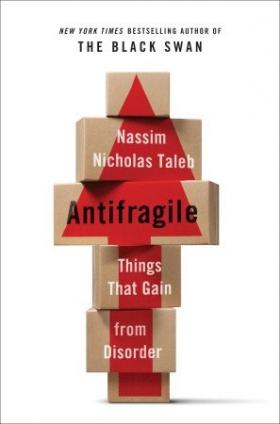
This is from a couple of days ago at the The Chronicle Review, a sort of but not really interview with noted risk engineering specialist and anti-academician Nassim Taleb, author of The Black Swan: Second Edition: The Impact of the Highly Improbable: With a new section: "On Robustness and Fragility" and his new book, Antifragile: Things That Gain from Disorder.

Taleb is a bit of a curmudgeon, which is not a bad trait in an author who seems to hate more things than he likes - but there are some things more than others:
editors who "overedit," when what they should really do is hunt for typos; unctuous, fawning travel assistants; "bourgeois bohemian bonus earners"; meetings of any kind; appointments of any kind; doctors; Paul Krugman; Thomas Friedman; nerds; bureaucrats; air conditioning; television; soccer moms; smooth surfaces; Harvard Business School; business schools in general; bankers at the Federal Reserve; bankers in general; economists; sissies; fakes; "bureaucrato-journalistic" talk; Robert Rubin; Google News; marketing; neckties; "the inexorable disloyalty of Mother Nature"; regular shoes.
I guess we'll have to read the book to know why these things and people made the list.

This Is Not a Profile of Nassim Taleb

By Tom Bartlett


This is a pretty long and interesting article, so here is only a section of it. Follow the link in the title above to see the whole piece.
Taleb is in the university but not of it. He spent the first couple decades of his career as a derivatives trader before turning to scholarship and essay writing in his mid-40s. Taleb is a professor of risk engineering at the Polytechnic Institute of New York University. Despite his wall of degrees (he has an M.B.A. from the University of Pennsylvania's Wharton School and a doctorate from the University of Paris), he believes that universities propagate "touristification," another term he coined, a phenomenon that occurs when what should be an exciting exploration turns into a programmatic exercise. It's better to be an adventurer than a tourist. Education isn't the only result of this modern sin; gym machines and "the electronic calendar" fall short as well.

Taleb has a low opinion of most professors. He titles one section of the new book "The Charlatan, the Academic, and the Showman." In a chart, Taleb divides professions into three categories: fragile, robust, and antifragile. It's bad to be fragile, better to be robust, best to be antifragile. Artists and writers are antifragile. Postal employees and truck drivers are robust. Academics, bureaucrats, and the pope are fragile. Benedict, beware.

Most of Taleb's ire is directed at business schools, specifically the one at Harvard. At Harvard they "lecture birds to fly," then arrogantly claim credit when the fledglings become airborne. He rails against the "Soviet-Harvard delusion," linking an institution that's graduated thousands with a state that killed millions. What is the delusion, exactly? It is a belief in a top-down system that tries to control and protect, purportedly for mankind's benefit, thereby eliminating the natural stressors and necessary randomness that create strength and encourage enterprise. Dekulakization and course catalogs are symptoms of the same ailment.

Taleb has no patience for so-called structured learning. "Only the autodidacts are free," he writes in the book. He pursued his real education in his spare time, doing only as much as was required to pass his courses. At 13, he set himself a goal of reading for 30 to 60 hours a week, pretty much a full-time job. To prove that he hit the books with enthusiasm, Taleb ticks off the names of more than 30 great writers he has read. We don't learn much about what he gleaned from this ardent page-turning or which authors influenced his own style. He does give the following assessment of the work of Austrian novelist Stefan Zweig: "didn't like."

Actually, Antifragile feels like a compendium of people and things Taleb doesn't like. He is, for instance, annoyed by editors who "overedit," when what they should really do is hunt for typos; unctuous, fawning travel assistants; "bourgeois bohemian bonus earners"; meetings of any kind; appointments of any kind; doctors; Paul Krugman; Thomas Friedman; nerds; bureaucrats; air conditioning; television; soccer moms; smooth surfaces; Harvard Business School; business schools in general; bankers at the Federal Reserve; bankers in general; economists; sissies; fakes; "bureaucrato-journalistic" talk; Robert Rubin; Google News; marketing; neckties; "the inexorable disloyalty of Mother Nature"; regular shoes.

The social sciences make the list, too. He contrasts them with "smart" sciences, like physics. He mocks social scientists as mired in "petty obsessions, envy, and icy-cold hatreds," contrasting the small-mindedness of academe with the joie de vivre of the business world. "My experience is that money and transactions purify relations," he writes. "Ideas and abstract matters like 'recognition' and 'credit' warp them, creating an atmosphere of perpetual rivalry." In our interview, he went even further, saying he would "shut down" the social sciences. "Those guys are living in their own world," he said. "That is the truth. You don't need them."

I pointed out that he praises some psychologists, like Daniel Kahneman, and regularly refers to psychological concepts in Antifragile. Would he padlock the psych labs, too? No, he told me. "Psychology is more empirical," he clarified. Sociologists, on the other hand, would presumably be better off delivering mail.

He saves his iciest hate for economists. Taleb has no use for the "charlatanic" field, comparing economic research to medieval medicine. Economists are, in his estimation, weak, ignorant, fearful, and generally pathetic. At one point he fantasizes about beating up an economist in public.

Taleb singles out his least-favorite economists, including Robert C. Merton, a professor of finance at MIT, formerly of Harvard, and Myron Scholes, a professor emeritus of finance at Stanford, who jointly received the Nobel Prize in 1997 for their model of valuing derivatives that's designed to hedge against risk. Merton is "serious, mechanistic, boring," according to Taleb, and the two used "fictional mathematics" in their research. He calls this "unsettling" in a footnote, though in the earlier draft he sent me he used a harsher word. I'd wager that punch may have been pulled by Random House's legal department. Merton didn't return my messages, and Scholes politely declined to comment.

Gary Pisano, however, was willing to talk. Pisano, a professor of business administration at Harvard, is singled out in the book for his "dangerous" thinking; Taleb hammers him for supposedly misunderstanding the market for biotechnology. Pisano told me Taleb didn't know what he was talking about. "His argument is about these rare events that generate huge returns," he said. "That doesn't happen in biotech." The specifics of that debate aside, Pisano shrugged off the criticism and said he had enjoyed Taleb's work in the past: "I think he writes some very interesting and provocative things, but I think it gets a little lost in the manner."

The idea that Taleb's insights are sometimes overwhelmed by his belligerence is a longstanding criticism. Articles published in the American Statistician soon after The Black Swan appeared chastised him for his alleged ignorance of "entire subfields of statistics," committing mathematical errors, and lobbing "gratuitous insults" at statisticians. The opprobrium was mixed with gratitude that, whatever his faults, Taleb had managed to shine a bright light on an arcane topic. Still, you got the sense that statisticians were smarting. Taleb's fans—and there are many of them—see his abrasiveness as proof that he doesn't tolerate nonsense. They show up in droves to hear him speak, leave rapturous reviews on Amazon, and praise his television appearances. One YouTube commenter put it succinctly: "He's so awesome."

While Taleb dislikes the university system and doesn't respect career academics, he's not against education per se. Studying mathematics is fine for its own sake. And it's worthwhile to read the classics. But modern scholarship is bewitched by novel findings—what Taleb dubs "neomania"—and researchers are driven by their need to publish, perverting their efforts and tainting the outcome. "How can knowledge be something you do for professional advancement?" he asked. But, you might counter, Taleb is a professor at a university who publishes in journals. It would be one thing if he were blogging from a cabin somewhere, but isn't he part of the problem he's identified?

Ah, but he doesn't publish papers to advance his career. They are technical addenda to his popular books. "I ban myself from publishing anything outside of these footnotes," he writes in Antifragile. Because of his success, he is not beholden to deans and committees or anyone else, for that matter. "You cannot rely on external confirmation and have a happy life," he told me. "I don't rely on external confirmation, and I have a happy life."
Read the whole article.

Wednesday, August 15, 2012

Academics are Revolting: The open access frontier


From Mean Land, an excellent article on the scam that is academic publishing. Where else can you make people (or institutions) pay to get their articles published and then make those same institutions pay incredible sums to have that journal in their library, and then make individuals like me pay between $10 and $50 dollars for access to the article (which is generally time limited, so I am not buying it so much as renting it)?

Open access fixes the problem, although now journals offer an open access option that costs the authors even more money then to get their article published - something needs to change. 

Academics are Revolting: The open access frontier

Posted at Friday 08 Jun
by Catherine Moffat.

Here’s the deal. You work hard to produce something, then sell it for a pittance. Perhaps you even give it away. The buyer ‘adds value’ and sells it back to you at an enormous profit. It’s standard sweatshop practice.

It can also be, in some cases, standard publishing practice. Authors and creators, keen to add the ‘value’ and prestige of a publisher to their work, or just excited that someone – anyone, is interested in publishing them, often give their work away with little thought of remuneration or what’s happening to their copyright.

Of course, publishers rightly argue they have the costs of editing, producing, advertising and distribution, not to mention the financial risks. It’s about adding value.

The rush to publish in ‘quality’ journals at any cost is particularly true of academic publishing. Academics are driven by a ‘publish or perish’ mandate where promotion and tenure is largely reliant on publishing and citation counts in accredited peer reviewed publications. Check out what’s happening at Sydney University (and coming soon to a university near you) where a retrospective performance marker of four research publications in the last three years is being used as one criteria to cull the ‘non performing’.

Of course, academics, unlike your average author, generally have the benefit of an income that is independent of their publications. As Louise Adler pointed out in The Australian last year, authors and creators not publishing in academia are probably in more actual danger of perishing, given, ‘the average annual income of Australian writers has declined in the past decade from $23,000 to a character-building $11,000.’
But while non-academic authors might be teetering on the breadline, operating outside of academic publishing models does provide the opportunity (and probably a more immediate incentive) to experiment with new modes of production.

In a recent appearance at the Sydney Writer’s Festival on a panel discussing the implications of the Protect Intellectual Property Act (PIPA) and the Stop Online Piracy Act (SOPA), Jeff Jarvis stressed the need for authors to develop new business models. While this may be good advice, many authors, and academic authors in particular, risk becoming trapped in their existing arrangements, relying on proving their publication record in traditional formats.

But as the cost of academic journals rise, many are asking who benefits most from the current model? Philip Soos in a piece on the Conversation, ‘The Great Publishing Swindle’, argues that what was intended as a public good has become a publishing monopoly.

Danny Kingsley, also writing on The Conversation about the US Research Works Act – A Small Bill in the US, a Giant Impact for Research Worldwide breaks it down like this:

‘Publicly funded research being undertaken by researchers who are often themselves (in Australia almost exclusively) also publicly funded, is written up and submitted to a publisher. The publisher sends it back out to the academic community to peer review the work, for no charge. Many of the editors of journals are also academics who again are doing the work gratis. The publisher then adds the journal design to the article and publishes it, charging disproportionally large subscription fees for access to the work. These fees are paid by university libraries, again, with public funding.’

And they are big fees. Each year university libraries pay millions of dollar to give scholars the right to access material that in the main has been provided by the same scholars, free of charge. Prices continue to increase while University budgets diminish and as Adam Habib outlines, developing countries are priced out of the market.

While authors are using the internet to experiment with new ways to reach their audience, many academics are also revolting and choosing open access publishing models that offer the same peer reviewed guarantee while allowing anyone who wants, access to their work.

Take a look at this open-access.net clip for a really simple overview:


Most users of the web, including authors and creators, aren’t interested in all this closed/open access and copyright stuff. Authors put their work on the internet and users take it for free if they can. Many people don’t realise that the internet is governed by the same copyright laws that exist in physical space. Others don’t care. But if you’ve been yawning behind your hand, consider this: One of the really interesting things about all the new google/facebook and other whizz gadgetry that allows your every move to be traced, is the potential to make it really easy to track the use of copyright material.

Unless you’re Kim.Dotcom making an estimated $175 million from alleged illegal filesharing, it’s unlikely you’ll find the FBI on your doorstep any time soon. I can’t help thinking, however, that we’ve been living in the digital equivalent of a frontier town, and sooner or later, for good or ill, the lawmen ride in and the frontier gets tamed.

Big Copyright has been slow to mobilize and grasp the monetary potential of the web, but it’s starting to lumber to its feet, and when it gets there you can be sure the 99% are going to be left hanging. PIPA and SOPA, the Research Works Act, extensions to copyright embedded in free trade agreements and similar actions are indications that the giant is awake now.

Copyright is like superannuation and interest rates – something no one pays attention to until they have to. But it’s important for authors and creators to think about how they want others to access their work. If you want others to access your work freely, make it clear. If you want them to pay, make it easy for them to do so. Read the contracts you sign. Because the reality is, if you don’t think about what’s happening to your copyright, someone else will.