Showing posts with label creative commons. Show all posts

Tuesday, July 01, 2014

The Internet’s Own Boy: The Story of Aaron Swartz - New Documentary Is Free Online


This story is a tragedy, in my opinion. Aaron Swartz was being made an example of for having embarrassed the government on a couple of occasions. Even the case for which charges were finally brought did not cause any financial harm to his target (JSTOR), who urged the government to drop the charges. The Feds refused - Swartz's conviction would serve as a warning. Instead, the young man hanged himself in his NYC apartment.

Here is a key passage that explains why so many of us supported Swartz's "work":
Swartz’s manifesto didn’t just call for the widespread illegal downloading and sharing of copyrighted scientific and academic material, which was already a dangerous idea. It explained why. Much of the academic research held under lock and key by large institutional publishers like Reed Elsevier had been largely funded at public expense, but was now being treated as private property – and as Swartz understood, that was just one example of a massive ideological victory for corporate interests that had penetrated almost every aspect of society. The actual data theft for which Swartz was prosecuted, the download of a large volume of journal articles from the academic database called JSTOR, was largely symbolic and arguably almost pointless. (As a Harvard graduate student at the time, Swartz was entitled to read anything on JSTOR.)
Academic publishers like Reed Elsevier, JSTOR, Science Direct, Nature, Hindawi, Springer, and others control nearly all of the published research in nearly every field, much of which is funded by tax dollars either directly or indirectly.

These publishers then charge authors hundreds [sometimes thousands] of dollars to publish, and charge more if the author wants open access; they charge for images in articles; they charge libraries hundreds of dollars for subscriptions, even digital subscriptions; and they try to charge consumers (like me) between $30 and $70 for use of an article (often on 24 hours).

Anyway, first up here is a review of the film and the life of its subject, via Salon, followed by an open access version of the film from Open Culture.

“The Internet’s Own Boy”: How the government destroyed Aaron Swartz

A film tells the story of the coder-activist who fought corporate power and corruption -- and paid a cruel price

Andrew O'Hehir |


Aaron Swartz (Credit: TakePart/Noah Berger)

Brian Knappenberger’s Kickstarter-funded documentary The Internet’s Own Boy: The Story of Aaron Swartz, which premiered at Sundance barely a year after the legendary hacker, programmer and information activist took his own life in January 2013, feels like the beginning of a conversation about Swartz and his legacy rather than the final word. This week it will be released in theaters, arriving in the middle of an evolving debate about what the Internet is, whose interests it serves and how best to manage it, now that the techno-utopian dreams that sounded so great in Wired magazine circa 1996 have begun to ring distinctly hollow.

What surprised me when I wrote about “The Internet’s Own Boy” from Sundance was the snarky, dismissive and downright hostile tone struck by at least a few commenters. There was a certain dark symmetry to it, I thought at the time: A tragic story about the downfall, destruction and death of an Internet idealist calls up all of the medium’s most distasteful qualities, including its unique ability to transform all discourse into binary and ill-considered nastiness, and its empowerment of the chorus of belittlers and begrudgers collectively known as trolls. In retrospect, I think the symbolism ran even deeper. Aaron Swartz’s life and career exemplified a central conflict within Internet culture, and one whose ramifications make many denizens of the Web highly uncomfortable.

For many of its pioneers, loyalists and self-professed deep thinkers, the Internet was conceived as a digital demi-paradise, a zone of total freedom and democracy. But when it comes to specifics things get a bit dicey. Paradise for whom, exactly, and what do we mean by democracy? In one enduringly popular version of this fantasy, the Internet is the ultimate libertarian free market, a zone of perfect entrepreneurial capitalism untrammeled by any government, any regulation or any taxation. As a teenage programming prodigy with an unusually deep understanding of the Internet’s underlying architecture, Swartz certainly participated in the private-sector, junior-millionaire version of the Internet. He founded his first software company following his freshman year at Stanford, and became a partner in the development of Reddit in 2006, which was sold to Condé Nast later that year.

That libertarian vision of the Internet – and of society too, for that matter – rests on an unacknowledged contradiction, in that some form of state power or authority is presumably required to enforce private property rights, including copyrights, patents and other forms of intellectual property. Indeed, this is one of the principal contradictions embedded within our current form of capitalism, as the Marxist scholar David Harvey notes: Those who claim to venerate private property above all else actually depend on an increasingly militarized and autocratic state. And from the beginning of Swartz’s career he also partook of the alternate vision of the Internet, the one with a more anarchistic or anarcho-socialist character. When he was 15 years old he participated in the launch of Creative Commons, the immensely important content-sharing nonprofit, and at age 17 he helped design Markdown, an open-source, newbie-friendly markup format that remains in widespread use.

One can certainly construct an argument that these ideas about the character of the Internet are not fundamentally incompatible, and may coexist peaceably enough. In the physical world we have public parks and privately owned supermarkets, and we all understand that different rules (backed of course by militarized state power) govern our conduct in each space. But there is still an ideological contest between the two, and the logic of the private sector has increasingly invaded the public sphere and undermined the ancient notion of the public commons. (Former New York Mayor Rudy Giuliani once proposed that city parks should charge admission fees.) As an adult Aaron Swartz took sides in this contest, moving away from the libertarian Silicon Valley model of the Internet and toward a more radical and social conception of the meaning of freedom and equality in the digital age. It seems possible and even likely that the Guerilla Open Access Manifesto Swartz wrote in 2008, at age 21, led directly to his exaggerated federal prosecution for what was by any standard a minor hacking offense.

Swartz’s manifesto didn’t just call for the widespread illegal downloading and sharing of copyrighted scientific and academic material, which was already a dangerous idea. It explained why. Much of the academic research held under lock and key by large institutional publishers like Reed Elsevier had been largely funded at public expense, but was now being treated as private property – and as Swartz understood, that was just one example of a massive ideological victory for corporate interests that had penetrated almost every aspect of society. The actual data theft for which Swartz was prosecuted, the download of a large volume of journal articles from the academic database called JSTOR, was largely symbolic and arguably almost pointless. (As a Harvard graduate student at the time, Swartz was entitled to read anything on JSTOR.)

But the symbolism was important: Swartz posed a direct challenge to the private-sector creep that has eaten away at any notion of the public commons or the public good, whether in the digital or physical worlds, and he also sought to expose the fact that in our age state power is primarily the proxy or servant of corporate power. He had already embarrassed the government twice previously. In 2006, he downloaded and released the entire bibliographic dataset of the Library of Congress, a public document for which the library had charged an access fee. In 2008, he downloaded and released about 2.7 million federal court documents stored in the government database called PACER, which charged 8 cents a page for public records that by definition had no copyright. In both cases, law enforcement ultimately concluded Swartz had committed no crime: Dispensing public information to the public turns out to be legal, even if the government would rather you didn’t. The JSTOR case was different, and the government saw its chance (one could argue) to punish him at last.

Knappenberger could only have made this film with the cooperation of Swartz’s family, which was dealing with a devastating recent loss. In that context, it’s more than understandable that he does not inquire into the circumstances of Swartz’s suicide in “Inside Edition”-level detail. It’s impossible to know anything about Swartz’s mental condition from the outside – for example, whether he suffered from undiagnosed depressive illness – but it seems clear that he grew increasingly disheartened over the government’s insistence that he serve prison time as part of any potential plea bargain. Such an outcome would have left him a convicted felon and, he believed, would have doomed his political aspirations; one can speculate that was the point. Carmen Ortiz, the U.S. attorney for Boston, along with her deputy Stephen Heymann, did more than throw the book at Swartz. They pretty much had to write it first, concocting an imaginative list of 13 felony indictments that carried a potential total of 50 years in federal prison.

As Knappenberger explained in a Q&A session at Sundance, that’s the correct context in which to understand Robert Swartz’s public remark that the government had killed his son. He didn’t mean that Aaron had actually been assassinated by the CIA, but rather that he was a fragile young man who had been targeted as an enemy of the state, held up as a public whipping boy, and hounded into severe psychological distress. Of course that cannot entirely explain what happened; Ortiz and Heymann, along with whoever above them in the Justice Department signed off on their display of prosecutorial energy, had no reason to expect that Swartz would kill himself. There’s more than enough pain and blame to go around, and purely on a human level it’s difficult to imagine what agony Swartz’s family and friends have put themselves through.

One of the most painful moments in “The Internet’s Own Boy” arrives when Quinn Norton, Swartz’s ex-girlfriend, struggles to explain how and why she wound up accepting immunity from prosecution in exchange for information about her former lover. Norton’s role in the sequence of events that led to Swartz hanging himself in his Brooklyn apartment 18 months ago has been much discussed by those who have followed this tragic story. I think the first thing to say is that Norton has been very forthright in talking about what happened, and clearly feels torn up about it.

Norton was a single mom living on a freelance writer’s income, who had been threatened with an indictment that could have cost her both her child and her livelihood. When prosecutors offered her an immunity deal, her lawyer insisted she should take it. For his part, Swartz’s attorney says he doesn’t think Norton told the feds anything that made Swartz’s legal predicament worse, but she herself does not agree. It was apparently Norton who told the government that Swartz had written the 2008 manifesto, which had spread far and wide in hacktivist circles. Not only did the manifesto explain why Swartz had wanted to download hundreds of thousands of copyrighted journal articles on JSTOR, it suggested what he wanted to do with them and framed it as an act of resistance to the private-property knowledge industry.

Amid her grief and guilt, Norton also expresses an even more appropriate emotion: the rage of wondering how in hell we got here. How did we wind up with a country where an activist is prosecuted like a major criminal for downloading articles from a database for noncommercial purposes, while no one goes to prison for the immense financial fraud of 2008 that bankrupted millions? As a person who has made a living as an Internet “content provider” for almost 20 years, I’m well aware that we can’t simply do away with the concept of copyright or intellectual property. I never download pirated movies, not because I care so much about the bottom line at Sony or Warner Bros., but because it just doesn’t feel right, and because you can never be sure who’s getting hurt. We’re not going to settle the debate about intellectual property rights in the digital age in a movie review, but we can say this: Aaron Swartz had chosen his targets carefully, and so did the government when it fixed its sights on him. (In fact, JSTOR suffered no financial loss, and urged the feds to drop the charges. They refused.)

A clean and straightforward work of advocacy cinema, blending archival footage and contemporary talking-head interviews, Knappenberger’s film makes clear that Swartz was always interested in the social and political consequences of technology. By the time he reached adulthood he began to see political power, in effect, as another system of control that could be hacked, subverted and turned to unintended purposes. In the late 2000s, Swartz moved rapidly through a variety of politically minded ventures, including a good-government site and several different progressive advocacy groups. He didn’t live long enough to learn about Edward Snowden or the NSA spy campaigns he exposed, but Swartz frequently spoke out against the hidden and dangerous nature of the security state, and played a key role in the 2011-12 campaign to defeat the Stop Online Piracy Act (SOPA), a far-reaching government-oversight bill that began with wide bipartisan support and appeared certain to sail through Congress. That campaign, and the Internet-wide protest of American Censorship Day in November 2011, looks in retrospect like the digital world’s political coming of age.

Earlier that year, Swartz had been arrested by MIT campus police, after they noticed that someone had plugged a laptop into a network switch in a server closet. He was clearly violating some campus rules and likely trespassing, but as the New York Times observed at the time, the arrest and subsequent indictment seemed to defy logic: Could downloading articles that he was legally entitled to read really be considered hacking? Wasn’t this the digital equivalent of ordering 250 pancakes at an all-you-can-eat breakfast? The whole incident seemed like a momentary blip in Swartz’s blossoming career – a terms-of-service violation that might result in academic censure, or at worst a misdemeanor conviction.

Instead, for reasons that have never been clear, Ortiz and Heymann insisted on a plea deal that would have sent Swartz to prison for six months, an unusually onerous sentence for an offense with no definable victim and no financial motive. Was he specifically singled out as a political scapegoat by Eric Holder or someone else in the Justice Department? Or was he simply bulldozed by a prosecutorial bureaucracy eager to justify its own existence? We will almost certainly never know for sure, but as numerous people in “The Internet’s Own Boy” observe, the former scenario cannot be dismissed easily. Young computer geniuses who embrace the logic of private property and corporate power, who launch start-ups and seek to join the 1 percent before they’re 25, are the heroes of our culture. Those who use technology to empower the public commons and to challenge the intertwined forces of corporate greed and state corruption, however, are the enemies of progress and must be crushed.


”The Internet’s Own Boy” opens this week in Atlanta, Boston, Chicago, Cleveland, Denver, Los Angeles, Miami, New York, Toronto, Washington and Columbus, Ohio. It opens June 30 in Vancouver, Canada; July 4 in Phoenix, San Francisco and San Jose, Calif.; and July 11 in Seattle, with other cities to follow. It’s also available on-demand from Amazon, Google Play, iTunes, Vimeo, Vudu and other providers.

* * * * *

Luckily for us (especially those of us in a town too small to get a showing of this film, or who can't afford to pay per view), there is an open access version of the film available online.


The Internet’s Own Boy: New Documentary About Aaron Swartz Now Free Online

Open Culture | June 29th, 2014

On BoingBoing today, Cory Doctorow writes: “The Creative Commons-licensed version of The Internet’s Own Boy, Brian Knappenberger’s documentary about Aaron Swartz, is now available on the Internet Archive, which is especially useful for people outside of the US, who aren’t able to pay to see it online…. The Internet Archive makes the movie available to download or stream, in MPEG 4 and Ogg. There’s also a torrentable version.”

According to the film summary, the new documentary “depicts the life of American computer programmer, writer, political organizer and Internet activist Aaron Swartz. It features interviews with his family and friends as well as the internet luminaries who worked with him. The film tells his story up to his eventual suicide after a legal battle, and explores the questions of access to information and civil liberties that drove his work.”

The Internet’s Own Boy will be added to our collection, 200 Free Documentaries Online, part of our larger collection, 675 Free Movies Online: Great Classics, Indies, Noir, Westerns, etc..

Monday, March 04, 2013

Why I Support Open Access Publishing - How Corporations Score Big Profits By Limiting Access To Publicly Funded Academic Research


Recently I was doing some research through Google Scholar and found a couple of articles relevant to what I was searching for, only to discover that they were behind a paywall. Generally, the hard sciences are more easily available to the public (i.e., open access) while the social sciences are not.


Anyway, here is the fee for one article (from SciVerse: Science Direct [Elsevier]):
Brain microglia constitutively express β-2 integrins
Journal of Neuroimmunology, Volume 30, Issue 1, November 1990, Pages 81-93
H. Akiyama, P.L. McGeer
If you do not have a Username and Password, click the "Register to Purchase" button below to purchase this article.
Price: US $ 31.50
Here is the required fee for another article (ingentaconnect):
Endogenous Regulators of Adult CNS Neurogenesis
Theo Hagg,
Current Pharmaceutical Design, Volume 13, Number 18, June 2007 , pp. 1829-1840(12)

Buy and download full text article:
Price: $63.10 plus tax
To get these two articles would cost me nearly $100. In many cases, the article fee is for 24 hours only, so you are essentially renting the article for $30 to $60. This is only the consumer side of things. Authors pay to get their manuscripts published, and they often pay more--a lot more--if they want to allow open access to their work. The institutions where the authors are doing their research (universities, most times) then have to pay enormous subscription fees to have the journals in their libraries, and even if they opt for digital only, the costs continue to increase.

Here is an in-depth look at this issue from Think Progress.

How Corporations Score Big Profits By Limiting Access To Publicly Funded Academic Research

By Andrea Peterson on Mar 3, 2013


"Red and blue liquids inside graduated test tubes" by Horia Varlan 
used under a Creative Commons Attribution 2.0 license

Here’s how the academic publishing industry works: Academics do research (frequently supported by public funds) and submit that research to journals, often paying “$600-$2,000 to either the publisher or the academic society that owns the journal” for the privilege of publication. Then journals send the research back out to other academics to be reviewed (typically pro-bono–a 2008 study estimated the worldwide worth of unpaid peer review was £1.9 billion a year), and the (often for-profit) journal publishers sell access to the published research, mostly to the academic institutions who do the majority of basic research.

The system is big business: The largest of the for profit academic publishers, Elsevier, reportedly earned over $1 billion in profits in 2011 with a profit margin around 35 percent and 71 percent of their revenue coming from academic customers like university libraries.

But the rapid inflation of journal subscription prices–the per subscription cost rose by 215% between 1986 and 2003–has left many of those universities struggling to keep up. In a statement last spring, the Harvard Faculty Council called rising costs to maintain access to scholarly works “untenable” and the University of California San Francisco Library spends 85 percent of their collection budget on journal subscriptions, but “[d]espite cancelling the print component of more than 100 journal subscriptions in 2012 to keep up with a budget reduction, [their] costs still increased by 3 percent.”

This major disconnect between how much of this research is funded and produced and who controls the final product has led to a flourishing Open Access movement with broad support among private and public academic institutions, focused on using technological innovations to democratize access to scholarly research and correct what they see as imbalances in the current system through reform on local and national levels. One such national reform they welcomed was the White House Office of Science and Technology Policy memorandum outlining a plan to open up access to research to some federally funded research.

ThinkProgress’ coverage of that announcement drew criticism from an executive at Elsevier:


When reached for comment, Elsevier head of Corporate Relations Tom Reller agreed with her comment and confirmed Smith is VP for Global Internal Communications for Reed Elsevier subsidiary Elsevier, but referred questions about the company’s support of Open Access movement to its website and a recent statement of support for the White House’s proposal. Elsevier’s website says the company “will continue to identify access gaps, and work towards ensuring that everyone has access to quality scientific content anytime, anywhere.”

But their parent company’s lobbying disclosures in 2012 and members of the Open Access community suggest a very different position. When asked over email if they have seen Elsevier and many of the for-profit academic publishers actively cooperate with the Open Access movement on advancing public access to federally funded research, Heather Joseph, the Executive Director of the Scholarly Publishing & Academic Resources Coalition (SPARC), balked at the suggestion:
Quite the opposite. SPARC and the Open Access community spent the first eight weeks of 2012 fighting The Research Works Act (H.R 3699) — a bill introduced into the House of Representatives with the sole aim of overturning the highly successful NIH Public Access Policy, and prohibiting other Federal Agencies from enacting similar policies. Elsevier and the American Association of Publishers were two of only three organizations who publicly endorsed the bill. 
If this was the first time they took this tactic, I might be tempted to cut them some slack. But it was a repeat performance; in 2008, they tried the same thing with “The Fair Copyright in Research Works Act (H.R. 801)” — a bill that tried to amend U.S. copyright code to make the NIH Policy — and policies like it — illegal.
According to the U.S. Senate Lobbying Database, Elsevier’s parent company Reed Elsevier spent $1,420,000 lobbying the U.S. government in 2012. Reed Elsevier’s in-house lobbying team disclosures and those from the Podesta Group listing Reed Elsevier as a client corroborate Wilson’s comments about their support for The Research Works Act — only withdrawingsupport after a boycott of from academic communities, according to news reports. That boycott continues today, and has attracted over 13,000 scholars and academics who object to Elsevier’s business practices.

Reed Elsevier lobbied OSTP on “[c]opyright issues related to scientific, technology, and medical publications” during the run up to the White House’s Open Access announcement and their in-house lobbying team reported working on “[i]ssues related to science, technical, medical and scholarly publications” and on “all provisions” of the Federal Research Public Access Act (FRPAA)–a proposal similar to the recently introduced Fair Access to Science and Technology Research Act (FASTR) that would have required federal agencies with annual extramural research budgets of $100 million or more to provide the public with online access to research manuscripts stemming from funded research no later than six months after publication in a peer-reviewed journal.

Elsevier was one of 81 publishers to sign a Association of American Publishers (AAP) letter opposing FRPAA, with AAP President and CEO Tom Allen calling it “little more than an attempt at intellectual eminent domain, but without fair compensation to authors and publishers.” Remember, these publishers claiming to be concerned about “fair compensation to authors,” are the same ones often charging them publication fees.

As Reller noted to ThinkProgress, the sum total of Reed Elsevier’s 2012 lobbying expenditures represents the all lobbying done in support of their business ventures and their disclosures list a number of bills unrelated to Open Access. Companies are not required to disclose what proportion of their total lobbying is spent on which topics. We do know that Elsevier, the corporate subsidiary involved with academic publishing, accounted for over 47 percent of Reed Elsevier’s adjusted operating profits in 2011.

While AAP released a statement in support of the White House’s plan Open Access memorandum, their comments praised how the plan only included guidelines for releasing research, not mandates, saying the policy’s success is dependent on “how the agencies use their flexibility to avoid negative impacts” on the current system and calling it fair “[i]n stark contrast to angry rhetoric and unreasonable legislation offered by some” — a reference to the Open Access movement. Elsevier’s similar response to the plan praised it for promoting “gold open access funded through publishing charges and flexible embargo periods for green open access” and dismissed Open Access legislative proposals, saying they would like “open-access advocates [to] withdraw their support from unnecessary and divisive open access legislation now introduced in the US at federal level.”

There’s ample room to credit the academic publishing industry’s history of serving as the shepherds of scholarly research — but technology has dramatically changed researchers’ ability to share knowledge without intermediaries. There is an ideological debate at hand, and it’s about if the public is better served by expanding access to the research they fund or protecting the interests of companies who have a substantial financial stake in limiting that access.

Wednesday, January 23, 2013

Jonathan Rowson - Who owns information: The defining battle of our time?


I am HUGE proponent of open access/Creative Commons publishing, especially for news and research (in all fields). If we are ever to have a true cultural commons, then we should have access to the information for which (many times) our tax dollars pays.

As the quote from Alan Swartz (below) makes clear, knowledge is power, but it is only power by keeping access controlled tightly so that others cannot have that same knowledge, thereby neutralizing the power.

This excellent article comes from Jonathan Rowson at The RSA.

Who owns information: The defining battle of our time?
January 22, 2013 by Jonathan Rowson
If you have an apple and I have an apple and we exchange these apples then you and I will still each have one apple. But if you have an idea and I have an idea and we exchange these ideas, then each of us will have two ideas. - George Bernard Shaw
Could our major problems have a discernible ‘form’ that is somehow more fundamental than their content? If there is some sort of pattern, wouldn’t it make sense to target the pattern as a whole, rather than individual issues piecemeal? Marxists might say that Capitalism as such is the underlying problem, but I don’t think we have to endorse that view to look for what Bateson once called “the pattern that connects“.

We will shortly be publishing a report examining Iain McGilchrist’s work that argues there is a discernible pattern relating to the distinctive phenomenologies of the two brain hemispheres. The claim is that many of our major problems relate to the fact that the ‘inferior’ (though definitely important) left hemisphere is slowly usurping the (wiser but more tentative) right hemisphere at a cultural level, with the consequence that we live increasingly virtual and instrumental lives, and may not even realise what we are losing. The details of that discussion are coming soon to a screen near you, but there are other ways to conceive the form of the problem.

Who controls information?
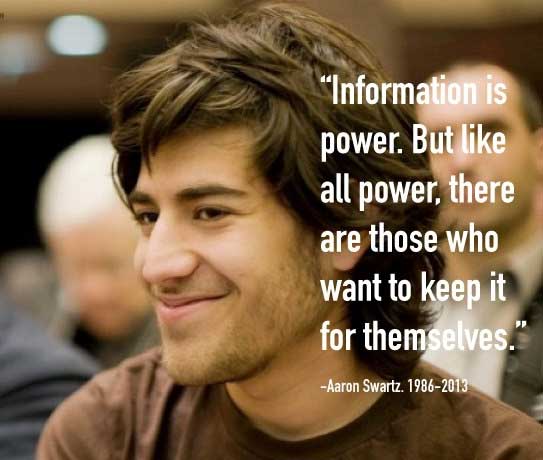
“Information is power. But like all power, there are those who want to keep it for themselves.” – Alan Swartz.
When you start to think deeply about our major challenges – including climate change – you quickly run into various vested interests that get in the way of solutions, and many such vested interests are preserved through unequal access to information – academic, technological, legal, environmental, political, financial and so forth. Information should be a public good, and benefits larger numbers when it is shared, but perhaps the main way that vested interests perpetuate their power is through the control and protection of information. For instance what do Shell tell us about their research into drilling in the Arctic, and how can we know it represents full disclosure? What if a doctor prescribes you medicine and you can’t access the relevant primary research because you run into a pay wall? What if the most promising components needed for a technological breakthrough on clean energy are patented by a small group, and therefore thousands of scientists can’t follow that path of inquiry?

“(American) politics is filled with easy cases that we get wrong. The scientific consensus on global warming is overwhelming, but we abandon the Kyoto Protocol. Nutritionists are clear that sugar is unhealthy, but the sugar lobby gets it into dietary recommendations. Retroactive copyright extensions do nothing for society, but Congress passes them over and over.Such control of information is deeply related to financial dependency. Those who control information are supported in their control by law and lawyers. An excerpt from a talk by Harvard academic and activist Lawrence Lessig captures the centrality of this point.

Similar errors are made in other fields that have the public trust. Studies of new drugs are biased towards the drug companies. Law professors and other scholars write papers biased towards the clients they consult for.

Why? Because the trusted people in each case are acting as dependants. The politicians are dependent on fundraising money. They are good people, but they need to spend a quarter of their time making fundraising calls. So most of the people they speak to our lobbyists and they never even hear from the other side. If they were freed from this dependence they would gladly do the right thing.

The scientists get paid to sign on to studies done by the drug companies. The law professors get paid to consult.

How do we solve it? We need to free people from dependency. But this is too hard. We should fight for it, but politicians will never endorse a system of public funding of campaigns when they have so much invested in the current system. Instead, we need norms of independence. People need to start saying that independence is important to them and that they won’t support respected figures who act as dependants. And we can use the Internet to figure out who’s acting as dependants.”

At the risk of simplification, the underlying problem is that the inequality in power is perpetuated by the unequal access to information, and this is a self-perpetuating problem because those with power based on information use it to create dependants, and these dependants thereby develop a vested interest in protecting the information that forms their livelihood.

Why did nobody tell me about Aaron Swartz?

I started to think about this when I realised, sadly, that I never knew the pioneering cyber activist Alan Swartz while he was alive. He recently ended his own life at the age of 26 under enormous legal and political pressure, but is viewed by many as a hero of our times who was driven over the edge by an excessively zealous witch hunt. He was known for being prodigious and hyper-intelligent, but is perhaps best known and admired for the way he swiftly conjured enormous political capital to prevent the SOPA (Stop online piracy act) law in the US which he speaks about so clearly and compellingly here (highly recommended viewing). In essence he prevented the passing of a law that would have radically undermined people’s capacity to connect and share information online, and the way he did so is inspiring, because it looked like he was facing impossible odds.


A friend and former RSA colleague Jamie Young remarked that if I was going to write about Alan Swartz, I should also mention the UK’s Chris Lightfoot who was a similar character fighting a similar kind of battle – a broadly political fight about who rightfully controls information- and also took his life at a young age. The RSA has raised similar questions before, for instance by hosting Evgeny Mozorov who’s talk on why Dictators love the internet was turned into an RSAnimate.

What follows?

What all these thinkers share is a belief that the access to information has much wider implications that people typically realise. As Professor Shamad Basheer puts it in the Spicy IP Blog We live in “a world where the powers that be conspire time and again to reassert hegemony and re-establish control in a digital world whose essential DNA is one of openness and sharing.”

The main take-home point for me lies in the gap between the social norms of sharing and openness online, with the economic and legal norms relating to the perpetuation of property rights and power that have been formed before the digital age. In Aaron Swartz’s case, this battle unfolded in his heart and mind to a tragic extent, but the more I think about it, the more it seems like an enormously important battle between the public good and private ownership that will be defined largely by the political will of the relevant institutions – which in turn is shaped by us (that’s what Lessig was getting at above about the need to shape social norms).

It may not make sense to ‘take sides’ as such, and there are certainly ways to protect intellectual property that are more canny and proportionate. (As an author of three books, all of which have been PDFed and sold cheaply by Xerox merchants online, I am also a kind of ‘dependant’ with a vested interest here).

Whatever you think, I would ask you to reflect on the opening quotation by George Bernard Shaw. Ideas need each other to flourish, but they can’t meet when they are help in captivity, and they will ultimately need some form of power to free them.

Saturday, January 12, 2013

Hacker, Open Commons Activist Aaron Swartz Commits Suicide


Sad that this has happened - he was only 26. Aaron Swartz was facing the possibility of dozens of years in prison for allegedly trying to share MIT academic journal articles on P2P file sharing sites. Over at ZDNet, Violet Blue provides the full story.

The charges were based on Swartz's sharing of four million academic articles from MIT, downloaded from the JSTOR site. Sadly, Swartz's suicide came two days after JSTOR announced it is releasing "more than 4.5 million articles" to the public.

Wired argued that many of the charges against Swartz were alleged Terms of Service violations. Their article strongly implies that the Department of Justice sought to make an example of Swartz:
The case tests the reach of the Computer Fraud and Abuse Act, which was passed in 1984 to enhance the government’s ability to prosecute hackers who accessed computers to steal information or to disrupt or destroy computer functionality. 
The government, however, has interpreted the anti-hacking provisions to include activities such as violating a website’s terms of service or a company’s computer usage policy, a position a federal appeals court in April said means “millions of unsuspecting individuals would find that they are engaging in criminal conduct.”
Asshats.

Hacker, Activist Aaron Swartz Commits Suicide

Summary: Aaron Swartz, hacker and information activist and Reddit cofounder, has committed suicide at age 26. UPDATED: Pirate Bay JSTOR torrent, public.resource.org memorial.


By Violet Blue for Zero Day | January 12, 2013

Reddit, Creative Commons and Demand Progress co-founder Aaron Swartz committed suicide in New York City on Friday, Jan. 11. He was 26 years old.


The tragedy was confirmed to MIT's The Tech by Swarz's uncle, and also his attorney.

This post has been updated to reflect public.resource.org going dark in mourning, and the extremely moving sharing of the JSTOR torrent on Pirate Bay to honor Swartz's memory.


Dedicated to the free and open Internet

Swartz was dedicated to sharing data and information online. He worked tirelessly to develop and popularize standards for free and open information sharing.


He co-authored RSS 1.0, developed the site theinfo.org, released the Python framework he developed web.py as free software, he co-founded Creative Commons, and he was a member of the Harvard University Ethics Center Lab.

Swartz co-founded Demand Progress, which launched the primary campaign against Internet censorship bills (SOPA/PIPA). His work on Reddit enabled millions to share information and news socially (Swartz sold Infogami to Reddit).

Aaron Swartz was facing a potential sentence of dozens of years in prison for allegedly trying to make MIT academic journal articles public.

Charged with felony hacking

In September 2012, Aaron Swartz was charged with thirteen counts of felony hacking.

In July 2011 Swartz was arrested for allegedly scraping 4 million MIT papers from the JSTOR online journal archive.

He appeared in court in Sept. 2012 and pled not guilty.

Swartz's subsequent struggle for money to offset legal fees to fight the Department of Justice and stay afloat was no secret.

After the September charges came down, the wife of Creative Commons founder Larry Lessig - social justice lawyer Bettina Neuefeind - established and organized the site free.aaronsw.com to raise money for his defense.
Read the whole article.