Showing posts with label Chris Hedges. Show all posts

Thursday, May 15, 2014

Chris Hedges - The Power of Imagination

This is an interesting article from Chris Hedges - posted at TruthDig. Rather than the usual political analysis and criticism, here he waxes somewhat philosophical. However, he demonstrates a bit of the pre/trans fallacy that is an aspect of integral theory. Here is the key quote:
Only this premodern ethic can save us as we enter a future of economic uncertainty and endure the catastrophe of climate change. Social and economic life will again have to be communal. The lusts of capitalism will have to be tamed or destroyed. And there will have to be a recovery of reverence for the sacred, the bedrock of premodern society, so we can see each other and the earth not as objects to exploit but as living beings to be revered and protected. This means inculcating a very different vision of human society.
Yes, we need a deeper and more embodied sense of the sacred, but we do NOT need a return to the premodern ethic. The premodern worldview is characterized by magical thinking, superstition, and the lack of an essential, rational consciousness capable of post-formal thinking (symbolic thought as opposed to belief in power gods and correlations between human actions and forces of nature).

The best known example of this is the difference in how God is depicted in the Old Testament (wrathful, jealous, angry, punitive) and the God of the New Testament, as embodied in Jesus (loving, centered in justice, inclusive). The first is pre-rational, the later is rational.

What we need is a transpersonal, post-rational model of the sacred as a way to embody purpose in meaning in nature as something other than physical material to be exploited.

The Power of Imagination

Posted on May 11, 2014
By Chris Hedges
 

John William Waterhouse’s painting “Miranda—The Tempest.”

Those in the premodern world who hoarded possessions and refused to redistribute supplies and food, who turned their backs on the weak and the sick, who lived exclusively for hedonism and their own power, were despised. Those in modern society who are shunned as odd, neurotic or eccentric, who are disconnected from the prosaic world of objective phenomena and fact, would have been valued in premodern cultures for their ability to see what others could not see. Dreams and visions—considered ways to connect with the wisdom of ancestors—were integral to existence in distant times. Property was communal then. Status was conferred by personal heroism and providing for the weak and the indigent. And economic exchanges carried the potential for malice, hatred and evil: When wampum was exchanged by Native Americans the transaction had to include “medicine” that protected each party against “spiritual infection.”

Only this premodern ethic can save us as we enter a future of economic uncertainty and endure the catastrophe of climate change. Social and economic life will again have to be communal. The lusts of capitalism will have to be tamed or destroyed. And there will have to be a recovery of reverence for the sacred, the bedrock of premodern society, so we can see each other and the earth not as objects to exploit but as living beings to be revered and protected. This means inculcating a very different vision of human society.

Our greatest oracles have sought to impart this wisdom. William Shakespeare lamented the loss of the pagan rituals eradicated by the Reformation. When Shakespeare was a boy, the critic Harold Goddard pointed out, he experienced the religious pageants, morality plays, church festivals, cycle plays, feast and saint days, displays of relics, bawdy May Day celebrations and tales of miracles that made up the belief system during the reign of the medieval Catholic Church. The Puritans, the ideological vanguard of the technological order, would eventually ban or greatly weaken all of these, and they made war on the Elizabethan and Jacobean theaters for celebrating these premodern practices. The London authorities in 1596 prohibited the public presentation of plays within city limits. Theaters had to relocate to the south side of the River Thames. The Puritans, in power under Cromwell in 1642, closed the London theaters. In Puritan New England at about the same time the authorities banned games, revels and “harlotry plays.” In 1644 the Puritans tore down Shakespeare’s Globe Theatre. Within four years all other theaters in and around London had been destroyed. The Puritans understood, in a way that is perhaps lost to us today, that Shakespeare subverts modernity.

Shakespeare portrays the tension between the premodern and the modern. He sees the rise of the modern as dangerous. The premodern reserved a place in the cosmos for human imagination. The new, modern, Machiavellian ethic of self-promotion, manipulation, bureaucracy and deceit—personified by Iago, Richard III and Lady Macbeth—deformed human society. Shakespeare lived during a moment when the modern world—whose technology allowed it to acquire weapons of such unrivaled force that it could conquer whole empires, including the Americas and later China—instilled through violence this new secular religion. He feared its demonic power.

Oracles were revered in premodern societies. These oracles were in touch with realities and forces that lay beyond the empirical. All societies have oracles—such as Thomas Paine, Emma Goldman, W.E.B. Du Bois and James Baldwin in the United States—but in a modern society they are pushed to the margins, ridiculed and often persecuted. Those who spoke out of their vision quests in Native American society, or from Delphi in ancient Greece, did not employ the cold, clinical language of science and reason. They spoke, rather, in the nebulous language of love, tenderness, patience, justice, redemption and forgiveness. They paid homage, and called on us to pay homage, to the mysterious incongruities of human existence. A society that loses its respect for the sacred, that ignores its oracles and severs itself from the power of human imagination, ensures its obliteration.

Reason makes possible the calculations, science and technological advances of industrial civilization. But reason does not lift us upward to the heavens. It does not bring us into contact with the sacred. It does not permit us to curb our self-destructive urges. Herman Melville, Fyodor Dostoevsky, Emily Dickinson, Marcel Proust, William Faulkner, James Joyce, Samuel Beckett, Lorraine Hansberry and August Wilson mocked the myth of human progress and the folly of hubris. They, like Shakespeare, warned that conflating technological advancement with human progress deforms us.

Prospero in Shakespeare’s “The Tempest” is master of an enchanted island where he has absolute power. He keeps the primitive Caliban and the spirit Ariel as his slaves. The play is about liberty, love and the capacity for awe. It reminds us that the power unleashed in the wilderness can prompt us to good if we honor the sacred but to monstrous evil if we do not. There are few constraints in the wilderness, a theme that would later be explored by the novelist Joseph Conrad. Imagination triumphed in “The Tempest” because those who were bound to their senses and lusts were subjugated. However, overseas in the American colonies, as Shakespeare knew, the poison of dark passions embodied by the Calibans and evil dukes of the world had unleashed an orgy of greed, theft and genocide.

Those who worship themselves, the essence of the modern, commit spiritual suicide. In love with himself after seeing his reflection in a pond, Narcissus is doomed, as many in the modern world are, by vanity, celebrity and the need for admirers and sycophants. Narcissists master the arts of manipulation, seduction, power and control. They eschew empathy, honesty, trust and transparency. It is a form of mental illness.

It is through imagination that we can reach the dark regions of the human psyche and face our mortality and the brevity of existence. It is through imagination that we can recover reverence and kinship. It is through imagination that we can see ourselves in our neighbors and the other living organisms of the earth. It is through imagination that we can envision other ways to form a society. The triumph of modern utilitarianism, implanted by violence, crushed the primacy of the human imagination. It enslaved us to the cult of the self. And with this enslavement came an inability to see, the central theme of “King Lear.” Imagination, as Goddard wrote, “is neither the language of nature nor the language of man, but both at once, the medium of communion between the two—as if the birds, unable to understand the speech of man, and man, unable to understand the songs of birds, yet longing to communicate, were to agree on a tongue made up of sounds they both could comprehend—the voice of running water perhaps or the wind in the trees. Imagination is the elemental speech in all senses, the first and the last, of primitive man and of the poets.”

All of the great visionaries and leaders of the Indian tribes, from medicine men like Black Elk and Sitting Bull to warriors such as Crazy Horse, in the presence of the natural world heard it speak to them, in the same way it spoke to Shakespeare, Dickinson or Walt Whitman. All elements of life, especially those that lie beyond articulation, infuse the human imagination. The communion—accentuated by vision quests, the sanctity of dreams, odd occurrences, miracles and the wonder of nature, as well as rituals that take place within a communal society—blurs the lines between the self and the world. This ability to connect with the sacred is what Percy Shelley meant when he wrote that poetry “lifts the veil from the hidden beauty of the world and makes familiar things as if they were not familiar.” We are reminded at that moment of the wonder of life and our insignificance in the vastness of the cosmos, reminded that, as Prospero said, “we are such stuff as dreams are made on.” Too often this wisdom comes too late, as it does when Othello stands over the dead Desdemona or Lear over his executed daughter, Cordelia. This wisdom makes grace possible. Songs, poetry, music, theater, dance, sculpture, art, fiction and ritual move human beings toward the sacred. They clear the way for transformation. The prosaic world of facts, data, science, news, technology, business and the military is cut off from the mysteries of creation and existence. We will recover this imagination, this capacity for the sacred, or we will vanish as a species. 


The World As It Is: Dispatches on the Myth of Human Progress

A collection of Truthdig Columns by Chris Hedges

Keep up with Chris Hedges’ latest columns, interviews, tour dates and more at www.truthdig.com/chris_hedges.

Tuesday, May 06, 2014

Chris Hedges: We're Losing the Last Shreds of Legal Rights to Protect Ourselves from Oligarchy


From AlterNet, via Truthdig, Pulitzer Prize winning reporter, Chris Hedges looks at the loss of Constitutional Protects, largely due to the cooperation of the Obama administration, the industrial military complex, and the corporatocracy.

Here is the key quote from the article:
The goals of corporate capitalism are increasingly indistinguishable from the goals of the state. The political and economic systems are subservient to corporate profit. Debate between conventional liberals and conservatives has been replaced by empty political theater and spectacle. Corporations, no matter which politicians are in office, loot the Treasury, escape taxation, push down wages, break unions, dismantle civil society, gut regulation and legal oversight, control information, prosecute endless war, and dismantle public institutions and programs that include schools, welfare, and Social Security. And elected officials, enriched through our form of legalized corporate bribery, have no intention of halting the process.
The system has already been rigged to the point that there is little we can do, as citizens, to change this state of affairs.

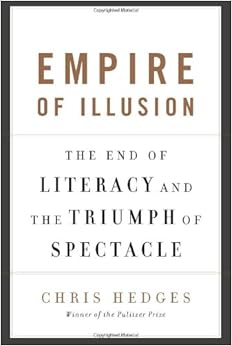
By the way, Hedges newest book is Empire of Illusion: The End of Literacy and the Triumph of Spectacle.

Chris Hedges: We're Losing the Last Shreds of Legal Rights to Protect Ourselves from Oligarchy

A ruling elite that accrues for itself total power, history has shown, eventually uses it.

May 5, 2014 | Chris Hedges


Photo Credit: WeAreChange; Screenshot / YouTube.com

The U.S. Supreme Court decision to refuse to hear our case concerning Section 1021(b)(2) of the National Defense Authorization Act (NDAA), which permits the military to seize U.S. citizens and hold them indefinitely in military detention centers without due process, means that this provision will continue to be law. It means the nation has entered a post-constitutional era. It means that extraordinary rendition of U.S. citizens on U.S. soil by our government is legal. It means that the courts, like the legislative and executive branches of government, exclusively serve corporate power — one of the core definitions of fascism. It means that the internal mechanisms of state are so corrupted and subservient to corporate power that there is no hope of reform or protection for citizens under our most basic constitutional rights. It means that the consent of the governed — a poll by OpenCongress.com showed that this provision had a 98 percent disapproval rating — is a cruel joke. And it means that if we do not rapidly build militant mass movements to overthrow corporate tyranny, including breaking the back of the two-party duopoly that is the mask of corporate power, we will lose our liberty.

“In declining to hear the case Hedges v. Obama and declining to review the NDAA, the Supreme Court has turned its back on precedent dating back to the Civil War era that holds that the military cannot police the streets of America,” said attorney Carl Mayer, who along with Bruce Afran devoted countless unpaid hours to the suit. “This is a major blow to civil liberties. It gives the green light to the military to detain people without trial or counsel in military installations, including secret installations abroad. There is little left of judicial review of presidential action during wartime.”

Afran, Mayer and I brought the case to the U.S. Southern District Court of New York in January 2012. I was later joined by co-plaintiffs Noam Chomsky, Daniel Ellsberg, journalist Alexa O’Brien, RevolutionTruth founder Tangerine Bolen, Icelandic parliamentarian Birgitta Jonsdottir and Occupy London activist Kai Wargalla.

Later in 2012 U.S. District Judge Katherine B. Forrest declared Section 1021(b)(2) unconstitutional. The Obama administration not only appealed — we expected it to appeal — but demanded that the law be immediately put back into effect until the appeal was heard. Forrest, displaying the same judicial courage she showed with her ruling, refused to do this.

The government swiftly went to the U.S. Court of Appeals for the 2nd Circuit. It asked, in the name of national security, that the court stay the district court’s injunction until the government’s appeal could be heard. The 2nd Circuit agreed. The law went back on the books. My lawyers and I surmised that this was because the administration was already using the law to detain U.S. citizens in black sites, most likely dual citizens with roots in countries such as Pakistan, Afghanistan, Somalia and Yemen. The administration would have been in contempt of court if Forrest’s ruling was allowed to stand while the federal authorities detained U.S. citizens under the statute. Government attorneys, when asked by Judge Forrest, refused to say whether or not the government was already using the law, buttressing our suspicion that it was in use.

The 2nd Circuit overturned Forrest’s ruling last July in a decision that did not force it to rule on the actual constitutionality of Section 1021(b)(2). It cited the Supreme Court ruling in Clapper v. Amnesty International, another case in which I was one of the plaintiffs, to say that I had no standing, or right, to bring the NDAA case to court. Clapper v. Amnesty International challenged the secret wiretapping of U.S. citizens under the FISA Amendments Act of 2008. The Supreme Court had ruled in Clapper that our concern about government surveillance was “speculation.” It said we were required to prove to the court that the FISA Act would be used to monitor those we interviewed. The court knew, of course, that the government does not disclose whom it is monitoring. It knew we could never offer proof. The leaks by Edward Snowden, which came out after the Supreme Court ruling, showed that the government was monitoring us all, along with those we interviewed. The 2nd Circuit used the spurious Supreme Court ruling to make its own spurious ruling. It said that because we could not show that the indefinite-detention law was about to be used against us, just as we could not prove government monitoring of our communications, we could not challenge the law. It was a dirty game of judicial avoidance on two egregious violations of the Constitution.

In refusing to hear our lawsuit the courts have overturned nearly 150 years of case law that repeatedly holds that the military has no jurisdiction over civilians. Now, a U.S. citizen charged by the government with “substantially supporting” al-Qaida, the Taliban or those in the nebulous category of “associated forces” — some of the language of Section 1021(b)(2) — is lawfully subject to extraordinary rendition on U.S. soil. And those seized and placed in military jails can be kept there until “the end of hostilities.”

Judge Forrest, in her 112-page ruling against the section, noted that under this provision of the NDAA whole categories of Americans could be subject to seizure by the military. These might include Muslims, activists, Black Bloc members and any other Americans labeled as domestic terrorists by the state. Forrest wrote that Section 1021(b)(2) echoed the 1944 Supreme Court ruling in Korematsu v. United States, which supported the government’s use of the military to detain 110,00 Japanese-Americans in internment camps without due process during World War II.

Of the refusal to hear our lawsuit, Afran said, “The Supreme Court has left in place a statute that furthers erodes basic respect for constitutional liberties, that weakens free speech and will chill the willingness of Americans to exercise their 1st Amendment rights, already in severe decline in this country.”

The goals of corporate capitalism are increasingly indistinguishable from the goals of the state. The political and economic systems are subservient to corporate profit. Debate between conventional liberals and conservatives has been replaced by empty political theater and spectacle. Corporations, no matter which politicians are in office, loot the Treasury, escape taxation, push down wages, break unions, dismantle civil society, gut regulation and legal oversight, control information, prosecute endless war and dismantle public institutions and programs that include schools, welfare and Social Security. And elected officials, enriched through our form of legalized corporate bribery, have no intention of halting the process.

The government, by ignoring the rights and needs of ordinary citizens, is jeopardizing its legitimacy. This is dangerous. When a citizenry no longer feels that it can find justice within the organs of power, when it feels that the organs of power are the enemies of freedom and economic advancement, it makes war on those organs. Those of us who are condemned as radicals, idealists and dreamers call for basic reforms that, if enacted, will make peaceful reform possible. But corporate capitalists, now unchecked by state power and dismissive of the popular will, do not see the fires they are igniting. The Supreme Court ruling on our challenge is one more signpost on the road to dystopia.

It is capitalism, not government, that is the problem. The fusion of corporate and state power means that government is broken. It is little more than a protection racket for Wall Street. And it is our job to wrest government back. This will come only through the building of mass movements.

“It is futile to be ‘anti-Fascist’ while attempting to preserve capitalism,” George Orwell wrote. “Fascism after all is only a development of capitalism, and the mildest democracy, so-called, is liable to turn into Fascism.”

Our corporate masters will not of their own volition curb their appetite for profits. Human misery and the deadly assault on the ecosystem are good for business. These masters have set in place laws that, when we rise up — and they expect us to rise up — will permit the state to herd us like sheep into military detention camps. Section 1021(b)(2) is but one piece of the legal tyranny now in place to ensure total corporate control. The corporate state also oversees the most pervasive security and surveillance apparatus in human history. It can order the assassination of U.S. citizens. It has abolished habeas corpus. It uses secret evidence to imprison dissidents, such as the Palestinian academic Mazen Al-Najjar. It employs the Espionage Act to criminalize those who expose abuses of power. A ruling elite that accrues for itself this kind of total power, history has shown, eventually uses it.


~ Chris Hedges, a Pulitzer Prize-winning reporter, writes a regular column for Truthdig every Monday. Hedges also wrote 12 books, including the New York Times bestseller “Days of Destruction, Days of Revolt (2012)," which he co-authored with the cartoonist Joe Sacco. Hedges's most recent book is "Empire of Illusion: The End of Literacy and the Triumph of Spectacle."