Begetting Change
Same Choices, Same Results
Repeated bouts of adversity are an unavoidable aspect of human existence. We battle against our inner struggles or outer world forces, and in many cases, we emerge on the opposite side of struggle stronger and better equipped to cope with the challenges yet to come. However, we can occasionally encounter trials that seem utterly hopeless. We strike at them with all of our creativity and perseverance, hoping desperately to bring about change, only to meet with the same results as always. Our first instinct in such situations is often to push harder against the seemingly immovable obstruction before us, assuming that this time we will be met with a different outcome. But staying power and stamina net us little when the same choices consistently garner the same results. A change in perspective, behavior, or response can do so much more to help us move past points where no amount of effort seems sufficient to overcome the difficulties before us.
Whether our intention is to change ourselves or some element of the world around us, we cannot simply wish for transformation or hope that our lives will be altered through circumstance. If our patterns of thought and behavior remain unchanged, our lives will continue to unfold much as they have previously. Patterns in which fruitless efforts prevail can be overcome with self examination and courage. It is our bravery that allows us to question the choices we have made thus far and to channel our effort into innovation. Asking questions and making small adjustments to your thought processes and behaviors will help you discover what works, so you can leave that which does not work behind you. To break free from those unconscious patterns that have long held sway over your actions and reactions, you will likely have to challenge your assumptions on a most basic level. You must accept once and for all that your beliefs with regard to cause and effect may no longer be in accordance with your needs.
Stagnation is often a sign that great changes are on the horizon. Courting the change you wish to see in yourself and in the world around you is a matter of acknowledging that only change begets change. The results you so ardently want to realize are well within the realm of possibility, and you need only step away from the well-worn circular path to explore the untried paths that lie beyond it.
Offering multiple perspectives from many fields of human inquiry that may move all of us toward a more integrated understanding of who we are as conscious beings.
Thursday, August 09, 2007
Daily Om: Begetting Change
TED Talks: Daniel Dennett on Memes
Here's one of those talks that can change your view of the world forever. Starting with the deceptively simple story of an ant, Dan Dennett unleashes a dazzling sequence of ideas, making a powerful case for the existence of "memes" -- a term coined by Richard Dawkins for mental concepts that are literally alive and capable of spreading from brain to brain. On the way, look out for:
+ a powerful one-sentence secret of happiness
+ a compelling insight into terrorists' motivation
+ a chilling view of Islam
And just when you think you know where the talk's heading, it dramatically shifts direction and questions some of western culture's fundamental assumptions.
This. Is. Unmissable.
Satire: Everyone Should Own A Gun For Protection And Possibly For Suicide
Everyone Should Own A Gun For Protection And Possibly For Suicide
By Thomas Studdelmeyer
August 8, 2007 | Issue 43•32For as long as I can remember, our Second Amendment right to own firearms has been under relentless attack. Opponents say having guns creates added dangers, that they hurt more than they help. But what these liberal do-gooders never seem to care about are the innocent families taken hostage and murdered inside their very own homes. Or the women who are attacked while walking back to their cars late at night. Or even men in their early 60s for whom life was going just fine until one day their wife decided that she wanted a divorce.
As Americans, it's our moral duty to protect our loved ones from the scum and filth of this world. And, by God, if those loved ones leave us because we drink too much or refuse to go to couples therapy, then we should also be able to feel the cold steel of a .45 caliber pistol between our trembling lips.
Our founding fathers realized this when they drew up the Constitution. They recognized the right for every man to bear arms against his aggressor. And, if that aggressor was not so much a physical entity as a devastating feeling of loneliness, the right of every man to cash in his chips.
People in this great country of ours should never have to live in fear—or live at all, once all hope of happiness has passed them by, and the thought of unloading a round into his worthless skull seems strangely comforting.
To the Hillary Clintons and Rosie O'Donnells of this world, I only have one thing to say: If you want to take our guns away from us, then you're going to have to pry them from our cold, dead hands. Most likely in our basements, near the woodpile. Or in the bathroom.
We refuse to let some left-wing numbnut in Washington, someone who has never had his truck jacked or spent an entire morning guzzling whiskey and staring at old photos of himself back when his future was still ahead of him, decide what's best for us. This is America, people, not France or some other godforsaken country where weapon ownership is limited or banned, and citizens are routinely denied the right to the quick, painless death that only a semi-automatic can bring.
You’ll have to excuse me for not wanting to take any chances with my own life. For choosing not to have to depend on my local police department, or an entire bottle of sleeping pills, to bail me out of a tough situation. I just happen to believe that sometimes the only person you can really rely on is yourself. And when the time comes to make a life or death decision, it's comforting to know that you can always pull the trigger on that long barreled rifle with your toe.
So go ahead and call me a "right-wing extremist," a "radical gun nut," a "man who used to routinely forget his daughter's birthday, and who now, alone in the home he once shared with his family, spends every waking moment thinking about leaving a bloodstain the size of Kansas across his bedroom wall." But before you do, ask yourselves this:
Would you want to be without a gun if some crazy, drug-fueled maniac broke into you home late at night? Of course not. Now, what if nobody broke into your home, or even thought to enter it, even if they still had the keys and could come in at any time just to check in on you and make sure you were okay, because they were never coming back and didn't even want to speak to you again until you had "resolved some deep issues"—would you want to be without a gun then?
I didn't think so.
Tags: satire, The Onion, second amendment, guns
Wednesday, August 08, 2007
Repressing Feelings vs. Experiencing Them
I was raised not to feel my emotions -- and that's my default response to things I don't want to deal with. But I know this isn't healthy. If I am to grow as a person, I have to be able to sit with my feelings, feel all of their affects on me, and tolerate the discomfort than might arise.
I've been working on this for years, in therapy and in my meditation practice. It's getting better, but until tonight, I didn't know how much better it had become.
When jealousy came up in me tonight, I was able to hold the feeling, not repress it. What I saw was how I responded, both physically and emotionally, as the feeling came up and dissipated. This was really useful in that I could watch the process at work, as an observing Self, and also in recognizing that I hold this feeling that I was previously unaware of.
If we are to do shadow work -- if I am to do shadow work -- I have to be able to face the hard things that come up and not try to repress them. This isn't easy for most of us, certainly not for me -- and I have been doing this work for years.
When we experience the hard feelings that come up -- from shadow work or in our daily lives -- we have to be able to allow the full experience of those feelings. It is only when we can be with our feelings, without attaching to them or repressing them, that we can learn about how they come up and how -- if we allow them to move through us -- they will often dissipate on their own, provided we do not attach to them.
This was a good lesson for me tonight. And it gives me hope that I can make progress in other areas of my life.
Graitude 8/8/07
1) IOC went over 100,000 visitors early this morning. I am so grateful for those who read regularly and those who merely stumble upon this blog. It makes this all much more fun.
2) I don't think of myself as a jealous person, but I guess I am wrong about that. I had an opportunity tonight to watch jealousy come up, see how my demeanor changed, and watch it fade away. A very useful experience in attachment -- and an opportunity to do some shadow work on this.
3) I did some cleaning today, which I despise, but I like the feeling of being in a clean space when I am done, so I am grateful that I made myself do it.
What are you grateful for today?
Drugs In Sports
I'm going to go out on a VERY thick limb and say drugs in sports is not the exception -- it's the rule. Back in 2001, Malcolm Gladwell wrote an excellent article on drugs in sports for The New Yorker. Among the many good quotes (all quotes here are from that article), here is one relevant to the Barry Bonds situation:
An aging baseball star, for instance, may realize that what he needs to hit a lot more home runs is to double the intensity of his weight training. Ordinarily, this might actually hurt his performance. "When you're under that kind of physical stress," Charles Yesalis, an epidemiologist at Pennsylvania State University, says, "your body releases corticosteroids, and when your body starts making those hormones at inappropriate times it blocks testosterone. And instead of being anabolic--instead of building muscle--corticosteroids are catabolic. They break down muscle. That's clearly something an athlete doesn't want." Taking steroids counteracts the impact of corticosteroids and helps the body bounce back faster. If that home-run hitter was taking testosterone or an anabolic steroid, he'd have a better chance of handling the extra weight training.
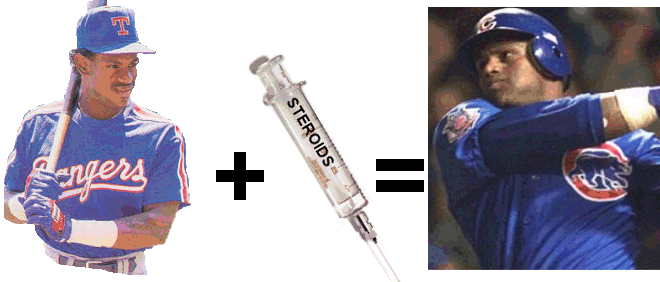
This is the reality of the situation - steroids enhance recovery allowing an athlete to train harder and heavier and build more muscle. If you don't think it works (and until the early 1980's, doctors said steroids did nothing - despite 25+ years of evidence to the contrary among athletes and bodybuilders), check this out:
Or this:
[image source]
When Sosa and Bonds came into the league, they were both very thin (Sosa was actually smaller). As their careers passed age 30, both of them began to grow in size and strength (Sosa went from 165 as a rookie to about 240 the year he was battling a naturally huge Mark McGuire for the single season home run title, although McGuire was also using PEDs).
Charlie Francis, who trained disgraced sprinter Ben Johnson (for the record, no trainer would have his athlete on the steroid Johnson tested positive for - everyone knows it stays in the body for months or even a year - he was set up), makes a compelling case for why he put his athletes on drugs:
Francis was driven and ambitious, eager to give his athletes the same opportunities as their competitors from the United States and Eastern Europe, and in 1979 he began discussing steroids with one of his prize sprinters, Angella Taylor. Francis felt that Taylor had the potential that year to run the two hundred metres in close to 22.90 seconds, a time that would put her within striking distance of the two best sprinters in the world, Evelyn Ashford, of the United States, and Marita Koch, of East Germany. But, seemingly out of nowhere, Ashford suddenly improved her two-hundred-metre time by six-tenths of a second. Then Koch ran what Francis calls, in his autobiography, "Speed Trap," a "science fictional" 21.71. In the sprints, individual improvements are usually measured in hundredths of a second; athletes, once they have reached their early twenties, typically improve their performance in small, steady increments, as experience and strength increase. But these were quantum leaps, and to Francis the explanation was obvious. "Angella wasn't losing ground because of a talent gap," he writes; "she was losing because of a drug gap, and it was widening by the day." (In the case of Koch, at least, he was right. In the East German archives, investigators found a letter from Koch to the director of research at V.E.B. Jenapharm, an East German pharmaceutical house, in which she complained, "My drugs were not as potent as the ones that were given to my opponent Brbel Eckert, who kept beating me." In East Germany, Ungerleider writes, this particular complaint was known as "dope-envy.") Later, Francis says, he was confronted at a track meet by Brian Oldfield, then one of the world's best shot-putters: "When are you going to start getting serious?" he demanded. "When are you going to tell your guys the facts of life?" I asked him how he could tell they weren't already using steroids. He replied that the muscle density just wasn't there. "Your guys will never be able to compete against the Americans--their careers will be over," he persisted.
The basic problem with drug testing is that testers are always one step behind athletes. It can take years for sports authorities to figure out what drugs athletes are using, and even longer to devise effective means of detecting them.
And:
"The bottom line is that only careless and stupid people ever get caught in drug tests," Charles Yesalis says. "The elite athletes can hire top medical and scientific people to make sure nothing bad happens, and you can't catch them."
So obviously, we need to take another look at this whole issue.
Steroids are a form of technology, just like low-weight aerodynamic bikes in the Tour de France, just like high-tech drivers in golf, just like composite materials used in poles for the pole vault, among many examples. If we don't ban other forms of technology, why ban steroids?
It may be a moot point. In reality, steroids will soon be obsolete. Gene doping is the new frontier. Within five years I suspect that athletes will be able to turn off the myostatin gene that limits muscle growth. Cows born without this gene grow enormous (and lean), so you end up with animals that look like this:
One bodybuilder (Ronnie Coleman, pictured here) is already suspected of having done gene doping to limit myostatin production. He was already a phenomenal physical specimen, but he changed the nature of bodybuilding by competing at nearly 300 pounds with a minimal 4% bodyfat.
The only real question in seeing drug use or gene doping as technology and not as cheating is the health of the athletes. Many bodybuilders have died from improper use of diuretics and from overuse of steroids. As long as drugs are black market and illegal, it will be impossible for many athletes to get doctor supervision to make sure they are not hurting themselves. Elite athletes can afford the doctors, many others can't.
If we simply accept that drugs are a technology, and allow their use under doctor supervision, we eliminate all the hysteria around performance and records, and we protect the athletes from hurting themselves to stay competitive.
Most sports employs a 6:1 testosterone to epitestosterone ratio to determine if someone is using testosterone, while the average is 1:1; pro cycling uses a hematocrit (a measure of red blood cell density in blood) of 50 to limit EPO use, which thickens the blood with oxygen-carrying red blood cells, allowing better performance in endurance races, while the normal range is 36-48. These numbers recognize that drugs are being used, but put limits on their abuse, which to me seems reasonable.
As long as there is big money to be made in sports, athletes will seek ways to improve their performance. Let's make it legal, and let's make it as safe as possible. And let there be no * next to anyone's performance.
Speedlinking 8/8/07
"I used to wake up at 4 A.M. and start sneezing, sometimes for five hours. I tried to find out what sort of allergy I had but finally came to the conclusion that it must be an allergy to consciousness."
~ James Thurber
Image of the day:
BODY
~ Chest Building 101 - Introduction! -- "Everyone is guaranteed an A for the course as long as you sit through the course and pay attention... This introduction will give details about anatomy of the chest, different parts, exercises, and workouts. Get the details right here!" This is geared toward bodybuilding style workouts, which I don't advocate, but for those who train that way this is useful.
~ Combos For Power and Size -- "Combos consist of big-money lifts done in rapid succession. Do them right and you'll muscle up quick, along with building speed and power. Oh yeah, you'll also drop some blubber... assuming your heart doesn't explode." This is more my style.
~ Children Raised On Diet Foods Can Turn Into Obese Adults -- "A team of scientists in Canada has suggested that raising children on diet foods and drinks could inadvertently turn them into obese adults. They said that children's bodies learn to connect the taste of different foods and drinks with whether they are high or low in calories, and if they only have diet food and drink this connection becomes distorted leading them to overeat as they develop into adults."
~ 15 Minutes Of Fame With Chad Waterbury -- "'If The Last Rep Recruits The Most Muscle Fibers, Then Why Isn't It The Easiest Rep?' That's the question posed (and answered here) by Muscle Revolution author Chad Waterbury Listen to Chad's neuro-science-based approach to loading parameters, and you'll understand why performance matters more than pain."
~ Energy drinks' caffeine in line with coffee -- "Despite such speedy-sounding names as "Full Throttle," "Amp" and "Rush," energy drinks pack a punch that is generally no stronger than coffee, according to a new report."
~ Vitamin B1 Deficiency Likely Key To Vascular Problems For Diabetics -- "Researchers at Warwick Medical School, University of Warwick, have discovered that deficiency of thiamine -- Vitamin B1 -- may be key to a range of vascular problems for people with diabetes. They have also solved the mystery as to why thiamine deficiency in diabetes had remained hidden until now."
~ PUMP IRON TO FIGHT FLAB – AND AGING -- "If you’re past your 20s, you’ve probably noticed that your body isn’t as easy to maintain as it used to be. That extra slice of pizza may be more likely to hit your middle, and your muscles may not recover as quickly as they once did."
~ Where's the beef? Not enough of it is on elders' plates, muscle-metabolism study suggests -- "Scientists at the University of Texas Medical Branch at Galveston have good news for people who want to stay strong in their old age: older bodies are just as good as young ones at turning protein-rich food into muscle."
PSYCHE
~ Mental Approach - Generating Mental And Physical Intensity -- "You need to have the motivation in order to generate the intensity required to spark muscle growth. Find the inspiration you need... get motivated with these great tips on goal setting, visualization, and more!"
~ Study Suggests High-Dose Fish Oil May Significantly Improve Behavior In Children With ADHD -- "The results of a pilot study published in the Nutrition Journal (http://www.nutritionj.com) suggest that children with attention deficit hyperactivity disorder (ADHD) can benefit from daily supplementation of high levels of purified fish oils."
~ Macho Men Not So Lovable -- "A new study found women think macho men are less faithful and make bad parents."
~ Secret to overcoming shyness revealed -- "The next time you're invited to a party but afraid to go, try approaching this: shyness may affect up to 40 percent of the population, but it doesn't have to be a life sentence."
~ A Sure Sign of Anxiety -- "Are you too anxious?"
~ How to Fight Depression and Anxiety -- "With one comes the other."
~ Infants display a kind of intuitive mind-Reading -- "One of the unique characteristics of humans that distinguish us from the animal kingdom is the ability to represent others' beliefs in our own minds. This sort of intuitive mind-reading, according to experts, lays the cognitive foundations of interpersonal understanding and communication.Despite its importance, scientists have yet to reach a consensus on how this psychological function develops.
~ Love at first sight of your body fat -- "When we choose a partner for a relationship there may be many and complex reasons for our choice, but it has been known for many years that we tend to select people with characteristics similar to our own."
CULTURE/POLITICS
~ The Cross-Cultural Meanings of a Smile -- "If I'm on a date (which believe me, doesn't happen often) I can usually tell how its going by how, and how much, my date is smiling. Is the smile genuine or forced? Polite or flirty? Or worse yet, not smiling at all??"
~ The Wide World of Online Literary Journals -- "Utne.com takes a tour of the hardworking online literary journals providing great writing and new venues for writers."
~ Democratic Debate Spawns Weird Economics -- "Is the budget deficit rising? Is China really our banker? Clinton, Obama, and the rest sure seem to think so."
~ Seventh-inning koan -- "The small mountainous state of Tibet was invaded by China in 1950 and remains occupied by its more powerful neighbor. Led by His Holiness the Dalai Lama, Tibetan refugees have maintained a government in exile based in India for nearly 60 years. With the 2008 Olympic games set to be held in Beijing, Tibetans are demanding that China be forced to comply with a pledge it made to the International Olympic Committee to improve its record on human rights. They have also assembled a group of Tibetan athletes in exile and have asked the International Olympic Committee to allow "Team Tibet" to participate in the 2008 games. In the United States, Tibetans are taking their message to where sports fans reside during these sweltering summer months: America's baseball stadiums."
~ ABC, NBC "Liberate" Presidential Video -- "Today, a right-left alliance praised ABC and NBC for joining CNN in liberating presidential debate video - allowing footage to be legally shared, blogged, excerpted, and put on sites like YouTube."
~ Clinton has big lead, but rivals say just wait -- "Hillary Clinton has surged to a big lead in national polls for the 2008 Democratic presidential nomination but her chief rivals say the polls are overblown and the race is far from over."
HABITATS/TECHNOLOGY
~ Compound BPA Found To Cause Reproductive Disorders, Study, Scientists Say -- "The journal Reproductive Toxicology on Thursday published on its Web site a statement warning that the compound bisphenol A, which is found in plastic and is similar to estrogen, likely is causing various human reproductive disorders, the Los Angeles Times reports."
~ A New Discovery in Human Evolution -- "A new discovery suggests that Homo erectus may not have evolved from Homo habilis—and that the two may have been contemporaries."
~ San Francisco Wi-Fi Issue Goes to Ballot -- "This freewheeling city can't seem to agree if free wireless access to the Internet is such a great idea."
~ Scientists show differing patterns of rainforest biodiversity -- "Rainforests are the world`s treasure houses of biodiversity, but all rainforests are not the same. Biodiversity may be more evenly distributed in some forests than in others and, therefore, may require different management and preservation strategies. That is one of the conclusions of a large-scale Smithsonian study of a lowland rainforest in New Guinea, published in the Aug. 9 issue of the journal Nature."
~ Conventional plowing is 'skinning our agricultural fields' -- "Traditional plow-based agricultural methods and the need to feed a rapidly growing world population are combining to deplete the Earth's soil supply, a new study confirms."
~ Trees Won't Fix Global Warming -- "Trees impractical for carbon storage because of high water, nutrient needs."
INTEGRAL/BUDDHIST
~ born, never asked -- "the one line she speaks is this: ‘You were born. And so you’re free. So happy birthday.’ tears just start running down my face when i hear this. because i finally get it. *i get it.*"
~ My view of Barry Bonds -- Matthew Dallman looks at Bonds' record as a teaching moment.
~ AFTER THE GIG LIST MORE BITCHING ABOUT INSTANT ENLIGHTENMENT -- Skip the gig list aqnd go to the part where he talks about Network Marketing, including a mention of Big Mind (Genpo Roshi). He's dead on -- "Also, interestingly, both the network marketing scams and Big Mind® espouse the same idea that this stuff used to take a lot of time, effort and energy, but now a new technique has been developed that'll give you the same effect right away without all the muss and fuss. In the case of the network marketers the goal getting rich, in the case of Genpo and all the rest of them it's getting enlightenment. Believe whatever you want, suckers." Big Mind is based on Voice Dialogue, as I've mentioned before -- and to do it right takes time. It's shadow work, not instant enlightenment.
~ Excavation, Thoughts & Photography -- "5:45am this past Monday morning I sat atop a mountain peak waiting for the sun to rise. The view was black with a gray haze of pre-sunrise. I could see shadows and silhouettes of trees and rolling hillsides. I set up my tripod and placed my camera on top, set the aperture to f/22 and shutter-speed to 45 sec and waited for the oncoming light to capture the image. Waiting for the shutter to click I noticed the peace of this instant, the stillness of life."
~ Start where you are -- "Anyhow, this single phrase is pretty big for me. Let me tell ya a bit about my practice since it's resumed in 2002. I started sitting cuz it was something I learned from a local meditation group in Chatham Ontario Canada. That was all very new-age, but I did learn visualization and how to focus a bit."
Daily Dharma: A Simplified Space
Today's Daily Dharma from Tricycle:
A Simplified Space
Sitting is essentially a simplified space. Our daily life is in constant movement: lots of things going on, lots of people talking, lots of events taking place. In the middle of that, it's very difficult to sense that we are in our life. When we simplify the situation, when we take away the externals and remove ourselves from the ringing phone, the television, the people who visit us, the dog who needs a walk, we get a chance--which is absolutely the most valuable thing there is--to face ourselves. Meditation is not about some state, but about the meditator. It's not about some activity or fixing something. It's about ourselves. If we don't simplify the situation the chance of taking a good look at ourselves is very small--because what we tend to look at isn't ourselves but everything else. If something goes wrong, what do we look at? We look at what's going wrong. We're looking out there all the time, and not at ourselves.
~ Charlotte Joko Beck, Everyday Zen
Barry Bonds Hits No. 756
From the New York Times:
SAN FRANCISCO, Aug. 7 — Barry Bonds swung and then immediately threw his arms in the air, realizing that he had become the most prolific home run hitter in major league history. Everyone in the ball park instantly realized the enormity of what they had witnessed as well, watching Bonds’s latest and most important white streak soar into the night.
Bonds Hits No. 756 to Break Aaron’s Record
Bonds’s 756th homer pushed him past Hank Aaron and pushed baseball’s history into an awkward spot. He is alone now atop the career home run list. Let the debate about the authenticity of Bonds’s record begin. It will be here for a while.
With his devastating, compact swing, Bonds blasted a fastball from Mike Bacsik of the Washington Nationals over the fence in right center field in the fifth inning. The eager San Francisco Giants fans, who were already standing and hoping to watch their hero create history at AT & T Park, cheered, hugged and high-fived. Some even wept.
When Bonds reached home, Nikolai, his 17-year old son and a Giants’ bat boy, was there to greet him. Nikolai held up one finger to his father, a sign that Bonds was No. 1. Bonds stopped at the plate, and raised his arms high again, then pointed to the sky, a tribute to his late father, Bobby.
In a post-game news conference later, Bonds, who has been suspected of using steroids, offered a sharp response to doubts about his record.
“This record is not tainted at all, at all,” Bonds said. “Period. You guys can say whatever you want.”
Read more. I'm happy for him.
Norman Mailer & Marshall McLuhan Debate, 1968
From the Google page (links added):
Norman Mailer and Marshall McLuhan expound on violence, alienation and the electronic envelope. The clash of two great minds. (1968)
Perfect Pictures of an Imperfect World
This is really an ad for Photoprix, but someone cut the credits at the end (which makes it more fun to watch), but in the interest of credit where due, you can see the whole version here.
Via: VideoSift
Crazy Cat Montage
Via: VideoSift
Tuesday, August 07, 2007
Random Thoughts on Life
I've been thinking about my life quite a bit in the last few days (free time will do that to me). I find myself in one of those in-between places, ready to move on from personal trainer to therapist, but knowing it will still be several years before I can practice as a therapist.
And then there is the fact that a few months ago, I thought my life would be going in a different direction, that I'd have a partner in this new adventure and transition, but that didn't work out. More and more it seems that the old adage that life doesn't always give you what you want, but usually gives what you need, is true.
I wanted that relationship to work, but I also needed the experience of being loved and of loving someone else -- without conditions. It was good even if it didn't progress as I had hoped.
So I am still a writer and trainer, though I'm doing less writing than I would like. I love blogging, and that, too, is a kind of useful endeavor.
But what I am seeing more and more is that my clients need help in ways I am not yet qualified to offer.
I like being a trainer, and I suspect that one way or another, it will continue to be a part of my life even when I am licensed as a therapist. My dream is to have an office with a consulting room, and another room set up as a miniature gym. There are a few therapists around who "analyze" their clients while putting them through a workout. I like that idea -- but I know it's only for some clients, not all.
So right now, I am living in another kind of liminal space. I'm not the person I was a few months ago, but I'm not yet the person I want to become. I have a hard time with patience, so maybe that is my lesson now -- to live as comfortably as possible in this in-between place.
Who knows? I'm just thinking out loud.