Showing posts with label sports. Show all posts

Saturday, August 30, 2014

In Praise Of Being Bored by Alva Noë

From NPR's 13.7 Cosmos and Culture blog, Alva Noë muses on the joys (which I would add are relative) to enjoying a lazy afternoon of watching a boring baseball game.

Personally, boredom is nearly unfathomable to me. I am seldom bored with so much to know in the world that I don't know. And baseball, yes, IS boring, on par with watching paint dry. So this will have to be one of the few times I must disagree with Noë.

In Praise Of Being Bored


by Alva Noë
August 29, 2014


Two young boys at a Cincinnati Reds game.
iStockphoto

When Bud Selig, baseball's long-serving commissioner, visited Oakland recently, he took the opportunity to bemoan the A's inadequate stadium and also to worry aloud about a topic that seems to loom large in the minds of many baseball people these days, namely, the increasingly slow pace of the game.

Indeed, the game has gotten slower over time.

A game today lasts, on average, more than 30 minutes longer than it did 30 years ago. I suspect the big culprit here is longer commercial breaks (between 30 and 40 minutes of a baseball game broadcast — the recent institution of instant replay may be a contributing factor). But the target of concern, as is so often the case, is the little guy — in this case, the players themselves. They're just playing too slowly, it is complained. Too much time elapses between pitches. Too many timeouts to adjust equipment or clothes.

Selig, in my opinion, is wrong on both counts. The A's have a great stadium. And baseball doesn't move too slowly.

As for the pace of the game, I am a bit surprised that MLB is concerned about this at all. Revenues are up, TV viewing is up, there are more teams than ever, and most of them are very rich. If you measure the sport's vitality in business terms, baseball, it would seem, has never been better. And if you visit the ballpark to watch a game, it's immediately clear that today's live baseball experience positively thrives on interruptions to the play. That's when you get to spend your money.

What exactly is the problem?

Don't say: "The game is too slow; it's getting boring."

As anyone who knows and loves baseball will tell you, baseball is boring. This is nothing new. Even at its most lively best, baseball is a game that unfolds at a walking pace, or at the pace of a relaxed conversation. When compared to the unstopping swarm dynamic of soccer or hockey, or the hustle and dance of basketball, baseball hardly even seems like a sport at all.

And this is what the great many of us who love baseball love about it. Baseball games aren't just long. There's no way of knowing how long they might be. A baseball game, like a good conversation, or a friendship, or a political controversy, has no fixed end. It takes however long it takes. As Selig observed, baseball is a game without a clock. And that's a good thing.

Selig also questions whether this kind of unstructured, open time is palatable in today's fast-paced world.

I say: God save us from today's ramped up, multi-interrupted, selfie-consumed, fast-paced world! We need to slow down. We need to turn off. We need to unplug. We need to start things and not know when they are going to end. We need evenings at the ballpark, evenings spent outside of real time.

What's so bad about being bored?

I found myself at a table with Europeans the other night. Inevitably, the topic turned to the relative merits of baseball and what they call "football." I had to restrain myself from expressing my irritation. It isn't that there isn't a boatload to be said about how these sports differ from each other. And it is certainly true that we love our sports and may find ourselves actively disliking the sports of others. For example, I admit that I found myself wanting to turn off the World Cup once they moved from flopping around on the floor in throes of pretend agony to actually biting each other.

But the thing is, arguing about sports is like arguing about foods. We like what we grew up with; kids around the world aren't soccer fans because, after having surveyed the world's sports, they chose soccer. And the same goes for Americans and baseball. We don't like our sports because they're great. They are great because we like them. Or, maybe, loving a sport — coming to understand it — lets you see the greatness that otherwise goes unwitnessed.

As for Selig's judgment on the A's stadium, I agree it's an old concrete and steel throwback to another era. True, there are no roller coasters, or hot tubs, or extensive gourmet food offerings. And yes, you can see the faded paint of the Raiders' gridiron running across the A's diamond.

But O.co field is a fabulous place to watch baseball. It may not be a top-of-the-line shopping mall and entertainment center, but it is a spacious, open, cathedral of baseball. It is a place where baseball happens and where you just may find, if you are lucky, that you have the opportunity to relax and get bored.

You can keep up with more of what Alva Noë is thinking on Facebook and on Twitter: @alvanoe

Wednesday, June 25, 2014

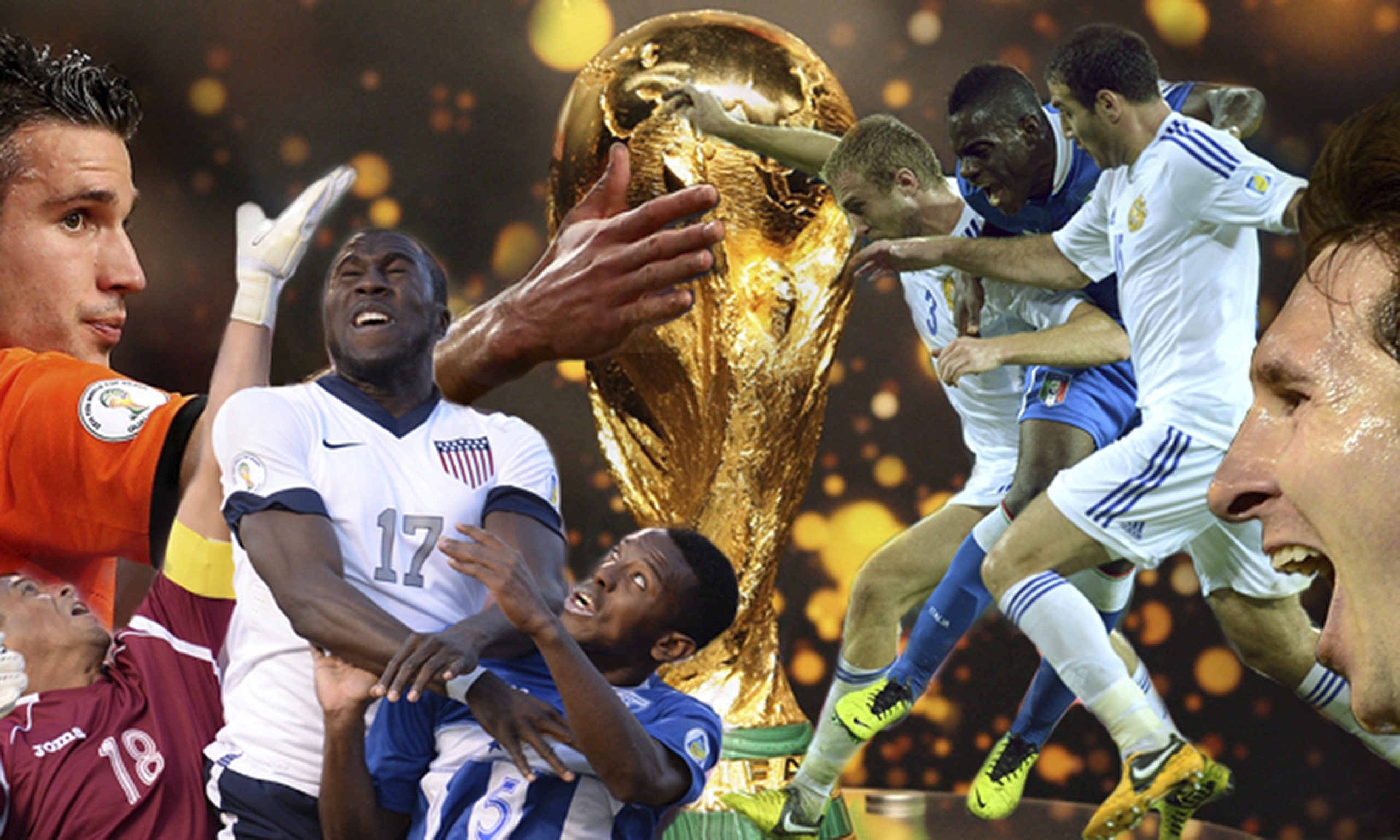
Why Americans Call Futbol Soccer, and Does Soccer Have a Future in the U.S.?


When the U.S. played Portugal on Sunday, a painful 2-2 draw when Portugal scored in the 95th minute (stoppage time), it was the most viewed soccer game in U.S. history. Tomorrow morning (Thursday), the U.S. plays Germany and must win to secure a spot in the knock-out round of 16.

Unfortunately for many American soccer fans, the game airs at noon EDT and 9 am PDT, making it difficult to watch unless we play hooky from work. Even so, if the Americans can pull out a miraculous win (Germany came into the World Cup as one of the two or three favorites, along with Brazil and Argentina), will soccer be guaranteed a bright future in the U.S.? Tom Ashbrook's On Point (NPR) looks at the future of soccer in the U.S.

And, while we're discussing it, why the hell do Americans call it soccer instead of futbol (football), as it is in most of the rest of the world? Turns out that it's a story, like all good stories, that begins in a pub (The Atlantic).

First up, a collection of links on soccer and the World Cup, then the future of U.S. soccer from On Point.

Theory of soccer

Jun 24 2014
9:00AM


* * * * *

The Future Of Soccer In The United States

What would it take for the United States to become a world soccer powerhouse? We’ll kick it around.

On Point with Tom Ashbrook | June 25, 2014

US players kick off the World Cup soccer match between the USA and Portugal at the Arena da Amazonia in Manaus, Brazil, Sunday, June 22, 2014. (AP)


World Cup fever has hit, of all places, the United States of America. The big global latecomer to soccer. Millions of American hearts went way up the Amazon Sunday night for the heartbreaking tie with Portugal. Millions celebrated the nifty first game win over Ghana. Millions more will tune in tomorrow for the big game with Germany. Team USA is performing better than expected. Of course, US women took the World Cup in ’91, ’99. What would it take to put US men’s soccer firmly up in that top tier? This hour, On Point: World Cup fever, and building an American soccer powerhouse.


– Tom Ashbrook

Guests
From Tom’s Reading List

New York Times: How Jurgen Klinsmann Plans to Make U.S. Soccer Better (and Less American) — “‘We cannot win this World Cup, because we are not at that level yet,’ Klinsmann told me over lunch in December. ‘For us, we have to play the game of our lives seven times to win the tournament.’”

Fusion: When the U.S. Made A Baby Step in Basel — “As good as the Swiss looked against Austria was as bad as they looked against the U.S. Only 16,500 showed up in the Herzog & de Meuron-designed St. Jakob’s Park—all the starchitecture was in Basel—and they booed their team off at half time and full time. Michael Bradley scored the only goal in the eighty-sixth minute in an ugly game but a brave performance for the U.S. team. Winning ugly was something it needed to learn how to do—the hell with wining over new fans.”

The Wall Street Journal: At World Cup, South America Is Ascendant – “South American sides haven’t had the pleasure of playing on home soil since 1978, and they are taking full advantage of it. Thursday, Uruguay pushed England to the brink of elimination with a 2-1 win that came just hours after Colombia notched a 2-1 win over Ivory Coast in front of thousands of delirious yellow-and-blue clad fans at Estadio Nacional in Brasilia.”

Video


Soccer fans in Kansas City celebrating John Brooks’ goal in the US match against Ghana at the World Cup in Brazil.

Friday, June 13, 2014

The World Cup Has Begun - All You Never Needed to Know about 2014's World Stopping Event


Goooooooooooooooaaalll! For fùtbol fans around the world (that's soccer for you yanks), it's the global celebration of the beautiful game (per Pelé).

According to Vox, there are 10 things American's need to know about the World Cup:
1. The World Cup is the pinnacle of soccer
2. The World Cup finals are a multi-stage tournament
3. The US team is in the "group of death"
4. Brazil and Spain are two of the favorites
5. Soccer is a complex game
6. There are millions of dollars at stake
7. Many Brazilians are protesting the World Cup
8. The matches are spread thousands of miles apart
9. Many teams ban their players from having sex during the World Cup
10. You can watch on the matches on ESPN and Univision
Of course, Vox goes into more detail on each of those. These links come from Bookforum's Omnivore blog.

The World Cup Is About to Begin

Jun 12 2014
3:00PM


1. The World Cup is the pinnacle of soccer
2. The World Cup finals are a multi-stage tournament
3. The US team is in the "group of death"
4. Brazil and Spain are two of the favorites
5. Soccer is a complex game
6. There are millions of dollars at stake
7. Many Brazilians are protesting the World Cup
8. The matches are spread thousands of miles apart
9. Many teams ban their players from having sex during the World Cup
10. You can watch on the matches on ESPN and Univision

Thursday, June 12, 2014

How the World Cup Explains the World

From Pacific Standard, here is a brief introduction to the World Cup (not the sports angle, the international relations angle), which begins today with Brazil taking on Croatia.

Welcome to World Cup Week

• June 09, 2014 
world-cup-orange
(Photo: shine2010/Flickr)
A couple of months ago, in response to the occupation of Crimea, two U.S. senators wrote to a powerful international federation in hopes of creating sanctions against Russia, citing “a brazen disrespect for fundamental principles … and international law.” A few days later, Russian officials fired back, filing a similar letter to the same organization, calling for the U.S. to be sanctioned for “military aggression against several sovereign states” and the “numerous cases of human rights violation all over the world revealed by E. Snowden.”

The organization? FIFA. The sanction? A ban from the 2014 World Cup.

"The 2014 World Cup will be the most uniting cultural event
in the history of human civilization
."

Alas, no sanctions were enacted. And Russia will be in Brazil, playing with a team that seems in keeping with the nation’s political tides, as the roster—in a tournament where 65 percent of the players play professionally in countries outside their own—consists entirely of Russia-based pros. Except, the team is coached by 68-year-old Italian who was previously the manager of England.

The U.S. will be there, too, led by a German manager who won a World Cup while playing for Germany and who will be coaching an American team with five German-born players, a guy from Norway, and another one from Iceland. Worried that the U.S. isn’t American enough? You can always root for Mexico. And if you’d prefer a different team with an American-born player and an American-born coach, why not throw your support behind Iran?

You get the point. Soccer, as you may have heard, is the most popular sport in the world. The 2014 World Cup will be the most uniting cultural event in the history of human civilization. It’s a game, but it’s also a game played and watched and consumed by multiple billions of people. “When a game matters to billions of people it ceases to be just a game,” Simon Kuper writes in Football Against the Enemy. “Soccer is never just soccer: it helps make wars and revolutions, and it fascinates mafias and dictators.”

Kuper wrote some form of those words 20 years ago, and the world’s changed since then. (For example: We’re writing about soccer on the Internet, and doing it for a national American magazine.) Saying that the sport still “makes wars and revolutions” might not be quite so accurate anymore, but the game, in this country and in the rest of the world, has only continued to grow. “The game remains too good a way of understanding the world to discard,” Kuper writes in the introduction to Soccer Against the Enemy, the 2010 American edition of his first book. “Soccer matters as much today as when I made the journey that became this book, but now it matters in different ways.”

So, all this week, we’ll be looking at some of those different ways. We hope to show how the sport gets tangled up in the different political, social, and cultural issues across the world—but it might be better to say that we just want to see how soccer reflects some of the important issues of 2014. You can find all the exhaustive tactical breakdowns and the lists of players you’ve never heard of but will definitely start hearing about elsewhere. Instead, we’ll be writing about the game’s role in the development of Iran, the most politically volatile matches in the tournament’s history, and why, at the same time, this is both the most important tournament ever played and the one with the least amount of meaning. We’ll also be talking to Kuper himself about many of those things and more.

The games kick off on Thursday, with Croatia playing Brazil, and we’ll be posting multiple stories a day through the end of the week. You’ll learn something—we promise.

Ryan O'Hanlon
Senior Digital Editor Ryan O’Hanlon joined Pacific Standard from Outside, where he was an assistant online editor. He is a graduate of the College of the Holy Cross, and his writing has appeared in Deadspin, Grantland, The Awl, New York, The Atlantic, and elsewhere. Follow him on Twitter @rwohan.

Wednesday, September 25, 2013

Malcolm Gladwell on "The Sports Gene" and "The Secret Race"


In an article a couple of weeks ago in The New Yorker, Malcolm Gladwell [author of, among others, The Tipping Point: How Little Things Can Make a Big Difference (2000), Blink: The Power of Thinking Without Thinking (2005), and Outliers: The Story of Success (2008)], reviews two relatively recent books on sports performance.


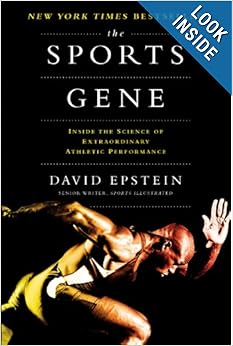
In the fist book, The Sports Gene: Inside the Science of Extraordinary Athletic Performance (2013), David Epstein offers a wide-ranging account of how biological and environmental factors can create amazing athletes. In the other book Gladwell looks at, The Secret Race: Inside the Hidden World of the Tour de France (2013 paper edition), former professional cyclist and Lance Armstrong teammate Tyler Hamilton offers an in-depth and brutally honest account of his career in cycling and his use of performance enhancing drugs.


Man and Superman

In athletic competitions, what qualifies as a sporting chance?

by
September 9, 2013
Élite sports is a contest among athletes with an uneven set of genetic endowments and natural advantages. Illustration by Barry Blitt.
Toward the end of The Sports Gene (Penguin/Current), David Epstein makes his way to a remote corner of Finland to visit a man named Eero Mäntyranta. Mäntyranta lives in a small house next to a lake, among the pine and spruce trees north of the Arctic Circle. He is in his seventies. There is a statue of him in the nearby village. “Everything about him has a certain width to it,” Epstein writes. “The bulbous nose in the middle of a softly rounded face. His thick fingers, broad jaw, and a barrel chest covered by a red knit sweater with a stern-faced reindeer across the middle. He is a remarkable-looking man.” What’s most remarkable is the color of his face. It is a “shade of cardinal, mottled in places with purple,” and evocative of “the hue of the red paint that comes from this region’s iron-rich soil.”

Mäntyranta carries a rare genetic mutation. His DNA has an anomaly that causes his bone marrow to overproduce red blood cells. That accounts for the color of his skin, and also for his extraordinary career as a competitive cross-country skier. In cross-country skiing, athletes propel themselves over distances of ten and twenty miles—a physical challenge that places intense demands on the ability of their red blood cells to deliver oxygen to their muscles. Mäntyranta, by virtue of his unique physiology, had something like sixty-five per cent more red blood cells than the normal adult male. In the 1960, 1964, and 1968 Winter Olympic Games, he won a total of seven medals—three golds, two silvers, and two bronzes—and in the same period he also won two world-championship victories in the thirty-kilometre race. In the 1964 Olympics, he beat his closest competitor in the fifteen-kilometre race by forty seconds, a margin of victory, Epstein says, “never equaled in that event at the Olympics before or since.”

In “The Sports Gene,” there are countless tales like this, examples of all the ways that the greatest athletes are different from the rest of us. They respond more effectively to training. The shape of their bodies is optimized for certain kinds of athletic activities. They carry genes that put them far ahead of ordinary athletes.

Epstein tells the story of Donald Thomas, who on the seventh high jump of his life cleared 7' 3.25"—practically a world-class height. The next year, after a grand total of eight months of training, Thomas won the world championships. How did he do it? He was blessed, among other things, with unusually long legs and a strikingly long Achilles tendon—ten and a quarter inches in length—which acted as a kind of spring, catapulting him high into the air when he planted his foot for a jump. (Kangaroos have long tendons as well, Epstein tells us, which is what gives them their special hop.)

Why do so many of the world’s best distance runners come from Kenya and Ethiopia? The answer, Epstein explains, begins with weight. A runner needs not just to be skinny but—more specifically—to have skinny calves and ankles, because every extra pound carried on your extremities costs more than a pound carried on your torso. That’s why shaving even a few ounces off a pair of running shoes can have a significant effect. Runners from the Kalenjin tribe, in Kenya—where the majority of the country’s best runners come from—turn out to be skinny in exactly this way. Epstein cites a study comparing Kalenjins with Danes; the Kalenjins were shorter and had longer legs, and their lower legs were nearly a pound lighter. That translates to eight per cent less energy consumed per kilometre. (For evidence of the peculiar Kalenjin lower leg, look up pictures of the great Kenyan miler Asbel Kiprop, a tall and elegant man who runs on what appear to be two ebony-colored pencils.) According to Epstein, there’s an evolutionary explanation for all this: hot and dry environments favor very thin, long-limbed frames, which are easy to cool, just as cold climates favor thick, squat bodies, which are better at conserving heat.

Distance runners also get a big advantage from living at high altitudes, where the body is typically forced to compensate for the lack of oxygen by producing extra red blood cells. Not too high up, mind you. In the Andes, for example, the air is too rarefied for the kind of workouts necessary to be a world-class runner. The optimal range is six to nine thousand feet. The best runners in Ethiopia and Kenya come from the ridges of the Rift Valley, which, Epstein writes, are “plumb in the sweet spot.” When Kenyans compete against Europeans or North Americans, the Kenyans come to the track with an enormous head start.

What we are watching when we watch élite sports, then, is a contest among wildly disparate groups of people, who approach the starting line with an uneven set of genetic endowments and natural advantages. There will be Donald Thomases who barely have to train, and there will be Eero Mäntyrantas, who carry around in their blood, by dumb genetic luck, the ability to finish forty seconds ahead of their competitors. Élite sports supply, as Epstein puts it, a “splendid stage for the fantastic menagerie that is human biological diversity.” The menagerie is what makes sports fascinating. But it has also burdened high-level competition with a contradiction. We want sports to be fair and we take elaborate measures to make sure that no one competitor has an advantage over any other. But how can a fantastic menagerie ever be a contest among equals?


During the First World War, the U.S. Army noticed a puzzling pattern among the young men drafted into military service. Soldiers from some parts of the country had a high incidence of goitre—a lump on their neck caused by the swelling of the thyroid gland. Thousands of recruits could not button the collar of their uniform. The average I.Q. of draftees, we now suspect, also varied according to the same pattern. Soldiers from coastal regions seemed more “normal” than soldiers from other parts of the country.

The culprit turned out to be a lack of iodine. Iodine is an essential micronutrient. Without it, the human brain does not develop normally and the thyroid begins to enlarge. And in certain parts of the United States in those years there wasn’t enough iodine in the local diet. As the economists James Feyrer, Dimitra Politi, and David Weil write, in a recent paper for the National Bureau of Economic Research:
Ocean water is rich in iodine, which is why endemic goiter is not observed in coastal areas. From the ocean, iodine is transferred to the soil by rain. This process, however, only reaches the upper layers of soil, and it can take thousands of years to complete. Heavy rainfall can cause soil erosion, in which case the iodine-rich upper layers of soil are washed away. The last glacial period had the same effect: iodine-rich soil was substituted by iodine-poor soil from crystalline rocks. This explains the prevalence of endemic goiter in regions that were marked by intense glaciation, such as Switzerland and the Great Lakes region.
After the First World War, the U.S. War Department published a report called “Defects Found in Drafted Men,” which detailed how the incidence of goitre varied from state to state, with rates forty to fifty times as high in places like Idaho, Michigan, and Montana as in coastal areas.

The story is not dissimilar from Epstein’s account of Kenyan distance runners, in whom accidents of climate and geography combine to create dramatic differences in abilities. In the early years of the twentieth century, the physiological development of American children was an example of the “fantastic menagerie that is human biological diversity.”

In this case, of course, we didn’t like the fantastic menagerie. In 1924, the Morton Salt Company, at the urging of public-health officials, began adding iodine to its salt, and initiated an advertising campaign touting its benefits. That practice has been applied successfully in many developing countries in the world: iodine supplementation has raised I.Q. scores by as much as thirteen points—an extraordinary increase. The iodized salt in your cupboard is an intervention in the natural order of things. When a student from the iodine-poor mountains of Idaho was called upon to compete against a student from iodine-rich coastal Maine, we thought of it as our moral obligation to redress their natural inequality. The reason debates over élite performance have become so contentious in recent years, however, is that in the world of sport there is little of that clarity. What if those two students were competing in a race? Should we still be able to give the naturally disadvantaged one the equivalent of iodine? We can’t decide.

Epstein tells us that baseball players have, as a group, remarkable eyesight. The ophthalmologist Louis Rosenbaum tested close to four hundred major- and minor-league baseball players over four years and found an average visual acuity of about 20/13; that is, the typical professional baseball player can see at twenty feet what the rest of us can see at thirteen feet. When Rosenbaum looked at the Los Angeles Dodgers, he found that half had 20/10 vision and a small number fell below 20/9, “flirting with the theoretical limit of the human eye,” as Epstein points out. The ability to consistently hit a baseball thrown at speeds approaching a hundred miles an hour, with a baffling array of spins and curves, requires the kind of eyesight commonly found in only a tiny fraction of the general population.

Eyesight can be improved—in some cases dramatically—through laser surgery or implantable lenses. Should a promising young baseball player cursed with normal vision be allowed to get that kind of corrective surgery? In this instance, Major League Baseball says yes. Major League Baseball also permits pitchers to replace the ulnar collateral ligament in the elbow of their throwing arm with a tendon taken from a cadaver or elsewhere in the athlete’s body. Tendon-replacement surgery is similar to laser surgery: it turns the athlete into an improved version of his natural self.

But when it comes to drugs Major League Baseball—like most sports—draws the line. An athlete cannot use a drug to become an improved version of his natural self, even if the drug is used in doses that are not harmful, and is something that—like testosterone—is no more than a copy of a naturally occurring hormone, available by prescription to anyone, virtually anywhere in the world.

Baseball is in the middle of one of its periodic doping scandals, centering on one of the game’s best players, Alex Rodriguez. Rodriguez is among the most disliked players of his generation. He tried to recover from injury and extend his career through illicit means. (He has appealed his recent suspension, which was based on these allegations.) It is hard to think about Rodriguez, however, and not think about Tommy John, who, in 1974, was the first player to trade in his ulnar collateral ligament for an improved version. John used modern medicine to recover from injury and extend his career. He won a hundred and sixty-four games after his transformation, far more than he did before science intervened. He had one of the longest careers in baseball history, retiring at the age of forty-six. His bionic arm enabled him to win at least twenty games a season, the benchmark of pitching excellence. People loved Tommy John. Maybe Alex Rodriguez looks at Tommy John—and at the fact that at least a third of current major-league pitchers have had the same surgery—and is genuinely baffled about why baseball has drawn a bright moral line between the performance-enhancing products of modern endocrinology and those offered by orthopedics.

The other great doping pariah is Lance Armstrong. He apparently removed large quantities of his own blood and then re-infused himself before competition, in order to boost the number of oxygen-carrying red blood cells in his system. Armstrong wanted to be like Eero Mäntyranta. He wanted to match, through his own efforts, what some very lucky people already do naturally and legally. Before we condemn him, though, shouldn’t we have to come up with a good reason that one man is allowed to have lots of red blood cells and another man is not?

“I’ve always said you could have hooked us up to the best lie detectors on the planet and asked us if we were cheating, and we’d have passed,” Lance Armstrong’s former teammate Tyler Hamilton writes in his autobiography, “The Secret Race” (co-written with Daniel Coyle; Bantam). “Not because we were delusional—we knew we were breaking the rules—but because we didn’t think of it as cheating. It felt fair to break the rules.”

“The Secret Race” deserves to be read alongside “The Sports Gene,” because it describes the flip side of the question that Epstein explores. What if you aren’t Eero Mäntyranta?

Hamilton was a skier who came late to cycling, and he paints himself as an underdog. When he first met Armstrong—at the Tour DuPont, in Delaware—he looked around at the other professional riders and became acutely conscious that he didn’t look the part. “You can tell a rider’s fitness by the shape of his ass and the veins in his legs, and these asses were bionic, smaller and more powerful than any I’d ever seen,” he writes. The riders’ “leg veins looked like highway maps. Their arms were toothpicks. . . . They were like racehorses.” Hamilton’s trunk was oversized. His leg veins did not pop. He had a skier’s thighs. His arms were too muscled, and he pedalled with an ungainly “potato-masher stroke.”

When Hamilton joined Armstrong on the U.S. Postal Service racing team, he was forced to relearn the sport, to leave behind, as he puts it, the romantic world “where I used to climb on my bike and simply hope I had a good day.” The makeover began with his weight. When Michele Ferrari, the key Postal Service adviser, first saw Hamilton, he told him he was too fat, and in cycling terms he was. Riding a bicycle quickly is a function of the power you apply to the pedals divided by the weight you are carrying, and it’s easier to reduce the weight than to increase the power. Hamilton says he would come home from a workout, after burning thousands of calories, drink a large bottle of seltzer water, take two or three sleeping pills—and hope to sleep through dinner and, ideally, breakfast the following morning. At dinner with friends, Hamilton would take a large bite, fake a sneeze, spit the food into a napkin, and then run off to the bathroom to dispose of it. He knew that he was getting into shape, he says, when his skin got thin and papery, when it hurt to sit down on a wooden chair because his buttocks had disappeared, and when his jersey sleeve was so loose around his biceps that it flapped in the wind. At the most basic level, cycling was about physical transformation: it was about taking the body that nature had given you and forcibly changing it.

“Lance and Ferrari showed me there were more variables than I’d ever imagined, and they all mattered: wattages, cadence, intervals, zones, joules, lactic acid, and, of course, hematocrit,” Hamilton writes. “Each ride was a math problem: a precisely mapped set of numbers for us to hit. . . . It’s one thing to go ride for six hours. It’s another to ride for six hours following a program of wattages and cadences, especially when those wattages and cadences are set to push you to the ragged edge of your abilities.”

Hematocrit, the last of those variables, was the number they cared about most. It refers to the percentage of the body’s blood that is made up of oxygen-carrying red blood cells. The higher the hematocrit, the more endurance you have. (Mäntyranta had a very high hematocrit.) The paradox of endurance sports is that an athlete can never work as hard as he wants, because if he pushes himself too far his hematocrit will fall. Hamilton had a natural hematocrit of forty-two per cent—which is on the low end of normal. By the third week of the Tour de France, he would be at thirty-six per cent, which meant a six-per-cent decrease in his power—in the force he could apply to his pedals. In a sport where power differentials of a tenth of a per cent can be decisive, this “qualifies as a deal breaker.”

For the members of the Postal Service squad, the solution was to use the hormone EPO and blood transfusions to boost their hematocrits as high as they could without raising suspicion. (Before 2000, there was no test for EPO itself, so riders were not allowed to exceed a hematocrit of fifty per cent.) Then they would add maintenance doses over time, to counteract the deterioration in their hematocrit caused by races and workouts. The procedures were precise and sophisticated. Testosterone capsules were added to the mix to aid recovery. They were referred to as “red eggs.” EPO (a.k.a. erythropoietin), a naturally occurring hormone that increases the production of red blood cells, was Edgar—short for Edgar Allan Poe. During the Tour de France, and other races, bags of each rider’s blood were collected in secret locations at predetermined intervals, then surreptitiously ferried from stage to stage in refrigerated containers for strategic transfusions. The window of vulnerability after taking a drug—the interval during which doping could be detected—was called “glowtime.” Most riders who doped (and in the Armstrong era, it now appears, nearly all the top riders did) would take two thousand units of Edgar subcutaneously every couple of days, which meant they “glowed” for a dangerously long time. Armstrong and his crew practiced microdosing, taking five hundred units of Edgar nightly and injecting the drug directly into the vein, where it was dispersed much more quickly.

“The Secret Race” is full of paragraphs like this:
The trick with getting Edgar in your vein, of course, is that you have to get it in the vein. Miss the vein—inject it in the surrounding tissue—and Edgar stays in your body far longer; you might test positive. Thus, microdosing requires a steady hand and a good sense of feel, and a lot of practice; you have to sense the tip of the needle piercing the wall of the vein, and draw back the plunger to get a little bit of blood so you know you’re in. In this, as in other things, Lance was blessed: he had veins like water mains. Mine were small, which was a recurring headache.
Hamilton was eventually caught and was suspended from professional cycling. He became one of the first in his circle to implicate Lance Armstrong, testifying before federal investigators and appearing on “60 Minutes.” He says that he regrets his years of using performance-enhancing drugs. The lies and duplicity became an unbearable burden. His marriage fell apart. He sank into a depression. His book is supposed to serve as his apology. At that task, it fails. Try as he might—and sometimes he doesn’t seem to be trying very hard—Hamilton cannot explain why a sport that has no problem with the voluntary induction of anorexia as a performance-enhancing measure is so upset about athletes infusing themselves with their own blood.

“Dope is not really a magical boost as much as it is a way to control against declines,” Hamilton writes. Doping meant that cyclists finally could train as hard as they wanted. It was the means by which pudgy underdogs could compete with natural wonders. “People think doping is for lazy people who want to avoid hard work,” Hamilton writes. For many riders, the opposite was true:
EPO granted the ability to suffer more; to push yourself farther and harder than you’d ever imagined, in both training and racing. It rewarded precisely what I was good at: having a great work ethic, pushing myself to the limit and past it. I felt almost giddy: this was a new landscape. I began to see races differently. They weren’t rolls of the genetic dice, or who happened to be on form that day. They didn’t depend on who you were. They depended on what you did—how hard you worked, how attentive and professional you were in your preparation.
This is a long way from the exploits of genial old men living among the pristine pines of northern Finland. It is a vision of sports in which the object of competition is to use science, intelligence, and sheer will to conquer natural difference. Hamilton and Armstrong may simply be athletes who regard this kind of achievement as worthier than the gold medals of a man with the dumb luck to be born with a random genetic mutation.

Thursday, September 05, 2013

Chuck Klosterman - There Are No Sound Moral Arguments Against Performance-Enhancing Drugs


In the New York Times recently, in the Ethicist column, Chuck Klosterman responded to a reader's question on the hypocrisy of making PEDs illegal while other forms of performance enhancement are not illegal. Klosterman argues that there is no sound moral argument against PED use, but he does offer an ethical argument.

He believes that morality is a personal choice, but that ethics are a contextual and socially constructed set of rules. Therefore, a sport (like a religion or a board game) can have a set of rules upon which most people have agreed. However, he also acknowledges that the lines drawn in sports are  capricious - why is a shot of Toradol okay for an injured player but not a shot of testosterone, when both offer healing benefits?

I reject the ethical argument as well - and below this article I offer a brief outline of my own views on PEDS. For another excellent argument relative to the hypocrisy of making these substances illegal, see this column by Miami Herald reporter Dan La Batard.

There Are No Sound Moral Arguments Against Performance-Enhancing Drugs

By CHUCK KLOSTERMAN
Published: August 30, 2013

Q: The argument against performance-enhancing drugs in sports is that the drugs give players an unfair advantage. But how do P.E.D.’s differ from Tommy John surgery? Or pre-emptive Tommy John surgery? What about rich kids? Is their access to superior coaching, facilities and equipment a similarly unfair advantage? In a society that embraces plastic surgery, Botox injections, Viagra and all kinds of enhancements, what moral line do P.E.D.’s cross? 
~ LYNN MOFFAT, SLEEPY HOLLOW, N.Y.

The hypocrisy you recognize is undeniable. Virtually all moral arguments against P.E.D.’s involve contradictions. The presumption of competitive unfairness could be applied to any two human experiences that aren’t identical. The notion that P.E.D.’s are “unnatural” isn’t that distant from making the same argument against elbow surgery or insulin or eyeglasses. Any impulse to criminalize steroids in the name of player safety is absurd (collision sports are more dangerous than the illegal drugs used within them). Some will insist that athletes have a unique responsibility as role models, but that claim evaporates the moment you question the assumptions therein. (Why are people who happen to run fast and jump high the best models for behavior? Can someone be forced to be a role model against his or her will?) There are no sound moral arguments against P.E.D.’s.

There is, however, an ethical argument.

Morality is about personal behavior. Ethics are more contextual. They create the framework for how a culture operates. Sports, unlike life, need inflexibly defined rules. Any game (whether it’s the World Cup or Clue) is a type of unreality in which we create and accept whatever the rules happen to be. Even the Super Bowl is fundamentally an exhibition. So how do we make an unreal exhibition meaningful? By standardizing and enforcing its laws, including the ones that don’t necessarily make sense. Three strikes constitute an out; four balls constitute a walk. In order for baseball to have structural integrity, we all have to agree that this is the system we’re using. Success or failure at baseball is measured against a player’s ability to perform within the framework that defines what baseball is; the logic behind that framework is almost a secondary concern.

For a variety of reasons — statistical tradition, illegality, fear — there’s a social consensus that P.E.D.’s are bad for sports. The lines have been drawn capriciously, but the lines exist. Though it’s difficult to explain why, we’ve collectively agreed it’s O.K. for an injured football player to take a shot of Toradol to help ignore an injury, but not a shot of testosterone to help that injury heal faster. Now, you can certainly argue there’s no moral justification for that dissonance. But morality is not the motive here. The motive is to create a world — or at least the illusion of a world — where everyone is playing the same game in the same way. P.E.D.’s are forbidden because that’s what our fabricated rules currently dictate. In real life, that’s a terrible, tautological argument. But in sports, arbitrary rules are necessary. The rules are absolutely everything, so the rules are enough.

E-mail queries to ethicist@nytimes.com, or send them to the Ethicist, The New York Times Magazine, 620 Eighth Avenue, New York, N.Y. 10018, and include a daytime phone number. 
Okay, here are my views on PEDs, which I have posted in various forms over the years (this is a slight revision of the comments I left at Debate.com on the PED in sports topic).
All performance enhancing drugs should be legalized for use under a doctor's supervision - for athletes, for you, for me. Athletes whose income (in the tens of millions of dollars) depends on producing statistics and being able to play as many games as possible (performance incentives) are going to do whatever it takes to stay on the field or in the game/race. The real benefit of HGH and testosterone (and all of their derivatives, as well as other drugs), are that they speed recovery from injury or simply from the wear and tear of the game (soccer, rugby, football).

The bottom line with PEDs is that they are simply another form of technology - like top of the line basketball shoes, the insanely lightweight bikes used at the Tour de France, the knee braces worn by NFL linemen, or the high-tension tennis racquets used on the pro tours. The list could go on and on.

In the 1940s and 1950s, just as an example, NFL players only had food as a "sports supplement," or maybe some dessicated liver pills (which you can still get, incidentally). Now all athletes have access to whey protein (quicker recovery and better immune health), creatine (strength and muscular endurance), a variety of amino acid supplements (l-tyrosine for alertness, l-leucine for muscle building, BCAAs for recovery), nutrient repartitioning supplements (ursolic acid, CLA), and even basic post-workout supplements specifically designed to aid recovery (containing a 2:1 carb to protein ratio with hydrolyzed whey, extra l-leucine, and other insulin potentiating substances). PEDs are in this same category, only more effective when used correctly.

Which is why they should require a doctor's supervision. With testosterone one needs to avoid the conversion into estrogen (so we also need an aromatase inhibitor), the increase in LDL cholesterol (so we need fish oil and other healthy lipids), or, with oral steroids, liver damage (so we need alpha lipoic acid, curcumin, and/or milk thistle extract).

PEDs can be used safely and effectively, but that will not happen as long as they are banned and/or illegal.

Tuesday, April 02, 2013

Christopher Bergland - Mindfulness Made Simple


This is a nice introductory article to mindfulness, including its role in sports and athletics. It comes from the world record holder in the Triple Ironman triathlon (7.2-mile swim, 336-mile bike, followed by a 78.6-mile run done consecutively)Christopher Bergland, in his The Athlete's Way blog at Psychology Today.

Bergland is the author of The Athlete's Way: Sweat and the Biology of Bliss (St. Martin's Press) and The Athlete's Way: Training Your Mind and Body to Experience the Joy of Exercise.

Mindfulness Made Simple

Mindfulness is easy: Stop. Breathe. Think about your thinking.

Published on March 31, 2013 by Christopher Bergland in The Athlete's Way

Mindfulness in a Daffodil

“Mindfulness” has become a buzzword that is often misinterpreted. What is mindfulness? How can it benefit you?

Mindfulness is much more basic than most people realize. In fact, I’ve isolated 3 easy steps to kickstart a state of mindfulness in a few seconds. To kickstart a state of mindfulness all you have to do is: Stop. Breathe. Think about your thinking. Anybody can use this simple mindfulness technique throughout the day to stay calm, focused, optimistic, and kind.

This close-up picture of a daffodil illustrates simple mindfulness training. What part of the image is your attention drawn to first? Is your focus initially drawn to the stamen at the center? Where do your eyes and your attention go from there? Notice how you can hone in on the center or decide to inspect the abstract shapes and different colors in the surrounding. We all have the power to guide our thoughts consciously—to zoom in and zoom out on specific things in our environment and inside our minds. Obviously, you can decide how long you want to look at the daffodil, what parts of the image you want to focus on, and decide when to turn your attention towards something else. This is mindfulness in action.

A recent New York Times Magazine article by Susan Dominus titled ‘Is Giving the Secret To Getting Ahead” offers insights into the power of mindfulness to help people succeed professionally. Although the article doesn’t use the term ‘mindfulness’ specifically, the concepts of mindfulness are represented in the advice given throughout the article.

The Times article profiles Adam Grant, who is a professor in the Management Department at Wharton, and features the ideas from his upcoming book "Give and Take." Grant is an expert in organizational psychology, which is designed to help people enjoy the work they do, and to keep them doing it. Grant is quoted as saying, “The greatest untapped source of motivation is a sense of service to others; focusing on the contribution of our work to other peoples’ lives has the potential to make us more productive than thinking about ourselves." It is interesting that whether the motivation to practice mindfulness comes from a place of capitalistic shrewdness or Buddhist loving-kindness, the benefits for the individual and the collective are still there.

What is Mindfulness?


Mindfulness is simply about being mindful of what you’re thinking and deciding where you choose to focus your attention. Ideally, one would choose to focus his or her attention towards compassion, loving-kindness, and optimism. Mindfulness is about deciding to look on the bright side and deciding to be kind to yourself and others. That’s it.

Mindfulness has its roots in Buddhism and the Noble Eightfold Path that Buddha taught over 2,500 years ago as the path to Nirvana or enlightenment. Although William James didn’t use the term “Mindfulness”, he explored the topic extensively in his life's work and in The Principles of Psychology (1890). Mindfulness is not a new age fad. It has been around forever, but in a modern world it’s more important than ever we each begin practicing it.

Some purists and Buddhist teachers aren’t thrilled to see mindfulness being diluted and applied to pop psychology and business. However, most seem to realize that the more people in the world who are practicing some type of mindfulness the better. Unfortunately, several definitions of mindfulness are currently being used in modern psychology and mindfulness training. It’s like the Wild West when it comes to a standardized Western definition of mindfulness...almost anything goes.

I base my definition of mindfulness on the landmark study by Bishop, Lau et al. (2004) from the University of Toronto titled: Mindfulness: A Proposed Operational Definition published by the American Psychological Association. In their consensus on an operational definition of mindfulness Bishop and Lau propose a two-component model of mindfulness:
1.The first component involves the self-regulation of attention so that it is maintained on immediate experience, thereby allowing for increased recognition of mental events in the present moment. 
2. The second component involves adopting a particular orientation toward one’s experiences in the present moment, an orientation that is characterized by curiosity, openness, and acceptance.

The Benefits of Mindfulness


There has been a surge of scientific research on mindfulness since Dr. Jon Kabat-Zinn began teaching the Mindfulness-Based Stress Reduction (MBSR) in 1979. In the past decades research has shown that the benefits of mindfulness include: stress reduction, improved concentration, boosts to working memory, reduced rumination, less emotional reactivity, more cognitive flexibility, higher level of relationship satisfaction, etc. The list goes on and on.

Studies on the benefits of mindfulness are currently trending heavily in psychology and medical journals. In the past month alone at least four studies were released on the benefits of mindfulness and mindfulness training. Two of particular interest are: "Mindfulness Training Improves Working Memory Capacity and GRE Performance While Reducing Mind Wandering” by Michael Mrazek and colleagues at UC Santa Barbara and another from Belgium which found that Mindfulness at School Reduces Likelihood of Depression-Related Symptoms in Adolescents.

Mindfulness Training 101


Many people avoid any type of ‘mindfulness training’ because they think that it’s complex, new-agey or fear that they ‘aren’t doing it right.’ Albert Einstein believed, “Everything should be made as simple as possible, but no simpler.” I realize that my “3 steps to kickstart mindfulness” are very basic. I simplify for a reason: I want to demystify mindfulness so more people will get in the habit of practicing mindfulness regularly throughout the day and benefit from it.

You don’t have to set aside time to sit quietly in the lotus position and burn incense to practice mindfulness. You can do it anytime, anywhere. From staying calm when you’re stuck in a traffic jam; to having a heart-to-heart conversation with a friend; to making scrambled eggs; to taking an exam; or when you're making love with your partner... Being fully present in the moment creates mindfulness no matter what you are doing.

Mindfulness is about being aware of your surroundings, connecting, and then guiding your thoughts in a positive and constructive direction. With practice you'll get better at guiding your thoughts to fine tune a state-of-mind that best fits whatever circumstance you find yourself in.

Mindfulness and Athletics


As an athlete, I never labeled my mindset of being totally focused and 'in the zone' as being a state of ‘mindfulness.’ But it is. Again, this is mostly semantics. Anyone who exercises regularly or competes in sports learns through practice that being distracted (or focusing your attention on the negatives) will cause you to fail. I recently wrote a Psychology Today blog about how-to create flow and superfluidity.

In order to master a sport (or complete a workout) athletes learn through practice how to guide their thoughts towards a positive and optimistic mindset. Everyone who works out regularly is doing a form of mindfulness training within the athletic process. You can bring this skillset back to the work-a-day world and create mindfulness in your daily life. This is the core principle of The Athlete’s Way.

Conclusion: Every Breath You Take


We all get stuck in mental ruts and have patterns of habitual thinking and behavior that can be counterproductive. Mindfulness is a chance to snap out of it, push the reset button and have a fresh start. The next time you find yourself dwelling on something that makes you feel resentful, negative or hopeless. Stop. Breathe. Think about your thinking. And then guide your attention and thoughts towards something positive.

William James wrote: “Why should we think upon things that are lovely? Because thinking determines life. It is a common habit to blame life upon the environment. Environment modifies life but does not govern life. The soul is stronger than its surroundings”

You have the power to focus your attention on positive thoughts that make you feel optimistic and hopeful; or you can think about negative things that make you feel cynical and depressed. You can choose to be mean and hateful, or kind and loving. The choice is yours. Mindfulness puts you in the driver’s seat of your thoughts and actions.

On average, human beings take 20,000 breaths a day. That gives each of us 20,000 chances everyday to kickstart some mindfulness. If you don’t already, try practicing some simple mindfulness today.


~ Christopher Bergland is a world-class endurance athlete, coach, author, and political activist. He has a Guinness World Record for running (153.76-miles in 24 hours on a treadmill) and is the three-time champion of the Triple Ironman, which is a 7.2-mile swim, 336-mile bike, followed by a 78.6-mile run done consecutively. He completed the Triple Ironman–which is the longest non-stop triathlon in the world–in a record-breaking time of 38 hours and 46 minutes.

Christopher is a founding partner of City Coach, a New York City based multi-sport coaching service. (www.citycoach.org). He is the author of The Athlete's Way: Sweat and the Biology of Bliss (St. Martin's Press) and will publish his second book, Origins of Imagination: Exploring the Neuroscience of Creative Thinking in 2012.

Sunday, September 02, 2012

Alva Noë - Doping: It's Just Part Of The Game


In his most recent column for NPR's 13.7 Cosmos and Culture blog, philosopher Alva Noë takes a pragmatic view of doping in sports. In his previous column, Making Peace with Our Cyborg Nature, he suggested (to much derision it appears) that performance enhancing drugs are simply another technology in the "extended self" model of human life (i.e., technologies are extensions of mind and body), another tool that extends our abilities and our experiences.

It seems the readers could not grasp that argument - to them, it's just cheating, plain and simple, black and white. So this week, he tries a different approach. Yes, doping is cheating, "but it is cheating that is intelligible and motivated internal to the game, it is cheating that is consistent, in so many ways, with the spirit of self-actualization, creativity, and achievement that is the mark of all sports."

In this argument, doping is cheating in the same way that a base runner takes down the catcher at home base to dislodge the ball, or the same way that a Nascar driver bumps a competitor to get past him (or her), or the same way that a striker goes down as though he was shot with the slightest contact from a defender in a soccer match. These are not the "best moments" of the sport, but they are part of the sport . . . just as PEDs are part of cycling, football, and so many other sports.

I totally agree.

Are performance enhancing drugs just part of the game, proscribed by the rules but understood by all to be a gray area open to interpretation, like a tough call by a referee or umpire?

I would like to begin by thanking readers, so many of whom took the effort to express their outrage at my suggestion, posted here last week, that perhaps the widespread criticism of Lance Armstrong, and other athletes who have been caught doping, is a symptom that we, the public at large, have not come to terms with something basic about ourselves, namely, that we are extended beings whose boundaries depend on the innovative use of technology as much as they depend on anything more intrinsic to our ourselves.

"It's about the cheating, dummy!" I think that fairly sums up what so many of you thought about my proposal. Maybe I had a good thought about technology, the extended mind, and the like. But, many of you believe, this has nothing to do with the matter at hand. The matter at hand is cheating.
Actually, I disagree. The matter at hand is not really cheating. Cheating is simple. Black and white. But there's nothing black and white about the current situation. Drug use in sports is widespread. Outrage against drug use is widespread. What's going on? Why are we so upset? Why are we unable to get athletes to stop doping? And why do we care so much? Why the outrage?

Let's notice, right off the bat, that organized sports have rules, but that not all rules are of the same standing. Some rules are constitutive of the activities they govern. If you take a bus to the finish line, or take short cuts through back yards, you are breaking the rules of road running in such a way that, really, you aren't even competing. At best you are perpetrating a fraud. Putting a piece of metal in your boxing glove, starting running before the pistol fires, using a motor to drive your bicycle through the Alps — theses violations are such as to remove you from any claim even to have participated.

But not all rules are defining in this way. The differences between the rules of NBA basketball and that of international or college play are substantial; but they are different ways of playing the same game, basketball. And baseball has changed many rules over the years — introducing the foul-strike rule, for example — without thereby destroying the game. The game has merely evolved.

Rules governing what athletes may eat, drink, or otherwise consume, and how they may legitimately train for competition, these fall into this second category of non-constitutive rules. You can't compare breaking a rule of this kind with breaking a rule of the first kind. Taking a drug to improve your performance is nothing like slipping a drug into your opponent's breakfast cereal. Eating a banned substance is nothing like using a motor in a bicycle race. It is just sloppy reasoning — equivocating between the different kinds of rules involved — to suggest that it is. Cheating comes in different varieties.

The thing about the first kind of rule, the constitutive ones, is that they define the limits of the game. They let you say this is inside and anything else is outside. Running across the diamond from first to third is excluded in baseball. According to the rules, it falls outside.

But this isn't true of the second kind of rule. The interesting thing about these rules is that they get formulated not at the boundaries of the game, but within it. And they remain, always, within the sport, areas of live concern and contention.

Consider: you can't drug an opponent to win a game. That's excluded by the basic, constitutive rules. But what about throwing the ball at a batter's head, or ramming into a defending catcher so hard that you threaten to hurt him in an effort to get him to drop the ball, as happened (for the umpteenth time) this past week? There are rules against this sort of thing as well. But note, although the rules proscribe these actions, the actions in question are not exactly excluded. The interesting thing here is not merely that players routinely pitch to intimidate, or slide to take out a defender. The interesting thing is that it actually belongs to the culture of the game to dispute whether such play is legitimate or not. The controversy happens not at the limits of the game, but at its heart.

And to test those internal limits, to be willing to give your all even at the risk of injury to yourself and to others, is actually what is required of any player who aims at excellence.

Now my proposal is this: doping is a violation of this latter kind. Doping does not put you outside the game in the way that driving to the finish line of a running race would. Doping is more like the unclean slide or the bean ball. It may be cheating, but it is cheating that is intelligible and motivated internal to the game, it is cheating that is consistent, in so many ways, with the spirit of self-actualization, creativity, and achievement that is the mark of all sports. Any athlete committed to being the best he or she can be, to going to new heights, is going to need to be willing to take risks of this kind.

One benefit of this proposal is that it explains why doping persists despite the efforts to ban it. Asking an athlete not to dope is like asking him to hold back while running the bases. There's good reasons to make that request. And good reasons for it to be disregarded.

I think it also explains why passions run so high. If doping were merely a matter of violating constitutive rules, then we'd simply disqualify the players and get on with it. But doping, like unclean slides in baseball, or roughness in hockey, but also, perhaps, like zone defense in basketball, is a hot topic, a controversial gray area, an area where we have strong feelings and are drawn to take a stand. These are open controversies that belong to the life of the games in question. We debate these questions on the inside.

The important point is this. From the standpoint of the athlete — and as fans we identify with the athlete — doping isn't cheating any more than sliding hard is cheating. Doping doesn't put you outside the game any more than sacrificing your marriage or getting up at 3:30 every morning so that you can get time at the ice rink puts you outside the game. Athletes are in it for the achievement. Athletes will not say No.

And that's why sports matter to us. We are not outsiders looking down on life. We are players. We can never take the rules of life for granted. We are learning them, or figuring them out, or making them up, or, sometimes, trying to change them, as we go along. If sports were merely about the moves that can be made in the space defined by the rules, I don't think we'd find sports that interesting. Sports are about living a life as a player. And players, like the rest of us, test the limits. At least if they are ambitious. They don't say no. And they don't fear going outside normal play. Because they understand — again, this is why sports matter — that, from their point of view, there is no outside.

You can keep up with more of what Alva Noë is thinking on Facebook and on Twitter: @alvanoe

Friday, November 11, 2011

Affective infrastructures: Toward a cultural neuropsychology of sport


This is an important step in our understanding of embodiment - to recognize that sport (and maybe all physical activity) plays a role in affect regulation. Leslie L. Heywood uses the work of affective neuroscientists Jaak Panksepp and Stephen Porges to show that "because sport so clearly activates neural systems that function at both proximate and ultimate levels of causation, it can be seen to serve fundamental needs for affective balance." Geeky stuff, but accessible and very cool.

This is an open access article from Frontiers in Evolutionary Neuroscience (a PDF of the full article is available).

Citation: Heywood LL (2011) Affective infrastructures: toward a cultural neuropsychology of sport. Front. Evol. Neurosci. 3:4. doi: 10.3389/fnevo.2011.00004

Affective infrastructures: toward a cultural neuropsychology of sport

  • 1 Institute for Evolutionary Studies, Binghamton University, Binghamton, NY, USA
  • 2 Department of English, Binghamton University, Binghamton, NY, USA
Recently there has been a turn toward considerations of embodiment, cognition, and context in sport studies. Many researchers have argued that the traditional focus on clinical psychology and performance enhancement within the discipline is incomplete, and now emphasize the importance of athletes’ social and familial contexts in a research paradigm that examines interconnections between movement, cognition, emotion, and the social and cultural context in which movement takes place. While it is important that the sport studies focus is being expanded to consider these interactions, I will argue that this model is still incomplete in that it is missing a fundamental variable – that of our evolutionary neurobiological roots. I will use the work of affective neuroscientists Jaak Panksepp and Stephen Porges to show that because sport so clearly activates neural systems that function at both proximate and ultimate levels of causation, it can be seen to serve fundamental needs for affective balance. A neurobiology of affect shows how the evolution of the mammalian autonomic nervous system has resulted in neurophysiological substrates for affective processes and stress responses, and has wide-ranging implications for sport studies in terms of suggesting what forms of coaching might be the most effective in what context. I propose the term cultural neuropsychology of sport as a descriptor for a model that examines the relationships between neurophysiological substrates and athletes’ social and familial contexts in terms of how these variables facilitate or fail to facilitate athletes’ neuroceptions of safety, which in turn have a direct impact on their performance. A cultural neuropsychological model of sport might thereby be seen to elaborate a relationship between proximate and ultimate mechanisms in concretely applied ways.