Showing posts with label pluralism. Show all posts

Thursday, February 20, 2014

Omnivore - Religion in the Public Sphere

From Bookforum's Omnivore blog, here is a collection of recent links on the role of religion in the public sphere, everything from religious pluralism to religious fanaticism to a supposed "global war" on Christianity.

Religion in the Public Sphere

Feb 17 2014 
3:00PM

Saturday, September 28, 2013

Synesthesia, At and Near its Borders


In this new opinion article from Frontiers in Psychology: Cognitive Science, Marks and Mulvenna examine the definition of synesthesia and six types of cross-modal experiences that may fit the definition. The six they examine are cross-modal correspondence, cross-modal imagery, sensory (cross-modal) autobiographical memory, empathic perception, hallucination, and the Doppler illusion.

They ask if any or all of the six constitute forms of synesthesia? According to their analysis, he answer depends on the framework for characterizing synesthesia. From there they identify three frameworks that differ in how they characterize these phenomena relative to prototypical forms of synesthesia


Full Citation: 
Marks LE and Mulvenna CM. (2013, Sep 26). Synesthesia, at and near its borders. Frontiers in Psychology: Cognitive Science; 4:651. doi: 10.3389/fpsyg.2013.00651

Synesthesia, at and near its borders

Lawrence E. Marks [1,2] and Catherine M. Mulvenna [3]
1. John B. Pierce Laboratory, Department of Environmental Health Sciences, Yale School of Public Health, New Haven, CT, USA
2. Department of Psychology, Yale University, New Haven, CT, USA
3. Child Study Center, Yale University School of Medicine, New Haven, CT, USA


Introduction


In synesthesia, experiences in one domain evoke additional experiences in another, as when musical notes or letters of the alphabet evoke colors. Both the domains and their pairings are diverse. Indeed, Day's (2013) recently tabulated 60 types of synesthesia, each referring to a different combination of inducing and induced domains. The domains conjoined through synesthesia may belong to different sense modalities, as in music-color synesthesia, but may also belong to the same modality: In grapheme-color synesthesia, seeing printed letters or numbers evokes color experiences.

In music-color and grapheme-color synesthesia, the inducing stimuli are perceptual, reflecting culture-specific categories (notes of the Western musical scale, letters of the alphabet) learned by synesthetes and non-synesthetes alike. Synesthesia may be triggered not only by sounds, tastes, smells, and pains, but also by more complex signals: words(e.g., Simner, 2007), emotional states (e.g., Ward, 2004), and even personalities (e.g., Novich et al., 2011). Analogously, the domains of synesthetic responses too can range widely. The composer Rimsky-Korsakoff “saw” the key of D-major as golden (Myers, 1914), while a grapheme-personification synesthete reported, “Ts are generally crabbed, ungenerous creatures” (Calkins, 1893; p. 454). Other phenomena, however, such as cross-modally evoked images or memories, are not typically considered examples of synesthesia.

In this article, we briefly describe half a dozen illustrative cases that border on traditional forms of synesthesia: cross-modal correspondence, cross-modal imagery, sensory (cross-modal) autobiographical memory, empathic perception, hallucination, and the Doppler illusion. Do any or all of the six constitute forms of synesthesia? The answer depends, we suggest, on the framework for characterizing synesthesia. Consequently, after describing the six phenomena, we sketch three frameworks that differ in how they characterize these phenomena relative to prototypical forms of synesthesia. Several investigators, taking different perspectives and coming to different conclusions, have already considered possible relations to synesthesia in three of the six: cross-modal correspondence (Martino and Marks, 2001; Deroy and Spence, 2013); cross-modal imagery (Craver-Lemley and Reeves, 2013; Spence and Deroy, 2013); and empathic perception (Fitzgibbon et al., 2010; Rothen and Meier, 2013).


Six at the Borders: Synesthesia's Far and Near Kin?


Cross-Modal Correspondence

Cross-modal correspondences pervade not only several forms of traditional synesthesia but also, importantly, the experiences of individuals typically deemed non-synesthetic (Marks, 1975, 1978; Spence, 2011). Even non-synesthetes perceive high-pitched vs. low-pitched sounds to resemble bright vs. dark colors—the resemblances evident in various tasks of cross-modal comparison (Marks, 1975; Ward et al., 2006). Where music-color synesthetes see brighter colors in high-pitched notes (e.g., “gold, yellow and white moving … like a rippling stream”: Mulvenna and Walsh, 2005; p. 399), people lacking the induced qualia of synesthesia nevertheless recognize cross-modal similarities.

Cross-modal correspondences often reflect alignments between bipolar dimensions, such as higher pitch being associated with greater lightness, greater brightness, higher vertical location, and smaller size (e.g., Karwoski et al., 1942; Wicker, 1968; Marks, 1974, 1989; Ward et al., 2006). Several auditory-visual correspondences reveal themselves in young children (Marks et al., 1987; Mondloch and Maurer, 2004) and infants (Lewkowicz and Turkewitz, 1980; Walker et al., 2010; Haryu and Kajikawa, 2012), as well as in denizens of disparate cultures: Members of a remote, semi-nomadic, preliterate desert-tribe in southern Africa, having virtually no contact with Western culture, nevertheless overwhelmingly matched lighter gray colors to higher-pitched tones—thereby revealing pitch-lightness correspondence (Mulvenna, 2012).

The tendency for non-synesthetes to perceive similarities between experiences in different domains, despite the absence of secondary qualia, has been called “synesthetic thinking” (Karwoski et al., 1942) and “weak synesthesia” (Martino and Marks, 2001), consistent with the notion that cross-modal correspondence reflects general perceptual and cognitive processes. Further, by capitalizing on cross-modal correspondences, synesthesia too presumably capitalizes on these general processes of perception and cognition (e.g., Karwoski et al., 1942; Marks, 1978; Ward et al., 2006).

Cross-Modal Imagery

Compared to cross-modal correspondence, which can lack induced qualia, cross-modal imagery is nearer, phenomenologicaly, to prototypical synesthesia. In cross-modal imagery, as in synesthesia, stimulation in one modality may arouse mental images in another, although cross-modal imagery exhibits greater voluntary control (e.g., Karwoski and Odbert, 1938). Synesthetic responses commonly arise automatically, without requiring effort and being under relatively little control (e.g., Mattingley et al., 2001). By comparison, some non-synesthetes can voluntarily conjure up images, for example, imagining colors while listening to music (Karwoski et al., 1942). In some instances, there may be an especially intimate connection between visual imagery and prototypical sound-color synesthesia. Karwoski and Odbert (1938) inferred that a small subset of their subjects experienced visual imagery that could be modulated by music—a phenomenon that seems more automatic (less voluntary) than typical visual imagery, albeit less automatic (more voluntary) than synesthesia. Perhaps music-modulated imagery bears an especially close connection to traditional music-color synesthesia.

Sensory Autobiographical Memory (Proust Phenomenon)

(Marcel Proust 1922) famously described the floods of detailed, sensory memories from childhood evoked by tasting a tea-soaked madeleine. Sensory, autobiographical memory of this sort has been dubbed the “Proust phenomenon” in honor of the eponymous author. In the Proust phenomenon, odors or flavors in particular evoke strong sensory-based memories of associated events experienced in childhood (Chu and Downes, 2000). Proustian memory resembles traditional synesthesia, but also differs from it—resembling synesthesia in the automatic manner in which sensory experiences evoke memory images, but differing in the episodic character of the memories. In this regard, the sensory qualia of traditional synesthesia seem more “semantic” than “episodic.”

Empathic Perception: Pain, Touch, Couvade Syndrome

In several respects, empathetic perception strongly resembles synesthesia. In empathic pain, seeing or hearing evidence of another person's pain or discomfort produces analogous pain or discomfort (e.g., Jackson et al., 2005). Similarly, seeing another person being touched may produce an analogous tactile sensation—often called “mirror touch” (e.g., Banissy and Ward, 2007). Although the inducing stimuli come from another modality—typically, vision or hearing—the mechanisms underlying empathic perception presumably rely on an underlying within-domain equivalence: where implicitly-recognized sensations evoke sensory experiences of the same or similar kind, perhaps through merging constructs of “self” and “other.”

Possibly related to empathic pain is the couvade syndrome, which refers to a set of empathic symptoms (such as nausea, vomiting, and abdominal pain) reported by the partners of pregnant women. The couvade syndrome appears to be fairly common, having a reported prevalence of about 22% (Lipkin and Lamb, 1982), roughly five times that of traditional synesthesia (Simner et al., 2006).

A feature that distinguishes empathic perception from traditional forms of synesthesia is the very characteristic that makes empathy empathic—the intrinsic equivalence between the emotional qualities of the inducing and induced experiences. In traditional forms of synesthesia, however, as when sound evokes visual color or shape, the inducing and induced sensations not only reflect different domains but are also usually related more abstractly, even “metaphorically” (Rothen and Meier, 2013).

Hallucination

A hallucination is a “percept-like experience which (a) occurs in the absence of appropriate stimulus, (b) has the full force or impact of the corresponding (real) perception, and (c) is not amenable to direct and voluntary control by the experiencer” (Slade and Bentall, 1988; p. 23). Several of these attributes also characterize synesthesia. Hallucinations may involve any of the senses (Ohayon, 2000) and are easily distinguished as “perceptions not confirmed by others” (Ohayon, 2000; p. 154). Some types of hallucinations, though not all, may fall near the borders of synesthesia. Thus, synesthetic experiences commonly include colors and shapes (Day, 2013). Analogously, “simple hallucinations,” often triggered by migraines or hallucinogens (Ermentrout and Cowan, 1979), commonly include simple recurring shapes and patterns, or ‘form constants (Klüver, 1966), which apparently reflect patterns of neural activation in visual cortex (Ermentrout and Cowan, 1979).

No longer considered explicitly pathological, hallucinations are now generally treated as independent perceptual phenomena (Romme and Escher, 1989; see Strauss, 1969). Auditory verbal hallucinations (hearing voices), for instance, occur in about 13% of adults in the general population (Beavan et al., 2011), and their presence does not correlate significantly with psychopathology (Johns et al., 2002; Sommer et al., 2010). Although the strongest predictor of psychopathology in hallucinations is distress over their content or possible basis (Romme and Escher, 1989; Chadwick and Birchwood, 1994; Beavan et al., 2011), distress is rarely associated with synesthetic experience.

The Doppler Illusion

Day's (2013) table listing 60 types of synesthesia includes only one type that is explicitly intra-modal, namely, grapheme-color synesthesia. We note here another phenomenon in which sensory experiences in one domain induce experiences in the same modality, the “Doppler illusion,” reported by Neuhoff and McBeath (1996): When a tone increases continuously in intensity over time (as though a sound-emitting source were approaching at constant velocity) but maintains a constant sound frequency, observers nevertheless report hearing the tone's pitch to increase as loudness increases. Neuhoff and McBeath dubbed the illusory increase in pitch the “Doppler illusion” because a sound source approaching at constant velocity will produce, at the observer's location, an elevated, albeit constant, sound frequency (the physical Doppler effect). But might we not also call the Doppler illusion a case of intra-modal (loudness-pitch) synesthesia?


Synesthesia: Continuous, Discrete, Pluralistic?


If, as the term implies, synesthesia is first and foremost a “conjoining of experiences,” then one might construe several or perhaps all six of our cases as examples of synesthesia. If, on the other hand, synesthesia is defined more narrowly, for example, by requiring it to include qualia and to arise automatically and consistently, then fewer cases would make the cut. Recently, the first author outlined three theoretical frameworks—monism, dualism, and pluralism—that, in different ways, characterize how synesthesia could relate to borderline perceptual and conceptual phenomena like the six just described (Marks, 2011, 2012).

Synesthetic monism refers to the notion that synesthesia may appropriately be considered a spectrum or continuum. Using this framework, traditional forms of synesthesia, such as music-color and grapheme-color, serve as prototypes, residing at the high end of the continuum, with weaker forms, such as cross-modal correspondence, residing toward the low end. In the present examples, music-modulated imagery, hallucinations, empathic perceptions, Proustian evoked memories, and the Doppler illusion might lie at various loci between the ends of the synesthetic spectrum—although the differences amongst them suggest that the hypothesized spectrum is multidimensional.

The other two frameworks both distinguish sharply between synesthesia and non-synesthetic forms of perception and conception. Dualism posits a simple dichotomy between the two categories, with synesthesia incorporating both traditional forms (e.g., sound-color, grapheme-color, word-flavor, taste-shape) and others (e.g., grapheme-personification, ordinal sequence-spatial sequence), and non-synesthesia incorporating cross-modal correspondence, cross-modal imagery, and hallucination. How to categorize other borderline examples, such as empathic perception, Proustian memory, and the Doppler illusion, however, is less clear.

Like dualism, the third framework, pluralism, explicitly distinguishes synesthetic from non-synesthetic experiences, but rests on the additional assumption that synesthesia is well characterized as (appropriating James's, 1890; p. 224, expression) “a teeming multiplicity.” Like monism, synesthetic pluralism recognizes that some forms of synesthesia, such as music-color, are better exemplars than are others, such as empathic perception and the Doppler illusion. In the pluralistic view, however, the broad category of synesthesia itself contains a cornucopia of distinct sub-categories, lacking common denominators but perhaps linked one to another along the lines suggested by (Wittgenstein's 1953) notion of family resemblance.

Critical, in our view, to choosing amongst frameworks is characterizing the role of phenomenal experience in defining synesthesia; many investigators judge this role to be significant (see, e.g., the exchange among Cohen Kadosh and Terhune, 2012; Eagleman, 2012; Simner, 2012a, b). Monism in particular relies substantially on the notion that phenomenal experience plays a central, and ineluctable, role in characterizing synesthesia. Alternatively, jettisoning phenomenology may be conducive to pluralistic frameworks that rely on mechanism-based distinctions amongst multiple forms of synesthesia. And jettisoning phenomenology may be especially conducive to dualistic frameworks that rely on a mechanism-based distinction between synesthesia and borderline phenomena—perhaps akin to distinguishing mechanistically between rhinovirus-induced sniffles and pollen-induced seasonal nasal allergies.

But we ask, Are phenomenal experiences (qualia) analogous to sneezes?


References available at the Frontiers site

Thursday, September 19, 2013

Omnivore - Moral Coherence and Other Issues in Morality

From Bookforum's Omnivore blog, here is an interesting collection of links on morality in all its many contemporary (and ancient) forms. Just for fun, here is the abstract to one of the more interesting papers linked to in this collection:

Moral Coherence and Principle Pluralism

Patricia Marino, University of Waterloo Department of Philosophy

August 14, 2012
Journal of Moral Philosophy (2013)

Abstract:

This paper develops and defends a conception of moral coherence that is suitable for use in contexts of principle pluralism. I argue that, as they are traditionally understood, coherence methods stack the deck against pluralist theories, by incorporating norms such as systematicity – that the principles of a theory should be as few and as simple as possible. I develop and defend an alternative, minimal, conception of coherence that focuses instead on consistency. It's been suggested that consistency in this context should aim at the avoidance of conflict, but I argue against this: what matters is "case consistency," or judging consistently from one case to another. This means judging in accordance with morally relevant similarities and differences. I defend my proposal of minimal coherence from objections having to do with complexity and arbitrariness.
Citation:
Marino, P. (2013) Moral Coherence and Principle Pluralism. Journal of Moral Philosophy. DOI: 10.1163/17455243-4681032. Available at SSRN.


Moral Coherence

Sep 19 2013
9:00AM

Tuesday, April 12, 2011

Reading Hannah Arendt for the 21st Century

http://therelativeabsolute.files.wordpress.com/2010/02/200641_174989_3_0241.jpg

Three great lectures on the work of Hannah Arendt and her importance as we move deeper into the 21st century. These come from the Institute for Advanced Studies in Culture. Below the links is a brief introduction to her life and work from the Standford Encyclopedia of Philosophy.

I have only read one of her books - The Human Condition - but I would like to read The Life of the Mind.
Reading Hannah Arendt for the 21st Century


* * * * * *

Hannah Arendt

First published Thu Jul 27, 2006

Hannah Arendt (1906–1975) was one of the most influential political philosophers of the twentieth century. Born into a German-Jewish family, she was forced to leave Germany in 1933 and lived in Paris for the next eight years, working for a number of Jewish refugee organisations. In 1941 she immigrated to the United States and soon became part of a lively intellectual circle in New York. She held a number of academic positions at various American universities until her death in 1975. She is best known for two works that had a major impact both within and outside the academic community. The first, The Origins of Totalitarianism, published in 1951, was a study of the Nazi and Stalinist regimes that generated a wide-ranging debate on the nature and historical antecedents of the totalitarian phenomenon. The second, The Human Condition, published in 1958, was an original philosophical study that investigated the fundamental categories of the vita activa (labor, work, action). In addition to these two important works, Arendt published a number of influential essays on topics such as the nature of revolution, freedom, authority, tradition and the modern age. At the time of her death in 1975, she had completed the first two volumes of her last major philosophical work, The Life of the Mind, which examined the three fundamental faculties of the vita contemplativa (thinking, willing, judging).

There is a huge page devoted to her and her work at the site.

Thursday, October 21, 2010

Rev. Danny Fisher Interviews Stephen Prothero

Stephen Prothero is the author most recently of God is Not One: The Eight Rival Religions That Run the World--and Why Their Differences Matter (HarperOne, 2010). Prothero was interviewed recently by Buddhist chaplain Danny Fisher for The Buddhist Channel. Prothero is an interesting guy, and Danny conducts a very cool interview with him.

“Only If We Are Not Listening…”

By Danny Fisher, Special to The Buddhist Channel, Oct 17, 2010

An Interview with Stephen Prothero on the Dalai Lama, Religious Pluralism, and What We Must Teach

San Francisco, CA (USA) -- Stephen Prothero is a professor in the Department of Religion at Boston University, author of the New York Times bestseller Religious Literacy: What Americans Need to Know (HarperOne, 2007) and the brand new God is Not One: The Eight Rival Religions That Run the World--and Why Their Differences Matter (HarperOne, 2010), and probably the religious studies world’s most widely-recognized public intellectual at this moment.

A regular contributor to the Wall Street Journal and USA Today (and a past guest on both The Daily Show with Jon Stewart and The Colbert Report), Steve also writes for the newly minted CNN Belief Blog. One of his recent posts regarding statements from His Holiness the Dalai Lama about relating with religious pluralism - the provocatively-titled “The Dalai Lama Is Wrong” - generated considerable response (624 comments and counting, as well as rejoinders elsewhere in the blogosphere).

Now that the smoke has cleared a little bit, I wanted to ask Steve - with whom I enjoy a friendly correspondence - for his response to the response, as well as thoughts on Buddhism and interfaith relations more broadly. We communicated via email this past week.

* * *

Steve, you took heat from some Buddhists over your CNN Belief Blog post "The Dalai Lama Is Wrong". Shambhala Sun Space quoted Wisdom Publications's editor Timothy J. McNeill as saying that the Dalai Lama's teachings are more nuanced than "all religions are different paths up the same mountain." McNeill used quotes from The Good Heart and the new Toward a True Kinship of Faiths to make that point. Any response to this? If you think his approach is more nuanced, do problems still persist with the Dalai Lama's approach in your view?

Let me start by saying that I think the Dalai Lama is right about most things most of the time. He is, however, a human being and, at least from my perspective, not a god. So he is going to be wrong about some things, too. History will judge, for example, whether the choices he has made in confronting China over Tibet have been effective. And scholars of religion will judge whether his comments on the world’s religions are true.

Regarding those comments, I begin by observing that the Dalai Lama is obviously an expert on Vajrayana Buddhism, and on Buddhism more generally. But is he an expert on Judaism or Daoism or Islam? I think not. So in my view it shouldn’t shock anyone to hear that the “Dalai Lama is wrong” when it comes to his “Many Faiths, One Truth” article in The New York Times.

Now that headline was almost certainly not written by the Dalai Lama. And I have heard that the op-ed was not written by him either. But when I wrote my response I was responding to that headline, and to the words in the newsprint. I was not responding to the rest of his books, and certainly not to a book (Toward a True Kinship of Faiths) that I had not yet seen.

Mr. McNeill has found work by the Dalai Lama that is more nuanced on the question of the essential unity of the world’s religions, and he offers up quotations to that effect. However, on his own web site the Dalai Lama says “ethics is the foundation of every religion.” And in a book edited by Paul Griffiths he says that, because “every religion emphasizes human improvement, love, respect for others, sharing other peoples’ suffering,” “every religion [has] more or less the same viewpoint and the same goal.”

I agree with the Dalai Lama the world’s religions converge when it comes to ethics. No religion tells you to trip an old lady as she is trying to cross the street. I disagree, however, that “ethics is the foundation of every religion.” Or, to put it another way, most religious people do not believe this. Christians have historically affirmed that the foundation of their religion is salvation from sin. Jesus did not die on the cross to tell us to follow the Golden Rule. That would have been redundant, since the Golden Rule had been affirmed not only by Jews but also by Confucians and others.

My position on the Dalai Lama and his defenders in this dispute is this. You cannot have it both ways. If the Dalai Lama affirms the essential unity of the world’s religions then you need to admit he is wrong. If his position rejects that unity - if his view is more nuanced than “Many Faiths, One Truth” - then I am happy to admit that he is right.

My overall point remains: we cannot understand the religious conflicts that beset our world, or the unique beauty of each of the world’s religions unless we come to grips with religious differences. And I make this point not out of some Ivory Tower concern with truth but out of a genuine concern for human suffering. The way to move forward into a world in which fewer people are killed on account of religion is not to pretend the world’s religions are all about one thing (compassion or salvation or otherwise). It is to acknowledge that those religions aim at very different things, and then to come to understand and perhaps even respect those differences.

I've heard you speak about individuals and organizations that you feel set good examples for approaching religious pluralism, such as Eboo Patel and the Interfaith Youth Core. I'm curious: are there Buddhist individuals and organizations that you feel set a similarly useful example?

I’m not much of an expert on this, so I don’t know the landscape. I can say that I have met many Buddhists in the interfaith organizations whose work I respect: Mirabai Bush and Sunanda Markus of the Center for Contemplative Mind in Society; Alisa Roadcup of the Council for a Parliament of the World’s Religions; and Robert Thurman (my former teacher) of Columbia University. And I think there are great resources inside the Buddhist tradition for what I have called Interfaith 2.0 - the sort of interreligious engagement that eschews “pretend pluralism” for an honest encounter of differences. One of those resources is the practice of not grasping after beliefs (or, for that matter, people) as if they can bring us eternal happiness.

In God Is Not One, you discuss many of the worlds' religions separately in individual chapters in order to underscore their various differences. For the benefit of readers who haven't had a chance to look at your book yet, I'd like you to say something about the unique qualities of the Buddhist path in your view. But I'm wondering if you can take a more personal approach here: As a self-described "confused Christian," how do you understand your spiritual path as fundamentally different from that of a Buddhist?

In each of the chapters in God is Not One, I begin by asking how people inside a given religious tradition analyze the human predicament: what is the problem the tradition seeks to address? In Christianity that problem is sin. In Islam it is pride. In Buddhism it is suffering. And that awareness is in my view unique to Buddhism. So is its single minded effort to eradicate the sources of human suffering. I have in the past described myself as a “confused Christian.” I’m not sure that label still fits, however. (As Buddhists observe, things change, as do people.) I am still plenty confused, but I am not sure I need to continue to honor my parents and grandparents by calling myself a Christian. As for Buddhism and my own yana, I have been attracted to Buddhist teachings such as anatta (no Self/Soul) and anicca (impermanence) from the moment I first learned of them. Christians are fond of saying that the doctrine of sin is empirically verifiable. But so is impermanence. And it seems inescapably true to me that much human suffering arises from our grasping after things that change as if they did not. I should also add that if I had to pick “the greatest story every told,” it would not be the story of the death of Jesus but of the life of the Buddha. I tell that story in almost every class I teach, and I find something new in it every time.

You’ve written, spoken, and blogged about the need for greater religious studies education, and I'm wondering about other practical advice you might have. In particular, what would you say to Buddhist leaders and teachers--whether they're ordained clergy or those in positions of lay leadership--who might look to you and say, "What can we do to be more helpful in this regard?"

Here I would say to Buddhist leaders what I say to Jewish and Protestant and Catholics leaders: figure out ways to teach your people the ways of your tradition. The French sociologist Danielle Hervieu Leger has argued that religion is a “chain of memory.” European-style secularization is rooted in her view not so much in the rejection of religion as in a sort of amnesia about it. Here in America we are a nation of forgetters. So Buddhist leaders would do well simply to help American Buddhists remember what their tradition is all about. This is not easy here, since the machine of America is designed to bend ancient traditions around to its own purposes, not least the buying and selling of things (religions included).

Our interview will probably be read by a lot of people who are Buddhists or who have an interest in Buddhism. By way of a final question, I'm wondering if there's anything you might like to add with that in mind. Is there anything I haven't asked you about that you'd like to share with such an audience?

I’d like to add that my first book - The White Buddhist: The Asian Odyssey of Henry Steel Olcott [which will be published in paperback by Indiana University Press next month] - was about the first U.S. convert to Buddhism. He claimed that the world’s religions were all in essence the same, but it was clear to me that he interpreted them all (Buddhism included) through a Protestant lens. Much of my writing on this topic seeks to goad people into seeing how their own parochial assumptions inform their reading of other religions. Compassion may be the foundation of certain forms of Buddhism. But is it the basis on which Daoism and Confucianism and Sikhism are built? Only if we are not listening…

Friday, September 17, 2010

Fred Dallmayr - Integral Pluralism: Beyond Culture Wars

Michael McLean at Zero Integral has already commented on how strange it is to see this book from Fred Dallmayr - Integral Pluralism: Beyond Culture Wars, University of Kentucky Press - that seems to make no mention of Ken Wilber (I checked the index to be sure). As Michael points out, it seems strange that he could have written this book without stumbling over Wilber's 'Integral Methodological Pluralism' someplace along the way.

On the other hand, I have yet to meet a "serious" philosopher who takes Wilber seriously. he is still seen primary as a New Age guru. Hanging out with and endorsing people like Andrew Cohen, Marc Gafni, and so many other less than academic "teachers" (using that word loosely) certainly does nothing to change that perception.

Anyway, Dallmayr mentions Jurgen Habermas and William James, as well as John Dewey, Charles Taylor, and others, all deserving of discussion (especially James, whose A Pluralistic Universe may have been the first real look at pluralism, and Taylor, who Dallmayr seems to dismiss (along with Maurice Merleau-Ponty and other embodied intersubjectivists) as "solely ... allies against "hegemony, exploitation, and oppression" (122)." I think this is wrong - and I saw no mention of Ken Gergen in this review, who must be included.

The review from University of Notre Dame Press is good and comprehensive.

Fred Dallmayr: Integral Pluralism: Beyond Culture Wars

Fred Dallmayr, Integral Pluralism: Beyond Culture Wars, University of Kentucky Press, 2010, 231pp., $40.00 (hbk), ISBN 9780813125718.

Reviewed by Kenneth W. Stikkers, Southern Illinois University, Carbondale


In his most recent volume, Integral Pluralism: Beyond Culture Wars, Fred Dallmayr again demonstrates, as he has throughout his distinguished career, his passionate commitment to making ours a more just and peaceful world. His central concern in this work is that, with postmodernism's steady move toward pluralism and emphatic rejection of totalizing monisms of every sort, there is a danger of cosmic incoherence whereby "individual lives likewise become incoherent and unintelligible" (1) and rendered incapable of effective engagement in the world. Dallmayr warns us:

Pluralism harbors a danger that curiously approximates it again to the monistic temptation. Carried to the extreme of radical fragmentation or dispersal, pluralism -- despite its protestations -- shades over into an assembly of fixed and self-enclosed monadic units exhibiting the same monadic units exhibiting the same static quality as its counterpart (8-9).

Such fragmentation, he further suggests, is a major source for today's "culture wars."

As an antidote to radical, atomizing pluralism, and as a middle position between it and tyrannizing monism, Dallmayr offers "integral pluralism," which he finds well exemplified already by classical pragmatists such as John Dewey, but especially by William James in A Pluralistic Universe. Integral pluralism entails "mutual embroilment, interpenetration, and contestation . . . differential entwinement without fusion or segregation" (9). The universe is taken as incomplete, but its pieces maintain real, although sometimes antagonistic, relations to one another. Other, non-Western thinkers whom Dallmayr offers as exemplars of integral pluralism are the philosopher of religion, Raimon Panikkar, whom Dallmayr discusses throughout this volume (and with whom this reviewer was privileged to study), Mahatma Gandhi, who receives a full chapter (Chapter 7), and two other, recently deceased Indian thinkers, little known in the West, Daya Krishna and Ramchandra Gandhi (a grandson of Mahatma Gandhi), who are the central subjects of the concluding chapter (Chapter 8). This reviewer is very appreciative of being made aware of these last two thinkers, and Dallmayr's interesting account of them has prompted him to read them first-hand.

Moreover, each of the above figures, including Dewey, is used to demonstrate the importance of religion for integrative pluralism. The Indian thinkers are especially exemplary because they articulate religious sensibilities that are integrated with the secular, in contrast to Western tendencies toward dualism, and thus steer between the dangers stemming from such dualism, namely, the politicizing of religion on the one hand (e.g., America's religious right and Islamic and Zionist extremisms), and the privatizing of religion and withdrawal into the solitude of religious consciousness, on the other.

Dallmayr offers brief references to Lyotard and Rorty to illustrate his concern about the danger of radical pluralisms, but they seem insufficient in persuasively demonstrating that his concern is a real rather than merely an imagined one or that he is attacking anything other than a strawman. Where do we actually see pluralism devolving into such atomism and causing the dire consequences he fears? "Pluralism" enjoys such a variety of meanings presently: a more nuanced discussion of its varieties at the start might have aided Dallmayr's analysis. In some contexts "pluralism" is merely descriptive of the fact that inquiry is concretely situated in the world, that we all think from somewhere, rather than from nowhere, that we are not placeless cogitos, that the starting points for inquiry are as numerous as thinkers, and that although we might usefully, but cautiously and provisionally, cluster such starting points, in terms such as race, gender, and class, there ultimately is no singular, privileged or God's-eye view from which inquiry begins. Pluralism understood descriptively in this way is thus the opponent of any sort of apriorism that imperialistically aims to secure a proper or "objective" perspective in advance of inquiry.

"Pluralism," however, also has normative meanings: normative pluralism, or what I have termed "cultivated pluralism,"[1] argues for the need to preserve plurality. Classical pragmatists, such as Peirce, James, and Dewey, are at least descriptive pluralists, but they also see the plurality of perspectives from which inquiry begins as a primary source of "irritation" (Peirce) and one of the factors that generates socially "problematic situations" (Dewey). The aim of inquiry, then, is to arrive at "truth" and thereby forge a common perspective as the alternative to violence. As Peirce describes, inquiry aims to "grind off" individuality and plurality. New perspectives, however, continuously emerge, and thus plurality remains an ineradicable feature of our world, despite even the most violent efforts toward uniformity. There are, however, at least for Dewey but especially for Alain Locke, good reasons to preserve and even cultivate plurality in the face of inquiry's tendency toward monism. For Dewey, the reasons are largely aesthetic: variety is the spice of life. For Locke, cultivated pluralism deepens the quality of inquiry by serving as a safeguard against a consensus that comes too quickly and easily. Locke's cosmopolitanism derives mainly from his study under Josiah Royce and his participation in the Baha'i faith, and I strongly recommend him as an important resource for Dallmayr and those interested in his project.

Dallmayr equivocates between descriptive and normative meanings of "pluralism," and it is not evident that he is a pluralist in the normative sense: he offers no clear arguments for the active preservation, cultivation, and celebration of plurality but only for its tolerance and against imperialistic monisms. "Integral pluralism" thus appears to be more a program for peaceful, democratic consensus-forming -- a noble goal, to be sure -- than it is one for the cultivation and celebration of difference. With James, Dallmayr holds that (descriptively) there is likely never to be an "all-form" to encase the whole of life, but it is not evident that such an ontological fact is a good thing for him. Indeed, like Carl Schmitt, whom he discusses extensively and critically (especially in Chapters 2 and 3), Dallmayr seems more impressed by society's need for decision-making than he is by the need for and goodness of plurality.
Read the whole review.


Friday, September 10, 2010

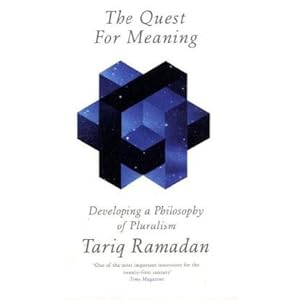
"The Quest for Meaning: Developing a Philosophy of Pluralism" by Tariq Ramadan - Some Reviews

Tariq Ramadan is a political activist, Muslim scholar, professor of Islamic Studies at Oxford. Many people see him as a positive reformer for modern Islam, helping to reduce the influence of the hard-core orthodoxy. However, many others see him as a "slippery", "double-faced" religious bigot, "a covert member of the Muslim Brotherhood whose aim is to undermine Western liberalism."

There who say that if you are controversial figure then you are probably doing something right. Tariq Ramadan's new book, "The Quest for Meaning: Developing a Philosophy of Pluralism," is generating some passionate reviews, so at least his likely to make some money on the deal.

Here are some reviews, all from the British press.

The Quest for Meaning by Tariq Ramadan

John Gray is frustrated by an idealistic treatise that mistakes poetic vagueness for pluralism

By John Gray
The Guardian, Saturday 28 August 2010

The Quest for Meaning: Developing a Philosophy of Pluralism

by Tariq Ramadan 224pp, Allen Lane, £14.99

"Time is linear or cyclical. The paths are steep, and sometimes there are mountains, plains and vast expanses of desert or water. We go on, in order to make progress or simply to go and then come back, and we learn to be, to live, to think and to love." This short passage captures the flavour of much of Tariq Ramadan's latest book. Before it is anything else, The Quest for Meaning is an exercise in rhetoric – something in which, Ramadan seems to think, clarity should be avoided wherever possible. He tells the reader that time is linear or cyclical, but which is it? Can it be both? Similar questions arise throughout the book, which contains few clear statements of any kind. One can read tens of pages, even whole chapters, and come away without recalling a single straightforward assertion.

Ramadan's equivocating style has made him the target of fierce attack. Neo-conservatives and some liberals have taken the Swiss Islamic scholar to task for failing to denounce human rights violations, while in his wildly hyperbolic The Flight of the Intellectuals the US writer Paul Berman has accused Ramadan of promoting a new kind of totalitarianism. Criticism of this sort is hard to take seriously. Anyone who sees Islamist movements as posing a threat on the scale of Nazism and communism has forgotten what these regimes were really like, and unless one subscribes to absurd theories of clashing civilisations, dialogue with and among Muslims can only be useful. Engaged in a type of intellectual diplomacy that places him at the most sensitive points of conflict between Islam and the west, Ramadan surely has a part to play.

The danger comes when the inevitable hypocrisies of public dialogue are presented as a coherent philosophy. In politics, compromise is unavoidable and often desirable. In the life of the mind, it is a recipe for a dangerous kind of woolliness. Ramadan claims to be developing a philosophy of pluralism, but that means looking for ways in which rival worldviews can coexist – a goal that cannot be achieved by blurring their differences or seeking an imaginary totality in which their conflicts are conjured away. Part of what is needed is old-fashioned tolerance – the willingness to accept that others be free to hold views you believe are mistaken or abhorrent.

Ramadan is having none of this. In a rare display of unambiguous clarity, he writes: "When it comes to relations between free and equal human beings, autonomous and independent nations, or civilisations, religions and cultures, appeals for the tolerance of others are no longer relevant." The idea that tolerance is obsolete because it presupposes a position of power or superiority has become a commonplace. But it is also nonsense, because the need for tolerance comes from something deeper than shifting power relations. It comes from the fact that we will always have to put up with ideas and people we loathe.

Read the whole review.

At the end of the day both religious and secular seek the same truth, says controversial Islamic scholar Tariq Ramadam. Michael Pye begs to differ

This is an extraordinary book, and that is not a compliment: a wishful incantation dressed up with a clatter of quotes and a touch of mysticism which even the author acknowledges could be thought "ethereal" (or, if you prefer, "fluffy"). You pick it up expecting a remarkable Islamic scholar on how we might stop talking clash of civilisations and try to live a pluralism that insults nobody. You get what the scholar himself calls some kind of "initiation", when he's not likening it, rather too accurately, to crossing a desert.

Maybe that's my fault for having a secular mind, because Tariq Ramadan certainly doesn't and our minds do not meet. He has certainties, and he is certain that if all our attitudes and truths were averaged out we'd find a truth on which we could all agree; and naturally this couldn't contradict his own certainties, so the process is risk-free. To him, everyone is a believer, which suggests he doesn't quite see the difference between believing the sun will rise and accepting a whole system of belief without immediate evidence, like a religion.

You can see the problem: a missionary mindset trying to engage with a secular issue like pluralism. For nobody supposes that everyone will manage a perfect, pluralist mind; we all, to use Ramadan's metaphor, have our windows on the world, and we can only look through one at a time. Pluralism matters somewhere else, in the space (it might be dentistry, it might be bus driving or accountancy) where we are not, first and foremost, religious and where we co-operate with people who believe nothing that we believe. At the moment, that's where we need help. And Ramadan ought to be the man to help: there is nobody quite like him.
Read the whole review.

The Quest for Meaning: Developing a Philosophy of Pluralism, By Tariq Ramadan

Reviewed by Kenan Malik

Friday, 13 August 2010

ALAMY: Seeking plurality: Muslim women shopping in London

In an age in which public intellectuals are often highly divisive figures – think of the storms surrounding Noam Chomsky, Richard Dawkins or Bernard-Henri Levy - few generate more controversy than Tariq Ramadan. Political activist, Muslim scholar, and professor of Contemporary at Oxford University, he is to some the "Muslim Martin Luther", a courageous reformer who helps bridge the chasm between Islamic orthodoxy and secular democracy.

To his critics, Ramadan is a "slippery", "double-faced" religious bigot, a covert member of the Muslim Brotherhood whose aim is to undermine Western liberalism. When, in 2004, Ramadan was appointed professor of religion by Notre Dame, America's leading Catholic University, the US State Department revoked his visa for supposedly endorsing terrorist activity. The ban has since been lifted.

The debate about Ramadan was re-ignited earlier this year with the publication of The Flight of the Intellectuals, American writer Paul Berman's savage attack on European thinkers like Ian Buruma and Timothy Garton Ash for what he regards as their appeasement of Ramadan. The Quest for Meaning, Ramadan's first book aimed at a wider Western audience, arrives therefore at a timely moment.

It is, he writes, "a journey and an initiation" into the world's faiths to discover the universal truths they hold in common and to set out "the contours of a philosophy of pluralism". Unfortunately it will do little to settle the argument about the nature of Ramadan's beliefs.

There is a willfull shallowness about this work, a refusal to think deeply or to pose difficult questions, that is truly shocking. Insofar as it is provocative, The Quest for Meaning seeks to provoke not through the excess of its rhetoric but the banality of its reasoning.

Read the whole review.

The Quest for Meaning: Developing a Philosophy of Pluralism

By Tariq Ramadan

Reviewed by Ziauddin Sardar - 09 August 2010

Tariq Ramadan is a feted thinker, but his argument for the equal value of all faiths is clothed in platitudes and patronising mysticism.

Philosophy as candyfloss

The noted Muslim preacher, philosopher and Oxford academic Tariq Ramadan invites us to join him on a journey. We are promised an exploration of the bottomless ocean of ancient wisdom, through various religious, mystical, spiritual and secular traditions. We are asked to put our differences aside, to rise above and move beyond our obvious "conflict of perceptions". It will be a quest to help us rediscover our humanity and it will give meaning to our lives.

The journey begins well enough. Ramadan points out that we have a rather restricted view of reality: we see through our own "window", but there are countless other windows, other ways of perceiving and understanding the world. The binary logic of the west confines one to a single window. To get a wider perspective, it is necessary to transcend the limitations of reason and rationality. We need to see not just through our minds but also through our hearts. "The science of the heart," Ramadan writes, "is not the science of reason."

The first truth we must acknowledge, Ramadan asserts, is that of intellectual modesty and humility. Our own perception of truth, scientific or otherwise, is only a single viewpoint over the horizon. Our own religion or way of life is a partial, often distorted, reflection of the Truth. We should not take our partial images as certainties and delude ourselves that we know everything, or have found ourselves. "The dogmatic spirit," he writes, "confuses its exclusive convictions with the oceans of quests and human truths."

True meaning can come only from appreciating the Whole. The ocean has countless shores, all waiting to be explored, all offering distinctly different perspectives on the cosmos. It is the plurality of perceptions that shapes our common humanity. This is the core of Ramadan's "philosophy of pluralism".

But Ramadan's pluralism requires more than simple acknowledgment of diversity. He insists that meaning can emerge only by experiencing plurality. To be fully human, we must share the truth of others. Only "by immersion in the object per se", he writes, will we "be able to meet human beings, or subjects, with their traditions, religions, their philosophies, their aesthetics and/or their psychologies". It is at this juncture that the journey becomes a little confusing. The "ocean" of wisdom seems to yield little beyond trite statements. All explorations of the truth, all varieties of religious exploration, lead to the same destination, he tells us. Stating the obvious with a sense of discovery is neither original nor philosophy. If all paths "lead to the heart", one could ask, why choose one over the other?

Read the whole review.