Showing posts with label homosexuality. Show all posts

Saturday, February 05, 2011

The Myth Buster: Evelyn Hooker Exploded the Notion that Homosexuality Was a Mental Illness


From the most recent issue of the APA's Monitor on Psychology, "time capsule" tribute to the woman who got homosexuality delisted as a mental illness and removed from the Diagnostic and Statistical Manual III of the American Psychiatric Association.

The myth buster

Evelyn Hooker’s groundbreaking research exploded the notion that homosexuality was a mental illness, ultimately removing it from the DSM.

By Katharine S. Milar
February 2011, Vol 42, No. 2
Print version: page 24

In 1953, Evelyn Hooker, PhD, applied for a National Institute of Mental Health (NIMH) grant to conduct research on “normal homosexuals.” During this period of American history, Sen. Joseph McCarthy was seeking out communists wherever he suspected they might be lurking; homosexual acts were a crime; bomb shelters were springing up in backyards; and the term “normal” homosexual was thought to be an oxymoron. A variety of medical and psychological treatments to “cure” homosexuality were employed, including ice pick lobotomies, electroshock, chemical castration with hormonal treatment or aversive conditioning. Gay parties were raided by the police, particularly in election years when a crackdown on “sexual perversion” was seen as a positive step in the fight on crime.

Hooker’s proposal to study gay men began as a result of a close friendship she developed with a former University of California, Los Angeles, student, Sam From, who introduced her to the gay subculture. She became one of the heterosexuals “in the know.” It was From who told her it was her “scientific duty” to study homosexuals and promised her access to all the subjects she needed. Initially she demurred but eventually, with the encouragement of From and her colleague Bruno Klopfer, Hooker began an investigation that would ultimately result in the removal of homosexuality as a form of psychopathology from the Diagnostic and Statistical Manual III of the American Psychiatric Association. This research was the culmination of Hooker’s lifelong interest in social justice.

Humble beginnings

Evelyn Hooker was born Evelyn Gentry Sept. 2, 1907 in North Platte, Neb., the sixth of nine children. Photos of her as a school child show that she towered above most of her classmates; she was nearly 6 feet tall as an adult. Her family was quite poor, and neither parent was educated past fourth grade. Her adolescence was colored by these social stigmata; she attributed her study of “an oppressed, deprived people,” (homosexual men) to her early experience (Garnets & Kimmel, 2003, p. 36). After earning her bachelor’s and master’s degrees at the University of Colorado with Karl Muenzinger, she aspired to earn a doctorate at Yale, but the department chair at Colorado refused to recommend a woman to his alma mater. Instead, she completed her doctorate in experimental psychology at Johns Hopkins University in 1932, studying vicarious trial-and-error learning in rats. A fellowship in 1937–38 took her to Berlin to pursue her increasing interest in clinical psychology at the Institute for Psychotherapy. She lived with a Jewish family and witnessed, with dismay, Hitler’s rise to power. Much later, after her return to the United States, she learned that all members of her host family perished in the concentration camps.

A trip to the Soviet Union at the end of her fellowship year exposed her to another totalitarian regime and caused problems for her after she returned to a tenure track position at Whittier College, in Whittier, Calif. Suspected of holding subversive political views, she lost her position. She appealed to her graduate mentor at Johns Hopkins, Knight Dunlap, who was then chair of the department at UCLA, but he could only offer her a research associate position in the psychology department, telling Hooker that the three women in the department were “cordially disliked” and he could not appoint another woman. She was instead appointed to the UCLA Extension division, and it was here that she met Sam From as a student in her introductory psychology course.

Stimulated by her experience with various forms of discrimination and her friendship with From, Hooker began interviewing gay men who were friends or friends of friends. In the middle of her investigations, her husband, Donn Caldwell, an alcoholic, divorced her, saying he didn’t want to destroy her as he was destroying himself. In emotional turmoil, Hooker left her research and California for a time. In 1948, she returned to her job at UCLA and rented a small house from a distinguished professor of English Edward Niles Hooker. They married in 1951.

Back in California, now happily married and without heavy teaching commitments, Evelyn Hooker returned to her research on gay men. She decided that her previous interviews were not useful; they had not been planned carefully enough. So, she decided to apply for a grant from NIMH. The chief of the grants division, John Eberhart, flew out to interview her to see who this woman was who claimed she had access to any number of gay men who were neither psychiatric patients nor prisoners. He told her, given the climate of McCarthyism, everyone was being investigated and if she got the grant, “you won’t know why and we won’t know why” (1993, p. 450). (Eberhart later told Hooker that her project was derisively referred to as “The Fairy Project” by some federal officials in Washington.) Funding was granted and Hooker embarked on her study.

She recruited 30 exclusively homosexual and 30 exclusively heterosexual men, matched for age, IQ scores and education. With the aid of the Mattachine Society, one of the first gay-rights organizations, access to homosexuals was no problem, but finding heterosexual men who would agree to participate was very difficult. She could not conduct the study on the UCLA campus in spite of pressure to do so. The nature of the research required strict confidentiality, so she used a small study on her spacious Los Angeles estate on Saltair Avenue. She approached firemen, policemen, maintenance workers, any heterosexual men she could persuade to participate. Her husband said, “No man is safe on Saltair Avenue.”

Each participant took three projective tests: The Rorschach, the Make a Picture Story Test (MAPS) and the Thematic Apperception Test (TAT). After scoring the tests herself, she then gave the test protocols with all identifying information removed to experts in those tests: Bruno Klopfer for the Rorschach, Edward Shneidman, the inventor of MAPS, and Mortimer Meyer for the TAT. An adjustment rating was assigned to each participant based on the test scores, and then the experts were given paired Rorschach protocols, one from a gay participant, one from a straight participant and asked to identify the homosexual. As with heterosexuals, homosexuals’ adjustment varied from superior to disturbed. Two-thirds of the research participants in each group were judged as having average or better adjustment. Further, experts were unable to identify the gay participant’s protocol from the matched pairs at better than chance accuracy. There was no association between homosexuality and psychological maladjustment. One of her experts, who was sure he could distinguish the groups, asked for another chance to review the protocols, but was no more successful the second time than the first.

Hooker reported that one of the most exciting days of her life was the day she presented the results of her research at APA’s 1956 Annual Convention in Chicago. This ground-breaking research and the work that followed on the homosexual subculture led to Hooker’s award in 1992 for Distinguished Contribution to Psychology in the Public Interest from APA. In her response to this honor, she shared the award with the gay and lesbian community and expressed pleasure that her research and her “long advocacy of a scientific view of homosexuality” could make their lives and the lives of their families better. She closed her address by reading from a letter she had received from a gay man thanking her for her work and saying, “I think you did it because you knew what love was when you saw it, and you knew that gay love was like all other love.”

~ Katharine S. Milar, PhD, is a professor of psychology at Earlham College and historical editor for “Time Capsule.”

Article Sidebar
Hooker’s legacy continues

Suggested reading

  • Garnets, L.D., & Kimmel, D. (2003). What a light it shed: The life of Evelyn Hooker. In L.D. Garnets & D.C. Kimmel (Eds.) Perspectives on gay, lesbian and bisexual experiences (pp. 31–49). New York: Columbia University Press.
  • Harrison, J. (Producer), & Schmiechen, R. (Director). (1991). Changing Our Minds, The Story of Dr. Evelyn Hooker. [film]. Distributed by Frameline. http://www.frameline.org
  • Hooker, E. (1993). Reflections of a 40-year exploration: A scientific view on homosexuality. American Psychologist, 48, 450–453.
  • Minton, H.L. (2002). Departing from deviance: A history of homosexual rights and emancipatory science in America. Chicago, IL: University of Chicago Press.
  • Shneidman, E.S. (1998). Evelyn Hooker (1907–1996). [Obituary]. American Psychologist, 53, 480–481.

Wednesday, December 01, 2010

NPR - Smithsonian Under Fire For Gay Portraiture Exhibit

Some days, people can really be annoying. Seriously, what the hell is wrong with portraits of gay people? One of the images (follow the link to see them) was removed because it "offends religion"? Silliness at best, censorship in reality. Catholic League President Bill Donohue quite often acts like a tool.


December 1, 2010

The Smithsonian Institution is under fire for an exhibition called Hide/Seek that is being touted as the "first major exhibition to focus on sexual difference in the making of modern American portraiture."

There are some very famous artists represented in the show: Andy Warhol, Walt Whitman and Jasper Johns, among many others. But the work that so far has been the most controversial is a provocative video from 1987 by the late artist David Wojnarowicz called A Fire In My Belly.

Martin Sullivan, director of the Smithsonian's National Portrait Gallery, says the artist created the piece as a response to the "agony and suffering" of his partner who at the time was dying of AIDS. Using "vivid colors, and some fairly grotesque scenes, it's more a meditation on the fragility of the human flesh," Sullivan says.

If it's wrong for the government to take the taxpayers' money to promote religion, why is it OK to take taxpayers' money to assault religion?

But included in that meditation is a crucifix — a cross bearing the body of Christ — crawling with ants. The image, according to Catholic League President Bill Donohue, is offensive. He calls the video "hate speech" and says that "the Smithsonian would never have their little ants crawling all over an image of Muhammad."

Donohue says he complained to members of Congress and the Smithsonian's Board of Regents. "My principle is very simple," he says, "If it's wrong for the government to take the taxpayers' money to promote religion, why is it OK to take taxpayers' money to assault religion?"

Donohue admits he has not seen the exhibition Hide/Seek, but he did see the video images of the ants on the crucifix online.

Donohue's concerns echo those of others who've complained to the National Portrait Gallery, says Sullivan. So Sullivan decided to remove A Fire In My Belly from the show.

"The concern that people of the Christian faith were apparently telling us — 'You wouldn't do this to a Muslim image' — was distracting to the larger and more important themes of the show, which is why we did the exhibition in the first place," Sullivan explains.

More On The Exhibit:

At least one critic has accused the Smithsonian of caving in to pressure from Catholics and from two Republican members of Congress. Representative Eric Cantor of Virginia called the exhibition "an outrageous use of taxpayer money." A spokesperson for incoming House Speaker John Boehner told The Hill newspaper that "Smithsonian officials should either acknowledge the mistake or be prepared to face tough scrutiny beginning in January."

Political football? You bet, says Lee Rosenbaum, who writes about the arts for The Wall Street Journal. In her blog, CultureGrrl, she says a show like this could be too controversial for a federal institution.

"Most of its artists are down the middle of the fairway: big-name American artists like Eakins, Bellows, Hartley, O'Keeffe even," says Rosenbaum. "The problem is that it's such an easy target when they're looking for cuts, when they're looking for differences with the administration, to look at a federal institution — which the National Portrait Gallery is — and try to make that into a big issue."

A spokesperson for the Smithsonian says that since the show opened on Oct. 30, the National Portrait Gallery has received only one complaint from a visitor.

Sullivan says the rest of the exhibition will remain open until mid-February.


Tuesday, June 22, 2010

An alarming number of gay and transgender young people are homeless

http://www.bcpwa.org/enewsletter/090424_files/winter09_homeless.jpg

This report from the Center for American Progress is very sad. There are an estimated 1.6 million to 2.8 million homeless young people in the United States (no one has exact numbers because these kids don't WANT to be found quite often), and estimates suggest that disproportionate numbers of those youth are gay, lesbian, bisexual, or transgender. These vulnerable gay and transgender youth often run away from home because of family conflict or violence in their home communities.

Gay and Transgender Youth Homelessness by the Numbers

Report: On the Streets: The Federal Response to Gay and Transgender Homeless Youth

lgbt youth population v. lgbt homeless youth population

There are approximately 1.6 million to 2.8 million homeless young people in the United States, and estimates suggest that disproportionate numbers of those youth are gay, lesbian, bisexual, or transgender. These vulnerable gay and transgender youth often run away from home because of family conflict and then face overt discrimination when seeking alternative housing, which is compounded by institutionalized discrimination in federally funded programs.

We do not have to accept this reality. The federal government has the power to reduce and eventually eliminate rates of gay and transgender youth homelessness while addressing youth homelessness overall. Congress can and should make a financial commitment to services directed at these young people. They should join with federal agencies and couple it with an expansion of equal rights and protections to all gay, lesbian, bisexual, and transgender people. As the numbers below show, it’s time we provide these young people with the help they need.

An alarming number of gay and transgender young people are homeless

1.6 million to 2.8 million: The estimated number of homeless youth in the United States.

20 to 40 percent: The portion of the homeless youth population who are gay or transgender, compared to only 5 to 10 percent of the overall youth population.

320,000 to 400,000: A conservative estimate of the number of gay and transgender youth facing homelessness each year.

14.4: The average age that lesbian and gay youth in New York become homeless.

13.5: The average age that transgender youth in New York become homeless.

Homeless gay and transgender youth see higher rates of abuse and victimization

graph of homeless lgbt and heterosexual youth who have been  sexually assulted

58 percent: The portion of homeless gay and transgender youth who have been sexually assaulted, compared to 33 percent of homeless heterosexual youth.

44 percent: The portion of homeless gay and transgender youth who reported being asked by someone on the street to exchange sex for money, food, drugs, shelter, or clothes, compared to 26 percent of straight homeless youth.

Rejection and discrimination at home lead to severe personal and social problems

13: The average age gay and lesbian youth now come out after self-identifying as gay or lesbian as young as ages 5 to 7.

graph of alcohol abuse

62 percent: The portion of homeless gay and transgender youth who experience discrimination from their families, compared to 30 percent of their heterosexual peers.

42 percent: The portion of homeless gay and transgender youth who abuse alcohol, compared to 27 percent of heterosexual youth.

62 percent: The portion of homeless gay and transgender youth who attempt suicide, compared to 29 percent of their heterosexual homeless peers.

8.4 times: How much more likely gay and transgender youth are to attempt suicide if they are rejected by their families in adolescence compared to if they are not rejected by their family. They are also 5.9 times as likely to have experienced depression, 3.4 times as likely to have used illicit drugs, and 3.4 times as likely to have had unprotected sex.

Harassment at school leads to high dropout rates

86 percent: The portion of gay and lesbian students who reported being verbally harassed at school due to their sexual orientation in 2007.

graph of abuse at school

44 percent: The portion of gay and lesbian students who reported being physically harassed at school because of their sexual orientation in 2007.

22 percent: The portion of gay and transgender students who reported having been physically attacked in school in 2007. Sixty percent say they did not report the incidents because they believed no one would care.

31 percent: The portion of gay and transgender students who report incidents of harassment and violence at school to staff only to receive no response.

Two times: How much less likely gay and transgender students are to finish high school or pursue a college education compared to the national average.

Child welfare systems often fail to protect gay and transgender youth

78 percent: The portion of gay and transgender youth who were either removed from or ran away from their New York foster care placements due to conflict and discrimination related to their sexual orientation or gender identity.

88 percent: The portion of professional staff in out-of-home placements who say that gay and transgender youth were not safe in group-home environments.

$53,665: The estimated cost to maintain a youth in the criminal justice system for one year, while it only costs $5,887 to permanently move a homeless youth off the streets and prevent them from reentering the criminal justice system.

Federal programs overlook homeless gay and transgender youth

$195 million: The portion of the federal government’s $4.2 billion budget for homeless-assistance programs that is targeted toward homeless youth.

graph of federal asssistance

Less than 1 percent: The portion of the $44 billion federal budget for rental assistance, public housing, and affordable housing programs allocated for homeless youth housing assistance.

44,483: The number of youth who were given a bed in a shelter through Runaway and Homeless Youth Act programs in 2008, compared to 766,800 homeless youth identified through these programs.

For more information, see:

Thursday, December 10, 2009

Rachel Maddow Demolishes Therapist Who Claims He Can Make Her Straight

I love Rachel Maddow.

Richard Cohen is an idiot. The idea that you can make gay people straight is laughable at best and abuse in reality. Homosexuality is a genetically determined predisposition, and you cannot undo that with "therapy" or anything else. This guy was kicked out of the American Counseling Association for ethical violations. He is not licensed in any state.

Maddow quotes from Cohen's book:
Maddow: Let me ask - I‘ll just read from your book, OK? Page 49, “Homosexuals are at least 12 times more likely to molest children than heterosexuals. Homosexual teachers are at least seven times more likely to molest a pupil. Homosexual teachers are estimated to have committed at least 25 percent of pupil molestation; 40 percent of molestation assaults were made by those who engage in homosexuality.”
Those "stats" are absolutely false, and he does not acknowledge that when he says he plans to take them out of the 3rd edition of the book that is being used in Uganda to justify killing gay men and women.

You can read the whole transcript here.

Or you can just watch the videos.

Part One:


Part Two:


Tuesday, July 14, 2009

Gay Marriage: What Would Buddha Do? - James Shaheen

This article appeared at The Huffington Post yesterday, but it's from the editor of Tricycle, one of the premier Buddhist magazines. While the Dalai Lama has come under fire for rejecting homosexuality (which is part of his tradition, not necessarily what he thinks personally), he only represents one small sect of Buddhism. So what would Buddha do?

Gay Marriage: What Would Buddha Do?

James Shaheen

Posted: July 13, 2009 04:08 PM

A lot of people ask me what the "Buddhist take" on gay marriage is. Well, it depends on who you talk to. A few years back, in an interview with the CBC, the Dalai Lama rejected same-sex relationships to the surprise of many convert Buddhists, who sometimes too easily assume that Buddhist ethics are consistent with their typically progressive views.

As the Canadian interview bounced around the internet, some people were shocked and perplexed, but the Dalai Lama's position shouldn't have come as a surprise to anyone who has followed the issue. After all, he has been consistent. At a conference some 12 years ago, when gay leaders met with him in San Francisco to discuss the Tibetan Buddhist proscriptions against gay sex, he reiterated the traditional view that gay sex was "sexual misconduct." This view was based on restrictions found in Tibetan texts that he could not and would not change. He did, however, advise gay Buddhist leaders to investigate further, discuss the issue, and suggested that change might come through some sort of theological consensus. But at a time when same-sex marriage has taken front-stage center in American politics, the Dalai Lama's more recent statements come as unwelcome news to proponents of civil rights.

Does this mean Buddhism condemns same-sex relationships? Not at all. Contrary to popular perception, the Dalai Lama does not speak for all Buddhists. As the leader of the dominant Gelug sect of Tibetan Buddhism, he speaks for one slice of the world's Buddhist population. The vast majority of Buddhists do not practice in his tradition -- however much they respect and admire him -- and the Tibetan texts the Dalai Lama refers to were written centuries after the Buddha had come and gone.

Buddhism is perhaps even more diverse than Christianity. In fact, the differences among schools can be so vast that some scholars consider them different religions. Indeed, according to Thanissaro Bhikkhu, abbot of the Metta Forest Monastery in southern California, the Buddha never forbade gay sex for lay people as far as we know. "When he drew the line between licit and illicit sex, it had nothing to do with sexual tastes or preferences," he says, citing early texts. "He seemed more concerned with not violating the legitimate claims that other people might have on your sexual partner."

The Buddhist monastic code, which contains detailed -- and sometimes ludicrous -- guidelines (think Leviticus), applies only to monks, leaving the rest open to debate.
Western dharma communities are known for their tolerance, and the Dalai Lama himself has openly gay students. It's rare to hear of anyone being drummed out of a Western Buddhist community for being gay, and in most Buddhist traditions practiced in the West--including the Tibetan communities--sexuality is rarely if ever an issue. Nonetheless, in the current political climate, hearing the world's most famous Buddhist declare homosexuality to be "sexual misconduct" can't help but lead people to believe that the Buddha's teachings proscribe same-sex relationships. They don't, any more than they promote them.

Friends of mine have argued that the Dalai Lama doesn't really look askance same-sex relationships, that he has no choice but to uphold his tradition's dictates; and that maybe the Dalai Lama is just stuck with the old texts' proscriptions in the same way that a Catholic, say, must deal with Thomas Aquinas. Of course, we can't know and must take his public statements at face value. In his case, though, our expectations tend to be different than they might be for the local minister, priest or orthodox rabbi. And so many of us who have benefited greatly from his teachings are apt to feel disappointed.


James Shaheen is the editor and publisher of Tricycle: The Buddhist Review.

Monday, June 22, 2009

William Irwin Thompson - Thinking Otherwise: On Gay Marriage

William Irwin Thompson, writing at Wild River Review, takes a big picture view of the cultural reality of homosexuality - and concludes that the state has no business regulating marriage rites.

Thinking Otherwise: On Gay Marriage

Filed under: WRR@LARGE — Tags: , , , — joystocke @ 7:33 am

by William Irwin Thompson

“We Irish think otherwise” Bishop Berkeley

Sappho and Erinna, Simeon Solomon, Tate Gallery

Sappho and Erinna, Simeon Solomon, Tate Gallery

It was the Canadian Prime Minister Pierre Eliot Trudeau who first fought off the hordes of the self-righteous who rose to the attack of homosexuality by insisting that “The State had no business in the bedrooms of the nation.” In the evolution of culture since the sixties—and because of the sixties, I might add—we have made some progress and people have come to accept homosexuality as a cultural reality and not simply as an “abomination in the eyes of the Lord.” Or, at least, those sensible people who prefer to live in a culture and not a cult have come to be more tolerant and pluralistic in their acceptance of tempora et mores.

So let us take a step back to look at the issue of Gay marriage from an evolutionary point of view, both cultural and biological—although these two are never really separated in human reality. If, in the terms of Natural Selection, homosexuals do not reproduce, what possible selective pressure can there be that enables homosexuals to survive over the millennia? They should have died out long ago as a kinky approach to orgasm that arose when we all had to huddle together in caves in the Ice Age and no one really knew late at night what was going on under all those furs. By the time of the sunlit nuclear families of the Neolithic, when houses shifted from round to square and had an extra room for individual food storage and private property, people began to domesticate animals and notice which black goat sired more black goats, and paternity reared its—well, you get the idea.

Homosexuality should have disappeared, but in fact most of those Abrahamic cultures of the Middle East and Central Asia have strong traditions of boy love, and those love poems of Hafez that celebrate the beauty of the “slim Turk,” are not talking about women. Across the vast continent of Eurasia to the Greeks and Romans, and up to the birth of Latin poetry with Catullus, poetry is celebrating homosexuality and bisexuality. And if we go back even further to the Gilgamesh Epic, we find a celebration of the love of men for men. When Gilgamesh couples with women, it is merely the relief of a biological drive, but his intense love for Enkidu is a sublime love of a higher order. Homosexuality has been with us for a long time and probably antedates the institution and so-called “sanctity of marriage.”

So we have to ask ourselves, what selective pressure exists for the continuation of homosexuality when it is obviously not an agency of reproduction? The answer is, of course, that there is a process of Baldwinian Evolution going on, and that the selective pressure is cultural. The homosexual is the magical “wounded healer,” the man with the vulva that heals itself. From the dawn of culture, vulvas were inscribed on rocks and cave walls, and the figurines of the Great Mother, like the Venus of Laussel, were daubed with red ochre to signify the menstrual blood. The vulva was the wound that healed itself in rhythm with the lunar cycle. The man with the vulva was the shaman, the wounded healer who had knowledge of animals and stars, healing and weather. When Christ shows the labial-shaped wound in his side to the doubting Thomas, he is showing that he is the vulva-man, the wounded healer who has healed death itself in his resurrection.

Androgynous men were often selected in early adolescence and marked out in their femininity for training as future shamans. So it is cultural selection and not simply natural selection that produces the selective pressure that insures the continuation of the homosexual. Unconsciously this is why Roman Catholic priests wear soutanes, Bishops and Cardinals dress in colorful and outrageously draggish clothes, and have a fondness for altar boys. It is naïve to think that child abuse is merely a case of a few bad apples; it is basic to the institution of priesthood. It is the boy love culture of Eurasia surviving into our day under wraps.

But as society evolves through the cultural vehicle of the city, from Athens to Rome to London to New York, the shaman also evolves from the sacerdotal figure to the artist. The small town or village still was religious and ignorant, so the Gay man, a Walt Whitman or a Hart Crane, had to move to the Big City. And what was true of Gay men was also true of Lesbian women, from Sappho to Yourcenar. In a more secular society, the shaman becomes the artist.

So if we are going to invoke tradition as the foundational justification of the family, then we had better be sure we know what our traditions really are.

But really–as Trudeau said–the State has no business in any of this. The State may need to issue certificates for birth and death, but certainly not for baptism or extreme unction. And so it is for marriage or confirmation and Bar Mitzvah. The State should issue certificates for civil unions that have to do with property rights and medical visitation rights, and that is all. After one receives a birth certificate from the State, one’s parents can choose to take one to church to be baptized. And so it should be for marriage: after you have been to City Hall, then you can go to whatever religious institution you choose that is willing to bless your union. If you are, for example, a Catholic or Evangelical, and your Church won’t accept your union, then that is grounds for divorce—from either your partner or your religion.

Choir Boys

Not the organ answering Job out of the whirlwind,
nor the tiny pointed notes of the harpsichord–
metallic and discrete as knights in armories
unfurled and elevated above the clubbed blood
of churlish battle or bones struck on mammoth skulls,
nor the sun’s arteries drained in stained glass truncheons;
bound in cassocks to their claustral occulted place
where priestly functions anoint the choir boys’ throats
in rituals thousands of years before the Mass,
cherub buttocks lean on the misericord’s hard love
tangled in wings of the dove and coils of the snake
that soon break sunset’s shaft on the rising full moon;
but now the pianoforte in thundering halls
breaks gods’ hold in revolution’s noisy applause.

Cultural philosopher and poet, William Irwin Thompson, is founder of the Lindisfarne Fellowship. He became nationally known as a writer for his best-selling book on contemporary affairs, At the Edge of History, which was a finalist for the National Book Award. He received the Oslo International Poetry Festival Award for his science fiction fantasy novel Islands Out of Time and has published four books of poetry. As a cultural historian, he is most widely known for his books, The Time Falling Bodies Take to Light: Mythology, Sexuality, and the Origins of Culture and Coming into Being: Artifacts and Texts in the Evolution of Consciousness. His collection of poems, Still Travels, will be published by Wild River Books, an imprint of Wild River Review, this summer.


Friday, February 27, 2009

Some New Psychology Books

Another installment in the perpetual listing of new books that I would like to own and read. Follow links to see the full reviews. All reviews come from Metapsychology Online Reviews.

* * *
Sexual Orientation and Psychodynamic Psychotherapy: Sexual Science and Clinical Practice
by Richard C. Friedman and Jennifer I. Downey
Columbia University Press, 2002
Review by Minna Forsell

Social psychology has taught us that gender is the first distinction that we make when meeting someone, so essential to our understanding of others that the question of what it is and how it influences us is one of the vastest and deepest in the field of psychology. The link between gender and sexual orientation is equally complex. Given the prominent place of sexuality in psychodynamic theory and treatment, the need for an understanding of its elusive nature is crucial.

Sexual Orientation and Psychodynamic Psychotherapy is a successful attempt to syncrhonize empirical studies on sexuality with psychodynamic thinking. The result is an engaging exploration of gender, sexual development and psychotherapy that gives thought-provoking perspectives on human sexuality as well as clinical work.
Read more.

* * *
Unsettled Minds: Psychology and the American Search for Spiritual Assurance, 1830-1940
by Christopher G. White
University of California Press, 2008
Review by Gustav Jahoda, Ph.D.

William James's Gifford Lectures, delivered in Edinburgh 1901/2 and published under the title The Varieties of Religious Experience remains one of his best-known works. It has the significant sub-title A Study in Human Nature, and the broad historical background that led to the use of this phrase is explored by White. It all began before mid-19th century when many (presumably educated) Americans found the rigid hell-fire Protestant theology unacceptable and looked around for alternatives. The religious liberals, including pastors, turned to teachings that promised help them in understanding the inner spiritual potentials of human nature. At the outset it was phrenology, and when that became gradually discredited, they turned to the then emerging discipline of scientific psychology. Initially it was the physiological reflex arc that was considered the central explanatory concept, later followed by such notions as 'the will' or 'suggestibility', whose adoption by a multitude of academics, pastors and lay people is described in considerable detail.
Read more.

* * *
Psychiatry and Empire
by Sloan Mahone and Megan Vaughan (Editors)
Palgrave Macmillan, 2007
Review by Tony O'Brien, RN, MPhil

Psychiatry and Empire is part of the Cambridge Imperial and Post-Colonial Studies Series, covering modern imperial history and contemporary issues in the former colonies. According editor Megan Vaughan's introduction, psychiatry has long been considered to more or less unproblematically have functioned as an instrument of colonization, adding scientific and medical authority to the subjugation of colonized peoples. The story is a familiar one. Early settlers paved the way with guns and occupation; the resulting crises of legitimation being addressed by the newly emerging social and medical sciences. Psychiatry is a prime candidate as a tool of colonization, having as it does, the mandate to manage unruly and disruptive members of the community. In this publication the various authors consider the relationship between psychiatry and the colonial enterprise, arriving at differing conclusions, although all broadly in support of the central argument that psychiatry helped provide a rationale, under the guise of science, for existing practices of social control. However as many of the contributions show, this was by no means an uncontested or straightforward process. Distance from the center, Paris, London or Amsterdam, meant that the effectiveness of psychiatry was limited. In some cases it also created opportunities for innovation and critique although the viability of any alternative discourses and practice were, in the end, subject to the fate of the colonial governments.

Read more.

* * *
How Infants Know Minds
by Vasudevi Reddy
Harvard University Press, 2008
Review by R.A. Goodrich, Ph.D.

The mixture of close observation and probing speculation that characterizes Vasudevi Reddy's eleven-chapter monograph, How Infants Know Minds, makes for compelling reading. Overtly inspired by the work of Margaret Donaldson, Peter Hobson, and Colwyn Trevarthen since the 'seventies, Reddy aims to shatter a number of shibboleths largely unquestioned by researchers in the field of developmental cognitive psychology. After briefly identifying her principal target, we shall then outline an initial set of contentions likely to figure in debates arising from Reddy's argument. That, in turn, will lead us to conclude with some reservations of a conceptual and an historical kind.

I

Readers are immediately introduced to the abiding epistemological problem of how infants "come to understand people," how they can become "aware of others' minds," how they "perceive" them as "'persons,' as psychological beings" (1). Without pausing to consider whether each expression of "how infants know minds" (to cite the title) is synonymous or not, Reddy aligns the problem to a pervasive yet disconcerting tendency. It is the tendency in the practices and theories of "a psychology which holds on, surreptitiously, to dualisms it claims to have discarded and, more openly, to methods of investigation...more appropriate to non-sentient subjects" (2). Yet, she continues, perhaps the problem is a result of the misguided assumption of "thinking of the organism's capacities separately from the environment in which it functions" (3). Returning the infant to its interactively human, familial context and allowing that affective interactions or exchanges between an infant and its caretaker(s) constitute an embodiment of minds is, Reddy believes, the means of resolving the puzzle of how one mind comes to know others non-inferentially:

engaging with other minds and becoming aware of them is an emotional process from start to finish (41).
In short, rather than presuming that minds develop in isolation, should we not begin with the premise that minds are "intrinsically connected" from the beginning by way of "emotional engagements" and not through the "belated consequences of a rationally constructed understanding"? (4) Why? Because if we adhere to the latter, we are condemned to construing or inferring the presence of other, seemingly inaccessible minds from the viewpoint of the detached spectator (or onlooker) rather than from the role of the engaged participant (7).

Read more.


Saturday, January 31, 2009

Psychology Today - A Cartoon Guide to Sexual Orientation

Hilarious, and educational.

A cartoon guide to sexual orientation

Ever since we published the first genetic scan for male sexual orientation, one of the most frequent questions I get asked is "why are people gay." While I have done my best to share information about the science of sexual orientation (this blog being one example), I am not an animator so I haven't explored cartoons as an option. Fortunately, I don't have to now because a cartoon recently posted on YouTube does a fairly good job. The video tries to take on two of what I like to call "the big three arguments against gay people." If you listen to enough anti-gay rhetoric you will find it usually comes down to at least one of the following statements, "I don't believe in it, its unnatural, it's a choice." After discovering these beliefs to be the root of most anti-gay propaganda Watch the video and then let me fill in some of the details from research on sexual orientation.


Parents.

The video starts out with theories about parental influences on sexual orientation, like having a distant father or overbearing mother making a man gay. In fact, this was a theory put forward by some Psychologists and Psychiatrists. It was also used to explain why some people were schizophrenic. Eventually it was disproved in both cases. For example, in the 1970 researchers at the Kinsey Institute conducted a large survey and found no support for the idea that these kinds of parental influences made children gay (Bell, Weinberg, & Hammersmith, 1981). In the 28 years since that book was published there hasn't been any credible evidence showing that any kind of parental behavior changes the sexual orientation of their children.

Being gay is natural.

Next the video tackles the question of if homosexuality is "natural." This is one of the big three. I don't believe something being "natural" is a good argument for or against it. After all, lead is natural, but that doesn't mean I want it in my drinking water. Nevertheless, the point made in the cartoon about animals is true. Many species of animals engage in same-sex behavior and some have members that exhibit primary sexual attractions to their own sex. A few very good books have addressed this topic (Bagemihl, 1999; Sommer & Vasey, 2006).

You don't decide who to love.

When Martha says "You don't just decide who to love," I think she is right. Research shows that sexual attractions emerge around the time of puberty. If you think back to puberty, do you remember making a choice of who you would be attracted to? In fact, research shows that it doesn't matter what your sexual orientation is, it tends to emerge around the time of puberty. All indications are that people don't choose their sexual orientation.

It's in our genes.

Twin research has indeed found that if one identical twin is gay the other twin is also more likely to be gay. More importantly from a scientific perspective, is the fact that identical twins are significantly more likely to have the same sexual orientation than fraternal twins (Mustanski, Chivers, & Bailey, 2002). One of the best of these studies found the heritability of sexual orientation to be 62% (Kendler, Thornton, Gilman, & Kessler, 2000). This means that 62% of why some people are gay and others are straight is due to genetic effects. The cartoon is right in saying this is higher than handedness, which has a heritability of around 25% (Medland, Duffy, Wright, Geffen, & Martin, 2006).

Older brothers.

One of the most established findings in all of developmental psychology is that each older brother increases the chance that a man will be gay. Younger brothers don't seem to have an effect and neither do sisters. In fact, siblings don't seem to be related to a women's sexual orientation at all. But among men, each older brother increases the chance of homosexuality by about 33% (Blanchard & Bogaert, 1996). It has been hypothesized that this effect is due to mothers producing antigens to male fetuses and that these antigens have effects on the developing brain (Blanchard, 2008). However, the cartoon seems to make it seem like this is a fact, when at this stage it is only a theory.

My therapist made me straight.

The video ends with a discussion of whether it is possible to change a person's sexual orientation through therapy or prayer. Conclusive research has yet to show this is possible and some very well respected doctors have said it is not possible (for a good summary of research in this area see Professor Gregory Herek's website). The video is correct in saying that all major mental health organizations have some out with statements saying that homosexuality is not a mental illness and attempts to change it are not advisable (for example, see the statement by the American Psychological Association).

I hope you enjoyed the cartoon. Share it by clicking the "Share/Email" button below and maybe if enough people watch it the statement "I don't believe in it, its unnatural, it's a choice," will become a think of the past.

References

Bagemihl, B. (1999). Biological exuberance : animal homosexuality and natural diversity (1st ed.). New York: St. Martin's Press.

Bell, A. P., Weinberg, M. S., & Hammersmith, S. K. (1981). Sexual Preference: Its development in men and women. Bloomington: Indiana University Press.

Blanchard, R. (2008). Review and theory of handedness, birth order, and homosexuality in men. Laterality, 13(1), 51-70.

Blanchard, R., & Bogaert, A. F. (1996). Homosexuality in men and number of older brothers. American Journal of Psychiatry, 153, 27-31.

Kendler, K. S., Thornton, L. M., Gilman, S. E., & Kessler, R. C. (2000). Sexual Orientation in a U.S. National Sample of Twin and Nontwin Sibling Pairs. The American Journal of Psychiatry, 157, 1843-1846.

Medland, S. E., Duffy, D. L., Wright, M. J., Geffen, G. M., & Martin, N. G. (2006). Handedness in twins: joint analysis of data from 35 samples. Twin Res Hum Genet, 9(1), 46-53.

Mustanski, B. S., Chivers, M. L., & Bailey, J. M. (2002). A critical review of recent biological research on human sexual orientation. Annual Review of Sex Research, 12, 89-140.

Sommer, V., & Vasey, P. L. (2006). Homosexual behaviour in animals : an evolutionary perspective. Cambridge ; New York: Cambridge University Press.


Wednesday, December 03, 2008

Daily Buddhism - Buddhism and Homosexuality


Here is a great discussion and explication on the Buddhist views on homosexuality. This is an often misunderstood issue, especially with the Dalai Lama having stated that homosexuality is "wrong" on several occasions. We need a more measured and compassionate view that relies on the original teachings of the Buddha.

Daily Buddhism offers this wider context (I am including almost the whole post here, so be kind and go visit the blog for other great content):

Buddhism and Homosexuality

Question:

What is the view on Homosexuality and Buddhism? Is it condemned or accepted or just something they don’t want to talk about? Hope your nor offended by me asking you to answer this topic.

Answer:

Offended? Nope. Actually, I’m surprised no one asked before the election. As you might imagine, opinions are all over the place on this topic.

***

Next, for laypeople:

We are supposed to follow the five precepts, which includes the promise not to engage in sexual misconduct. What exactly is sexual misconduct?

(from religionfacts.com see source links below):

Right and wrong behavior in Buddhism is generally determined by considerations such as the following:

* Universalibility principle - “How would I like it if someone did this to me?”
* Consequences - Does the act causes harm and regret (in oneself or others) or benefit and joy?
* Utilitarian principle - Will the act help or harm the attainment of goals (ultimately spiritual liberation)?
* Intention - Is the act motivated by love, generosity and understanding?

“Sexual misconduct” has thus traditionally been interpreted to include actions like coercive sex, sexual harassment, child molestation and adultery. As Homosexuality is not explicitly mentioned in any of the Buddha’s sayings recorded in the Pali Canon (Tripitaka), most interpreters have taken this to mean that homosexuality should be evaluated in the same way as heterosexuality, in accordance with the above principles.

The above seems to point to the acceptability of homosexuality. There are plenty of opposition opinions on this, and there are even some important people who don’t seem fully committed either way.

***

Overall, Buddhism is more accepting of gays than most of the other “big” religions. My own point of view is that consensual sexual activity by a committed couple, whether engaged in by a heterosexual or homosexual couple, is not sexual misconduct, and this is a point of view shared by many others. It really all hinges upon whether or not harm is being done and the motivations behind the relationship, and the same goes for heterosexual relationships for that matter!

Here are a few sites that discuss the issue more fully. I have quoted from a few them above.
http://www.religionfacts.com/homosexuality/buddhism.htm
http://www.religioustolerance.org/hom_budd.htm
http://www.buzzle.com/editorials/7-18-2004-56791.asp

My personal sense is that if we follow the five precepts in our sexual conduct, then any loving, consensual sexual relations are cool. And as far as sexual misconduct, I think the four points above on right and wrong behavior cover the issue well.

Here is another view on this topic:

Homosexuality and Sexual Misconduct

The third of the five precepts refers to sexual behaviour. In the Theravada tradition of Buddhism, with which I am most familiar, the third precept is perhaps more precisely rendered as "I undertake the rule of training not to go the wrong way for sexual pleasure". What then would constitute "going the wrong way" and would this include homosexual acts? To determine this, we need to consider the criteria which Buddhists are advised to use in making ethical judgements. From the Buddha's discourses, there can be discerned three bases on which we can make judgements about our behaviour:-

  • we should consider the consequences of our actions, their effects on ourselves and others
  • we should consider how we would feel if others did the same thing to us
  • we should consider whether the behaviour is instrumental to our goal of Nirvana.

Using these criteria, Buddhist commentators have usually construed sexual misconduct to include rape, sexual harassment, molestation of children, and unfaithfulness to one's spouse. Clearly, these manifestations of sexual misconduct can apply equally to homosexual and heterosexual behaviour. The third precept is not a blanket prohibition, nor a simplistic depiction of some behaviours as wrong and other behaviours as right.

In fact, Buddhist ethics have been described as utilitarian, in that they are concerned less with "good" and "evil" and more with whether an action is "skilful", ie conducive to a good end in relation to the criteria mentioned above and whether it is motivated by good intentions (based upon generosity, love and understanding).

The sayings of the Buddha, as recorded in the Pali Canon, do not I believe include any explicit reference to homosexuality or to homosexual acts. This has been taken to mean that the Buddha did not consider that one's sexual orientation was relevant to his message, which was how to escape from suffering and achieve enlightenment. If it was not important enough to mention, homosexuality could not have been considered a barrier to one's moral and spiritual development.

On the other hand, the Buddha's teachings in no way exhort us to a life of hedonistic pursuit of pleasure, sexual or otherwise. While the Buddha did not deny the existence of enjoyment in this world, he pointed out that all worldly pleasure is bound up with suffering, and enslavement to our cravings will keep us spinning in a vortex of disappointment and satiation. The Buddhist's objective is not to eliminate sensual pleasures but to see them as they are through the systematic practice of mindfulness.

One feature of Buddhism which may interest gays and lesbians is that the teachings place no particular value on procreation. Marriage and the raising of children are seen as positive but are by no means compulsory. On the contrary, celibacy is in most traditions considered to be a requirement for those seeking higher levels of development as Buddhists. Monks and nuns take vows of strict celibacy, and even pious lay people undertake to be celibate at certain times in order to pursue their mental and spiritual development. This means that from the religious perspective there is no stigma which is necessarily attached to being unmarried and childless, although there may of course be social and cultural pressures which override this.

I agree with their take on it.


Wednesday, November 05, 2008

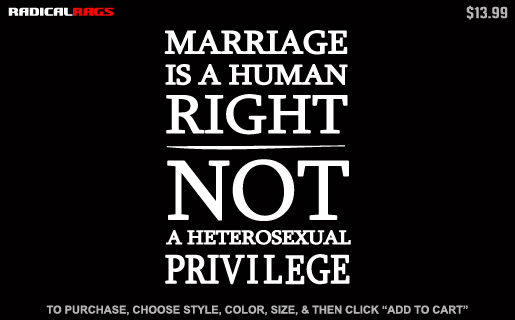
Gay Marriage and Civil Unions


Both California and Arizona passed ballot measures limiting marriage to a union between one man and one women, and both measures claimed to be defense of marriage acts. Say what?

In the US, "50% percent of first marriages, 67% of second and 74% of third marriages end in divorce, according to Jennifer Baker of the Forest Institute of Professional Psychology in Springfield, Missouri."

If marriage needs defending, it's from heteros not gays and lesbians.

Then there is the real issue -- the government has no business regulating marriage, and marriage should have no standing under the law. Why? Marriage is a religious institution, not a legal institution. It's the separation clause this country was founded upon.

The government can and should regulate civil unions which, under the 14th Amendment, cannot be denied to any citizens - black, white, gay, or straight.
The amendment requires states to provide equal protection under the law to all persons within their jurisdictions and was used in the mid-20th century to dismantle racial segregation in the United States, as in Brown v. Board of Education. Its Due Process Clause has been the basis of much important and controversial case law regarding privacy rights, abortion (see Roe v. Wade), and other issues.
Solution?

Allow the states to regulate civil unions (the marriage license everyone must obtain anyway) and force them to honor the 14th Amendment. The state should not discriminate against any of its citizens, for any reason, period. All laws pertaining to marriage should pertain to civil unions.

Allow each church or religion to regulate marriage as they see fit. If your church discriminates against you, change churches, denominations, or religions. It's that simple. A "marriage" should carry no weight under the law.

It really is that simple.

Will it happen? Probably not in my lifetime. But, then, I never thought I would see a black man elected president.


Monday, August 04, 2008

Is Being Gay in Your Biology?

Last week's All in the Mind looked at the issue of homosexuality and biology. Surprisingly, this is still a highly debated issue.

It was an interesting discussion, to me, even though I have long believed sexual orientation to be biological -- and that it is a spectrum with few people embodying either extreme, no matter what they might think. They talked about some of the correlations between handedness, birth order, gender conformity, and other factors that might be associated with sexual orientation.

Is being gay in your biology?

What makes someone gay? The quest for the biological roots of sexual orientation remains rife with controversy. Is it in your genes, handedness, or the hormonal soup of the early foetus? Or, is the answer hidden deep inside the brain? Homo or hetero - the science of sexual attraction captures everyone's attention.

Show Transcript

Guests

Simon LeVay
Neuroscientist and neuroanatomist
Author

Richard Lippa
Professor of Psychology
California State University
Fullerton
http://hss.fullerton.edu/psychology/

Sven Bocklandt
Post-doctoral researcher
Department of Human Genetics
David Geffen School of Medicine
University of California
Los Angeles
http://www.uclatwins.com/

Further Information

The All in the Mind blog with Natasha Mitchell - read, comment, discuss. A chance to comment on each week's show or read other titbits about the mind
The blog relevant post to this specific edition of All in the Mind can be found here.

The Real Story on Gay Genes by Michael Abrams
Article in Discover magazine, 2007

BBC Test on how the mind works
Based on the BBC Series, Secrets of the Sexes

81 Words: the inside story of psychiatry and homosexuality [Part 1 of 2]
Broadcast on All in the Mind in 2007. Produced by Alix Spiegel, originally for Chicago Public Radio's This American Life.

81 Words: the inside story of psychiatry and homosexuality (Part 2 of 2)
Broadcast on All in the Mind in 2007. Produced by Alix Spiegel, originally for Chicago Public Radio's This American Life.

Publications

Title: Are 2D:4D Finger-Length Ratios Related to Sexual Orientation?
Author: Richard A. Lippa
Publisher: Journal of Personality and Social Psychology 2003, Vol. 85, No. 1, 179-188
URL: http://psycnet.apa.org/index.cfm?fa=search.displayRecord&uid=2003-05568-017

Title: Handedness, Sexual Orientation, and Gender-Related
Author: Richard A. Lippa
Publisher: Archives of Sexual Behavior, Vol. 32, No. 2, April 2003, pp. 103-114
URL: http://www.springerlink.com/content/gm28031548u408q1/

Title: A difference in hypothalamic structure between heterosexual and homosexual men
Author: Simon LeVay
Publisher: Science 253(5023): 1034-7 1991
URL: http://www.ncbi.nlm.nih.gov/sites/entrez?Db=pubmed&Cmd=ShowDetailView&TermToSearch=1887219

Title: The science of desire: the search for the gay gene and the biology of behavior
Author: Hamer D and P Copeland
Publisher: Simon and Schuster, 1994
ISDN 0-671-88724-6

Title: Sexual Orientation and Personality
Author: Richard A Lippa
Publisher: Annual Review of Sex Research, 2005;16:119-53
URL: http://www.ncbi.nlm.nih.gov/pubmed/16913290

Title: Extreme skewing of X chromosone inactivation in mothers of homosexual men
Author: S Bocklandt, S Horvath, E Vilain, D Hamer
Publisher: Human Genetics 2005 Dec 21; :1-4 16369763 (P,S,E,B,D)
URL: http://lib.bioinfo.pl/pmid:16369763

Title: PET and MRI show differences in cerebral asymmetry and functional connectivity between homo- and heterosexual subjects
Author: Ivanka Savic & Per Lindström
Publisher: Proceedings of the National Academy of Sciences, 2008
URL: http://www.pnas.org/content/105/27/9403

Title: The Man Who Would Be Queen: The Science of Gender-Bending and Transsexualism
Author: J. Michael Bailey
Publisher: Joseph Henry Press 2003
URL: http://www.nap.edu/catalog.php?record_id=10530
ISBN-10: 0309084180