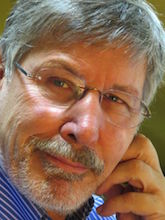
This week's New York Times Magazine featured an in-depth article about the work of Bessel van der Kolk and his work in treating post-traumatic stress disorder (PTSD) through somatic avenues (i.e., the body).
It's a pretty balanced article, which is appreciated even though I am a fan of his work. It would be great if this started a larger discussion on the etiology and treatment of trauma, but I would not hold my breath.
Janeen Inerlandi | May 24, 2014
New York Times Magazine
Bessel van der Kolk sat cross-legged on an oversize pillow in the center of a smallish room overlooking the Pacific Ocean in Big Sur. He wore khaki pants, a blue fleece zip-up and square wire-rimmed glasses. His feet were bare. It was the third day of his workshop, “Trauma Memory and Recovery of the Self,” and 30 or so workshop participants — all of them trauma victims or trauma therapists — lined the room’s perimeter. They, too, sat barefoot on cushy pillows, eyeing van der Kolk, notebooks in hand. For two days, they had listened to his lectures on the social history, neurobiology and clinical realities of post-traumatic stress disorder and its lesser-known sibling, complex trauma. Now, finally, he was about to demonstrate an actual therapeutic technique, and his gaze was fixed on the subject of his experiment: a 36-year-old Iraq war veteran named Eugene, who sat directly across from van der Kolk, looking mournful and expectant.
Van der Kolk began as he often does, with a personal anecdote. “My mother was very unnurturing and unloving,” he said. “But I have a full memory and a complete sense of what it is like to be loved and nurtured by her.” That’s because, he explained, he had done the very exercise that we were about to try on Eugene. Here’s how it would work: Eugene would recreate the trauma that haunted him most by calling on people in the room to play certain roles. He would confront those people — with his anger, sorrow, remorse and confusion — and they would respond in character, apologizing, forgiving or validating his feelings as needed. By projecting his “inner world” into three-dimensional space, Eugene would be able to rewrite his troubled history more thoroughly than other forms of role-play therapy might allow. If the experiment succeeded, the bad memories would be supplemented with an alternative narrative — one that provided feelings of acceptance or forgiveness or love.
The exercise, which van der Kolk calls a “structure” but which is also known as psychomotor therapy, was developed by Albert Pesso, a dancer who studied with Martha Graham. He taught it to van der Kolk about two decades ago. Though it has never been tested in a controlled study, van der Kolk says he has had some success with it in workshops like this one. He likes to try it whenever he has a small group and a willing volunteer.
With some gentle prodding from van der Kolk, Eugene told us how he came to be a specialist in the United States Army, how he spent a full year stationed in Mosul, the largest city in northern Iraq, and how his job involved disposing of exploded bombs. It was a year of dead bodies, he said. He saw, touched, smelled and stepped in more bodies than he could possibly count. Some of them were children. He was only 26.
Can Psychomotor Therapy Help an Iraq War Vet?

People turn to grease when they explode, he told us, because their fat cells burst open. He witnessed multiple suicide bombings. Once, he accidentally stepped in an exploded corpse; only the legs were still recognizable as human. Another time, he saw a kitchen full of women sliced to bits. They’d been making couscous when a bomb went off and the windows shattered. He was shot in the back of the head once. He was also injured by an improvised explosive device.
But none of those experiences haunted him quite as much as this one: Several months into his tour, while on a security detail, Eugene killed an innocent man and then watched as the man’s mother discovered the body a short while later.
“Tell us more about that,” van der Kolk said. “What happened?” Eugene’s fragile composure broke at the question. He closed his eyes, covered his face and sobbed.
“The witness can see how distressed you are and how badly you feel,” van der Kolk said. Acknowledging and reflecting the protagonist’s emotions like this — what van der Kolk calls “witnessing” them — is a central part of the exercise, meant to instill a sense of validation and security in the patient.
Eugene had already called on some group members to play certain roles in his story. Kresta, a yoga instructor based in San Francisco, was serving as his “contact person,” a guide who helps the protagonist bear the pain the trauma evokes, usually by sitting nearby and offering a hand to hold or a shoulder to lean on. Dave, a child-abuse survivor and small-business owner in Southern California, was playing Eugene’s “ideal father,” a character whose role is to say all the things that Eugene wished his real father had said but never did. They sat on either side of Eugene, touching his shoulders. Next, van der Kolk asked who should play the man he killed. Eugene picked Sagar, a stand-up comedian and part-time financial consultant from Brooklyn. Finally, van der Kolk asked, Who should play the man’s mother?
Eugene pointed to me. “Can you do it?” he asked.
I swore myself in as the others had, by saying, “I enroll as the mother of the man you killed.” Then I moved my pillow to the center of the room, across from Eugene, next to van der Kolk.
“O.K.,” van der Kolk said. “Tell us more about that day. Tell us what happened.”
Psychomotor therapy is neither widely practiced nor supported by clinical studies. In fact, most licensed psychiatrists probably wouldn’t give it a second glance. It’s hokey-sounding. It was developed by a dancer. But van der Kolk believes strongly that dancers — and musicians and actors — may have something to teach psychiatrists about healing from trauma and that even the hokey-sounding is worthy of our attention. He has spent four decades studying and trying to treat the effects of the worst atrocities we inflict on one another: war, rape, incest, torture and physical and mental abuse. He has written more than 100 peer-reviewed papers on psychological trauma. Trained as a psychiatrist, he treats more than a dozen patients a week in private practice — some have been going to him for many years now — and he oversees a nonprofit clinic in Boston, the Trauma Center, that treats hundreds more. If there’s one thing he’s certain about, it’s that standard treatments are not working. Patients are still suffering, and so are their families. We need to do better.
Van der Kolk takes particular issue with two of the most widely employed techniques in treating trauma: cognitive behavioral therapy and exposure therapy. Exposure therapy involves confronting patients over and over with what most haunts them, until they become desensitized to it. Van der Kolk places the technique “among the worst possible treatments” for trauma. It works less than half the time, he says, and even then does not provide true relief; desensitization is not the same as healing. He holds a similar view of cognitive behavioral therapy, or C.B.T., which seeks to alter behavior through a kind of Socratic dialogue that helps patients recognize the maladaptive connections between their thoughts and their emotions. “Trauma has nothing whatsoever to do with cognition,” he says. “It has to do with your body being reset to interpret the world as a dangerous place.” That reset begins in the deep recesses of the brain with its most primitive structures, regions that, he says, no cognitive therapy can access. “It’s not something you can talk yourself out of.” That view places him on the fringes of the psychiatric mainstream.
It’s not the first time van der Kolk has been there. In the early 1990s, he was a lead defender of repressed-memory therapy, which the Harvard psychologist Richard McNally later called “the worst catastrophe to befall the mental-health field since the lobotomy era.” Van der Kolk served as an expert witness in a string of high-profile sexual-abuse cases that centered on the recovery of repressed memories, testifying that it was possible — common, even — for victims of extreme or repeated sexual trauma to suppress all memory of that trauma and then recall it years later in therapy. He’d seen plenty of such examples in his own patients, he said, and could cite additional cases from the medical literature going back at least 100 years.
In the 1980s and ‘90s, people from all over the country filed scores of legal cases accusing parents, priests and day care workers of horrific sex crimes, which they claimed to have only just remembered with the help of a therapist. For a time, judges and juries were persuaded by the testimony of van der Kolk and others. It made intuitive sense to them that the mind would find a way to shield itself from such deeply traumatic experiences. But as the claims grew more outlandish — alien abductions and secret satanic cults — support for the concept waned. Most research psychologists argued that it was much more likely for so-called repressed memories to have been implanted by suggestive questioning from overzealous doctors and therapists than to have been spontaneously recalled. In time, it became clear that innocent people had been wrongfully persecuted. Families, careers and, in some cases, entire lives were destroyed.
After the dust settled in what was dubbed “the memory wars,” van der Kolk found himself among the casualties. By the end of the decade, his lab at Massachusetts General Hospital was shuttered, and he lost his affiliation with Harvard Medical School. The official reason was a lack of funding, but van der Kolk and his allies believed that the true motives were political.
Van der Kolk folded his clinic into a larger nonprofit organization. He began soliciting philanthropic donations and honed his views on traumatic memory and trauma therapy. He still believed that repressed memories were a common feature of traumatic stress. Traumatic experiences were not being processed into memories, he reasoned, but were somehow getting “stuck in the machine” and then expressed through the body. Many of his colleagues in the psychiatric mainstream spurned these ideas, but he found another, more receptive audience: body-oriented therapists who not only embraced his message but also introduced him to an array of alternative practices. He began using some of those practices with his own patients and then testing them in small-scale studies. Before long, he had built a new network of like-minded researchers, body therapists and loyal friends from his Harvard days.
The group converged around an idea that was powerful in its simplicity. The way to treat psychological trauma was not through the mind but through the body. In so many cases, it was patients’ bodies that had been grossly violated, and it was their bodies that had failed them — legs had not run quickly enough, arms had not pushed powerfully enough, voices had not screamed loudly enough to evade disaster. And it was their bodies that now crumpled under the slightest of stresses — that dove for cover with every car alarm or saw every stranger as an assailant in waiting. How could their minds possibly be healed if they found the bodies that encased those minds so intolerable? “The single most important issue for traumatized people is to find a sense of safety in their own bodies,” van der Kolk says. “Unfortunately, most psychiatrists pay no attention whatsoever to sensate experiences. They simply do not agree that it matters.”
That van der Kolk does think it matters has won him an impressive and diverse fan base. “He’s really a hero,” says Stephen Porges, a professor of psychiatry at the University of North Carolina, Chapel Hill. “He’s been extraordinarily courageous in confronting his own profession and in insisting that we not discount the bodily symptoms of traumatized people as something that’s ‘just in their heads.’"
These days, van der Kolk’s calendar is filled with speaking engagements, from Boston to Amsterdam to Abu Dhabi. This spring, I trailed him down the East Coast and across the country. At each stop, his audience comprised the full spectrum of the therapeutic community: psychiatrists, psychologists, social workers, art therapists, yoga therapists, even life coaches. They formed long lines up to the podium to introduce themselves during coffee breaks and hovered around his table at lunchtime, hoping to speak with him. Some pulled out their cellphones and asked to take selfies with him. Most expressed similar sentiments:
Thank you so much for what you said about this treatment, that therapy, those studies.
Your research on cutting, child sexual abuse, family violence confirms what I have seen in my own patients, or experienced myself, for decades now.
Can you help me?
Van der Kolk’s entire life has been a study in human trauma. He was born in The Hague in the summer of 1943, three years into the German occupation of the Netherlands and one year before the great Dutch famine, when a military blockade cut off food and fuel shipments to the country’s western provinces and more than 20,000 people starved to death. His father was imprisoned in a Nazi work camp. According to van der Kolk family lore, his mother had to ride her bike to the hospital when she went into labor with him, and his first birthday cake was made of tulip bulbs because there was hardly any flour.
He was a weak and scrawny boy, but daring nonetheless. Ask him about his childhood, and he will tell you about playing amid the bombed-out ruins of his native city. Nearly everyone around him was deeply traumatized. His neighbors on either side were Holocaust survivors. His mother did not enjoy motherhood; she was pulled out of school at 14 to care for her father and then pulled away from a satisfying career to assume her wifely duties. By the time Bessel, her middle child, was old enough to know her, she had grown bitter and cold. His father was an executive at Royal Dutch Shell, and despite being a devout Protestant and dedicated pacifist, he suffered violent rages and inflicted them on his children. In his new book, “The Body Keeps the Score,” which comes out this fall, van der Kolk mentions being locked in the basement as a little boy for what he describes as “normal 3-year-old offenses” and hating himself for being too puny to fight back.
As a teenager, he began traveling on his own. He liked to hitchhike into France. On one such trip, as he passed a monastery, he heard the chanting of monks and was so taken with the sound that he asked the driver to let him off there. He spent the rest of that summer, and the following Easter break, and the summer after that, at the monastery contemplating monkhood. The abbot took a liking to him and promised that if he joined the order, they would send him to Geneva for medical school. “I seriously considered it,” he told me. But in the end, a youthful thirst for adventure beat out any yearning he might have felt for quiet meditation, and he chose the University of Hawaii instead. “I still have some spiritual feelings,” he says. “I believe that all things are connected. But organized religion gives me the creeps.”
And so in 1962, he came to the United States and made his way from the University of Hawaii to the University of Chicago to Harvard Medical School, where he posed to science and medicine all of his many questions about the horrors of human nature and the miracles of human resilience. “The human species is messed up,” he says. “We make the same mistakes over and over, and I’m deeply curious about why that is. Why do we keep doing things that we know are horrible and will have terrible consequences?”
One of van der Kolk’s first jobs out of school was as a staff psychiatrist at the Veterans Affairs clinic in Boston; he arrived there in 1978, in time for the influx of Vietnam veterans. “The waiting list to see a doctor was a mile long,” he says. “And the clinic’s walls were pocked full of fist imprints.”
The first thing van der Kolk noticed about his new patients was how utterly stuck in the past they were. Even the older veterans from World War II seemed to vacillate between one of two states: immersion in their wartime experiences or lifeless disengagement. In Rorschach tests, every inkblot was a dead baby, a fallen comrade or nothing at all. It was as if war had broken the projector of their imaginations, he says, and their only options were to play one reel over and over or turn the machine off altogether.
The second thing that struck van der Kolk was how the men managed their own conditions. Almost all of them claimed that highly risky behaviors were capable of yanking them into the present in a way that no form of therapy could (one patient, for example, rode his Harley at breakneck speeds whenever he felt himself swirling into a rage or disconnecting from his surroundings). Van der Kolk’s treatment — the only thing he had been taught in medical school — involved getting the men to talk. In both group and one-on-one sessions, he would ask them about their horrible memories, nightmares and troubles at home. But talking didn’t seem to help; in some cases, he thought, it made things worse.
Van der Kolk scoured the clinic’s medical library for books on shell shock and combat fatigue — anything that might help him better understand what he was seeing or give him some clue about how to treat it. Post-traumatic stress disorder was not yet a recognized condition. Then he came across a book at Harvard’s Francis A. Countway medical library, “The Traumatic Neurosis of War.” It was published in 1941, just before shellshocked American veterans would return from World War II. In its pages, van der Kolk found the first seeds of an idea that would ultimately shape his career: The nucleus of neurosis is physioneurosis. In other words, he thought, the root of what would eventually be called PTSD lay in our bodies.
Bessel van der Kolk Credit Illustration by Matthew Woodson
This meshed perfectly with what van der Kolk was seeing in his patients. In addition to their nightmares and hallucinations, many of them had a host of physical ailments, including headaches, fatigue, digestive troubles and insomnia. When he tried accessing their traumas in therapy, they often became jittery, broke into cold sweats or shut down. The book, van der Kolk said, did not offer any suggestions for treatment, but it did give him a starting point. In the two decades that followed, he made a careful study of all his patients’ physiological symptoms. And in 1994, not long before his Harvard lab was shuttered, he wrote a paper in The Harvard Review of Psychiatry summarizing all he had learned. Traumatic stress, it seemed, triggered a cascade of physiological catastrophes that affected almost every major system in the body.
Eugene was on military leave in San Francisco, about halfway through his tour of duty, when he first realized something was wrong. The bay was cool and breezy; people were walking around in parkas and hoodies. But he was sweating profusely. He thought his months in the desert had maybe activated some weird sweat gene that needed time to turn itself off. He figured it would pass eventually. It didn’t. By the time he came home for good, sweat was the least of his problems. He was seeing dead bodies on the side of the road. And he could not stop going to the bathroom. At his first post-military job in the corporate offices of a large bank, he went to the bathroom so often that he was sure his co-workers wondered what was wrong with him.
The military had little to offer. “They are not even trying to help,” he would tell friends and relatives. “You say, ‘I have horrible diarrhea, and I can’t stop going to the bathroom.’ And they say, ‘Stop going to the bathroom.’ Or you say, ‘I have a horrible time with the subway; the noise just terrifies me.’ And they say, ‘Well, New York is pretty noisy.’ ” One doctor prescribed an anti-anxiety medication, but it was so strong that Eugene started walking into walls. He tried talk therapy and group therapy. Neither did anything to relieve the uncomfortable tingling up his spine or the constant feeling that he was about to be attacked from behind.
He was nearly a full decade into this private war by the time he came to sit across from van der Kolk in the room overlooking the Pacific and to tell a group of strangers how he killed an innocent man.
Mosul reminded Eugene of a movie, he said: an old western in which the bad guys take over some small town, and all the townsfolk hide indoors and tumbleweed blows across the screen. In this movie, though, the bad guys were crazy terrorists who not only fired on Eugene and his team constantly but also strapped explosives to themselves, wandered into residential areas and detonated.
Eugene was on the security detail for a bomb patrol when a man drove up without yielding for inspection. Eugene signaled to him to stop, but the man kept his foot on the gas. Eugene signaled a second time, and a third.
Stop. Stop. Stop.
The man kept driving. So Eugene opened fire. His team searched the car afterward but found no bombs. As Eugene left the scene, he saw the man’s mother. She ran over to the car, distraught.
As he told us this, Eugene stared into the empty space between him and van der Kolk. His face was red and contorted, and it was easy to imagine that he was not so much remembering what happened as reliving it. I wondered what torments had led him to submit to such an experiment. I wondered how it could possibly work.
“What do you want the mother to know?” van der Kolk asked. Again, Eugene covered his face and broke into loud sobs.
“I’m sorry,” he said. “I’m so, so sorry. There are not words for how sorry. . . .” He buried his face in his hands again. “Do you want to look at her?” van der Kolk asked. Eugene couldn’t seem to speak, but he lifted his head and squinted at me with one eye. It was too much. He tucked his chin into his chest, wracked by sobs.
“The witness sees how truly sorry and how upset you are,” van der Kolk said. I kept my eyes focused on Eugene, so I didn’t see van der Kolk’s face. But Kresta would later tell me that watching him was like watching a wizard or a magician or a superfast computer. She could see him tracking Eugene’s facial expressions, tone of voice and changes in posture and responding to each in microseconds, posing a question or remarking “the witness sees.”
Van der Kolk instructed me in a low, steady voice. “Tell him that you forgive him,” he said. “Tell him you understand that it was a crazy time, and you know that he didn’t mean to do what he did. He was very young, and both of you were trapped in the same hell. Tell him you forgive him. And that you are O.K. now.” I repeated the words. I tried to make them sound genuine. I found myself hoping, fervently, that Eugene could hear me.
For a man who speaks to more than 15,000 people a year, van der Kolk has a surprisingly hard time projecting his voice. His thick Dutch accent is easy enough to decipher if you’re sitting right next to him, but it is difficult to penetrate from even a few feet away. As is often the case, the first audience comment at a recent lecture he gave in Philadelphia was “We can’t hear you!” Van der Kolk asked a sound technician to turn up the volume and promised the 200 or so attendees that he would speak as loudly as he could. There were some grumbles, even from people in the front row, who still couldn’t hear him. But van der Kolk is effusively charming and, as usual, managed to win the group over quickly.
“Everybody hunch their backs forward and droop their heads, like this,” he said, demonstrating. “Now try saying: ‘Oh, I’m feeling great! I’m very happy today!’ ” The audience laughed. “See, it’s impossible to feel happy in that position.” To drive the point home, he asked us to do the opposite: sit upright, assume cheerful expressions and then try to feel bad.
The mind follows the body, he said.
Trauma victims, van der Kolk likes to say, are alienated from their bodies by a cascade of events that begins deep in the brain with an almond-shaped structure known as the amygdala. When faced with a threat, the amygdala triggers a fight-or-flight response, which includes the release of a flood of hormones. This response usually persists until the threat is vanquished. But if the threat isn’t vanquished — if we can’t fight or flee — the amygdala, which can be thought of as the body’s smoke detector, keeps sounding the alarm. We keep producing stress hormones, which in turn wreak havoc on the rest of our bodies. It’s similar to what happens in chronic stress, except that in traumatic stress, the memories of the traumatic event invade patients’ subconscious thoughts, sending them back into fight-or-flight mode at the slightest provocation. Therapists and patients refer to this as being “reactivated.” In the short term, patients avoid the pain it causes by “dissociating.” That is, they take leave of their bodies, so much so that they often cannot describe their own physical sensations. This happens a lot in therapy, van der Kolk says.
In the long term, they become experts in self-numbing. They use food, exercise, work — or worse, drugs and alcohol — to stifle physical discomfort. The longer they do this, the more difficult it becomes to remain present in any given moment. “That’s why the guy at the end of ‘The Hurt Locker’ is so utterly incapable of playing with his kid,” van der Kolk says.
The goal of treatment should be to resolve this disconnect. “If we can help our patients tolerate their own bodily sensations, they’ll be able to process the trauma themselves,” he says. In his own patients, particularly those suffering from treatment-resistant PTSD, yoga has proved an especially good way to do this. So has emotional freedom technique, or tapping. With a therapist’s guidance, the patient taps various acupressure points with his or her own fingertips. If done correctly, it can calm the sympathetic nervous system and prevent the patient from being thrown into fight-or-flight mode. Ultimately, van der Kolk supports almost any therapy that involves paying careful attention to patients’ physiological states, like psychomotor therapy, or getting up and moving around through theater, dance and even karate. For patients with acute PTSD from isolated traumatic memories (think car accidents or single-episode assaults), van der Kolk is a fan of eye movement desensitization and reprocessing, or E.M.D.R., in which a therapist wiggles fingers back and forth across the patient’s field of vision and the patient tracks the fingers while “holding in mind” the traumatic memory. Proponents say the technique enables patients to process their traumas so that they pass into memories and stop invading the present. Van der Kolk likes to point out that he came to the technique as a skeptic. “It’s this weird treatment,” he said. “You ask people to remember what happened to them, and you wiggle your finger in front of their eyes and have them follow it. Crazy.” More than 60,000 therapists around the world have now been certified in E.M.D.R., though the practice remains controversial, with critics and supporters debating the validity of each new study. Van der Kolk places his faith in what he sees in his own patients, he says. For them, E.M.D.R. has been a godsend.
Van der Kolk’s most vocal critics tend to have the same complaint: He overstates his case. There is far less evidence for therapeutic tapping or theater or massage therapy than for cognitive behavioral therapy or even exposure therapy. And while the National Institutes of Health and the Department of Defense have begun studying the benefits of yoga and E.M.D.R., van der Kolk’s own studies have been criticized for a lack of rigor and small sample sizes; there were just 88 people in his 2007 study of E.M.D.R. and 64 people in his 2014 study of yoga. “Anyone is going to tell their therapist that they’re doing better if they like their therapist,” says Patricia Resick, a clinical psychologist and researcher in the use of C.B.T. for post-traumatic stress at Duke University. “You need an independent assessor.” There is a standard in the field, Resick says. “If he wants to be taken seriously, he has to do studies that live up to that standard.”
Van der Kolk has also been charged with oversimplifying neuroscience to support his clinical work. He likes to divide the brain into distinct regions — rational and emotional — that he says are “not all that connected to one another.” He says the techniques he favors are capable of accessing the emotional brain, where the amygdala resides, whereas C.B.T., exposure therapy and talk therapy aren’t necessarily capable of doing so. Van der Kolk has scores of fMRI scans showing that when faced with a trauma — or in the case of PTSD, with a traumatic memory — the prefrontal cortex becomes muted, the speech center becomes muted and the amygdala becomes hyperactive. But a vast majority of neurobiologists say the so-called rational and emotional brains are much more integrated than his model suggests. In fact, the two communicate regularly through a multitude of circuitous loops that researchers have only just begun to map. And the scans that van der Kolk uses offer a bird’s-eye view of the brain — too sweeping to justify such detailed inferences. “He has a lot of interesting and important ideas, but the relatively weak connection to the brain detracts from his message,” says Joseph LeDoux, a neuroscientist at New York University. “This happens in a lot of fields now. Everybody wants to use the brain to justify certain things. But sometimes what the brain does is more important than how it does it.”
Some of van der Kolk’s closest colleagues have suggested that his exaggerations are by design. It’s not so much that he abhors conventional therapies or thinks his own methods are ironclad. It’s that he is trying to persuade people to be more open-minded. Indeed, when I pressed him on C.B.T., he acknowledged that it might have some uses, perhaps for anxiety or obsessive-compulsive disorder. And despite his contention that Prozac is less effective than E.M.D.R. at treating PTSD, he is not antimedication.
But there is a larger issue, too. “Testing a therapeutic technique is not like conducting a drug trial,” says Frank Ochberg, a professor at Michigan State University and clinical psychiatrist who specializes in PTSD. “With a drug trial, everyone gets the exact same pill or the exact same placebo. With therapy, you can’t separate the tools from the person using the tools. There’s no good experimental technique for measuring a therapist’s kindness, wisdom or judgment.”
For his part, van der Kolk says he would love to do large-scale studies comparing some of his preferred methods of treatment with some of the more commonly accepted approaches. But funding is nearly impossible to come by for anything outside the mainstream. In the wake of the Sept. 11 terrorist attacks, he says, he was invited to sit on a handful of expert panels. Money had been designated for therapeutic interventions, and the people in charge of parceling it out wanted to know which treatments to back. To van der Kolk, it was a golden opportunity. We really don’t know what would help people most, he told the panel members. Why not open it up and fund everything, and not be prejudiced about it? Then we could study the results and really learn something. Instead, the panels recommended two forms of treatment: psychoanalysis and cognitive behavioral therapy. “So then we sat back and waited for all the patients to show up for analysis and C.B.T. And almost nobody did.” Spencer Eth, who was then the medical director of behavioral health services at St. Vincent’s Hospital in Manhattan, gathered data on the mental-health care provided to more than 10,000 Sept. 11 survivors. The most popular service by far was acupuncture. Yoga and massage were also in high demand. “Nobody looks at acupuncture academically,” van der Kolk says. “But here are all these people saying that it’s helped them.”
Van der Kolk is always evaluating his own clinical experiences for clues to what works best. “Maybe I should have done E.M.D.R. with Eugene instead of that structure,” he said not long after the California workshop. “I’m not sure how much good it will do.”
Back at the Trauma Center in Boston, van der Kolk and his colleagues are working on what he sees as the next step: redefining trauma itself. “We have a tendency now to label everything as PTSD,” he says. “But so much of what we see is the result of long-term, chronic abuse and neglect. And that produces a different condition than one-off, acute traumatic incidents.” Van der Kolk and his colleagues call this chronic form of traumatic stress “developmental trauma disorder”; in 2010, they lobbied unsuccessfully to have it listed in the Diagnostic and Statistical Manual of Mental Disorders as a condition separate from PTSD. They’re hoping that with more data, they might finally prevail. Formal acceptance, van der Kolk says, is the key to getting support.
“There’s a grant to give more than $8 million to help survivors of the marathon bombing,” van der Kolk mentioned one afternoon. “That’s psychotic. Yes, it was horrible, and yes, those people are suffering and deserve help. But we have tens of thousands of children being traumatized every day, right in the same city — a couple million across the country — and no one is offering to help them.” I asked why he thought that was. He told me about Pierre Janet, a psychiatrist at the Salpêtrière Hospital in 19th-century Paris. Janet published the first book on what was then called hysteria but which we now refer to as PTSD. He, too, became enmeshed in a dispute with his peers. He, too, was forced out of his laboratory.
“There’s this cycle of knowing and forgetting,” van der Kolk told me. “We discover trauma. And then when we see how horrifying and how inconvenient it is, we turn on the concept and peel off the messengers.” Without missing a beat, he segued from Janet to World War I and World War II, explaining how the military establishments in both Europe and the United States stigmatized shell shock and combat fatigue, for fear that they would undermine the war effort. It’s willful amnesia, he said, and he had plenty of more recent examples. Just a few years ago, he interviewed a group of foster children at a United States Senate hearing on the state of foster care. “Afterward, I’m sitting with the kids,” van der Kolk said. “And a judge walks past us on his way out, and he says to the kids: ‘You’re all doing so great! Look how terrific you all are!’ And I say, ‘Well, no, why don’t you ask them how they’re doing?’ These are kids that have suffered significant abuse and neglect. A couple of them are suicidal. They have substance-abuse problems. One of them cuts herself. But the judge didn’t want to hear about that any more than we want to hear about what really happens to soldiers when they’re off at war.”
Before enlisting in the Army, Eugene earned a bachelor’s degree in art history from the American University of Paris. Now he’s an antique art dealer. He lives in Queens with his wife and 3-year-old daughter but often goes into Manhattan to meet clients and visit galleries. I met him for coffee on the Upper East Side a couple of months after van der Kolk’s workshop. I wanted to know how he felt about the exercise now that some time had passed. Did he think it had any impact on his PTSD?
What intrigued him most, he said, is how well it worked in the moment. Whatever spell van der Kolk cast lingered into the next day, so that Eugene really saw me, a complete stranger, as the object of his guilt. “I was terrified of you,” he told me. It wasn’t until the following day, when van der Kolk had me forgive him a second time, that the spell finally broke and he was able to face me as just another workshop participant. “It reminded me of that movie ‘The Master,’ with Philip Seymour Hoffman,” he said. “When Amy Adams asks Joaquin Phoenix, ‘What color are my eyes?’ and he says, ‘Green,’ and she says, ‘Turn them blue,’ and you see them change color. It really reminded me of that.”
For a while at least, he said, he felt better. He recalled driving down the Pacific coast with his wife the day the workshop ended and noticing how weird it was not to feel stressed out. For weeks he was able to drive and use the subway with no trouble. “It felt like it sort of repaired my perception somehow,” he said. “I used to always feel paranoid — like, I’d get freaked out going to my doctor because there were all these security guards in the waiting room — and for a while that was lifted.”
But some of those effects were starting to fade. He was having headaches and memory problems again, and he was trying to figure out what triggered the relapse. He thought it had something to do with a painting he saw. He attended an Asian art fair earlier in the week, and an Arab dealer was selling some contemporary paintings; most of them were of soldiers, but one was of a woman. She looked like me, he said. He remembered staring at it and freezing up. The next day at a client’s house, he misplaced his briefcase. “It was like I threw it out the window,” he said. He spent 20 frantic and embarrassing minutes searching the house in a sweaty panic before he finally found it, right where he’d left it, near a window by the door.
Still, he was feeling hopeful. Van der Kolk had suggested some other possible approaches at the end of the workshop. He was planning to try E.M.D.R. next.
I asked him how he felt sitting across from me now. He said that he had to go to the bathroom and that his face felt numb around one eye. Ever since the exercise, the area around his right eye — the one he’d squinted at me with — went numb whenever he got nervous. He said he didn’t know why exactly, but he was sure it had something to do with the exercise itself. “I’ve been reading everything I can get my hands on,” he said. “It definitely helped, more than anything else I’ve tried so far. But I still have no idea what he did to me.”
~ Jeneen Interlandi is a freelance writer in New York. Her last article for the magazine was about the involuntary psychiatric commitment of her father.
~ Editor: Sheila Glaser