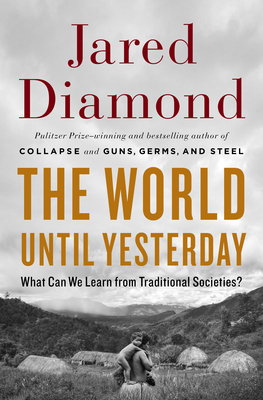
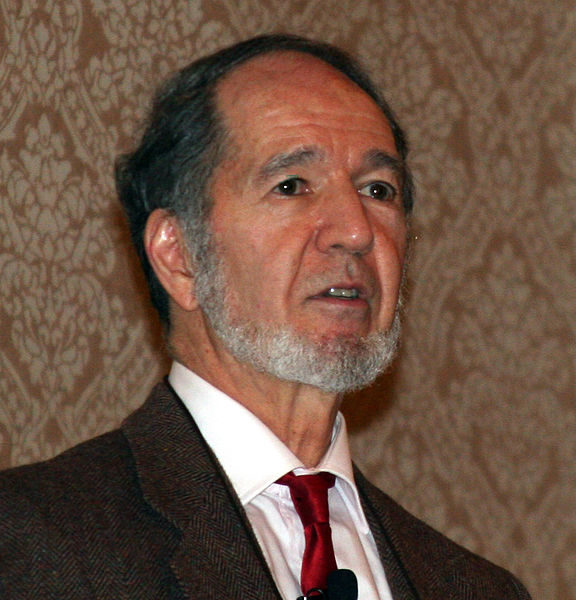
A lot is being written about Jared Diamond's new book,
The World Until Yesterday: What We Can Learn from Traditional Societies. I'm offering here a serious criticism, a review of praise, and Jared Diamond in his own voice.
Jan 30, 2013
Jared Diamond’s new book, The World Until Yesterday, is completely wrong, writes Stephen Corry. Diamond argues that industrialized people (‘modern’) can learn from tribal peoples (‘traditional’) because they show how everyone lived until a few thousand years ago. Corry agrees that ‘we’ can learn from tribes, but counters they represent no more of a throwback to our past than anyone else does. He shows that Diamond’s other—and dangerous—message is that most tribes engage in constant warfare. According to Diamond, they need, and welcome, state intervention to stop their violent behavior. Corry argues that this is merely a political opinion, backed by questionable and spurious data. He sees Diamond’s position as one of supporting colonial ideas about ‘pacifying savages’ and says it is factually and morally wrong.

I ought to like this book: after all, I have spent decades saying we can learn from tribal peoples, and that is, or so we are told, Jared Diamond’s principal message in his new “popular science” work, The World Until Yesterday. But is it really?
Diamond has been commuting for 50 years between the U.S. and New Guinea to study birds, and he must know the island and some of its peoples well. He has spent time in both halves, Papua New Guinea and Indonesian‐occupied West Papua. He is in no doubt that New Guineans are just as intelligent as anyone, and he has clearly thought a lot about the differences between them and societies like his, which he terms Western, educated, industrialized, rich, and democratic (“WEIRD”). He calls the latter “modern.”
Had he left it at that, he would have at least upset only some experts in New Guinea, who think his characterizations miss the point. But he goes further, overreaching considerably by adding a number of other, what he terms “traditional” societies, and then generalizing wildly. His information here is largely gleaned from social scientists, particularly (for those in South America) from the studies of American anthropologists, Napoleon Chagnon, and Kim Hill, who crop up several times.
It is true that Diamond does briefly mention, in passing, that all such societies have “been partly modified by contact,” but he has still decided they are best thought about as if they lived more or less as all humankind did until the “earliest origins of agriculture around 11,000 years ago in the Fertile Crescent,” as he puts it. That is his unequivocal message, and the meaning of “yesterday” in his title. This is a common mistake, and Diamond wastes little of his very long book trying to support it. The dust jacket, which he must agree with even if he did not actually write it, makes the astonishingly overweening claim that “tribal societies offer an extraordinary window into how our ancestors lived for millions of years” (my emphasis).
This is nonsense. Many scientists debunk the idea that contemporary tribes reveal anything significantly more about our ancestors, of even a few thousand years ago, than we all do. Obviously, self-sufficiency is and was an important component of the ways of life of both; equally obviously, neither approach or approached the heaving and burgeoning populations visible in today’s cities. In these senses, any numerically small and largely self-sufficient society might provide something of a model of ancient life, at least in some respects. Nevertheless, tribal peoples are simply not replicas of our ancestors.
Britain’s foremost expert on prehistoric man, Chris Stringer of London’s Natural History Museum, for example, routinely cautions against seeing modern hunter-gatherers as “living fossils,” and repeatedly emphasizes that, like everyone else, their “genes, cultures and behaviors” have continued to evolve to the present. They must have changed, of course, or they simply would not have survived.
It is important to note that, although Diamond’s thesis is that we were all once “hunter-gatherers” and that this is the main key to them being seen as our window into the past, in fact most New Guineans do little hunting. They live principally from cultivations, as they probably have for millennia. Diamond barely slips in the fact that their main foodstuff, sweet potato, was probably imported from the Americas, perhaps a few hundred or a thousand years ago. No one agrees on how this came about, but it is just one demonstration that “globalization” and change have impacted on Diamond’s “traditional” peoples for just as long as on everyone else. Disturbingly, Diamond knows these things, but he does not allow them to spoil his conclusions.
But he has come up with a list of practices he thinks we should learn from “traditional” societies, and all this is well and good, though little of it appears particularly radical or novel. He believes we (Americans, at least) should make more effort to put criminals on a better track, and try to rehabilitate rather than merely punish. He feels we should carry our babies more, and ensure they’re facing forward when we cart them around (which is slightly odd because most strollers and many baby carriers face forward anyway). He pleads with us to value old people more … and proffers much similar advice. These “self-help manual” sections of the book are pretty unobjectionable, even occasionally thought-provoking, though it is difficult to see what impact they might really have on rich Westerners or governments.
Diamond is certainly in fine fettle when he finally turns to the physiology of our recent excessive salt and sugar intake, and the catastrophic impact it brings to health. His description of how large a proportion of the world is racking up obesity, blindness, limb amputations, kidney failure, and much more, is a vitally important message that cannot be overstressed. Pointing out that the average Yanomami Indian, at home in Amazonia, takes over a year to consume the same amount of salt as can be found in a single dish of a Los Angeles restaurant is a real shocker and should be a wake-up call.
The real problem with Diamond’s book, and it is a very big one, is that he thinks “traditional” societies do nasty things which cry out for the intervention of state governments to stop. His key point is that they kill a lot, be it in “war,” infanticide, or the abandonment, or murder, of the very old. This he repeats endlessly. He is convinced he can explain why they do this, and demonstrates the cold, but necessary, logic behind it. Although he admits to never actually having seen any of this in all his travels, he supports his point both with personal anecdotes from New Guinea and a great deal of “data” about a very few tribes—a good proportion of it originating with the anthropologists mentioned above. Many of his boldly stated “facts” are, at best, questionable.
How much of this actually is fact, and how much just personal opinion? It is of course true that many of the tribes he cites do express violence in various ways; people kill people everywhere, as nobody would deny. But how murderous are they exactly, and how to quantify it? Diamond claims that tribes are considerably more prone to killing than are societies ruled by state governments. He goes much further. Despite acknowledging, rather sotto voce, that there are no reports of any war at all in some societies, he does not let this cloud his principal emphasis: most tribal peoples live in a state of constant war.
He supports this entirely unverifiable and dangerous nonsense (as have others, such as Steven Pinker) by taking the numbers killed in wars and homicides in industrialized states and calculating the proportions of the total populations involved. He then compares the results with figures produced by anthropologists like Chagnon for tribes like the Yanomami. He thinks that the results prove that a much higher proportion of individuals are killed in tribal conflict than in state wars; ergo tribal peoples are more violent than “we” are.
There are of course lies, damned lies, and statistics. Let us first give Diamond the benefit of several highly debatable, not to say controversial, doubts. I will, for example, pass over the likelihood that at least some of these intertribal “wars” are likely to have been exacerbated, if not caused, by land encroachment or other hostilities from colonist societies. I will also leave aside the fact that Chagnon’s data, from his work with the Yanomami in the 1960s, has been discredited for decades: most anthropologists working with Yanomami simply do not recognize Chagnon’s violent caricature of those he calls the “fierce people.” I will also skate over Kim Hill’s role in denying the genocide of the Aché Indians at the hands of Paraguayan settlers and the Army in the 1960s and early 1970s. (Though there is an interesting pointer to this cited in Diamond’s book: as he says, over half Aché “violent deaths” were at the hands of nontribals.)
I will also throw only a passing glance at the fact that Diamond refers only to those societies where social scientists have collected data on homicides, and ignores the hundreds where this has not been examined, perhaps because—at least in some cases—there was no such data. After all, scientists seeking to study violence and war are unlikely to spend their precious fieldwork dropping in on tribes with little noticeable tradition of killing. In saying this, I stress once again, I am not denying that people kill people—everywhere. The question is, how much?
Awarding Diamond all the above ‘benefits of doubt’, and restricting my remarks to looking just at “our” side of the story: how many are killed in our wars, and how reasonable is it to cite those numbers as a proportion of the total population of the countries involved?
Is it meaningful, for example, to follow Diamond in calculating deaths in the fighting for Okinawa in 1945 as a percentage of the total populations of all combatant nations—he gives the result as 0.10 percent—and then comparing this with eleven tribal Dani deaths during a conflict in 1961. Diamond reckons the latter as 0.14 percent of the Dani population—more than at Okinawa.
Viewed like this, the Dani violence is worse that the bloodiest Pacific battle of WWII. But of course the largest nation involved in Okinawa was the U.S., which saw no fighting on its mainland at all. Would it not be more sensible to look at, say, the percentage of people killed who were actually in the areas where the war was taking place? No one knows, but estimates of the proportion of Okinawa citizens killed in the battle, for example, range from about 10 percent to 33 percent. Taking the upper figure gives a result of nearly 250 times moredeaths than the proportion for the Dani violence, and does not even count anyof the military killed in the battle.
Similarly, Diamond tells us that the proportion of people killed in Hiroshima in August 1945 was a tiny 0.1 percent of the Japanese people. However, what about the much smaller “tribe” of what we might call “Hiroshimans,” whose death toll was nearly 50 percent from a single bomb? Which numbers are more meaningful; which could be seen as a contrivance to support the conceit that tribespeople are the bigger killers? By supposedly “proving” his thesis in this way, to what degree does Diamond’s characterization differ significantly from labeling tribal peoples as “primitive savages,” or at any rate as more savage than “we” are?
If you think I am exaggerating the problem—after all, Diamond does not say “primitive savage” himself—then consider how professional readers of his book see it: his reviewers from the prestigious Sunday Times (U.K.) and The Wall Street Journal (U.S.) both call tribes “primitive,” and Germany’s popular Sternmagazine splashed “Wilde” (“savages”) in large letters across its pages when describing the book.
Seek and you shall find statistics to underscore any conceivable position on this. Diamond is no fool and doubtless knows all this—the problem is in what he chooses to present and emphasize, and what he leaves out or skates over.
I do not have the author’s 500 pages to expand, so I will leave aside the problem of infanticide (I have looked at it in other contexts), but I cannot omit a response to the fact that, as he repeatedly tells us, some tribes abandon, or abandoned, their old at the end of their lives, leaving them only with what food or water might be spared, and moving on in the sure knowledge that death would quickly follow, or even hastening it deliberately.
Again, Diamond explains the logic of it, and again he tells us that, because of munificent state governments’ ability to organize “efficient food distribution,” and because it is now illegal to kill people like this, “modern” societies have left such behavior behind.
Really? So let us forget the 40 million or so dead in the Great Chinese Famine of the early 1960s. But what about the widespread, though usually very quiet, medical practice of giving patients strong doses of opiates— really strong doses—when illness and age have reached a threshold? The drugs relieve pain, but they also suppress the respiratory reflex, leading directly to death. Or, what about deliberately withholding food and fluids from patients judged near the end? Specialist nonprofits reckon there are about a million elderly people in the U.K. alone who are malnourished or even starving, many inside hospitals. So how different is what we industrialized folk get up to from some tribal practices? Are we all “savages” too?
Contrasting tribal with industrialized societies has always been more about politics than science, and we should be extremely wary of those who use statistics to “prove” their views. It all depends on what your question is, whom you believe, and most of all, exactly where you are standing when you ask it.
If, for example, you are an Aguaruna Indian in Peru, with a history of occasional revenge raiding stretching back the small handful of generations which comprise living memory (no Aguaruna can really know the extent to which such raiding was going on even a few generations ago, leave alone millennia), and if you have recently been pushed out of the forest interior into riverine villages by encroachment from oil exploration or missionaries, then your chances of being killed by your compatriots might even exceed those caught in Mexican drugs wars, Brazilian favelas, or Chicago’s South Side.
In such circumstances there would undoubtedly be much more homicide in Aguaruna-land than that faced by well-heeled American college professors, but also much less than that confronted by inmates in Soviet gulags, Nazi concentration camps, or those who took up arms against colonial rule in British Kenya, or apartheid South Africa.
If you find yourself born a boy in the Pine Ridge Indian Reservation, in the center of the world’s richest nation, your average lifespan will be shorter than in any country in the world except for some African states and Afghanistan. If you escape being murdered, you may end up dead anyway, from diabetes, alcoholism, drug addiction, or similar. Such misery, not inevitable but likely, would not result from your own choices, but from those made by the state over the last couple of hundred years.
What does any of this really tell us about violence throughout human history? The fanciful assertion that nation states lessen it is unlikely to convince a Russian or Chinese dissident, or Tibetan. It will not be very persuasive either to West Papuan tribes, where the Indonesian invasion and occupation has been responsible for a guessed 100,000 killings at least (no one will ever know the actual number), and where state-sponsored torture can now be viewed onYouTube. The state is responsible for killing more tribespeople in West Papua than anywhere else in the world.
Although his book is rooted in New Guinea, not only does Diamond fail to mention Indonesian atrocities, he actually writes of, “the continued low level of violence in Indonesian New Guinea under maintained rigorous government control there.” This is a breathtaking denial of brutal state-sponsored repression waged on little armed tribespeople for decades.
The political dimensions concerning how tribal peoples are portrayed by outsiders, and how they are actually treated by them, are intertwined and inescapable: industrialized societies treat tribes well or badly depending on what they think of them, as well as what they want from them. Are they “backward,” from “yesterday”; are they more “savage,” more violent, than we are?
Jared Diamond has powerful and wealthy backers. He is a prestigious academic and author, a Pulitzer Prize winner no less, who sits in a commanding position in two American, and immensely rich, corporate-governmental organizations (they are not really NGOs at all), the World Wildlife Fund (WWF) and Conservation International (CI), whose record on tribal peoples is, to say the least, questionable. He is very much in favor of strong states and leaders, and he believes efforts to minimize inequality are “idealistic,” and have failed anyway. He thinks that governments which assert their “monopoly of force” are rendering a “huge service” because “most small-scale societies [are] trapped in … warfare’ (my emphasis). “The biggest advantage of state government,” he waxes, is “the bringing of peace.”
Diamond comes out unequivocally in favor of the same “pacification of the natives,” which was the cornerstone of European colonialism and world domination. Furthermore, he echoes imperial propaganda by claiming tribes welcome it, according to him, “willingly abandon[ing] their jungle lifestyle.”
With this, he in effect attacks decades of work by tribal peoples and their supporters, who have opposed the theft of their land and resources, and asserted their right to live as they choose—often successfully. Diamond backs up his sweeping assault with just two “instances”: Kim Hill’s work with the Aché; and a friend who recounted that he, “traveled half way around the world to meet a recently discovered band of New Guinea forest hunter-gatherers, only to discover that half of them had already chosen to move to an Indonesian village and put on T- shirts, because life there was safer and more comfortable.”
This would be comic were it not tragic. The Aché, for example, had suffered generations of genocidal attacks and slavery. Was Diamond’s disappointed friend in New Guinea unaware of the high probability of carrying infectious diseases? If this really were a recently “discovered” band, which is highly unlikely, such a visit was, to say the least, irresponsible. Or, was it rather a contrived tourist visit, like almost all supposed “first contacts” in New Guinea where a playacting industry has grown up around such deception? In either event, West Papuans are “safer” in Indonesian villages only if they are prepared to accept subjugation to a mainstream society which does not want them around.
As I said, I ought to like this book. It asserts, as I do, that we have much to learn from tribal peoples, but it actually turns out to propose nothing that challenges the status quo.
Diamond adds his voice to a very influential sector of American academia which is, naively or not, striving to bring back out-of-date caricatures of tribal peoples. These erudite and polymath academics claim scientific proof for their damaging theories and political views (as did respected eugenicists once). In my own, humbler, opinion, and experience, this is both completely wrong—both factually and morally—and extremely dangerous. The principal cause of the destruction of tribal peoples is the imposition of nation states. This does not save them; it kills them.
Were those of Diamond’s (and Pinker’s) persuasion to be widely believed, they risk pushing the advancement of human rights for tribal peoples back decades. Yesterday’s world repeated tomorrow? I hope not.
* * * * *
Civilisation’s gains and losses.
BY JOHN GRAY
PUBLISHED 31 JANUARY 2013
Chief Joe of the Insect Tribe from Papua New Guinea at a farmhouse in Wales, 2009. Photograph: Muir Vidler
The World Until Yesterday: What Can We Learn from Traditional Societies?
Jared Diamond
Allen Lane, 512 pages
From the standpoint of anthropology, a distinguished practitioner of the discipline once told me, modernity is an unnecessary concept. It was a striking observation. The idea that modern human beings are vastly different from those who came before is central to the way that many people now think of themselves and, for most of them, it seems obvious that being modern is an unmixed blessing. Economists and some historians tell impressive-sounding stories of how humankind has struggled to leave behind the darkness and misery of pre-modern times to achieve its present level of wellbeing and enlightenment, while “modernisation” has been the rallying cry of generations of politicians.

To be sure, the meaning of modernisation has changed over time. If practically the entire political class today understands being modern to mean that society must adapt itself to the market, many were equally convinced until only a few decades ago that no society could be truly modern until market forces had been replaced by collective planning. Again, nowadays everyone equates being modern with acceptance of democracy and liberal values; but during the interwar years fascism was perceived as a thoroughly modern movement. Everybody celebrates modernisation and understands it as the passage to a better world but ideas of what it means to be modern are like the advertisements you watch on television – quickly dated and soon forgotten.
“‘Modern’ conditions have prevailed, even just locally, for a tiny fraction of human history,” writes Jared Diamond. “All human societies have been traditional for far longer than any society has been modern.” Diamond begins his inquiry with the wise observation that no society is fully modern. “Billions of people around the world today still live in traditional ways,” he writes, and traditional ways of life persist within the most modern societies. In the Montana valley where Diamond and his family spend their summer holidays, he tells us, “Many disputes are still resolved by informal social mechanisms rather than by going to court.”
Many Europeans who grew up in the 1950s had childhoods not unlike those Diamond has studied in traditional New Guinea villages: “Everyone knew what everyone else was doing and expressed their opinions about it, people married spouses born only a mile or two distant, people spent their entire lives in or near the village except for young men away during the world war years and disputes within the village had to be settled in a way that restored relationships or made them tolerable, because you were going to be living near that person for the rest of your life.” When a society becomes modern, older ways of living don’t altogether vanish. “The world of yesterday wasn’t erased and replaced by a new world of today: much of yesterday is still with us.”
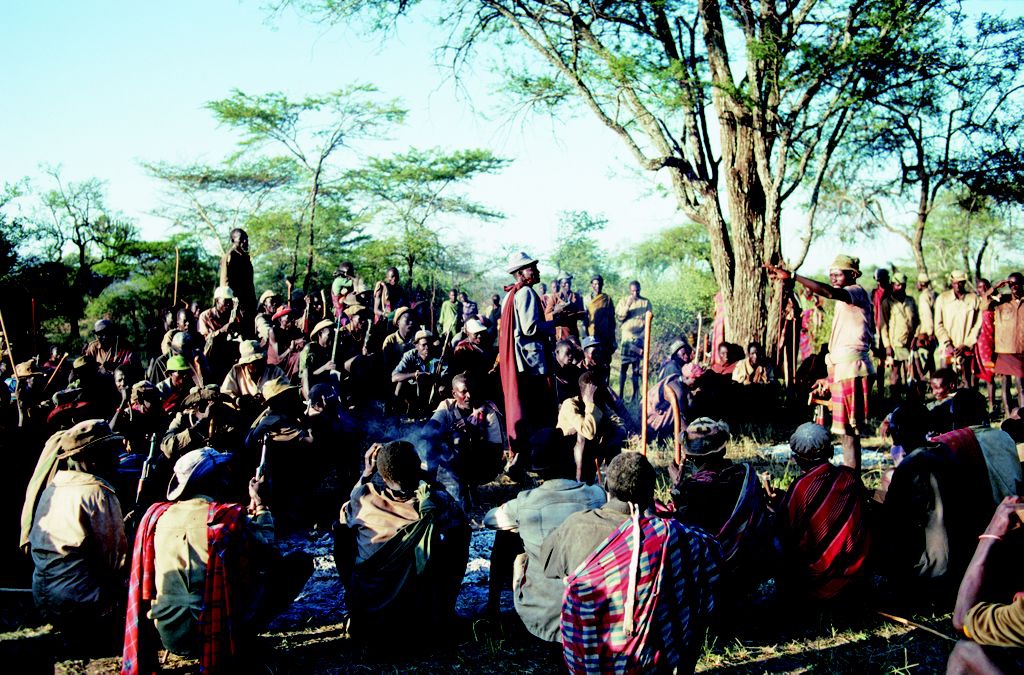
Modernity isn’t, for Diamond, a condition that should triumph completely but this is not because he romanticises traditional ways of living. Much ofThe World Until Yesterday is an account of the drawbacks of life in traditional societies, some of it deriving from the author’s experience during periods of fieldwork. He describes vividly how on one of his first trips, when he spent a month with a group of New Guineans studying birds on a forest-covered mountain, his companions became agitated and refused to sleep in a beautiful valley where he had selected a place to set up camp at the base of a giant tree. The campsite was dangerous, the New Guineans explained, because the tree was dead and might fall over and kill them all. After a number of other incidents, including one in which he nearly drowned, Diamond came to see their response as an example of what he calls “constructive paranoia” – a sense of danger that comes with living in environments that are chronically unsafe for humans.
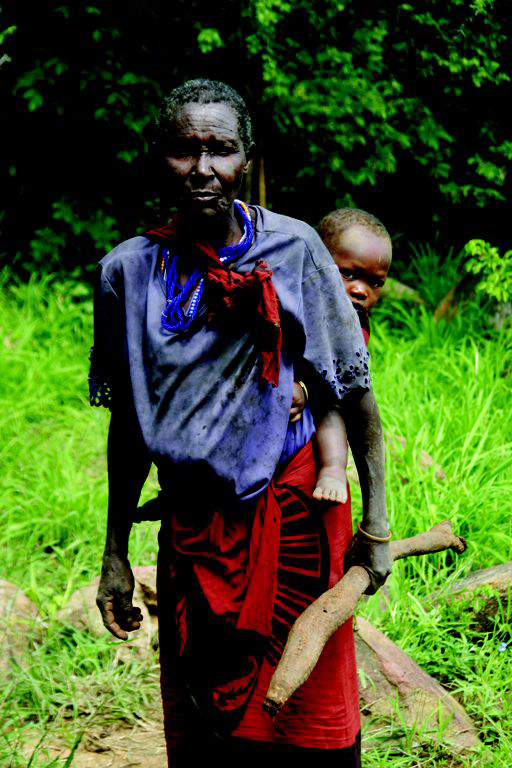
Rightly, Diamond thinks that we may have something to learn from this attitude; but he underscores clearly how it is a response to living in a world that, in some important respects, is more insecure than the one that has been built in modern times. Without modern medicine, accidents are more easily fatal or permanently disabling – and there is no place in traditional cultures for the severely impaired. As Diamond notes: “Some traditional societies, especially nomadic ones or those in harsh environments, are forced to neglect, abandon or kill their elderly.”
The paranoia he describes has another source in how, in traditional communities, encounters with strangers are infused with peril. When New Guinean Highlanders had their first sight of a European in 1933, they wept in terror. Reflecting this horror of outsiders, their relations with other tribal groups were governed by more or less continuous warfare. These are not the innocent primitives of Rousseauesque mythology but nor are they the bloodthirsty savages of Victorian imperialist folklore. Living as everyone lived until around 11,000 years ago, they are human beings in many ways like ourselves.
When a 50-year-old Yahi Indian from Northern California gave up his huntergatherer life to live in San Francisco, Diamond tells us, he was deeply impressed by matches and glue, thinking them the most admirable modern inventions (later he became attached to running water, flushing lavatories and railway trains, among other amenities). The Yahi admired these modern inventions for the same reason Europeans invented them: they add to the ease and enjoyment of life.
For Diamond, the modern world is a patchwork of such inventions but their overall impact on human well-being has been complex and mixed. The domestication of plants and animals, the emergence of large human settlements along with formal systems of justice, the expansion of states, the spread of literacy, cumulative innovation in science and technology – these are some of the developments that together produced the way we live today.
Along with their undoubted benefits, modern societies have their distinctive disorders, including the epidemic spread of diseases such as diabetes and hypertension that are unknown in traditional societies, unremitting time-scarcity and the cultural and cognitive losses that go with vanishing languages (one of the remaining 7,000 languages that are still extant disappears every nine days, Diamond tells us). As he sees it, modernity is not a unique transition that some societies have experienced at various times during the past few centuries; it is an ongoing process whose upshot is uncertain and insecure.
The fragility of civilisation is a theme that runs through much of Diamond’s work. His bestselling books Guns, Germs and Steel (1997) and Collapse: How Societies Choose to Fail or Succeed (2005) have given him the reputation of being something of a doommonger. This is only to be expected, since Diamond points to an undeniable but unwelcome truth. Modern societies are no more immune from environmental collapse than the many that have disappeared in the past – having become so closely interconnected, they are in some ways more at risk. Yet Diamond’s work is about much more than the vulnerabilities of advanced societies and it would be more accurate to describe him as inquiring into the environmental conditions that shape human communities.
One way or another, most theories of human development privilege the kind of society in which the theorist lives. Where 19th-century racial theories posited the biological superiority of Europeans, the triumphal celebrations of unending economic advance that filled the airport bookstalls in the 1990s invoked the cultural superiority of American individualism – something of which we hear rather less now that the financial crisis has shown reckless debt rather than bourgeois virtue to be the chief source of America’s apparent economic outperformance in recent times.
Diamond’s divergence from such ways of thinking is bracing and deeply instructive. Arguing that, “The explanation for the differences in types of societies existing in the modern world depends on environmental differences,” he suggests that human groups in the relatively few regions of the world with plants and animals suitable for domestication had a major advantage over others. Food surpluses led to population growth, which in turn led to political centralisation and social stratification, the growth of cities and the rise of industrial production. Rather than any built-in biological or cultural advantage, it was this environmental head start that eventually produced the modern societies we know today.
Diamond is one of our most consistently illuminating thinkers and The World Until Yesterday is a compelling account of the gains and losses that go with modern living. But if Diamond is impressive in deconstructing simple-minded ideas about what it means to be modern, he does not explain why modernisation has become such a powerful myth. Recent history is littered with vast political experiments aiming to impose models of modernisation on refractory societies, often incurring huge human costs. Not only in Russia and China in the communist era but also in many emerging countries, millions of lives have been lost or ruined by the imposition of crudely schematic plans of development. If Nazism is included as a modernist ideology aiming to remake the world on a hideous new model, probably more human beings were killed in the 20th century for the sake of a vision of the future than for any other single reason.
At this point, the scales tilt against modern societies. Traditional cultures may live in a state of continuous warfare with each other, while genocide is not unknown. No traditional people has attacked and murdered its own members on anything like the scale perpetrated by some modern states. No doubt one reason for this is that traditional societies lack a state apparatus, one of the preconditions of industrial-style killing. Yet there may be a more fundamental reason why traditional peoples do not engage in large-scale slaughter of their own members. Partly because of their non-linear, cyclical understanding of time, traditional cultures lack the idea that a new world can be brought into being by human action. To sacrifice the present generation of human beings for a hypothetical future would be literally inconceivable to them.
Traditional cultures have many disadvantages but it is silly to think of them as being simply backward when the belief that we are forever on the brink of a new world has led to so many disasters. Think of the experiment in financial deregulation that resulted, only a few years later, in an unprecedented bust in the global banking system. Undoubtedly, part of the pressure for deregulation came from selfinterest – if anyone has benefited, it is surely bankers and those with substantial financial assets. Yet the experiment could not have been attempted if an ideology that envisioned the future in terms of a self-regulating global market had not been widely promoted and accepted by mainstream politicians. We had entered a “great moderation”, we were assured, in which the buffering institutions of earlier times – a welfare state, full employment policies –were obsolete. The results of chasing this fantasy can be seen all around us.
As much as the inventions that Diamond describes, it is myths of the future that have come to drive modern life. The self-regulating market was only the latest version of a dream in which the cycles of history have been left behind. If we’d retained some of the constructive paranoia of traditional cultures, we might still not have been able to prevent the neoliberal experiment; but we would have been better prepared for the fiasco that has ensued.
John Gray is the New Statesman’s lead book reviewer. His next book, “The Silence of Animals: on Progress and Other Modern Myths”, will be published by Allen Lane in February
* * * * *
The World Until Yesterday: What we can learn from traditional societies
5th Feb 2013; 13:00
Listen Live: You can listen to this event live online
Watch Live: You can watch this event live online
RSA Keynote
Why are modern afflictions like diabetes, obesity and hypertension largely non-existent in tribal societies? Do traditional societies have superior ideas about how to live well?
Our current, modern way of living comprises only a tiny fraction of human history. Traditional living has moulded and shaped us for millennia, and tribal societies today provide us with incredible insights into all aspects of human nature and the human condition.
Join Jared Diamond as he draws on his experiences from over five decades working and living in New Guinea, an island that is home to one thousand of the world's 7,000 languages and one of the most culturally diverse places on earth. He will explore how tribal peoples approach essential human problems, from childrearing to old age to conflict resolution to health.
Speaker: Jared Diamond, professor of geography at UCLA, author and noted polymath, influential in the fields of anthropology, biology, ornithology, ecology and history.
Chair: Evan Davis, economist, journalist and presenter of the BBC’s Today Programme.
Speakers:
Books:
The World Until Yesterday: What Can We Learn from Traditional Societies?
Jared Diamond (Penguin Books, 2012)