Showing posts with label silence. Show all posts

Friday, August 22, 2014

Daniel A. Gross - This Is Your Brain on Silence

Silence is in short supply in the modern world. In fact, the World Health Organization has studied the impact of noise pollution and found it can be fatal:
It (the WHO) concluded that the 340 million residents of western Europe—roughly the same population as that of the United States—annually lost a million years of healthy life because of noise. It even argued that 3,000 heart disease deaths were, at their root, the result of excessive noise.
But did you know that your brain is more relaxed in silence than when listening to relaxing music? Or that we can probably add silence to small list of things that cause neurogenesis, the creation of new neurons in the brain [the others being cardiovascular exercise, relational stimulation (meeting new people), solving difficult challenges, and antidepressants]?

The author of this cool article from Nautilus (truly one of the great online magazines!), Daniel A. Gross, mentioned an article from Frontiers in Human Neuroscience in relation to this topic - I will post the full article this morning as this post goes up.

This Is Your Brain on Silence

Contrary to popular belief, peace and quiet is all about the noise in your head.


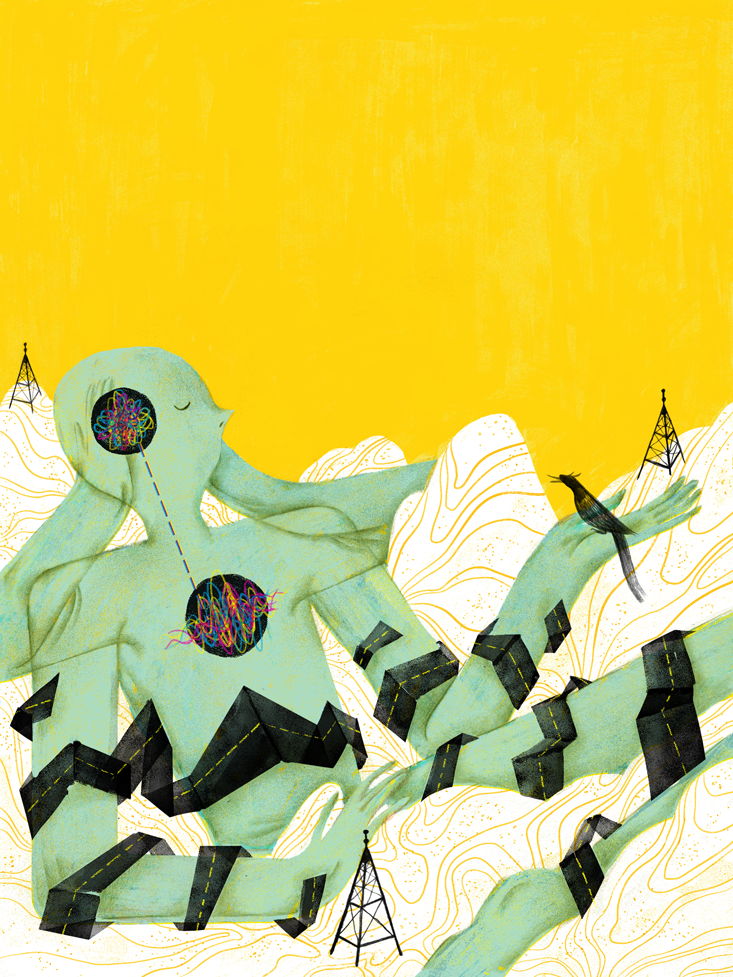
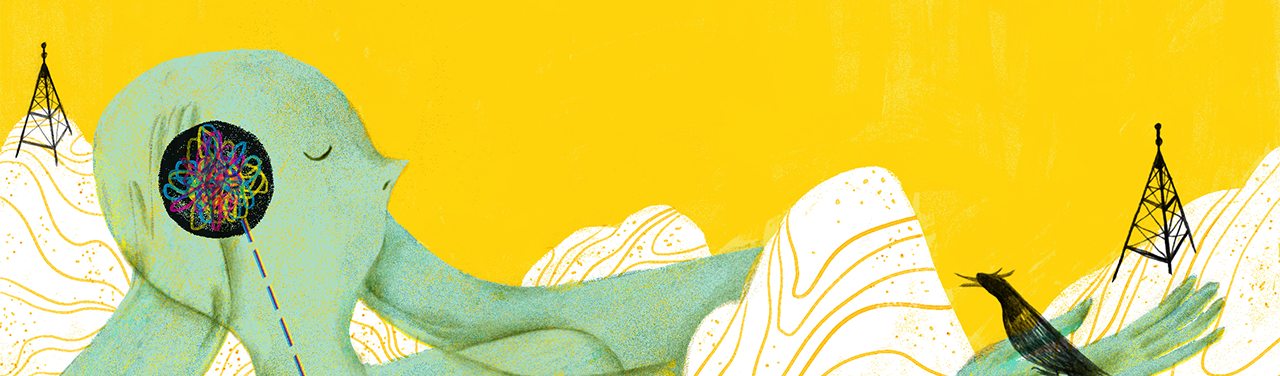
By Daniel A. Gross | Illustration By Leonard Peng
August 21, 2014

http://static.nautil.us/3898_37db6bb5f1db992df92a919d20757eec.png

One icy night in March 2010, 100 marketing experts piled into the Sea Horse Restaurant in Helsinki, with the modest goal of making a remote and medium-sized country a world-famous tourist destination. The problem was that Finland was known as a rather quiet country, and since 2008, the Country Brand Delegation had been looking for a national brand that would make some noise.

Over drinks at the Sea Horse, the experts puzzled over the various strengths of their nation. Here was a country with exceptional teachers, an abundance of wild berries and mushrooms, and a vibrant cultural capital the size of Nashville, Tennessee. These things fell a bit short of a compelling national identity. Someone jokingly suggested that nudity could be named a national theme—it would emphasize the honesty of Finns. Someone else, less jokingly, proposed that perhaps quiet wasn’t such a bad thing. That got them thinking.

A few months later, the delegation issued a slick “Country Brand Report.” It highlighted a host of marketable themes, including Finland’s renowned educational system and school of functional design. One key theme was brand new: silence. As the report explained, modern society often seems intolerably loud and busy. “Silence is a resource,” it said. It could be marketed just like clean water or wild mushrooms. “In the future, people will be prepared to pay for the experience of silence.”

People already do. In a loud world, silence sells. Noise-canceling headphones retail for hundreds of dollars; the cost of some weeklong silent meditation courses can run into the thousands. Finland saw that it was possible to quite literally make something out of nothing.

In 2011, the Finnish Tourist Board released a series of photographs of lone figures in the wilderness, with the caption “Silence, Please.” An international “country branding” consultant, Simon Anholt, proposed the playful tagline “No talking, but action.” And a Finnish watch company, Rönkkö, launched its own new slogan: “Handmade in Finnish silence.”

“We decided, instead of saying that it’s really empty and really quiet and nobody is talking about anything here, let’s embrace it and make it a good thing,” explains Eva Kiviranta, who manages social media for VisitFinland.com.

Silence is a peculiar starting point for a marketing campaign. After all, you can’t weigh, record, or export it. You can’t eat it, collect it, or give it away. The Finland campaign raises the question of just what the tangible effects of silence really are. Science has begun to pipe up on the subject. In recent years researchers have highlighted the peculiar power of silence to calm our bodies, turn up the volume on our inner thoughts, and attune our connection to the world. Their findings begin where we might expect: with noise.

The word “noise” comes from a Latin root meaning either queasiness or pain. According to the historian Hillel Schwartz, there’s even a Mesopotamian legend in which the gods grow so angry at the clamor of earthly humans that they go on a killing spree. (City-dwellers with loud neighbors may empathize, though hopefully not too closely.)

Dislike of noise has produced some of history’s most eager advocates of silence, as Schwartz explains in his book Making Noise: From Babel to the Big Bang and Beyond. In 1859, the British nurse and social reformer Florence Nightingale wrote, “Unnecessary noise is the most cruel absence of care that can be inflicted on sick or well.” Every careless clatter or banal bit of banter, Nightingale argued, can be a source of alarm, distress, and loss of sleep for recovering patients. She even quoted a lecture that identified “sudden noises” as a cause of death among sick children.


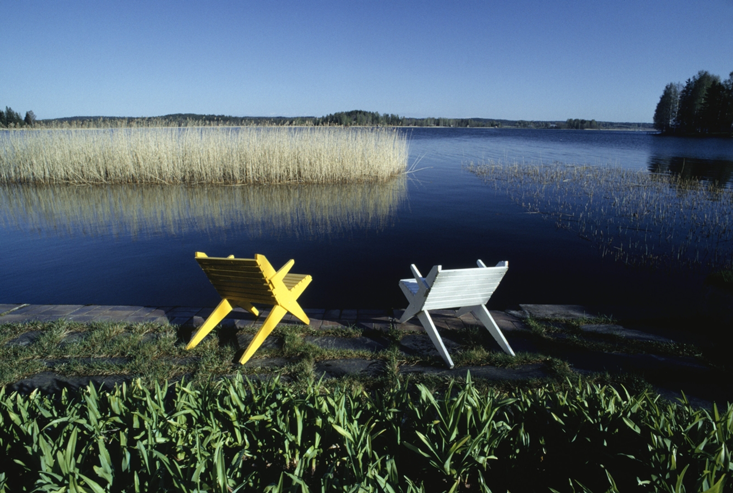
The Quiet Sell: Two wooden armchairs stand on a lake shore in Finland, where marketers have rebranded the Nordic country with a slogan, “Silence, Please.”veer.com

Surprisingly, recent research supports some of Nightingale’s zealous claims. In the mid 20th century, epidemiologists discovered correlations between high blood pressure and chronic noise sources like highways and airports. Later research seemed to link noise to increased rates of sleep loss, heart disease, and tinnitus. (It’s this line of research that hatched the 1960s-era notion of “noise pollution,” a name that implicitly refashions transitory noises as toxic and long-lasting.)

Studies of human physiology help explain how an invisible phenomenon can have such a pronounced physical effect. Sound waves vibrate the bones of the ear, which transmit movement to the snail-shaped cochlea. The cochlea converts physical vibrations into electrical signals that the brain receives. The body reacts immediately and powerfully to these signals, even in the middle of deep sleep. Neurophysiological research suggests that noises first activate the amygdalae, clusters of neurons located in the temporal lobes of the brain, associated with memory formation and emotion. The activation prompts an immediate release of stress hormones like cortisol. People who live in consistently loud environments often experience chronically elevated levels of stress hormones.

Just as the whooshing of a hundred individual cars accumulates into an irritating wall of background noise, the physical effects of noise add up. In 2011, the World Health Organization tried to quantify its health burden in Europe. It concluded that the 340 million residents of western Europe—roughly the same population as that of the United States—annually lost a million years of healthy life because of noise. It even argued that 3,000 heart disease deaths were, at their root, the result of excessive noise.

So we like silence for what it doesn’t do—it doesn’t wake, annoy, or kill us—but what does it do? When Florence Nightingale attacked noise as a “cruel absence of care,” she also insisted on the converse: Quiet is a part of care, as essential for patients as medication or sanitation. It’s a strange notion, but one that researchers have begun to bear out as true.

Silence first began to appear in scientific research as a control or baseline, against which scientists compare the effects of noise or music. Researchers have mainly studied it by accident, as physician Luciano Bernardi did in a 2006 study of the physiological effects of music. “We didn’t think about the effect of silence,” he says. “That was not meant to be studied specifically.”

He was in for a quiet surprise. Bernardi observed physiological metrics for two dozen test subjects while they listened to six musical tracks. He found that the impacts of music could be read directly in the bloodstream, via changes in blood pressure, carbon dioxide, and circulation in the brain. (Bernardi and his son are both amateur musicians, and they wanted to explore a shared interest.) “During almost all sorts of music, there was a physiological change compatible with a condition of arousal,” he explains.

This effect made sense, given that active listening requires alertness and attention. But the more striking finding appeared between musical tracks. Bernardi and his colleagues discovered that randomly inserted stretches of silence also had a drastic effect, but in the opposite direction. In fact, two-minute silent pauses proved far more relaxing than either “relaxing” music or a longer silence played before the experiment started.

The blank pauses that Bernardi considered irrelevant, in other words, became the most interesting object of study. Silence seemed to be heightened by contrasts, maybe because it gave test subjects a release from careful attention. “Perhaps the arousal is something that concentrates the mind in one direction, so that when there is nothing more arousing, then you have deeper relaxation,” he says.

In 2006, Bernardi’s paper on the physiological effects of silence was the most-downloaded research in the journal Heart. One of his key findings—that silence is heightened by contrasts—is reinforced by neurological research. In 2010, Michael Wehr, who studies sensory processing in the brain at the University of Oregon, observed the brains of mice during short bursts of sound. The onset of a sound prompts a specialized network of neurons in the auditory cortex to light up. But when sounds continue in a relatively constant manner, the neurons largely stop reacting. “What the neurons really do is signal whenever there’s a change,” Wehr says.

The sudden onset of silence is a type of change too, and this fact led Wehr to a surprise. Before his 2010 study, scientists knew that the brain reacts to the start of silences. (This ability helps us react to dangers, for example, or distinguish words in a sentence.) But Wehr’s research extended those findings by showing that, remarkably, the auditory cortex has a separate network of neurons that fire when silence begins. “When a sound suddenly stops, that’s an event just as surely as when a sound starts.”

Even though we usually think of silences as a lack of input, our brains are structured to recognize them, whenever they represent a sharp break from sounds. So the question is what happens after that moment—when silence continues, and the auditory cortex settles into a state of relative inactivity.


One of the researchers who’s examined this question is a Duke University regenerative biologist, Imke Kirste. Like Bernardi, Kirste wasn’t trying to study silence at all. In 2013, she was examining the effects of sounds in the brains of adult mice. Her experiment exposed four groups of mice to various auditory stimuli: music, baby mouse calls, white noise, and silence. She expected that baby mouse calls, as a form of communication, might prompt the development of new brain cells. Like Bernardi, she thought of silence as a control that wouldn’t produce an effect.

As it turned out, even though all the sounds had short-term neurological effects, not one of them had a lasting impact. Yet to her great surprise, Kirste found that two hours of silence per day prompted cell development in the hippocampus, the brain region related to the formation of memory, involving the senses. This was deeply puzzling: The total absence of input was having a more pronounced effect than any sort of input tested.

Here’s how Kirste made sense of the results. She knew that “environmental enrichment,” like the introduction of toys or fellow mice, encouraged the development of neurons because they challenged the brains of mice. Perhaps the total absence of sound may have been so artificial, she reasoned—so alarming, even—that it prompted a higher level of sensitivity or alertness in the mice. Neurogenesis could be an adaptive response to uncanny quiet.

The growth of new cells in the brain doesn’t always have health benefits. But in this case, Kirste says that the cells seemed to become functioning neurons. “We saw that silence is really helping the new generated cells to differentiate into neurons, and integrate into the system.”

While Kirste emphasizes that her findings are preliminary, she wonders if this effect could have unexpected applications. Conditions like dementia and depression have been associated with decreasing rates of neurogenesis in the hippocampus. If a link between silence and neurogenesis could be established in humans, she says, perhaps neurologists could find a therapeutic use for silence.

While it’s clear that external silence can have tangible benefits, scientists are discovering that under the hoods of our skulls “there isn’t really such a thing as silence,” says Robert Zatorre, an expert on the neurology of sound. “In the absence of sound, the brain often tends to produce internal representations of sound.”

Imagine, for example, you’re listening to Simon and Garfunkel’s “The Sound of Silence,” when the radio abruptly cuts out. Neurologists have found that if you know the song well, your brain’s auditory cortex remains active, as if the music is still playing. “What you’re ‘hearing’ is not being generated by the outside world,” says David Kraemer, who’s conducted these types of experiments in his Dartmouth College laboratory. “You’re retrieving a memory.” Sounds aren’t always responsible for sensations—sometimes our subjective sensations are responsible for the illusion of sound.

This is a reminder of the brain’s imaginative power: On the blank sensory slate of silence, the mind can conduct its own symphonies. But it’s also a reminder that even in the absence of a sensory input like sound, the brain remains active and dynamic.

In 1997, a team of neuroscientists at Washington University was collecting brain scan data from test subjects during various mental tasks, like arithmetic and word games. One of the scientists, Gordon Shulman, noticed that although intense cognition caused spikes in some parts of the brain, as you’d expect, it was also causing declines in the activity of other parts of the brain. There seemed to be a type of background brain activity that was most visible, paradoxically, when the test subject was in a quiet room, doing absolutely nothing.

The team’s lead scientist was Marcus Raichle, and he knew there were good reasons to look closer at the data. For decades, scientists had known that the brain’s “background” activity consumed the lion’s share of its energy. Difficult tasks like pattern recognition or arithmetic, in fact, only increased the brain’s energy consumption by a few percent. This suggested that by ignoring the background activity, neurologists might be overlooking something crucial. “When you do that,” Raichle explains, “most of the brain’s activities end up on the cutting room floor.”

In 2001, Raichle and his colleagues published a seminal paper that defined a “default mode” of brain function—situated in the prefrontal cortex, active in cognitive actions—implying a “resting” brain is perpetually active, gathering and evaluating information. Focused attention, in fact, curtails this scanning activity. The default mode, Raichle and company argued, has “rather obvious evolutionary significance.” Detecting predators, for example, should happen automatically, and not require additional intention and energy.

Follow-up research has shown the default mode is also enlisted in self-reflection. In 2013, in Frontiers in Human Neuroscience, Joseph Moran and colleagues wrote the brain’s default mode network “is observed most closely during the psychological task of reflecting on one’s personalities and characteristics (self-reflection), rather than during self-recognition, thinking of the self-concept, or thinking about self-esteem, for example.” During this time when the brain rests quietly, wrote Moran and colleagues, our brains integrate external and internal information into “a conscious workspace.”

Freedom from noise and goal-directed tasks, it appears, unites the quiet without and within, allowing our conscious workspace to do its thing, to weave ourselves into the world, to discover where we fit in. That’s the power of silence.

Noora Vikman, an ethnomusicologist, and a consultant on silence for Finland’s marketers, knows that power well. She lives in the eastern part of Finland, an area blanketed with quiet lakes and forests. In a remote and quiet place, Vikman says, she discovers thoughts and feelings that aren’t audible in her busy daily life. “If you want to know yourself you have to be with yourself, and discuss with yourself, be able to talk with yourself.”

“Silence, Please” has proven to be the most popular theme in Finland’s rebranding, and one of the most popular pages on VisitFinland.com. Maybe silence sells because, so often, we treat it as a tangible thing—something easily broken, like porcelain or crystal, and something delicate and valuable. Vikman remembers a time when she experienced the rarity of nearly complete silence. Standing in the Finnish wilderness, she strained her ears to pick out the faintest sounds of animals or wind. “It’s strange,” she says, “the way you change. You have all the power—you can break the silence with even with the smallest sounds. And then you don’t want to do it. You try to be as quiet as you can be.”


~ Daniel A. Gross is a freelance journalist and public radio producer who writes about history and science.
Saturday, November 23, 2013

Sacred Silence in Sufism and the Vedanta - 2013 Festival of Faiths


This is a lengthy and interesting talk from this Fall 2013's Festival of Faiths, a festival devoted to Sacred Silence: Pathway to Compassion. Forum presentations focused on compassion and common action that our community of many faiths can embrace.

From Wikipedia:
Seyyed Hossein Nasr is a Muslim Persian philosopher and renowned scholar of comparative religion, a lifelong student and follower of Frithjof Schuon, and writes in the fields of Islamic esoterism, Sufism, philosophy of science, and metaphysics.

Nasr was the first Muslim to deliver the prestigious Gifford Lectures, and in year 2000, a volume was devoted to him in the Library of Living Philosophers. Professor Nasr speaks and writes based on the doctrine and the viewpoints of the perennial philosophy on subjects such as philosophy, religion, spirituality, music, art, architecture, science, literature, civilizational dialogues, and the natural environment.
From Spiritual Paths:
Swami Atmarupananda is a renowned scholar, teacher, and Monk of the Ramakrishna Order of India, a monastic organization dedicated to the teaching of Vedanta. He joined the Order in 1969 and spent many years in India engaged in monastic, scholarly and spiritual training. He combines a contemplative and mystical approach with a extraordinary scholarly training and a good sense of humor that are helpful in explaining subtle concepts of Hinduism to Western students.


Sacred Silence in Sufism and the Vedanta - 2013 Festival of Faiths


Published on May 27, 2013
Seyyed Hossein Nasr, one of the world's leading experts on Islamic science and spirituality, and Swami Atmarupananda, renowned teacher of Hinduism, will talk about Compassion as being intrinsic to who we really are -- the true Self, the "image of God" which is free of all alienation. And that is wisdom itself, love itself, discovered in inner silence -- the still point that unites us to both God and the universe.

Wednesday, November 20, 2013

Fr. Richard Rohr: Finding God in the Depths of SIlence


From this May 2013's Festival of Faiths, this is a wonderful talk by Fr. Richard Rohr, the heir apparent to the contemplative lineage of Fr. Thomas Keating (Centering Prayer). Fr. Rohr is the author of several excellent books, including Everything Belongs: The Gift of Contemplative Prayer (2003), The Naked Now: Learning to See as the Mystics See (2009), Immortal Diamond: The Search for Our True Self (2013), and Yes, and...: Daily Meditations (2013), among many other books.

Fr. Rohr's vision of a contemplative, nondual Christianity has been a blessing to several of my Christian clients, even those who see Catholicism as essentially broken. As a non-Christian, I enjoy his sense of the possible within silence . . . and the conviction that we all can find the compassion and vitality of being fully alive.

Fr. Richard Rohr: Finding God in the Depths of Silence


Published on May 15, 2013

Fr. Richard Rohr, ecumenical teacher, author and founder of the Center for Action and Contemplation.


Rohr shares his perspective on Silence as the only thing broad enough and deep enough to hold all of the contradictions and paradoxes of Full Reality and our own reality, too. 99.9% of the known universe is silent, and it is in this space that the force fields of life and compassion dwell and expand. We can live there too!

The 2013 May edition of the Festival of Faiths was presented in partnership with:

Tuesday, November 19, 2013

Evan Imber-black - A Family Therapist Uncovers the Cost of Keeping Silent

Evan Imber-black is a family therapist and the author of The Secret Life of Families: Making Decisions About Secrets: When Keeping Secrets Can Harm You, When Keeping Secrets Can Heal You-And How to Know the Difference (1999), and she is Director of the Center for Families and Health and a faculty member at the Ackerman Institute for the Family in New York City.

In this article for Nautilus, she discusses and provides examples of how family secrets can be so terribly destructive - any counselor who has ever worked with families in any depth can attest to the destructiveness of secrets.

Secrets That Won’t Rest

A family therapist uncovers the cost of keeping silent

By Evan Imber-black

http://static.nautil.us/1410_512c5cad6c37edb98ae91c8a76c3a291.png
Photo by Christopher Anderson

As someone who has studied and practiced family therapy for 37 years, I am repeatedly struck by a secret’s impact on a family. With the best intentions, parents often strive to protect a child from a shameful or painful event that happened in the past. But keeping a secret usually has the opposite effect. It can take a toll on bearers and their families for years, even generations.

One way a secret surfaces is via an “anniversary reaction,” a physical or emotional response to a calendar date. A study of Hurricane Katrina survivors shows a rise in depression, headaches, and stomachaches every August, the month of the 2005 tragedy. When recognized in a supportive social context of family and community, these symptoms tend to be of short duration. But anniversary reactions stirred by private events last longer. Their origins are harder to uncover and explain, and portend long-held family secrets the keeper finds too traumatic to reveal.

We each carry an inner calendar, just at the edge of awareness. Anniversary reactions might be experienced by the secret bearer or another family member. Either way a secret exacts a steep price on family relationships and individual identity. But just as I have been struck by the damage done by secrets, I have been repeatedly struck by the healing power of exposing them. It’s an insight that was impressed on me by two families in particular.

1. Carol

Several years ago, I worked with a family where the mother compulsively washed her hands several dozen times a day. I’ll call her Carol to protect her real identity. In her early 70s, Carol was a healthy and energetic woman who refused to leave the house, except for doctor’s visits. Her husband, Bill, complained of feeling like a prisoner. Grown children and grandchildren were exiled from her home. He and Carol had fruitless arguments centering on her hand washing. Her symptoms handicapped her life.

Carol’s anxiety worsened every year in March and November, often resulting in brief hospitalizations. Although the family told me they didn’t like outsiders, they paradoxically dragged their mother to one new professional after another. The Littletons’ four children were competitive, each trying to be the one to find the answer to their mother’s agony. The two months were spent intensely trying to resolve “mother’s problems.”

What, I wondered, could have happened in this family?

When Carol was finally able to speak, I learned of a secret anchored in deep shame. Carol became pregnant at 17. Her two oldest children—two daughters—were born prior to her legal marriage in 1950. She would later marry their father but in the meantime faced strong disapproval from her parents, who sent her away to deliver the baby, and her future in-laws, who sent her a note blaming Carol entirely for the situation. Carol did not reveal the letter to her husband till they arrived in therapy with me nearly 50 years later.

Despite going on to have a full life with her family, Carol felt compelled to keep the secret. She hid her wedding license in the bottom of an old trunk in the basement, and the date of her wedding was off limits in family conversation. Her pre-teen children found it, understood the meaning of the date, grasped the shame, and compounded the secrecy. The couple never celebrated their wedding anniversary because that would give away the fact that they were married fewer years than the age of their daughters. They didn’t celebrate their daughters’ birthdays in November and March. Instead of marking those milestones, this was the time Carol disintegrated emotionally.

When Carol finally shared her long-held secret, her grown children responded with care and compassion, affirming that they knew all that was hidden in plain sight. They had not connected their mother’s biennial extreme anxiety to the secret. They identified their mother’s compulsive hand washing as a problem but they had never connected it to her personal shame.

After I worked with Carol, I marveled that in hindsight, she suffered so much for doing something that is considered almost quaint today. Carol didn’t wake up one morning and decide to create a secret. It formed based on the strong disapproval from her family, future in-laws and the wider culture. The code to unlocking family secrets is often the shame and humiliation felt by individuals and families when one’s personal reality departs from wider social, cultural, and political contexts. Shame and secrecy live together in a tight circle—the more shame, the more secrecy; the more secrecy, the more shame.

2. Jaime

While a person harboring a secret often suffers emotional damage, so does a person from whom a secret is being kept. The latter was the case with my client, whom I’ll call Jaime.1

Jaime was a promising 17-year-old high school senior—a scholar and an athlete—when he began hearing voices telling him to harm his stepmother, Anna. He was quickly hospitalized, diagnosed with schizophrenia, and put on anti-psychotic medication. At the same time, the family was told to enroll in therapy. We soon discovered that Jaime’s “episode” coincided with the second anniversary of his beloved grandmother’s death. No one in the family had made any connection between the anniversary and Jaime’s behavior.

Jaime was raised from infancy by his grandmother in Mexico. The summer before her death, Jaime’s father, Alberto, brought him to New York to be with him and his stepmother, keeping his grandmother’s terminal cancer from him. “I didn’t want to upset him. I just wanted to protect him and let him have a fun summer,” his father explained. When his grandmother died that August, Jaime remained in New York.

No rituals in New York marked his grandmother’s death, and because of immigration concerns, Jaime was not allowed to go to Mexico for her funeral. Conversations in the family about this relationship, perhaps the most important one for Jaime, were non-existent. The silence echoed the absence of any talk about his biological mother, as well as any story of his father and stepmother’s migration, or his life with his grandmother. As in many families, secrets were multiple and linked one to another.

Jaime spoke little to his father and less to his stepmother. What was the mystery that would account for the “voices” telling him to harm Anna? And where was Jaime’s biological mother? The story remained out of reach until his stepmother Anna revealed a secret she held. She told Jaime that while his grandmother loved him deeply, took very good care of him, and encouraged him to be an excellent student, she was not welcoming, and in fact mistreated, his real mother and her. With the best intentions, Jaime’s father and Anna kept this a secret from him. When Anna had a daughter, the family migrated from Mexico to New York, leaving Jaime with his grandmother. Growing up, his grandmother told him terrible stories about his stepmother.

Multiple layers of secrecy and silence in all corners of this well-meaning family nearly created a permanent tragedy of psychiatric misdiagnosis and irreparable relationships. Just prior to the anniversary of his grandmother’s death—an anniversary with no markers and no conversations—Anna had begun to help Jaime with his college applications. “I felt so confused—my grandmother told me never to let Anna in to my life—I needed to be loyal to her—yet here was Anna, being so sweet and loving. No one acknowledged my grandmother’s death. I knew she would not want me to be living here, and especially to be letting my stepmother help me. None of it made any sense—I felt like my head was going to explode.”

Resolution dawned for Jamie as he shared conversations with stepmother and father, and learned to acknowledge his contradictory feelings about his grandmother and stepmother. Not long after the family secrets were revealed, Jaime stopped hearing voices.

These two cases illustrate how secrets entangle relationships. Anniversary reactions help bring to the surface secrets which may be of recent creation, as with Jaime and his family, or decades old and permeating every corner of an extended family’s life, as we saw with Carol. Jaime’s turmoil was anchored in death, while Carol’s was generated by birth. What they share is their steep price to family relationships and individual identity.


~ Evan Imber-Black is a professor in the Marriage and Family Therapy Masters Program at Mercy College. She is also the director of the Ackerman Center for Families and Health at the Ackerman Institute for the Family and the author of several books, including The Secret Life of Families.

Tuesday, July 30, 2013

The Last Quiet Places: Gordon Hempton on Silence and the Presence of Everything (from On Being)

Gordon Hempton is founder and vice president of The One Square Inch of Silence Foundation based in Joyce, Washington. He's the author of One Square Inch of Silence: One Man's Quest to Preserve Quiet. He was Krista Tippett's guest a few weeks ago on NPR's On Being.

Hempton defines silence not as the absence of sound, but as the absence of noise. He says that quiet is a "think tank of the soul." I like that.

The Last Quiet Places: Gordon Hempton on Silence and the Presence of Everything

July 4, 2013

Gordon Hempton records the winter silence of the Hoh Rain Forest in Olympic National Park near One Square Inch of Silence

Silence is an endangered species, says Gordon Hempton. He defines real quiet as presence — not an absence of sound, but an absence of noise. The Earth, as he knows it, is a "solar-powered jukebox." Quiet is a "think tank of the soul." We take in the world through his ears.

Listen


Radio Show/Podcast (mp3, 51:09)
Unedited Interview Gordon Hempton (mp3, 89:37)

Learn


Krista's Journal
Transcript

Soundscapes of Nature's Silence


We've isolated some of our favorite narrative sound treatments included in this radio show and podcast. Listen in (we strongly encourage headphones or earbuds!) as we pair these soundscapes with reflective passages and photos.


A Hike Through the Hoh Rain Forest: A Soundscape Meditation

Through the sounds of the Hoh Rain Forest in Olympic National Park, Hempton guides us on an aural hike to One Square Inch of Silence.

*****


Sitka Spruce on Rialto Beach

Poke your head inside this giant driftwood log and experience a "surf symphony in the wild" as the surf plucks the wood fibers and cause them to vibrate like the strings of a violin.

*****


The Poetics of Space Across Latitudes

An aural journey across three zones — from the Amazon and Central America to the temperate latitudes of the Great Northwest. The difference in silence will astound you.

*****


The Listening Horizon at Dawn

Taken from his recordings of dawn in the Midwest U.S., Gordon Hempton uses this condensed audio to help people practice true listening in wide, open space.

Voices on the Radio


Gordon Hempton is founder and vice president of The One Square Inch of Silence Foundation based in Joyce, Washington. He's the author of One Square Inch of Silence: One Man's Quest to Preserve Quiet.

Selected Reading from "One Square Inch of Silence"

by Gordon Hempton

The day will come when man will have to fight noise as inexorably as cholera and the plague." So said the Nobel Prize-winning bacteriologist Robert Koch in 1905. A century later, that day has drawn much nearer. Today silence has become an endangered species. Our cities, our suburbs, our farm communities, even our most expansive and remote national parks are not free from human noise intrusions. Nor is there relief even at the North Pole; continent-hopping jets see to that. Moreover, fighting noise is not the same as preserving silence. Our typical anti-noise strategies — earplugs, noise cancellation headphones, even noise abatement laws — offer no real solution because they do nothing to help us reconnect and listen to the land. And the land is speaking.

We've reached a time in human history when our global environmental crisis requires that we make permanent life-style changes. More than ever before, we need to fall back in love with the land. Silence is our meeting place.

It is our birthright to listen, quietly and undisturbed, to the natural environment and take whatever meanings we may. Long before the noises of mankind, there were only the sounds of the natural world. Our ears evolved perfectly tuned to hear these sounds-sounds that far exceed the range of human speech or even our most ambitious musical performances: a passing breeze that indicates a weather change, the first birdsongs of spring heralding a regreening of the land and a return to growth and prosperity, an approaching storm promising relief from a drought, and the shifting tide reminding us of the celestial ballet. All of these experiences connect us back to the land and to our evolutionary past.

One Square Inch of Silence is a place in the Hoh Rain Forest, part of Olympic National Park &mdas; arguably the quietest place in the United States. But it, too, is endangered, protected only by a policy that is neither practiced by the National Park Service itself nor supported by adequate laws. My hope is that One Square Inch will trigger a quiet awakening in all those willing to become true listeners.

Preserving natural silence is as necessary and essential as species preservation, habitat restoration, toxic waste cleanup, and carbon dioxide reduction, to name but a few of the immediate challenges that confront us in this still young century. The good news is that rescuing silence can come much more easily than tackling these other problems. A single law would signal a huge and immediate improvement. That law would prohibit all aircraft from flying over our most pristine national parks.

Silence is not the absence of something but the presence of everything. It lives here, profoundly, at One Square Inch in the Hoh Rain Forest. It is the presence of time, undisturbed. It can be felt within the chest. Silence nurtures our nature, our human nature, and lets us know who we are. Left with a more receptive mind and a more attuned ear, we become better listeners not only to nature but to each other. Silence can be carried like embers from a fire. Silence can be found, and silence can find you. Silence can be lost and also recovered. But silence cannot be imagined, although most people think so. To experience the soul-swelling wonder of silence, you must hear it.

Silence is a sound, many, many sounds. I've heard more than I can count. Silence is the moonlit song of the coyote signing the air, and the answer of its mate. It is the falling whisper of snow that will later melt with an astonishing reggae rhythm so crisp that you will want to dance to it. It is the sound of pollinating winged insects vibrating soft tunes as they defensively dart in and out of the pine boughs to temporarily escape the breeze, a mix of insect hum and pine sigh that will stick with you all day. Silence is the passing flock of chestnut-backed chickadees and red-breasted nuthatches, chirping and fluttering, reminding you of your own curiosity.

Have you heard the rain lately? America's great northwest rain forest, no surprise, is an excellent place to listen. Here's what I've heard at One Square Inch of Silence. The first of the rainy season is not wet at all. Initially, countless seeds fall from the towering trees. This is soon followed by the soft applause of fluttering maple leaves, which settle oh so quietly as a winter blanket for the seeds. But this quiet concert is merely a prelude.

When the first of many great rainstorms arrives, unleashing its mighty anthem, each species of tree makes its own sound in the wind and rain. Even the largest of the raindrops may never strike the ground. Nearly 300 feet overhead, high in the forest canopy, the leaves and bark absorb much of the moisture … until this aerial sponge becomes saturated and drops re-form and descend farther … striking lower branches and cascading onto sound-absorbing moss drapes … tapping on epiphytic ferns … faintly plopping on huckleberry bushes ... and whacking the hard, firm salal leaves … before, finally, the drops inaudibly bend the delicate clover-like leaves of the wood sorrel and drip to leak into the ground. Heard day or night, this liquid ballet will continue for more than an hour after the actual rain ceases.

Recalling the warning of Robert Koch, developer of the scientific method that identifies the causes of disease, I believe the unchecked loss of silence is a canary in a coal mine-a global one. If we cannot make a stand here, if we turn a deaf ear to the issue of vanishing natural quiet, how can we expect to fare better with more complex environmental crises?

Like-Minded Conversations


Elizabeth Alexander on Words That Shimmer

Poetry is something many of us seem to be hungry for these days. We're hungry for fresh ways to tell hard truths and redemptive stories, for language that would elevate and embolden rather than demean and alienate. Elizabeth Alexander shares her sense of what poetry works in us — and in our children — and why it may become more relevant, not less so, in hard and complicated times.


A Wild Love For the World with Joanna Macy

Joanna Macy is a philosopher of ecology, a Buddhist scholar, and an exquisite translator of the poetry of Rainer Maria Rilke. We take that poetry as a lens on her wisdom on spiritual life and its relevance for the political and ecological dramas of our time.

Production Credits

  • Host/Producer: Krista Tippett
  • Senior Editor: Trent Gilliss
  • Technical Director/Producer: Chris Heagle
  • Senior Producer: David McGuire
  • Associate Producer: Nancy Rosenbaum
  • Coordinating Producer: Stefni Bell

Tuesday, May 15, 2012

Mysteries of the Jesus Prayer - The Contemplative Tradition in Orthodox Christianity


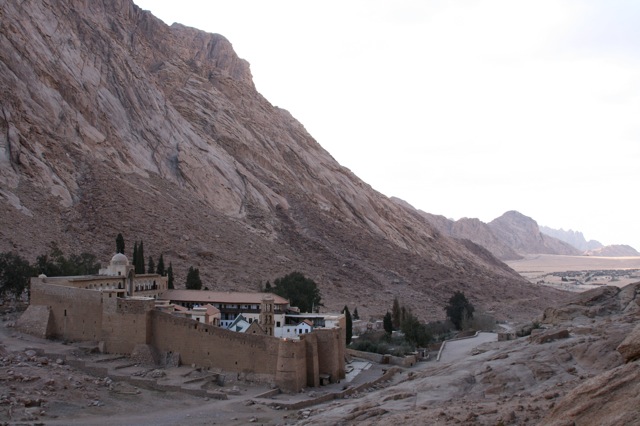
This is an excellent documentary on the desert monks who seek internal silence and probably are the closest living link we have to the original Christian Orthodox desert mystics and their descendents in Eastern Europe. The home page for the film is here. Here is the intro from their site:
A Pilgrimage to the Heart of an Ancient Spirituality. 

"Mysteries of the Jesus Prayer" a new documentary feature film from SnagFilms (Comcast & Fios On-Demand) and HarperOne book, focuses on the mysteries behind the prayer that is thought to have first been practiced by the Apostles some 2,000 years ago. The prayer is still chanted by monks and nuns in far away caves and monasteries but is mostly unknown to the rest of the western world. Many say that with this prayer, it is possible to communicate directly with God.

Very Rev. Dr. John A. McGuckin and Dr. Norris J. Chumley bring you to ancient lands of peace and solitude, filming for the first time hermits, monks and nuns in caves, monasteries and convents who share this ancient mystical prayer. The documentary retraces their steps and beyond, bringing the wisdom of both ancient saints and living Christian spiritual masters to worldwide audiences.


Mysteries of the Jesus Prayer Synopsis
For the first time on film desert hermits, monks and nuns share their practices and invite us into their private cells, caves and sanctuaries in the Middle East, Mediterranean, Eastern Europe and Russia.

Film Credits

Director

  1. Norris J. Chumley

Producers

  1. David Aslan
  2. John A. McGuckin

Writers

  1. Norris J. Chumley
  2. John A. McGuckin

Executive Producer

  1. Norris J. Chumley

Editor

  1. David Aslan

Friday, February 24, 2012

Father Laurence Freeman - Knowledge Is . . . Love: Christian Meditation


This is a two-part Google Tech Talk - Father Laurence Freeman (Benedictine Monk) talks about meditation and different kinds of knowing. He has done a lot of work in "interfaith friendship." He is the Director of the World Community for Christian Meditation, a global network of Christian meditation groups that practice the way of Christian meditation, and of its Benedictine oblate community.

Very cool to see this side of the Catholic tradition.


Father Laurence Freeman - Knowledge is... Love
ABSTRACT

Different kinds of knowing - but the most human kind reveals our universal kinship and transforms relationship. Meditation is more than you think. The oldest and youngest form of human wisdom makes good sense in a digital age.

Speaker Info:

Father Laurence Freeman is a benedictine monk whose work in teaching meditation and interfaith friendship takes place in a global community formed by the daily practice of dynamic stillness and transformative silence.

Meditate with Father Laurence Freeman