Showing posts with label mysticism. Show all posts

Saturday, April 05, 2014

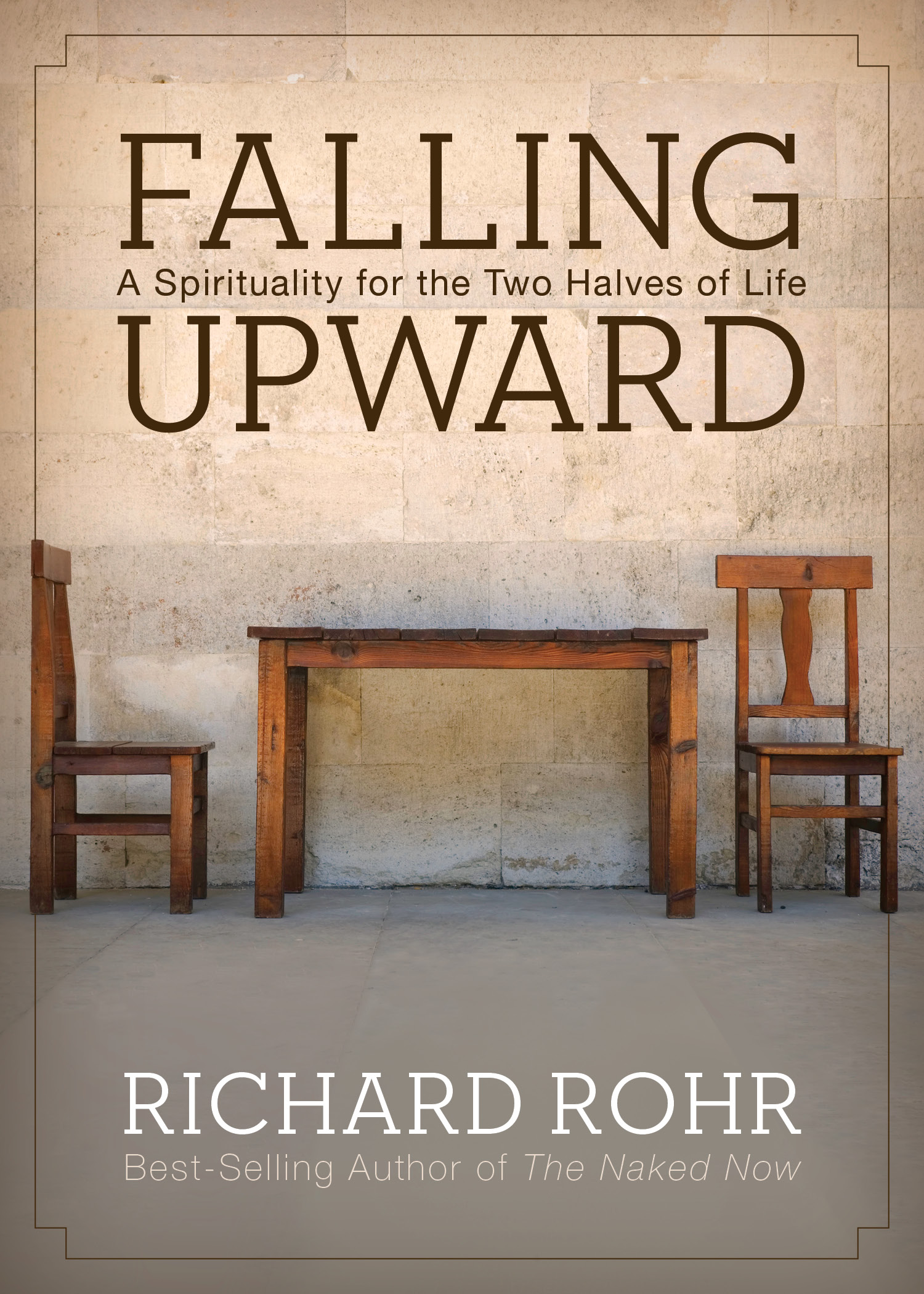
Father Richard Rohr - "Falling Upward"


Father Richard Rohr is the author of Falling Upward: A Spirituality for the Two Halves of Life (2011), as well as Everything Belongs: The Gift of Contemplative Prayer (2003), The Naked Now: Learning to See as the Mystics See (2009), Immortal Diamond: The Search for Our True Self (2013), and Dancing Standing Still: Healing the World from a Place of Prayer; A New Edition of A Lever and a Place to Stand (2014).

Fr. Rohr is in the tradition of Father Thomas Keating:
Fr. Richard Rohr is a globally recognized ecumenical teacher bearing witness to the universal awakening within Christian mysticism and the Perennial Tradition. He is a Franciscan priest of the New Mexico Province and founder of the Center for Action and Contemplation (www.cac.org) in Albuquerque, New Mexico. Fr. Richard's teaching is grounded in the Franciscan alternative orthodoxy--practices of contemplation and lived kenosis (self-emptying), expressing itself in radical compassion, particularly for the socially marginalized.

Fr. Richard is author of numerous books, including Everything Belongs, Adam's Return, The Naked Now, Breathing Under Water, Falling Upward, and Immortal Diamond: The Search for Our True Self.

CAC is home to the Rohr Institute where Fr. Richard is Academic Dean of the Living School for Action and Contemplation. Drawing upon Christianity's place within the Perennial Tradition, the mission of the Rohr Institute is to produce compassionate and powerfully learned individuals who will work for positive change in the world based on awareness of our common union with God and all beings.
His books are profound even for non-Christians.

Father Richard Rohr - "Falling Upward"

Uploaded on Oct 21, 2011


Contemporary theologian and best selling author Richard Rohr spoke at Texas Lutheran University on Sunday, Sept. 25th in Jackson Auditorium. Rohr spoke from the content of his latest book, "Falling Upward: A Spirituality for the Two Halves of Life."

About the book: As we begin to embark on a further journey, one that involves challenges, mistakes, loss of control, broadening horizons, and necessary suffering, we find that 'falling down' is actually the way that we move upward. Fr. Richard offers this new paradigm for understanding one of the most profound of life's mysteries: how the heartbreaks, disappointments, and first loves of life are actually stepping stones to the spiritual joys that the second half of life has in store for us. You can find more information about Richard Rohr on his website www.fallingupwardbook.com.

Wednesday, November 20, 2013

Fr. Richard Rohr: Finding God in the Depths of SIlence


From this May 2013's Festival of Faiths, this is a wonderful talk by Fr. Richard Rohr, the heir apparent to the contemplative lineage of Fr. Thomas Keating (Centering Prayer). Fr. Rohr is the author of several excellent books, including Everything Belongs: The Gift of Contemplative Prayer (2003), The Naked Now: Learning to See as the Mystics See (2009), Immortal Diamond: The Search for Our True Self (2013), and Yes, and...: Daily Meditations (2013), among many other books.

Fr. Rohr's vision of a contemplative, nondual Christianity has been a blessing to several of my Christian clients, even those who see Catholicism as essentially broken. As a non-Christian, I enjoy his sense of the possible within silence . . . and the conviction that we all can find the compassion and vitality of being fully alive.

Fr. Richard Rohr: Finding God in the Depths of Silence


Published on May 15, 2013

Fr. Richard Rohr, ecumenical teacher, author and founder of the Center for Action and Contemplation.


Rohr shares his perspective on Silence as the only thing broad enough and deep enough to hold all of the contradictions and paradoxes of Full Reality and our own reality, too. 99.9% of the known universe is silent, and it is in this space that the force fields of life and compassion dwell and expand. We can live there too!

The 2013 May edition of the Festival of Faiths was presented in partnership with:

Thursday, November 14, 2013

Carl Gustav Jung, Quantum Physics and the Spiritual Mind: A Mystical Vision of the Twenty-First Century


The Jungians have had a fascination with quantum physics ever since CG Jung collaborated with physicist Wolfgang Pauli (and Albert Einstein) in developing his concept of synchronicity. It seems, in principle, that the idea or theory of synchronicity is an essential underpinning to the article presented below, so here is a more in-depth conceptualization of synchronicity from Wikipedia:
Synchronistic events reveal an underlying pattern, a conceptual framework that encompasses, but is larger than, any of the systems that display the synchronicity. The suggestion of a larger framework is essential to satisfy the definition of synchronicity as originally developed by Carl Gustav Jung.[3]

Jung coined the word to describe what he called "temporally coincident occurrences of acausal events." Jung variously described synchronicity as an "acausal connecting principle", "meaningful coincidence" and "acausal parallelism". Jung introduced the concept as early as the 1920s, but gave a full statement of it only in 1951 in an Eranos lecture[4] and in 1952, published a paper, Synchronizität als ein Prinzip akausaler Zusammenhänge (Synchronicity – An Acausal Connecting Principle),[5] in a volume with a related study by the physicist (and Nobel laureate) Wolfgang Pauli.[6]

It was a principle that Jung felt gave conclusive evidence for his concepts of archetypes and the collective unconscious,[7] in that it was descriptive of a governing dynamic that underlies the whole of human experience and history – social, emotional, psychological, and spiritual. Concurrent events that first appear to be coincidental but later turn out to be causally related are termed incoincident.

Jung believed that many experiences that are coincidences due to chance in terms of causality suggested the manifestation of parallel events or circumstances in terms of meaning, reflecting this governing dynamic.[8]

Even at Jung's presentation of his work on synchronicity in 1951 at an Eranos lecture, his ideas on synchronicity were evolving. Following discussions with both Albert Einstein and Wolfgang Pauli, Jung believed that there were parallels between synchronicity and aspects of relativity theory and quantum mechanics.[9] Jung was transfixed by the idea that life was not a series of random events but rather an expression of a deeper order, which he and Pauli referred to as Unus mundus. This deeper order led to the insights that a person was both embedded in an orderly framework and was the focus of that orderly framework and that the realisation of this was more than just an intellectual exercise, but also having elements of a spiritual awakening. From the religious perspective, synchronicity shares similar characteristics of an "intervention of grace". Jung also believed that in a person's life, synchronicity served a role similar to that of dreams, with the purpose of shifting a person's egocentric conscious thinking to greater wholeness. A close associate of Jung, Marie-Louise von Franz, stated towards the end of her life that the concept of synchronicity must now be worked on by a new generation of researchers.[10] For example, in the years since the publication of Jung’s work on synchronicity, some writers largely sympathetic to Jung's approach have taken issue with certain aspects of his theory, including the question of how frequently synchronicity occurs. For example, in "The Waking Dream: Unlocking the Symbolic Language of Our Lives", Ray Grasse suggests that instead of being a "rare" phenomenon, as Jung suggested, synchronicity is more likely all-pervasive, and that the occasional dramatic coincidence is only the tip of a larger iceberg of meaning that underlies our lives. Grasse places the discussion of synchronicity in the context of what he calls the "symbolist" world view, a traditional way of perceiving the universe that regards all phenomena as interwoven by linked analogies or "correspondences." Though omnipresent, these correspondences tend to become obvious to us only in the case of the most startling coincidences.
Here is a diagram of that model as Jung envisioned it:

With that, on to the paper. I have included the first three sections and then two later sections - the whole paper is available online at the link given in the title (or you can download it from the link provided for the pdf).
Full Citation:
Ponte, DV, Schäfer, L. (2013, Nov 13). "Carl Gustav Jung, Quantum Physics and the Spiritual Mind: A Mystical Vision of the Twenty-First Century." Behav. Sci. 3, no. 4: 601-618.
(This article belongs to the Special Issue Analytical Psychology: Theory and Practice)
Download PDF Full-Text [75 KB, uploaded 13 November 2013]
1. Associação AVC (Cerebral Vascular Diseases), 4750-175 Barcelos, Portugal
2. Physical Chemistry, University of Arkansas, Fayetteville, AR 72701, USA
Abstract: 

We describe similarities in the ontology of quantum physics and of Carl Gustav Jung’s psychology. In spite of the fact that physics and psychology are usually considered as unrelated, in the last century, both of these disciplines have led at the same time to revolutionary changes in the Western understanding of the cosmic order, discovering a non-empirical realm of the universe that doesn’t consist of material things but of forms. These forms are real, even though they are invisible, because they have the potential to appear in the empirical world and act in it. We present arguments that force us to believe, that the empirical world is an emanation out of a cosmic realm of potentiality, whose forms can appear as physical structures in the external world and as archetypal concepts in our mind. Accordingly, the evolution of life now appears no longer as a process of the adaptation of species to their environment, but as the adaptation of minds to increasingly complex forms that exist in the cosmic potentiality. The cosmic connection means that the human mind is a mystical mind.

1. Introduction

When René Descartes declared that the world consisted of two kinds of material, i.e., thinking substance and extended substance, and when Isaac Newton ([1], p. 400) declared that “God in the beginning formed Matter in solid, massy, hard, impenetrable, moveable Particles...so very hard, as never to wear or break in pieces”, Western Science then became a form of materialism, and anything that wasn’t matter didn’t matter. When Darwin introduced Newton’s materialism into biology, having-or-not-having stuff became the essence of life, and greed and aggression became the natural virtues of our society, segregating one individual from the next, one country from another, and one species from the next. In this way, the classical world was a segregative world, and all aspects of life were affected: The physical sciences had nothing to do with ethics, philosophy had nothing to do with the arts, and the order of the universe had nothing to do with the way in which we should live. As Jacques Monod described it: “Man must at last wake out of his millenary dream and discover his total solitude, his fundamental isolation. He must realize that, like a gypsy, he lives on the boundary of an alien world; a world that is deaf to his music, and as indifferent to his hopes as it is to his suffering or his crimes” ([2], p. 160).

In this totalitarian materialistic environment, Carl Gustav Jung had the courage to propose that our mind is guided by a system of forms, the archetypes, which are powerful, even though they don’t carry any mass or energy, and which are real, even though they are invisible. The archetypes exist, as Jung ([3], pp. 43–44) described, in a “psychic system of a collective, universal, and impersonal nature”. Out of this system, the invisible forms can appear in our mind and guide “our imagination, perception, and thinking”.

As it turns out, Carl Gustav Jung’s revolutionary views of the human mind are in perfect agreement with the discoveries of Quantum Physics, which, during the last century, also came as a shock, because they revealed the fundamental errors of Classical Physics and led to a radical change in the Western view of the world. The quantum phenomena now force us to think that the basis of the material world is non-material, and that there is a realm of the world that we can’t see, because it doesn’t consist of material things, but of non-material forms. These forms are real, even though they are invisible, because they have the potential to appear in the empirical world and to act on us. They form a realm of potentiality in the physical reality, and all empirical things are emanations out of this realm. There are indications that the forms in the cosmic potentiality are patterns of information, thought-like, and that they are hanging together like the thoughts in our mind. Accordingly, the world now appears to us as an undivided wholeness, in which all things and people are interconnected and consciousness is a cosmic property.

In this essay, we will describe the similarities between Carl Gustav Jung’s psychology and Quantum ontology. Our description will show that Jung’s teaching is more than psychology: it is a form of spirituality. By “spirituality”, we mean a view of the world that accepts the numinous at the foundation of the cosmic order. In the same way, Quantum Physics is more than physics: it is a new form of mysticism, which suggests the interconnectedness of all things and beings and the connection of our minds with a cosmic mind.

2. Quantum Physics and the Spiritual Foundation of the Empirical World

If we want to characterize Carl-Gustav Jung’s psychology in one sentence, we can say that Analytical Psychology, embodied in the archetype structure, leads us to the view that there is a part of the world that we can’t see, a realm of reality that doesn’t consist of material things but of non-material forms. These forms are real even though they are invisible, because they have the potential to appear in our mind and act in it. In the following sections, we will show that this view of the world is identical with the ontology of Quantum Physics. Our description is necessarily short, but the interested reader will find many details and references in our previous works [4–22]; particularly, in a recent book, “Infinite Potential. What Quantum Physics Reveals About How We Should Live” [23].

3. The Basis of the Material World is Non-Material

The first aspect of the quantum world that we have to consider concerns the fact that the basis of material things is not material. This view is in complete contrast to our experience of the world, but it follows from Schrödinger’s quantum mechanics, which is currently the only theory that allows us to understand the properties of atoms and molecules. In this theory, the electrons in atoms and molecules aren’t tiny material particles, little balls of matter, but standing waves or forms.

All atoms consist of a positively charged nucleus, which contains most of the mass of an atom, and of electrons, which are somehow arranged in the space surrounding the nucleus. Electrons are tiny elementary particles: they have a definite mass and, whenever we see one, it appears as a tiny dot: for example, as a flash on a TV screen or a little mark on a photographic film.

In contrast to their appearances, the electrons in atoms and molecules aren’t tiny material particles or little balls, which run around atomic the atomic nuclei like planets around the sun, but they are standing waves: when an electron enters an atom, it ceases to be a material particle and becomes a wave. We owe Max Born for the discovery that the nature of these waves is that of probability waves. That is, the electrons in atoms are probability fields.

When this aspect of electrons first became known was unclear. What are probabilities? Probabilities are dimensionless numbers, ratios of numbers. Probability waves are empty and carry no mass or energy, just information on numerical relations. Nevertheless, the visible order of the world is determined by the interference of these waves. The interferences of atomic wave patterns, for example, determine what kind of molecules can form. In addition, the interferences of molecular wave forms determine how molecules interact. The molecules in your body, for example, interact in such a way that they keep you alive.

In view of these properties of the elementary units of matter, we have to conclude that the order of the visible world is based on phenomena, which transcend the materialism of classical physics. If one pursues the nature of matter to its roots, at the level of atoms and molecules all of a sudden one finds oneself in a realm of mathematical forms and numbers, where all matter is lost: Thus, one is led to the view that the basis of reality is nonmaterial.

In modern science, this finding was unexpected, and many scientists still don’t accept it, but the idea isn’t new. For example, in the sixth century B.C.E. Pythagoras ([24], p. 54) was already teaching that “all things are numbers” and that “the entire cosmos is harmony and number.” In Plato’s philosophy, atoms are mathematical forms. St. Augustine wrote in his Confessions: “The older I got, the more despicable became the emptiness of my thought, because I could think of no entity in any other way than as bodily visible”. Moreover, Nicolas da Cusa, a fifteenth century German theologian, is credited with the statement: “Number was the first model of things in the mind of the Creator.”

At this point, the reader may already note the importance of the quantum world for Carl Gustav Jung’s psychology: The discovery of a realm of non-material forms, which exist in the physical reality as the basis of the visible world, makes it possible to accept the view that the archetypes are truly existing, real forms, which can appear in our mind out of a cosmic realm, in which they are stored. Thus, we can confirm here on the basis of the quantum phenomena Jung’s view that “it is not only possible but fairly probable, even, that psyche and matter are two different aspects of one and the same thing” ([25], para. 418).


* * * * *

6. Quantum Physics Is the Psychology of the Universe

An important concept in quantum chemistry is the concept of virtual states: virtual states are the empty states of atoms and molecules. (For a more detailed description of the concept of virtuality in chemistry, with additional examples, see “Infinite Potential” [23]).

All atoms and molecules exist in quantum states. You can think of a molecule like of a mountain range with countless hills and valleys. Each valley is an energy hole, which contains an energy ladder. The steps of these ladders represent fixed, or quantized, amounts of energy: they are the quantum states of a molecule. Each molecule must occupy one of its states—it must stand on one of the steps of its ladders—so that a large number of states are empty. Quantum chemists call the empty states of things their virtual states. Virtual states are mathematical forms or patterns of information. They have the forms of waves, but these waves are invisible, because they are empty: there is nothing there to see. But they are real and they truly exist, even though we can’t see them, because a molecule can jump into such a state and make it a visible state. You can think of virtual states as the logical structure of a system, which contains its future empirical possibilities: All that a molecule can do is to jump from an occupied state into a virtual state.

In an empirical science the appearance of entities, which have no matter, no energy and are invisible, is an embarrassment. You can very well compare the situation to Jung’s thesis that behind our conscious thinking there is a realm of unconscious forms. If you have to describe the world by referring to an invisible, numinous realm of reality, you are leaving the realm of empirical science. Thus, many of the pioneers of quantum physics tried to explain the virtual states away as mere constructs that don’t really exist. However, we have no choice: we have to think that the empty states of atoms and molecules are real, because they can control empirical phenomena.

For example, all chemical reactions are steered by the virtual states of the reacting molecules, which determine what kinds of molecules can form in a reaction. In a specific type of reactions, called Redox reactions, the products appear with characteristic magnetic properties, which are determined by their virtual states. In addition, oxygen can serve our metabolism, because it contains what chemists call degenerate states. Degenerate states are invisible and yet they are the basis for the particular reactivity of oxygen.

There is no doubt: invisible virtual states are real. Since their inner forms can affect visible phenomena, they must be truly existing, real entities. Molecules are guided in their actions by the wave forms of their virtual states, like by inner images.

The concept of the inner images derives from psychology. Brain scientist Gerald Hüther ([37], p. 17) calls inner images all that “which is hidden” behind the visible surface of living beings and steers their actions. Similarly, Jung [3] believed that archetypal images exist in our consciousness, which are manifestations of the pure forms of archetypes, which are unknowable.

In chemistry, a molecule doesn’t do anything that isn’t allowed by a wave form—an inner image—of one of its virtual states. In life, a human being does nothing that isn’t allowed by an inner image of the mind. There is an equivalence of the mental and the physical. Psychology is the physics of the mind: Quantum physics is the psychology of the universe.

7. Quantum Wave Functions Are Archetypes

It is no accident that the development of psychology as a science took a quantum leap after 1900 C.E, when the era of the Classical Sciences came to an end and the Quantum era began. Jung’s view of the human psyche presupposes a structure of the universe that is in perfect agreement with the Quantum universe, but impossible in Newton’s world. For example, Jung’s assumption that an invisible part of the world exists, which doesn’t consist of material things, but of forms—the archetypes—is unacceptable in a Newtonian universe, in which all phenomena depend on the properties of matter.

Jung’s collective unconscious is a non-personal part of the human psyche. It is a realm of forms—the archetypes—which can appear spontaneously in our consciousness and act in it, influencing “our imagination, perception, and thinking” ([3], p. 44). The archetypes are “typical modes of  apprehension” ([25], p. 137), which shape, regulate and motivate the conscious forms in our mind in the same way, in which the virtual states of atoms and molecules shape and control empirical phenomena. We must constantly reach into the realm of the archetypes and actualize their virtual forms, in order to be able to live and to give meaning to life.

We have described above, how molecules are guided in their actions by the wave forms of their quantum states, like by inner images. Since the inner images control all the processes of the world, they must have guided, too, the evolution of life. In this way, biological evolution appears primarily not as an adaptation of life forms to their environment, but as the adaptation of minds to increasingly complex forms—archetypes—in the cosmic potentiality. In our minds, the cosmic forms appear as thoughts; in the physical reality they appear as material structures. We can understand the world, because the forms within our mind and the structures of the world outside, both derive from the same cosmic source.

It makes sense to think that all of reality is like the reality of the atoms. That is, behind the visible surface of things there is a realm of invisible forms, which have the potential to appear in the empirical world and act in it. As pointed out above, we can think of this realm like of an ocean, whose waves are hanging together and are mind-like, so that the universe now appears as an indivisible wholeness, and consciousness is a cosmic property.

The appearance of the archetypes in our mind shows our connection with a transpersonal order. Beyond the narrow confines of our personal psyche, Jung pointed out, the collective unconscious is
“a boundless expanse full of unprecedented uncertainty, with apparently no inside and no outside, no above and no below, no here and no there, no mine and no thine, no good and no bad…where I am indivisibly this and that; where I experience the other in myself and the other-than-myself experiences me…There I am utterly one with the world, so much a part of it that I forget all too easily who I really am.” ([3], p. 21).

Idealist philosophers and mystics have pursued such ideas through the ages. In the nineteenth century, for example, Georg Wilhelm Friedrich Hegel taught that “Absolute Spirit” is the primary structure of the universe. Everything that exists is the actualization of spirit, and everything is connected with it. Spirit is everything, creates everything, and thinking and being, subject and object, the real and the ideal, the human and the divine—all are One. Thus, Hegel concluded, our thinking is the thinking of the Cosmic Spirit, who is thinking in us.

Thousands of years prior to Hegel, the Indian Sages invented the allegory of the water pots, which are filled with water and placed into the sun: You can see the sun in each one of them, but there is only one sun. Similarly, you can find consciousness in countless human minds, but there is only one consciousness: the Cosmic Consciousness.

The word, “consciousness” derives from the Latin, “con” and “sciencia”, and it means a state of “knowing together”. Interestingly, when we speak of our consciousness and that of other people, we always speak of “our consciousness”, and never use the plural form, speaking of our consciousnesses. There is no plural form, because there is only one consciousness: the cosmic consciousness. If our personal consciousness is merely a part of a cosmic system, it isn’t amazing that archetypes can appear in our mind and act in it.

By the way, in which it describes the world, quantum physics has taken science into the center of ancient spiritual teachings. For example, molecular wave functions have no units of matter or energy. They are pure, non-material forms. The same is true for Jung’s archetypes: like the wave functions of quantum systems, they are pure, non-material forms. In Aristotle’s metaphysics, all things are mixtures of matter and form. There was only one pure form: God.

The name that quantum chemists have given the empty states of atoms and molecules—that is, calling them “virtual states”—is a peculiar expression and one wonders, where it is coming from? As it turns out, the concept wasn’t invented by quantum chemists, but by Meister Eckhart, a medieval Dominican Monk and Mystic. “The visible things are out of the oneness of the divine light”, Meister Eckhart (cit. in [38], pp. 63–64) wrote, and their existence in the empirical world is due the “actualization of their ‘virtual being’”.

What a stunning phenomenon! The same unusual term appears in the mind of a medieval mystic and then, hundreds of years later, in the mind of a quantum chemist. The example shows, that absolute truths can appear, again and again, with the same messages, through thousands of years, in different minds, different ages and different parts of the world. It is difficult to avoid the impression that our minds are connected to a cosmic realm of thoughts: the realm of Jung’s archetypes.

Jung’s archetypes and the wave functions of quantum states are so similar that we could think of the archetypes as the virtual state functions of our mind; and we could speak of the virtual quantum wave functions as the archetypes of the physical reality. Because they “have never been in consciousness” before ([3], p. 42), the archetypes appear out of a nonempirical realm of the world. For each one of us the birth of a conscious self is out of a realm of nonempirical forms, in the same way in which the birth of an empirical world is out of a realm of virtual states. It is difficult to avoid the conclusion that the two families of forms have their home in the same cosmic realm; that is, in the realm of the cosmic consciousness. “That the world inside and outside ourselves rests on a transcendent background is as certain as our own existence.” (Jung cit. in [30], p. 4).

Sunday, June 09, 2013

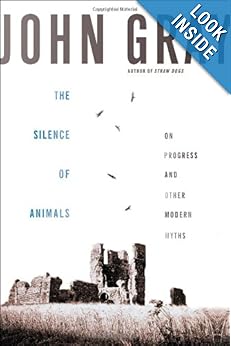
Simon Critchley on John Gray’s Godless Mysticism in "The Silence of Animals"


Philosopher John Gray's new book, The Silence of Animals: On Progress and Other Modern Myths (Jiune, 2013) [the third book in a sequence beginning with False Dawn: The Delusions of Global Capitalism (2000) and then Straw Dogs: Thoughts on Humans and Other Animals (2007)], is reviewed within the context of the whole sequence in this article from The Los Angeles Review of Books.

Key quotes:
The radical core of Gray’s work, unfashionable as it might seem, is a strident defense of the ideal of contemplation against action, whether the bios theoretikos of Aristotle or the ataraxia of the Epicureans. As Gray says in the final words of Straw Dogs, “Can we not think of the aim of life as being simply to see?”
Gray’s godless mysticism would retain the forms of askesis common to religious forms of mystical practice (fasting, concentration and prayer) that attempt to nullify the self. But this would be done not in order to attain a higher experience of “Self” [sic] or some union with god, but rather to occasion a turn towards the nonhuman world in its mere being. A godless mysticism would not redeem us, but would redeem us from the need for redemption, the very need for meaning. A redemption from redemption, then. Meaninglessness would here be the achievement of the ordinary, the life of the senses. This line of thought gets very close to what the philosopher Eugene Thacker has called a mysticism of the inhuman, a climatological mysticism expressed in the dust of the planet.
 This is an in-depth and interesting review, as well as critical in a productive way - makes me want to go back and read the three books in order, especially since I have only read a handful of essays.

Simon Critchley on The Silence of Animals

John Gray’s Godless Mysticism: On "The Silence of Animals"

Simon Critchley

June 2nd, 2013

The Silence of Animals : On Progress and Other Modern Myths

Triptych image: Mariechen Danz, "Ye (3)," 2006
Photo: Andrea Huyoff. Courtesy of the artist and Galerie Tanja Wagner, Berlin

HUMAN BEINGS DO NOT just make killer apps. We are killer apes. We are nasty, aggressive, violent, rapacious hominids, what John Gray calls in his widely read 2002 book, Straw Dogs, homo rapiens. But wait, it gets worse. We are a killer species with a metaphysical longing, ceaselessly trying to find some meaning to life, which invariably drives us into the arms of religion. Today’s metaphysics is called “liberal humanism,” with a quasi-religious faith in progress, the power of reason and the perfectibility of humankind. The quintessential contemporary liberal humanists are those Obamaists, with their grotesque endless conversations about engagement in the world and their conviction that history has two sides, right and wrong, and they are naturally on the right side of it.

Gray’s most acute loathing is for the idea of progress, which has been his target in a number of books, and which is continued in the rather uneventful first 80 pages or so of The Silence of Animals. He allows that progress in the realm of science is a fact. (And also a good: as Thomas De Quincey remarked, a quarter of human misery results from toothache, so the discovery of anesthetic dentistry is a fine thing.) But faith in progress, Gray argues, is a superstition we should do without. He cites, among others, Conrad on colonialism in the Congo and Koestler on Soviet Communism (the Cold War continues to cast a long shadow over Gray’s writing) as evidence of the sheer perniciousness of a belief in progress. He contends, contra Descartes, that human irrationality is the thing most evenly shared in the world. To deny reality in order to sustain faith in a delusion is properly human. For Gray, the liberal humanist’s assurance in the reality of progress is a barely secularized version of the Christian belief in Providence.

With the Nazi jurist Carl Schmitt in mind, Gray writes in Black Mass (2007): “Modern politics is a chapter in the history of religion.” Politics has become a hideous surrogate for religious salvation, and secularism is itself a religious myth. In The Silence of Animals, he writes, “Unbelief today should begin by questioning not religion but secular faith.” What most disturbs Gray are utopian political projects based on some faith that concerted human action in the world can allow for the realization of seemingly impossible political ends and bring about the perfection of humanity. As he makes explicit in Black Mass, he derives his critique of utopianism from Norman Cohn’s 1957 book, The Pursuit of the Millennium. What Cohn implied but Gray loudly declares is that Western civilization can be defined in terms of the central role of millenarian thinking. Salvation is collective, terrestrial, imminent, total, and miraculous. What takes root with early Christian belief, and massively accelerates in medieval Europe, finds its modern continuation in a sequence of bloody utopian political projects, from Jacobinism to Bolshevism, Stalinism, Nazism, and different varieties of Marxist-Leninist, anarchist, or Situationist ideologies. They all promised to build heaven on earth and left us with hell instead.

In Black Mass, Gray persuasively attempted to show how the energy of such utopian political projects has drifted from the left to the right. Bush, Blair, and the rest framed the war on terror as an apocalyptic struggle that would forge the new American century of untrammeled personal freedom and free markets. During the first years of the new millennium, a religious fervor energized the project of what we might call “military neoliberalism”: violence was the means for realizing liberal democratic heaven on earth. The picture of a world at war where purportedly democratic regimes, like the USA, deploy terror in their alleged attempts to confront it is still very much with us, even if full-scale, classical military invasions have given way to the calculated cowardice of drone strikes and targeted assassinations.

Carl Schmitt’s critique of parliamentary democracy led him towards an argument for dictatorship. Where does Gray’s loathing of liberalism leave him? He identifies the poison in liberal humanism, but what’s the antidote? It is what Gray calls “political realism”: we have to accept, as many ancient societies did and many non-Western societies still do, that the world is in a state of ceaseless conflict. Periods of war are followed by periods of peace, only to be followed by war again. What goes around comes around. And around. History makes more sense as a cycle than as a line of development or even decline.

In the face of such ceaseless conflict, Gray counsels that we have to abandon the belief in utopia and accept the tragic contingencies of life: there are moral and political dilemmas for which there are simply no solutions. We have to learn to abandon pernicious daydreams such as a new cosmopolitan world order governed by universal human rights, or that history has a teleological, providential purpose that underwrites human action. We even have to renounce the Obamaesque (in essence, crypto-Comtian or crypto-Saint-Simonian) delusion that one’s life is a narrative that is an episode in some universal story of progress. It is not.

Against the grotesque distortion of conservatism into the millenarian military neoliberalism, Gray wants to defend the core belief of traditional Burkean Toryism. The latter begins in a realistic acceptance of human imperfection and frailty. As such, the best that flawed and potentially wicked human creatures can hope for is a commitment to civilized constraints that will prevent the very worst from happening: a politics of the least worst. Sadly, no one in political life seems prepared to present this argument, least of all those contemporary conservatives who have become more utopian than their cynical pragmatist left-liberal counterparts, such as the British Labor Party.

* * *

The most extreme expression of human arrogance, for Gray, is the idea that human beings can save the planet from environmental devastation. Because they are killer apes who will always deploy violence, force, and terror in the name of some longed-for metaphysical project, human beings cannot be trusted to save their environment. Furthermore — and this is an extraordinarily delicious twist — the earth doesn’t need saving. Here Gray borrows from James Lovelock’s Gaia hypothesis. The ever-warming earth is suffering from disseminated primatemaia, a plague of people. Homo rapiens is savagely ravaging the planet like a filthy pest that has infested a once beautiful, well-appointed, and spacious house. In 1600, the human population was about half a billion. In the 1990s it increased by the same amount. And the acceleration continues. What Gray takes from the Gaia hypothesis is that this plague cannot be solved by the very people who are its cause. It can only be solved by a large-scale decline in human numbers back down to manageable levels. Let’s go back to 1600!

Such is the exhilaratingly anti-humanist, dystopian, indeed Ballardesque, vision of a drowned world at the heart of Gray’s work: when the earth is done with humans, it will recover and the blip of human civilization will be forgotten forever. Global warming is simply one of the periodic fevers that the earth has suffered during its long, nonhuman history. It will recover and carry on. But we cannot and will not.

* * *

Where does this leave us? Although Gray is critical of Heidegger’s residual humanism (animals are poor in world and rocks and stone are worldless, Martin insists), he is very close to a line of thought in a collection of Heidegger’s fragments published as Overcoming Metaphysics. Written between 1936 and 1946, these are Heidegger’s bleakest and most revealing ruminations, in my view. At their center stands an all-too-oblique critical engagement with National Socialism filtered through the lens of his willful reading of Nietzsche. Heidegger concludes his meditations with the words, “No mere action will change the world.” 
The statement finds its rejoinder in the title of Heidegger’s posthumously published 1966 interview with Der Spiegel: “Only a god can save us.” For Heidegger and Gray, there is no god, unfortunately, and we cannot save ourselves. It’s the belief that we can save ourselves that got us into our current mess. If political voluntarism is the motor of modernity’s distress, then the task becomes how we might think without the will.

This takes us to the compelling critique of the concept of action in Gray’s work. Whether Arendtian fantasies of idealized praxis, liberal ideas of public engagement and intervention, or leftist delusions about the propaganda of the deed, action provides consolation for killer apes like us by momentarily staving off the threat of meaninglessness. The radical core of Gray’s work, unfashionable as it might seem, is a strident defense of the ideal of contemplation against action, whether the bios theoretikos of Aristotle or the ataraxia of the Epicureans. As Gray says in the final words of Straw Dogs, “Can we not think of the aim of life as being simply to see?” 
But Gray’s ideological masterstroke is the fusion of his quasi-Burkean critique of liberalism, underpinned as it is by a deep pessimism about human nature, with a certain strand of Taoism. More particularly, what engages Gray is the ultra-skeptical illusionism of Chuang-Tzu, magnificently expressed in the subtle paradoxes of The Inner Chapters. Chuang-Tzu writes, “How do I know that to take pleasure in life is not a delusion?” The answer is that I do not know and furthermore it doesn’t matter. Pushing much further than the furtive Descartes in his Dutch oven, Chuang-Tzu writes, “While we dream we do not know that we are dreaming, and in the middle of a dream interpret a dream within it.” He concludes, “You and Confucius are both dreams, and I who call you a dream am also a dream.” There is no way out of the dream and what has to be given up is the desperate metaphysical longing to find some anchor in a purported reality. 
Homo rapiens must learn to give up the destructive and pointless search for meaning and learn to see that the aim of life is the release from meaning. What interests Gray in the mind-bending paradoxes of Chuang-Tzu is the acceptance of the fact that life is a dream without the possibility, or even the desire, to awaken from the dream. If we cannot be free of illusions, if illusions are part and parcel of our natural constitution, then why not simply accept them? In the final pages of Black Mass Gray writes: “Taoists taught that freedom lies in freeing oneself from personal narratives by identifying with cosmic processes of death and renewal.” Rather than seek the company of utopian thinkers, we should find consolation in the words of “mystics, poets and pleasure-lovers. 
Such is the consoling company Gray keeps in The Silence of Animals. There is much here that is familiar to readers of Gray, such as the critique of progress and the constant tilting at liberal humanism. There is also much that is welcome, such as the robust defense of Freud as a moralist based on Philip Rieff’s classic interpretation, which is wielded against Jungian obscurantism, the triumph of the therapeutic, and the desire to fill the Freudian void with grisly specters like the collective unconscious. But what’s new in The Silence of Animals is Gray’s argument for what he calls “godless mysticism” based largely on a reading of Wallace Stevens (it’s true that Stevens makes a couple of cameo appearances in Gray’s The Immortalization Commission from 2011). Stevens is the still point around which the world turns in The Silence of Animals. 
Each of the three parts of The Silence of Animals is framed and guided by quotations from Stevens; what seems to draw Gray’s attention is the sheer austerity of his late verse, for example the 25 poems included under the title “The Rock” in the Collected Poems in 1954, the year before Stevens’s death. Stevens’s poetry self-consciously moves between the poles of reality and the imagination. In his most Wordsworthian mood, as in “The Idea of Order at Key West,” the two poles would appear to fuse or be held in a creative balance: imagination grasps and transfigures reality. But in the very late poems, a hard, cold, contracted reality takes center stage. The power of imagination appears to be impoverished. The season of these late poems — always important for Stevens — changes from the florid and Floridian landscapes of the earlier verse to the harsh, unending cold of the Connecticut winter. 
In the final poem in The Palm at the End of the Mind, “Of Mere Being,” Stevens speaks of that which is “Beyond the last thought,” namely a bird that sings “Without human meaning, / Without human feeling, a foreign song.” Stevens seems to be saying that things merely are: the tree, the bird, its song, its feathers, the wind moving in the branches. One can say no more. For Gray, “The mere being of which Stevens speaks is the pure emptiness to which our fictions may sometimes point.” That is to say, in accepting that the world is without meaning, a path is indicated that takes us beyond the meaning we have made. 
Paradoxically, for Gray, the highest value in existence is to know that there is nothing of substance in the world. Nothing is more real than nothing. It is the nothingness beyond us, the emptiness behind words, that Gray wants us to contemplate. His is a radical nominalism behind which stands the void. In this, as he is well aware, Gray is close to Beckett. We are condemned to words, but language is a prison house from which we constantly seek to escape. Rather than any comforting dogma of the linguistic turn, Gray is trying to imagine a turn away from the linguistic. Human language should be pointed towards a nonhuman silence. 
In his very last poems, Stevens comes about as close as one can get to giving up poetry in poetry. It is poetry of the antipodes of the poetry; the hard, alien reality that we stare at, unknowing. All we have are ideas about the thing, but not the thing itself. Desire contracts, the mind empties, the floors of memory are wiped clean and nothingness flows over us without meaning. In a very late lyric that Gray does not cite but which he might, “A Clear Day and No Memories,” Stevens writes:
Today the air is clear of everything.
It has no knowledge except of nothingness
And it flows over us without meanings,
As if none of us had ever been here before
And are not now: in this shallow spectacle,
This invisible activity, this sense.
It is “this sense” that Gray wants to cultivate in us, this turning of the self away from itself and its endless meaning-making and toward things in their variousness and particularity. The point is to undergo a kind of movement from the limitations of the human towards a greater inhuman realm of experience that can be had in the observation of plants, birds, landscapes, and even cityscapes. Stevens continues, with another “as if” (and whole books have been written on his use of hypothetical conjunctions):
As if nothingness contained a métier,
A vital assumption, an impermanence
In its permanent cold, an illusion so desired.
Poems are words chosen out of desire, but words that don’t create anything permanent. In creating illusion, they assume impermanence. This is what Stevens sees as the métier of nothingness: its work, its craft, its supreme fictiveness. It is abstract. It must change. It must give pleasure. 
Gray’s godless mysticism would retain the forms of askesis common to religious forms of mystical practice (fasting, concentration and prayer) that attempt to nullify the self. But this would be done not in order to attain a higher experience of “Self” [sic] or some union with god, but rather to occasion a turn towards the nonhuman world in its mere being. A godless mysticism would not redeem us, but would redeem us from the need for redemption, the very need for meaning. A redemption from redemption, then. Meaninglessness would here be the achievement of the ordinary, the life of the senses. This line of thought gets very close to what the philosopher Eugene Thacker has called a mysticism of the inhuman, a climatological mysticism expressed in the dust of the planet. 
* * *

There’s an unexpected local hero in The Silence of Animals: J.A. Baker (1926–1987), author of The Peregrine, a book that, to my shame, I didn’t know prior to reading Gray. It is the record of 10 years spent watching peregrine falcons in a narrow stretch of Essex countryside between Chelmsford and the coast. I happen to know that landscape quite well, or once knew it. It’s a minimal, flat landscape of neat fields, mudbanks, estuarial systems, and vast skies with huge clouds shuttling from west to east. In intense lyrical descriptions, Baker sought to escape the human perspective and look at the world through the eyes of this predatory bird, “Looking down, the hawk saw the big orchard beneath him shrink into dark, twiggy lines and green strips […] saw the estuary lifting up its blue and silver mouth, tongued with green islands.”

Baker was not crazy. He knew that there is no way out of the human world, and no way he could become a peregrine falcon. What interests Gray is the discipline (for Baker, an askesis of time, place and repetition: many days, months, and years spent returning to the same small strip of countryside) involved in peeling enough of oneself away in order to try to look outwards and upwards. Contemplation here is not some Hamlet-like, inward-facing attempt at stilling the self’s commotion. It’s the outward-facing decreation of the self through a cultivation of the senses. What’s being attempted is a non-anthropomorphic relation to animals and nature as a whole, where the falcon cannot hear the falconer. Gray’s godless mysticism asks us to look outside ourselves and simply see. This is a lot more difficult than it sounds.

* * *

Schopenhauer, usually read in abridged, aphoristic form, was the most popular philosopher of the 19th century. Epigrammatic pessimism of his sort gives readers reasons for their misery and words to buttress their sense of hopelessness and impotence. Few things offer more refined intellectual pleasure than backing oneself into an impregnably defended conceptual cul-de-sac and sitting there, knowing and immovable. It’s the thrill of reading Adorno or, in a certain light, Agamben. Such is what Nietzsche called “European Buddhism.”

Sometimes I think John Gray is the great Schopenhauerian European Buddhist of our age. What he offers is a gloriously pessimistic cultural analysis, which rightly reduces to rubble the false idols of the cave of liberal humanism. Counter to the upbeat progressivist evangelical atheism of the last decade, Gray provides a powerful argument in favor of human wickedness that’s still consistent with Darwinian naturalism. It leads to passive nihilism: an extremely tempting worldview, even if I think the temptation must ultimately be refused. 
The passive nihilist looks at the world with a highly cultivated detachment and finds it meaningless. Rather than trying to act in the world, which is pointless, the passive nihilist withdraws to a safe contemplative distance and cultivates his acute aesthetic sensibility by pursuing the pleasures of poetry, peregrine-watching, or perhaps botany, as was the case with the aged Rousseau (“Botany is the ideal study for the idle, unoccupied solitary,” Jean-Jacques said). Lest it be forgotten, John Stuart Mill also ended up a botanist. 
In a world that is rushing to destroy itself through capitalist exploitation or military crusades — two arms of the same Homo rapiens — the passive nihilist resigns himself to a small island where the mystery of existence can be seen for what it is without distilling it into a meaning. The passive nihilist learns to see, to strip away the deadening horror of habitual, human life and inhale the void that lies behind our words. 
What will define the coming decades? I would wager the following: the political violence of faith, the certainty of environmental devastation, the decline of existing public institutions, ever-growing inequality, and yet more Simon Cowell TV shows. In the face of this horror, Gray offers a cool but safe temporary refuge. 
Truth to tell, the world of Gray’s passive nihilist can be a lonely place, seemingly stripped of intense, passionate, and ecstatic human relations. It is an almost autistic universe, like J.A. Baker’s. It is also a world where mostly male authors and poets seem to be read, although Elizabeth Bishop comes to mind. As Stevens writes in his Adagia, “Life is an affair of people not of places. But for me life is an affair of places and that is the trouble.” Gray, like Stevens, seems preoccupied with place but, unlike Stevens, appears untroubled. What Gray says is undeniable: we are cracked vessels glued to ourselves in endless, narcissistic twittering. We are like moths wheeling around the one true flame: vanity. Who doesn’t long to escape into an animal silence? 
Of course, love is the name of the counter-movement to that longing. Love — erotic, limb-loosening and bittersweet — is another way of pointing outwards and upwards, but this time towards people and not places. But that, as they say, is another story.

Author’s Note: This essay builds from certain formulations that the reader can find in The Faith of the Faithless (Verso, London and New York, 2012). See Chapter 2, pp.109-117.

Simon Critchley's last book was The Mattering of Matter. Documents from the Archive of the International Necronautical Society (with Tom McCarthy, Sternberg, Berlin, 2012) and his next book is Stay, Illusion! The Hamlet Doctrine (Pantheon, New York, 2013).
Monday, December 31, 2012

James Finley Interviews - The Contemplative Way in Christianity


James Finley, PhD, spent six years in the cloistered Trappist monastery of the Abbey of Gethsemani. Finley leads retreats and workshops throughout the United States and Canada, attracting people from all religious traditions who seek a contemplative path in their Christian practice. He is also a clinical psychologist in private practice with his wife in Santa Monica, California.

James Finley is the author of Merton's Palace of Nowhere, The Contemplative Heart, and Christian Meditation: Experiencing the Presence of God.

Jami (my girlfriend) was listening to an audio program of his from Sounds True and I really liked his integration of Christian mysticism and contemporary psychology as a form of nondual practice. His work is not dissimilar to that of Father Thomas Keating (Centering Prayer) and Father Richard Rohr (his seven themes).

Here are two interviews he has posted as his site - each is a good introduction to his thinking.
The following interview was conducted by Sounds True and will give the reader a sense of Dr. Finley's understanding of Thomas Merton and the Contemplative Way. 
Thomas Merton and His Path to the Palace of NowhereSounds True
* * * * *
The following interview was conducted by Gary Moon for Pathways Magazine and will give the reader a sense of Dr. Finley's understanding of Christian Meditation. 
Christian Meditation: Experiencing the Presence of God Pathways Magazine: April-June Issue 2000, Vol. 9, Number 2.

Wednesday, December 19, 2012

Dr. Jennifer Howard Speaks with Andrew Harvey - Today at 4 pm EST

Dr. Jennifer Howard is host of  "A Conscious Life," a weekly podcast that is part of the Co-Creator Radio Network. On this week's show, at 4 pm EST/1 pm PST, she is speaking with spiritual teacher and author, Andrew Harvey. I have read some of his work, particularly the translations of Rumi, but I am not very familiar with his work as a whole - seems a little woo to me, but then I am a skeptic.

Date: December 19
Andrew Harvey


Andrew Harvey is an internationally acclaimed poet, novelist, translator, mystical scholar, and spiritual teacher. Harvey has published over 20 books including The Hope a Guide to Sacred Activism (Hay House) and Heart Yoga the Sacred Marriage of Yoga and Mysticism (North Atlantic Books). Harvey is a Fellow of All Souls College Oxford from (1972-1986) and has taught at Oxford University, Cornell University, The California Institute of Integral Studies, and the University of Creation Spirituality, as well as various spiritual centers throughout the United States. He was the subject of the 1993 BBC film documentary The Making of a Modern Mystic. He is the Founder of the Institute for Sacred Activism in Oak Park, Illinois, where he lives. His website is www.andrewharvey.net.
You can listen to the show at the A Conscious Life page from the Co-Creator Radio Network.


Here is a little ad copy about Dr. Howard's A Conscious Life podcast.
In “A Conscious Life,” internationally known psychotherapist, life and business coach, energy healer, and speaker, Dr Jennifer Howard, Ph.D., and her guests, will explore what it means to be awake and conscious in your daily life, in your relationships, in your spirituality, in relationship to your health and wellness, and in your work and financial life. Dr. Howard’s guests will encompass interdisciplinary perspectives and multi-faith, and a wide range of modalities, from psychology and spirituality to medicine and wellness to quantum physics science and social activism – plus much more.

“A Conscious Life” is an invitation to take charge of your life, to identify and change what is getting in the way of you reaching your full potential. Even if you’re pretty happy with your life, the reward of living consciously is a continually deepening sense of wholeness, and satisfaction with life. The goal, here, isn’t perfection, but progress—greater awareness, steady growth, and lasting change.

Sunday, August 12, 2012

Ellis Sandoz - What is a Mystic Philosopher and Why does it Matter? Preliminary Reflections


This paper was delivered by Ellis Sandoz at the Eric Voegelin Society, 27th Annual International Meeting in Seattle, Washington (September 2, 2011). Sandoz is the Hermann Moyse Jr. Distinguished Professor of Political Science and is Director of the Eric Voegelin Institute for American Renaissance Studies at Louisiana State University.

Sandoz offers this definition of the mystic philosopher of his title:
A mystic philosopher is one who takes the tension toward the transcendent divine ground of being as the cardinal attribute of human reality per se and explores the whole hierarchy of being from this decisive perspective. 


Here is a little about Eric Voegelin, since his theory and philosophy play a central role in this paper (from Wikipedia):
Voegelin worked throughout his life to account for the endemic political violence of the twentieth century in an effort variously referred to as a philosophy of politics, history, or consciousness.

Voegelin published scores of books, essays, and reviews in his lifetime. An early work was Die politischen Religionen (1938), (The Political Religions), on totalitarian ideologies and their structural similarities to religion. His magnum opus is the multi-volume (English-language) Order and History, which began publication in 1956 and remained incomplete at the time of his death 29 years later. His 1951 Charles Walgreen lectures, published as The New Science of Politics, is generally seen as a prolegomenon to this, and remains his best known work. He left many manuscripts unpublished, including a history of political ideas that has since been published in eight volumes.

Order and History was originally conceived as a six-volume examination of the history of order occasioned by Voegelin's personal experience of the disorder of his time. The first three volumes, Israel and Revelation, The World of the Polis, and Plato and Aristotle, appeared in rapid succession in 1956 and 1957 and focused on the evocations of order in the ancient Near East and Greece.

Voegelin then encountered difficulties that slowed the publication down. This, combined with his university administrative duties and work related to the new institute, meant that seventeen years separated the fourth from the third volume. His new concerns were indicated in the 1966 German collection Anamnesis: Zur Theorie der Geschichte und Politik, and the fourth volume, The Ecumenic Age, appeared in 1974. It broke with the chronological pattern of the previous volumes by investigating symbolizations of order ranging in time from the Sumerian King List to Hegel. Continuing work on the final volume, In Search of Order, occupied Voegelin's final days and it was published posthumously in 1987.

One of Voegelin's main points in his later work is that a sense of order is conveyed by the experience of transcendence. This transcendence can never be fully defined nor described, though it may be conveyed in symbols. A particular sense of transcendent order serves as a basis for a particular political order. It is in this way that a philosophy of politics becomes a philosophy of consciousness. Insights may become fossilised as dogma. The main aim of the political philosopher is to remain open to the truth of order, and convey this to others.

Voegelin is more interested in the ontological issues that arise from these experiences than the epistemological questions of how we know that a vision of order is true or not. For Voegelin, the essence of truth is trust. All philosophy begins with experience of the divine. Since God is experienced as good, one can be confident that reality is knowable. As Descartes would say, God is not a deceiver.

Voegelin's work does not fit in any standard classifications, although some of his readers have found similarities in it to contemporaneous works by, for example, Ernst Cassirer, Ludwig Wittgenstein, Martin Heidegger, and Hans-Georg Gadamer. He has a sometimes unapproachable style and a heavy reliance upon extensive background knowledge. Voegelin often invents terms or uses old ones in new ways. However, there are patterns in his work with which the reader can quickly become familiar.

Among indications of growing engagement with Voegelin's work are the 305 page international bibliography published in 2000 by Munich's Wilhelm Fink Verlag; the presence of dedicated research centers at universities in the United States, Germany, Italy, and the United Kingdom; the appearance of recent translations in languages ranging from Portuguese to Japanese; and the publishing of the nearly complete 34 volume collection of his primary works by the University of Missouri Press and various primary and secondary works offered by the Eric-Voegelin-Archiv of Ludwig-Maximilians-Universität.

Having read a couple of Voegelin's books (Order and History, Vol. 3: Plato and Aristotle and From Enlightenment to Revolution), I would suggest that he is one of the under-appreciated (if at all even acknowledged) philosophers in the canon of integral theory.

This is an interesting paper by the man who has edited the Collected Works of Voegelin.

Full Citation:
Sandoz, E. (2011). What is a Mystic Philosopher and Why does it Matter? Preliminary Reflections. APSA 2011 Annual Meeting Paper. Available at SSRN: http://ssrn.com/abstract=1903028


Abstract:
The question posed by my title (What is a Mystic Philosopher and Why Does it Matter?) can be answered briefly: A mystic philosopher is one who takes the tension toward the transcendent divine ground of being as the cardinal attribute of human reality per se and explores the whole hierarchy of being from this decisive perspective.

Introduction
The question posed by my title (What is a Mystic Philosopher and Why Does it Matter?) can be answered briefly: A mystic philosopher is one who takes the tension toward the transcendent divine ground of being as the cardinal attribute of human reality per se and explores the whole hierarchy of being from this decisive perspective. Thus, all philosophy worthy of the name is mystic philosophy. It has been so from the pre-Socratics to Plato to Voegelin himself, by his account, as the sine qua non of philosophizing, past, present, and future. It matters because more than a mere definition is at take. It matters because the experiential core of noetic and pneumatic reality insofar as glimpsed in consciousness and regarded as basic to human existence is available only through individual persons‟ divine-human mystical encounters– which happen as events in a variety of modalities evidenced from prehistory to the contemporary.

If it be suspected that this implies that the history of philosophy may be in largest part the history of its derailment the point is conceded, as Voegelin himself tells us (1). To inventory and critique the assorted ways in which the philosophic impulse has been diverted or has otherwise gone astray is a task for another day–a task, however, already substantially addressed in Voegelin's own life-long quest for truth in resistance to untruth under such familiar rubrics as sophistry, gnosticism, scholasticism, Enlightenment, phenomenalism, ideology, and positivism among myriad other deformations. Enough here if I can bring a bit more clearly to light the meaning and implications of mystic philosophy and its importance for a non-reductionist exploration of metaxic reality, one grounded in common sense and participatory (or apperceptive) empiricism– i.e., one which invokes in principle the Socratic “Look and see if this is not the case.”

This then gets us to more familiar ground: Mystic philosophy is what Plato‟s Socrates was about, as the messenger of the God. Sundry Spinozaists and latter day Averroists among us will be unpersuaded, since for them and their epigones theology (a neologism and term of art in Plato, Republic 379a) and philosophy are taken to be radically different enterprises. Dogmatic delusion everywhere dies a hard death, and you can‟t win them all. However, to argue that the history of philosophy is largely the history of its derailment admittedly puts Voegelin somewhat in the company of Johannes Brahms when he departed a social gathering, insouciantly turning at the door to say: “If there‟s anyone here I haven't offended I apologize.”

What is at stake here, however, is more than social amenities. When Voegelin told an old friend from Vienna days not to be too surprised to learn that he was a mystic as well as a philosopher (2), he did so after a high stakes battle to recover something of the truth of reality–one he had pursued for decades so as to find his way out of the lethal quandaries of radical modernity and convincingly critique National Socialism. The effort produced three books while he was a professor in Vienna, cost him his job, and very nearly his life. Still, as the battle in various less grim forums continued thereafter, humor intruded from time to time. So with a genial intramural debate while at LSU in the 1940s with the head of the philosophy department (a great admirer of Bertrand Russell) that at one point found Voegelin retorting: Mr. Carmichael you are a philosophy professor. I am a philosopher.

Perhaps the fullest direct clarification of the pertinent issues Voegelin gave in a 1965 talk to the German Political Science Association plenary session, subsequently published as “What is Political Reality?” (3) The drift of that presentation is to explain why political science cannot rightly be assimilated to the natural science model most famously exemplified by Newton's Principia Mathematica but has its own unique paradigm as a philosophical science which Voegelin sketches on the occasion. In effect a minority report to political scholars (rather like our own colleagues here in Seattle still today) eager to be as “scientific” as possible, the tenor is combative as well as diagnostic and therapeutic.

Read the whole article by downloading the PDF.


Notes from the text above:

1 Cf. Eric Voegelin, Order and History, 5 vols. (Baton Rouge: Louisiana State University Press, 1956-1987), 3:277.

2 Saint “Thomas [Aquinas] is a mystic, for he knows that behind the God of dogmatic theology there is the tetragrammatic abyss that lies even behind the analogia entis. But in that sense also Plato is mystic, for he knows that behind the gods of the Myth, and even behind the Demiurge of his philosophy, there is the real God about whom one can say nothing. It may horrify you: But when somebody says that I am a mystic, I am afraid I cannot deny it. My enterprise of what you call „de-reification‟ would not be possible, unless I were a mystic.” Letter 422. To Gregor Sebba (Feb. 3, 1973) in The Collected Works of Eric Voegelin, 34 vols. (hereinafter CW), vol. 30, Selected Correspondence 1950-1984, trans. Sandy Adler, Thomas A. Hollweck, & William Petropulos, ed. and intro. Thomas A. Hollweck (2007; Columbia: University of Missouri Press), 751.

3 Eric Voegelin, Anamnesis, trans. and ed. Gerhart Niemeyer (pb. edn, Columbia: University of Missouri Press, 1978), 143-214; originally Voegelin, Anamnesis: Zur Theorie der Geschichte und Politik (Munich: R. Piper & Co. Verlag, 1966); also revised and reprinted in Collected Works of Eric Voegelin, vol. 6, trans. M. J. Hanak, ed. with an intro. by David Walsh (2002; 34 vols., University of Missouri Press).

Tuesday, May 15, 2012

Mysteries of the Jesus Prayer - The Contemplative Tradition in Orthodox Christianity


This is an excellent documentary on the desert monks who seek internal silence and probably are the closest living link we have to the original Christian Orthodox desert mystics and their descendents in Eastern Europe. The home page for the film is here. Here is the intro from their site:
A Pilgrimage to the Heart of an Ancient Spirituality. 

"Mysteries of the Jesus Prayer" a new documentary feature film from SnagFilms (Comcast & Fios On-Demand) and HarperOne book, focuses on the mysteries behind the prayer that is thought to have first been practiced by the Apostles some 2,000 years ago. The prayer is still chanted by monks and nuns in far away caves and monasteries but is mostly unknown to the rest of the western world. Many say that with this prayer, it is possible to communicate directly with God.

Very Rev. Dr. John A. McGuckin and Dr. Norris J. Chumley bring you to ancient lands of peace and solitude, filming for the first time hermits, monks and nuns in caves, monasteries and convents who share this ancient mystical prayer. The documentary retraces their steps and beyond, bringing the wisdom of both ancient saints and living Christian spiritual masters to worldwide audiences.


Mysteries of the Jesus Prayer Synopsis
For the first time on film desert hermits, monks and nuns share their practices and invite us into their private cells, caves and sanctuaries in the Middle East, Mediterranean, Eastern Europe and Russia.

Film Credits

Director

  1. Norris J. Chumley

Producers

  1. David Aslan
  2. John A. McGuckin

Writers

  1. Norris J. Chumley
  2. John A. McGuckin

Executive Producer

  1. Norris J. Chumley

Editor

  1. David Aslan

Wednesday, March 21, 2012

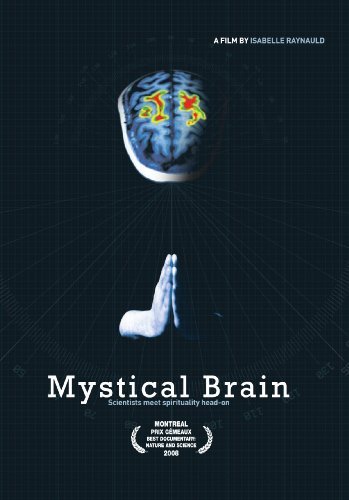
Documentary - Mystical Brain (2006)


This documentary has been around for a while, but it's a god documentary. When the research here was first published, it received a lot of attention. Subsequent research has supported the studies detailed in the film.

This film is part of a new field often referred to as neurotheology.

Mystical Brain


Thursday, February 16, 2012

Mark Vernon - Physics as Metaphysics

Big Questions Online posted this article by Mark Vernon, journalist, writer, and former Anglican priest. His books include The Meaning of Friendship, Plato's Podcasts: The Ancients' Guide to Modern Living, and After Atheism: Science, Religion, and the Meaning of Life. He blogs at www.markvernon.com.

In this piece he looks at the quantum physics and the human quest for meaning. He concludes, "They are distinct enterprises. We gain from both. But throwing them together in a spiritual mash-up creates a spiritual mess."

 I agree.
Is there a quantum spirituality? 
physics
Photo: US Dept. of Energy - Researcher Matthew Pelt tries to connect the quantum dots
Thursday, January 6, 2011

The notion that physics might have metaphysical meaning for human beings is as old as physics itself. The ancient Greeks did natural philosophy not only to learn about the cosmos but also to learn about how to live. In the medieval period, Aristotelian cosmology became tightly knitted to Scholastic theology, causing all sorts of problems for Galileo when he sought to challenge it. And then in the early modern period, Newton’s discoveries led again to a reassessment of what it is to be human.

No less a figure than Einstein invoked the notion of what he called “cosmic religion.” It would need to ask questions such as whether the universe is friendly towards us, the father of the new physics mused. And the new physics of the 20th century has certainly sparked a welter of speculation as to whether the meaning of life is written in the stars. Are the laws of nature transcendent, like God? Does the fine-tuning of various fundamental constants suggest that the universe is right for life, for us? Is consciousness as basic a feature of things as quarks and photons?

One of the best-known of the spiritualities that draw on the new physics was penned by physicist Fritjof Capra. In his 1975 popular classic The Tao of Physics, Capra relates a vision he had in the summer of 1969, as he stared out to sea from the beach of Santa Cruz. “I suddenly became aware of my whole environment as being engaged in a gigantic cosmic dance,” he recalls.

His use of the metaphor of dance stemmed from his knowledge of particle physics, which views matter as a flux of possibilities across fields of energy. Capra draws on one of the most familiar features of quantum physics: the wave-particle duality of light. If you look at it one way, light behaves like a wave. If you look at it another way, it is a particle. The suggestion is that we, as observers, are deeply implicated in the nature of things.

Further, as nothing can be both a wave and a particle, it looks as if the fundamental nature of things lies behind what the Templeton Prize-winning physicist Bernard d’Espagnat has called a “veiled reality.” This conclusion seems to offer a way of synthesizing the activities of science and religion. As Capra continues: “Physicists explore levels of matter, mystics levels of mind. What their explorations have in common is that these levels, in both cases, lie beyond ordinary sense perception.”

Such ideas are very influential, and similar moves have been made by other figures seeking new kinds of spirituality, like the Jesuit paleontologist Pierre Teilhard de Chardin and, more recently, the Episcopal priest Matthew Fox. You can get a feel for it from this remark by Teilhard: “The history of the living world can be summarized as the elaboration of ever more perfect eyes within a cosmos in which there is always something more to be seen.”

Thus, today, it’s quite common to hear people reflecting that we’re all somehow connected, just like entangled quantum particles that remain linked even when they’re on opposites sides of the universe. Alternatively, there’s the growing spread of what has been called the Universe Story. It tells of the emergence of energy from the Big Bang, that formed the fundamental particles, that coalesced into the elements, that became the building block of the stars, that formed alongside planets, that are nurseries for life, which itself became consciousness, and then self-aware: in us, the universe can contemplate itself.

But does this quantum spirituality add up? A number of critiques can be pressed upon it.

For one thing, the science is itself in a state of flux. The Big Bang, out of which this extraordinary experiment in emergence supposedly came, is itself now widely questioned by physicists. Some prefer a “mega-verse” that continuously gives rise to new universes in a process called “eternal inflation.” Others are asking whether there’s actually a multiverse: our universe is just the one out of the billions that is right for life, and so the fine-tuning is a delusion. Others again, are developing models of a pulsating universe, which expands over the eons to such an extent that it “forgets” its size, and so begins all over again.

Quantum spiritualities can accommodate such developments in science — though a skeptic might observe that they are so nebulous, they could accommodate just about anything. Then again, Capra himself notes, “Many concepts we hold today will be replaced by a different set of concepts tomorrow.” But he believes the basic link between the scientific and the mystical traditions will be enforced, not diminished.

Another critique is the pick-and-choose nature of this cosmic religiosity. It emerges in a number of ways. For example, the entangled nature of quantum particles is highlighted to celebrate our connectedness. What’s overlooked, though, is the colossally destructive power of quantum particles too — the fissions and fusions that release the energy of nuclear weapons. The quantum world is not just a strange place. It’s a hideously violent place too. Spiritualities are wary of celebrating that.

The pickiness appears in other ways. Some advocates, for example, don’t actually like references to fine-tuning and human consciousness because they perceive it as anthropocentric — what is sometimes referred to as the anthropic principle, that the cosmos was designed for us. The fear is that this is a way of reasserting human dominance in the order of things, by declaring we are at the pinnacle of a hierarchy of being. Ecologically-minded quantum writers seek something different: a spirituality that puts the planet first. They tend to overlook the priority some interpretations of quantum mechanics give to us observers.

The conclusion would seem to be that quantum spiritualities represent an à la carte approach to the science. It’s not the science that’s driving the spirituality. Rather, the science is being mined and filleted for metaphors and analogies that fit a pre-existing sense of things.

In fact, it ever was thus. When Isaac Newton published his theory of gravity, it was not just astronomers that grew excited. Astrologers did too. The theory of gravity said that bodies act upon one another over vast distances. Isn’t this precisely what astrology had long taught — that the alignment of the planets and stars at your birth had a profound and subtle effect upon the body of the newborn? Newton was saying no such thing, of course. But that did not stop quacks running away with his ideas.

So, I don’t think there is such a thing as quantum spirituality. Instead, there’s quantum physics and then there’s the human quest for meaning. They are distinct enterprises. We gain from both. But throwing them together in a spiritual mash-up creates a spiritual mess. Spirituality is not only about the search for rich metaphors. It’s also about the struggle for fine discernment. The bizarre world of quantum physics teaches us that, too: it is extraordinarily hard to interpret the cosmos aright.