Buddhists have been telling us that self is an illusion for around 2,500 years. Over the last 30 years or so, neuroscience has come to agreement with that view, although neuroscience has made this realization with a top-down approach (objective measurements) and the Buddha employed a bottom-up approach (subjective experience).
Thomas Metzinger -
The Ego Tunnel: The Science of the Mind and the Myth of the Self and
Being No One: The Self-Model Theory of Subjectivity - has been one of the most articulate authors in this realm.
Bruce Hood has also done some good work, and his new book -
The Self Illusion: How the Social Brain Creates Identity - has received a featured discussion on Edge and generated an interview with Sam Harris. I am sure there will be more reviews in the coming weeks.
Let's begin with the opening of Sam Harris's article/interview with Hood.
An Interview with Bruce Hood
Bruce Hood is currently the Director of the Bristol Cognitive Development Centre at the University of Bristol. He has been a research fellow at Cambridge University and University College London, a visiting scientist at MIT, and a faculty professor at Harvard. He has been awarded an Alfred Sloan Fellowship in neuroscience, the Young Investigator Award from the International Society of Infancy Researchers, the Robert Fantz Memorial Award and voted a Fellow by the Association for Psychological Science. He is the author of several books, including SuperSense: Why We Believe the Unbelievable. This year he was selected as the 2011 Royal Institution Christmas Lecturer—to give three lectures broadcast by the BBC—the most prestigious appointment for the public engagement of science in the UK. Bruce was kind enough to answer a few questions about his new book, The Self Illusion: How the Social Brain Creates Identity.
* * *
In what sense is the self an illusion?
For me, an illusion is a subjective experience that is not what it seems. Illusions are experiences in the mind, but they are not out there in nature. Rather, they are events generated by the brain. Most of us have an experience of a self. I certainly have one, and I do not doubt that others do as well – an autonomous individual with a coherent identity and sense of free will. But that experience is an illusion – it does not exist independently of the person having the experience, and it is certainly not what it seems. That’s not to say that the illusion is pointless. Experiencing a self illusion may have tangible functional benefits in the way we think and act, but that does not mean that it exists as an entity.
If the self is not what it seems, then what is it?
For most of us, the sense of our self is as an integrated individual inhabiting a body. I think it is helpful to distinguish between the two ways of thinking about the self that William James talked about. There is conscious awareness of the present moment that he called the “I,” but there is also a self that reflects upon who we are in terms of our history, our current activities and our future plans. James called this aspect of the self, “me” which most of us would recognize as our personal identity—who we think we are. However, I think that both the “I” and the “me” are actually ever-changing narratives generated by our brain to provide a coherent framework to organize the output of all the factors that contribute to our thoughts and behaviors.
I think it helps to compare the experience of self to subjective contours – illusions such as the Kanizsa pattern where you see an invisible shape that is really defined entirely by the surrounding context. People understand that it is a trick of the mind but what they may not appreciate is that the brain is actually generating the neural activation as if the illusory shape was really there. In other words, the brain is hallucinating the experience. There are now many studies revealing that illusions generate brain activity as if they existed. They are not real but the brain treats them as if they were.
Go read the whole interview.
A few days ago, Edge posted a "conversation" with Bruce Hood centered on the ideas in his new book.
A Conversation with Bruce Hood [5.17.12]
The self is something that is central to a lot of psychological questions and, in fact, a lot of psychologists have difficulty describing their work without positing the notion of a self. It's such a common daily, profound, indivisible experience for most of us. Some people do manage to achieve states of divided self or anatta, no self, they're really skilled Buddhists. But for the majority of us the self is a very compulsive experience. I happen to think it's an illusion and certainly the neuroscience seems to support that contention. Simply from the logical positions that it's very difficult to, without avoiding some degree of infinite regress, to say a starting point, the trail of thought, just the fractionation of the mind, when we see this happening in neurological conditions. The famous split-brain studies showing that actually we're not integrated entities inside our head, rather we're the output of a multitude of unconscious processes.
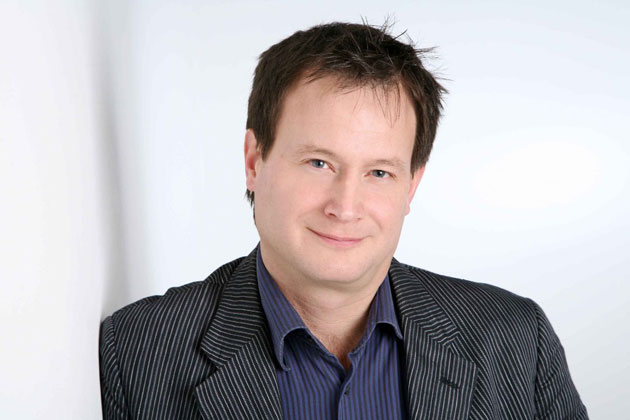
BRUCE HOOD is a British experimental psychologist who holds the Chair in Developmental Psychology in Society at Bristol Cognitive Development Centre. He is well known for his ideas on humans being hard-wired for supernatural beliefs. He is the author of
Supersense: Why We Believe in the Unbelievable, and most recently,
The Self Illusion: How the Brain Creates Identity. In 2011, he presented the Royal Institution Christmas Lectures, "Meet Your Brain" which was broadcast on the BBC.
Bruce Hood's Edge Bio Page
ESSENTIALISM
[BRUCE HOOD:] I've reached a crossroads in my research and in the questions I'm now starting to ask. Part of that was driven by some insight and realization about the direction I was taking, and part of it was also driven by changes in economic circumstances. Notably, the reduction in funding in this country has impacted upon my field quite dramatically (behavioral sciences). The way that that has impacted is that there's far less money to fund research, so the competition to get funding has become very acute. Now we have to justify with a view to application. In the past you could just go off on a flight of fancy studying the things that were of intrinsic interest.
But now we have to steer our grant applications towards potential application, and certainly we have to write a substantial proportion of the proposal to deal with impact, public engagement. And that's across the board. As I said, if this had been five, ten years ago, there would have been some resistance to that, but increasingly now the research councils feel that we, as a public body funded by taxation, need to be called to account in terms of what we're doing with the money, the taxpayers' money.
This has led me to start thinking more about what I do in terms of its tangible application in the real world? That's the external influences that have been shaping the sorts of questions I'm starting to ask now.
There's been a growing awareness that there have been a lot of problems with the way that psychological research has been going on in the past, very much lab-based type of work. There has been a general issue in the experimental method, what you typically do is you hone in on a question, and you try to refine that question by removing all the extraneous variables to try and make it as clean as possible. But then that does raise the question, to what extent? And does what you eventually find actually have real relevance or validity to the external world? Because in many senses, the complexity of the external world might be part of the problem that the brain is trying to solve.
A number of us have been getting increasingly concerned that the theories that have been derived by purely experimental methods may not necessarily translate into the real world as well. There's a combination of this external pressure to come up with research which is seen to have application, but also a growing concern that maybe some of the findings wouldn’t necessarily translate. That's the kind of major forces that have been changing the way that I do things.
I've also got increasingly interested in public communication and education, engagement, transfer of knowledge, and so there's more of that on my plate these days. I did the Christmas lectures in 2011. That was a great opportunity. I've actually changed my job title, I'm Professor of Developmental Psychology in Society. I see myself continuing with my research career, but trying to find opportunities to take that out to the general public.
To give you a tangible example, one of the things that we study in my laboratory is how children navigate or build up spatial maps of the world. They wander around our laboratory and they try to find targets, which are embedded in the floor as LED switches. It's a very useful experimental measure of foraging. How do you keep track of where you've been? How do you optimize your search behavior? That's led to some interesting ideas and we could have stayed just pursuing that, but now we're starting to say, well, can we see whether those findings actually are relevant to the real world? We're taking those paradigms and testing them out in the local science museum. That provides not only an opportunity to see whether it's relevant in the real world, but also an opportunity to engage the public. It's killing two birds with one stone. It's something that the public can actually do and it seems of importance, contribution, and also trying something that is a little bit more real world. I'm not suggesting that this is a good absolute model for foraging in the forest or the savannah, but it is a way of taking the work that has, up to this point in time, been done on laptops and then trying to make it closer to what a real world situation would be.
The environments we have been looking at are at the science museums and these are dotted around the country, where they're open to the general public, and it's usually a motivated audience that come in to try and find out what's going on in science and there's demonstrations. We've seen this as an opportunity to look at some of the findings that we have in environments that are not within the laboratory. So it's not entirely what you would regard as a field study as such because these are very unusual environments. But it is closer to what would be, certainly a lot further away from the laboratory settings that most work on intentional search has been done. There are other researchers who actually do experiments in supermarkets and different environments. This is the field of ergonomics where they're basically trying to find the best way of solving tasks in a work environment, occupational type of way. We're not really attempting to do that. I'm just finding this, we're just looking for more opportunities to engage the public in a kind of activity which has a credible experimental basis.
This is a new venture for us. This is what we're now starting to turn towards. Up to now I've been doing basically lab-based work. This is the new point in the transition I'm going to make which is to increasingly look for opportunities to do things with the general public. As yet, it's early days. It's driven, as I say, partly by motivation to be seen to be relevant, partly for the fact it's actually cheaper to do research in the real world in terms of getting the numbers through. These are all kind of factors.
The lab has changed, as I said, because the financial situation has changed in the past five years and our field has been hit heavily, I feel, in many ways. Behavioral science and psychology used to be funded by at least seven of the research councils. They've all retracted and there's really only one research council now that funds psychological research. There's greater competition. So that means the labs are getting smaller. We're not taking on as many graduate students, and I think that's probably the right thing because the climate at the moment isn't right. I think it's probably wrong to train our people to a high standard for situations where there aren't actually jobs for them. So that's one issue.
We are doing much more consultancy work. We're doing much more applied applications of the principles that we've been using, the methodologies that we use to study young children, we've been using these in sort of commercial situations. For example, we're just beginning work with Aardman, the animation company. They want questions answered about what children, preschool children and young children, like and find most memorable about some of their projects. Those are empirical questions that you can use our methodologies to unravel. That's an example of an application. The work in the museums, as I say, is the specific example of looking at foraging.
How it's changed the lab? The training that I'm now giving to the graduate students and the post docs increasingly involves them doing public engagement activity, and that's actually what everyone's asking for. The grant funding bodies, the universities now, as we've seen a change in the funding situation, we're now in this country charging fees, quite substantial fees, and so we're entering into a very competitive situation because all the universities are trying to compete with each other to get the best students. We now have to market ourselves, so there are more of these academics doing videos and snippets and stuff on the web.
What would I do with a million dollar Chair? Well, my big thing is essentialism. Its origins probably can be traced to the notion of ideal forms, which is a platonic idea. I discovered essentialism basically by reading Susan Gelman's work, and essentialism has an experimental tradition, not that old by the way, in naïve biology. The way that children reason about the world, there's a lot of good evidence to suggest that there are domains of knowledge: physical, reasoning about the physical world; reasoning about the living world, the biological one; and reasoning about the psychological world. Those three domains are the physics, the biology and the psychology, and are deemed to cover the majority of what we do when we're thinking about concepts.
In the biological world, people like Gelman have argued that children infer an invisible dimension. When they're making categorical decisions about why dogs are different from cats, for example, they go over and beyond the outward appearances, and infer that there must be some internal property that makes a dog a dog. Irrespective of changing its outward appearance or if you raise it with a litter of kittens, it will still turn out and grow up into a dog. So they kind of understand there's something over and beyond the physical aspect of it. Well, there is, it's DNA, but no four year old knows explicitly about DNA. But they do have this intuition that there is this essential property. Essentialism in the research field, in developmental psychology, started off in biology. But I was interested in essentialism basically almost contaminating to different domains for objects, the way that we treat objects as irreplaceable. This is the issue of authenticity. The authenticity of objects is starting to get into the boundary of what, of an essential property, makes something irreplaceable.
This is work I've done with Paul Bloom. We initially started looking at sentimental objects, the emergence of this bizarre behavior that you find in children in the West. They form these emotional attachments to blankets and teddy bears and it initially starts off as an associative learning type of situation where they need to self-soothe, because in the West we typically separate children, for sleeping purposes, between one and two years of age. In the Far East they don't, they keep children well into middle childhood, so they don't have as much attachment object behavior. It's common, about three out of four children start off with this sort of attachment to particular objects and then it dissipates and disappears.
What Paul and I are interested in is whether or not it was the physical properties of the object or if there was something about the identity or the authenticity of the object which is important. We embarked on a series of studies where we convinced children we had a duplicating machine, and basically we used conjuring tricks to convince the child that we could duplicate any physical object. We have these boxes which looked very scientific, with wires and lights, and we place an object in one, and activate it, and after a few seconds the other box would appear to start up by itself and you open it up and you see you've got two identical objects. The child spontaneously said, "Oh, it's like a copying machine." It's like a photocopier for objects, if you like. Once they're in the mindset this thing can copy, we then test what you can get away with. They're quite happy to have their objects, their toys copied, but when it comes to a sentimental object like a blanket or a teddy bear, then they're much more resistant to accepting the duplicate. Now, of course, we can't actually copy the things, but they think that when the machine starts up there will be another duplicated object. That's how we test their intuitions and inferences on it.
On the basis of that, we've started to, just completed a set of studies looking at copying real things, living things, like hamsters. Because the question is, would a child think that a machine that duplicates objects could duplicate minds? We're getting into the issue about minds being separate or a product of bodies. The work is still under review, so I can't say too much about it, but you can see the obvious link to the philosophical issues about mind-body dualism.
Also, we're getting into the territory of authenticity and identity. There are some fairly old philosophical issues about what confers identity and uniqueness, and these are the principles, quiddity and haecceity. I hadn't even heard of these issues until I started to research into it, and it turns out these obscure terms come from the philosopher Duns Scotus. Quiddity is the invisible properties, the essence shared by members of a group, so that would be the 'dogginess' of all dogs. But the haecceity is the unique property of the individual, so that would be Fido's haecceity or Fido's essence, which makes Fido distinct to another dog, for example.
These are not real properties. These are psychological constructs, and I think the reason that people generate these constructs is that when they invest some emotional time or effort into an object, or it has some significance towards them, then they imbue it with this property, which makes it irreplaceable, you can't duplicate it. In effect, it becomes sacred, and so I think that sacred objects, which exist across various religions, also have this notion of them being unique. You can't duplicate and you can't corrupt them. They have this property that is indivisible. I think essentialism is pervasive in our attitude towards objects, but it's also there in our attitudes to valuation.
Paul has done more work on this about works of art, what makes a masterpiece unique, and it turns out that our intuitions often guided by this sense that there's an additional property over and beyond the actual sort of physical aspects of works of art. But I think you can also see it operating in other things.
For example, a lot of marketing, when you're selling products, whether through design or just by sheer experience, what I think a lot of advertisers have realized is that certain properties, if you emphasize the essential quality of the object, this confers this notion of quality. For example, Coors beer, from what I understand, was going to relocate their brewery, but then there was this concern that they wouldn't have the original source of the water. If you start to think about a lot of luxury products, there's this notion of craftsmanship, this kind of, something of the maker going into the product. So I also think this is a principle or way of thinking which affects and influences the way we think about genetic modification, for example. Tinkering with the essence or the natural properties of things, people don't like the idea of it. It just seems to violate what are core integrity principles.
I see essentialism everywhere I look now. It just seems to be pervasive. It's one of these ways of seeing the world. People say, oh, it might just be association, but association strikes me as inadequate as an explanation as to why some things seem to have this property. Of course, Paul Rozin'’s work on moral contamination and contagion, again, I think speaks to this idea there are things which you can contaminate with evil, for example, just by wearing a killer's cardigan, things like that. So as I say, I see it everywhere. I'm hoping to continue that kind of work. So that's an example of a philosophical kind of question, or certainly a philosophical domain that I think does lend itself to the empirical studies and, who knows, that might actually turn out to have some application as far as marketers are concerned.
There are actual real colleagues, Susan Gelman and Paul Bloom and George Newman is the psychologist who's now in the Economics School at Yale. We're planning on doing some research looking at advertising and looking at what aspects of it conform to this essentialist principle. I've done some work with my graduate students showing that children have intuitions about ownership of objects. If somebody has put some craftsmanship into it, for example, if you've got some clay and I've got some clay and I take your clay and make something, and if I said, "Who owns it?" an adult would try and probably evaluate that ownership on the basis of how much effort went into it, and also who owned the original material. But young children spontaneously say, well, irrespective of who owned the material, it's actually the person who changed and transformed it. The ownership transfers to the person of the craftsmanship.
That's interesting because that gets to whole questions about intellectual property. Who had the original idea? Is there any such thing as an original idea? To what extent does modification of the idea transfer the ownership of the intellectual property? So, again, there are all these kinds of issues that are, we have intuitions about, and some of them are culturally defined, but I think there's a developmental process. I think that children start off with some basic ideas that then become modified and changed through culture. The detractors of the whole essentialist position are likely to be those from the associative schools who argue that a lot of behaviors can be explained away by simple mechanisms of learning and reinforcement, but that tends to be the older school. Nobody comes to mind about that.
Read the whole post - there is much more.



