Showing posts with label God. Show all posts

Thursday, May 01, 2014

W.R. Klemm - Our Godless Brains: Emerging Science Reveals Mind-Blowing Alternatives to a Higher Power


From Salon, here is an excerpt from W.R. Klemm's new book, Mental Biology: The New Science of How the Brain and Mind Relate (2014).

Here is the text from the publisher to promote the book:
How the mysterious three-pound organ in our heads creates the rich array of human mental experience, including the sense of self and consciousness, is one of the great challenges of 21st-century science. Veteran neuroscientist W. R. Klemm presents the latest research findings on this elusive brain-mind connection in a lucidly presented, accessible, and engaging narrative.

The author focuses on how mind emerges from nerve-impulse patterns in the densely-packed neural circuits that make up most of the brain, suggesting that conscious mind can be viewed as a sort of neural-activity-based avatar. As an entity in its own right, mind on the conscious level can have significant independent action, shaping the brain that sustains it through its plans, goals, interests, and interactions with the world. Thus, in a very literal sense, we become what we think.

Against researchers who argue that conscious mind is merely a passive observer and free will an illusion, the author presents evidence showing that mental creativity, freedom to act, and personal responsibility are very real. He also delves into the role of dream sleep in both animals and humans, and explains the brain-based differences between nonconscious, unconscious, and conscious minds.

Written in a jargon-free style understandable to the lay reader, this is a fascinating synthesis of recent neuroscience and intriguing hypotheses.
From SciBooks - What's New in Science Books (timely reviews of new science books):
“Against researchers who argue that conscious mind is merely a passive observer and free will an illusion, the author presents evidence showing that mental creativity, freedom to act, and personal responsibility are very real.”
 Give it a read and see what you think - I am a bit underwhelmed by this excerpt.

Our godless brains: Emerging science reveals mind-blowing alternatives to a higher power

Science has yet to uncover many mysteries of the mind. But there are more reasons than ever why God isn't necessary


Saturday, Apr 26, 2014

Our godless brains: Emerging science reveals mind-blowing alternatives to a higher power  
(Credit: akindo via iStock)
Physics is the mother science. As such, it holds the greatest power for discovering the true nature of the universe and life within it. Physicists these days seem preoccupied with astronomical issues, such as the origin and ultimate fate of the universe. But some physicists venture into the realm of biology, claiming that their unique experimental and mathematical skills give them special insight into matters of life and death.

I just hate it when physicists write about biology. They sometimes say uninformed and silly things. But I hate it just as much when I write about physics, for I too am liable to say uninformed and silly things—as I may well do here.

To digress briefly, I am reminded of the communication gap between people of science and everybody else, as so powerfully discussed by C. P. Snow in his classic book “Two Cultures.” These days, within science there are also two cultures: physical science and biological science, and they don’t always speak the same language. The language of physics, for example, relies heavily on mathematics, which is rarely mastered by biologists.

For most of my career, biology was generally considered a “soft” science, unworthy of the same stature as physics and chemistry. The discovery of DNA structure gave biology new respect in the “hard science” community because DNA is simple, as clearly explainable as chemistry, and easy to measure with mathematics. But the rest of biology is still a second-class science. I remember my College-of-Science dean, a nuclear physicist, refused to allow me to offer a course in sociobiology, based on E. O. Wilson’s classic text, because the he did not consider such studies to be real science. He also objected to my publishing with experimental economists on the same grounds.

It’s hard for biologists to argue with physicists. Often physicists listen with detached bemusement because biologists can’t explain life with mathematics. Physics could not exist without math. Sometimes I think physicists get too enamored with math. I get the impression that they think that describing and predicting phenomena with equations is the same as explaining why and how such phenomena occur. Take the most famous equation of all, E = mc2. Just what does that equal sign mean? It implies that the variables on each side are the same. But is mass really identical to energy? True, mass can be converted to energy, as atom bombs prove, and energy can even be turned into mass. Still, they are not the same things. Not only are the units of measurement different, but the equation is only descriptive and predictive. It does not explain how mass converts to energy or vice versa.

The limits of math become more troublesome when physicists try to explain the origin of the universe. Math does not really explain how a universe can exist without a first cause. True, physicists invoke the “big bang,” a massive explosion of supercondensed matter. They call this the “singularity,” as if that explains things any better. Whatever words, or math, they use, they cannot explain what created the supercondensed mass in the first place. Where did that mass come from? If it was created by energy, where did that come from? You can see that such questions create an infinite loop of effects that have a cause. Scientists call this “infinite regression,” which is an untenable way to explain anything.

Even if you invoke the idea of a creator god, where did that god come from? So, you see, physicists and the rest of us are stuck with the unsatisfying conclusion that something can be created from nothing. I have only read one explanation for how this might happen, which I will discuss shortly, but it makes no sense to me.

Surely, many mysteries of the universe and of life itself are well hidden. Science is in the business of revealing hidden realities. What we call religious beliefs may be among those realities. Maybe we should revisit the view of the ancient Greek philosophers who held that there is “true” reality hidden by what we think is reality.

Today, physicists are starting to see previously unseen realities, as I am about to summarize. Such unseen realities may well include unknown kinds of matter and energy that give rise to mind. Maybe there is a counterpart mind, operating in parallel in a way that electrodes and amplifiers or magnetic imaging scanners cannot detect.

Only a few neuroscientists argue that the human mind is not materialistic. Neuroscientist Mario Beauregard and journalist Denyse O’Leary have written a whole book to argue the point. Their “Spiritual Brain” documents many apparent mystical experiences. These authors use the existence of such mental phenomena as intuition, will power, and the medical placebo effect to argue that mind is spiritual, not material. None of this is proof that such experiences have no material basis. Their argument seems specious. They have no clear definition of spirit, and they do not explain how spirit can change neuronal activity or how neuronal activity translates into spirit. They dismiss that the mind can affect the brain because it originates in the brain and can modify and program neural processes because mind itself consists of neural process.

Sometimes we don’t see hidden realities even when they are right under our nose. Consider water, for example, which before the advent of science was grossly misunderstood. Now we can explain how water exists in several states: liquid, vapor, solid. You and I are mostly water. My point is that our mental essence may also exist in several states. At the moment, the only one you and I know about is the state of nerve impulse patterns. Just as water has no way to know which state it is in, I (so far at least) can only know about my impulse-pattern state.

By now readers know brains make sense (pun intended). That is, we know enough about the brain to know that conscious mind may someday be explained by science. We already know enough about the nonconscious mind of the brainstem and spinal cord to realize that what we call mind has a material basis that can be explained by science. Science may someday be able to examine what we today call spiritual matters. Consider the possibility that “spirit” is actually some physical property that scientists do not yet understand.

The idea of a material, biological basis of conscious mind may be offensive to those who believe in the mysteries of the soul and eternity. After all, many people of faith refuse to accept science’s doctrine of evolution. To these believers we could say that one of the least mysterious ways God works in the world is through the laws of chemistry and physics that govern the universe and all living things. Even God has to have methods for doing things. Educated believers surely have to admit the possibility that God created these laws as a way to create the universe and even the human mind. Otherwise, from that perspective, what are the laws for? Nobody knows how these laws came to be or why they exist.

Many scientists are not sanguine about their belief in a material mind. For example, one scientist-engineer, Paul Nunez, has suggested that some yet to-be-discovered information field might interact with brains such that brains act like a kind of “antenna,” analogous to the way the retina of the eye can be thought of as an antenna that detects the part of the electromagnetic spectrum we call light.

To me, other possibilities for discovering material attributes of “spirit” seem more likely. Modern physics, especially quantum mechanics and the theories of relativity, dark matter, and dark energy, has already shown that not even physicists understand what “material” is. I will now summarize the more likely possibilities for hidden realities of mind.

Quantum Mechanics (QM). Quantum mechanics is so weird that Einstein called it “spooky science.” Ironically, there remains a spooky weirdness in Einstein’s own relativity theories, which I will get to momentarily.

The heart of the QM enigma lies in the apparent fact that subatomic particles can be in two places at the same time. But that is not quite correct. What has been demonstrated experimentally is that photons or electrons can have characteristics of both waves and particles at the same time. Where the wave and/or particle is located depends on whether or not its location is pinned down by observation. That observation includes instruments, not just the human eye.

Moreover, the waves are actually mathematical wave functions of the probability of where a particle is located. The shape of the probability of the wave function as it evolves can actually be quantified by the so-called Schrödinger equation. When we observe where a particle is located, the probability function “collapses,” going from zero percent probability for all the locations where the part is not found to 100 percent for the place where it is observed.

But beyond the math, some particles, like photons, are clearly waves that oscillate at particular frequencies. The physics community was rocked in the 1920s by experiments that showed that electrons, known at the time to be subatomic particles, behaved like common waves, interfering with each other when their waves overlapped, much as two ripples in water do as the ripples move into each other. Electron interference seems to depend on a wave from one place crossing another wave from another place. How can that be? Max Born in 1927 found the answer: the waves are not physical waves but probability waves. Specifically, the size of a probability wave at any given point of location is proportional to the probability that the electron is located at that location. Stated in another way, the wave function tells us the probability of finding a particle at any given point of space. A profound consequence is that the probability wave applies to all locations in the universe.

Some of the experimentally demonstrable spooky things about QM include a seeming influence on elementary particles from distant parts of the universe with no time delay (called entanglement), particles jumping from one place to another without ever locating in places in between like successive frames in a motion picture (called tunneling), that particles can be in more than one place at the same time, and that the behavior of a particle is governed by its being observed or measured impersonally by instruments.

Knowing about QM is not the same as understanding it. Even Heisenberg’s uncertainty principle, a bedrock of QM theory, has recently been called into question.

A key enigma in QM is that we can only observe a tiny subset of what actually exists. In QM theory, you can’t make a complete observation, even remotely with instruments, of an object or event without disrupting its actual existence. The location of an object, for example, is one of several states: it may here or several places there. But in QM these states are specified as wave functions, not “here” or “there.” Wave functions are probability statements. The object has, for example, a 75 percent chance of being in one place and a 25 percent change of being in another. Where it actually is depends on whether or not we detect its location. This is confusing I know, but I will let physicists do the apologizing.

To date, there is no compelling evidence that QM operates at levels beyond subatomic particles. But how can we be sure? QM might even be a basis for what we would otherwise think of as nonmaterial consciousness. Indeed, views on QM consciousness are published in scientific journals, and one journal is devoted exclusively to QM consciousness.

The most recent idea I have read is that Shannon’s information theory lies at the heart of QM and can explain how something can emerge from nothing. Information, quantified as “bits” (0 and 1) is inversely proportional to the probability of an occurrence (with probability measured on a logarithmic scale). I always wonder why physical scientists like to express things in inverse relationships. Anyway, the equation says that “information” has only two properties: an event and its probability of happening. The equation applies to any kind of event, from occurrences today to the moment the universe came into being.

Moreover, the amount of information contained in an event is directly proportional to how unlikely it is to occur. Unlikely events do happen, and their rarity gives them the most information.
Physicist Vlatko Vedral, in his “Decoding Reality,” asserts that QM can resolve disputes over whether the world is random or deterministic. The enigma is that quantum events are random, but large objects behave deterministically (that is, are effects with causes). The key point is that quantum events can also be deterministic (quantified by the Schrödinger equation). For example, experiments using a beam-splitter mirror show that a photon can seem to be in two places at the same time (that is, that it has gone through the mirror and has also been reflected by it). But when you try to detect where the photon is, it will randomly appear in only one place (behind the mirror or in front of it). The mere act of observing, even if you do it indirectly with some kind of instrument, affects where the photon is. If that is not spooky, what is?

The corollary is that this science seems to suggest that we humans create reality by observation. This point of view is philosophical solipsism, which was championed by Walter Seegers in a book chapter he wrote for an earlier book of mine. Seegers was a pioneer in the discovery of many of the mechanisms of blood clotting. Along the way, he came to the philosophical conclusion that science does not exist except in our own minds. He approvingly quotes Arthur Eddington, “We have found a strange footprint on the shores of the unknown. We have devised profound theories, one after another, to account for its origin. At last we have succeeded in reconstructing the creature that made the footprint. And Lo! It is our own.” In the solipsistic view, the conscious sense of self discussed earlier now has a new dimension beyond developing events along the continuum of womb to tomb.

Vedral’s view of reality is a little different. He has not explicitly integrated QM into solipsism, nor has anybody else as far as I know. But some of the ideas seem related. Vedral’s main point is that random events can exist as a deterministic reality when they occur without being detected—as was likely the case at the birth of the universe when there was presumably nothing around to do the detecting. Today’s reality is supposedly created by our observation, either directly or remotely via instrumentation.

QM gives a new dimension to information theory, for now quantification can be done in terms of “qubits,” which can exist in multiple states as any combination of yes or no, on or off, and the like. This view of reality assumes the universe is digital. But my experience with biology, especially brain function, is that life is analog. Analog properties vary continuously, not as digital events of on or off. We use digital sampling and measurement of life events as a convenience. In fact, it is so convenient that we come to mistakenly believe that the world really is digital.

The first thing that qubits have to explain is the first law of thermodynamics, which says that energy—and by extension, matter—cannot be created from nothing. The universe supposedly arose from the big bang explosion of supercondensed matter. Where did that matter come from? To explain the inexplicable, Vedral speculates that subatomic particles exist only as the labels we use to describe the outcomes of experimental observations. He claims that “any particle of matter . . . is defined with respect to an intricate procedure that is used to detect it.” If particles only exist in the presence of a detector, then the nothingness of the pre-universe developed a reality only when something that could detect a reality appeared. Sounds like gibberish to me. What was that first detector? Where and how did it appear?

There are multiple scholars who think consciousness may someday be explained by QM. With great trepidation, as a biologist suggesting to physicists how to study this matter, I would advise focusing on the wave function aspects of QM. Brain electrical currents, which are the currency of thought, still have magnetic properties, even though the current is carried by ions not electrons. There are sophisticated imaging devices that can monitor such magnetic fields, and they are used to produce a magnetoencephalogram.

Relativity. Einstein never came to grips with QM. I’ve had physicists tell me that had Einstein seen the evidence gathered since his death, he would surely have become a believer in what he had called “spooky science.” Yet Einstein’s own discoveries have their own spookiness. His theories have stood such a long test of time that some scientists are lured into thinking they understand relativity better than they actually do.

Most people know that Einstein discovered relativity. First, there was special relativity, which held that time is a fourth dimension that is relative depending on the location and speed of objects used as a frame of reference, that increasing speed of an object causes time to slow down, and that the only constant time is the speed of light. And of course there is the famous E = mc2 equation that holds that mass and energy are interconvertible. Most of these seemingly wild ideas have been experimentally verified.

But nobody talks about the possible relevance of these ideas to brain function and consciousness. Of course, relativity effects are measurable only at high speeds. Does anything in the brain moves at high speeds? What about the propagation of voltage fields associated with nerve impulses? The brain does have a high-speed passive spread of voltage fields from multiple moving ionic currents.

Also, what about the energy generated as electrons whip through protein chains in mitochondria? Only some of the energy is trapped in phosphate bonds of adenosine triphosphate. We assume that all the other energy is lost as heat. How can we be sure relativity is irrelevant to energy capture? Energy is well established as crucial for consciousness.

Many years later Einstein added variable movements and gravity to his theory to produce the general theory of relativity. In this perspective, time and space are wedded in an inseparable space-time continuum in which space is filled with the gravitational forces of stars and earths that cause space to bend and stretch “the fabric” of space-time. Think of space as a three-dimensional rubber sheet that is bent where bowling balls (stars and planets) occur within it. We think we know what this means on cosmic scales. What does it mean at the level of cells in the brain and the microgravity of their cellular mass and the time course of their chemical activities?

An added complication is that recent research confirms Einstein’s original conjecture that gravity exists as ripples in the curvature of space-time that propagate as a wave, traveling outward from the source. Thus, we should think of gravity radiation as a form of energy release by objects with mass. There is a group at my own Texas A & M University actively engaged in study of such radiation.

But all studies of gravity radiation are done at the macro level of the universe. Does not our own body have mass? The molecules within our body have mass. Do they not have microgravity radiation? If so, what does such radiation do? Gravity waves oscillate, in theory at a variety of frequencies. Could this have anything to do with rhythms in the brain? Most scientists would probably discount such possibilities because gravity waves are so weak. But the ones we study, from distant galaxies, are weak because they are so far away. The mass in our body may emit weak gravity that is close at hand.

Moreover, think about the implications of general relativity’s “continuum.” That implies infinity. Our being and life locate on this space-time continuum. Maybe death is just one (temporary) point on the continuum.

String Theory. Physicists agree that relativity and quantum mechanics are in conflict, yet both theories stand on solid experimental ground. A major thrust of physics research today is devoted to finding how to reconcile these two views of the universe. String Theory is one of several mathematical approaches to resolving the conflicts. String theory holds that ultimate reality exists not as particles but as miniscule vibrating “strings” whose oscillations give rise to all the particles and energy in the universe and—nobody mentions—in our brain! The requirement for oscillation in vibrating strings should resonate with our emerging understanding of the role of oscillation in brain function and also with what was said above about gravity waves. What information is contained in the vibrating strings inside the atomic particles of neurons? Where did the vibrating strings come from? If string theory is correct, it will likely have great explanatory power for all living matter.

Parallel universes. Mathematically, string theory only works correctly if there are 11 dimensions or “universes.” If there are such parallel universes, where are they “out there?” Some physicists imagine our universe like an expanding bubble inside a froth of space that is spawning multiple universe bubbles. Moreover, like foam in beer, each bubble might contain some portion of the properties of the parent source of froth.

Does the matter of our bodies simultaneously exist in more than one universe? Can bubbles in the froth of multiple universes interact, perhaps through quantum entanglement, or even coalesce? Perhaps what happens in our own inner universe of the brain is mirrored in another universe.

These esoteric ideas are gradually coming within the scope of experimental science. The new Large Hadron Collider particle accelerator on the Swiss-French border is designed to test string theory among other things. If the theory is correct, the collider should generate a host of exotic particles we never knew existed. One example is the Higgs boson, tentatively confirmed in 2013.

Another line of evidence might come from the Planck satellite to be launched by the European space satellite consortium. Some string-theory models predict that there is a specific geometry in space that will bend light in specific ways that the satellite is designed to detect.

String theory is not accepted by all physicists. But most agree that the known facts of physics do not fit any alternative unifying theory. Whatever theory emerges from accumulating evidence, it will, like Darwin’s theory of evolution, revolutionize our thinking about the world and our life.

Dark matter. One of those parallel universes may be right under our nose. I’m talking about the massive amount of “dark matter,” which astronomers believe to have mass because they see light being bent, presumably by gravity. This light bending occurs in regions of space where there is no observable matter to generate the gravitational force. This unseen matter is also inferred because it is the only known way to account for the rotational speed of galaxies, the orbital speed of galaxies in clusters, and the temperature distribution of hot gas in galaxies.

Last Spring, a fifteen-month census of the universe’s matter by the European Space Agency calculated that this invisible matter accounts for 26.8 percent of the universe and that our ordinary matter accounts for only 4.6 percent. Everything else is energy.

Another thing to ponder: galaxies differ in their amount of dark matter, depending on the size of the galaxy. The really interesting questions deal with possible interactions of dark matter and detectable matter. Are they totally independent? Or do they interact in some way we don’t know about?

If dark matter is spread around the universe, and living things are created out of the matter of the universe, shouldn’t some dark matter reside inside of us? Are properties of regular matter mirrored in dark matter? Is any part of us mirrored in dark matter? Similar questions could be asked about dark energy. 

Dark energy. In 1998, two teams of researchers deduced from observing exploding stars that the universe is not only expanding but doing so at an accelerating rate. Forces of gravity should be slowing down expansion, and indeed they do seem to hold each galaxy together. But the galaxies are flying away from each other at incredible, accelerating speed.

Think of the “big bang” theory as a supercondensed hand grenade, which when it explodes sends shrapnel in all directions. The difference is that when the universe was born the pieces of its shrapnel (stars and planets, organized as galaxies) started accelerating as they moved apart.

The only sensible way to explain accelerating expansion is to invoke a form of energy, a “dark” energy that we don’t otherwise know how to observe, that is pushing galaxies farther apart in a nonlinear way. Clearly, this dark energy is by far the most powerful force in the universe.

Why wouldn’t some of that dark energy be within us? If so, it would obviously have to be present in relatively miniscule amounts, lest we blow up. All that we know is that energy has to be absorbed by its target to have any effect. When we get a sun burn, for example, enough of the sun’s energy is absorbed in our skin to damage it. In the case of radiation, like x-rays and gamma rays, the absorption is ionizing: that is, electrons are knocked out of atoms as the energy is absorbed, leaving positive ions in the wake. An x-ray print shows the image created as a result of the rays that passed through your tissue hitting the photosensitive molecules in the film to darken them. Bone, for example, appears white because it is more likely to absorb x-rays and not allow them access to the photographic plate. Gamma rays have much more energy, and when they are absorbed by tissue they can cause greater damage, even setting up DNA changes that can lead to cancer.

So what about dark energy? To push galaxies apart, it must impart some of its energy to the cluster of stars and planets to give them a push. What must dark energy be doing to us? Obviously, its push is not greater than the gravity that keeps us fixed to earth. But if that energy is absorbed by the galaxy, surely some of it must be absorbed in us. But what could such absorption do? Would such dark energy interact with the regular energy that we know about—like the energy in our brain? Could it act on consciousness?

There are still larger questions. Science is still trying to explain how ordinary matter and energy arose from the “big bang.” Science does not even know how to start investigating where dark matter and dark energy came from.

Excerpted from “Mental Biology: The New Science of How the Brain and Mind Relate” by W.R. Klemm (Prometheus Books, © 2014). Reprinted by permission of the publisher. 


Wednesday, April 09, 2014

Did God Have a Wife?: Archaeology and Folk Religion in Ancient Israel


William G Dever is the author of Did God Have a Wife?: Archaeology and Folk Religion in Ancient Israel (2005), as well as, more recently, The Lives of Ordinary People in Ancient Israel: When Archaeology and the Bible Intersect (2012).

In the Old Testament, the goddesses Asherah is quite possibly linked to the "Queen of Heaven" in the Book of the Prophet Jeremiah (circa 628 BC). Dever is not alone in making that connection. In 1967, Raphael Patai was the first historian to mention that the ancient Israelites worshiped both Yahweh and Asherah. The theory has gained new prominence due to the research of Francesca Stavrakopoulou (a senior lecturer in the department of Theology and Religion at the University of Exeter) - see more at Discovery News.

Dever spoke recently at Emory University, where he is Distinguished Visiting Professor, Lycoming College, and Professor Emeritus of Near Eastern Studies, Arizona State University. He spoke on the topic of his, Did God Have a Wife? Here is a synopsis of the book from Amazon.
Following up on his two recent, widely acclaimed studies of ancient Israelite history and society, William Dever here reconstructs the practice of religion in ancient Israel from the bottom up. Archaeological excavations reveal numerous local and family shrines where sacrifices and other rituals were carried out. Intrigued by this folk religion in all its variety and vitality, Dever writes about ordinary people in ancient Israel and their everyday religious lives. Did God Have a Wife? shines new light on the presence and influence of women's cults in early Israel and their implications for our understanding of Israels official Book religion. Dever pays particular attention to the goddess Asherah, reviled by the authors of the Hebrew Bible as a foreign deity but, in the view of many modern scholars, popularly envisioned in early Israel as the consort of biblical Yahweh. His work also gives new prominence to women as the custodians of Israels folk religion. The first book by an archaeologist on ancient Israelite religion, this fascinating study critically reviews virtually all of the archaeological literature of the past generation, while also bringing fresh evidence to the table. Though Dever digs deep into the past, his discussion is extensively illustrated, unencumbered by footnotes, and vivid with colorful insights. Meant for professional and general audiences alike, Did God Have a Wife? is sure to spur wide and passionate debate.


Did God Have a Wife?: Archaeology and Folk Religion in Ancient Israel

Published on Apr 1, 2014


William G. Dever, Distinguished Visiting Professor, Lycoming College, and Professor Emeritus of Near Eastern Studies, Arizona State University, presents the 2014 Tenenbaum Lecture (February 3, 2014). His illustrated lecture showcases recent archaeological evidence that reveals the differences in beliefs and practices of ordinary people in ancient Israel compared to the elitist, idealist portrait in the Bible, particularly the ongoing veneration of the Canaanite Goddess Asherah.

~ The Tenenbaum Family Lectureship in Judaic Studies salutes the family of the late Meyer W. Tenenbaum '31C-'32L of Savannah, Georgia. Past lectures can found here.

Saturday, March 22, 2014

Tanya Luhrmann - The Quest for Heaven is Local: How Spiritual Experience is Shaped by Social Life


Interesting talk. Tanya Marie Luhrmann is currently the Watkins University Professor in the Anthropology Department at Stanford University. She has been elected to the American Academy of Arts and Sciences, and has been the recipient of a John Simon Guggenheim Fellowship. She is the author of When God Talks Back: Understanding the American Evangelical Relationship with God
(2012).

The Quest for Heaven is Local: How Spiritual Experience is Shaped by Social Life

Published on Feb 21, 2014


(Visit: http://www.uctv.tv) Drawing on fieldwork in new charismatic evangelicals churches in the Bay Area and in Accra, Ghana, Tanya Luhrmann, Stanford University, explores the way that cultural ideas about mind and person alter prayer practice and the experience of God. Luhrmann's work focuses on the way that objects without material presence come to seem real to people, and the way that ideas about the mind affect mental experience. Recorded on 11/12/2013.

Monday, March 03, 2014

Rick Hanson - The Mind, the Brain, and God

In a great three-part series from his blog, Rick Hanson, PhD, author of Hardwiring Happiness: The New Brain Science of Contentment, Calm, and Confidence (2013), Just One Thing: Developing a Buddha Brain One Simple Practice at a Time (2011), and Buddha's Brain: The Practical Neuroscience of Happiness, Love, and Wisdom (2009), among other works, offers a clear and concise argument for why the debate about god's existence or non-existence is never going to be solved by neuroscience.

Hanson says:
I am not asserting that there is or is not God; nor am I asserting that, if God exists, he/she/it/none-of-the-above plays a role in mind, consciousness, or morality. I am asserting that attempts to draw inferences from neuropsychology about God’s existence or role in human affairs are usually a waste of time.
I could not be more in agreement.

More importantly, at least in my opinion, he also asserts the importance of a top-down model of mind and consciousness. Much of contemporary neuroscience works in a bottom-up model, which makes it much easier to dismiss consciousness as a by-product of brain activity (essentially discarding agency and free will).

A top-down model, which is also advocated for by Dr. Daniel Siegel, recognizes that the mind changes the brain:
[W]hen your mind changes, your brain changes. Temporary changes include the activation of different neural circuits or regions when you have different kinds of thoughts, feelings, moods, attention, or even sense of self. For example, the anterior (frontal) cingulate cortex gets relatively busy (thus consuming more oxygen) when people meditate; the caudate nucleus in the reward centers of the brain lights up when college students see a photo of their sweetheart; and stressful experiences trigger flows of cortisol into the brain, sensitizing the amygdala (the brain’s alarm bell). 
And this . . .
As Dan Siegel puts it, the mind uses the brain to make the mind. In a basic sense, it would be just as accurate to say that “the brain is just the mind writ in neural tissues.”
These are great posts and definitely worth your time to read.

RICK HANSON, Ph.D.
RICK HANSON, Ph.D.

Rick Hanson, Ph.D., is a neuropsychologist and New York Times best-selling author. His books include Hardwiring Happiness, Buddha's Brain, Just One Thing, and Mother Nurture. Founder of the Wellspring Institute for Neuroscience and Contemplative Wisdom, and on the Advisory Board of the Greater Good Science Center at UC Berkeley, he's been an invited speaker at Oxford, Stanford, and Harvard, and taught in meditation centers worldwide. He has several audio programs and his free Just One Thing newsletter has over 100,000 subscribers.

* * * * *

The Mind, the Brain, and God – Part I

posted on: February 7th, 2014

With all the research on mind/brain connections these days – Your brain in lust or love! While gambling or feeling envious! While meditating, praying, or having an out-of-body experience! – it’s natural to wonder about Big Questions about the relationships among the mind, the brain, and God.For instance, some people have taken the findings that some spiritual experiences have neural correlates to mean that the hand of God is at work in the brain. Others have interpreted the same research to mean that spiritual experiences are “just” neural, and thus evidence against the existence of God or other supernatural forces. These debates are updated versions of longstanding philosophical and religious wrestlings with how God and nature might or might not intertwine.What’s your own gut view, right now, as a kind of snapshot: Do you think that God is involved in some way in your thoughts and feelings? In your most intimate sense of being?In this essay, we’ll explore what mind, brain, and God could be, how they might interact, and what studies on the neuropsychology of spiritual experiences can – and cannot – tell us.

What the Words Mean
The more profound the subject, the murkier the discussion. There’s a lot of fog and illogic in books, articles, and blogs about the potential relationships among the mind, the brain, and God. In this territory, it’s particularly important to be clear about key terms – like mind, brain, and God.

So – by mind, I mean the information represented by the nervous system (which has its headquarters in the brain – the three pounds of tofu – like tissue between the ears). This information includes incoming signals about the oxygen saturation in the blood and outgoing instructions to the lungs to take a bigger breath, motor sequences for brushing one’s teeth, tendencies toward anxiety, memories of childhood, knowing how to make pancakes, and the feeling of open spacious mindfulness. Most of mind is outside the field of awareness either temporarily or permanently. Conscious experience – sensations, emotions, wants, images, inner language, etc. – is just the tip of the iceberg of mental activity. The nervous system holds information much like a computer hard drive holds the information in a document, song, or picture. Hardware represents software.

Immaterial information is categorically distinct from its material substrate. For example, often the same information (such as Beethoven’s 9th Symphony) can be represented by a variety of suitable material substrates (e.g., sound waves, music score, CD, iPod). Therefore, at one level of analysis, Descartian dualism is correct: information and matter, mind and body, are two different things. Nonetheless – as we will see – at another, higher level of analysis, it is clear that the mind and the nervous system arise interdependently, shaping each other, as one integrated process. (And perhaps at a lower level of analysis – that of quantum phenomena – information and materiality are inextricably woven together; but I’m not going there in this essay!)

Mind, as I define it here, occurs in any creature with a nervous system. Humans have a mind – and so do monkeys, squirrels, lizards, worms, and dust mites. More complex nervous systems can produce more complex minds. But just as there is a spectrum of complexity of the nervous system, from the simplest jellyfish 600 million years ago to a modern human, there is a similar spectrum of complexity in the mind. Or to put it bluntly, there is no categorical distinction between the mind of a millipede and a mathematician. The difference is one of degree, not kind. (And how many mathematicians – or anyone, for that matter – could move dozens of limbs together in undulating harmony?)

By God, I mean a transcendental Something (being, force, ground, mystery, question mark) that is outside the frame of materiality; materiality includes matter and energy since E=mc2, plus dark matter/energy, plus other wild stuff that scientists will discover in the future. God is generally described in two major ways: as an omniscient and omnipotent being “who knows when a sparrow falls,” or as a kind of Ground from and as which everything arises – with many variations on these two view, plus syntheses and divergences.

By definition, while God may intersect or interact with the material universe, it is in some sense other than that universe – otherwise we don’t need another word than “universe.” For example, if someone says that God is the same thing as nature, that begs the question of whether God exists, distinct from nature.

The Interdependent Mind and Brain

Let’s review three facts about the mind and the brain.

First, when your brain changes, your mind changes. Everyday examples include the effects of caffeine, antidepressants, lack of sleep, and having a cold. More extreme examples: concussion, stroke, brain damage, and dementia.

Without a brain, you can’t have a mind. The brain is a necessary condition for the mind. And apart from the hypothetical influence of God – which we’ll be discussing further on – the brain is a sufficient condition for the mind. Or more exactly, a proximally sufficient condition for the mind, since the brain intertwines with the nervous system and other bodily systems, which in turn intertwine with nature, both here and now, and over evolutionary time; and as you’ll see in the next paragraph, the brain also depends on the mind.

Second, when your mind changes, your brain changes. Temporary changes include the activation of different neural circuits or regions when you have different kinds of thoughts, feelings, moods, attention, or even sense of self. For example, the anterior (frontal) cingulate cortex gets relatively busy (thus consuming more oxygen) when people meditate; the caudate nucleus in the reward centers of the brain lights up when college students see a photo of their sweetheart; and stressful experiences trigger flows of cortisol into the brain, sensitizing the amygdala (the brain’s alarm bell).

Mental activity also sculpts neural structure, so changes in your mind can lead to lasting changes in your brain. This is learning and memory (as well as lots of other alterations in neural structure below the waterline of conscious awareness): in other words, neuroplasticity, most of which is humdrum, like remembering what you had for breakfast, or getting more skillful at chopsticks with practice.

Examples of neuroplasticity include:
  • Meditators have a thicker anterior cingulate cortex and insula (a part of the brain that tracks the internal state of the body); a thicker cortex means more synapses, capillaries (bringing blood), and support cells.
  • Cab drivers have a thicker hippocampus (which is central to visual spatial memory) at the end of their training, memorizing the spaghetti snarl of streets in London.
  • Pianists have thicker motor cortices in the areas responsible for fine finger movements.
Within science, it has been long presumed that mental activity changed neural structure – how else in the world could any animal, including humans, learn anything? – so the idea of neuroplasticity is not news (though it’s often erroneously described as a breakthrough). What is news is the emerging detail in our understanding of the mechanisms of neuroplasticity, which include increasing blood flow to busy neurons, altering gene expression (epigenetics), strengthening existing synapses (the connections between neurons), and building new ones. This growing understanding creates opportunities for self-directed neuroplasticity, for using the mind in targeted ways to change the brain to change the mind for the better. Some of these ways are dramatic, such as stroke victims drawing on undamaged parts of the brain to regain function. But most of them are the stuff of everyday life, such as building up the neural substrate of well – controlled attention through meditative practice. Or deliberately savoring positive experiences several times a day to increase their storage in implicit memory, thus defeating the brain’s innate negativity bias, which makes it like Velcro for negative experiences but Teflon for positive ones. (You can learn more about self-directed neuroplasticity in Buddha’s Brain.) Third, the mind and brain co-arise interdependently. The brain makes the mind while the mind makes the brain while the brain makes the mind . . . They are thus properly understood as one unified system.

Stay tuned for parts II and III in this series where we’ll discuss the proofs and disproofs for God, the co-dependance of the mind and the brain, and neuropsychology’s role in understanding the existence of God.

* * * * *

The Mind, the Brain and God – Part II

posted on: February 10th, 2014


In the last blog post we discussed the meaning of the words mind, brain and God and saw how the mind and the brain are interdependent.

In this segment we’ll go into the popular arguments for and against God and further into the link between the mind and the brain.

Proofs and Disproofs

Lately, numerous authors have tried to rebut beliefs in God (e.g., The God Delusion, by Richard Dawkins), while others have tried to rebut the rebuttals (e.g., Answering the New Atheism: Dismantling Dawkins’ Case against God). The intensity of these debates is often startling; people commonly talk past each other, arguing at different levels; and the “evidence” marshaled for one view or another is often hollow. (A delightful exception is the dialogue between Andrew Sullivan and Sam Harris.)

For example, it’s an error to conflate religion and God. Whether religions are wonderful or horrible or both is not evidence for or against the existence of God. Critiques of religion (e.g., the Crusades, fundamentalism) are not disproofs of God. It’s also an error to think that biological evolution is evidence for the nonexistence of God. Just because a creation story developed thousands of years ago turns out to be inaccurate does not mean that God does not exist. Evolution does not need to be attacked in order to have faith in God.

Then there are so-called proofs of the existence of God within the material universe (e.g., burning bushes, miracles, visions, psychic phenomena). But that “evidence” must be experienced via the brain and mind. Therefore, in principle, that experience could simply be produced by the mind/brain alone, without divine intervention. (You could assert that God is known by some transcendental faculty outside of materiality, but then you’d still have to explain how the knowing achieved by that transcendental faculty is communicated to the material brain, so you are back to the original problem, that the ordinary brain could be making up information purportedly derived from a transcendental source.) So you can’t prove the existence of the transcendental through material evidence.

On the other hand, since any God by definition extends beyond the frame of materiality, nothing in the material universe can disprove its existence. You could endlessly rebut apparent evidence for the existence of God, but those rebuttals can not in themselves demonstrate that God is a fiction. At most, they can only eliminate a piece of apparent evidence, but in terms of ultimate conclusions, so what? As scientists say, the absence of evidence is not evidence of absence. Further, a God outside the frame of materiality (particularly a playful one) could amuse herself by fostering rebuttals of seeming evidence for her existence in order to bug some people and test the faith of others: who knows? Most anything could be possible for a transcendental being, ground, something-or-other.

Bottom-line: You can’t prove or disprove the existence of God. So the fundamentally scientific attitude is to acknowledge the possibility of God, and then move on to working within the frame of science, which is plenty fertile as is, without resorting to God.

Let’s explore an illustration of how these issues often play out in the media.

Is the Mind “Just” the Brain?

Recently a friend sent me an article on the National Public Radio (NPR) website, titled “Study Narrows Gap between Mind and Brain,” about some new research. The investigators had found that suppressing neural activity in a part of the brain (on the right side, near where the temporal and parietal lobes come together) changed the way that subjects made moral judgments: they became less able to take the intentions of others into account.

The study itself is interesting, and takes its place in a growing body of research on the neuropsychology of moral reasoning and behavior. But the article about it on the NPR site contains comments from a scholar from a leading university that are worth examining. He is initially quoted as saying: “Moral judgment is just a brain process.” Hmm. What does the “just” mean? He could have said something like, “Moral judgment involves processes in the brain,” but instead he seemed to assert that the psychological subtleties of ethics, altruism, hypocrisy, and integrity, are just epiphenomena of the brain. Whether this is exactly what he meant or not, let’s consider this idea in its own right: that our thoughts and feelings, longings and fears, and subtle moral or spiritual intimations are “just” the movements of the meat, to put it bluntly,between the ears. This is a common notion these days, but there are numerous problems with it.

First, neural processes certainly do underlie mental processes. For example, as the study showed, normal right temporal-parietal function underlies reflections about the intentions of others in moral reasoning. But those neural activities are in the service of mental ones. That’s their point. We evolved neural structures and processes in order to further psychological adaptations that conferred reproductive advantages, which is the engine of biological evolution. Mind is not an epiphenomenon of brain: mind is the function of the brain, its reason for existence.

Second, mental processes pattern neural structure. Morality-related information – in other words, mental activity – has shaped the brain of each person since early childhood. As Dan Siegel puts it, the mind uses the brain to make the mind. In a basic sense, it would be just as accurate to say that “the brain is just the mind writ in neural tissues.”

Third, the neural substrates of conscious mental activity are continually changing in their physical details (e.g., neurons involved in a substrate, connections among them, and neurochemical flows). This means that the thought “2 + 2 = 4” on Monday maps to a different neural substrate than it does on Tuesday; in fact, that math fact would have a different substrate if you re-thought it only a few seconds later on Monday! Similarly, reflections on the Golden Rule on Monday will have a different neural substrate than on Tuesday. Consequently, it is the meaning of the thought that is fundamental, not its neural substrate. Taking this a step further, the ideas that two and two are four, or that we should treat others as we would like them to treat us, can be represented in many sorts of physical substrates, including marks on a page, patterns of sound waves, and magnetic charges on a computer hard drive. Here, too, it is the information, the meaning, that is the key matter, and the physical substrate, whether brain or something else, recedes in significance.

Fourth, and most fundamentally, the mind and the brain co-dependently arise. It’s kind of silly to make one causally senior to the other. Psychology shapes neurology shapes psychology shapes neurology, and so on. These two are distinct – immaterial information is not material neural tissues – but they are also interdependent and cannot be understood apart from each other. There is indeed a dualism between mind and matter, but they also form one coherent system. When people try to de-link mind and brain, and then argue that one rather than the other is primary – The mind is really just the brain at work! or The brain is really just the mind at work! – there is usually some sort of agenda going on: typically either an attempt to argue a strongly materialist, even atheist view, or to argue a fundamentalist spiritual view. But arguments about the primacy of either mind or brain are just not productive: all they produce is smoke and heat, but no light.

In the last part of this series we’ll discuss neural correlates and morality and summarize this discussion.

* * * * *

The Mind, the Brain, and God – Part III

posted on: February 13th, 2014


In Part I and Part II of this blog series, we discussed the meaning of the words: mind; brain and God, and looked at the interdependence between the mind and the brain.

In this last part of the discussion we’ll examine the neural correlates and morality and summarize the discussion.

Do Neural Correlates Mean There’s No Soul?

The last sentence in the article on the NPR site really caught my eye: “If something as complex as morality has a mechanical explanation, [the scholar said], it will be hard to argue that people have, or need, a soul.”

First, to repeat the point made in the previous blog post, it’s simplistic to claim that morality has a “mechanical explanation”– in other words, that morality boils down to “just” the operations of the material (= mechanical) brain – simply because there are neural correlates to moral experience and action.

Second, to the heart of the matter, the closing sentence refers to the view, held by different religions and philosophies, that the fundamental source of morality – and by extension, human goodness, compassion, altruism, kindness, etc. – is transcendental, such as a proposed soul, divine spark, or Mind of God. In the culture wars of the last few decades, studies on the neural substrates of the loftier realms of experience and behavior (including the one discussed here, on moral judgment) have been taken as evidence by some that we don’t need transcendental factors to account for those aspects of a human life – and by extension, that such transcendental factors do not exist: in other words, that “people do not have or need a soul.” Let’s try to unpack this.

Human psychology alone – without reference to transcendental factors – can fully account for morality, or it cannot. (And as we’ve seen, that psychology is inextricably intertwined with our neurology.) Separately, either there are transcendental factors or there are not. If we do not make the assumption that morality is based on God, then evidence that morality requires only a mind and brain is not evidence against the existence of God.

You see a similar fallacy in the cultural conflicts over the implications of biological evolution. If one believes that “God created Man,” then evidence that modern humans gradually evolved from hominid and primate ancestors sounds like an argument against the existence or importance of God. Those who think that evolution would somehow eliminate God consider evidence for it to be a kind of blasphemy, so some school boards have tried to slip creationism into science textbooks.

Yes, the evolutionary account of life on this planet does undermine the story of God the Creator in the book of Genesis, but that’s just one portrayal of the nature of God. Setting aside that particular portrayal leaves plenty of other ways that God could work in the world. Evidence that God did not create Man is not evidence that there is no God: in principle, God could exist and not have created Man. In other words, a reasonable person could believe both that evolution has unfolded without being guided by the hand of God and that God exists – and similarly believe that morality does not require God and that God exists. It is a category error, and a deeply unscientific one, to think that evidence for the neuropsychological substrates of morality is evidence against a soul (or against other transcendental factors).

In this light, one does not need to resist evidence for evolution, or for the neuropsychology of morality or spiritual experiences. This point has significant social implications, because the resistance to scientific findings out of a fear that they somehow challenge faith has dramatically lowered scientific literacy in America. For example, in the 2008, biannual survey by the National Science Board of scientific understanding, only 45% of respondents agreed that, “Human beings, as we know them today, developed from earlier species of animals.” Th is percentage is much lower than in Japan (78%) , Europe (70%), China (69%), and South Korea (64%). Similarly, only 33% of those surveyed agreed that, “The universe began with a big explosion.”

Summing Up

To be clear: I am not asserting that there is or is not God; nor am I asserting that, if God exists, he/she/it/none-of-the-above plays a role in mind, consciousness, or morality. I am asserting that attempts to draw inferences from neuropsychology about God’s existence or role in human affairs are usually a waste of time. At most such inferences can refute a particular theory about God’s role in life – such as God is necessary for human morality, or for the existence of our species altogether. But that leaves all sorts of other theories about God that are not yet disproved – as well as the fundamental matter that God is by definition categorically outside the realm of proofs or disproofs within the material universe.

God may or may not exist. You have to find your own beliefs in that regard – and brain science will not help you.

Tuesday, February 25, 2014

Omnivore - The Age of Atheism

From Bookforum's Omnivore blog, a collection of interesting links on atheism and its discontents.

The age of atheism

Feb 24 2014 
3:00PM

  • Stephen Bullivant (St. Mary’s): Why Study Atheism?; and Defining “Atheism”
  • The real New Atheism: Jeffrey Tayler on rejecting religion for a just world. 
  • Remembering Christopher Hitchens: G. Elijah Dann on religious belief and Hitch's greatest hits. 
  • When did faith start to fade? Adam Gopnik reviews The Age of Atheists: How We Have Sought to Live Since the Death of God by Peter Watson; and Imagine There's No Heaven: How Atheism Helped Create the Modern World by Mitchell Stephens. 
  • George Dvorsky on the 7 most intriguing philosophical arguments for the existence of God. 
  • From Philosophy Now, does God exist? William Lane Craig says there are good reasons for thinking that He does (and a response); and Rick Lewis interviews Simon Blackburn on his atheism. 
  • Clayton Littlejohn reviews God and Evidence: Problems for Theistic Philosophers by Rob Lovering. 
  • Ryan Stringer on a logical argument from evil. 
  • Oliver Burkeman on David Bentley Hart's The Experience of God: Being, Consciousness, Bliss, the one theology book all atheists really should read (and more by Damon Linker; Isaac Chotiner on how the case for God's existence is empowering atheists; and Jerry Coyne on why the “best arguments for God's existence” are actually terrible). 
  • No, we don’t owe your religion any “respect”. 
  • Can a Christian be an atheist? Dom Turner finds out. 
  • Are religious teachings fairy tales? Howard Kainz wonders. 
  • Research indicates that lack of religion is a key reason why people in wealthy countries don't feel a sense of purpose. 
  • Katie Engelhart on the age of atheism: “If God exists, why is anybody unhappy?”

Wednesday, February 05, 2014

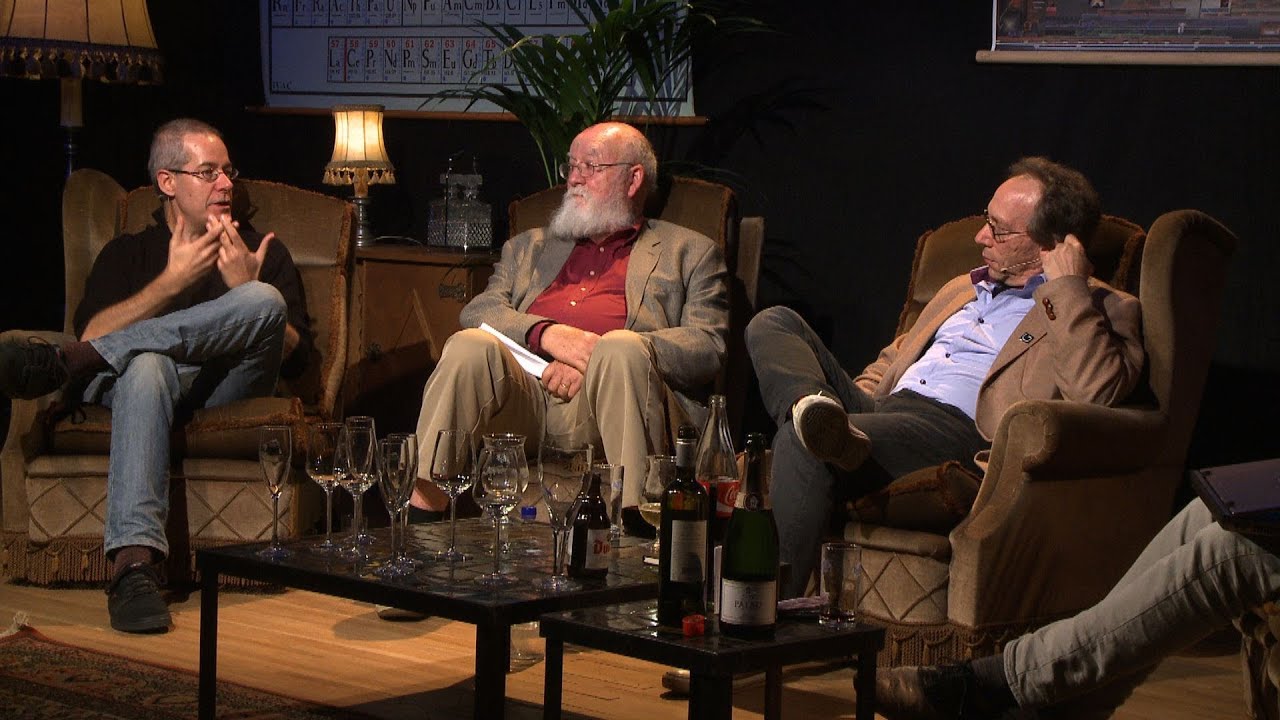
The Limits of Science with Lawrence M. Krauss, Daniel Dennett, and Massimo Pigliucci


This is a long conversation, and I found myself shaking my head in disbelief many times, but it's not often we get to witness three great minds talking about BIG ideas. Pretty cool (and, of course, it's from Europe, Germany to be precise).

The Limits of Science

with Lawrence M. Krauss, Daniel Dennett, and Massimo Pigliucci


00:00 Introduction
07:07 Limits of Science
19:40 God & the Supernatural
31:20 Science & Morality
50:11 Something out of Nothing
1:03:42 The Value of Philosophy
1:20:59 Cognitive Limits
1:35:43 Questions:
- 1:35:56 Science & Politics
- 1:43:33 The Status of Economics
- 1:48:17 Does Consciousness Exist?
1:55:00 Credits

Friday, December 06, 2013

Omnivore - Can You Have Religion Without God?

From Bookforum's Omnivore blog, a collection of links on all things religious - from Satan to Jesus, and from evolution to a religious worldview for secularists. A particularly good read is an article from Scientific American, The Psychological Power of Satan.


Can you have religion without God?

Dec 5 2013
9:00AM

Thursday, November 14, 2013

Jim Palmer - 6 Things I Said About the Bible that Received Hate Mail

I like Jim Palmer - I only very recently discovered him on Facebook and began reading his blog. He is as close to a secular Christian as I have ever seen (his motto is "Life Is My Religion") - and as a secular Buddhist, that really appeals to me. He is founder of the Religion-Free Bible Project.

This post will give you a sense of why I resonate with him and his work.

6 things I said about the Bible that received hate mail


(1)

“From the very beginning, there was no attempt at creating a single orthodoxy with the Bible. If there’s one thing that’s clear is that the editors of the Bible incorporated different and diverse traditions about such things as the creation story, the stories of the patriarchs, the story of the exodus from Egypt and four different views of Jesus, each with distinctive slants on Jesus. The Bible is not a landing strip for landing on a particular belief system or theology about God, but a spiritual launching pad setting me free to explore the height, width, and depth of myself, God, humankind, life and this world.”

(2)

“The Bible is not a club that you beat over someone’s head,
it’s a cup of cool water to a parched and weary soul.

The Bible is not a book of information and doctrines about God,
it’s an invitation into the reality of love, peace, and freedom.

The Bible is not a playbook for being more religious,
it’s a story about humankind’s relationship with God – the good, the bad, the beautiful, the ugly.

The Bible is not a book with a message about what’s wrong with you,
the Bible is a voice, whispering how good and beautiful you are.

The Bible is not a smack in the face about what you should be doing better,
it’s a tap on the shoulder, reminding you that you are never separated from what you most deeply long for.

The Bible was not written for establishing a belief system about God,
it was written as an invaluable spiritual resource for one’s journey with God.”

(3)

9 Thoughts To Challenge Your View Of The Bible:

1. The Bible is not a religious book.
2. The story of the Bible has value for all of humankind, regardless of your religious tradition or no religion at all.
3. The Bible is not owned by any particular sect of people, including institutional Christianity; the Bible is a spiritual resource for all people.
4. Contrary to what “they” say, there is more than one way to read, interpret, and understand the Bible.
5. People need to know that the destructive and oppressive ideas they learned about God as a result of their involvement with religion are not truly “biblical.”
6. In the hands of the people, the Bible can be an instrument of love, beauty, peace, acceptance and harmony in the world.
7. Humankind needs permission to walk away from the lie we learned about ourselves that we are bad, flawed, defective, not good enough, and unacceptable to God.
8. You don’t need an MDiv or PhD in theology to embrace the simple but profound message of the Bible.
9. Jesus could not and would not subscribe to what is often passed off as “orthodoxy.”

(4)

Why we need a Religion-Free Bible

Reason #12: Toxic Claims “Spiritual Leaders” Make About the Bible:

In order to be a real Christian you need to know who the real God is, and how the real God feels. Some of you … God hates you. Some of you, God is sick of you. God is frustrated with you. God is wearied by you. God has suffered long enough with you. He doesn’t think you’re cute. He doesn’t think it’s funny. He doesn’t think your excuse is meritorious. He doesn’t care if you compare yourself to someone worse than you, He hates them too. God hates, right now, personally, objectively hates some of you. He has had enough.” – Mark Driscoll

(5)
  • What if a collection of writings, giving different snapshots of humankind’s relationship with the divine, were assembled into one volume?
  • What if these snapshots told a story that we somehow find ourselves in at every turn, including moments of profound beauty and goodness, and moments of deep heartache and sorrow?
  • What if the story includes chapters where people are getting God horribly wrong and justifying hatred and atrocity in God’s name, and other chapters where people are getting it right and living as powerful expressions of love in the world?
  • What if it’s a human story, a divine story, and a cultural story happening, evolving and intertwined all at once?
  • What if their is an unnamed brilliance, depth and mystery to the story that requires one to look deeper, read between the lines, and listen with your heart?
  • What if the primary plot or theme of the whole story is strangely fulfilled in the birth, life, and death of a divine nobody?
  • What if the story has the power to inspire love, peace, beauty, healing, wholeness, harmony, and goodness in the world, and transform humankind’s relationships with ourselves individually and collectively, with God, with others, and with life itself?
What if this story is the Bible?

(6)

During my process of shedding religion I put away my Bible for a season, and it’s one of the best things I’ve done for my relationship with God. I quit reading it. I tuned out preachers and others quoting or referring to it. Of course, I had enough horse sense not to broadcast my taking a break from reading the Bible, but it’s not something you can hide from everyone.

The results? God deepened his life in me during my hiatus from the Scriptures in ways I’m still coming to grips with. At the top of the list was the experience of God’s unconditional acceptance. For many years I carried inside and unspoken list of “what if” questions about the extent of God’s acceptance. I knew God loved me, in a general John 3:16 sort of way, but what if I didn’t go to church anymore… or have daily quiet times… or didn’t read my Bible? Would God accept me and love me then? Would I still have a relationship with God then? Would there really even be a God… then?

God didn’t stop communicating with me when I quit reading the Bible, which took care of several of my “what if” questions. I discovered a living God I could know and interact with in real time whenever I wanted to. The personal and intimate, accepting and loving Father God the Scriptures pointed to was real, really real! God began expressing himself in a variety of ways, which I had been oblivious to operating under the assumption that God only spoke through the words of Scripture. These spiritual exchanges between God and me occurred through such things as nature, people, art, film, music, and the still, small voice within.

For me, God went from being locked up in a book that I accessed during morning quiet times, sermon preparation, and Bible study to being everywhere all the time. It’s amazing what you can see when you’re actually looking… and that goes for hearing, touching, smelling, tasting, and feeling as well. It’s like God was always there but my radar was off, or only on during specific times and then only narrowly focused in one particular area of Scripture.