Showing posts with label states of consciousness. Show all posts

Monday, November 03, 2014

Dreams—The Lucid Experience

http://humanityhealing.omtimes.netdna-cdn.com/wp-content/uploads/2010/11/humanityhealing_lucid-Dreams.jpg

From Australia's  Radio National All in the Mind, this is an interesting discussion of lucid dreaming.

Dreams—the lucid experience


Sunday 2 November 2014
Presenter: Lynne Malcolm

Image: Your dreams can take you anywhere (Paula Danielse, Getty Images)

Have you ever had a dream in which you are aware that you are dreaming? These seemingly altered states of consciousness are called lucid dreams. If you’re not sure of what they are they can be disturbing, but many people use them to solve the problems of their waking lives, or even just for fun. We’ll hear about this experience from a couple of dreamers, and find out about the science of lucid dreaming from one of the world’s leading researchers in the field.

Joining in? We'd love to hear about your own lucid dream experience. Has it had an impact on your waking life?

Transcript Show

Guests
  • Stephen La Berge: Founder, Lucidity Institute 
  • Paul Davies: AM Director of the Beyond Center, Arizona State University 
  • Nano Daemon: Author: 'Fate or destiny?'
Publications

  • Lucid Dreaming: A Concise Guide to Awakening in Your Dreams and in Your Life by Stephen La Berge (01 Feb 2008)
  • Exploring the World of Lucid Dreaming by Stephen La Berge, Howard Rhinegold (27 Oct 1990)
  • The Goldilocks Enigma: Why is the Universe just Right for Life? by Paul Davies (27 Oct 2006)
  • The Eerie Silence: Renewing our Search for Alien Intelligence by Paul Davies (27 Oct 2010)
  • Fate or Destiny? by Nano Daemon (11 Jul 2014)
Further Information 

Saturday, June 21, 2014

Do We Need a Theory-Based Assessment of Consciousness in the Field of Disorders of Consciousness?


Cognitive science diagnoses several disorders of consciousness (minimally conscious state, Persistent vegetative state, Locked-in syndrome, chronic coma, Brain stem death), which is curious in that we do not know (for sure) what consciousness is or is not.

Bottom line is that I agree that we need a theory-based assessment of consciousness from we can determine some norms, and then we can diagnose disorders of consciousness.

Full Citation: 
Fingelkurts, AA, Fingelkurts, AA, Bagnato, S, Boccagni, C, and Galardi, G. (2014, Jun 4). Do we need a theory-based assessment of consciousness in the field of disorders of consciousness? Frontiers in Human Neuroscience; 8:402. doi: 10.3389/fnhum.2014.00402

Do we need a theory-based assessment of consciousness in the field of disorders of consciousness?

Alexander A. Fingelkurts [1], Andrew A. Fingelkurts [1], Sergio Bagnato [2,3], Cristina Boccagni [2,3] and Giuseppe Galardi [2,3]
1. Research Department, BM-Science – Brain and Mind Technologies Research Centre, Espoo, Finland
2. Neurorehabilitation Unit, Rehabilitation Department, Fondazione Istituto “San Raffaele-G. Giglio,” Cefalù, Italy
3. Neurophysiology Unit, Rehabilitation Department, Fondazione Istituto “San Raffaele-G. Giglio,” Cefalù, Italy
Adequate assessment of (un)consciousness is not only of theoretical interest but also has a practical and ethical importance, especially when it comes to disorders of consciousness (DOC). Accurately determining the presence or absence of consciousness in patients with DOC allows informed decisions to be made about long-term care support, referral for rehabilitation, pain management and withdrawal of life support.

In spite of significant progress in neuroimaging and the introduction of clear-cut clinical diagnostic criteria, determining the (un)consciousness still presents an important clinical problem: errors are common and have been shown to be as high as 37–43% (Tresch et al., 1991; Childs et al., 1993; Andrews et al., 1996; Schnakers et al., 2006).

Assessment errors arise because the evaluation of patients with DOC is based mostly on clinical observation of subjectively interpreted behavioral responses, while conscious experience often occurs without any behavioral signs. Additionally behavioral responses of such patients are usually limited by their cognitive dysfunctions and/or by their frequent motor impairment. Therefore, determining if a non-communicative or minimally communicative patient is phenomenally conscious poses a major clinical and ethical challenge. For this reason, there is a need for paraclinical diagnostic markers for the presence or absence of consciousness.

We believe that a theoretical account of what conscious experience is and how it emerges within the brain will advance the search for appropriate neuromarkers of the presence or absence of consciousness in non-communicative brain-damaged patients.

In our view, several important considerations need to be kept in mind:

Consciousness vs. Vigilance

Consciousness is often conceptualized as a phenomenon with two components: wakefulness and awareness (Posner et al., 2007). Though such understanding is currently quite wide-spread, it confuses and mixes two different and independent phenomena: subjective awareness and vigilance. While awareness is an important component of consciousness, wakefulness belongs to the vigilance domain. Independence of these two concepts can be demonstrated by examples from a daily life: (a) we are able to unconsciously perform complex actions like brushing our teeth or driving a car while being completely awake; (b) being at the same level of wakefulness we are usually aware of some events/stimuli while unaware of others; and (c) during sleep we can be aware of our phenomenal experience (dreams) but are not awake. Hence, wakefulness is not a component of consciousness but of vigilance. Vigilance, however, affects consciousness by limiting the amount of information available for conscious access (Rusalova, 2006), thus affecting the amount of content (Overgaard and Overgaard, 2010).

Is Consciousness Gradually Continuous or Discrete (“All-or-None”)?

From the abovementioned fallacy, another misconception arises—levels of consciousness. The assumption is that consciousness itself can be somehow diminished (less consciousness) or increased (more consciousness), and thus considered to be gradual (Laureys et al., 2002; Vanhaudenhuyse et al., 2010a). However, there is no introspective evidence to support this widely accepted idea (Overgaard and Overgaard, 2010). Indeed, from a third-person perspective, consciousness presents itself in varying amounts, depending on the level of vigilance of the studied subject. However, what is important is that from the first-person perspective one is either discretely fully aware or unaware of something. It is the amount of content that varies gradually (Overgaard and Overgaard, 2010). There is no additional degree of consciousness during such awareness of the content (for a discussion see Fingelkurts et al., 2012a). In other words, consciousness is not merely a quantitative matter of a degree but in fact a qualitative matter of absence or presence of a particular state (Plum et al., 1998). In this sense, when consciousness is separated from arousal/wakefulness, then it is more of a categorical (all-or-none) phenomenon rather than a continuous (gradual) one (Fingelkurts et al., 2012a). It is the degree of vigilance (wakefulness) that conflates the expression of consciousness, resulting in an illusion of its continuous or graded nature (Hudetz, 2010).

What is Then Consciousness?

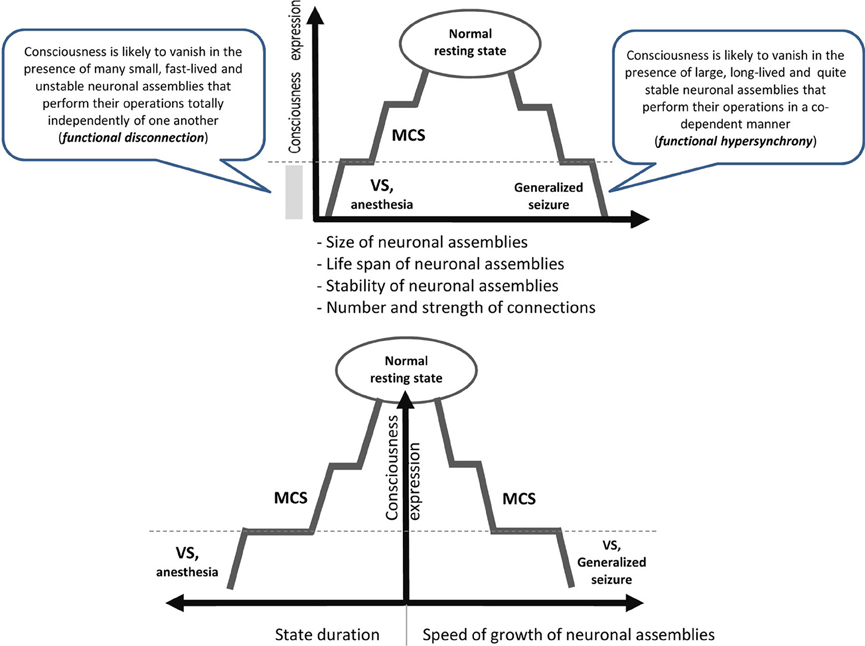
It is reasonable to assume that to be conscious is to be in a particular state which has projections onto mental/ psychological, neurophysiological and cognitive/behavioral dimensions (Edelman, 1989; Sokolov, 1990; Flohr, 1991; Tononi, 2008). Currently we do not know all parameters of this state, but recent empirical studies have provided several important observations (see Figure 1):
FIGURE 1  
http://www.frontiersin.org/files/Articles/90970/fnhum-08-00402-HTML/image_m/fnhum-08-00402-g001.jpg

Figure 1. Schematic illustration relating consciousness expression and neuronal assembly characteristics. The stepwise line represents the idea that gradual changes in neuronal mechanisms need to be accumulated to reach a particular threshold level required for qualitative change in the functional state (Bagnato et al., 2013). During VS as a result of a brain injury, the functions of the neural net subtending consciousness (awareness) are reduced in both hemispheres below the threshold level required for minimal consciousness expression. The recovery of consciousness is a dynamic process that involves many plastic changes in many brain structures. If this reorganization crosses the threshold of the minimal neuronal mechanisms that are jointly sufficient for any conscious awareness (particular level of the size, life-span, stability and speed of growth of neuronal assemblies, as well as the amount and strength of functional connectivity between them), the patient will regain consciousness (Fingelkurts et al., 2012a,b). The critical factor regulating the occurrence or absence of consciousness recovery is the distance of these functional characteristics of neuronal assemblies from this threshold level (Bagnato et al., 2013).VS, vegetative state; MCS, minimally conscious state; dashed horizontal line illustrates a threshold of the minimal neuronal mechanisms that are jointly sufficient for any conscious awareness to emerge.
Taken together (Figure 1) these findings suggest that consciousness is an emergent phenomenon of coherent dynamic binding of multiple, relatively large, long-lived and stable, but transient alpha and beta generated neuronal assemblies organized as synchronized patterns within a nested, hierarchical brain architecture. It seems that these are minimally sufficient conditions at the more basic level (brain) that are required for the emergent quality (conscious mind) to manifests itself. Indeed, if phenomenal consciousness is a biological phenomenon within the confines of the brain, then there must be a specific level of brain organization and a specific spatial–temporal grain in it where consciousness resides. In other words, we could expect that at the lower (in comparison with the phenomenal consciousness) level of brain organization there should be non-experiential entities (some complex electrophysiological mechanisms) that function as the direct realization base of the phenomenal world (Fingelkurts et al., 2010, 2013a). The abovementioned nested hierarchical architecture of separate and synchronized neuronal assemblies forms the very particular level of brain functioning, so-called operational architectonics level, which on the one hand intervenes between physical level of the brain where it literally resides, and on the other, is isomorphic to the experiential/subjective phenomenal structure of the mind (Fingelkurts et al., 2010). In other words, the level of the operational architectonics has emergent properties relatively independent from the neurophysiological/neuroanatomical properties of the physical level. And the phenomenal level supervenes on this operational level with one-to-one correspondence thus making it ontologically inseparable from it (though it is separable from the brain neuroanatomical processes through the operational level) (Fingelkurts et al., 2013a).

Analytic Model for Assessing Consciousness

Patients in VS or in minimally conscious state (MCS) offer a unique opportunity to study the neural basis of (un)consciousness due to the fact that impairment in awareness of self and environment is dissociated in such patients from preserved and stable wakefulness. We believe that an appropriate level of consciousness description should articulate the operational level of brain organization where the phenomenal/conscious phenomena reside (Fingelkurts et al., 2013b). Electroencephalogram (EEG) is a suitable and adequate measure for the instrumental analysis of such operational level, because it (a) provides a direct (in contrast to indirect fMRI an PET) measure of the behavior of large-scale neuronal networks with a millisecond temporal resolution and reflects functional properties and states of brain functioning as well as being closely connected to information processing in/among neuronal assemblies (for a discussion see Fingelkurts et al., 2012a) and (b) enables clinicians to assess spontaneous brain activity at each level of vigilance and in any state of consciousness, bypassing the need to elicit a behavioral or any other response from the patient (Vanhaudenhuyse et al., 2010b).

Following Baars's (1988) recommendation, an experimental analytic model for the assessment of consciousness should consider only those EEG parameters that satisfy the rule: (i) NORM ≥ MCS > VS for subjective awareness of self and environment, (ii) NORM ≥ MCS < VS for subjective unawareness of self and environment. This model was already successfully used in several recent studies (Fingelkurts et al., 2012a,b,c, 2013b).

In conclusion we argue that in the situation where there is no consensus on what would constitute the reliable markers of consciousness in the absence of the subject's report, a theory-based insight into neural substrates and mechanisms involved in conscious content may be useful for detecting the presence of conscious experiences in non-communicating subjects.

Do we Need a Theory-Based Assessment of Consciousness for Proper Rehabilitation of Patients with DOC?

On the basis of the foregoing concepts, we may assume that patients with similar clinical behavior (i.e., VS or MCS) differ considerably in their level of operational architectonic dysfunction and that in turn translates into different expression of consciousness (Fingelkurts et al., 2012b). This is a critical point, if we consider that chances of recovery from a DOC (particularly, from a VS) depend on the interaction of two main factors: (i) the degree of impairment of neuronal systems supporting consciousness, and (ii) the amount of spontaneous and rehabilitation-induced plastic changes aimed to restore brain functions and connectivity within nested operational architectonics (Bagnato et al., 2013). If so, the precise measurement of brain dysfunction characteristics will be decisive, as it will allow rehabilitative treatments to be tailored for each patient. In the future, we may test the effectiveness of specific interventions (i.e., cognitive rehabilitations, drugs or neurostimulation) in patients in VS or MCS by evaluating the effects of the treatments on the patients' neuronal assembly characteristics mentioned earlier. We will then be able to choose the best rehabilitative intervention (or a suitable combination of treatments) for each patient with severe DOC by taking in consideration neurophysiological markers that are easily quantifiable at any stage of rehabilitation.

Conflict of Interest Statement

The authors declare that the research was conducted in the absence of any commercial or financial relationships that could be construed as a potential conflict of interest.

Acknowledgments

The authors would like to thank Dmitry Skarin for English editing.


Tuesday, January 21, 2014

Shrink Rap Radio #386 – An Update on Mind-Expanding Substances with Ralph Metzner PhD


Ralph Metzner Ph.D. is an American psychologist, writer, and researcher (born in Germany), who participated in psychedelic research at Harvard University in the early 1960s with Timothy Leary, Richard Alpert (Ram Dass), and Andrew Weil. Dr. Metzner is a psychotherapist and Professor Emeritus of psychology at the California Institute of Integral Studies in San Francisco, where he was formerly the Academic Dean and Academic Vice-president.

Dr. Metzner has been involved in consciousness research, including psychedelics, yoga, meditation, and shamanism for over 45 years. He is a co-founder and President of the Green Earth Foundation, a non-profit educational organization devoted to healing and harmonizing the relationship between humans and the Earth. Metzner was featured in the 2006 film Entheogen: Awakening the Divine Within, a documentary about rediscovering an enchanted cosmos in the modern world.

His books include Green Psychology: Transforming our Relationship to the Earth (1999), Well of Remembrance: Rediscovering the Earth Wisdom Myths of Northern Europe (2001, originally 1994), and The Unfolding Self: Varieties of Transformative Experience (2010), among many others.

He was the guest of Dr. David Van Nuys earlier this week on Shrink Rap Radio.

Shrink Rap Radio #386 – An Update on Mind-Expanding Substances with Ralph Metzner PhD

Ralph Metzner

A psychology podcast by David Van Nuys, Ph.D.
copyright 2014: David Van Nuys, Ph.D.
Posted on January 16, 2014

Ralph Metzner, Ph.D., a graduate of Oxford and Harvard, is a recognized pioneer in psychological, philosophical and cross-cultural studies of consciousness and its transformations. He collaborated with Leary and Alpert in classic studies of psychedelics at Harvard University in the 1960s, co-authored The Psychedelic Experience and was editor of The Psychedelic Review. He is a psychotherapist and Professor Emeritus at the California Institute of Integral Studies, where he was also the Academic Dean for ten years in the 1980s. His books include The Unfolding Self, The Well of Remembrance, Green Psychology, The Expansion of Consciousness, Alchemical Divination, and Mind Space and Time Stream. He is the editor of two collections of essays on the pharmacology, anthropology and phenomenology of ayahuasca and of psilocybin mushrooms. He is also the president and co-founder of the Green Earth Foundation, dedicated to healing and harmonizing the relations between humanity and the Earth.

Play

Thursday, February 14, 2013

ZEN BRAIN: EXPLORING CONSCIOUSNESS: Waking, Sleeping, Dreaming, Dying (Upaya Zen Center)


Another excellent Zen Brain conference hosted by Joan Halifax Roshi and the Upaya Zen Center. This yearly event always features excellent speakers and enlightening discussions. This year is no exception, with Al Kaszniak, Evan Thompson, Stephen Batchelor, Richard Davidson, and Joan Halifax all participating.

All eleven segments (+1) are linked to below - you can listen for free at the Upaya site in exchange for an email address.


ZEN BRAIN: EXPLORING CONSCIOUSNESS: Waking, Sleeping, Dreaming, Dying (Part 1): Al Kaszniak, Evan Thompson, Stephen Batchelor, Richard Davidson, and Joan Halifax: 02-07-2013

Speakers: Al Kaszniak & Evan Thompson & Stephen Batchelor & Richard Davidson & Joan Halifax
Recorded: Thursday Feb 7, 2013

SERIES DESCRIPTION: At the core of Zen practice lies an intention to develop the ability to rest our attention in the broad field of conscious awareness and to observe the mental continuum without grasping, aversion, or judgment. In doing so, we can begin to examine the enormous range and subtlety of the mysterious phenonemon that we call “consciousness”. In this ground-breaking retreat, neuroscientists, a philosopher, Buddhist scholars, and Buddhist teachers will explore the intersection of what philosophy, science, Buddhist scholarship, and meditation practice have contributed to our understanding of the variations of consciousness from waking to dreaming and the states that unfold in the process of dying.

Episode Description: This is the opening session of Zen Brain. Each of the presenters explains what their upcoming talks will be about and respond to Roshi’s question: “Why is it important to explore the nature of consciousness at this point in time.”

Teacher BIOs: 


Al Kaszniak received his Ph.D. in clinical and developmental psychology from the University of Illinois in 1976, and completed an internship in clinical neuropsychology at Rush Medical Center in Chicago. He is currently Director of the Arizona Alzheimer’s Consortium Education Core, and a professor in the departments of psychology, neurology, and psychiatry at The University of Arizona (UA. He formerly served as Head of the Psychology Department, and as Director of the UA Center for Consciousness Studies. Al also presently serves as Chief Academic Officer for the Mind and Life Institute, an organization that facilitates collaborative scientific research on contemplative practices and traditions. He is the co-author or editor of seven books, including the three-volume Toward a Science of Consciousness (MIT Press), and Emotions, Qualia, and Consciousness (World Scientific). In addition to his academic and administrative roles, he is a lineage holder and teacher (Sensei) in the Soto tradition of Zen Buddhism.

Dr. Evan Thompson is Professor of Philosophy at the University of Toronto. He received his B.A. from Amherst College in Asian Studies, and his Ph.D. in Philosophy from the University of Toronto. He is the author of Mind in Life: Biology, Phenomenology, and the Sciences of Mind (Harvard University Press, 2007), and the co-editor (with P. Zelazo and M. Moscovitch) of The Cambridge Handbook of Consciousness (Cambridge University Press, 2007) He is also the co-author with F.J. Varela and E. Rosch of The Embodied Mind: Cognitive Science and Human Experience (MIT Press, 1991) and the author of Color Vision: A Study in Cognitive Science and the Philosophy of Perception (Routledge Press, 1995). He is currently working on a new book, titled Waking, Dreaming, Being: New Revelations about the Self from Neuroscience and Meditation. Thompson held a Canada Research Chair at York University (2002-2005), and has also taught at Boston University. He has held visiting positions at the Centre de Récherch en Epistémologie Appliqué (CREA) at the Ecole Polytechnique in Paris and at the University of Colorado at Boulder.

Stephen Batchelor is a contemporary Buddhist teacher and writer, best known for his secular or agnostic approach to Buddhism. Stephen considers Buddhism to be a constantly evolving culture of awakening rather than a religious system based on immutable dogmas and beliefs. Through his writings, translations and teaching, Stephen engages in a critical exploration of Buddhism’s role in the modern world, which has earned him both condemnation as a heretic and praise as a reformer. Stephen spent his young adult life ordained as a Buddhist Monk, first in the Tibetan tradition, and later in Korean Zen. He has been the co-ordinator of the Sharpham Trust and since 1990 has been a guiding teacher at Gaia House Meditation Center. Stephen is the translator and author of various books and articles on Buddhism including the bestselling Buddhism Without Beliefs and Living with the Devil: A Meditation on Good and Evil . His most recent publication is Confession of a Buddhist Atheist.

Richard J. Davidson received his Ph.D. in Personality, Psychopathology, and Psychophysiology from Harvard University. He is currently Director for the Laboratory of Affective Neuroscience as well as the Waisman Laboratory for Brain Imaging and Behavior, at the University of Wisconsin-Madison. His research is focused on cortical and subcortical substrates of emotion and affective disorders, including depression and anxiety, using quantitative electrophysiology, positron emission tomography and functional magnetic resonance imaging to make inferences about patterns of regional brain function. A major focus of his current work is on interactions between prefrontal cortex and the amygdala in the regulation of emotion in both normal subjects and patients with affective and anxiety disorders. He has also studied and published several papers on brain physiology in long-term Buddhist meditators, and in persons receiving short-term training in mindfulness meditation. Among his several books is Visions of compassion: Western Scientists and Tibetan Buddhists Examine Human Nature (2002, Oxford University Press), co-edited with Anne Harrington.

Joan Halifax Roshi is a Buddhist teacher, Zen priest, anthropologist, and author. She is Founder, Abbot, and Head Teacher of Upaya Zen Center, a Buddhist monastery in Santa Fe, New Mexico. She received her Ph.D in medical anthropology in 1973. She has lectured on the subject of death and dying at many academic institutions, including Harvard Divinity School and Harvard Medical School, Georgetown Medical School, University of Virginia Medical School, Duke University Medical School, University of Connecticut Medical School, among many others. A Founding Teacher of the Zen Peacemaker Order, her work and practice for more than three decades has focused on applied Buddhism. Her books include: The Human Encounter with Death (with Stanislav Grof); Shamanic Voices; Shaman: The Wounded Healer; The Fruitful Darkness; Simplicity in the Complex: A Buddhist Life in America; Being with Dying; and Wisdom Beyond Wisdom (with Kazuaki Tanashashi).

Al Kaszniak: 02-08-2013: ZEN BRAIN: EXPLORING CONSCIOUSNESS: Waking, Sleeping, Dreaming, Dying (Part 2)
In this session Dr. Al Kaszniak takes listeners through some of the ways that cognitive science and neuroscience have approached the study of consciousness.

Al Kaszniak, Evan Thompson, Stephen Batchelor, Richard Davidson, and Joan Halifax: 02-08-2013: ZEN BRAIN: EXPLORING CONSCIOUSNESS: Waking, Sleeping, Dreaming, Dying (Part 3)

In this second panel discussion our presenters answer such guest questions as: difference between awareness and consciousness, is unconscious created externally, long term meditation and pain response, historical use of term consciousness.

Evan Thompson: 02-08-2013: ZEN BRAIN: EXPLORING CONSCIOUSNESS: Waking, Sleeping, Dreaming, Dying (Part 4)

Dr. Thompson takes the listener on a cross-cultural fusion, neuro-phenomenology journey. He weaves Buddhist ideas from the Abhidharma, with work on the cognitive neuroscience of consciousness.

Al Kaszniak, Evan Thompson, Stephen Batchelor, Richard Davidson, and Joan Halifax: 02-08-2013: ZEN BRAIN: EXPLORING CONSCIOUSNESS: Waking, Sleeping, Dreaming, Dying (Part 5)

During the Fri afternoon and evening panels. The Zen Brain faculty consider questions on “out of body” experiences, embodiment and direct experience, Indian writings on interoception, lucid dream states, consciousness as a layered phenomenon, the mind and life meeting held in monastery in India attended by 10000 monks, relationship between attention and consciousness.

Al Kaszniak: 02-06-2013: Consciousness, Neuroscience, and Zen Practice

Sensei Al notes that understanding consciousness can be useful in our lives. In this dharma talk he explores what can be learned about the nature and function of consciousness through some recent research in neuroscience and through experience in meditation practice. (NOT part of the Zen Brain series, but it fits here anyway.)

Stephen Batchelor: 02-09-2013: ZEN BRAIN: EXPLORING CONSCIOUSNESS: Waking, Sleeping, Dreaming, Dying (Part 6)

In this presentation, Stephen Batchelor considers two questions: What was the Buddha trying to do? and How does consciousness fit in? His draws on the Pali canon but not any particular school of buddhism.

Al Kaszniak, Evan Thompson, Stephen Batchelor, Richard Davidson, and Joan Halifax: 02-09-2013: ZEN BRAIN: EXPLORING CONSCIOUSNESS: Waking, Sleeping, Dreaming, Dying (Part 7)

During this session the Zen Brain faculty answer questions about the concepts: rebirth, fully knowing, mindful awareness, yoni awareness & Dogen, near death experience. store consciousness and memory.

Richard Davidson: 02-09-2013: ZEN BRAIN: EXPLORING CONSCIOUSNESS: Waking, Sleeping, Dreaming, Dying (Part 8)

In this presentation, Richard Davidson explores three of the major topics of the seminar: waking, sleeping, and dying. Richard orients the presentation specifically to the intersection of Neuroscience and contemplative practice. Richard begins the presentation by taking offering the audience a visual contemplative journey through the beautiful complexity of the brain. This video can be found here (or direct URL : http://smithlab.stanford.edu/Smithlab/AT_Movies.html ), titled “Machinery of Mind.” Richard goes on to identify particular phenomena of contemplative practice that are currently being investigated by neuroscientists. He then discusses recent findings of this exciting work.

Al Kaszniak, Evan Thompson, Stephen Batchelor, Richard Davidson, and Joan Halifax: 02-09-2013: ZEN BRAIN: EXPLORINGCONSCIOUSNESS: Waking, Sleeping, Dreaming, Dying (Part 9)

During our Saturday afternoon session, our faculty respond to questions about the scientific and subjective significance of near death experience and the continuity of consciousness after death. Also, Richard comments on the differences he has measured between different styles of meditation, and he further discusses the implications of contemplative science in the health care fields.

Al Kaszniak, Evan Thompson, Stephen Batchelor, and Joan Halifax: 02-10-2013: ZEN BRAIN: EXPLORING CONSCIOUSNESS: Waking, Sleeping, Dreaming, Dying (Part 10A)

This is the final day of Zen Brain. This podcast includes the reflections of the faculty on their own personal way of coming to grips with what has been talked about during these days.

Al Kaszniak, Evan Thompson, Stephen Batchelor, and Joan Halifax: 02-10-2013: ZEN BRAIN: EXPLORING CONSCIOUSNESS: Waking, Sleeping, Dreaming, Dying (Part 10B, last part)

This is the final day of Zen Brain. This last session contains participant reflections on what they are taking from this time, what is most relevant to them, what are the implications for what they do and what does all this have to do with practice.