Charles Taylor is one of the giants of contemporary philosophy. Two of his books,
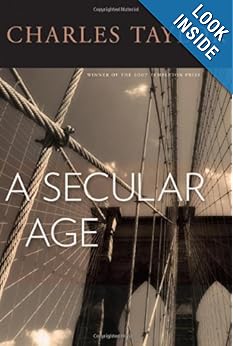
A Secular Age (2007) and
Sources of the Self: The Making of the Modern Identity (1992), are contemporary classics.
From
Wikipedia, here is a brief summary of some of the ideas in
Part IV: Narratives of Secularization:
The last half century has seen a cultural revolution in the North Atlantic civilization. "As well as moral/spiritual and instrumental individualisms, we now have a widespread "expressive" individualism"(p. 473). Taylor calls this a culture of "authenticity," from the Romantic expressivism that erupted in the late 18th century elite, "that each one of us has his/her own way of realizing our humanity, and that it is important to find and live out one's own"(p. 475).
This affects the social imaginary. To the "horizontal" notion of "the economy, the public sphere, and the sovereign people"(p. 481) is added a space of fashion, a culture of mutual display. The modern moral order of mutual benefit has been strengthened, mutual respect requires that "we shouldn't criticize each other's 'values'"(p. 484) in particular on sexual matters. Since "my" religious life or practice is my personal choice, my "link to the sacred" may not be embedded in "nation" or "church." This is a continuation of the Romantic move away from reason towards a "subtler language" (Shelley) to understand individual "spiritual insight/feeling." "Only accept what rings true to your own inner Self"(p. 489). This has "undermined the link between Christian faith and civilizational order"(p. 492).
The revolution in sexual behavior has broken the culture of "moralism" that dominated most of the last half millennium. Developing individualism was bound to come into conflict with moralism, but in the mid 20th century the dam broke. Thinkers started to think of sexual gratification as good, or at least unstoppable, especially as "in cities, young people could pair off without supervision"(p. 501). Now people are not bound by moralism: "they form, break, then reform relationships"(p. 496); they experiment.
It is a tragedy, however that "the codes which churches want to urge on people" still suffer from "the denigration of sexuality, horror at the Dionysian, fixed gender roles, or a refusal to discuss identity issues"(p. 503).
Today, the "neo-Durkheimian embedding of religion in a state"(p. 505) and a "close interweaving of religion, life-style and patriotism"(p. 506) has been called into question. People are asking, like Peggy Lee, "Is that all there is?" They are heirs of the expressive revolution, "seeking a kind of unity and wholeness of the self... of the body and its pleasures... The stress is on unity, integrity, holism, individuality."(p. 507). This is often termed "spirituality" as opposed to "organized religion."
This has caused a breaking down of barriers between religious groups but also a decline in active practice and a loosening of commitment to orthodox dogmas. A move from an Age of Mobilization to an Age of Authenticity, it is a "retreat of Christendom." Fewer people will be "kept within a faith by some strong political or group identity"(p. 514), although a core (vast in the US) will remain in neo-Durkheimian identities, with its potential for manipulation by such as "Milosevic, and the BJP"(p. 515).
Assuming that "the human aspiration to religion will [not] flag"(p. 515) spiritual practice will extend beyond ordinary church practice to involve meditation, charitable work, study group, pilgrimage, special prayer, etc. It will be "unhooked" from the paleo-Durkheimian sacralized society, the neo-Durkheimian national identity or center of "civilizational order" but still collective. "One develops a religious life"(p. 518).
While religious life continues many people retain a nominal tie with the church, particularly in Western Europe. This "penumbra" seems to have diminished since 1960. More people stand outside belief, and no longer participate in rites of passage like church baptism and marriage. Yet people respond to, e.g. in France the 1500th anniversary of the baptism of Clovis, or in Sweden the loss of a trans-Baltic ferry. Religion "remains powerful in memory; but also as a kind of reserve fund of spiritual force or consolation"(p. 522).
This distancing is not experienced in the United States. This may be (1) because immigrants used church membership as a way to establish themselves: "Go to the church of your choice, but go"(p. 524) Or (2) it may be the difficulty that the secular elite has in imposing its "social imaginary" on the rest of society vis-a-vis hierarchical Europe. Also (3) the US never had an ancien régime, so there has never been a reaction against the state church. Next (4) the groups in the US have reacted strongly against the post-1960s culture, unlike Europe. A majority of Americans remain happy in "one Nation under God." There are less skeletons in the family closet, and "it is easier to be unreservedly confident in your own rightness when you are the hegemonic power"(p. 528). Finally (5) the US has provided experimental models of post-Durkheimian religion at least for a century.
After summarizing his argument, Taylor looks to the future, which might follow the slow reemergence of religion in Russia in people raised in the "wasteland" of militant atheism, but suddenly grabbed by God, or it might follow the "spiritual but not religious" phenomenon in the west. "In any case, we are just at the beginning of a new age of religious searching, whose outcome no one can foresee."
And here is more from the summary of
Part V: Conditions of Belief:
We live in an immanent frame. That is the consequence of the story Taylor has told, in disenchantment and the creation of the buffered self and the inner self, the invention of privacy and intimacy, the disciplined self, individualism. Then Reform, the breakup of the cosmic order and higher time in secular, making the best of clock time as a limited resource. The immanent frame can be open, allowing for the possibility of the transcendent, or closed. Taylor argues that both arguments are "spin" and "involve a step beyond available reasons into the realm of anticipatory confidence"(p. 551) or faith.
There are several Closed World Structures that assume the immanent frame. One is the idea of the rational agent of modern epistemology. Another is the idea that religion is childish, so "An unbeliever has the courage to take up an adult stance and face reality"(p. 562). Taylor argues that the Closed World Structures do not really argue their world views, they "function as unchallenged axioms"(p. 590) and it just becomes very hard to understand why anyone would believe in God.
Living in the immanent frame "The whole culture experiences cross pressures, between the draw of the narratives of closed immanence on one side, and the sense of their inadequacy on the other"(p. 595). Materialists respond to the aesthetic experience of poetry. Theists agree with the Modern Moral Order and its agenda of universal human rights and welfare. Romantics "react against the disciplined, buffered self"(p. 609) that seems to sacrifice something essential with regard to feelings and bodily existence.
To resolve the modern cross pressures and dilemmas Taylor proposes a "maximal demand" that we define our moral aspirations in terms that do not "crush, mutilate or deny what is essential to our humanity"(p. 640). It aspires to wholeness and transcendence yet also tries to "fully respect ordinary human flourishing"(p. 641).
Taylor imagines a two-dimensional moral space. The horizontal gives you a "point of resolution, the fair award"(p. 706). The vertical hopes to rise higher, to reestablish trust, "to overcome fear by offering oneself to it; responding with love and forgiveness, thereby tapping a source of goodness, and healing"(p. 708). and forgoing the satisfaction of moral victory over evil in sacred violence, religious or secular.
In his
New York Times column on Monday, David Brooks identifies with the idea that secularism, through the breakdown of religious identity, is creating more isolated and insular individuals:
Individuals don’t live embedded in tight social orders; they live in buffered worlds of private choices. Common action, Taylor writes, gives way to mutual display. Many people suffer from a malaise. They remember that many people used to feel connected to an enchanted, transcendent order, but they feel trapped in a flat landscape, with diminished dignity: Is this all there is?
I disagree with this perspective as a final outcome of secularism, seeing it instead as a transitional moment. If people feel they are trapped in a "flat landscape, with diminished dignity," this is in itself an example of being embedded in a social order (tight or otherwise) in which meaning is felt to be absent.
BUT, and this is the BIG BUT I pose in opposition to Taylor's argument (as much as I admire him and his work), people are finding communities of seekers with similar paths outside of the mainstream and dying religious traditions. More to the point, people are finding their own "tribes" or "families" that have nothing to do with blood or heritage and much more to do with commonality and similarity in values and purpose.
I think Brooks get the gist of Taylor's perspective, and agrees with it, but I counter that both are wrong, or at the least, short-sighted.
By DAVID BROOKS
Published: July 8, 2013
I might as well tell you upfront that this column is a book report. Since 2007, when it was published, academics have been raving to me about Charles Taylor’s “A Secular Age.” Courses, conferences and symposia have been organized around it, but it is almost invisible outside the academic world because the text is nearly 800 pages of dense, jargon-filled prose.
As someone who tries to report on the world of ideas, I’m going to try to summarize Taylor’s description of what it feels like to live in an age like ours, without, I hope, totally butchering it.
Taylor’s investigation begins with this question: “Why was it virtually impossible not to believe in God in, say 1500, in our Western society, while in 2000 many of us find this not only easy but even inescapable?” That is, how did we move from the all encompassing sacred cosmos, to our current world in which faith is a choice, in which some people believe, others don’t and a lot are in the middle?
This story is usually told as a subtraction story. Science came into the picture, exposed the world for the way it really is and people started shedding the illusions of faith. Religious spirit gave way to scientific fact.
Taylor rejects this story. He sees secularization as, by and large, a mottled accomplishment, for both science and faith.
Advances in human understanding — not only in science but also in art, literature, manners, philosophy and, yes, theology and religious practice — give us a richer understanding of our natures. Shakespeare helped us see character in more intricate ways. An improvement in mores means we take less pleasure from bear-baiting, hanging and other forms of public cruelty. We have a greater understanding of how nature works.
These achievements did make it possible to construct a purely humanistic account of the meaningful life. It became possible for people to conceive of meaningful lives in God-free ways — as painters in the service of art, as scientists in the service of knowledge.
But, Taylor continues, these achievements also led to more morally demanding lives for everybody, believer and nonbeliever. Instead of just fitting docilely into a place in the cosmos, the good person in secular society is called upon to construct a life in the universe. She’s called on to exercise all her strength.
People are called to greater activism, to engage in more reform. Religious faith or nonfaith becomes more a matter of personal choice as part of a quest for personal development.
This shift in consciousness leads to some serious downsides. When faith is a matter of personal choice, even believers experience much more doubt. As James K.A. Smith of Comment Magazine, who was generous enough to share his superb manuscript of a book on Taylor, put it, “We don’t believe instead of doubting; we believe while doubting. We’re all Thomas now.”
Individuals don’t live embedded in tight social orders; they live in buffered worlds of private choices. Common action, Taylor writes, gives way to mutual display. Many people suffer from a malaise. They remember that many people used to feel connected to an enchanted, transcendent order, but they feel trapped in a flat landscape, with diminished dignity: Is this all there is?
But these downsides are more than made up for by the upsides. Taylor can be extremely critical of our society, but he is grateful and upbeat. We are not moving to a spiritually dead wasteland as, say, the fundamentalists imagine. Most people, he observes, are incapable of being indifferent to the transcendent realm. “The yearning for eternity is not the trivial and childish thing it is painted as,” Taylor writes.
People are now able to pursue fullness in an amazing diversity of different ways. But Taylor observes a general pattern. They tend not to want to live in a world closed off from the transcendent, reliant exclusively on the material world. We are not, Taylor suggests, sliding toward pure materialism.
We are, instead, moving toward what he calls a galloping spiritual pluralism. People in search of fullness are able to harvest the intellectual, cultural and spiritual gains of the past 500 years. Poetry and music can alert people to the realms beyond the ordinary.
Orthodox believers now live with a different tension: how to combine the masterpieces of humanism with the central mysteries of their own faiths. This pluralism can produce fragmentations and shallow options, and Taylor can eviscerate them, but, over all, this secular age beats the conformity and stultification of the age of fundamentalism, and it allows for magnificent spiritual achievement.
I’m vastly oversimplifying a rich, complex book, but what I most appreciate is his vision of a “secular” future that is both open and also contains at least pockets of spiritual rigor, and that is propelled by religious motivation, a strong and enduring piece of our nature.
A version of this op-ed appeared in print on July 9, 2013, on page A21 of the New York edition with the headline: The Secular Society.