Showing posts with label crows. Show all posts

Friday, November 08, 2013

Annalee Newitz - The Mysterious Tool-Making Culture Shared by Crows and Humans


From io9, Annalee Newitz presents the findings from a recent collection of studies on the evolution of tool use. Only humans and crows make tools of a specific kind for the acquisition of food - we both have learned how to use naturally available hooks or to fashion hooks to achieve a goal.

Why?

It seems, based on one of the studies presented on the evolution of tool use in the Philosophical Transactions of the Royal Society B, gathered into a special issue on the subject, that animals develop tools in response to their environments. If the tasty little beetle larvae the New Caledonian crows love to eat were easily accessible, they likely would not have developed the hook tools they use to gather the larvae.

[You can read the Introduction to the special issue, "Tool use as adaptation," by Dora Biro, Michael Haslam, and Christian Rutz, for free at the link.]

Good stuff.

The Mysterious Tool-Making Culture Shared by Crows and Humans

Annalee Newitz
11.7.2013


Many animal species use tools, from insects, elephants and sea urchins to apes, badgers and octopuses, but there are only two animals who make hooks to catch food: humans and crows. Why we both do this is a mystery — and unraveling it could explain the reasons why tool use evolved in the first place.

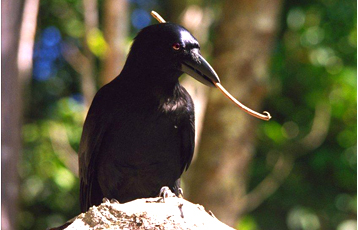
On the south Pacific island of New Caledonia, families of wild crows have developed a tool-making industry. One of their main sources of protein is beetle larvae, which are found in the rotted trunks of fallen trees. The problem is that the crows can't actually get inside the trunks with beak and claw alone. So they've learned to fish for the tasty bugs by fashioning tools out of slender sticks. Using its dextrous beak, a crow prepares the stick by stripping bark from one end. Then it tweaks the end into a small hook that looks something like the tip of a crochet needle. Carefully holding the stick in its beak, the bird dips it into bore holes in the logs, fishing out a meal.


Crow the Tool-Maker


This isn't just some genetically-programmed behavior. Crows aren't born knowing how to make these tools; they teach the technique to their young. And they can improvise, too. In one lab experiment, a crow bent the end of a wire using the edge of a glass as a cantilever. It used the hooked wire to retrieve another stick, which was long enough to reach some food it wanted. So it used one tool to make another tool — and then used that tool to grab still another tool. That's pretty sophisticated stuff.


On New Caledonia, crows use other tools as hooks, too. They carefully tear the barbed edges from the wide leaves of the pandanus plant, then dip these thin, serrated strips into bore holes, pulling up unwary insects caught on the tiny prongs.


What we don't know is how well the birds actually understand their tools. Do they just understand that sticks mean dinner? Or are they clear on what kind of sticks get the job done? Two UK biologists, James St. Clair and Christian Rutz, recently studied crow tool use on New Caledonia, and found that the birds aren't just randomly trying different kinds of sticks on their prey — they know exactly what they're doing, and quickly recognized pre-made hooks the humans offered them.

In a series of experiments where the researchers presented captured crows with different kinds of tools, the crows correctly went for the hooks, deploying them neatly to fish bits of meat out of a hole bored in a log. St. Clair and Rutz concluded that crows "paid close attention to the functional properties of hooked stick tools, with no need for trial-and-error learning." They've honed their fishing skills over generations.


As an interesting aside, St. Clair and Rutz also found that crows seem to be "left handed" and "right handed" when it comes to their fishing sticks. When crows grip these tools in their beaks, most prefer to position the non-business end of the sticks pressed against their right cheeks, rather than their left. And no matter which direction the sticks were presented to them by the researchers, the crows would make sure to position the sticks correctly — aiming the hooked end directly at the meat.

What we see in this study is one of the only detailed portraits of how crows understand their tools in the wild. There have been plenty of lab studies showing that crows can learn to be very deft tool-makers, like the one I mentioned earlier with the crow who made a hook out of wire. The problem is that animals in the lab nearly always show greater facility with tools — domestication seems to inspire more tool-using behavior.

These wild New Caledonian crows were clearly creative, making hooks, repositioning them, and adapting pre-made tools for their uses. They convinced St. Clair and Rutz that crows regard hooks in pretty much the same way humans do, as flexible tools we make to get at desirable things (such as food) that are out of reach.

While that's fascinating, it still begs the question of why some animals like crows and humans have responded to their physical limitations by making tools. Why don't all animals do it?


Opportunity, Not Necessity


Last month, St. Clair and Rutz's findings appeared in a collection of papers on the evolution of tool use in the Philosophical Transactions of the Royal Society B. As biologist Dora Biro, archaeologist Michael Haslan and Rutz remark in the introduction to this collection, we still have a lot to learn about why tool use evolves in the first place. Obviously, using tools confers a great advantage — it helps animals get food more easily, and that's probably why such a diverse range of animals have adapted to grip tools in their beaks, claws, hands, trunks and mandibles.


The question is, why does one group start using tools while another does not? A big problem is that it's hard to observe tool use in the wild, and even harder to compare the fitness of tool users with non-tool users to see whether one group clearly has an advantage over the other.

A single study conducted several years ago, of bottlenose dolphins off the coast of Australia, offered an intriguing peek at tool development in action. One group of the dolphins started gripping sponges in their beaked mouths while they foraged for food in the rough sands of the sea bottom. Other groups in the same area never "sponged." Scientists observing the two groups found virtually no difference in how many offspring each had. There was no reproductive advantage to the dolphins' tool use, and therefore it was difficult to come up with an evolutionary explanation for their behavior.


That's about to change. The authors of the new studies in the Royal Society collection do have some theories about why tool use evolved. One possibility — which could be relevant in the dolphins' case — is that tool-using groups gain access to food sources that non-tool users can't. So that means a group of tool-users can share an ecoystem with non-tool users, because they feed off different things.

Tool use is a direct result of environmental opportunity. For an animal to start using tools, it obviously has to be in an environment where tools are available, and where using tools confers an advantage. This explains why, for example, sea creatures often use other sea creatures as tools. Biological materials are more available (and less likely to rot right away) in a marine environment where few sticks and rocks are floating around in the water column.

Crucially, this explanation suggests that tool use doesn't evolve out of our needs. It develops out of what animals find in their environments. The New Caledonian crows wouldn't need to invent hooked tools if their favorite grubs typically lived in shallow holes that the birds could reach with their beaks. What this means is that animals will develop tools in response to their environments.


Other environmental factors may affect tool adoption too. Riskier environments seem to spur tool use, perhaps because food sources are more difficult to come by. And in addition, animals with large toolkits — like humans — seem to invent more tools as their populations grow. This could help explain why humanity's population explosion over the past century has been accompanied by an explosion in tool diversity, including radical new technologies.


This Is Your Brain on Tools


Another key factor in tool use seems to be social learning. Species like chimps, crows, and humans all spend an extended period of time during adolescence learning from their families and social groups. And this confers a greater advantage when it comes to tool invention.

One intriguing possibility is that when tool use has emerged in a species, it can actually change the course of its evolution, affecting both minds and bodies. Perhaps bipedalism emerged in humans partly because generations of people used their hands for tools. The people who could walk with tools in their hands, and whose hands had the best fine motor control, survived to reproduce more often than those who didn't. If tools can affect the course of our evolution, it could mean that our behavior has been changing our biology over generations.


We know from brain imaging tests that animals treat sticks, hooks, and other tools as extensions of their bodies. Could these tools have changed our brains over time, resulting in this self/tool merging at the neurological level? That's one possible reason why studies of human children show that we're born with a predisposition to use tools. Maybe the urge to make tools is itself an adaptation. And that urge is something humans might share with species like crows, who are in other ways dramatically different from us.

The fact that humans use tools doesn't make us unique among animals. Comparing ourselves with other tool users has helped us understand that the evolution of this skill is as much a reflection of our environment as it is any innate capability. Instead of looking at tools as a way we change the environment, it might be more accurate to think of tools as the most profound way our environments have changed us.

Read the collection of papers in the Philosophical Transactions of the Royal Society B.

Saturday, September 22, 2012

Crows Join Humans in the Ability to Infer Hidden Causal Agents

For those of us who love crows and ravens (and all the other amazing corvids), this is not really new information. There have been loads of other studies documenting the advanced cognitive skills of ravens and crows, especially the New Caledonian crows.

However, the fact that mainstream science is catching on the how smart crows are bodes well for their future in intelligence research. Now if we could just ban hunting and killing them.

This article is from Misc.ience - there is a second one from Wired (below):

Crows join humans in the ability to infer hidden causal agents

New Caledonian crows – smarter every time we look at them.

A fascinating new piece of research was published a couple of days ago in the journal Proceedings of the National Academy of Sciences (or PNAS for short).


New Caledonian crow. Credit: University of Auckland

It shows that New Caledonian crows are capable of a cognitive feat previously only thought to be doable by human beings – the ability to reason about a hidden causal agent (in this case someone behind a sheet). Inference, in other words.

ResearchBlogging.org
As the (open access/free) paper explains in its opening sentences:
The ability to make inferences about hidden causal mechanisms underpins scientific and religious thought. It also facilitates the understanding of social interactions and the production of sophisticated tool-using behaviors. However, although animals can reason about the outcomes of accidental interventions, only humans have been shown to make inferences about hidden causal mechanisms."
Alex Taylor of the University of Auckland’s School of Psychology (hooray NZ!) and colleagues have shown, however, that we’re NOT the only creatures capable of doing it.

They took eight Caledonian crows – very clever birds, admittedly, who’ve previously been shown to be capable of making and using tools – and showed two series of events. Before the events, the crows had been given some experience with extracting food from a box using a tool.

Both events involved a sheet, and a stick which moved.

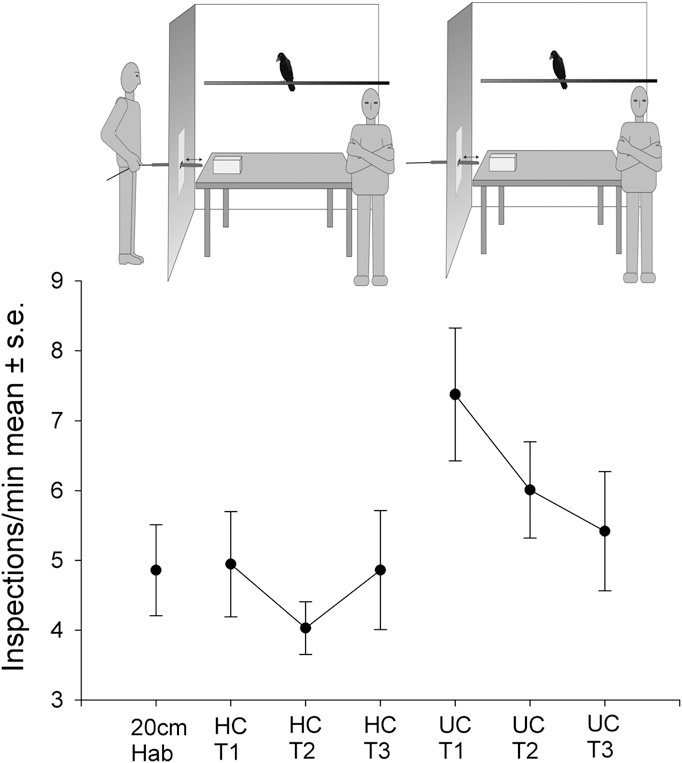
The first set of events: the Hidden Causal Agent (HCA)

In the first set of events, the crows were able to watch as a person (of the human sort) walked behind a blue sheet that was hanging up near to a box containing food. The box had been set up so that the crows had to turn their heads away from watching the sheet in order to get their food out.

Once the human had walked behind the sheet, the crows saw the stick poking out from behind it move, making motions towards the food box, and then they saw the human leave again.  ’Meh’, one could imagine the crows thinking, ‘makes total sense. Fudz om nom nom.’

And that’s what they did – they came down to the food box, picked up a tool and extracted their food, giving nary a glance towards the sheet.

Ah, yes. There was also a second person who came into the room with the first, stood in the corner 1.5m from the sheet with closed eyes and hands held crossed in front of their body. This second person did nothing, and then left with the first person.

The second event: the Unknown Causal Agent (UCA)

In the second set of events, they saw the stick move in the same way without someone walking behind, or walking away from, the sheet. A ghost stick!*

As in the first event, there was also a second person who did nothing at all and then left.


Inspection rate across conditions. Final habituation trial before testing is indicated by 20cm hab. (Upper Left ) Diagram of the HCA condition. (Upper Right) Diagram of the UCA condition. In the HCA condition, one human walked into the hide and one stood in the corner of the room. A wooden stick was then probed from the hide. The agent then exited the hide. Both humans then left the room. In the UCA condition, one human entered the cage and stood in the corner. The tool was then probed through the hole. The human then left. (Taylor, A.H. et al, 2012)

And so?
The experiment had been designed so that this stick stimulus would be a new experience for the crows, and so probably something they’d intrinsically distrust (or not like, at the very least)**.

Read the whole article. And here is another one from Wired.

Whodunit? Crows Ask That Question, Too

A New Caledonian crow uses a twig tool. Image: Mick Sibley

By Virginia Morell, ScienceNOW

Imagine hearing a distant roll of thunder and wondering what caused it. Even asking that question is a sign that you, like all humans, can perform a type of sophisticated thinking known as “causal reasoning”—inferring that mechanisms you can’t see may be responsible for something. But humans aren’t alone in this ability: New Caledonian crows can also reason about hidden mechanisms, or “causal agents,” a team of scientists report Sept. 17 in the Proceedings of the National Academy of Sciences. It’s the first time that this cognitive ability has been experimentally demonstrated in a species other than humans, and the method may help scientists understand how this type of reasoning evolved, the researchers say.


Causal reasoning is “one of the most powerful human abilities,” says Alison Gopnik, a psychologist at the University of California, Berkeley, who was not involved in the study. “It’s at the root of our understanding of the world and one another.” Indeed, it is the key mental ability for many things humans do, including inventing, making, and using tools. We develop this ability early in life: A 2007 study in Developmental Psychology reported that human infants as young as 7 months old understand that when a beanbag is tossed from behind a screen, something or someone must have thrown it. The infants infer that a “causal agent” must be involved in the motion of the flying beanbag.

But why should this ability be limited to humans? “It seems like it would make good sense for crows and many other animals to be able to distinguish between the wind rustling tree limbs and an unseen animal crashing through the canopy,” says Alex Taylor, an evolutionary psychologist at the University of Auckland in New Zealand and the lead author of the new study. Because New Caledonian crows are also inventive and skillful tool-users, Taylor and his colleagues thought the birds might have causal reasoning skills similar to those of humans.

Working on Mare Island in New Caledonia, the scientists captured eight wild crows (five adults and three juveniles) and housed them inside a large outdoor aviary. Over the next few days, the birds used a slender stick to extract food from a small box placed on a table in the aviary. Then the plot thickened: The scientists placed the food box close to a blue tarp large enough for a person to hide behind. The researchers also set up a large stick that could be poked through the tarp and waved around by a human outside the aviary pulling on a string; the moving stick posed a danger to the birds if they tried to extract the food.

The crows in the aviary then observed two different situations. In one, the “hidden causal agent” scenario, the crows saw a human enter the blind. Then, a few moments later, the stick poked through the tarp and moved back and forth 15 times. The human then exited the blind. In the “unknown causal agent” scenario, the crows saw only the stick as it emerged from the tarp and moved back and forth 15 times.

In both situations, a human also stood next to the table in the aviary, so the crows never tried to get the food. And in both cases, when the visible human left, the crows began to remove their food from the box. Yet the crows’ behavior differed depending on whether they had seen a human come and go from the blind. If the birds had seen a human stepping out of the blind, they seldom gave the stick so much as a glance as they dug out their food. But the crows that saw the stick move but no one emerge from the blind were nervous: They often stopped probing for food and studied the blue tarp and stick—apparently suspecting that someone or something unknown had caused the stick to move and that it might move again. Some even flew away from the setup.

Together, the tests show that the crows are “capable of causal reasoning,” Taylor says. “We expected the crows to initially be scared of the moving stick. Instead, they only became scared when they could not attribute the movement to a hidden human—which suggests the crows were reasoning that the stick’s movement was caused by that human.” The crows, he says, apparently don’t expect an inanimate object to move on its own, just as infants don’t expect beanbags to be tossed through the air by a toy block.

“It’s an extremely clever study,” says John Marzluff, a wildlife biologist at the University of Washington, Seattle. “Using a controlled experiment, they’ve validated what many crow hunters know—that crows keep track of hunters in blinds. Even if the crows [in this study] never see a person push the stick, they connect the dots between the location of a person and the actions they associate with people.”

The study “makes important new advances in our understanding of the extent to which nonhuman animals may be capable of causal reasoning and offers the potential to open this whole area up to scientific inquiry in animals,” adds Nicola Clayton, an experimental psychologist at the University of Cambridge in the United Kingdom. Because it suggests that causal reasoning evolved in parallel in humans and crows, the work may even “help solve the fascinating question of just how and why our human intelligence evolved,” Gopnik says.

This story provided by ScienceNOW, the daily online news service of the journal Science.

Tuesday, September 18, 2012

Corvid Brains - Crows and Jays Show Human Traits

There were two very cool stories about corvids in the press last week, one from the University of Washington in Seattle on how crows can remember faces (confirming previous studies) and another from the University of California Davis on the fact that scrub jays mourn their dead, not just individually but as a group.

The cool thing about the crow study was that the researchers developed a less invasive and traumatizing method for conducting the research. Anything that can be done to reduce the trauma is good in my book.

Both of these studies reaffirm the intelligence of corvids in particular and birds/animals in general.

Crows recall faces with human-like brain activity

U. WASHINGTON (US) — Like humans, crows recognize faces and form associations with them—and to accomplish this, the two species’ brains appear to work in similar ways.

Posted by Sandra Hines-UW on Wednesday, September 12, 2012


The findings reveal that similar processes take place in the brains of crows and humans, both of which recognize faces and form positive and associations with them based on experience. "Our approach has wide applicability and potential to improve our understanding of the neural basis for animal behavior," write the University of Washington researchers.

“The regions of the crow brain that work together are not unlike those that work together in mammals, including humans,” says John Marzluff, University of Washington professor of environmental and forest sciences. “These regions were suspected to work in birds but not documented until now.

“For example it appears that birds have a region of their brain that is analogous to the amygdala of mammals,” he says. “The amygdala is the region of the vertebrate brain where negative associations are stored as memories. Previous work primarily concerned its function in mammals while our work shows that a similar system is at work in birds.

“Our approach could be used in other animals—such as lizards and frogs—to see if the process is similar in those vertebrates as well.”


The “caring” and “threatening” masks both have neutral expressions, so the researchers could be sure the crows were remembering and responding to positive or negative associations. 


Marzluff is the lead author of a paper published this week in the online edition of the Proceedings of the National Academy of Sciences.

Previous research on the neural circuitry of animal behavior has been conducted using well-studied, often domesticated, species like rats, chickens, zebra finches, pigeons, and rhesus macaques—but not wild animals like the 12 adult male crows in this study.

The crows were captured by investigators all wearing masks that the researchers referred to as “the threatening face.” The crows were never treated in a threatening way, but the fact they’d been captured created a negative association with the mask they saw.

Then, for the four weeks they were in captivity, they were fed by people wearing a mask different from the first—this one called “the caring face.” The masks were based on actual people’s faces and both bore neutral expressions so the associations made by the crows was based on their treatment.

Awake and active
In most previous neurological studies of animals, the work usually starts by sedating the animals, Marzluff says. Instead, the new approach involved injecting a glucose fluid commonly used in brain imaging into the bodies of fully alert crows that then went back to moving freely about their cages.
The fluid flooded to the parts of the crow brains that were most active as they were exposed for about 15 minutes to someone wearing either the threatening or caring mask.

Then the birds were sedated and scans made of their brains. All the birds were returned to the wild once all the work was completed.

“Our approach has wide applicability and potential to improve our understanding of the neural basis for animal behavior,” write Marzluff and co-authors Donna Cross, Robert Miyaoka, and Satoshi Minoshima, all faculty members with the radiology department. The department funded the preliminary work while the main project was conducted using money from the University’s Royalty Research Fund.

Most neurological studies to date in birds have concerned their songs—how their brain registers what they hear, how they learn and come up with songs of their own. This new approach enables researchers to study the visual system of birds and how the brain integrates visual sensation into behavioral action, Marzluff says.

Stress reduction
Among other things the findings have implications for lowering the stress of captive animals, he says.

“By feeding and caring for birds in captivity their brain activity suggests that the birds view their keepers as valued social partners, rather than animals that must be feared. So, to keep captive animals happy we need to treat them well and do so consistently,” he says.

Intriguingly, Marzluff says the findings might also offer a way to reduce conflict between birds and endangered species on which they might be feeding. In the Mojave Desert, for instance, ravens prey on endangered desert tortoises. And on the West and East coasts, crows and ravens prey on threatened snowy plovers.

“Our studies suggest that we can train these birds to do the right thing,” Marzluff says. “By pairing a negative experience with eating a tortoise or a plover, the brain of the birds quickly learns the association. To reduce predation in a specific area we could train birds to avoid that area or that particular prey by catching them as they attempt to prey on the rare species.”

Collaborative work among neuroscientists and ecologists could be used to better understand the neural basis of cognition in widely diverse animals, says co-author Cross. For example, her suggestion to use the glucose technique prior to brain scans, so the crows could be fully awake, could be used for other animals.
A researchers wore the “caring mask” to feed the crows. (Credit: Jack DeLap/U of Washington)

Source: University of Washington
* * * * * * *

Scrub jays react to their dead

Posted On: September 11, 2012

Western scrub jays summon others to screech over the body of a dead jay, according to new research from the University of California, Davis. The birds' cacophonous "funerals" can last for up to half an hour.

Anecdotal reports have suggested that other animals, including elephants, chimpanzees and birds in the crow family, react to dead of their species, said Teresa Iglesias, the UC Davis graduate student who carried out the work. But few experimental studies have explored this behavior.

The new research by Iglesias and her colleagues appears in the Aug. 27 issue of the journal Animal Behaviour.

Western scrub jays live in breeding pairs and are not particularly social birds.

"They're really territorial and not at all friendly with other scrub-jays," Iglesias said.

Working in the backyards of homes in Davis, Calif., Iglesias set up feeding tables to encourage visits from the jays. Then she videotaped their behavior when she placed a dead jay on the ground. She compared these reactions with the birds' behavior when confronted with a dead jay that had been stuffed and mounted on a perch, a stuffed horned owl, and wood painted to represent jay feathers.

On encountering a dead jay, prostrate on the ground, jays flew into a tree and began a series of loud, screeching calls that attracted other jays. The summoned birds perched on trees and fences around the body and joined in the calling. These cacophonous gatherings could last from a few seconds to as long as 30 minutes.

Western scrub-jay at a backyard bird feeder in Davis, CA. UC Davis researchers found the birds gather for noisy "funerals" when they encounter a dead jay. (Photo Credit: Stephanie Macey-Gallow, UC Davis.)
Jays formed similar cacophonous gatherings in response to a mounted owl, but ignored painted wood. When confronted with a mounted jay, the birds swooped in on it as if it were an intruder.

Jays typically gathered within seconds of the first bird calling, Iglesias said. If they did not, the first jay would often fly higher into a tree, apparently to call more widely.

"It looked like they were actively trying to attract attention," she said.

The purpose of the calls seems to be to alert other birds of danger, Iglesias said. But why the calls summon others, rather than warning them off, is unclear. Having more jays present might mean more eyes to locate a predator, or more numbers to drive it away, she speculates.

There might also be a learning component to the gatherings, if they help teach young jays about dangers in the environment, Iglesias said.

While reactions of animals to their dead are sometimes called "funerals," that does not imply that there is an emotional or ritual element to the behavior, Iglesias said. We simply don't know enough about the emotional life of animals to understand that.

But Iglesias isn't ruling it out. "I think there's a huge possibility that there is much more to learn about the social and emotional lives of birds," she said.


Wednesday, August 01, 2012

John Marzluff, Ph.D. - The Alluring Language of Crows and Ravens


John Marzluff, Ph.D. is a professor of wildlife science at the University of Washington where he researches the behavior and conservation of birds, especially crows, ravens, and jays, and teaches classes in field ecology, ornithology, and endangered species conservation. Marzluff is author of Gifts of the Crow: How Perception, Emotion, and Thought Allow Smart Birds to Behave Like Humans.

Why are crows and ravens so verbose?


On a recent trip into the Alaskan wilderness I had the opportunity to listen and wonder about animal communication. I marveled at the thunderous breaths and splashes of humpback whales, though I could not hear their songs. Soprano seabird cries—the keer-keer of the murrelet, yodel of the loon, and tinny screech of the tern—combined with the base of sea mammal sounds and soft crashing of waves to create a truly wild symphony. In this orchestra, the raven was the soloist.  From the spruce forest came a performance that was simply divine. A unique rendition of quorks, yells, trills, knocks, and rattles rang with clarity above the wild background. The raven repeated some phrases, perhaps to emphasize an important message, but variety is what distinguished the raven’s language from that of the typical seabird or sea mammal. As a life-long student of ravens, I recognized many of the calls. Most are directed to potential territorial intruders, but others signal common dangers or opportunities. Always, it seems there is something new to hear. Today it was a dripping noise, perhaps innovated by the composer raven as she listened to mussel shells clink against pebbles.  As I listened I questioned why the raven should be so verbose.  

A rich vocabulary is an advantage to any animal that must coordinate daily activities with social partners. This is the case for the raven, as each bird jointly defends space with a lifelong mate, quarrels and displays status with others that flock to rich foods, and warns all listeners of danger afoot. As Tony and I describe in our book “Gifts of the Crow,” the raven is the largest songbird and as such has a brain capable of continual song learning. New, useful, and intriguing noises can be memorized by the raven and imitated as near perfect renditions. These can be incorporated into a growing and individual repertoire. A complex social lifestyle, long lifespan, and songbird brain provides the motive and the machinery a raven needs to remain the most eloquent of avian orators.

The vocal nature of the raven allows it to thrive in a variable social scene. Speech also allows the huge ebony birds to engage humans. As I stood near the Gustavus, Alaska boat dock a worker rode his bike toward shore. The man let out a curious “Kraaw” as he peddled past a perched raven. The raven looked, but did not answer. With continued listening, some day he may reply. The Caesar, Augustus, purchased ravens that routinely spoke, hailing him with praise as “the victorious commander.” Some ravens at the Tower of London also speak to tourists, commanding those who stray to “keep to the path.”  By investigating the reports of ravens and other corvids that imitate human speech, we have learned that they often use our words to get a desired reaction—recognition of a social partner, a startled drop of a favorite food, or the rounding up of other animals.

The sounds made by crows and ravens share many properties with our language, and above all this is what so captivates those who listen. The words they learn are associated with a particular meaning, and unlike onomatopoetic words, the sounds themselves have no inherent meaning. To a corvid, our words are arbitrary symbols. As we listen, we are also learning that their typical corvine calls are also often arbitrary. Ravens cluck like hens at the sight of a predator, trill at each other when ready to battle for a privileged spot at a carcass, and beg for mercy from a dominant. Some raven calls are even referential; the haaa call refers only to meat. There may be important information in the sequence of a crow’s caws or a raven’s quorks, but as of yet that has not been deciphered. The future may bring finer resolution. One thing we don’t expect to learn about corvid communication is an ability to converse about the past or future. As far as we know, all animal communication (other than our own) is about the hear and now. But for myself, and the worker in Gustavus, there remains plenty to wonder about whenever we hear a gabbing group of ravens. As we wrote in Gifts of the Crow:
“Talking crows reveal a part of their cognitive lives. To talk, crows must be able to form and replay memories. They confront the immediate with memory of the past. They dream. While we don’t claim that speaking crows really grasp the complexity of human language, they use our words to get what they want, which is remarkable. That a crow will learn and use a human trick reinforces the depth to which our species are intertwined. Crows manipulate, deceive, play, and converse with other species. They anticipate rewards and, to reap them, devise and carry out plans. When we overhear crows singing softly to themselves, we wonder if they derive pleasure simply by listening to the sounds they can make. So much of what we hear from crows or ravens is inexplicable. They ring like bells, drip like water, and have precise rhythm. They sing alone or in great symphonies. Some of their noise could be music.” (Copyright 2012 Free Press)
Take a good listen to the next crow or raven you encounter and let us know what you hear. Help us to connect sounds with meaning, so that we may continue to improve our understanding of the communicative abilities of smart and innovative birds.

Thursday, July 26, 2012

John Marzluff - Gifts of the Crow: How Perception, Emotion, and Thought Allow Smart Birds to Behave Like Humans

Amazon has a book review feature that I had kind of forgotten about, called Omnivoracious. An old friend from Seattle, who knows I love all things related to crows and ravens, sent me a link to the review of a new book by John Marzluff called, Gifts of the Crow: How Perception, Emotion, and Thought Allow Smart Birds to Behave Like Humans. Martzluff is a professor at the University of Washington, in Seattle, which has one of the densest populations of crows on the planet.

Here is the brief review (which is actually a commentary by the author on why crows?):

Are Crows Smarter Than Us? John Marzluff Explains

We’ve seen a few fun bird books this year, including Bird Sense: What It is Like to Be a Bird, a Best of the Month pick in April, and What The Robin Knows: How Birds Reveal the Secrets of the Natural World.

Now comes John Marzluff's captivating Gifts of the Crow: How Perception, Emotion, and Thought Allow Smart Birds to Behave Like Humans. Among other shockers I learned that crows (and their kin, ravens and jays) have huge brains and street smarts, they drink coffee and beer, they use tools and language, and they're even capable of murder.

So we asked the author, What’s the deal with crows? Are they, like, the smartest birds on the planet? Here's what Martzluff, a University of Washington professor, has to say.
~~~~~~~~~~~~~~~~~~~~~~~~~~~~~~~~~~~~~~~~~~~~~~~~~~~~~~~~~~~~~~~~~~~~~~
MarzluffJohnHere’s the deal with crows. They are basically flying monkeys. Their brains are as large as a monkey’s brain of their size would be; much larger than other birds. Remember the Wizard of Oz? That pack of flying primates that hunted Dorothy and her companions had nothing (stylish hats and coats aside) on the crows that roam your backyard. The monkeys seemed only to express the emotion of fear or anger, and were fully under the control of the Wicked Witch of the West. Heck in the movie they couldn’t even speak! Crows, on the other hand, always seem to express their free will. They can imitate human voice and often do so! In Montana, one crow was so adept at mimicking a master’s “Here Boy, Come Boy” that it could call dogs, and did so on many occasions. This talking crow even assembled a pack of mutts by flying from house to house and fooling dogs into thinking they were following their owner! With his pack in tow, the crow headed to the University of Montana campus, kept them at attention beneath a tree, and ran them through students as they walked between classrooms! For fun or to possibly dislodge a sandwich remains unknown, but certainly Oz’s monkeys couldn’t do that!

CrowsCrows are super smart because they have long lifespans, spend considerable portions of their lives with others in social groups, and learn quickly through trial and error and by observation. Their brains, like our own, allow crows to form lasting, emotionally charged memories. They dream and reconsider what they see and hear before acting (something we aren’t always so good at). They go through their lives much as we do—sensing, considering, forming a plan of action, and adjusting. They can recognize and remember individual people, for years. In Sweden, magpies (close relatives of crows) learned to ring a doorbell whenever they saw the lady of house because she occasionally fed them. Her husband never fed them and even attempted to shoo them away. In retaliation they crapped on his car windshield every morning. It’s a good thing monkeys can’t really fly.

CROWSBut are crows the smartest birds on the planet? I wouldn’t go quite that far but certainly they are among the smartest. As with people, it is hard to develop a standardized test of intelligence with which to score and rank birds. If the test required making a tool, then the New Caledonia crow would win. If, on the other hand, the test required the creation of a new word, then the African Gray Parrot would likely win. We humans are today administering perhaps the toughest test ever on those with whom we share Earth. Our rapid transformation of land, cooption of resources, and change of climate challenges all plants and animals. To this test, again the crow is well suited. Their large and complex brains allow crows to innovate, intuit, and quickly associate reward and punishment with action. Through this complex cognition they are able to solve whatever humanity throws their way: they adapt to new foods, new lands, new resources, and likely a new climate. So, if the test includes the question “can you live with people?” then crows by their wonderful adaptability will come out at the head of the class.
--John Marzluff

(The illustration on the right--in which a crow rounds up a pack of dogs--is by Tony Angell, whose drawings and diagrams of mischievous and playful crows appear throughout Gifts of the Crow, a perfect complement to Marzluff's lively storytelling.)

Wednesday, May 09, 2012

Documentary - A Murder of Crows


Long-time readers of this blog know I am a huge fan of crows and ravens - these corvids (along with some parrots) are smarter than many primates and nearly all other mammals. A Murder of Crows is a great documentary on the intelligence of crows.


A Murder of Crows
Although cultures around the world may regard the crow as a scavenger, bad omen, or nuisance, this bad reputation might overshadow what could be regarded as the crow’s most striking characteristic – its intelligence. New research indicates that crows are among the brightest animals in the world. A Murder of Crows brings you these so-called feathered apes, as you have never seen them before.

Thursday, December 29, 2011

The Amazing Intelligence of Ravens and Crows

Here are a couple of posts from the last month on the amazing intelligence of ravens - for newer readers, I have been fascinated by the whole corvid family, but especially crows and ravens, for a couple of decades at least. I tend to post whatever new research comes out about their intelligence and culture.

First from io9:

Monday, November 14, 2011

PBS Nature - A Murder of Crows


My friend Tom sent me a link to this video - anyone who is fascinated by the incredible intelligence of crows will likely enjoy this. We seriously need to reconsider our assumptions about intelligence in other species.

The video below is part one of six - you can watch the whole show at the PBS site.


Watch A Murder of Crows on PBS. See more from NATURE.

A Murder of Crows
Introduction

Crows live everywhere in the world except Antarctica and are a part of myths and legends in many cultures. Their reputation in the stories varies from comical to frightening, godlike or wise, bringers of light and bringers of death, though a “murder” of crows refers to a flock of crows, and not to anything murderous, at all. They may be all these things, but what we are learning is that they are especially smart.

New research has shown that they are among the most intelligent animals on the planet. They use tools as only elephants and chimpanzees do, and recognize 250 distinct calls. One particular talent they have been discovered to possess is the ability to recognize individual human faces and pick them out of a crowd up to two years later – a trick that might make even Hitchcock shiver with fright.

They thrive wherever people live and have used their great intelligence to adapt again and again to a constantly changing world. Some memorize garbage truck routes, and follow the feast from day to day. Others drop nuts in the road and wait for passing cars to crack them open. And some build their nests from items we throw away – like wire clothes hangers.

These are social birds that mate for life and raise their young for up to five years. And they learn from each other’s misfortunes. When one is killed in a farmer’s field, it’s not uncommon for them to change entire migratory patterns so that no crows fly over that field for as long as two years.

These birds might have a scary reputation, but what may prove to be the scariest thing about them is how much they know about us, and how little we know about them!