Showing posts with label parts work. Show all posts

Friday, September 05, 2014

Shrink Rap Radio #419 – Internal Family Systems Therapy with Jay Earley PhD

http://www.selfleadership.org/files/ifs_store/WBK-004-SELF-THERAPY-WORKBOOK-c.jpg

Aside from Richard Schwartz, the creator of Internal Family Systems Therapy, no one has done more to make the ideas and techniques available to therapists and lay readers than Jay Earley (along with his wife and frequent co-author, Bonnie Weiss).

On this week's episode of Shrink Rap Radio, Dr. David Van Nuys interviews Dr. Jay Earley.

Shrink Rap Radio #419 – Internal Family Systems Therapy with Jay Earley PhD

A psychology podcast by David Van Nuys, Ph.D.
Posted on September 3, 2014
Copyright 2014: David Van Nuys, Ph.D.


Jay Earley

Jay Earley, PhD, is a psychotherapist, group leader, author, teacher, and theorist. He teaches Internal Family Systems Therapy (IFS) IFS to the general public as a practice for self-help and peer counseling. He also teaches a variety of classes and workshops applying IFS to specific psychological issues such as procrastination, communication, relationships, and the inner critic. He is the author of Self-Therapy: A Step-by-Step Guide to Inner Wholeness Using IFS, Freedom from Your Inner Critic, Resolving Inner Conflict, Working with Anger in IFS, and Negotiating for Self-Leadership in IFS. Jay Earley and Bonnie Weiss have published a series of audio products related to IFS, including IFS Courses, Guided Meditations, and Demonstration Sessions.

Jay has created the Pattern System, a method for understanding parts, behavior, healthy capacities, internal dynamics, and underlying psychological issues. It is useful for mapping the psyche, understanding how people act and relate to others, and guiding IFS work. He has published a book entitled The Pattern System, and a book Conflict, Care, and Love that helps you to understand your relationship patterns and transform them.

Jay is the creator of Self-Therapy Journey, a web application for psychological exploration and healing, which is based on IFS and the Pattern System.

Podcast:

Play
Check out the following Psychology CE Courses based on listening to Shrink Rap Radio interviews:

Wednesday, August 20, 2014

How Shame Devalues the Self and Reviving the True Self

One of the commonalities in nearly all of the people I see as a therapist is the shame they feel about who they are as human beings. And to clarify, shame is the sense that "I am wrong, defective, worthless." Shame is often confused with guilt, which is the sense that "I did something wrong." There is a huge difference - shame is about who we are, guilt is about what we did. And to confused things, we can sometimes become shame-filled about things we have done or not done if those actions are seen as a reflection of who we are as people.

Margarita Tartakovsky, over Psych Central's World of Psychology blog, offers some insights on shame from Darlene Lancer's book, Conquering Shame and Codependency: 8 Steps to Freeing the True You.

One of the cool distinctions is the four selves:
  • Ideal self: “who we believe we should be”
  • Persona: “what we show to others”
  • Critic: “our inner shaming voice”
  • Devalued self: “the result of the critic’s shaming”
This is the material, the selves, I often end up working with in clients. I don't if the book is good, but the suggestions in this article for working with these selves on your own are good.


Overcoming Shame to Connect with Your True Self 

By Margarita Tartakovsky, M.S.
Associate Editor

Each of us experiences shame.

“[I]t is part of our human condition,” writes author and therapist Darlene Lancer, LMFT, in Conquering Shame and Codependency: 8 Steps to Freeing the True You.

Without good coping skills, we may feel like failures when we don’t meet our own or others’ expectations, she writes. In fact, shame can even prevent us from being our true selves. Shame often starts in childhood. It can even get passed down from generation to generation. 
Shame thrives in families where kids must keep secrets about such as issues as addiction, infidelity or poverty, to keep up appearances.

Teachers might shame kids for their academic performance. Parents might shame kids for expressing feelings such as anger or sadness.

Shame can camouflage our true self, because it can lead us to manufacture false selves, according to Lancer. These are the:

  • Ideal self: “who we believe we should be”
  • Persona: “what we show to others”
  • Critic: “our inner shaming voice”
  • Devalued self: “the result of the critic’s shaming”
For instance, if your parents or caregivers rejected or denied certain parts of your real self, you might’ve experienced shame and created an ideal self. If sadness wasn’t accepted in your family, then you might imagine being the “family hero,” a “tough kid” or a “good girl,” Lancer writes.

This ideal self provides an imagined sense of acceptance and worth. But it also alienates the real self, because, after all, it’s a false self. People may pick professions, partners and lifestyles to garner others’ approval.

Before she was a therapist, Lancer pursued a law career. “I unconsciously thought that being a lawyer would gain my parents’ respect, since they didn’t support my original career goals — one of which was to become a therapist.”

We also bend for our inner critic. We suppress our real feelings and anything else that doesn’t conform to the ideal. So we force ourselves to think different thoughts, to feel different feelings and do different things. When we inevitably don’t measure up to our ideal image, we’re stricken with shame. But as Lancer writes, “In actuality we’re expecting the impossible — to become someone other than ourselves.”

In Conquering Shame and Codependency, Lancer includes valuable and practical strategies for overcoming shame and becoming our authentic selves. She notes that “getting to know our real self is a process of uncovering and discovering.” These tips from her book can help with this process:

Check in with yourself on a daily basis.

Ask yourself what you’re feeling and what you want today. Ask yourself what you’d like for the future. Consider what your body, mind, heart and soul need. Then figure out the steps you can take to respond to these needs.

Write about your interactions.

You also can review your interactions every day. Lancer includes these additional questions to explore: “Did you ever avoid saying what you were really thinking or feeling? What kept you from doing so? Did you make decisions based on your values?”

Write about your feelings.

Be honest about what you’re feeling, and know that you can express yourself fully on the page. If you were shamed for having certain feelings — such as anger or sadness — know that any feeling you’re experiencing is valid.

Explore your values.

“Knowing our values helps us make decisions that are right for us,” writes Lancer. Look within and write down what’s important to you – not your parents, partner or anyone else.

Share your real self.

According to Lancer, being vulnerable with others creates connection, builds trust in them and ourselves and strengthens our true selves.

Share your feelings and needs with people who make you feel safe and won’t judge you. For instance, Lancer suggests attending a 12-step meeting, such as Al-Anon or Codependents Anonymous, or working with a therapist.

She also suggests starting to express your vulnerability by sharing a mistake you made with someone you trust.

Shame can stifle our true selves. By seeking supportive resources and delving into your feelings, thoughts and values, you can get to know yourself better, overcome your shame and embrace the real you.


~ Margarita Tartakovsky, M.S. is an Associate Editor at Psych Central and blogs regularly about eating and self-image issues on her own blog, Weightless.

Like this author?
Catch up on other posts by Margarita Tartakovsky, M.S. (or subscribe to their feed).

Tuesday, March 11, 2014

Feeling Self-Critical? Try Mindfulness (Emily Nauman at Greater Good)

This is a brief but useful article from the Greater Good Science Center (UC Berkeley) on using mindfulness to deal with inner critic, although they frame it more in terms of self-esteem.

I would suggest using mindfulness directly in the inner critic by learning to identify its voice, its criticisms, and then be curious about the reasons the critic might be acting this way. What does it want? What are its needs? How is it trying to serve you?

And that last question is crucial - when we begin to understand that all of our "parts," including (and maybe especially) the inner critic, came into existence to help us in some way, then our relationship with them can shift from adversarial to cooperative.

Feeling Self-Critical? Try Mindfulness

New research shows that mindfulness may help us to stop comparing ourselves to other people

By Emily Nauman | March 9, 2014


Our Mindful Mondays series provides ongoing coverage of the exploding field of mindfulness research. Dan Archer

Many of us feel great about ourselves when we focus on how much success we’ve had in comparison to others. But what happens when we don’t succeed? Self-esteem sinks. 

New research shows that developing mindfulness skills may help us build secure self-esteem—that is, self-esteem that endures regardless of our success in comparison to those around us.

Christopher Pepping and his colleagues at Griffith University in Australia conducted two studies to demonstrate that mindfulness skills help enhance self-esteem.

In the first study, the researchers administered questionnaires to undergraduate students in an introductory psychology course to measure their mindfulness skills and their self-esteem. The researchers anticipated that four aspects of mindfulness would predict higher self-esteem:
  • Labeling internal experiences with words, which might prevent people from getting consumed by self-critical thoughts and emotions;
  • Bringing a non-judgmental attitude toward thoughts and emotions, which could help individuals have a neutral, accepting attitude toward the self;
  • Sustaining attention on the present moment, which could help people avoid becoming caught up in self-critical thoughts that relate to events from the past or future;
  • Letting thoughts and emotions enter and leave awareness without reacting to them.
The results, published in The Journal of Positive Psychology, support the researchers’ predictions: students with these mindfulness skills indeed had higher self-esteem. However, this study did not clarify whether mindfulness causes self-esteem, or whether those with mindfulness also had higher self-esteem because of some other factor.

In order to find out if mindfulness directly causes higher self-esteem, the researchers conducted a second study. They instructed half of the participants to complete a 15-minute mindfulness meditation that focused on the sensation of their breath. The other half of participants read a 15-minute story about Venus fly-trap plants. All of the participants completed questionnaires that assessed their level of self-esteem and mindfulness both before and after they completed the 15-minute task.

Consistent with the researchers’ predictions, those that participated in the mindfulness meditation had higher scores in mindfulness and in self-esteem after meditating, while there was no change in these dimensions for those that read the Venus fly-trap plant story.

Because the only difference between the two groups was whether or not they participated in a mindfulness exercise, these results suggest that mindfulness directly causes enhanced self-esteem.

The authors write that because the effects of the mindfulness exercise on self-esteem in this study were temporary, future research should examine if mindfulness interventions can lead to long-term changes in self-esteem.

However, these findings are promising. The authors write, “Mindfulness may be a useful way to address the underlying processes associated with low self-esteem, without temporarily bolstering positive views of oneself by focusing on achievement or other transient factors. In brief, mindfulness may assist individuals to experience a more secure form of high self-esteem.”

About The Author

Emily Nauman is a GGSC research assistant. She completed her undergraduate studies at Oberlin College with a double major in Psychology and French, and has previously worked as a research assistant in Oberlin’s Psycholinguistics lab and Boston University’s Eating Disorders Program.

Related Articles

Wednesday, December 25, 2013

Preliminary Thoughts on a New Nomenclature of Psychotherapeutic Diagnosis and Practice

 
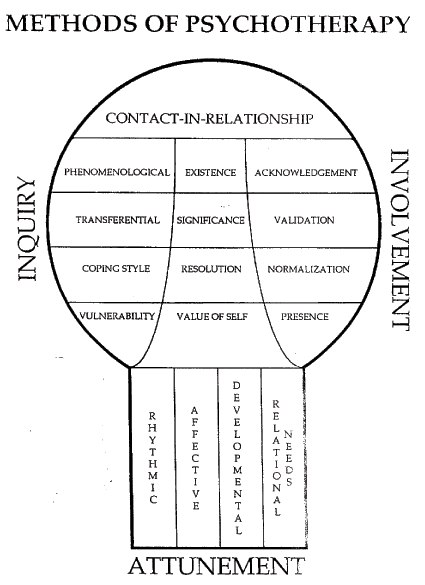
Above is one model of integrative psychotherapy (Erskine and Trautmann, 1996). What follows below are some preliminary thoughts on how I practice as a therapist and how I might change the existing nomenclature to reflect a more client-centered, relational model that rejects pathologizing language and structures (i.e., the DSM).

Premise: 


What counselors and psychotherapists have been taught to identify as symptoms of a corresponding condition pejoratively defined as "mental illness" should rather be understood as adaptations to experience.

All adaptations are at their genesis the best available mechanism for survival. As a person ages, these adaptations become either skillful (healthy) or unskillful (not supporting physical, emotional, mental, and spiritual health).

Disclaimer:


Short-term responses to challenging situations are not, in general, to be seen as adaptations to that experience (i.e., normal human emotional responses to life events such as death of a loved one, losing a job or promotion, surviving an accident, and so on). If, however, there are several similar experiences over a person's lifetime, with a corresponding response pattern that has solidified into what Carl Jung defined as a "complex," then this then can be seen as an adaption and not a response. 

Diagnosis:


When we join a new client on their healing journey, our task is to identify with them the somatic symptoms, affect dysregulation, cognitive distortions, lost spirituality, the core beliefs, and each domain's corresponding defense mechanisms that block an integrative experience of full health.

An integrative approach assesses from (at least) five domains, four of which are addressed by specific models of psychotherapy that contend their model is the only necessary model:
  • Body - somatic symptoms and unconscious behaviors
  • Affect - ability to regulate affect and for affect to match verbal and behavioral expression
  • Cognitive - possessing rational and non-distorted self-concepts, lack or pervasive thinking errors, or other forms of unskillful cognitive and behavioral scripts
  • Spiritual - a sense of purpose and meaning in one's life whether it's religious, spiritual, or atheist/humanist
The fifth domain is the Core Beliefs a person holds about who s/he is and what other people believe about him or her. These beliefs are deeply held and generally unconscious. They tend to originate in infancy and early childhood, making them difficult to uproot in order to plant new seeds for healthier core beliefs. Further, core beliefs tend to manifest in each of the four other domains listed above.

Multiplicity


We are all born (barring organic defects) with a whole and healthy Self-seed (our genetic and characterological template) that will become a mature sense of Self. However, no one escapes childhood without that Self being compromised in some way. Some children are so abused and/or neglected that they never develop a solid sense of self.

Consequently, parts of the self that are either overwhelming (emotional responses to trauma), unsafe (natural behaviors that are punished by caregivers), or not nurtured (for example, capacity for compassion or generosity) are split off from the Self and become self-fragments, ego states, parts, or subpersonalities that often remain unconscious and tend to show up in various forms of projection.

For each split off part, there is a part or parts that manages the outside world in some way to keep those "exiled" parts out of consciousness. Some of the common "managers" are the Pusher (focused on achievement and constant movement toward the next goal), Perfectionist (all or nothing thinking, a need for personal perfection, the failure of which brings intense shame), Pleaser (often middle children or first children who try to make everyone else happy, often at the expense of their own happiness), and the Inner Critic (a part who seeks to ensure the client is never criticized by others by being so hyper-critical of the client that any other criticism will be avoided). 

In order for splitting to become "hard-wired," there must be repeated episodes of the experiences that lead to the splitting. Normal misattunement between child and caregiver will not lead to splitting and, in fact, such misattunements are necessary for the development of resilience when they are quickly repaired by the caregiver.

Worldviews or Reality Frames


It is incumbant upon the therapist to be "experience near" (Kohut) with the client and be able to identify their basic worldview or reality model. This does not mean that the therapist necessarily supports the client's worldview, however, but it does require that the therapist be able to work within that reality frame.

It's also important that a client's worldview be held lightly - different parts of the client will possess alternate worldviews with anywhere from slight to profound variations.

Likewise, when a therapist encounters a new client whose worldview is unfamiliar (for example, someone from another country, or members of Tribal Nations, and so on), it is essential that therapists educate themselves as best they can and that they inquire with the client when they start to make assumptions about the client's experience that may not fit their reality frame.

Models of Psychotherapy


Successful therapeutic interventions require the all five domains are addressed. Here are a few examples of the therapeutic models that address the various domains:

Body - nutrition, exercise, somatic therapies (Somatic Experiencing, Bioenergetics, Yoga Therapy), behavioral psychotherapies, mindfulness-based therapies, Internal Family Systems Therapy (IFS - "parts work"), Hakomi, Eye Movement Desensitization, and Reprocessing (EMDR)
Affect - affective neuroscience, interpersonal neurobiology, intersubjective and relational psychotherapies, mindfulness-based therapies, IFS
Cognitive - cognitive behavioral therapies (CBT), dialectical behavioral therapy (DBT), neurolinguistic programming (NLP), rational emotive behavioral therapy (REBT), script analysis (Transactional Analysis), existential psychotherapy, narrative therapy, IFS
Spiritual - transpersonal psychotherapy, Jungian Analytical Psychotherapy, contemplative practices, meta-narrative therapies, existential psychotherapy, IFS (developing "Self-Leadership"), expressive therapies
Core Beliefs - cognitive therapies, relational psychotherapies, IFS, narrative therapies, creative visualization, soul retrieval, expressive therapies

Undoubtedly, there are other models I am not familiar with or that have slipped my mind at the moment, so this list should not be taken as my final position on this topic.

Goals of Psychotherapy


First rule: Do No Harm. Second rule: It's not the therapy, it's the relationship.

If therapists can successfully follow these two rules, and hold a belief in the inherent ability of the client to heal, as well as a belief in the client's ability to know what therapeutic pace and which interventions are best for them, then the client becomes his or her own healer and the therapist simply "midwife" that process with them.

The goal is never to impose a therapist's sense of "mental health" but, rather, to explore with the client what their own sense of mental health looks like and feels like in their lives. Having done so, then it becomes easier for the therapist to identify with the client which areas or domains of their life are not functioning optimally.

Areas of less-than-optimal function are the adaptations defined as unskillful that therapy seeks to minimize while also helping the client learn skillful adaptations to replace those being minimized.

***

Okay then, that is my first-pass at a new model. Please share your thoughts, comments, and criticisms in the comments section here or at Facebook.


Thursday, October 03, 2013

Tami Simon in Conversation with Jay Earley - Self-Therapy


I have had the good fortune to chat with Dr. Earley a couple of times at the annual Internal Family Systems (IFS) Conference, although it has been years now. Early is one the leading exponents of the IFS therapy model developed by Dr. Richard Schwartz (Internal Family Systems Therapy, 1997).


I use the IFS approach quite often with my clients - for everything from depression and anxiety to dissociative identity disorder. It is a central part of my integrative approach to dissociative disorders.

Dr. Early is the author of many, many books - besides those with Sounds True listed below - including Negotiating for Self-Leadership in Internal Family Systems Therapy (2012), Letting Go of Perfectionism: Gaining Perspective, Balance, and Ease (2012), Working with Anger in Internal Family Systems Therapy (2012), and Self-Therapy for Your Inner Critic: Transforming Self Criticism into Self-Confidence (2010).

Jay Earley: Self-Therapy

Tuesday, September 24, 2013


Tami Simon speaks with Dr. Jay Earley, a transformational psychologist and psychotherapist specializing in a method called Internal Family Systems (IFS) therapy, an approach that recognizes our many sub-personalities and their roles in the overall health of our psyche. With Sounds True, Dr. Earley has created an audio learning course called Self-Therapy, as well as a new book with co-author Bonnie Weiss called Freedom from Your Inner Critic. In this episode, Tami speaks with Jay about how we can work with and heal the inner Exiles in ourselves, the function of the sub-personalities known as Protectors, and how awakening to our true Self is the key to successful self-therapy. (60 minutes)

Play 

<< Download >>

<< Read Transcript >> 


More from Jay Earley: 


Self-Therapy


Freedom from Your Inner Critic 

Saturday, August 10, 2013

TED Blog - Everything You Ever Wanted to Know About Voice Hearing (But Were Too Afraid to Ask)


Eleanor Longden is the author of Learning from the Voices in My Head, a book in which she chronicles her experience of hearing voices, struggling with a diagnosis of schizophrenia, and her eventual befriending of the voices.

This is a topic close to my heart - many of the clients I deal with hear voices and none of them are schizophrenic. As an advocate of the Internal Family Systems model of therapy, I generally attempt to bring the voices into the therapeutic alliance. This process requires the client to befriend the voices and approach them with compassion and curiosity - two of the 8 c-words indicating the client is in Self and not in a part (all 8 of the c-words: calmness, curiosity, clarity, compassion, confidence, creativity, courage, and connectedness).

Everything you ever wanted to know about voice hearing (but were too afraid to ask)

Posted by: Michelle Quint
August 8, 2013


Eleanor Longden gave a candid talk about the fact that she hears voices at TED2013. Today, we also release her TED Book, which delves further into her experience in the mental health system. Below, all the questions you’d want to ask Longden. Photo: James Duncan Davidson


During her freshman year of college, Eleanor Longden began hearing voices: a narrator describing her actions as she went about her day. Diagnosed with schizophrenia, Longden began what she describes as a “psychic civil war,” fighting to stop the voices as they became antagonistic. Eleanor Longden: The voices in my head. What helped her was something unexpected: making peace with them. By learning to see the voices as a source of insight rather than a symptom, Longden took control.

What’s it like to hear voices? Read Eleanor’s FAQ below — where she tells you everything you wanted to know about voice hearing, with her signature honesty and humor.

Want more? Longden first spoke during our Worldwide Talent Search; then told a longer version of her journey toward acceptance of her own mind on the mainstage at TED2013. And today, Longden premieres her TED Book, delving deeper into her experience. Learning from the Voices in My Head is available for the Kindle, the Nook and through the iBookstore.

Do your voices ever talk to each other (and exclude you)?

Sometimes. In the old days they would talk about me a lot more, but now they usually speak to me directly. And when they do discuss me, it’s more likely to be compliments or positive encouragement. Or sometimes they’ll discuss something I’m worried about and debate possible solutions. There’s one particular voice that will repeat helpful mantras to the others. A recent one was: “If you can do something about it, there’s no need to worry. And if you can’t do anything about it, there’s no point in worrying!”

Do the voices sound like they are coming from inside your head or through your ears?

This is something else that’s changed a bit over time. They used to be more external, but now tend to be internal or outside, but very close to my ears. It can also vary depending on which voice is speaking.

What would you miss if you lost the voices? Would you be lonely?

My voices are an important part of my identity – literally, they are part of me – so yes, I would miss them if they went. I should probably insure them actually, because if they do ever go I’ll be out of a job! This seems extraordinary given how desperate I used to be to get rid of them. But they provide me with a lot of insights about myself, and they hold a very rich repertoire of different memories and emotions. They’re also very useful when I do public speaking, as they’ll often remind me if I’ve missed something. They can be helpful with general knowledge quizzes too! One of them even used to recite answers during my university exams. Peter Bullimore, a trustee of the English Hearing Voices Network, published a beautiful children’s book that was dictated to him by his voices.

Do your voices ever overlap? Could they harmonize?

They sometimes talk over each other, but don’t really say the same things in unison. I’ve met people whose voices do that though, like a chorus. Other people sometimes describe voices that sound like a football crowd, or a group talking at a party. At a recent conference, I heard a really extraordinary fact: that people who’ve been deaf from birth don’t hear voices, but see hands signing at them.

Do your voices happen all the time? Like, even during sex? Do you have to shush them during a movie?

No, not all the time! Although they’re often more active (and sometimes more negative or antagonistic) when I’m stressed. Even this can be useful though, as it’s a reminder to take some time out and look after myself. I relate to them so much better now, so if they become intrusive and I ask them to be quiet in a calm, respectful way — then 99% of the time they would.

Can you make certain voices pop up at will?

Yes, some of the time. Actually, this was something I used several years ago during therapy – my therapist would say for example, “I’d like to speak with the voice that’s very angry,” or “the voice that talks a lot about [a particular traumatic event],” and he’d dialogue with it.

Is there a time when you want to hear voices or are you always trying to get them to be quiet?

I sometimes discuss dilemmas or problems with them, or ask their opinion about decisions, although I would never let them dictate something to me that I didn’t want to do – it’s like negotiating between different parts of yourself to reach a conclusion ‘everyone’ is happy with. So, for example, maybe there’s a voice that represents a part of me that’s very insecure, which will have different needs, to a part of me that wants to go out into the world and be heard. Or the needs of very rational, intellectual voice may initially feel incompatible with those of a very emotional one. But then I can identify that conflict within myself and try to resolve it. It’s quite rare now that I have to tell them to be quiet, as they don’t intrude or impose on me in the way that they used to. If they do become invasive then it’s important for me to understand why, and there’ll always be a good reason. In general, it’ll be a sign of some sort of emotional conflict, which can then be addressed in a positive, constructive way.

Do you ever confuse your internal voice with ‘the voices’?

No, they feel quite distinct.

When you talk back to the voices, do they react differently if you speak out loud or just think your response?

I rarely respond to them out loud now, but they wouldn’t react differently to when I ‘speak’ to them internally.

What’s the difference between schizophrenia and voice hearing?

While the experiences that get labeled as symptoms of schizophrenia –and the distress associated with them — are very real, the idea that there’s a discrete, biologically-based condition called schizophrenia is increasingly being contested all over the world. While voice hearing is linked with a range of different psychiatric conditions (including many non-psychotic ones), many people with no history of mental health problems hear voices. It’s also widely recognized as part of different spiritual and cultural experiences.

Do you feel like other voice hearers understand you better?

They can appreciate what it’s like more precisely, but I’m fortunate enough to have met some really empathic, imaginative non-voice hearers who really want to understand too. In this respect, I think there’s actually more continuity between voices and everyday psychological experience then a lot of people realize. For example, everyone knows what it’s like to have intrusive thoughts. And most of us recognize the sense of having more than one part of ourselves: a part that’s very critical, a part that wants to please everyone, a part that’s preoccupied with negative events, a part that is playful and irresponsible and gets us into trouble, and so on. I think voices often feel more disowned and externalized, but represent a similar process.

What makes the voices talk more at some moments than others?

Usually emotional experiences, both positive and negative. In the early days, identifying these ‘triggers’ were very helpful in making more sense of why the voices were there and what they represented.

Do the voices ever make you laugh out loud?

Yes, sometimes! Some can be very outrageous with their humor, very daring, whereas others have a droll, Bill Hicks-like cynicism. Well, maybe not quite like Bill Hicks. Wouldn’t that be great though … having Bill Hicks in your head!

Tuesday, June 04, 2013

Richard Schwartz - Depathologizing the Borderline Client (Internal Family Systems Therapy)


Here is a new article from Richard Schwartz, founder of Internal Family Systems Therapy, published in the May/June 2013 issue of Psychotherapy Networker. In this article he addresses the issue of the "borderline" client in the psychotherapeutic relationship through the use of his Internal Family Systems model.

Specifically, he looks at we can get triggered as therapists by a client (with Borderline Personality Disorder) who often equals parts highly defended, lacking any appropriate boundaries, solicitous, and self-destructive. It's important for therapists to be self-aware with these clients, paying attention to our own parts and how they react with this kind of client.

Originally, psychoanalysts such as Otto Kernberg were using it to refer to a broad spectrum of issues, describing an intermediate level of personality organization [N-2] between neurosis and psychosis.[124] The diagnosis is often identified by a need for intimacy, and a fear of rejection - "I hate you! Don't leave me!"

There is a growing demand for the elimination of the BPD diagnosis. Many people who work with trauma survivors prefer the term Complex Post-Traumatic Stress Disorder.

Image: Courtney Love is the poster-child for BPD in the media.

Depathologizing the Borderline Client

Published in 2013 May/June
By Richard Schwartz, Ph.D.

I've specialized in treating survivors of severe sexual abuse for many years, which means that many of my clients fit the diagnostic profile of borderline personality disorder. Therapists typically dread these clients since they can be among their most difficult, unpredictable, and unnerving. My clients have often been highly suicidal—some threatening suicide to manipulate me, and others making serious attempts to kill themselves. Many have been prone to self-harm, cutting their arms or torsos and showing me the raw, open wounds. I’ve known them to binge on alcohol to the point of ruining their health, to drive under the influence, and to show up drunk for sessions. Sometimes they’ve acted out by stealing and getting caught or exploding into such rage in traffic or on the street that lives were actually in danger.

At times, they’ve formed a childlike dependence on me, wanting—and sometimes demanding—not only my continual personal reassurance, but also my help in making even small decisions, like whether to get a driver’s license. Some have had tantrums when I’ve left town. Others have wanted regular contact between sessions and asked to know in detail how I felt about them and what my personal life was like. They’ve continually tried to stretch my boundaries by demanding special treatment—such as free sessions and extra time on the phone to talk about every detail of their lives—or violating my privacy by finding out where I live and dropping by unannounced. When I’ve set limits on my availability by telling them when or if they could call me at home, some have responded by implying or stating outright that they might cut or kill themselves.

Sometimes I’ve been idealized—“You’re the only person in the world who can help me!” Other times, I’ve been attacked with head-spinning unpredictability—“You’re the most insensitive person I’ve ever known!” During therapy, some clients have suddenly shifted into behaving as if scared young children had just taken over their bodies; others have erupted in almost murderous rage at seemingly small provocations. Repeatedly, progress in therapy has been followed by self-sabotage or a backlash against me that’s made treatment seem like a Sisyphean nightmare.

Early in my career, I’d react to such behaviors as I’d been taught: correct the client’s misperceptions about the world or about me, firmly enforce my boundaries by allowing little contact between our weekly sessions and refusing to disclose my own feelings, and make contracts for them to help them refrain from harming themselves or acting out. Not only did this rational, impeccably “professional” approach typically not work, it usually made things worse. My careful, neutral responses seemed to turbocharge client dramas, and I spent large chunks of my life preoccupied with clients who never seemed to get better.

In retrospect, I can see that despite my best intentions, I was subjecting too many of my clients to a form of therapeutic torture. By interpreting some behaviors that scared me as signs of severe pathology and others as forms of manipulation, I often made matters worse. I hardened my heart against these troubled clients, and they sensed it. They felt that I’d abandoned them emotionally, especially during crises, when they most needed a loving presence. My well-intentioned attempts to control their risky behaviors frequently convinced them that I didn’t get it, and even that I was dangerous, no different from their coercive perpetrator.

Of course, I’m not alone in having these experiences. Many therapists become detached, defensive, and directive when confronted with the extreme thoughts and behaviors of their borderline clients. It’s hard not to have these reactions when you’re responsible for protecting someone who seems out of control. Alternatively, some therapists react by trying to be even better caretakers, expanding their boundaries beyond their comfort level until they grow so overwhelmed and resentful that they end up unloading their clients onto someone else.

The Internal Family Systems Perspective


These struggles can result just as much from therapists’ reactions to their clients’ behaviors as from the clients’ intrapsychic extremes. How therapists react is largely determined by their understanding of what’s happening. The Internal Family Systems (IFS) approach, a model that I’ve developed over the past 30 years, offers an alternative to conventional ways of working with borderline clients. It can make the therapist’s task less intimidating and discouraging, and more hopeful and rewarding. From the IFS perspective, borderline personality disorder symptoms represent the emergence of different parts, or subpersonalities, of the client. These parts all carry extreme beliefs and emotions—what we call burdens—because of the terrible traumas and betrayals the client suffered as a child.

The central task of IFS therapy is to work with these parts in a way that allows the client’s undamaged core self to emerge and deep emotional healing to take place. If each part—even the most damaged and negative—is given the chance to reveal the origin of its burdens, it can show itself in its original valuable state, before it became so destructive in the client’s life.

Suppose that you were sexually molested, repeatedly, as a child by your stepfather and could never tell your mother. As an adult, you’ll probably be carrying parts of yourself stuck back in those scenes of abuse, isolation, and shame. Those parts remain young, scared, and desperate, and when they surface in your consciousness, you’re pulled back into those dreadful times. This cycle raises the same terrible memories, emotions, and sensations that you swore decades ago never to think about again. I call these parts your exiles because you try to keep them banished and locked away, deep inside. However, when not actively hurting, these parts are sensitive, trusting, playful, and imaginative, so suppressing them stifles some of your capacities for love and creativity.

Much of the time, these exiles remain hidden. They’re kept buried by protective parts, which use various strategies to prevent you from experiencing them. One strategy is to prevent the exiles from being triggered in the first place. These protectors organize your life so you avoid anyone who reminds you of the stepfather and remain at a safe distance from people in general. They constantly scold you, forcing you to strive for perfection to keep you from being criticized or rejected—which would bring up the feelings of shame, fear, and worthlessness carried by the exiles. Despite these protective efforts, however, not only does the world still manage to trigger your exiles, but the exiles themselves want to break out of their inner jail so that you’ll deal with them. Their breakout strategy comes in the form of flashbacks, nightmares, panic attacks, or less overwhelming but still intense and pervasive feelings of anxiety, shame, or desperation.

To escape the bad feelings generated by the exile states, other parts of you develop an arsenal of distracting activities, to be used as needed. You feel the urge to get drunk, or you abruptly go numb and find yourself feeling confused and flat. If those efforts don’t work, you may be both comforted and terrified by thoughts of suicide. If you qualify for the borderline personality disorder diagnosis, it’s likely that you also have two sets of protective parts that specialize in handling relationships: the recruiters and the distrusters.

Suppose your mind were a house with lots of children and no parents. The younger children are badly hurt and needy, and the older ones, overwhelmed with the task of caring for them, have locked them in the basement. Some of these older ones desperately want to find a grown-up to take care of these basement orphans. These are the recruiters. They search for likely prospects—therapists, spouses, acquaintances—and make use of your charm to recruit those people into the role of redeemer. However, these recruiter parts share with your exiles a sense that you’re basically worthless, that as soon as people see how vile you are, they’ll bolt. They believe you have to prove yourself special in some way or manipulate people so they’ll continue to play the redeemer role. The recruiters also believe that caring for your exiles is a full-time job, so they try to invade the life of whomever they target.

Among the older kids in this house of your mind is a faction that tries to protect the basement kids in a different way—by trusting no one and keeping them away from people who might falsely raise their hopes of liberation. These protectors have seen in the past what happens when the exiles attach too strongly to a potential redeemer. The exiles become infatuated with the supposed redeemer, who inevitably lets them down by never helping enough, or even by becoming repulsed by their neediness. The protectors have seen how the redeemer’s distaste and rejection devastates the basement children, so these “big brothers” make sure you remain isolated, detached, completely engrossed in work, and emotionally unavailable. They remind you that the redeemers flee because you’re truly repulsive—and that if others are allowed to get close enough to see you as you really are, they’ll be disgusted, too.

Whenever your recruiters override the distrusters and succeed in getting you close to someone, these distrusting protectors watch that person’s every move for signs that the person is false and dangerous. They scan everything about your therapist, for instance—from his taste in clothes and office furniture to perceived shifts in his mood or lengths of his vacation. They then use these imperfections as evidence that he doesn’t really care or is incompetent, especially if he ever does anything that reminds you of your perpetrator. If your therapist uses a similar phrase or wears a similar shirt, he becomes your stepfather. So your therapist innocently enters the house of your mind and quickly finds himself caught in the crossfire between these sets of protectors: one set will do almost anything to get him to stay, and the other set will do almost anything to get him kicked out. If the therapist lasts long enough, he’ll be subjected to the suffocating needs of your basement children and exposed to the disturbing methods the older children use to keep them contained. A therapist unprepared for this inner war or untrained in approaching these various internal factions will become embroiled in endless battles.

An Early Wake-Up Call


Early in my career, before developing IFS, I began seeing Pamela, an obese, 35-year-old office manager who came to the mental health center where I worked complaining of depression and compulsive eating. In our first session, she said she thought her dark moods might be related to having been sexually abused by a babysitter when she was 10 years old, but that she also felt alone in life and stuck in a job she hated. She liked that I was young and seemed kind, and wondered if she could come in twice a week. I, in turn, looked forward to working with her, appreciating how eager and articulate she was compared with the sullen adolescents who made up much of my caseload. For a number of sessions, I coached her as she debated leaving her job and developed an eating plan. I felt confident that her trust in me was growing, and I was enjoying the work, which seemed to be progressing nicely.

Then came the session when she began talking about the abuse. She became frightened and weepy and didn’t want to leave my office at the end of the hour. I extended the session until she seemed to recover and could leave. I was bewildered by this shift, but understood that we’d hit on an emotional subject.

In her next session, Pamela was apologetic and worried that I wouldn’t work with her anymore. I reassured her that I thought the last session had been the beginning of something important and that I was committed to helping her. She asked if she could come in three times a week, in part because she was having some suicidal thoughts. I agreed.

This pattern repeated in the following session: she began talking about the abuse, then became mute, started to cry, and seemed increasingly desperate. I tried to be empathically present, trusting my Rogerian instincts. The subsequent session began in the same way, and then someone knocked on my door. Although I ignored the knock and encouraged Pamela to continue, she erupted furiously, “How could you let that happen? What’s wrong with you?!”

I apologized for forgetting to put the in-session sign up, but she’d have none of it and bolted from the office. I tried futilely to reach her several times that week, grew increasingly panicked as she missed all her appointments, and was about to call the police when she showed up unannounced at my office, repentantly pleading for me to continue seeing her.

I did continue, but no longer with an open heart. Parts of me had felt powerless and frightened during the week she was missing, and other parts resented the way she’d treated me. I should have had the sign up, but her reaction was way over the top, I thought. I began resenting all her requests for more of my time.

I’m now certain that the work with Pamela didn’t go well in large part because she sensed this shift in me and my feelings about her. There were further suicidal episodes and escalating demands for reassurance and more time. She even began running into me on the street. I suspected she was stalking me—which made my skin crawl. Try as I might to hide it, I’m sure my exasperation and antipathy leaked out at times, making her recruiters more desperate to get me to care and her distrusters more invested in driving me away.

After about two years of working with her in this way, she died suddenly of a heart attack related to her obesity. I’m ashamed to admit that I mostly felt relief. I’d never developed any real awareness of my role in her downward spiral and had been feeling increasingly burdened by this “hopeless borderline.”

Advancing Self-Leadership


After many years of learning from clients like Pamela about their inner systems, my style of therapy has changed radically. From that experience with her, I understand why so many therapists retreat to their own inner fortresses, hiding their panic and anger behind a façade of professional detachment. If you don’t have a systemic perspective on what’s going on, you’re faced with what seems like the wildly oscillating expressions of different, often contradictory, personalities.

From the IFS perspective, however, the shifts in demeanor that signal the appearance of different subpersonalities aren’t bad news. Far from necessarily being evidence of extreme pathology on the client’s part or incompetence on the therapist’s part, the emergence of these subpersonalities signals that the client feels safe enough to let them out. In IFS land, things like flashbacks, dissociation, panic attacks, resistance, and transference are the tools used by the different parts and, as such, are useful signposts indicating what needs to happen in therapy.

If therapists understand borderline personality disorder in this way, they’re more comfortable with jarring shifts, personal attacks, desperate dependence, and apparent regression, as well as controlling and coercive behaviors. Because these behaviors aren’t signs of deep pathology, they shouldn’t be taken personally. They’re part of the territory. The attacks are coming from protective parts whose job it is to make you feel bad and force you to retreat. The regression isn’t a crossing of the border into psychosis: it’s a sign of progress because the system feels safe enough to release a hurting exile. The manipulation and coercion aren’t signs of resistance or character disorder: they’re just indications of fear. The self-harm and suicidal symptoms aren’t signals of scary pathology: they’re attempts to self-soothe.

This perspective can help you remain the “I” in the storm—grounded and compassionate in the face of your clients’ extremes. It’s like having X-ray vision. You can see the pain that drives the protectors—which helps you avoid overreacting to them. The more accepting and understanding you are of your clients’ parts when they emerge, the less your clients will judge or attack themselves or panic when they feel out of control. The better you get at passing the protectors’ tests, the more they can relax, allowing your clients’ calm, confident, mindful self to separate from the protectors and emerge.

A hallmark of IFS is the belief that beneath the surface of their parts, all clients have an undamaged, healing self. At the beginning of therapy, most borderline clients have no awareness of this inner self, so they feel completely unmoored. In the absence of self-leadership, parts become scared, rigid, and polarized, like the older kids in the parentless house. As the therapist perseveres with his or her calm, steady, compassionate self, clients’ parts will relax, and their self will begin to emerge spontaneously. At that point, clients will start to feel different, as if the stormy waves of life are more navigable.

Internal Family Systems in Action


I recently began work with a 42-year-old client named Colette, who’d been in and out of several treatment centers for an unresolved eating disorder and diagnosed by the last two centers with borderline personality disorder. Like so many borderline clients, she’d been sexually abused as a child—in her case, by a neighbor. However, her previous treatments had focused mainly on getting her to examine and correct her irrational cognitions around the eating disorder.

She told me she’d heard that I was good at helping people with their traumas. I said I could help her with the parts of her that had been hurt and were stuck in the past. I added that we wouldn’t visit those parts until we’d gotten to know them and received their permission to approach those emotions and memories. In subsequent sessions, I helped Colette talk to and reassure several different protectors, including her eating disorder, so they wouldn’t be afraid of our contacting her exiles.

Once she got tentative permission to proceed, I encouraged her to focus on the memory of the abuse. She saw herself as a curious 5-year-old girl who’d been lured to the neighbor’s house to play with his pet bunnies. Colette became able to witness the ensuing abuse scene with compassion for her younger self. In her mind’s eye, she could then enter the scene and bring the girl to safety. Her protectors were relieved to see that this part was no longer so vulnerable and said they were considering taking on new roles. As Colette left that session, she said she felt hopeful for the first time in a while. I was moved by the intensity of the work and grateful for the privilege of being allowed to share in her journey.

In the next session, however, Colette was distant and shut down. She said she had no memory of what we’d done in the previous session and that continuing to work with me wasn’t a good idea. She added that she’d come in just to say that this would be our last session. There was no talking her out of it.

Despite knowing better, there are still young parts of me that get disappointed by such sudden downturns and others that feel pouty when I work hard to help someone who doesn’t appreciate it. So at that point, one of my own protectors took over, and I said with cool, clinical detachment that I was really sorry to hear this news, but if she was certain, I’d be happy to give her referrals. As we chatted a little longer, I had a chance to notice the reactive part of my own personality that had been triggered. I reminded it through inner dialogue that it didn’t have to take over. I know you think she’s ungrateful, I told my reactive part, but it’s really just her own protective parts that are scared. Just relax a bit. Let me handle this and I’ll talk to you after the session.

As my protective part receded, I sensed returning feelings of empathy and care for Colette and gained a clearer perspective on why she was being so distant. I interrupted our conversation and said, “I owe you an apology. Your wanting to stop surprised and disappointed me. I’ve been feeling really good about the work we’ve been doing and want to keep going. I get that our last session upset some parts of you that maybe we need to hear from, and I’m totally open to that.”

Colette thanked me for my time and said she appreciated my honesty, but she still wanted to stop. Then, during the week, she called to ask if we could meet again. At that next session, she said that my telling her that I wanted to keep going had meant a lot to her and she’d already negotiated with the part that had fired me to give me another chance. I told her I was glad for the second chance, but that I wasn’t sure what I’d done to be fired in the first place. She said she wasn’t sure either, so I told her to focus on the part that had pink-slipped me and ask it why. When she did, she said the part refused to answer and started swearing at her instead. I had her ask the part if it was willing to talk to me directly. The answer was yes.
Dick Schwartz: Are you there?
Colette’s Protector, in a harsh voice: Yes. What do you want?
DS: So you’re the part that fired me. Is that right?
CP: That’s right! She doesn’t need this bullshit. And you’re such an asshole!
(There’s a part of me that reacts reflexively to being called names. I had to ask this part to relax so that I could stay curious.)
DS: I appreciate your willingness to talk to me. I want to know more about why you think what we’ve been doing is bullshit or why you don’t like me.
CP: You’re no different than the last two loser therapists. You all get her hopes up and then shit on her.
(I sensed a part of me wanting to argue with her protector and convince it that I’m different, that I’m safe and won’t hurt her. I reminded it that this approach doesn’t work.)
DS: I get that you have no reason to trust me. She’s been betrayed by lots of people who told her to trust them, and she’s gotten her hopes up and been disappointed lots of times. I also get that you’re determined to keep those things from happening again, and you have a lot of power to do that. You’re the boss, and we’re not going to do anything more with her traumas without your permission.
CP: You’re an asshole! I know what you’re doing right now with this caring therapist bullshit. I see through you, asshole!
(Now a part of me was saying that this was a pointless and tiresome waste of time and it was sick of being insulted. I asked it to step back.)
DS: OK. As I said, I don’t expect you to trust me until I’ve proven myself to be trustworthy. I do appreciate that you let her continue to see me even though you have these feelings about me, and I want to check in with you frequently to see how we’re doing. Now I’d like to talk to Colette again. Are you there, Colette?
Colette: Yeah. That was weird! He’s always been so mean to me that I never realized that he’s trying to help me. While he was talking to you, I could feel his sadness.
DS: So how does that make you feel toward him?
C: I feel sorry that he has to act so tough when he’s so sad himself.
DS: Can you let him know that? See how he reacts?
C: (after a pause) He seems softer. He’s not saying anything, and just seems sad.
As Colette listened to me talk to her protector, she got a different sense of that part. When I asked how she felt toward it afterward, it was clear that her self was more present. Her voice was calm, and she exhibited a confidence and compassion that had been missing in earlier discussions about this part.

She still felt sorry for that protector in the next session, so I had her convey her new compassion to the part through inner dialogue. Initially it reacted with the same kind of contempt for her that it had shown toward me, telling her that she was a worthless fool to trust me. But as I helped her keep her heart open to it, the part disclosed that it liked that she’d finally realized it had been trying to help her.

Later in the therapy, after Colette had unburdened many more exiles, she began with my support to make big changes in her life. She stopped bingeing and purging and left a relationship in which she’d been recreating some of the original abuse patterns. I’d become fond of her and reveled in her growth and in my ability to help her. Then one day, I got a phone message from her that gave me chills. The voice on the message was deep and menacing. “You can’t have her. She’s mine!” it said, and then hung up.

I called back and got no response. Suddenly I felt a knot of panic in my belly similar to the one I’d felt with Pamela. Here was a client who might be in danger, and I couldn’t reach her. Fortunately, I had a few days to work with my distress before our next session. I asked a colleague to help me with a part of me related to a time in my early life when I felt powerless to help someone. This work turned out to be revealing and valuable.

When Colette came to the next session, she looked downtrodden and reported that she was back to square one, bingeing again and attempting to reignite the relationship she’d left. She was having suicidal thoughts for the first time in years. She remembered calling me, but couldn’t recall what she’d said. Because I’d gotten so excited by her progress, I sensed my heart drop and a familiar inner voice question whether we’d achieved anything at all in our work together. I asked this part to let me stay present. I connected to her and felt the shift toward more spaciousness that comes when my self is more embodied.

I told her to focus on the suicidal impulse and ask the part of her that feared it to step back, allowing her to simply be curious. Then she was able to ask the other part why it wanted her to die. The scary voice from the phone message replied that its job was “to take her down.” I got my own nervous parts to step back and helped her stay curious about why that part wanted to do that. It told her that she deserved to die, and it was going to make sure she did. Colette looked at me and said that it seemed like pure evil. I told her to just stay calm and curious so she could talk to it and we could see if that was true.
Colette: Why do you think I deserve to die?
Suicidal Part: You just do, and it’s my job to make sure you do.
C: What are you afraid would happen if I didn’t die?
SP: I’m not afraid of anything!
Dick Schwartz: Ask it what would be good about your death.
C: OK then, why would it be good if I died?
SP: You wouldn’t keep feeling good about yourself.
C: So you don’t want me to feel good about myself?
SP: Yes, because you’re a worthless piece of shit and a waste of space!
C: What’s so bad about me feeling good?
SP: (after a long silence) Because then you try.
C: And what’s bad about trying?
SP: You keep getting hurt.
Ultimately, the part revealed that it couldn’t stand another failure: it would rather have her dead than disappointed yet again. Colette showed the part appreciation for trying to protect her from that outcome, and we asked for its permission to heal the parts of her that had been devastated in the past by disappointment.

Fortunately, Colette’s story has a happier ending than Pamela’s. She realized that this wasn’t a suicidal part per se, but another, tougher extreme protector part that had been a major player in her life. Because of its belief that pain and suffering were her destiny and any good thing coming her way had to be false and delusory, it had limited the amount of confidence or happiness she was allowed to experience and had resorted to sabotage when it felt things were going too well. Without the unconscious constraint of this saboteur, the trajectory of healing went steadily upward.

The difference in outcomes between Pamela and Colette was related to my differing perspectives on borderline personality disorder. What helped even more was my ability to notice the parts of myself that were triggered by Colette, work with them in the moment, and then return to self-leadership. Regardless of your orientation as a therapist, this ability to monitor the openness of your heart and quickly recover from a “part attack” is especially crucial when treating borderline clients. As my experiences have shown, clients’ distrusting protectors are monitoring your heart, and they’ll test and torment you or terminate therapy the moment they sense it closing.

One of life’s great inequities is that so many people traumatized as children are reinjured throughout their lives because the original hurt has left them raw and reactive. It’s inevitable that borderline clients will, from time to time, trigger feelings of fear, resentment, and suffocation in their therapists. Your recognition of what’s happening inside you and authentic attempt to reconnect can become a turning point in the therapy. Many borderline clients have had little validation in their lives. When they’ve been in conflict with someone, they’ve typically been shamed and rejected for being too sensitive, emotional, or impulsive. As a result, they often carry the sense that they’re doomed to be alone along with a battery of unusually reactive and extreme protectors.

These clients deserve to be in relationship with someone who, after initially being triggered, can regain perspective and see behind the explosive rage, icy withdrawal, or manipulative controlling to the pain that drives those behaviors. As you become aware of the parts that try to protect you from these clients and get them to let your inner self shine through, not only will these “difficult” clients become some of your most rewarding, but your level of self-leadership and compassionate presence will increase.

~ Richard Schwartz, Ph.D., director of the Center for Self Leadership and the originator of the Internal Family Systems model, is the author of Internal Family Systems Therapy and You Are the One You've Been Waiting For: Bringing Courageous Love to Intimate Relationships.

Tell us what you think about this article by email at letters@psychnetworker.org, or at www.psychotherapynetworker.org. Log in and you’ll find the comment section on every page of the online Magazine.