Showing posts with label parables. Show all posts

Wednesday, April 02, 2014

Parsing the Ludicrous Details of Noah's Ark


It's amusing that so many modern humans take a story that was likely meant as a parable and try to make it factual. With the release of the new David Aronofsky film, Noah, starring Russell Crowe, the flood myth and the idea of an arc are back in the news.

Even this headline from Live Science is deceptive - of course it's not true. But with a headline like that, you'll get more hits to your site.

The Ark: Could Noah's Tale Be True?

Benjamin Radford, Live Science Contributor | March 28, 2014


Mount Agri (also called Mount Ararat) is the highest mountain in Turkey, and some believe that Noah's Ark is there. Credit: Mount Ararat photo via Shutterstock

The new film "Noah" stars Russell Crowe as the man chosen by God to collect pairs of Earth's animals on a massive ark to save them from a global flood. The film, which opened March 28, is sizing up to be a Biblical blockbuster, replete with star power and stunning special effects. But how realistic is it?

While many people consider the story of Noah's Ark merely an instructive myth or parable about God's punishment for man's wickedness, others believe that the story is historically accurate. To them, Noah's tale describes events that really happened only a few thousand years ago.

A plausible ark?

Henry Morris, author of "The Biblical Basis for Modern Science" (Baker House, 1984), a creationist text, states that "The ark was to be essentially a huge box designed essentially for stability in the waters of the Flood rather than for movement through the waters. ... The ark was taller than a normal three-story building and about one and a half times as long as a football field. The total volumetric capacity was equal to 1,396,000 cubic feet [39,500 cubic meters] ... equivalent to 522 standard railroad stock cars, far more than enough space to carry two of every known kind of animal, living or extinct." 

The flaws in Morris's calculations become evident when you consider that, according to many creationists, Noah's Ark included hundreds of dinosaurs. That would mean, for example, the brachiosaurus (two of them, of course), each of which weighed about 50 tons and reached 85 feet (26 meters) long. Even if two representatives all of Earth's animals could somehow fit on the ark, enough space would be needed for drinking water and food for an entire year.

Furthermore, contrary to many depictions of the ark, God actually asked Noah to collect not one but seven pairs of "clean" animals and one pair of "unclean" animals (Genesis 7:2-3) — resulting, in some cases, in fourteen of many animals. There simply would not be nearly enough space for all of them.

There's also the problem of collecting all those animals in the first place, anthropology professor Ken Feder notes in his book "The Encyclopedia of Dubious Archaeology" (Greenwood, 2010).

"How would koala bears from Australia, llamas from South America and penguins from Antarctica have managed the trip to the ark's location in the Middle East?" Feder writes. "And how would their human caretakers have looked after this vast menagerie of animals? Noah, his wife, and his three sons and their wives (that's only eight people) providing food and water to the animals would have been an impossible task. What (or who) would the carnivores, living in close quarters with all those delicious herbivores, have eaten?"

Since the ark's purpose was merely to float (and not necessarily go anywhere), it would have had no means of propulsion (such as a sail) or even steering. According to Morris, "As far as navigation was concerned, God Himself evidently steered the ship, keeping its occupants reasonably comfortable inside while the storms and waves raged outside."

Of course, this rather begs the question, because if God created the global flood and divinely steered the ark, then presumably He could have done any other miracle to assure the success of Noah's mission, from temporarily shrinking all the animals to the size of rats or even allowing them all to live for a year without food or water. Once a supernatural miracle is invoked to explain one thing, it can be used to explain everything.

A closer look

Another problem with the Ark story arises because there is no evidence for a global flood. Creation stories from many different religions and cultures include flood stories, and Feder notes that if a worldwide flood had occurred, "The archaeological record of 5,000 years ago would be replete with Pompeii-style ruins — the remains of thousands of towns, villages and cities, all wiped out by flood waters, simultaneously. ... It would appear that the near annihilation of the human race, if it happened, left no imprint on the archaeological record anywhere."

The lack of physical evidence of the great flood hasn't stopped modern believers from searching for Noah's Ark itself. But the boat is conspicuously missing. It has never been found despite repeated claims to the contrary. Forty years ago, Violet M. Cummings, author of "Noah's Ark: Fable or Fact?" (Creation-Science Research Center, 1973) claimed that the Ark had been found on Mount Ararat in Turkey, exactly as described in Genesis 8:4, which states, "and on the 17th day of the seventh month the ark came to rest on the mountains of Ararat."

In February 1993, CBS aired a two-hour prime-time special titled, "The Incredible Discovery of Noah's Ark." It included the riveting testimony of a man who claimed not only to have personally seen the Ark on Ararat, but also to have recovered a piece of it. The claims were later revealed to be a hoax. In March 2006, researchers found a rock formation on Mount Ararat that resembled a huge ark, but nothing came of that claim.

A few months later, a team of archaeologists from a Christian organization found yet another rock formation that might be Noah's Ark — not on Mt. Ararat but instead in the Elburz Mountains of Iran. That sensational discovery fizzled out, too. In 2012, "Baywatch" actress Donna D'Errico was injured on Mount Ararat while on a quest to find Noah's Ark. She said she had been inspired to search for the Ark ever since she saw a movie about it as a child.

The fact that Noah's Ark has been "discovered" so many times yet remains lost is something of a mystery in itself. Whether "Noah" floats or sinks at the box office this weekend, it notably doesn't include the tagline "Based on a true story."

Editor's Recommendations

Monday, September 30, 2013

Breaking Bad Is Over and Everyone Has an Opinion

Last night was the final 75 minutes of one of the most compelling television shows in my lifetime. I can not remember and show whose final episodes has engendered such a profusion of opinions, assessments, analysis, or explication. Many bloggers and critics are reading this series as one might read a novel . . . and employing many of the same tools of exegesis.

ALL of the articles listed below were written before the airing of the final episode, so none of them have the advantage of knowing the whole story, yet they still have a profound need to write, including at least one plea for Walt's death.

I'm just posting a little taste of these articles - follow the links to read the whole of any article(s) about which you are curious. Here they are, in no particular order.

Why You’re Hooked On Breaking Bad

The show developed legions of fans thanks to deft writing, superb acting and the miracles of binge-watching

By Eric Dodds
Sept. 28, 2013


Though the premise for Breaking Bad — a high school chemistry teacher transforms himself into a meth kingpin — might sound far-fetched, the explanation for Walter White’s rapid ascension to the top of the drug game is not. He has the best product, the best distribution and the best reputation. In the landscape of television dramas, the same is true of Breaking Bad show-runner Vince Gilligan.

Since its debut in 2008, Breaking Bad has arguably been the best drama on television — not unlike Heisenberg’s blue meth. Of course, there are plenty of other reasons why the show has become so incredibly popular over the last year (we’ll get to those in a bit), but that popularity begins and ends with the fact that Breaking Bad is simply better than its peers. That superiority is thanks, in large part, to Gilligan, who was a writer for the X-Files prior to creating Bad. His vision for the show (taking Mr. Chips and turning him into Scarface) has been unwavering since the beginning, but what’s far more impressive is the way in which he has realized that vision without veering off into the convoluted plot twists and unnecessary melodrama that afflicted so many of Bad‘s contemporaries.
* * * * *

“Breaking Bad”: Walter White must be punished – America, finally, needs to see someone pay
We'll be rooting for justice because there's so little of it: Jamie Dimon walks free but whistleblowers face prison

By Colin McEnroe
 
 
Jamie Dimon, Walter White, James Clapper (Credit: AMC/Ursula Coyote/Reuters/Gary Cameron/Jason Reed)

You may be aswim with doubts about the real-world efficacy of punishment, the usefulness of the “war on drugs” and the morality of the death penalty, but I’m betting you expect to see Walter White die in the final episode of “Breaking Bad.” I’m betting you even need that.

Maybe it’s a little easier because Walt is dying from cancer anyway. He’s a pre-digested protein. He’ll zoom through Death’s intestines like a kid on a water park slide.

We all have strong ideas about the fates of Walt and the people around him partly because – here in real life — crime and punishment seem more disjointed from one another than ever before. You’re more likely to be prosecuted for lying to Congress about steroids and strikeouts than for bald-faced perjury about the wholesale government espionage directed at all of its citizens. You can run a major investment bank using the handbook from a pirate ship and never face criminal indictment. Blow the whistle about war crimes, and you could be looking at serious prison time.

And it’s not just the crimes. There’s something in Walt’s self-righteous tone and his indifference to the little people who get hurt that we recognize from today’s news. In 2010, Charlie Munger, number two guy at Berkshire Hathaway, was asked if bailout money should have gone to beleaguered homeowners instead of to big banks. His answer: “At a certain place, you’ve got to say to people: Suck it in and cope, Buddy. Suck it in and cope.” And this week AIG CEO Robert Benmosche told the Wall Street Journal the public caterwauling about bonuses for executives at bailed-out banks was “just as bad and just as wrong” as the lynchings decades ago in the Deep South.
* * * * *

The hidden clues to “Breaking Bad’s” meaning
 

The show's many visual "Easter eggs" reveal its deeper message 
By Michael Darnell 
 
Aaron Paul as Jesse Pinkman in "Breaking Bad" (Credit: AMC/Ursula Coyote) 
At the end of “Breaking Bad’s” five-season run, I, like so many others, have turned to the Internet to squeeze every last drop of enjoyment from this remarkably rich series. Redditors in particular have long been poring over the subtle callbacks and visual motifs that have become “Breaking Bad’s” signature, compiling a virtual archive of many details that I, for one, missed on my first viewing. (This piece is much indebted to the Redditors’ keen eyes.) Much has been made, for example, of Season 2′s pink teddy bear, which, having fallen in the wreckage of Wayfarer 515, haunts the show as a constant reminder of the chaos wrought by Walter White. These Easter eggs are a reward to dedicated fans and a boon to television theorists who read them as messages from Vince Gilligan himself. But they’re also invitations for an ethical interpretation of a show based around the effects of violence.

“Breaking Bad’s” main ethical dilemma challenges the viewer to decide at what point Walter White ceases to be the hero and starts to be the villain of his own story; and implicit to this question are still stickier ones. What acts of violence are we prepared to accept as somehow not bad enough to deserve our contempt? And why are we willing to condone our protagonist’s violence while condemning the violence of others?

The pink teddy bear invites us to consider these questions by subtly connecting three seemingly unrelated acts of violence with the visual of a half-destroyed face. The charred bear initially signals Walt’s indirect blame for the death of Jesse Pinkman’s girlfriend Jane when he chooses not to save her from a fatal overdose. His inaction ultimately leads Jane’s grieving father, an air traffic controller, to cause the midair collision where we first see the bear. Two seasons later, after we’ve forgotten Wayfarer 515 and the telltale teddy bear, the symbol returns as the mangled face of drug lord Gus Fring who, himself guilty of several grisly murders, is justifiably (apparently) killed by Hector Salamanca at Walt’s behest. And most recently, Jesse’s face is similarly mutilated after Walt hands him over to the Aryan Brotherhood for going to the DEA.

The One Who Knocked First 
From start to finish, Breaking Bad has echoed the uncannily similar—and equally good—cop show The Shield.
By Mark Peters 
 
Michael Chiklis on The Shield and Bryan Cranston on Breaking Bad. Photos courtesy FX, AMC 
My favorite TV show is a Shakespearean tragedy in which the antihero’s sins, spinning out from a fatal decision he makes in the pilot, slowly destroy everyone around him. The main character insists he’s doing it all for his family—but he’s lying, especially to himself. There’s a lot of collateral damage, but this murderer’s worst crime might be the corruption of his vulnerable younger partner. The show maintains a remarkable level of quality throughout its run, and helped put its network on the map. It was largely carried by a great performance from its lead actor, a man previously known mainly for comedy who transformed himself into an Emmy-winning badass. 
Of course, I’m talking about The Shield.
As Breaking Bad winds down, conventional wisdom says it’s a contender for Best Show Ever, along with The Wire and The Sopranos. No argument there. But major argument here: The Shield should be in that conversation, too. Shawn Ryan’s saga of Vic Mackey (Michael Chiklis) and the Strike Team, which aired on FX from 2002 to 2008, remains—pardon the expression—criminally underrated. It was every bit as riveting and consistent as Breaking Bad. And the two shows are also remarkably similar. In many ways, The Shield was Breaking Bad before Breaking Bad.

* * * * *

Breaking Bad Is TV’s Best Medical Drama, Ever
 
Not that there’s a lot of worthy competition.
 

By Haider Javed Warraich 
 
Jesse Pinkman (Aarol Paul) in Breaking Bad | Courtesy of AMC 
Breaking Bad is about a lot of things—the contextualization of evil, the blind bond of family, the consequences of lifelong repression—and of course, the macro and micro-economics of the methamphetamine industry. But wrapped within all of this is a medical drama unlike any other, possibly the best medical drama on TV, ever. 
Not that current medical dramas offer any meaningful competition. Personal disclaimer: As a physician, I can’t stand watching medical dramas. They are inaccurate, over the top, and give a very poor representation of the environments we work in, the nature of the work, and the people involved. But my wife sees enough, leaving me to explain that not every shower taken in the hospital involves collateral canoodling à la Grey’s Anatomy or that it’s impossible for me to simultaneously do both surgery and cardiac catheterization and run all my own lab tests à la House. Even when there are interesting subplots, deeper themes, or stellar performances, the lack of overall believability makes it hard for me to become engrossed or to separate the medical setting from the drama.
* * * * *

Jesse Pinkman: One Sorry Individual 
 

Every single bad thing that's happened to Breaking Bad’s saddest soul.

By Andrew Bouvé


Breaking Bad comes to an end Sunday after five grueling seasons, and no one has had a harder time than poor Jesse Pinkman. Here is our video goodbye.
* * * * *

Breaking Bad Has a Pinkman Problem
By Jessica Winter
   
In the pilot episode of Breaking Bad, Jesse Pinkman is sprinting away from the fearsome drug dealers Emilio and Krazy 8 when he trips and falls eye-socket-first onto a rock in the New Mexico desert. When he wakes up, he’ll have a scone-shaped shiner the color of a Marie Schrader accent wall. But for the moment, he’s out cold, and Emilio can’t resist kicking him—hard, spitefully, once in the side—when he’s down.
As goes Emilio, so goes Breaking Bad. This show has never passed up an opportunity to kick Jesse Pinkman when he’s down. It’s forever endeavoring to find new, more vigorous techniques for kicking him when he’s down—through pirouettes of plot and calisthenics of character development—and new, pliant body regions to kick or, when the kicking is done, punch or stomp or split open bleeding. What horrible thing hasn’t happened to Jesse, perhaps repeatedly, over the last five seasons? Psycho Tuco beat him bad enough to put him in the hospital. Psycho Hank beat him bad enough to put him in the hospital again. He awoke one morning to find his beloved Jane dead beside him. He feels responsible for the deaths of Jane and Combo and Tomás. He is responsible for the death of Gale, although Walter was the one really pulling the strings. He’s been rejected by his biological family, and lost his adopted one—Andrea and Brock—around the time that Walter decided the best plan of action for preserving his meth empire was to poison a small child and later plant a ricin cigarette in Jesse’s Roomba, just to reinforce one more time (but not one last time) what a stupid worthless junkie imbecile Jesse is, because that’s always been Walter’s favorite topic of discussion—his go-to when the cocktail chatter is flagging.
However difficult this may be to watch, Jesse’s ongoing abasement served a narrative purpose. Jesse evolved from bratty burnout to, for a time, the show’s most complex and interesting character—a “bad” kid who increasingly, desperately wanted to be good, without knowing that in the pitiless Breaking Bad universe, no good deed goes unpunished.
* * * * *

Breaking Bad: I Want Walter White to Survive the Finale
How wrong is it that some fans want this evil person to get away with his crimes?
By Charlotte Alter Sept. 27, 2013
 
Walter White (Bryan Cranston) | Frank Ockenfels/AMC 
Unless you’re decomposing in a barrel of acid, you are likely aware that Breaking Bad ends this Sunday.
And unless you’re one of the 15% of Americans who don’t have Internet, you must also have come across some of the endless back-and-forth about how the show will end, and why. Who shall live, and who shall die; who by ricin and who by Uncle Jack; who shall be degraded and who shall be mourned.
But for some TV critics and active tweeters, the question of Breaking Bad’s ending has become as much a moral question as an artistic one. And while I love the back-and-forth, it’s getting a little sanctimonious for my taste.
You see, I want Walt to get away with all the horrible things he’s done. So sue me.
I’d like to see him drive across the desert with little Holly and a truck full of cash, off to start a new life somewhere like Mike and his granddaughter might have done. Skyler, I have a lot of respect for you, and I wish you the best. Walter Jr., whatever.
* * * * *

The World According to Team Walt
By ROSS DOUTHAT
Published: September 28, 2013
ACROSS five seasons of riveting television, the antihero of AMC’s “Breaking Bad,” Walter Hartwell White, has committed enough crimes to earn several life sentences from any reasonable jury. He has cooked crystal meth in bulk, hooking addicts from his native Albuquerque all the way to Prague. He has personally killed at least seven people and is implicated in the deaths of hundreds more. He has poisoned an innocent child, taken out a contract on his longtime partner, and stood by and watched a young woman choke to death.

But one thing he hasn’t done, as this weekend’s series finale looms, is entirely forfeit the sympathies of his audience. As a cultural phenomenon, this is the most striking aspect of “Breaking Bad” — the persistence, after everything he’s done, of a Team Walt that still wants him to prevail. In the online realms where hit shows are dissected, critics who pass judgment on Walt’s sins find themselves tangling with a multitude of commenters who don’t think he needs forgiveness. And it isn’t just the anonymous hordes who take his side. “You’d think I’d bear Walt some serious ill will considering he sat there and watched Jane die,” the actress who played his vomit-choked victim wrote for New York magazine last week, “but I’m still rooting for everything to work out for the guy.”
* * * * *
The Psychology of Becoming Walter White  
Six reasons why breaking bad is easier than it looks  
Published on September 28, 2013 by Thomas Hills, Ph.D. in Statistical Life
Vince Gilligan, creator of Breaking Bad, said that his goal with Walter White was to turn Mr. Chips into Scarface. Take a regular person, like you—assume you’re regular for a second—and then make you nice and evil, like a witch in a gingerbread house. Is that really even possible? Could you become another Walter White?
I’m inclined to believe that most of us still think some people are good and some people are bad, and never the twain shall meet. Despite the lessons we learned from Buffy the Vampire Slayer, we still think that good and evil belong in different people. Walter clearly shows that it doesn’t. And he demonstrates this with so many good psychological reasons—reasons that experimental psychologists observe in ‘normal’ people on a daily basis.
What are these reasons and do they apply to you? See for yourself.
* * * * *

Walter White’s sickness mirrors America
"Breaking Bad" strikes such a nerve because Walt's ills of body and soul are also those of our country
By David Sirota
 
Bryan Cranston as Walter White in "Breaking Bad" (Credit: AMC/Frank Ockenfels 3)
It is safe to say that as “Breaking Bad” comes to a close, Vince Gilligan’s series is the moment’s Best Show In the History of Television. Incredibly, the show isn’t even over yet, and it is already a cult classic, with all the attendant prop fetishization and tourism industries that come with such a designation. But as we approach the final episode, there’s an unanswered question: What makes the show so historically important?
Critics have rightly lauded the series for, among other things, its cinematography, its dialogue, its character development and its carefully constructed plot twists. Yet, in this much-vaunted new Golden Age of TV, there are plenty of programs with great visuals, terrific conversations, nuanced personalities and enticing stories — but most never achieve the same notoriety as the life of Walter White. Similarly, “Breaking Bad” is part crime drama, part satire of the legal system and part commentary on family dysfunction — but those narrative vectors are hardly unexplored territory in television. So what makes the story of Walter White so special?
Here’s a theory: Maybe “Breaking Bad” has ascended to the cult firmament because it so perfectly captures the specific pressures and ideologies that make America exceptional at the very moment the country is itself breaking bad.
Whew . . . and that was only the ones that showed up in my feeds the last couple of days.

Tuesday, October 25, 2011

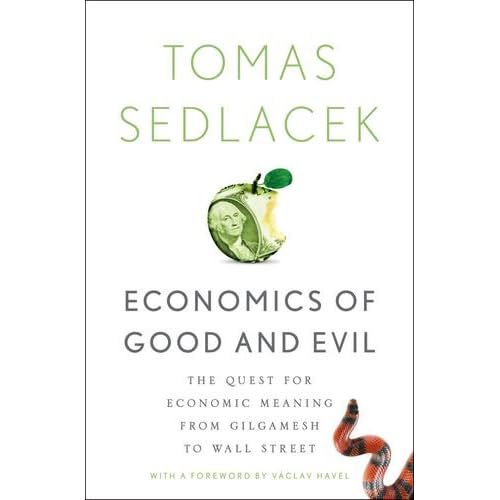
Authors@Google - Tomas Sedlacek: The Economics of Good and Evil


This is an interesting talk - framing economics as a choice between good and evil? Wait, didn't Google do that already? And how is their stock doing? Maybe Sedlacek has a point - his book is The Economics of Good and Evil: The Quest for Economic Meaning from Gilgamesh to Wall Street.


From the description: "Even the most sophisticated mathematical model," Sedlacek writes, "is, de facto, a story, a parable, our effort to (rationally) grasp the world around us." Compelling argument for a relativist perspective on economics.


Authors@Google - Tomas Sedlacek: The Economics of Good and Evil


Tomas Sedlacek has shaken the study of economics as few ever have. Named one of the "Young Guns" and one of the "five hot minds in economics" by the Yale Economic Review, he serves on the National Economic Council in Prague, where his provocative writing has achieved bestseller status. How has he done it? By arguing a simple, almost heretical proposition: economics is ultimately about good and evil.


In The Economics of Good and Evil, Sedlacek radically rethinks his field, challenging our assumptions about the world. Economics is touted as a science, a value-free mathematical inquiry, he writes, but it's actually a cultural phenomenon, a product of our civilization. It began within philosophy--Adam Smith himself not only wrote The Wealth of Nations, but also The Theory of Moral Sentiments--and economics, as Sedlacek shows, is woven out of history, myth, religion, and ethics. "Even the most sophisticated mathematical model," Sedlacek writes, "is, de facto, a story, a parable, our effort to (rationally) grasp the world around us." Economics not only describes the world, but establishes normative standards, identifying ideal conditions. Science, he claims, is a system of beliefs to which we are committed. To grasp the beliefs underlying economics, he breaks out of the field's confines with a tour de force exploration of economic thinking, broadly defined, over the millennia. He ranges from the epic of Gilgamesh and the Old Testament to the emergence of Christianity, from Descartes and Adam Smith to the consumerism in Fight Club. Throughout, he asks searching meta-economic questions: What is the meaning and the point of economics? Can we do ethically all that we can do technically? Does it pay to be good?


Placing the wisdom of philosophers and poets over strict mathematical models of human behavior, Sedlacek's groundbreaking work promises to change the way we calculate economic value.


Sunday, September 04, 2011

Sogyal Rinpoche's Glimpse of the Day

From September 4, 2011:


Dudjom Rinpoche used to tell the story of a powerful bandit in India, who, after countless successful raids, realized the terrible suffering he had been causing. He yearned for some way of atoning for what he had done, and visited a famous master. He asked him: “I am a sinner, I am in torment. What’s the way out? What can I do?”

The master looked the bandit up and down and then asked him what he was good at.

“Nothing,” replied the bandit.

“Nothing?” barked the master. “You must be good at something!”

The bandit was silent for a while, and eventually admitted: “Actually there is one thing I have a talent for, and that’s stealing.”

The master chuckled: “Good! That’s exactly the skill you’ll need now. Go to a quiet place and rob all your perceptions, and steal all the stars and planets in the sky, and dissolve them into the belly of emptiness, the all-encompassing space of the nature of mind.”

Within twenty-one days, the bandit had realized the nature of his mind, and eventually came to be regarded as one of the great saints of India.

Saturday, September 04, 2010

Sogyal Rinpoche - Glimpse of the Day

Cool parable from Sogyal Rinpoche's Glimpse of the Day, repeating a story from Dudjom Rinpoche.

Dudjom Rinpoche used to tell the story of a powerful bandit in India, who, after countless successful raids, realized the terrible suffering he had been causing. He yearned for some way of atoning for what he had done, and visited a famous master. He asked him: "I am a sinner, I am in torment. What's the way out? What can I do?"

The master looked the bandit up and down and then asked him what he was good at.

"Nothing," replied the bandit.

"Nothing?" barked the master. "You must be good at something!"

The bandit was silent for a while, and eventually admitted: "Actually there is one thing I have a talent for, and that's stealing."

The master chuckled: "Good! That's exactly the skill you'll need now. Go to a quiet place and rob all your perceptions, and steal all the stars and planets in the sky, and dissolve them into the belly of emptiness, the all-encompassing space of the nature of mind."

Within twenty-one days, the bandit had realized the nature of his mind, and eventually came to be regarded as one of the great saints of India.


Monday, June 14, 2010

Venerable Tenzin Palm - Dharma Quote


REFLECTIONS ON A MOUNTAIN LAKE
Teachings on Practical Buddhism

by Venerable Tenzin Palmo
more...

5O% off
for this week only.

Dharma Quote of the Week

(Our sincere apologies...your quote was delayed due to technical problems.)

A tenth-century Bengali pandita named Palden Atisha reintroduced Buddhism into Tibet. He had a servant who was really awful. He was abusive to Atisha, disobedient, and generally a big problem. The Tibetans asked Atisha what he was doing with such an awful guy who was so completely obnoxious. They said, "Send him back. We'll take care of you." Atisha replied, "What are you talking about? He is my greatest teacher of patience. He is the most precious person around me!"

Patience does not mean suppression, and it doesn't mean bottling up our anger or turning it in on ourselves in the form of self-blame. It means having a mind which sees everything that happens as the result of causes and conditions we have set in motion at some time in this or past lives. Who knows what our relationship has been with someone who is causing us difficulties now? Who knows what we have have done to him in another life! If we respond to such people with retaliation, we are just locking ourselves into that same cycle. We are going to have to keep replaying this part of the movie again and again in this and future lifetimes. The only way to break out of the cycle is by changing our attitude.

--from Reflections on a Mountain Lake: Teachings on Practical Buddhism by Venerable Tenzin Palmo, published by Snow Lion Publications

Reflections on a Mountain Lake • 5O% off • for this week only
(Good through June 18th).


Tags: , , , , , , ,

Thursday, November 26, 2009

A Parable from Glimpse of the Day


Confined in the dark, narrow cage of our own making that we take for the whole universe, very few of us can even begin to imagine another dimension of mind. Patrul Rinpoche tells the story of an old frog who had lived all his life in a dank well. One day a frog from the sea paid him a visit.

“Where do you come from?” asked the frog in the well.
“From the great ocean,” he replied.
“How big is your ocean?”
“It’s gigantic.”
“You mean about a quarter of the size of my well here?”
“Bigger.”
“Bigger? You mean half as big?”
“No, even bigger.”
“Is it . . . as big as this well?”
“There’s no comparison.” “That’s impossible! I’ve got to see this for myself.”

They set off together. When the frog from the well saw the ocean, it was such a shock that his head just exploded into pieces.


Wednesday, September 16, 2009

Glimpse of the Day on Reincarnation

http://www.dharma-media.org/ratnashripj/dwnld/thanka/scan/Arhat_Nagasena_71987_3000X2103.jpg

Today's Glimpse of the Day takes on reincarnation with a cool little story - I'm always a sucker for stories.

The King Milinda once asked the Buddhist sage Nagasena: “When someone is reborn, is he the same as the one who just died, or is he different?”

Nagasena replied: “He is neither the same nor different. . . . Tell me, if a man were to light a lamp, could it provide light the whole night long?”

“Yes.”

“Is the flame then which burns in the first watch of the night the same as the one that burns in the second . . . or the last?”

“No.”

“Does that mean there is one lamp in the first watch of the night, another in the second, and another in the third?”

“No, it’s because of that one lamp that the light shines all night.”

“Rebirth is much the same: One phenomenon arises and another stops, simultaneously. So the first act of consciousness in the new existence is neither the same as the last act of consciousness in the previous existence, nor is it different.”

Monday, September 07, 2009

Fairy tales have ancient origin

Very cool.

Fairy tales have ancient origin

Popular fairy tales and folk stories are more ancient than was previously thought, according research by biologists.

Fairy tales have ancient origin

They have been told as bedtime stories by generations of parents, but fairy tales such as Little Red Riding Hood may be even older than was previously thought.

A study by anthropologists has explored the origins of folk tales and traced the relationship between varients of the stories recounted by cultures around the world.

The researchers adopted techniques used by biologists to create the taxonomic tree of life, which shows how every species comes from a common ancestor.

Dr Jamie Tehrani, a cultural anthropologist at Durham University, studied 35 versions of Little Red Riding Hood from around the world.

Whilst the European version tells the story of a little girl who is tricked by a wolf masquerading as her grandmother, in the Chinese version a tiger replaces the wolf.

In Iran, where it would be considered odd for a young girl to roam alone, the story features a little boy.

Contrary to the view that the tale originated in France shortly before Charles Perrault produced the first written version in the 17th century, Dr Tehrani found that the varients shared a common ancestor dating back more than 2,600 years.

He said: “Over time these folk tales have been subtly changed and have evolved just like an biological organism. Because many of them were not written down until much later, they have been misremembered or reinvented through hundreds of generations.

“By looking at how these folk tales have spread and changed it tells us something about human psychology and what sort of things we find memorable.

“The oldest tale we found was an Aesopic fable that dated from about the sixth century BC, so the last common ancestor of all these tales certainly predated this. We are looking at a very ancient tale that evolved over time.”

Dr Tehrani, who will present his work on Tuesday at the British Science Festival in Guildford, Surrey, identified 70 variables in plot and characters between different versions of Little Red Riding Hood.

He found that the stories could be grouped into distinct families according to how they evolved over time.

The original ancestor is thought to be similar to another tale, The Wolf and the Kids, in which a wolf pretends to be a nanny goat to gain entry to a house full of young goats.

Stories in Africa are closely related to this original tale, whilst stories from Japan, Korea, China and Burma form a sister group. Tales told in Iran and Nigeria were the closest relations of the modern European version.

Perrault’s French version was retold by the Brothers Grimm in the 19th century. Dr Tehrani said: “We don’t know very much about the processes of transmission of these stories from culture to culture, but it is possible that they may being passed along trade routes or with the movement of people.”

Professor Jack Zipes, a retired professor of German at the University of Minnesota who is an expert on fairy tales and their origins, described the work as “exciting”. He believes folk tales may have helped people to pass on tips for survival to new generations.

He said: “Little Red Riding Hood is about violation or rape, and I suspect that humans were just as violent in 600BC as they are today, so they will have exchanged tales about all types of violent acts.

“I have tried to show that tales relevant to our adaptation to the environment and survival are stored in our brains and we consistently use them for all kinds of reference points.”


Friday, September 04, 2009

Glimpse of the Day - Use Your Talent

Nice teaching story from the Glimpse of the Day at Rigpa.

Dudjom Rinpoche used to tell the story of a powerful bandit in India, who, after countless successful raids, realized the terrible suffering he had been causing. He yearned for some way of atoning for what he had done, and visited a famous master. He asked him: "I am a sinner, I am in torment. What's the way out? What can I do?"

The master looked the bandit up and down and then asked him what he was good at.

"Nothing," replied the bandit.

"Nothing?" barked the master. "You must be good at something!"

The bandit was silent for a while, and eventually admitted: "Actually there is one thing I have a talent for, and that's stealing."

The master chuckled: "Good! That's exactly the skill you'll need now. Go to a quiet place and rob all your perceptions, and steal all the stars and planets in the sky, and dissolve them into the belly of emptiness, the all-encompassing space of the nature of mind."

Within twenty-one days, the bandit had realized the nature of his mind, and eventually came to be regarded as one of the great saints of India.