Showing posts with label painting. Show all posts

Friday, August 30, 2013

Raghava KK: Coloring Outside the Lines (FORA.tv)


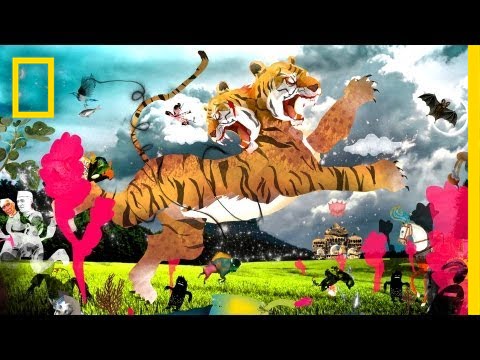
This short video from National Geographic Live is pretty cool. The 2013 National Geographic Emerging Explorer Raghava KK creates interactive art with an agenda - to change the viewer's mind, literally.


Raghava KK: Coloring Outside the Lines


Raghava KK: Coloring Outside the Lines from National Geographic Live on FORA.tv

Your brain waves may change the appearance of art by 2013 National Geographic Emerging Explorer Raghava KK, but at the same time his art may change you through interactivity that shows the many perspectives within every story.

Bio of Raghava KK

Raghava KK's globally acclaimed art pushes the boundaries of creativity and technology, often blending the two in interactive, participatory experiences that challenge and change perceptions. His work spans genres as disparate as painting, sculpture, film and performance. His work spans genres as disparate as painting, sculpture, film and performance." You walk into an art gallery, approach a painting, touch the canvas, and watch it transform before your eyes. No alarms sound. No guards descend. In fact, you've done exactly what the painting's creator wanted you to do. For Raghava KK, interactive art isn't a stunt, but a powerful way to broaden perspectives and encourage empathy. "I like to question the way information itself is delivered," he explains. "Everyone has a bias. What can be transformational is creative expression that allows many different biased perspectives to coexist simultaneously. When you see the world through other people's eyes, you have a richer understanding of who you are and why people do what they do."

KK's distinctive style first flourished in his work as a newspaper cartoonist. His penchant for using comic pathos to challenge accepted societal norms has since swept through myriad art forms, including painting, sculpture, installation, film, and performance. Today, technology plays a pivotal role in his art, allowing multiple perspectives to be revealed and manipulated by the viewer, essentially becoming a new creation each time it is seen. His iPad picture book for children created a new genre of "shaken stories." Each time parents and kids shake the screen, a new definition of "family" appears. Mom, dad, and child; two dads and kids; two moms and kids; single parents. "I grew up in the bubble of a very traditional Indian family and only saw one point of view," he says. "I created this book because I wanted to expose my own children to many perspectives at a very early age." Now he's helping develop a new technology, embedded in picture frames, that lets his paintings become touch screens.

He creates the art with real paint, but when someone touches the canvas, the image changes via the magic of a digital projection system. "It's reinvented by each person who interacts with it," KK says. Another idea begins with an empty wall. As you stand before it, a randomly chosen character projects onto the blank space and mirrors your movements. "It's fascinating to see how people step outside their own inhibitions and start moving the way they think that character would move." He's using brain-wave technology to push the participatory experience even further. Wearing an EEG headset, the viewer's mood and perspective become part of the art. "I start with an image of a grumpy old woman; I call her Mona Lisa 2.0," he explains. "As you look at her, the EEG headset measures 13 frequencies from your brain waves to indicate if you're stressed, calm, sad, angry, relaxed, concentrating hard, or anything in between." A computer algorithm processes those brain-wave measurements and makes the woman's face respond to your mental activity. As your emotions change, the art changes in real time-grinning, smiling broadly, frowning, scowling, or gazing peacefully.

Technology is also key to an educational tool he's developing to teach children shapes-not just as flat geometric graphics, but as concepts. "We crowd-source photographs of structural objects in the real world that physically demonstrate different shapes-using a car tire to teach circles or the pyramids to teach triangles. It's a much more meaningful way to learn. This idea of many crowd-sourced images all existing simultaneously could be a great way to take on some of the world's bigger issues and show multiple perspectives on different topics." Ultimately, KK sees participatory art as a tool for encouraging self-realization, and he hopes the interactive experiences he creates will make people more open to having their opinions challenged. "I explore sensitive topics such as politics, identity, gender, sexuality, and conformity, but there's often an element of humor to my work. I like to disrupt your thinking, but make you feel like I'm hugging you while I'm disrupting you. That's why I frequently use the disarming aesthetic of cartoons to say something powerful. I want to make people think differently, without losing them along the way. "I think the most important ingredient of happiness is to feel you are useful and adding value to the world," he explains. "When I judge what my life has meant, it's not how much money I've made or how many paintings I've sold. It's whether I've used my art as a tool to give back and make a difference, large or small."

Monday, July 02, 2012

AS Byatt - Edvard Munch: The Ghosts of Vampires and Victims

 Death of Marat, 1907

It's sad to me that most people have only seen Edvard Munch's "The Scream," the iconic image of existential angst sure to be found on several walls in every college dorm in the U.S. But, as I was reminded while visiting a museum in Vienna last month, there is so much more to Munch than that single image.

Weeping Nude, 1913

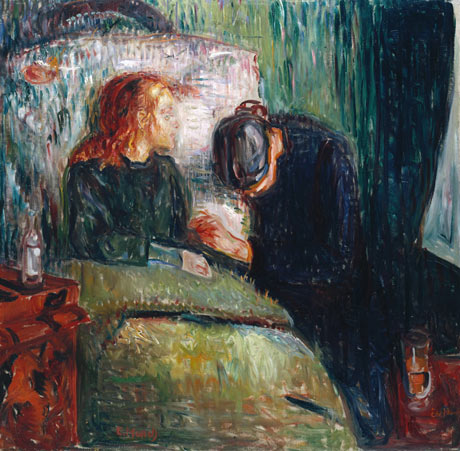
Early in his career, Munch struggled to find his own vision, but with The Sick Child (1886), based on his sister's death, he discovered his first "soul painting," and an important separation began from his failed efforts with Impressionism.

 Madonna, 1894-1895

As he matured, his paintings (beginning in the 1890s) embraced the "simplified forms, heavy outlines, sharp contrasts, and emotional content" (Wikipedia) that would become his mature style. His painting became more calculated to generate tension and convey emotion. He developed a more symbolist content, exploring his own emotional and psychological states and those of the world around him.

Edvard Munch: the ghosts of vampires and victims

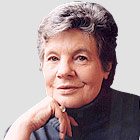
On the eve of a major exhibition at London's Tate Modern, AS Byatt reflects on how she is haunted by the artist's work.


AS Byatt
guardian.co.uk, Friday 22 June 2012  
Detail from Edvard Munch's The Sick Child, 1907 version. 
'I don't paint what I see but what I saw': Photograph: Tate
 
Art, wrote Edvard Munch, "is the pictorial form created by the human nerves – the heart – the brain – the eye." As a young man in Norway in the late 1880s he set out a manifesto for an art of passion.
Edvard Munch: The Modern Eye. Tate Modern, London, SE1 9TG
Starts 28 June 2012 Until 14 October 2012 - Venue details

"We want more than a mere photograph of nature. We do not want to paint pretty pictures to be hung on drawing room walls. We want to create, or at least to lay the foundations of, an art that gives something to humanity. An art that arrests and engages. An art created of one's innermost heart."

Like Van Gogh, he wanted to make passionate images of human beings and nature for a secular world, to replace the old religious images. Over his life time he worked and reworked a series of paintings he called The Frieze of Life. Among these were Puberty, Jealousy, Vampire, The Kiss, Madonna, Sphinx, Anxiety, Melancholy, The Dance of Life, Ashes, The Scream. They were painted initially in the 1890s. They are compelling and frequently appalling. The curators of the new exhibition at Tate Modern, Angela Lampe and Clément Chéroux, point out in their catalogue that three-quarters of Munch's output dates from after 1900, most particularly from between 1913 and 1930. Edvard Munch: The Modern Eye is an exhibition of Munch's modern consciousness, and the catalogue analyses his artistic intelligence, his construction of optical space, his relationship with the spectator, his work, in the early days of photography and film, on the reproducibility of images. The authors are not claiming that the modern Munch was less passionate than the symbolist. They are showing how he found new ways of exploring the human nerves, the heart, the brain, the eye. The catalogue is fascinating and full of new ways of looking and thinking.

Munch's is a world full of the ultimate human things – sickness, death, sex, fear, desire, hatred and destruction. His rooms are furnished with dark, solid beds seen from all angles – deathbeds, sickbeds surrounded by those about to become mourners or by mourners, sex beds in which encounters have happened or will happen, beds in which the onlooker can see parts of the corpse of a murdered person while the murderer stares transfixed, the bed in Puberty on which a thin, anxious girl sits with her hands crossed over her genitals. Beside her is a dark shadow, not unlike a magnified image of her own dark hair, which rises like smoke from a point beside her knees. She is unforgettable, as is The Sick Child, an image Munch reworked repeatedly, in both paintings and lithographs. She represents his sister, Sophie, who died when she was 15 and Munch was 13. Looking at these works we are struck by the incongruous liveliness of the child's bright red hair, exactly as we see the tense stillness of the face, the drawn lips. Munch himself described his own struggle to retrieve the image he remembered.

When I saw the sick child for the first time – her pale face with vigorous red hair against a white pillow – it made an impression on me, only to disappear as I worked. I painted a good picture on the canvas, but it was a different one. I repainted that picture many times over the years – scraped it off – let it dissolve into layers of paint … I had captured a lot of that first impression, the tremulous mouth, the translucent skin – the tired eyes – but the colours in the painting were not finished – it was pale grey. The painting as a whole was heavy, like lead.

In 1890 Munch said "I don't paint what I see – but what I saw", and this reference to the part played by memory in the construction of his images makes us see them as different from, for instance, Monet's beautiful and terrifying image of his wife Camille, painted as she died. The first Sick Child was painted in 1885-86, and another in 1896, and there are versions in, for instance, 1907, 1925 – six versions in all.

Lampe and Chéroux point out that Munch came under attack for making numerous copies of The Sick Child. He defended himself by saying that all the repetitions were an act of memory – a continuous struggle with the motif – a continuing work of art. He pointed out that what he was doing was analogous to Monet's series of haystacks or cathedrals – something seen and recorded at successive times, in successive moods. In a splendid chapter called "Reworkings", the authors show how Munch both needed to revisit images and ideas, and was unusually interested in, and sophisticated about, the 20th-century ability to reproduce and record images. I have often, as a writer, wondered what painters feel when they sell a painting. Books proliferate in many forms once they are written. They don't leave the author's possession. Munch records repainting certain images in order still to have one of his own, to think about and remember. Repainting a subject must be a way of both recapturing an idea, and of thinking about it in new ways. Munch painted, for instance, 12 different versions of Vampire – an image of a naked woman with long, wild red hair bent over the dark head of a man whose face is buried in her breasts. Her sharp nose is above his neck and her teeth are presumably buried in it. The background and the subject vary – it is dark and threatening, it is a woodland glade, the woman is more and less animal, the hair is wilder or softer. The effect on the onlooker is to make the image more fixed as it is repeated – there is an archetypal vampire, this is how she is; you can represent her in this way or that but she is constant.

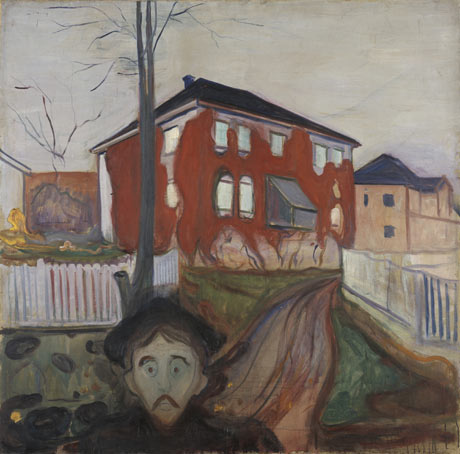
Munch's painting Red Virginia Creeper  
Red Virginia Creeper 1898-1900. 
Photograph: Sidsel De Jong/Munch Museet, Norway

One of the theoretical problems about repetition and reworking is that of authenticity – what is an original, what is a copy? This, the writers point out, later became involved in the idea of the market value of uniqueness. Munch was able to make a living partly by exhibiting versions of paintings already owned by others. Arnold Böcklin was commissioned to repaint his famous Isle of the Dead by Marie Berna, in memory of her dead husband. The case of Giorgio de Chirico is interesting – his early paintings excited, for instance, the surrealists, with their mysterious settings and symbols. But the surrealists were dismayed when after 1920 the painter began to make copies of his own earlier work, which André Breton and Max Ernst found repellent and lifeless. He also made copies and predated them, selling them fraudulently. Both Munch's copies and De Chirico's were in turn copied by Andy Warhol, that master of the repeated image – he did his own versions of Munch's self-portrait with the skeletal arm, of his ghoulish Madonna, and of The Scream itself. As Lampe and Chéroux say: "Warhol had understood that Munch's motifs were just as autonomous and free as a Campbell's soup can or a Marilyn image, and could easily be recombined. He recognised their iconic branding, with The Scream standing for fear, Madonna for ecstasy and Self-Portrait for death."

Munch used many techniques of what Walter Benjamin called "mechanical reproduction" in his essay on "The Work of Art in the Age of Mechanical Reproduction". Benjamin argued that the proliferation of images of images – prints, photographs – deprived a work of art of its "aura", the sense of power and mystery it had as a unique object of contemplation in societies with religious structures. Benjamin did believe that there still existed "original" works of art, which had "authenticity". But as the Munch catalogue points out, the dividing line between original and copy was blurring appreciably. The availability of original prints by the artists meant that copies were themselves seen to be original works of art.

Munch made etchings and lithographs of the motifs in his well-known paintings. He also took photographs – both conventional and experimental. He recorded himself – a severe profile, a naked man striding on a beach, wielding a paintbrush and palette, a kind of hazy ectoplasm in a deliberately doubled exposure. He took portraits in which he deliberately moved during the shooting, which he called Metabolism – an image, the catalogue remarks, of "the transformation of molecules and energy". He took formal pictures of himself as an inmate of a clinic, taking tea. He took photographs of paintings – of himself, solid and dark, among a group of shadowy painted self-portraits, of the painting of The Sick Child, of himself in bed, one in the series of fateful beds. He painted a sensuous nude with long auburn hair, and photographed the model, standing in the same pose among canvases in the studio. He photographed the truncated skirts and boots of two headless women – the authors suggest that the long shadow that falls across their feet is yet another portion of Munch's self-recording, another hinted self-portrait.

He learned also from the visual forms of early moving pictures. The cinema and the camera revealed new ways of recording movement – how a galloping horse, or an advancing pedestrian or an animated crowd appear to the camera. These contribute to Munch's compelling representations of space – often receding from a figure or creature which is advancing towards the onlooker and is cut off by the frame of the canvas. The painter somehow stretches the space that funnels into the space of the canvas, making everything rush. There is an extraordinary Galloping Horse, hurtling through snow with huge forequarters and wild mane. The animal's diminished hindquarters are barely visible, and the driver, on a kind of sledge, is dwarfed in a perspective which is vertiginous and abnormal. The effect is heightened by the snowy background, which blurs the structure of the landscape – the charging horse appears to be in its own avalanche of white speed. (It has all the same an anxious and homely face.) Two onlookers stand each side of the slope, parallel to the sides of the frame, intensifying the abnormal space of the gallop and the rushing snow.

Something similar is going on in one of my favourite pictures in The Frieze of Life, Red Virginia Creeper. A terrible face is just above the bottom of the frame, under a black cap, with greenish flesh and huge, round staring eyes; a neat inverted V of red moustache over a small frightened mouth makes that mouth simultaneously appalled. Behind this head a brownish path recedes and narrows rapidly – rising reddish out of the shoulder of the terrible figure as the swollen shadow rises out of the hip of the clenched girl in Puberty. Behind that is a very solid block of a bourgeois house, and some clean white railings. There are what may be gravestones leaning above the ground level of the house – which has no visible door. The house is blood red. It is the red of virginia creeper – one of the reds of virginia creeper – but it is flat, not leafy, solid like meat. The red has overwhelmed parts of the upper windows. The white shapes of the two lower windows look like coffins or shrouds. Munch's variations on the colour red are among the most staggering things he does. Here is his description of the moment when he decided to paint The Scream: "One evening I was walking along a road – with the fjord and the town below on the other side. I was sick and tired – I stood for some time looking across the fjord. The sun was setting – the clouds were turning red – like blood. I felt as if a scream was going through nature – I thought I heard a scream. I painted the picture – painted the clouds like real blood. – The colours were screaming. This was the picture The Scream in The Frieze of Life."

These reds are related to the fiery red hair of the sick child and the vampire. They are also related to the face of a repeated image he made late in his life. The subject of Young Woman Weeping by the Bed walks, or stands, naked, with her face bent down, and the face is usually the same blood-red as the creeper – a red maybe of skin bloated by weeping, or a blush of shame or terror?

The shape of Munch's relationship with the onlooker was also influenced by his venture into stage design. In 1906 he worked in Berlin with the great theatre director, Max Reinhardt, who had opened a new, intimate Kammerspiele (chamber theatre), which was like a room in which the audience was close to the action. Munch designed sets for Ibsen's Ghosts and Hedda Gabler, and had his own studio space where he worked on the Frieze of Life, one version of which was exhibited in the foyers. His set for Ghosts is particularly impressive. He placed a huge black armchair with its back to the audience – representing the space of the unspoken family secrets that drove the action behind it. Reinhardt was enthusiastic about this design. "The armchair says it all! … And the walls of the rooms in Munch's painting! They are the colour of gum disease. We have to try to find wallpaper in exactly this tone. It will put the actors in the right mood! To come fully into its own, facial expression needs space that is modulated through form, light, and above all, colour."

It was round about that time that Munch remarked of one of his works: "I have painted a still life as good as any by Cézanne, except that in the background I have painted a murderess and her victim." The title is Still Life, the Murderess. I don't know what this would be in the original language. Nature Morte is an even grimmer joke.

Throughout Munch's career he studied himself, implacably, in a series of self-portraits in various media that recorded his ageing and sickness – both mental and physical. In 1930 he had a rupture in the retina of his right eye that led to a haemorrhage. This was his good eye, as the other had been injured in a fight. Munch painted what his eye recorded – the "inside of sight" as Max Ernst put it. He painted the "spots in his vision", circular, concentrically coloured optical illusions, blood red and bright blue, and an image of the artist in his bed "seeing" a floating blue skull with reddened eyehole shadows. He painted also a great illusory bird form – Kneeling Nude with Eagle, in which the creature appears to be attacking the kneeling figure. This unflinching study of the damage is a distant continuation of the fact that when he was first painting The Sick Child he saw his own eyelashes as dark streaks in the upper corner of the image and painted them in too.

The late portraits, of a thinning, questioning, diminishing figure, still curious about himself and his world, are moving and remarkable. In Self-Portrait between the Clock and the Bed he stands with hanging arms and an almost mild, almost expressionless face between the tall, dark pillar of time and a hospital-like bed, with a white bedspread striped in black and red. He is in shadow. Behind him the space is full of golden light and the wall is studded with paintings and drawings. On the right in a strip of dark is a narrow, moony abstract female nude, suspended in space. Death, painting? It is unforgettable, in its use of space, in its perfectly executed feeling.

Wednesday, June 20, 2012

Modern Masters: Watch BBC Series Featuring Warhol, Matisse, Picasso and Dali


Another great find from Open Culture. I have watched two of these so far, Matisse and Warhol, and both are excellent. The host, Alastair Sooke, clearly loves art and he shares that enthusiasm with the viewer. Good stuff.

Modern Masters: Watch BBC Series Featuring Warhol, Matisse, Picasso and Dali


June 18th, 2012


Modern art. Like it or not, it’s had a profound impact on the way our world looks. As critic Alastair Sooke explains in this four-part series from the BBC, the great artworks of the past century have exerted an influence that extends far beyond museum walls.
Modern Masters, first broadcast in 2010 on the mainstream channel BBC One, looks at the life, work, and abiding influence of Henri Matisse, Pablo Picasso, Salvador Dali and Andy Warhol. “Art during the 20th century was radical, intoxicating, and immensely influential,” says Sooke, deputy art critic of The Daily Telegraph. “Matisse, Picasso, Dali and Warhol didn’t just change art history; they changed the world.”

Episode one, Andy Warhol: For a series examining the influence of 20th century art through the prism of celebrity artists, it’s fitting that Sooke should begin with an artist obsessed with celebrity. Sooke follows Warhol (see above) from his impoverished childhood in Pittsburgh to New York City, where he struggled as a commercial artist before becoming famous as a pop artist. Along the way he shows how Warhol’s aesthetic sensibility now permeates our culture. The other three episodes proceed along similar lines. Each is just under an hour long.

Episode two, Henri Matisse:


Episode three, Pablo Picasso:


Episode four, Salvador Dali:


Related Content:

Sunday, December 18, 2011

Open Culture - The Inner Object: Seeing Kandinsky


Open Culture posted this the other day on the occasion of Kandinsky's 145th birthday (December 16). Kandisnky has long been one of my favorite artists, so this was fun to watch.

The Inner Object: Seeing Kandinsky


Today is the birthday of the Russian abstract painter and art theorist Wassily Kandinsky. He was born in Moscow on December 16, 1866 (December 4 on the Julian calendar), and raised in Odessa, where he took an early interest in music. As a young man he studied economics and law, but in 1895 his life was forever changed when he attended a Moscow exhibition of paintings by the French Impressionists. Kandinsky was deeply struck by one of Monet’s paintings from the series Haystacks at Giverny. He later recalled his epiphany:

That it was a haystack the catalogue informed me. I could not recognize it. This non-recognition was painful to me. I considered that the painter had no right to paint indistinctly. I dully felt that the object of the painting was missing. And I noticed with surprise and confusion that the picture not only gripped me, but impressed itself ineradicably on my memory. Painting took on a fairy-tale power and splendor.

Kandinsky quit his job as a law professor and dedicated himself to painting. He emigrated, first to France and then to Germany, where he moved further and further away from figurative painting. He was among the first to create works that were completely abstract, or non-objective. In his 1910 treatise, Concerning the Spiritual in Art, Kandinsky declares that the elements within a painting should not correspond to any outer object, but only to the artist’s “inner need.”

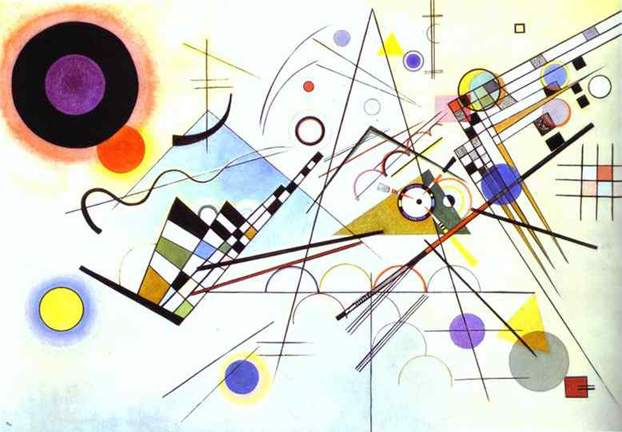
In observance of the artist’s 145th birthday, we present two videos with different perspectives on his work. Above, actress Helen Mirren talks with the Museum of Modern Art about what Kandinsky, and art, mean to her. Below, a trio of scholars–Beth Harris, Juliana Kreinik and Steven Zucker–discuss Kandinsky’s 1913 masterpiece, “Composition VII,” for the Khan Academy’s Smarthistory series. “Composition VII” was painted by Kandinsky in Munich over a period of four days–but only after he had made more than 30 preparatory sketches, watercolors and oil studies.


Kandinsky, Composition VII, 1913 from Smarthistory Videos on Vimeo.


Related Content
MoMA Puts Pollock, Rothko & de Kooning on Your iPad
Jackson Pollock: Lights, Camera, Paint! (1951)
John Berger’s Ways of Seeing: The TV Series