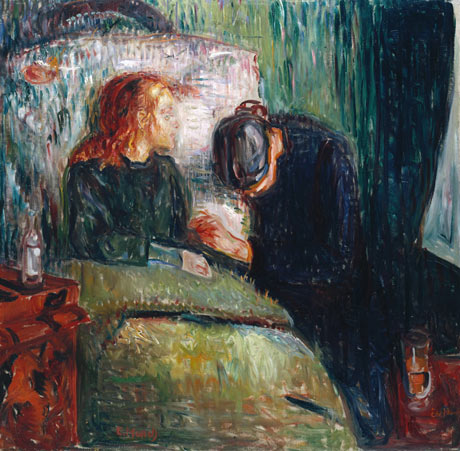
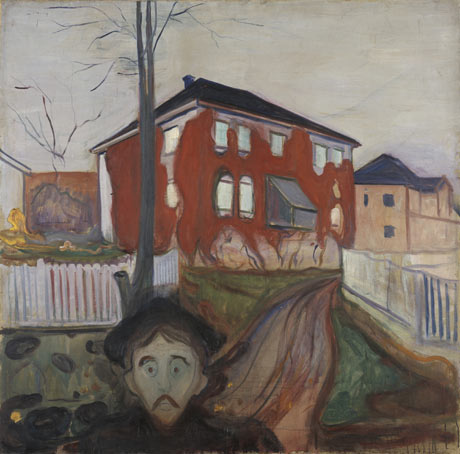
Detail from Edvard Munch's The Sick Child, 1907 version.
'I don't paint what I see but what I saw': Photograph: Tate
Art, wrote
Edvard Munch,
"is the pictorial form created by the human nerves – the heart – the
brain – the eye." As a young man in Norway in the late 1880s he set out a
manifesto for an art of passion.
Edvard Munch: The Modern Eye. Tate Modern, London, SE1 9TG
Starts 28 June 2012 Until 14 October 2012 - Venue details
"We want more than a mere photograph of nature. We do not want
to paint pretty pictures to be hung on drawing room walls. We want to
create, or at least to lay the foundations of, an art that gives
something to humanity. An art that arrests and engages. An art created
of one's innermost heart."
Like
Van Gogh,
he wanted to make passionate images of human beings and nature for a
secular world, to replace the old religious images. Over his life time
he worked and reworked a series of paintings he called
The Frieze of Life. Among these were
Puberty,
Jealousy,
Vampire,
The Kiss,
Madonna,
Sphinx,
Anxiety,
Melancholy,
The Dance of Life,
Ashes,
The Scream. They were painted initially in the 1890s. They are compelling and frequently appalling. The curators of the new exhibition at
Tate Modern,
Angela Lampe and Clément Chéroux, point out in their catalogue that
three-quarters of Munch's output dates from after 1900, most
particularly from between 1913 and 1930. Edvard Munch: The Modern Eye is
an exhibition of Munch's modern consciousness, and the catalogue
analyses his artistic intelligence, his construction of optical space,
his relationship with the spectator, his work, in the early days of
photography and film, on the reproducibility of images. The authors are
not claiming that the modern Munch was less passionate than the
symbolist. They are showing how he found new ways of exploring the human
nerves, the heart, the brain, the eye. The catalogue is fascinating and
full of new ways of looking and thinking.
Munch's is a world full
of the ultimate human things – sickness, death, sex, fear, desire,
hatred and destruction. His rooms are furnished with dark, solid beds
seen from all angles – deathbeds, sickbeds surrounded by those about to
become mourners or by mourners, sex beds in which encounters have
happened or will happen, beds in which the onlooker can see parts of the
corpse of a murdered person while the murderer stares transfixed, the
bed in
Puberty
on which a thin, anxious girl sits with her hands crossed over her
genitals. Beside her is a dark shadow, not unlike a magnified image of
her own dark hair, which rises like smoke from a point beside her knees.
She is unforgettable, as is
The Sick Child,
an image Munch reworked repeatedly, in both paintings and lithographs.
She represents his sister, Sophie, who died when she was 15 and Munch
was 13. Looking at these works we are struck by the incongruous
liveliness of the child's bright red hair, exactly as we see the tense
stillness of the face, the drawn lips. Munch himself described his own
struggle to retrieve the image he remembered.
When I saw the sick
child for the first time – her pale face with vigorous red hair against a
white pillow – it made an impression on me, only to disappear as I
worked. I painted a good picture on the canvas, but it was a different
one. I repainted that picture many times over the years – scraped it off
– let it dissolve into layers of paint … I had captured a lot of that
first impression, the tremulous mouth, the translucent skin – the tired
eyes – but the colours in the
painting were not finished – it was pale grey. The painting as a whole was heavy, like lead.
In
1890 Munch said "I don't paint what I see – but what I saw", and this
reference to the part played by memory in the construction of his images
makes us see them as different from, for instance, Monet's beautiful
and terrifying image of his wife Camille, painted as she died. The first
Sick Child was painted in 1885-86, and another in 1896, and there are versions in, for instance, 1907, 1925 – six versions in all.
Lampe and Chéroux point out that Munch came under attack for making numerous copies of
The Sick Child.
He defended himself by saying that all the repetitions were an act of
memory – a continuous struggle with the motif – a continuing work of
art. He pointed out that what he was doing was analogous to Monet's
series of haystacks or cathedrals – something seen and recorded at
successive times, in successive moods. In a splendid chapter called
"Reworkings", the authors show how Munch both needed to revisit images
and ideas, and was unusually interested in, and sophisticated about, the
20th-century ability to reproduce and record images. I have often, as a
writer, wondered what painters feel when they sell a painting. Books
proliferate in many forms once they are written. They don't leave the
author's possession. Munch records repainting certain images in order
still to have one of his own, to think about and remember. Repainting a
subject must be a way of both recapturing an idea, and of thinking about
it in new ways. Munch painted, for instance, 12 different versions of
Vampire
– an image of a naked woman with long, wild red hair bent over the dark
head of a man whose face is buried in her breasts. Her sharp nose is
above his neck and her teeth are presumably buried in it. The background
and the subject vary – it is dark and threatening, it is a woodland
glade, the woman is more and less animal, the hair is wilder or softer.
The effect on the onlooker is to make the image more fixed as it is
repeated – there is an archetypal vampire, this is how she is; you can
represent her in this way or that but she is constant.
What makes a masterpiece? In this visually stunning high definition production, A World of Art, the magnificence of America’s premier art museum lights up the screen.