Showing posts with label ideas. Show all posts

Thursday, October 09, 2014

Salon Culture: Network of Ideas - A Conversation with Andrian Kreye

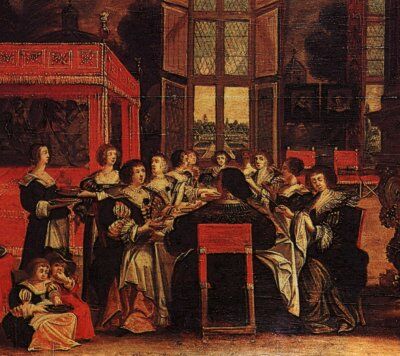
http://upload.wikimedia.org/wikipedia/commons/c/c6/Abraham_Bosse_Salon_de_dames.jpg

In 2001, the LA Times wrote about the emergence of a new salon culture in Los Angeles, frequented by writers, filmmakers, and actors. This phenomenon is the re-emergence of a salon culture, which began originally in the 16the century in Italy, but is most often associated with the 17th and 18th century literary culture of France.

In 2011, both Alternet (US) and The Telegraph (UK) did articles on salon culture. This is a bit of the history of American salons from the Alternet article:
The modern salon formally emerged in New York during the early 20th century. Edith Wharton, who loathed the American literary scene and resettled in Paris in 1907, likely attended the intellectual gatherings hosted by her sister-in-law, Mary Cadwalader Jones, on East 11th Street. In 1900, Jones gained national prominence championing the role of nurses in public health, fiercely arguing for the professionalization of a traditionally female vocation. She enjoyed intellectual life and hosted "Mary Cadwal's parlor” at which many leading intellectual lights of the day were regulars, including the writers Henry James, Henry Adams and F. Marion Crawford, the painters John LaFarge and John Singer Sargent, and the sculptor Augustus Saint-Gaudens.

However, it was Mabel Dodge’s famous “Evenings,” hosted at her townhouse at 23 Fifth Avenue during the 1910s, that made salons part of the city’s social life. Dodge was a classic Gilded Age “poor little rich girl,” a spoiled dilettante and libertine who, until she found her calling, attached herself to the latest fad and male celebrity. In 1913 she helped organize the controversial International Show of Modern Art, popularly known as the Armory Show, which launched modern art in America. That same year, she joined John Reed, “Big Bill” Hayward and Emma Goldman in support of the IWW-backed silk workers strike in Paterson, NJ, playing a leading role organizing the controversial, “Pageant of the Paterson Strike,” held at Madison Square Garden.

Dodge’s salons were organized along the lines of the traditional discussion-group format known as the General Conversation. An appointed leader, normally a specialist in an artistic, academic or political subject, offered a brief introductory commentary focusing the discussion and then invited those in attendance to jump into the discussion. Salon leaders ranged from A. A. Brill on Sigmund Freud and psychoanalysis, Reed on Pancho Villa and the Mexican Revolution, Margaret Sanger on birth control and women’s rights and even African-American entertainers from Harlem.

As the scholar Andrea Barnet reminds us, “Dodge’s salon was where black Harlem first met Greenwich Village bohemia and, conversely, where white bohemia got its first taste of a parallel black culture that it would soon not only glorify but actively try to emulate.”
I wish there were something like this in Tucson today. It would be awesome to meet up with a group of intelligent and educated people to exchange ideas, explore new topics, and generally hear new ideas or new perspectives.

I said this out loud the other night, so my girlfriend immediately mentioned to a friend on Facebook, and he and his wife like the idea, so maybe it will happen. And as tradition holds, the salon is often hosted by a female, the Salonnière.

The article below is about one of the major ongoing salons in the 20th-21st century - the Edge Salons hosted by John Brockman.

Salon Culture: Network of Ideas

A Conversation with Andrian Kreye [10.2.14]


Despite their intense scientific depth, John Brockman runs these gatherings with the cool of an old school bohemian. A lot of these meetings indeed mark the beginning of a new phase in science history. One such example was a few years back, when he brought together the luminaries on behavioral economics, just before the financial crisis plunged mainstream economics into a massive identity crisis. Or the meeting of researchers on the new science of morality, when it was noted that the widening political divides were signs of the disintegration of American society. Organizing these gatherings over summer weekends at his country farm he assumes a role that actually dates from the 17th and 18th century, when the ladies of the big salons held morning and evening meetings in their living rooms under the guise of sociability, while they were actually fostering the convergence of the key ideas of the Enlightenment.


Salon Culture
NETWORK OF IDEAS


The Salon was the engine of enlightenment. Now it's coming back. In the digital era the question might be different from the ones in the European cities of the 17th century. The rules are the same. Why is there such a great desire to spend some hours with likeminded peers in this age of the internet?

by Andrian Kreye, Editor, The Feuilleton (Arts & Essays), Süddeutsche Zeitung, Munich.

The salon, which marked a entire era: Duchess Anna Amalia of Saxe-Weimar with her guests, including Goethe (third from left) and Herder (far right).

For more than a century now the salon as a gathering to exchange ideas has been a footnote of the history of ideas. With the advent of truly mass media this exchange had first been democratized, then in rapid and parallel changes diluted, radicalized, toned down, turned up, upside and down again. It has only been recently that a longing emerged for those afternoons in the grand suites of the socialites in the Paris, Vienna, Berlin or Weimar of centuries past, where streams of thought turned into tides of history, where refined social gatherings of the cultured elites became the engine of the Enlightenment.

Just like back then, today's new salons are mostly exclusive if not closed circles. If you do happen to be invited though you will swiftly notice the intellectual force of those gatherings. On a summer's day on Eastover Farm in Connecticut for example, in the middle of green rolling hills with horse paddocks and orchards under the sunny skies of New England. This is where New York literary agent John Brockman spends his weekends. Once a year, he invites a small group of scientists, artists and intellectuals who form the backbone of what is called the Third Culture. Which is less of a new culture, but a new form of debate across all disciplines traditionally divided into the humanities and the natural sciences, i.e.,  the first and second culture.

On that weekend, for example, he had invited a half-dozen men. Each of whom had a large footprint in their respective disciplines: the gene researcher Craig Venter, who was the first to sequence the human genome; his colleague George Church, Robert Shapiro, who explored the chemistry of DNA, the astronomer Dimitar Sasselov, quantum physicist Seth Lloyd, and the physicist Freeman Dyson, who sees in his his role as scientist the need to continually question universally accepted truths. A few science writers were also present, along with Deborah Triesman, literary editor at the New Yorker.

At some of his other meetings, the number of Nobel Laureates might have been higher, but the question under discussion in the warm summer wind among rustling tops of maple trees with jugs full of freshly made lemonade, carried utmost weight: "What is life?" Seth Lloyd formulated the problem right at the start: science knows everything about the origin of the universe, but almost nothing about the origin of life. Without this knowledge, the sciences, on the threshold of the biological age, are groping in the dark.

Brockman had deliberately chosen the invited scientists as representatives of different fields, who, for years, had understood the need to think across the scientific disciplines. But even then, you could feel like an outsider, as was the case when Robert Shapiro made a joke about ribonucleic acids, which was greeted with boisterous laughter by the scientists.

Despite their intense scientific depth, John Brockman runs these gatherings with the cool of an old school bohemian. A lot of these meetings indeed mark the beginning of a new phase in science history. One such example was a few years back, when he brought together the luminaries on behavioral economics, just before the financial crisis plunged mainstream economics into a massive identity crisis. Or the meeting of researchers on the new science of morality, when it was noted that the widening political divides were signs of the disintegration of American society.  Organizing these gatherings over summer weekends at his country farm he assumes a role that actually dates from the 17th and 18th century, when the ladies of the big salons held morning and evening meetings in their living rooms under the guise of sociability, while they were actually fostering the convergence of the key ideas of the Enlightenment.


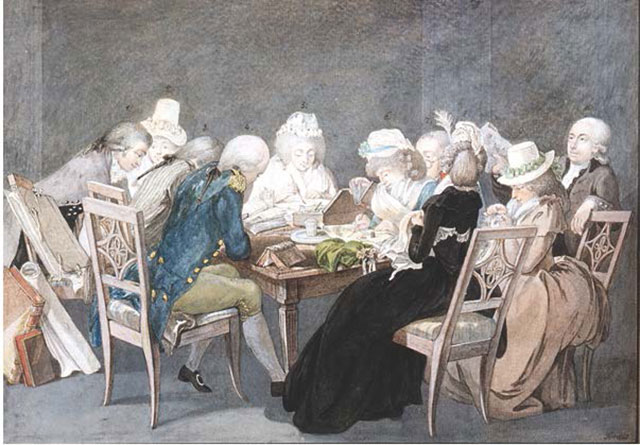
Not all salonnières were content to play the host role—Johanna Schopenhauer (the mother of the philosopher Arthur, here with her daughter Adele) was a significant writer with an extensive oeuvre.

The salon is still regarded as a mysterious world of thoughts and ideas, a world in which the participants soon were consigned to the role of historical figures in history books. In the early days of the salon culture these meetings were incubators of new ideas as well as the first form an urban and bourgeois culture. The first salons were formed in Paris in the early 17th century, when the nobles left their estates and are gathered in the capital around the King. Initially, they cemented these early manifestations of bourgeois culture such as music and literature. But soon philosophers such as Voltaire and Diderot appeared in the 18th century and prepared the intellectual ground for the French revolution.

In all major cities in Europe, it soon was common for ladies of high society to gather influential thinkers around them. Often, these were for their time radical gatherings, because those salons dissolved the rigid boundaries between social classes. With rational thinking of the Enlightenment, the reputation enjoyed by a person was measured in terms of intellect, not status or wealth. Berlin and Vienna were established, next to Paris, as cities of culture of the salon. But in small towns too, the intellectual life soon revolved around salons. The salons in Weimar were legendary, where Johanna Schopenhauer, the mother of the future philosopher, Arthur, and the Duchess Anna Amalia of Saxe-Weimar-Eisenach, counted Johann Wolfgang von Goethe and Friedrich Schiller among their guests.


At the end of the 18th century, the revolutionary spirit was present in the salons of Caroline Schelling in Mainz. The Prussian military arrested Schelling in 1793 for her links to the Jacobins.

At the same time England developed the first coffee house culture. In 1650, the first English cafe, called Grand Café, opened in Oxford. The open structure of the cafés had a tremendous effect on the culture of debate, but so did coffee and tea, the new drinks from the colonies. In a country in which the entire population at any time of day was drinking alcohol, the stimulant of caffeine acted as fertilizer for the burgeoning idea cultures. But it was mostly the lounges and cafes in Europe (and later America) that gave birth to the fundamental principle of progress and innovation, namely the network. Indeed, it was rarely the sudden Eureka-moments in the solitude of the laboratory of the study, that scientists and thinkers brought humanity from the dark times of the pre-modern era into the light of reason.  It was the fierce debates held in the lounges and cafes that allowed the ideas behind these Eureka-moments to mature.


The salon of the Duchess Anna Amalia  was called "Garden of the Muses." In addition to her role as salonnière, the Duchess was also generous patron of Goethe and Schiller.

No wonder that the nostalgia for these meetings between big thinkers is so strong today. With his 2010 film "Midnight in Paris", Woody Allen, the greatest of the urban romantics, created a cinematic monument to this nostalgia. As the American author Gil Pender roams the nighttime streets and alleys of Paris, he accidentally falls into a time portal and lands in the Paris of the 1920s. There, in the rooms of the writer and collector Gertrude Stein with walls covered in works of art, he meets Pablo Picasso, F. Scott Fitzgerald, Ernest Hemingway, Salvador Dalí and Luis Buñuel. This is a tribute to the small world of bohemians who gave birth to so many great things in the history of culture.

This nostalgia fits perfectly in an age when the mass media abandon models of publications and programs to turn into networks with an infinite number of nodes. Facebook, Twitter and countless blogs and forums perfectly simulate this exciting exchange of ideas for an audience of billions. In terms of today's digital Weltgeist, there is already talk about the global salon, and a universal brain. Could it be that nostalgic interest in the salons of the past is a desire for more clarity to face the complexity of the networked future?

In the digital era we might very well witness once again the phenomenon that Jürgen Habermas has called "structural transformation of the public sphere", the rise of a new bourgeoisie and mass society that began with the salons. There is no across-the-board answer to this question, that's impossible when the structural transformation of the digital age affects various spheres of the international community differently. In Europe and America, digital media always leads to new cul-de-sacs and roundabouts of communication. Social networks claim to be not only the successors of salons, they evoke the ominous metaphysical principle of the Weltgeist (global mind), while they actually reduce the principle of intellectual eruptions in salons to a de-intellectualized white noise.


Salon of the 21st century: the literary agent John Brockman (Center, with Hat) in the circle of the scientists of the Edge network during one of his legendary weekends at Eastover Farm in Connecticut.

In emerging and developing countries on the other hand, the use of digital media has indeed made Habermas's structural transformation of the public possible, in much the same way as in the Europe of the Enlightenment in terms of the salons and the early mass media. In countries like Iran, Egypt or the Ukraine, each change begins with dangerous ideas, because if ideas are to make a difference, they must be dangerous.

This was no different in the early salons. If the great intellectuals and artists of the time met in the literary salons, it was by no means solely to discuss questions of aesthetics or literary forms. In the late 18th century salons of the woman of letters Caroline Schelling, for example, in Mainz and Göttingen, were collecting revolutionary spirits who took a stand in Paris, at the dawn of a new era that brought the demise of the monarchy. Caroline Schelling was arrested, slandered, vilified, but it did not change the fact that, under her leadership, the Jacobins eventually formed in Germany as well as a force opposing the monarchy and empire.

This is the very reason that an autocracy such as China uses its power to promote the social concept of the individual, because a single individual cannot spread dangerous ideas. This fear of the power of networks also explains the unusually harsh persecution of religious communities. It's bad enough that faith calls into question the sovereignty of the party on thinking. However there is a danger for power is also lurking in the networks of churches and monasteries. Faith calls into questions the sovereignty of the party line of thinking and thoughts. Danger lurks for those in power in the networks of churches and monasteries.

In the birthplaces of the enlightenment, in America and Europe, the current struggle for sovereignty over interpretation is not a political fight though—this has dissolved since the end of ideologies in countless, often regional micro-conflicts. Similarly, the battle between religion and science has been in play for a long time. Yet it is science that challenges the certainties.


The Internet has the possibility to enlarge the circle of great minds that exchange ideas ad infinitum. To not get lost in the vastness of cyberspace, thinkers and creators have started to meet again on a regular basis for various new forms of salons like DLD; the Aspen Ideas Forum or the TED Conference. What started as an elite gathering of Silicon Valley pioneers thirty years ago has turned into a global forum of ideas, which are spread via internet videos of lectures and talks. Twice a year about a thousand scientists, artists, activist and entrepreneur come together in one place like Monterey, Vancouver, Oxford or Rio, to learn about new ideas "worth spreading" to quote the motto of the conference. In a lot of cases, such ideas will have an impact on the world for years on end.

At this point, the memory of that summer day in Connecticut comes into focus, and the moment when the scientists asking questions about the origin of life talked about their research and projects. Craig Venter told of his plans to develop bacteria that could supplant fossil fuels as an energy source. George Church described the sequencing of the genome of the Mammoth. Dimitar Sasselov reported by his search for Earth-like planets. Seth Lloyd explained the unprecedented opportunities of the quantum computer.  What, for the onlookers under the maple trees only a few years ago sounded like science fiction, is today, to a large extent, scientific reality.


In the New York of the 1960s, hardly anyone understood the network of eccentric artist Andy Warhol, as seen here with John Brockman (left) and Bob Dylan (right) in the "Factory", a hybrid of salon, studio, and party room.

Of course, John Brockman long ago put his salon online. Leading scientists, artists, prominent intellectuals, regularly meet on his edge.org website to have a conversation about the issues of our time. Annually, there is a concerted action in which he asks the entire network a big question. Eight years ago, the following was central issue for this salon culture: "What is your most dangerous idea?" More than a hundred responses were submitted and published. It reads like intellectual fireworks. In your own head, you quickly feel for yourself how ideas clash, release energy and generate new ideas. It is then that you experience the intellectual thrill that has always inspired the salons.
In the meantime, Brockman's arena of ideas has sparked countless likeminded gatherings of all scales and fields. Conferences have been established as a distinct independent form of communication, because the network tends to be significantly more effective and fruitful beyond the Internet. Other than the observable external format, events such as the TED Conferences, the Aspen Ideas Festival, PopTech, or the Digital Life Design (DLD), have little in common with the congresses and meetings of old. They have long since become the new crucibles in the history of ideas. Especially the American TED Conference has shown in recent years the way in the salon of the 21st century can evolve. What started in 1984 as a meeting of Silicon Valley elites under the banner "Technology, Entertainment, Design", is now a global network that utilizes all channels of communication—conferences, online videos, books, TV, radio, blogs to make ideas blossom and develop on a global scale. Twice a year, a small circle from this large network meets in a cosmopolitan city ... in the spirit of the salons of yesteryear.

Monday, June 30, 2014

David Burkus | The Myths of Creativity


As one might gather from the title of this Google Talk, David Burkus is the author of The Myths of Creativity: The Truth About How Innovative Companies and People Generate Great Ideas (2013). Back around the beginning of June (the 9th), Burkus stopped by Google to talk about his book (which is described below the video).

David Burkus | The Myths of Creativity

Published on Jun 13, 2014


We tend to think of creativity in terms reminiscent of the ancient muses: divinely-inspired, unpredictable, and bestowed upon a lucky few. But when our jobs challenge us to be creative on demand, we must develop novel, useful ideas that will keep our organizations competitive. The Myths of Creativity demystifies the processes that drive innovation. Based on the latest research into how creative individuals and firms succeed, David Burkus highlights the mistaken ideas that hold us back and shows us how anyone can embrace a practical approach, grounded in reality, to finding the best new ideas, projects, processes, and programs.

Answers questions such as: What causes us to be creative in one moment and void in the next? What makes someone more or less creative than his or her peers? Where do our flashes of creative insight come from, and how can we generate more of them?

Debunks 10 common myths, including: the Eureka Myth; the Lone Creator Myth; the Incentive Myth; and The Brainstorming Myth.

David Burkus | The Myths of Creativity: The Truth About How Innovative Companies and People Generate Great Ideas

For anyone who struggles with creativity, or who makes excuses for delaying the work of innovation, The Myths of Creativity will help you overcome your obstacles to finding new ideas.

Tuesday, March 04, 2014

Exchanges: Ideas and Argument - BBC - 6 Episodes

A.C. Grayling is the author of about 30 books on philosophy, including  The Meaning of Things (2001), Against All Gods: Six Polemics on Religion and an Essay on Kindness (2007), The Good Book: A Humanist Bible (2011), Ideas That Matter: The Concepts That Shape the 21st Century (2012), and The God Argument (2013).

He is a director and contributor at Prospect Magazine. His main academic interests lie in epistemology, metaphysics and philosophical logic. He has described himself as "a man of the left" and is associated in Britain with the new atheism movement, and is sometimes described as the 'Fifth Horseman of New Atheism'. He frequently appears in the British media discussing philosophy, as in this series from BBC World Service.

In these six episodes, Grayling speaks with Kay Redfield Jamison, Iain Couzin, Henry Markram, Bonnie Bassler, Daniel Cohen, and Nassim Nicholas Taleb.

Exchanges - Ideas and Argument

Exchanges - Ideas and Argument

The world's leading figures in science, economics, politics and architecture join an audience to discuss their ideas.

Recent episodes

  • Exchanges at the Frontier: 01 Mar 14 - Kay Redfield Jamison

    Sat, 1 Mar 14
    Duration: 50 mins
    The Psychiatrist Kay Redfield Jamison is a world leading specialist in bipolar disorder, and suffers from the condition herself. She shares her unique perspective with A.C.Grayling and an audience at Wellcome Collection, London.
  • Exchanges at the Frontier: 22 Feb 14 - Iain Couzin

    Sat, 22 Feb 14
    Duration: 50 mins
    Why do locusts swarm? How do ants manage their traffic flow so much better than humans? Iain Couzin talks to Matthew Sweet about what we can learn from collective animal behaviour.
  • Exchanges at the Frontier: 15 Feb 14 - Henry Markram

    Sat, 15 Feb 14
    Duration: 50 mins
    Henry Markram has received the biggest personal grant in the history of science. He has a billion euros to build a super computer which will replicate the human brain. He tells A.C.Grayling and an audience at Wellcome Collection how the virtual brain will reveal revolutionise the treatment of mental disorders.
  • Exchanges at the Frontier: 08 Feb 14 - Bonnie Bassler

    Fri, 7 Feb 14
    Duration: 50 mins
    Bonnie Bassler is the world specialist in how bacteria communicate within the human body. She explains to A.C.Grayling and pupils at Haverstock School, that this process holds the key to solving the problem of failing antibiotics.
  • Exchanges: The Global Economy 18 Jan 14: Daniel Cohen

    Sat, 18 Jan 14
    Duration: 50 mins
    Why doesn’t money make us happy? French economist Daniel Cohen explores the paradox of why growing economies do not lead to growing satisfaction with life. He tells Justin Rowlatt, and an audience at Paris Dauphine University that economics focusses us on competition while it’s cooperation and free-giving that makes us happy.
  • Exchanges: The Global Economy 11 Jan 14: Nassim Nicholas Taleb

    Sat, 11 Jan 14
    Duration: 50 mins
    He has been described as a ‘super hero of the mind’ and ‘the hottest thinker in the world; the one-time business trader and full-time philosopher of randomness Nassim Nicholas Taleb joins Justin Rowlatt and an audience at the Grand Amphitheatre of the Sorbonne in Paris for a special event staged in partnership with Paris Dauphine University.

Thursday, January 23, 2014

The Self - A Scientific Idea Ready for Retirement (EDGE Question 2014)

 
The 2014 EDGE Question is out and all 176 contributors (174 responses) can be reviewed and pondered at the EDGE site. This year's question is a good one (they are always interesting) in that it provided many respondents an opportunity to question some of the basic tenets of scientific belief.
Science advances by discovering new things and developing new ideas. Few truly new ideas are developed without abandoning old ones first. As theoretical physicist Max Planck (1858-1947) noted, "A new scientific truth does not triumph by convincing its opponents and making them see the light, but rather because its opponents eventually die, and a new generation grows up that is familiar with it." In other words, science advances by a series of funerals. Why wait that long?

 WHAT SCIENTIFIC IDEA IS READY FOR RETIREMENT?

Ideas change, and the times we live in change. Perhaps the biggest change today is the rate of change. What established scientific idea is ready to be moved aside so that science can advance?
Among this years respondents are the usual who's who of science, as well as a lot of people I have never heard of but who contribute excellent responses.

One of the cool responses this year is from Bruce Hood, who is still arguing that we might do well to be done with the notion of the self. His book, The Self Illusion: How the Social Brain Creates Identity (2012), conceptualized the self as the product of our relationships and interactions with others, a thing that exists only in our brains. Hood argues, however, that though the self is an illusion, it is one that humans cannot live without. As a scientific concept, it has become useless in its traditional understanding.

NOTE: I disagree with Hood that we must do away with free will when we discard the scientific notion of the self - the two things are not identical.


The Self

Bruce Hood
Director of the Bristol Cognitive Development Centre in the Experimental Psychology Department at the University of Bristol; Author, The Self Illusion: How the Social Brain Creates Identity

It seems almost redundant to call for the retirement of the free willing self as the idea is neither scientific nor is this the first time that the concept has been dismissed for lacking empirical support. The self did not have to be discovered as it is the default assumption that most of us experience, so it was not really revealed by methods of scientific enquiry. Challenging the notion of a self is also not new. Freud's unconscious ego has been dismissed for lacking empirical support since the cognitive revolution of the 1950s.

Yet, the self, like a conceptual zombie, refuses to die. It crops up again and again in recent theories of decision-making as an entity with free will that can be depleted. It re-appears as an interpreter in cognitive neuroscience as capable on integrating parallel streams of information arising from separable neural substrates. Even if these appearances of the self are understood to be convenient ways of discussing the emergent output of multiple parallel processes, students of the mind continue to implicitly endorse that there is a decision-maker, an experiencer, a point of origin.

We know that the self is constructed because it can be so easily deconstructed through damage, disease and drugs. It must be an emergent property of a parallel system processing input, output and internal representations. It is an illusion because it feels so real, but that experience is not what it seems. The same is true for free will. Although we can experience the mental anguish of making a decision, our free will cannot be some kind of King Solomon in our mind weighing up the pros and cons as this would present the problem of logical infinite regress (who is inside their head and so on?). The choices and decisions we make are based on situations that impose on us. We do not have the free will to choose the experiences that have shaped our decisions.

Should we really care about the self? After all, trying to live without the self is challenging and not how we think. By experiencing, evoking and talking about the self, we are conveniently addressing a phenomenology that we can all relate to. Defaulting to the self in explanations of human behavior enables us to draw an abrupt stop in the chain of causality when trying to understand thoughts and actions. How notable that we do this all so easily when talking about humans but as soon as we apply the same approach to animals, one gets accused of anthropomorphism!

By abandoning the free willing self, we are forced to re-examine the factors that are really behind our thoughts and behavior and the way they interact, balance, over-ride and cancel out. Only then we will begin to make progress in understanding how we really operate.

Wednesday, May 15, 2013

The Partially Examined Life, Episode 76: Deleuze on What Philosophy Is

From The Partially Examined LIfe - a very cool philosophy podcast and blog - this is an interesting discussion on Gilles Deleuze's vision of what philosophy is. Here are a few helpful links to get you acquaniuted with his ideas.

Gilles Deleuze at the Stanford Encyclopedia of Philosophy

Other Internet Resources
Enjoy the podcast.

Episode 76: Deleuze on What Philosophy Is


Podcast: Play in new window | Download (Duration: 2:10:55 — 119.9MB)
Posted by Mark Linsenmayer on May 14, 2013


On Gilles Deleuze and Félix Guattari’s What Is Philosophy? (1991).

How is philosophy different from science and art? What’s the relationship between different philosophies? Is better pursued solo, or in a group? Deleuze described philosophy as the creation of new concepts, whereas science is about functions that map observed regularities and art is about creating percepts and affects. Just reading or writing about past philosophers is not enough; you have to actually create concepts, and to create or understand a concept requires a “plane of immanence,” which is something like a set of background intuitions that is not private to a particular mind. Such a plane constitutes an image of what thought is and determines what questions will be considered legitimate, so trying to evaluate a past philosophy without grappling with the plane means you’ll inevitably misunderstand the philosopher and your critiques will just talk past him or her. Likewise, if you yank a philosophical concept out of its plane and try to turn it into a proposition that you can evaluate, it’s inevitably going to seem weak, like “just an opinion,” because propositions are not what philosophy creates. As for a pragmatist, “truth” for Deleuze is something defined within a plane, not some transcendental standard used to judge planes or concepts.

Mark, Seth, and Dylan are joined by “sophist” (PhD in rhetoric) Daniel Coffeen to try to figure this out. Read more about the topic and get the book.

End song: “Tolerated” by New People, the new album Might Get It Right. Read about it.

Please go to partiallyexaminedlife.com/donate to help support our efforts. A recurring donation will gain you all the benefits of PEL Citizenship, including another Deleuze discussion.

Wednesday, February 13, 2013

6 Game-Changing Ideas In The State Of The Union (Think Progress)

State of the Union speeches have become lofty in their aspirations for the country, and impotent as an impetus to real change. Such was last night's fifth State of the Union speech from President Obama. However, the folks at Think Progress have identified six ideas from Obama's speech that they consider "game changers." Sadly, I suspect none of them will ever come to fruition, not even the one that seems most likely to be supported by both parties - putting people to work repairing the nation's crumbling infrastructure.

You can watch or read the whole speech here. You watch or read the GOP response from Marco Rubio here,
6 Game-Changing Ideas In The State Of The Union

By Igor Volsky on Feb 13, 2013


On Tuesday night, President Obama delivered his fifth State of the Union and laid out an agressive agenda that could set the nation on a more progressive course. Below are 6 of his most ambitious and far reaching proposals:

1) Executive action on climate change. “I urge this Congress to pursue a bipartisan, market-based solution to climate change…If Congress won’t act soon to protect future generations, I will. Obama urged Congress to pass a standard cap and trade bill along the framework developed by Sen. John McCain (R-AZ) and Joe Lieberman. That measure ultimately failed, and Obama warned that if Congress does not act, he will take executive action and direct the Environmental Protection Agency to limit emission standards for power plants imposed under the Clean Air Act. Obama also proposed a federal fund for states that pursue energy efficiency and halve their energy use. After all, climate change is contributing to a growing number of extreme weather events that that is costing the United States billions:


2) Investing in infrastructure and creating jobs. “I propose a “Fix-It-First” program to put people to work as soon as possible on our most urgent repairs, like the nearly 70,000 structurally deficient bridges across the country.” The average American bridge is now 43 years old — and a 2008 Department of Transportation survey determined that 72,868 are “structurally deficient,” while 89,024 are “functionally obsolete.” Obama’s plan calls for “$50 billion in frontloaded infrastructure investment includes $40 billion that would be targeted to the most urgent upgrades, like the 70,000 structurally deficient bridges across the country.” Economistsestimate that new federal spending for infrastructure “would generate $1.44 of economic activity for each $1 spent” and in reviewing the economic impact of the Recovery Act, the Congressional Budget Office “found that infrastructure investments and purchases by the federal government for goods and services had the largest jobs multiplier impact of all the stimulus elements”:


3) Universal preschool. “I propose working with states to make high-quality preschool available to every child in America. Every dollar we invest in high-quality early education can save more than seven dollars later on – by boosting graduation rates, reducing teen pregnancy, even reducing violent crime.” Obama is urging Congress to provide low- and moderate-income 4- year-old children with high-quality preschool, while allowing states a great deal of latitude and flexibility to run their own programs. At-risk children without early childhood education are more likely to drop out of school, become teen parents, or get arrested for violent crime, and they are less likely to attend college. Investing in those children early would reduce societal and economic costs later in their lives, while also increasing economic mobility. A recent study showed that Chicago’s preschool program generates “$11 of economic benefits over a child’s lifetime for every dollar spent initially on the program.” As the University of Chicago’s James Heckman has found, “investing in early childhood development for disadvantaged children provides a great return to society through increased personal achievement and social productivity”:


4) A pathway to citizenship. “Real reform means establishing a responsible pathway to earned citizenship – a path that includes passing a background check, paying taxes and a meaningful penalty, learning English, and going to the back of the line behind the folks trying to come here legally.” Immigration reform that includes a pathway to citizenship is essential to the economy. A naturalized immigrant will earn “between 5.6 percent and 7.2 percent more within two years of becoming a citizen,” boosting consumer spending and overall economic growth. Immigration reform would add up to $5.4 billion in new tax revenue over the first three years, and a cumulative $1.5 trillion to the U.S. economy over a decade:


5) A livable wage. “Tonight, let’s declare that in the wealthiest nation on Earth, no one who works full-time should have to live in poverty, and raise the federal minimum wage to $9.00 an hour.” Raising the minimum wage to $9 “restores the inflation-adjusted value of the minimum wage back to where it was in 1981.” In fact, had the minimum wage had simply kept up with inflation since the 1960s, it would be over $10 per hour today. The increase will disproportionately help women and minorities, since they make up a majority of low-wage workers, without negatively effecting employment:


6) Enhancing gun safety. “Each of these proposals deserves a vote in Congress. If you want to vote no, that’s your choice. But these proposals deserve a vote.” In the aftermath of the Newton tragedy, a bipartisan group of lawmakers have begun working on legislation to ensure that everyone who purchases a firearm undergoes a background check, among other reforms limiting access to military-style weapons. Residents in 45 states can buy guns through private sales without undergoing the otherwise-mandatory background check. 40 percent of all gun sales are purchased without any screening, including 80 percent of guns used in crimes:


Friday, August 10, 2012

Making Sense of Jürgen Habermas - Three Books


In the Marx and Philosophy Review of Books - in the Reviews section, Michael Reno reviews three books about Jürgen Habermas.Irrespective of the place Habermas holds in the integral world as a result of Ken Wilber's promotion of his ideas and work, Habermas is one of the most influential living philosophers of our time. These three books offer brief introductions to his ideas, with lesser or greater success.

Marx & Philosophy Review of Books

Reviews » Jürgen Habermas
Barbara Fultner (ed.)
Jürgen Habermas: Key Concepts
Acumen, 2011. 264pp., $24.95 pb

David Ingram
Habermas: Introduction and Analysis
Cornell University Press, Ithaca and London, 2010. 360pp., $19.95 pb

Lasse Thomassen
Habermas: A Guide for the Perplexed
Continuum, London, 2010. 182pp., $18.96 pb

Reviewed by Michael Reno 

Michael Reno recently finished a dissertation on Adorno and is a Visiting Instructor in the Department of Philosophy at Michigan State University. He can be contacted via email: renomich@msu.edu.

Review

With a good part of the world in the throes of economic and political crises—particularly relevant for Habermas are the economic crises in the eurozone and the political situation in Greece, which threatens the unity of the eurozone—the publication of several books attempting to synthesize and present Habermas’s oeuvre is timely. For, Habermas is the most influential social theorist of the last half-century. And, given his recent attempts to prod Europeans toward democratic political integration as the solution to economic crisis and anti-democratic centralization on the part of European elites, especially those in Berlin and Paris, it is worthwhile to consider the theoretical basis for his calls to double down on the project of European unification.

Whatever one may think about the rash of introductory volumes on important thinkers over the last decade, the synthesis and simplified presentation of Habermas’s thought is no enviable task. The sheer number of other thinkers digested into Habermas’s system presents a challenge to the would-be summarizer. In addition, Habermas is no dilettante; he assumes his readers already possess more than a basic understanding of the thinkers integrated into his system. Each of the volumes begins with mention of this difficulty, but has differing strategies for dealing with it.

Thomassen’s strategy is perhaps dictated by his writing as part of the `A Guide for the Perplexed’ series. The series is clearly targeted at intermediate to advanced university students for whom the primary texts are simply too difficult to tackle without help. Thus, in the main, Thomassen limits himself to an overview of Habermas’s ideas, stripped of much their historical relation to other thinkers. After a fairly brief biographical introduction, Thomassen orients his presentation around the notion of the public use of reason, which, as he notes several times in the introduction, “runs like a red thread through Habermas’s work” (14). In the context of the European response to the global economic crisis, this is particularly apt. After adequately summarizing Habermas’s version of Adorno and Horkheimer, more generally situating Habermas in the critical theory tradition (chapter 1), and offering an account of Habermas’s changing conceptualization of the public sphere (chapter 2), Thomassen presents two key aspects of Theory of Communicative Action: formal pragmatics and the colonisation thesis (chapter 3). Thomassen’s effort is admirable for the way it clearly and concisely spells out the evolving characterizations of the relationships between system and lifeworld in Habermas’s work (chapter 5). In the earlier works, up through Theory of Communicative Action the solution to the system’s colonisation of the lifeworld is to “build a bulwark around the lifeworld, protecting it against the system” (118). While the more nuanced approach of the later works—Between Facts and Norms, particularly—invokes the notion of sluices or censors through which the system imperatives of the state and economy can be mediated by democratic engagement and lifeworld concerns. The communicative power of weak publics can be brought to bear on administrative power through the strong public of the legislature. Chapter 5 on deliberative democracy captures Habermas’s attempts to mediate several dichotomies in legal theory: natural law and positivism, liberalism and republicanism, constitutionalism and democracy, and shows the tensions in this attempt brought to the fore through civil disobedience. The last chapter (chapter 6), too, in presenting Habermas’s cosmopolitanism in relation to his public stance on the European polity and the NATO bombing of Serbia in response to conflict in Kosovo, offers a way into Habermas’s most recent public pronouncements regarding Europe. At least in the abstract then, Habermas’s calls for engagement on the part of European publics as well as the protests sweeping Greece and the rest of Europe can be understood in the Habermas presented by Thomassen. It is to the book’s credit that despite its brevity, even the uninitiated reader is given some conceptual tools with which to address contemporary economic and political conflict.

Ingram’s ability to review the entirety of Habermas’s corpus shows up the constraints of attempting an introduction to a key thinker from within one of the already existing series dedicated to this goal. Like Thomassen’s work, Ingram first offers a biographical introduction coupled with a philosophical contextualisation. Following this, he, alone among the volumes under review, devotes an entire chapter to Knowledge and Human Interests (chapter 2). Ingram’s account provides its best insights in the nuanced presentation of the complicated relations between state, economy, and lifeworld; Ingram spends four of the book’s eleven chapters (chapters 6-9) detailing the conflicts between law and democracy, an additional chapter on the social pathologies of late capitalism (chapter 10), four of the six appendices on aspects of social theory, and the last chapter (chapter 11) of the book re-contextualising Habermas’s understanding of social development and conflict within Marxist and critical theory traditions.

Ingram’s piece is a complicated attempt to not only present Habermas’s philosophy and social theory in an accessible way, but also an interpretative claim about Habermas’s solutions to the problems of modernity and thus his relationship to Marx, Weber, and the earlier generation of Frankfurt School thinkers. This is an asset for understanding the current economic crisis and the political crises that have followed in its wake. Ingram’s summation of Habermas’s tri-level model of global governance in the penultimate chapter paired with the account of social learning given in the last chapter, Postsecular Postscript, at least makes it plausible why one would turn to Habermas in order to understand contemporary events, rather than, say, merely turning to Marx. These chapters especially show that Habermas not only offers a way to understand class conflict in the mediated terms of social pathologies that emerge in response to system imperatives finding their way into the lifeworld and/or the uneven cultivation of rationalization complexes (319), but also makes clear why global governance with actual democratic input from the people is required to solve system crises that inevitably emerge in the globalized economy. Indeed, Ingram focuses on the current economic crisis as a test case for Habermas’s theory of global governance, pointing out that “Habermas may have underestimated the extent to which the new global economy breaks with the older form of welfare capitalism and its state-centered presuppositions” (303).

Jürgen Habermas: Key Concepts, approaches the difficult problem of synthesis through a division of labour among specialists in crucial areas of Habermas’s thought. So, it more effectively handles the way in which Habermas draws from and alters other thinker’s insights than Thomassen’s piece. The thinkers brought together by Fultner are among the best of the current crop of scholars seriously engaged with Habermas and teaching at North American institutions; several of the authors have also translated important works by Habermas into English. After Fultner’s introduction, Max Pensky gives an intellectual biography, which, in Habermasian fashion situates the philosopher between immanence and transcendence.

Those interested in an introduction to Habermas’s theory of language, especially those coming to Habermas via analytic approaches to philosophy of language will be best served by Habermas: Key Concepts. As Ingram admits in his third chapter, The Linguistic Turn, he barely gives “Habermas’s theory of language the attention it deserves” (87), though it is more extensive than the account in Thomassen’s work. Though Ingram offers an appendix on Brandom, and his chapter on language is adequate as far as it goes, Barbara Fultner’s chapter (chapter 3) on Habermas’s formal pragmatics along with Melissa Yates’s on the meaning of post-metaphysical thinking (chapter 2) better situate Habermas’s appropriation of speech act theory and his formal pragmatics in relation to the key analytic philosophers of language. Particularly useful in this regard are Fultner’s endnotes, which list the key Habermas texts addressing these analytic thinkers.

This is not to deny the quality of the contributions relevant to understanding social crisis. Joseph Heath’s presentation in “System and Lifeworld” (chapter 4) in Key Concepts is a model of clarity. And it is alone in adequately situating the colonisation thesis in terms of Parsons’s account of social subsystems. Haysom’s contribution (chapter 9), one of the most critical, provides an account of the changing place of social conflict in Habermas’s system. In summarizing the role of social movements in the mature account of Between Facts and Norms, Haysom notes, “Habermas’s account allows for the fact that in the normal course of events, initiative lies not with civil society, nor even with parliaments or legislatures, but with senior members of government and administrative bureaucracy” (191). This critical stance is echoed by Cronin’s account of cosmopolitan democracy (chapter 10), in which she wonders “what is left of popular sovereignty” in an international system which depends on governmental and media elites for legitimacy (218). This tension between the social integrative role of law in contemporary societies and the anti-democratic aspects of Habermas’ theory of law are nicely highlighted in Zurn’s piece on the discourse theory of law (chapter 8). These critical accounts are balanced by Olsen’s chapter on deliberative democracy (chapter 7), in which he notes the above problems regarding the potential inability of democratic will-formation to be appropriately taken up in the strong public of the legislature. But concludes that this “problem awaits further discussion between Habermas and his critics” (150).

Habermas’s discourse ethics are taken up by Ingram in chapter 5 and William Rehg’s contribution to Key Concepts (chapter 6). Rehg’s work on Habermas is indispensable, as evidenced by Ingram’s repeated citation of him in his own chapter. But, by offering short summaries of meta-ethical positions (to which the universalization principle answers) and normative ethical positions (to which the “discourse principle” answers) and Piaget and Kohlberg’s developmental theories, Ingram’s chapter better situates discourse ethics in the context of moral philosophy and developmental psychology. Rehg does, in articulating the assumptions of the universalization principle, connect Habermas to the Kantian moral tradition. His account is concerned to articulate the theory to the uninitiated and show the plausibility of discourse ethics for dealing with real moral conflicts, both public and private, rather than the more philosophic ethical concerns of Ingram’s account. In these aims, Rehg’s account succeeds, but also points out the motivation problem in post-conventional accounts of ethics, offering the theory, in the end as conditional upon both the internal structure of moral discourse and the nature of the society in which the discourse occurs (137). Rehg’s account thus characterizes Habermas’s ethics as answering to the modern problems of both autonomy and solidarity.

The questions of personal and political identity are also addressed in both Ingram’s work and Joel Anderson’s contribution (chapter 5) to Key Concepts. Anderson attempts an abstract reconstruction of intersubjective concepts of autonomy and authenticity. Ingram argues that Habermas understands feminism and multiculturalism as struggles against exclusion from equal citizenship. Ingram’s account concludes with an embrace of the gestures toward the aesthetic cultivation of self that are sprinkled through Habermas’s work—despite the emphasis on intersubjectivity and reason, we remain embedded in the search for identity that marks modern subjects. This is similar to the account Mendieta (chapter 11) offers of Habermas’s evolving views on religion, secularization, and rationalization. Religion takes up an inspirational role whose semantic content cannot be reduced to reason or philosophy. Given Habermas’s dismissal of his predecessors in the Frankfurt School, who took alienation and anomie as serious problems of capitalist development, I find these recent moves less than compelling.

Thomassen’s volume will be useful for those completely unfamiliar with Habermas’s work. The other two works are useful not only for a more advanced reading of Habermas, but for offering tools for understanding our current economic crises and the political responses to those crises. They both give the sense that the current crises are tests of Habermas’s system. The prospect of the failure of the European Union rightly concerns Habermas, as this seems to be where he has placed his bets as a public intellectual. And, indeed, since his theory of a democratic international politics, as well as his theory of national law argue that the subsystems of government and market are necessary to deal with the complexities of contemporary societies, the current crises provide a test case not just for Habermas’ social theory, but his unflagging optimism.
18 June 2012