Offering multiple perspectives from many fields of human inquiry that may move all of us toward a more integrated understanding of who we are as conscious beings.
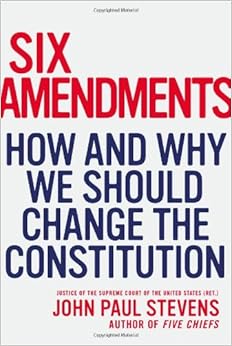
(1) The Second Amendment shall apply only to those who keep and bear arms "when serving in the Militia." (2) Congress and state governments can impose "reasonable limits on the amount of money that candidates for public office, or their supporters, may spend in election campaigns." (3) Capital punishment, because it risks killing innocent inmates, is not "tolerable in a civilized society." (4) All congressional districts "shall be compact and composed of contiguous territory" to prevent racial gerrymandering. (5) Eliminate the anti-commandeering rule, which prevents the federal government from requiring states to perform federal duties, possibly damaging "the federal government's ability to respond effectively to natural disasters that recur with distressing frequency." (6) Deprive states of sovereign immunity for violating federal law, allowing private citizens to bring suit against state governments when federal statutes are violated.
The common theme that binds Stevens' proposed amendments is his belief in the right of self-governance. With the exception of banning the death penalty, Stevens seeks to return devolve the authority assumed by the Supreme Court.
Below is a review of the new book, from Cass Sunstein, former Administrator of the White House Office of Information and Regulatory Affairs in the Obama administration, and well-known Constitutional scholar - via The New York Review of Books.
It’s hard to amend the United States Constitution. Under Article V, an amendment can be proposed only with the approval of either two thirds of both houses of Congress or the legislatures of two thirds of the states. It’s difficult enough to obtain that level of agreement, but there is another obstacle, which is that no proposed amendment can be ratified without agreement from either three fourths of the state legislatures or conventions in three fourths of the states. The authors of the Constitution knew exactly what they were doing. They wanted to limit amendments to what James Madison called “great and extraordinary occasions.” Their plan worked. In well over two centuries, only twenty-seven constitutional amendments have been ratified. Two periods of constitutional change stand out. In 1791, the nation added the ten amendments that constitute the Bill of Rights, thus rejecting the view, originally pressed by Madison himself, that an explicit enumeration of rights was unnecessary. After the Civil War, the nation added three amendments, which (among other things) abolished slavery, applied the due process clause to state governments, adopted a new principle of “equal protection,” and guaranteed the right to vote to African-Americans. The Bill of Rights and the Civil War amendments account for nearly half of the total. Other amendments allow Congress to collect income taxes, call for direct elections of senators, forbid denial of the vote to women, impose a two-term limit on presidents, prohibit poll taxes, and allow all citizens who are eighteen or older to vote. In the successful efforts to amend the Constitution, a recurring theme has been improvement of self-government, above all by extending the right to vote.
As a member of the Supreme Court from 1975 to 2010, John Paul Stevens was widely liked and admired. Modest and eclectic, he could not be pigeonholed, and he displayed a consistent openness to both facts and arguments. He frequently emphasized that under the American Constitution, the government must be “impartial,” and he exemplified impartiality with his own capacity to listen, his unfailing humility, and his insistence on giving respectful attention to opposing views. Stevens also revered, and reveres, the American Constitution. It is nothing short of remarkable that at the age of ninety-four, he has published a book calling for no fewer than six new amendments to the nation’s founding document. No Supreme Court justice, sitting or retired, has ever done anything of this kind.
It is noteworthy, though perhaps not surprising, that in every case, Stevens wants an amendment that will overturn what he sees as a wrongheaded decision by the Supreme Court. In each of these cases, Stevens was a dissenter. It is also noteworthy that Stevens’s broadest theme is the importance of democratic rule. His general goal is to promote self-government, which, as he sees it, has been badly compromised by recent Supreme Court rulings.
Let’s begin with gun control. The Second Amendment states: “A well regulated Militia, being necessary to the security of a free State, the right of the people to keep and bear Arms, shall not be infringed.” For over two hundred years, federal courts generally interpreted the Second Amendment quite narrowly. In their view, the opening reference to a “well regulated Militia” limited the scope of the amendment. The Second Amendment did not create a freestanding individual right to have guns.
Well-organized groups, above all the National Rifle Association, rejected this interpretation and insisted that the Second Amendment did indeed create an individual right. For many years, their view was widely regarded as unpersuasive, a form of ideology masquerading as constitutional law. Stevens notes that as late as 1991, even retired Chief Justice Warren Burger—a well-known conservative, appointed by President Richard Nixon—said that the Second Amendment “has been the subject of one of the greatest pieces of fraud, I repeat the word ‘fraud,’ on the American public by special interest groups that I have ever seen in my lifetime.” It is remarkable but true that in 2008, in District of Columbia v. Heller, a majority of the Court accepted the very view that Burger deemed to be a “fraud.” Stevens thinks that in so ruling, the Court departed from the original understanding of the Second Amendment, and in the process greatly increased judicial power to oversee what state and federal governments do to prevent gun violence. He laments that a constitutional provision
adopted to protect the states from federal interference with their power to ensure that their militias were “well regulated,” has given federal judges the ultimate power to determine the validity of state regulations of both civilian and militia-related uses of arms.
Stevens thinks that democratic processes, and not federal judges, should decide on the fate of regulations designed to minimize gun violence. As a remedy for “what every American can recognize as an ongoing national tragedy,” he would amend the Second Amendment to specify that it applies only to those who keep and bear arms “when serving in the Militia.”
Stevens begins his discussion of campaign finance with the Court’s 2010 decision in the Citizens United case, which held that under the First Amendment, Congress cannot limit the ability of corporations to make independent expenditures on political campaigns. In that case, Stevens wrote an eighty-six-page dissent, but his most fundamental objection is to a critical part of the Court’s opinion in its first significant campaign finance case, Buckley v. Valeo (1976). In that case, the Court upheld restrictions on campaign contributions, ruling that such restrictions could provide legitimate protection against corrupt practices. (Citizens United did not disturb that ruling.) But it simultaneously struck down restrictions on campaign expenditures by which people spend on their own behalf and do not contribute to anyone. In its key passage, the Court said that “the concept that government may restrict the speech of some elements of our society in order to enhance the relative voice of others is wholly foreign to the First Amendment.”
This conclusion was exceedingly important, because it meant that campaign finance limits could never be justified as a way of promoting political equality, or of ensuring that inequalities in wealth are not translated into inequalities in political power. Stevens believes that here the Court made a big mistake. To be sure, he agrees that speech about controversial issues “may not be censored for the purpose of enhancing the persuasive appeal of either side of the debate.” But he thinks that it is altogether different, and entirely legitimate, if rules are issued to restrict the quantity of speech in order to give “adversaries an equal opportunity to persuade a decision maker to reach one conclusion rather than another.” Acknowledging that some campaign finance restrictions may be too low, he insists that Congress should be able to act to reduce the risk that wealth will be the deciding factor in contested elections. Hence his proposed constitutional amendment, which would allow Congress and state governments to impose “reasonable limits on the amount of money that candidates for public office, or their supporters, may spend in election campaigns.”
In 1972, the Supreme Court seemed to be on the verge of ruling that the death penalty is cruel and unusual punishment, prohibited by the Eighth Amendment. But in 1976, the Court backed off, allowing the death penalty so long as its imposition was preceded by a set of procedural safeguards designed to reduce the risk that innocent people would be executed. Stevens joined the majority at the time, and for most of his years on the Court, he accepted that basic approach.
In 2008, however, he concluded that because the risk of executing the innocent could not be eliminated, the death penalty must be abolished. Here he insists that the ultimate penalty is unlikely to have a deterrent effect and that its real justification lies in retribution. In his view, that justification is not sufficient, because execution of innocent people is not “tolerable in a civilized society.” He would amend the Constitution to entrench that judgment. The Constitution is universally understood to forbid racial gerrymanders. No state can structure its electoral districts so that they consist only of white people. But political gerrymanders, favoring one party over another, are pervasive, and under existing law, they are rarely struck down. Stevens thinks that from the standpoint of democratic self-government, this is a most unfortunate result, because it makes general elections far less competitive and ensures that in many places, the primary elections are what matter. As a result, “gerrymandering has made our elected officials more doctrinaire and less willing to compromise with members of the opposite party.” Indeed, Stevens contends that political gerrymandering “may well have been the principal cause of the government shutdown that occurred in October 2013.” He would amend the Constitution to say that districts “shall be compact and composed of contiguous territory,” and that any departures from that requirement cannot be justified by the “interest in enhancing or preserving the political power of the party in control of the state government.” Issues of federalism, as such, rarely get people’s blood boiling, but Stevens is greatly troubled by a seemingly technical principle that constitutional lawyers know as the “anti-commandeering rule.” The Court gave birth to that idea relatively recently. In 1997, the Court decided Printz v. United States, which forbids Congress from requiring state officials to perform federal duties (hence the term “commandeering”). In Printz, Congress sought to require state law enforcement officers to make a “reasonable effort” to determine whether a proposed sale of a firearm would be lawful. The Court ruled that under the Constitution, Congress must respect the sovereignty of state governments, and cannot force state authorities to take such action as it deems fit. Stevens insists that this idea is not merely wrong and inconsistent with the original constitutional plan but also dangerous, because it might turn out to be damaging to “the federal government’s ability to respond effectively to natural disasters that recur with distressing frequency.” He would amend the Constitution to eliminate the anti-commandeering rule. Sovereign immunity is an ancient English doctrine, stating that the sovereign (meaning the government) cannot be sued without its consent. The idea is sometimes attributed to the idea that “the King can do no wrong.” In Stevens’s account, that idea is essentially un-American. It had little appeal in the nation’s first century, having been explicitly rejected by Chief Justice John Marshall and also by Abraham Lincoln, who said:
It is as much the duty of Government to render prompt justice against itself, in favor of its citizens, as it is to administer the same between private individuals.
After the Civil War, however, the Court began to construe the Constitution to create barriers to lawsuits brought by citizens against states as such. In recent decades, the Court has said that the Constitution does not allow Congress to give private parties the right to obtain damages against state treasuries when states have acted inconsistently with the Fair Labor Standards Act, or denied people benefits payments in violation of federal law.
Walker Evans Archive/Metropolitan Museum of Art Electric chair, Sing Sing Prison; postcard, early 1900s
Stevens believes that the Court’s decisions, immunizing official wrongdoing, have not only departed from the constitutional plan but also produced serious unfairness. He believes that if a hospital is owned by a state, it should not be given sovereign immunity when an otherwise identical hospital, owned privately, would have to pay damages. He would amend the Constitution to deprive states of sovereign immunity for violating federal law.
Gun control, campaign finance, capital punishment, political gerrymandering, anti-commandeering, and sovereign immunity—it’s a heterogeneous list. But there is a unifying theme, which is the importance of democratic self-government. With respect to gun control, campaign finance, anti-commandeering, and sovereign immunity, Stevens would free the political process from the control of the courts. In the case of political gerrymandering, he would go in the other direction, because he would impose a constitutional barrier where one does not now exist. But the reason for the barrier is to improve the functioning of American democracy. It is only in the case of the death penalty that Stevens would create a new, rights-based safeguard, designed to protect an individual right, not to promote self-government as such.
There is a general lesson here. A Republican appointee to the Supreme Court, having served for thirty-five years with mostly Republican appointees and under three Republican chief justices, is arguing for constitutional amendments that would largely entrench judicial restraint, and that would reduce the role of the federal courts in American political life. His proposals attest to the fact that in recent decades, the most aggressive judicial decisions have tended to come from the right—and have an uncomfortable overlap with the political positions of the conservative wing of the Republican Party. However much one may applaud or deplore that tendency, Stevens’s book raises a more fundamental question: whether and when the Constitution should be amended to correct a mistaken or harmful decision by the Supreme Court. No one thinks that whenever the Court has erred, the nation should amend the Constitution to set things right. Do we have, in any or all of the six cases, a “great and extraordinary occasion,” sufficient to justify constitutional amendments? The answer depends in part on the kind of burden that must be met by those who seek such amendments. Exactly how great, and exactly how extraordinary? Some people think that by making the Constitution so hard to amend, the founding generation compromised self-government, reducing the capacity of We the People to alter their handiwork. In principle, there is no abstract answer to the question whether a constitution should be made easy or difficult to amend; we need to know some details. If a nation’s constitution is full of mistakes, or if its high court is systematically misinterpreting it, easy amendment might be a good idea. If we should adopt a strong presumption against constitutional change, it must be because the existing document is excellent, or at least excellent enough, so that frequent or easy amendments would be likely to make things worse rather than better. Throughout American history, citizens have participated in the equivalent of an arms control agreement, in which they engage in a kind of mutual forbearance with respect to constitutional change. In recent decades, some people have vigorously supported amendments that would allow school prayer, make a commitment to sex equality, impose term limits, protect “victims’ rights,” allow states to ban same-sex marriages and flag-burning, and require a balanced budget. None of these has been ratified. You might think that the Constitution would be better if one or more of them were part of it, but you might agree that the general pattern of forbearance is also in the national interest. You might even think that the founding generation was wise to make forbearance more likely, if only because of the importance of constitutional stability and the risk of harmful or ill-considered amendments. There could well be strong national majorities in favor of some amendments that Justice Stevens and civil libertarians would deplore, while national majorities would be exceedingly difficult to muster for some of the amendments that he proposes—a point that might strengthen the case for forbearance. And if you approve of forbearance, you might be inclined to reject most or even all of Stevens’s proposals for constitutional change, even if you think that on most or even all of them, he is right as a matter of public policy.
Consider the two federalism issues, anti-commandeering and sovereign immunity. Stevens is correct to suggest that if Congress deems it necessary to require state officials to take certain actions—say, to combat a natural disaster—it is hard to see why the Constitution should stand as a barrier. And if states have violated federal law, and injured people in the process, the national legislature should be authorized to require them to pay compensation. By their very design, the compositions of the Senate and the House of Representatives make it unlikely that Congress will be inattentive to the legitimate concerns of states as such.
But in both cases, we might wonder whether the problems are serious enough to call for constitutional change. If the federal government cannot commandeer the states, it might well be able to persuade them to help voluntarily, or to act either on its own or with the private sector to achieve its goals. And as the law now stands, principles of sovereign immunity generally do not bar people from suing states to require them to comply with federal law. The main function of sovereign immunity is to prevent people from invading state treasuries to obtain monetary damages. That’s unfair, to be sure, but do we really have a “great and extraordinary occasion,” justifying a change to our founding document? On gun control, there is a strong reason to think that constitutional change is unwarranted, which Stevens himself emphasizes: the Court’s rulings continue to leave considerable flexibility to state and federal governments. True, the Court has recognized an individual right to bear arms, but it has pointedly declined to impose anything like an across-the-board barrier to gun control. The individual right remains relatively narrow, and if states or the nation really wants to impose new limits on gun ownership, they can do a great deal. The Obama administration, for example, proposed a number of new restrictions, including background checks for all gun sales, a ban on military-style assault weapons, and a limitation on magazines to a capacity of ten rounds. These restrictions, and many more, would be fully consistent with the Second Amendment as the Supreme Court understands it. The principal obstacle to new gun control legislation is an absence of political will, not the Second Amendment. And in light of the strong political opposition to any such legislation, it is an understatement to say that a constitutional amendment would be extremely difficult to obtain. With respect to capital punishment, any judgment will, of course, depend on contested questions of both fact and value. Stevens is right to say that no legal system is likely to be able to eliminate the risk of executing innocent people. One recent study estimates that over 4 percent of all death row inmates were wrongly convicted. If you consider the risk of executing the innocent to be intolerable, or if you believe that capital punishment is a form of unconscionable barbarity, you will very probably support his proposal. Moreover, Stevens has a good argument that political gerrymandering is creating serious problems for our system of self-government, above all because it allows political parties to entrench themselves, and simultaneously contributes to a high degree of polarization in Washington. One objection to his proposed amendment is that party leaders would try to evade it, and it would not be so easy for courts to prevent that evasion.
Stevens’s strongest proposal involves campaign finance regulation. In the defining First Amendment cases, a political majority is attempting to entrench itself by censoring speech that it deems to be dangerous. The free speech principle forbids that kind of self-entrenchment. It ensures political liberty, and with respect to ideas, a kind of political equality. With campaign finance regulation, the goal is not to entrench the power or opinions of the majority, but to ensure that economic inequalities are not turned into political ones. In a society that tolerates disparities in wealth, that is not merely a worthy goal; it is essential. As those disparities continue or even grow, there is a serious risk that wealthy people will be able to buy not only their preferred goods and services, as they are certainly entitled to do, but also their preferred policies and candidates, which is anathema to a system that prizes self-government.
To be sure, some campaign finance restrictions could turn out to be measures that protect incumbents. But the best way to combat that risk is through democratic debate, not through judicially imposed constraints on campaign finance laws as such. In support of his proposed amendment, Stevens could invoke the views of James Madison, who was not at all enthusiastic about economic equality, but who insisted on the importance of “establishing a political equality among all.” In the end, Madison himself might be willing to agree with Stevens that in the twenty-first century, a democratic effort to promote that ideal would count as a “great and extraordinary occasion,” warranting a change to the nation’s founding document.
I have argued for most of the last decade or more that all laws banning same-sex marriage, or reducing same-sex marriage to the level of civil unions, is a violation of the Establishment Clause in the U.S. Constitution (the separation of church and state). These laws are founded in and argued from a distinctly Christian framework, which is in essence establishing a state religion (any encoding of religious beliefs in law by the government can be seen as a violation of the Establishment Clause).
I have never seen a legal expert make this argument, so I thought I would share this article from Eric Yordy, Associate Dean and Assistant Professor, The W.A. Franke College of Business, Northern Arizona University (Yordy has a J.D. from Cornell Law School).
Abstract: This article addresses the conflict between marriage as a religious concept and marriage as a legal concept. It analyzes the "establishment" of religion when government defines marriage.
Full Citation: Yordy, Eric D., Caught in the Clause: An Analysis of Same-Sex Marriage Through the Lens of the Establishment Clause (February 5, 2013). 22 Tul. J.L. & Sexuality 55, 2013. Available at SSRN: http://ssrn.com/abstract=2278641
LEXISNEXIS SUMMARY:
... At the federal level, the Defense of Marriage Act was passed into law in 1996, giving states the ability to refuse to recognize same-sex marriages performed in other states and defining marriage as a union between a man and a woman for all federal purposes. ... Because the religion clauses do focus on the term "religion" rather than "moral belief" or simply "belief," Professor Choper uses the after-life consequences as the sole factor to separate religious beliefs from other beliefs. ... Goodsell, early Christian churches sanctioned and accepted existing nonchurch marriages. ... And like the MCC churches, the UUA seems to be a legitimate religion under the Brimmer test. ... Justice Thomas concurred in the opinion but argued that the Establishment Clause should not even be a consideration for two reasons: (1) the Establishment Clause was never meant to apply to the states but only to the federal government, and (2) even if the clause applies to the states, there is nothing about this display that coerces a person to view the display. ... Applying this idea to the marriage definition question, the precise argument of many religious leaders is that a civil definition of marriage that includes same-sex couples will lead to coercion to perform those marriages or lose government benefits (such as tax exempt status). ... Applying a two-prong Lemon test, where excessive entanglement and effect are analyzed together, we see that civil marriage definitions still fail the test - in large part due to the tremendous effect of advancing traditional religion over legitimate, nontraditional, religion or nonreligion. ... Conclusion: Given that marriage is primarily a religious concept, or at least is a primary and defining concept in many religions, it is a violation of the Establishment Clause of the United States Constitution for the government to be involved in defining religion.
Chief Justice John Roberts is exactly what he claimed to despise in his confirmation hearings - a judicial activist. This is a man who came to the Court with a well-defined agenda, and one of the areas in which he had a solid track record coming in was his desire to eliminate the Voting Rights Act.
When he was in his late 20s, John Roberts was a foot soldier in the Reagan administration's crusade against the Voting Rights Act. Now, as chief justice of the Supreme Court, he will help determine whether a key part of the law survives a constitutional challenge.
Memos that Roberts wrote as a lawyer in President Reagan's Justice Department during the 1980s show that he was deeply involved in efforts to curtail the effectiveness of the Voting Rights Act, the hard-won landmark 1965 law that is intended to ensure all Americans can vote. Roberts' anti-VRA efforts during the 1980s ultimately failed. But on Wednesday, when the Supreme Court hears oral arguments in Shelby County v. Holder, he'll get another chance to gut the law. Roberts' history suggests a crucial part of the VRA may not survive the rematch.
My guess is that the VRA will not survive this challenge, especialy with Roberts as the Chief Justice - a man with an agenda. This summary of the current challenge comes from the New York Review of Books.
Voters waiting in line, Birmingham, Alabama, November 4, 2008
Mario Tama/Getty Images
What happens when a Supreme Court ostensibly committed to judicial restraint confronts a long-standing civil rights statute that offends its conservative majority’s sense that law should be colorblind, even if the world is not? That question will be front and center when the Court hears arguments Wednesday in Shelby County v. Holder, a case challenging the constitutionality of a central provision of the 1965 Voting Rights Act. The provision, known as Section 5, requires nine states, mostly in the South, and select jurisdictions in seven other states, to obtain federal approval for any change in their voting laws. Congress concluded that this was necessary to ensure equal opportunity in voting. But conservatives in some of the southern states have long complained that the law gives the federal government too much power, and now, Shelby County—a largely white suburb of Birmingham, Alabama found guilty of racial discrimination in voting as recently as 2008—has sued the US government to get it annulled. If the Supreme Court majority exercises restraint, it will acknowledge that Section 5 falls within Congress’s constitutionally assigned authority to enforce rights of equal protection and voting. But if the Court chooses to impose its own view of racial justice—according to which laws should be drafted without regard to race, even if race-conscious efforts are needed to forestall discrimination—it will invalidate a core part of one of the country’s signal civil rights laws. The Court has frequently reviewed the Voting Rights Act since its initial enactment, and has until now always upheld it. But this time around, the result could well be different. It shouldn’t be. The Voting Rights Act is the most successful anti-discrimination law in US history. It has transformed a nation in which minority voters were routinely and systematically denied access to the ballot box, through literacy tests and the like, into one where registration and voter restrictions are the exception. And the Act has also defeated many attempts by states and local jurisdictions to gerrymander minority voters into districts designed to minimize or negate their influence. Yet while there has been great progress, many of the problems the Act was designed to address persist in different ways today. Quite apart from the battles over “voter ID” rules during the 2012 election, “racially polarized voting,” in which white and minority voters divide along racial lines in the candidates they support, continues to occur in many parts of the country; and de-facto residential segregation is all too common. As a result, it is easy for those drawing voting district lines to group black or Latino voters into districts in which they are a minority, meaning that their votes will rarely if ever “count,” because candidates will need to appeal only to the white majority. And because minority voters often favor Democratic candidates, there is great temptation among Republican-dominated state legislatures to minimize the influence of those voters, even if old-fashioned racial animus is not the prime motivator. Section 5 has provided an effective and flexible way to address these continuing problems. It applies to specific states and locales that have histories of voter discrimination and especially poor records of registering minority voters. Although most of the covered jurisdictions are in the South—Alabama, Georgia, Louisiana, Mississippi, South Carolina, Texas, and Virginia—the provision also governs all of Alaska and Arizona, and parts of California, Michigan, New Hampshire, New York, and South Dakota. Importantly, states and counties that have not discriminated for ten years may “bail out” of Section 5’s obligations, and many jurisdictions have done so. (The Justice Department has approved every such application since 1982). The law also empowers courts to “bail in” non-covered jurisdictions that show a persistent pattern of discrimination, and courts have imposed this requirement on jurisdictions in nine states. Moreover, there is continued evidence of discrimination in many of the original Section 5 jurisdictions. The majority of successful voter discrimination lawsuits in the twenty-five years leading up to 2006, for example, were against jurisdictions covered by Section 5. Yet those jurisdictions represent less than one-quarter of the nation’s population, and ought to be less vulnerable to lawsuits precisely because their voting rules must satisfy preclearance. In 2012 alone, Section 5 blocked Texas from implementing a voter ID law that would have disproportionately barred black and Latino citizens from casting their ballots, and prevented a statewide redistricting plan that was found to be designed to reduce black and Latino influence in federal and state elections. Section 5 also compelled South Carolina to modify its voter ID law to reduce its discriminatory impact, by providing an exception for those who faced a reasonable impediment to obtaining a government-issued identification card. Critics of Section 5’s “preclearance” process argue that it is not needed because another provision of the Voting Rights Act, Section 2, already permits parties to sue in court to challenge discriminatory voting practices. But Congress found Section 2 insufficient because voting rights lawsuits are extremely expensive to mount, often necessitating complex expert analyses of voluminous demographic data, and can take years to resolve, whereas Section 5 creates an administrative process and puts the onus on states and localities with bad records to show that their changes to voting laws are not discriminatory. And the preclearance process’s deterrent effects are substantial, because officials in the covered jurisdictions know that any change they make will have to pass muster in Washington before it can go into effect. While the Supreme Court has ruled against previous challenges to Section 5, it expressed grave doubts about the provision when it heard the last challenge three years ago. The Court’s concern centered on the law’s differential treatment of covered and non-covered states, and on what it considered the substantial “federalism costs”—or infringement on states’ rights—in the requirement that covered states obtain advance federal approval of changes in state law. The Court did not ultimately rule on the constitutionality of Section 5, but warned that the law’s “current burdens” had to be justified by “current needs” and gave a broad interpretation to the conditions under which the law’s “bail out” provision was available to the challenger. This time, though, that way out is not available. Shelby County is not eligible for a “bail out” because it was found guilty of discriminating in its voting rules in 2008. County officials argue that the formula used to identify states and counties subject to preclearance requirements makes no sense, because it is tied to legal practices and registration rates from three and four decades ago. And they contend that discrimination is no longer sufficiently prevalent to warrant the extraordinary requirement that covered states come to Washington “hat in hand” for approval of their every voting law change. How the Court decides this case will turn on its view of Congress’s power to enforce the Fourteenth and Fifteenth Amendments. Those amendments do not merely create rights enforceable by courts, as do other “individual rights” provision in the Bill of Rights. They expressly authorize Congress to enforce their guarantees through “appropriate legislation.” The amendments’ drafters foresaw that judicial enforcement might not be enough to make equality guarantees meaningful, and therefore empowered Congress to play a coequal enforcement role. Past decisions have found that Congress, in exercising this authority, can enact laws that go beyond core violations of the Constitution where appropriate to forestall such violations. Thus, even though only laws that are discriminatory in purpose violate the Constitution, Congress can also prohibit practices that have a discriminatory effect. Section 5 does just that. For example, in a city that is 30 percent black and 70 percent white, an ostensibly neutral rule that all ten members on the city council should be elected “at large” will often mean in practice that the 70 percent white majority will elect all ten representatives. If the council is divided into districts, however, it should be possible to ensure that black voters are able to elect some members to the council, particularly where, as is often the case, housing segregation makes it relatively easy to identify districts in which minority voters form a majority. Section 5 requires states and jurisdiction to show that their voting rules, even if ostensibly neutral, do not “dilute” minority voters’ ability to elect candidates of their choice. But today’s Court features five conservative Justices committed to a “colorblind” view of equality, who find offensive laws that take race into account, even for ameliorative purposes. This skepticism was evident in the Court’s oral argument last fall in the case challenging the University of Texas’s affirmative action program, in which conservative justices questioned whether one could really determine the race of an applicant, and expressed doubts about the value of racial diversity. Section 5 bothers many of these justices for similar reasons: in order to ensure that a voting change does not have a discriminatory effect, states and local jurisdictions must consider the racial impact that an otherwise neutral change to a voting law might have. The court’s majority may well doubt that this requirement is truly warranted by “current needs.” It is. Before Congress reenacted Section 5 in 2006, it held twenty-one separate hearings, compiled a record of over 15,000 pages, and concluded on that basis that Section 5’s preclearance obligations remained necessary for another twenty-five years—except in states or localities that can successfully demonstrate that they have a clean record and “bail out.” The question before the Supreme Court on Wednesday will be whether it should respect Congress’s considered, recent judgment as a co-equal branch of government. Do “current needs” justify the continued use of Section 5? As long as racially polarized voting and residential segregation persist, the need to protect voting rights remains urgent—and nowhere more so than in those states and jurisdictions that have the worst histories of discrimination and have been unable to show that they have cleaned up their acts. February 26, 2013, 12:46 p.m.
From Bookforum Omnivore, an interesting collection of links to articles proposing a variety of different ways to "fix" the American political system - and none of them involve armed revolution.
From Wonkblog, Ezra Klein interviews Steven Teles, author of Kludgeocracy: The American Way of Policy; why Congress can’t seem to get anything done: Dylan Matthews interviews George Tsebelis, author of Veto Players; and John Sides on why gerrymandering is not what’s wrong with American politics.
For anyone interested in law, especially at the Constitutional level, it's always interesting to hear one of the sitting justices speak. Justice Ginsburg talks about herself a bit, but she also touches on Constitutional law.
UC Hastings Professor Joan Williams welcomes U.S. Supreme Court Associate Justice Ruth Bader Ginsburg for a conversations that touches on a broad range of subjects, from opera to marriage to work/life balance, doctrinal questions, and cases from the 1970's to present, including the court's role in establishing individual rights and equal protection. Series: "Legally Speaking" [12/2011]
Interesting documentary from the from the folks at HBO. I used a different description than the one at Top Documentary Films - seemed a little more relevant.
Since 9/11, the First Amendment has again been under attack. Liz Garbus' Shouting Fire, a riveting exploration of the current state of free speech in America is crucially relevant.
Interweaving historical cases - The New York Times' fight to publish the Pentagon Papers and the Nazis' insistence on marching in Skokie, IL. among them - with contemporary free-speech battles, the film documents the way both the Right and the Left have lashed out in fear.
We think of First Amendment rights as inviolable; but in fact, they're profoundly vulnerable. Prominent First Amendment attorney - and the filmmaker's father - Martin Garbus, leads us through this perilous landscape and wisely warns, if we don't fight for our freedoms every day, we will lose them.
Watch the full documentary now (playlist – 1 hour, 14 minutes)
This was part of Wednesday's thematic link collections (Omnivore) from Bookforum (a cool site if you have never been there) - these links are all related to law, the Constitution, the Supreme Court, and associated topics. Some interesting stuff here - and some disturbing stuff.
For me, one of the more interesting and disturbing stories was on Justice Scalia's rock star status among the (mostly ignorant) tea party crowd - and his appearance in their chamber to "educate" them on the document they claim to worship. They are the perfect audience for him because they "want to believe" and they don't know anything about the Constitution - so they will believe is his strict Originalist version of its meaning.
The problem with this is that he should NEVER be making them his ally or becoming theirs. It's called the Separation of Powers and it's kind of a big deal. He was invited by the Constitutionally challenged Rep. Michele Bachmann (R-Minn.) to speak to the new "freshman" members of the House - many or all of whom will be trying to pass laws that will surely be brought to the Highest Court - will Scalia recuse himself? Not likely. Can we impeach a Justice? Yes, we can, but it's also not likely.
Law professor Jonathan Turley Sunday, January 23, 2011
on why the high court doesn't need celebrity justices
Justice Antonin Scalia is scheduled to appear before an eager freshman class Monday to talk about the Constitution. This is nothing new for Scalia, who often speaks at law schools. These students, however, are a little different.
At the invitation of Rep. Michele Bachmann (R-Minn.), Scalia will be addressing new conservative members of the House of Representatives. To them, Scalia is a nothing short of a rock star. He personifies not only conservative values but a new model for the Supreme Court: the celebrity justice.
Where Scalia has ventured with crowd-pleasing rhetoric, other justices are following. They rally their bases on the right or the left with speeches, candid interviews, commencement addresses and book tours. They appear to be abandoning the principle of strict neutrality in public life, long a touchstone of service on the highest court.
The Bachmann event takes this posturing to a new level. Scalia will be directly advising new lawmakers who came to Congress on a mission to remake government in a more conservative image. Many of them made pledges to repeal health-care reform, restrict immigration and investigate the president - pledges based on constitutional interpretations that might end up before the court.
At best, Scalia's appearance can be viewed as a pep talk. At worst, it smacks of a political alliance.
Supreme Court justices have long chosen fairly cloistered lives and avoided public speeches and appearances. Historically, most members of the highest court - where the proceedings are still not televised - were unrecognizable to citizens. In an incident that's a favorite of mine, a tourist family once asked an elderly man to take their picture at the court - and found out later that it was Justice Byron White.
Justice John Paul Stevens, who retired last year, may have been the last of the breed of judges truly committed to limiting public appearances. A couple of years ago, Stevens and I spoke to a judicial conference in Milwaukee and flew on the same plane. While we chatted at the gate, a lawyer came up and introduced himself to me. He didn't recognize Stevens, and when I introduced him to the justice, the lawyer turned scarlet and made a fast retreat. Stevens never wanted to be a legal idol. He wanted to speak only through his opinions.
But as soon as Scalia was appointed to the Supreme Court by President Ronald Reagan, it was clear that he would be a different type of justice. He was instantly recognized as the intellectual leader of the right on the court at a time of intense ideological divisions. He also chafed at the court's monastic environment. Charming and irascible, Scalia is a much valued speaker and loves to interact with lawyers and law students. He often appears at conservative events and thrills crowds by attacking liberal doctrines. Scalia gave a revealing interview, published in this month's California Lawyer magazine, speaking against claims that the 14th Amendment protects women and gays from discrimination. While that was not a new position for Scalia, he again triggered a public debate on issues that are likely to come before the court this term.
Scalia is not the first justice to cultivate a constituency. Justice William Douglas, appointed by Franklin D. Roosevelt in 1939, publicly embraced environmental causes, including the preservation of the C&O Canal. More recently, Justice Sandra Day O'Connor was criticized for condemning the death penalty. In a 2001 speech in Minnesota, O'Connor said that she questioned whether the death penalty could be "fairly administered in this country." She told her audience, "Minnesota doesn't have [the death penalty], and you must breathe a big sigh of relief every day."
Still, Scalia is the first real celebrity justice. When he appears at conservative events, supporters line up to greet a man who seems more oracle than orator. They are drawn not just to his originalist views but to the sense that he is a purist on a court of relativists. And his fans are often rewarded with a zinger from the justice that would set the hair of every liberal on fire. For example, in a 2006 talk to students in Switzerland, Scalia denounced the idea of giving Guantanamo detainees rights in federal courts, with a disturbingly personal take on the matter: "Give me a break. . . . If he was captured by my army on a battlefield, [Guantanamo] is where he belongs. I had a son on that battlefield, and they were shooting at my son, and I'm not about to give this man who was captured in a war a full jury trial. I mean, it's crazy."
Other justices, particularly those on the right, appear to be following Scalia's lead and presenting their politics publicly. This includes Justice Clarence Thomas, who is known for his utter silence during oral arguments. Outside the court, though, he has denounced our society's "focus on our rights" and the "proliferation of rights" protecting citizens. And the whole world saw Justice Samuel Alito shake his head and mouth "not true" as the president criticized the recent Citizens United decision on campaign finance at the State of the Union address last year.
Justices who flaunt their politics publicly do more than just lecture - they also can raise cash for ideological allies. Scalia and Thomas have reportedly attended events funded by conservative billionaires David and Charles Koch. Last week, Thomas admitted through a spokesman that he "dropped by" a Koch session in 2008. Both justices were even featured in Koch promotional material with Glenn Beck and Rush Limbaugh.
Alito has spoken at a fundraiser for the Intercollegiate Studies Institute, a conservative educational group. He regularly attends conservative fundraisers, including a recent event for the American Spectator magazine; he headlined that annual dinner in 2008. When confronted about his presence at the clearly partisan event, Alito dismissed concerns, saying, "It's not important."
But it is important. Perhaps not to Alito or Scalia, but to the court. If justices come to personify political movements, the law appears to be merely an extension of the personalities - and the politics - on the bench.
Some judicial commentary and appearances raise serious ethical questions. Canon 4 of the judicial Code of Conduct states that a federal judge should not take part in any activities that "reflect adversely on the judge's impartiality." This canon specifically warns that "a judge should not personally participate in fund-raising activities, solicit funds for any organization, or use or permit the use of the prestige of judicial office for that purpose."
But this code applies only to lower-court judges; the members of the highest court in the land are not, in fact, subject to any code of conduct. The only direct limitation is the federal law that requires a judge or a justice to "disqualify himself in any proceeding in which his impartiality might reasonably be questioned." This law, however, lacks a process for making a complaint and has never been enforced against a justice. Each justice is left to be the judge of his or her own alleged misconduct.
This is not a problem only for the more conservative justices. While Justices John Roberts, Scalia, Thomas and Alito have all spoken to or been honored by the conservative Federalist Society, Justice Ruth Bader Ginsburg has headlined for the liberal American Constitution Society, and Justice Stephen Breyer appears frequently before outside groups. In one speech at a foreign conference, Ginsburg assailed conservative members of Congress for statements that she said "fueled" an "irrational fringe" that threatened her life.
Ginsburg's remarks highlight an irony with celebrity justices. During her confirmation hearings in 1993, she refused to answer questions about issues that might later come before the court. Thus the "Ginsburg rule" was born: Aspiring justices, at very cautious confirmation hearings, avoid engaging on the substance of their legal opinions. Yet, after confirmation, justices are increasingly entering into public debates over the law.
Monday's Bachmann-convened summit featuring Scalia magnifies this problem. The effort to educate new lawmakers about the Constitution is commendable. (I have met several times with members of Congress, including Bachmann, for lunches to discuss constitutional principles.) However, if Scalia educates new members, that undermines both the court and Congress. The principle of judicial neutrality should not be compromised for a legal seminar.
Justice Robert Jackson once advised that justices "are not final because we are infallible, we are infallible because we are final√." That winking observation is certainly true - Justices clearly can make mistakes. Few can resist public adoration. However, as justices yield to that temptation, citizens may find it hard to accept the finality of their decisions. If justices merely carry the torch for their political allies, law becomes little more than a part of politics.
Justices do not have a "base." They must ask more of themselves by offering less to their respective constituencies.
Jonathan Turley is the Shapiro professor of public interest law at George Washington Law School.
I think that Laurence Tribe over-estimates the impartiality of this Court (i.e., they are partisan whores), but this is the best explanation of the law around this case that I have seen (and my lawyer friend who specializes in Constitutional law assures me that he has it right, although she too doubts that the Court will rule on the law as much as they will on their partisan biases).
THE lawsuits challenging the individual mandate in the health care law, including one in which a federal district judge last week called the law unconstitutional, will ultimately be resolved by the Supreme Court, and pundits are already making bets on how the justices will vote.
But the predictions of a partisan 5-4 split rest on a misunderstanding of the court and the Constitution. The constitutionality of the health care law is not one of those novel, one-off issues, like the outcome of the 2000 presidential election, that have at times created the impression of Supreme Court justices as political actors rather than legal analysts.
Since the New Deal, the court has consistently held that Congress has broad constitutional power to regulate interstate commerce. This includes authority over not just goods moving across state lines, but also the economic choices of individuals within states that have significant effects on interstate markets. By that standard, this law’s constitutionality is open and shut. Does anyone doubt that the multitrillion-dollar health insurance industry is an interstate market that Congress has the power to regulate?
Many new provisions in the law, like the ban on discrimination based on pre-existing conditions, are also undeniably permissible. But they would be undermined if healthy or risk-prone individuals could opt out of insurance, which could lead to unacceptably high premiums for those remaining in the pool. For the system to work, all individuals — healthy and sick, risk-prone and risk-averse — must participate to the extent of their economic ability.
In this regard, the health care law is little different from Social Security. The court unanimously recognized in 1982 that it would be “difficult, if not impossible” to maintain the financial soundness of a Social Security system from which people could opt out. The same analysis holds here: by restricting certain economic choices of individuals, we ensure the vitality of a regulatory regime clearly within Congress’s power to establish.
The justices aren’t likely to be misled by the reasoning that prompted two of the four federal courts that have ruled on this legislation to invalidate it on the theory that Congress is entitled to regulate only economic “activity,” not “inactivity,” like the decision not to purchase insurance. This distinction is illusory. Individuals who don’t purchase insurance they can afford have made a choice to take a free ride on the health care system. They know that if they need emergency-room care that they can’t pay for, the public will pick up the tab. This conscious choice carries serious economic consequences for the national health care market, which makes it a proper subject for federal regulation.
Even if the interstate commerce clause did not suffice to uphold mandatory insurance, the even broader power of Congress to impose taxes would surely do so. After all, the individual mandate is enforced through taxation, even if supporters have been reluctant to point that out.
Given the clear case for the law’s constitutionality, it’s distressing that many assume its fate will be decided by a partisan, closely divided Supreme Court. Justice Antonin Scalia, whom some count as a certain vote against the law, upheld in 2005 Congress’s power to punish those growing marijuana for their own medical use; a ban on homegrown marijuana, he reasoned, might be deemed “necessary and proper” to effectively enforce broader federal regulation of nationwide drug markets. To imagine Justice Scalia would abandon that fundamental understanding of the Constitution’s necessary and proper clause because he was appointed by a Republican president is to insult both his intellect and his integrity.
Justice Anthony Kennedy, whom many unfairly caricature as the “swing vote,” deserves better as well. Yes, his opinion in the 5-4 decision invalidating the federal ban on possession of guns near schools is frequently cited by opponents of the health care law. But that decision in 1995 drew a bright line between commercial choices, all of which Congress has presumptive power to regulate, and conduct like gun possession that is not in itself “commercial” or “economic,” however likely it might be to set off a cascade of economic effects. The decision about how to pay for health care is a quintessentially commercial choice in itself, not merely a decision that might have economic consequences.
Only a crude prediction that justices will vote based on politics rather than principle would lead anybody to imagine that Chief Justice John Roberts or Justice Samuel Alito would agree with the judges in Florida and Virginia who have ruled against the health care law. Those judges made the confused assertion that what is at stake here is a matter of personal liberty — the right not to purchase what one wishes not to purchase — rather than the reach of national legislative power in a world where no man is an island.
It would be asking a lot to expect conservative jurists to smuggle into the commerce clause an unenumerated federal “right” to opt out of the social contract. If Justice Clarence Thomas can be counted a nearly sure vote against the health care law, the only reason is that he alone has publicly and repeatedly stressed his principled disagreement with the whole line of post-1937 cases that interpret Congress’s commerce power broadly.
There is every reason to believe that a strong, nonpartisan majority of justices will do their constitutional duty, set aside how they might have voted had they been members of Congress and treat this constitutional challenge for what it is — a political objection in legal garb.
Laurence H. Tribe, a professor at Harvard Law School, is the author of “The Invisible Constitution.”
Every so often an idea comes along that rings with such clarity and purpose that it ignites the imaginations of millions of people. That spark of excitement becomes hope, hope becomes action, action becomes community, and that community grows to become a movement. Marine biologist, author, fisherma'am, and Exxon Valdez survivor, Dr. Riki Ott has such an idea.
Exxon's recently reported record profits marks a new height of American corporate corruption and influence over our federal government--corporations find more protection under the law than American citizens, health and safety regulations are stripped away to serve profits ahead of people, politicians serve only their corporate backers, and our environment is falling victim to the lustful greed of this disaster capitalism. How did it come to this?
Dr. Riki Ott is launching the movement for the 28th Amendment to the Constitution: Separation of Corporation and State. In the video above, she explains what a 28th Amendment will accomplish, how it is possible, why it is necessary for our democracy.
In Riki's own words:
In my book, Not One Drop, I answer the question I frequently heard on the streets in Cordova. (It's a small town where people often visit in groups on Main Street or at the post office.) How did corporations get so big where they could manipulate our legal system?
As survivors of the Exxon Valdez spill and 20-year lawsuit, practically everyone in town has first-hand experience with a legal system that failed to deliver justice and Exxon's promise to make us whole.
In researching our nation's legal history, I found the answer. In this 4-minute video, I explain the solution--passing the 28th amendment to the U.S. Constitution: separation of corporation and state.
Please listen. Then ask others to listen. In Not One Drop, I explain this idea more fully. Together we can build a movement to restore government of, for, and by the people.
I am a survivor and witness of the Exxon Valdez oil spill. It happened in my backyard, Prince William Sound, Alaska.
We have been in a lawsuit now for nearly two decades, and Exxon has managed to drag this out while it has managed to increase its profits to, basically, obscene levels: over $40 billion in net profits now. How did things get this bad?
The conclusion that I came to in Not One Drop is that we need the 28th Amendment to the United States Constitution: the separation of corporation and state.
Starting in 1886, judges started recognizing corporations had rights accorded to people. The first one was the 14th Amendment. And nowhere in the Constitution, nowhere in the Bill of Rights, do we find the word "corporation." This is totally judicial fiat. What this has done is allow a consolidation of wealth and power to the corporations that now threatens to destroy the republic. We want separated church and state—we now need to separate corporation and state.
On March 24, 1989—which is when [the] Exxon [Valdez] grounded and spilled 11–38 million gallons of oil in Prince William Sound, I was commercial fishing. I held a commercial fishing permit, and I fished salmon. I also held a Masters and a PhD in marine toxicology. Exxon came to Cordova, Alaska, stood in our high school gym, and promised us, "We will make you whole." Instead, Exxon worked behind the scenes to eliminate thousands of business claims. Exxon threw an army of attorneys at this case. And it's not just the Exxons of the world, it's any of these big transnational corporations have the ability, because of their wealth and power, to completely overwhelm small communities that get in their way.
If we had had the 28th Amendment to the Constitution, Exxon would not have been able to use the 5th Amendment and the 7th Amendment.
The 7th Amendment is that facts tried by a jury cannot be undermined or revisited by higher courts. So in this case, a jury of peers, ordinary people, determined that the price that Exxon had to pay was one year's net profit. Exxon challenged the amount, and also that punitive damages should be held at all.
Exxon also used, in a related lawsuit, the 5th Amendment. The 5th Amendment is a takings—takings of property. After the Exxon Valdez oil spill, there was a federal law passed (the Oil Pollution Act of 1990) that essentially banned the Exxon Valdez from Prince William Sound. It banned any tanker that has spilled over a million gallons from transporting oil in Prince William Sound. Exxon said, that is a takings of our future profit: that's illegal under the 5th Amendment. If Exxon was not a person, Exxon would not have been able to apply the 5th Amendment.
Five years after the Exxon Valdez ran aground, we had our hearing, and the jury awarded us—the fishermen, the natives—$5 billion in punitive damages and $287 million in compensatory damages. Exxon appealed that $5 billion for over fourteen years, and ultimately, the Ninth Circuit Court of Appeals finally threw its hands in the air and cut the 5 billion in half. The Supreme Court, in June of 2008, slashed the $2.5 billion to $507 million.
If we're planning on passing a livable planet onto future generations, the democracy debate needs to be entwined with the sustainable future debate, and I believe now that the best way to do that is to pass the 28th Amendment to the Constitution—separation of corporation and state—and strip corporations of their personhood.
If you pay any attention to these things, you knew the fundamentalist right wasn't going to to give up on making abortion illegal. Overturning Roe v. Wade seems less likely as Bush's presidency winds down and there is a good chance Obama, a pro-choice Democrat, might be the next president.
So, what do they do now? The make the zygote a "person," with full rights under the law, and they make contraception equivalent to abortion. Hmmm . . . how do they propose to pay for all the new babies running around who were never wanted or intended?
Anyway, according to the Washington Post, Colorado is doing their part by defining a person as "any human being from the moment of fertilization."
If voters agreed, legal experts say, it would give fertilized eggs the same legal rights and protections to which people are entitled.
The ballot initiative is funded by Colorado for Equal Rights, a grass-roots antiabortion organization. Its purpose, initiative sponsor Kristi Burton said, is to lay a legal and legislative basis for protecting the unborn. Its passage would also open the door to modifying other laws for the same purpose, she said.
As to what laws could then be modified, Burton would not elaborate. "We try not to focus on some of the issues that will be taken care of later on," she said, repeatedly saying that the amendment is not aimed at outlawing abortion.
"If we give fertilized eggs legal rights, abortion could be considered murder and a woman could be sent to jail for making the difficult life decision to terminate a pregnancy," said Crystal Clinkenbeard, spokeswoman for Protect Families, Protect Choice, a coalition of medical professionals, community groups and religious leaders who oppose the amendment.
The measure also could expand the reach of the law into other arenas, legal experts say. For instance, if a woman miscarries, she could be held responsible if it were found she caused it, even unintentionally. If she smoked or drank while pregnant, her behavior might be considered negligence. Damaged eggs might be eligible for monetary damages. The use of fertilized eggs at fertility clinics or in medical research labs would come into question because the disposal of unused eggs could be considered homicide.
"Because this amendment would define a person in a given way and expand the universe of who persons are, it expands the reach of laws that deal with persons," said Bill Araiza, a law professor at Loyola University in Los Angeles.
The amendment also calls into question pregnant women's medical access, said Scott Moss, a professor at the University of Colorado Law School. "If a pregnant woman is really two people with exactly equal rights, then it is not clear the pregnant woman can undergo any medical treatment that jeopardizes a fertilized egg," he said, adding that the amendment would generate a flood of litigation.
Am I the only one who thinks this is insane? And that this is the future battleground for anti-choice factions?
The Bush administration is taking another approach -- it seeks to make some forms of birth control equivalent to abortion.
In the proposal, obtained by The New York Times, the administration says it could cut off federal aid to individuals or entities that discriminate against people who object to abortion on the basis of “religious beliefs or moral convictions.”
The proposal defines abortion as follows: “any of the various procedures — including the prescription, dispensing and administration of any drug or the performance of any procedure or any other action — that results in the termination of the life of a human being in utero between conception and natural birth, whether before or after implantation.”
Mary Jane Gallagher, president of the National Family Planning and Reproductive Health Association, which represents providers, said, “The proposed definition of abortion is so broad that it would cover many types of birth control, including oral contraceptives and emergency contraception.”
“We worry that under the proposal, contraceptive services would become less available to low-income and uninsured women,” Ms. Gallagher said.
Indeed, among other things the proposal expresses concern about state laws that require hospitals to provide emergency contraception to rape victims who request it.
By this definition, the birth control pill is defined as a type of abortion. If the government can make this definition a part of how it dispenses funding, it sets the precedent for expanding this definition into other areas of law.
Oh wait, maybe this is more insane. Is that possible?
All of these angles are based on religious beliefs, as are all anti-choice arguments, and therefore should be disallowed under the Separation Clause. It's that simple.






Chelsea Green | November 10, 2008 02:22 PM