Showing posts with label Arizona. Show all posts

Tuesday, June 17, 2014

Documentary - Stuck in Traffick (Child Sex Trafficking from Survivors' Perspective)

I don't like "trigger warnings" in general, but this feels like an exception. This documentary is likely to be triggering to anyone who has been through childhood sexual abuse. Please be aware of your own feelings and avoid this if necessary.

This documentary is based in Phoenix, AZ, a couple of hours north of Tucson. In Arizona, child sex trafficking in the fastest growing criminal activity, as it is in the U.S. and the rest of the world (it is the 2nd largest criminal activity in the world now).

Definition of ST.jpg

Part of the problem in AZ is that the drug cartels, who straddle the U.S.-Mexico border, have realized that they can only sell drugs once, but they can sell a child over and over and over again.

According to Sold No More, a Tucson-based anti-trafficking group:

Trafficking FAQs

  • Human trafficking is now the 2nd largest and fastest growing illegal trafficking activity in the world.  (United Nations Office on Drugs and Crime, 2008)
  • The annual market value of human trafficking is $32+ billion. (Ibid.)  80% of victims  are women and 50% are children.  (Trafficking in Persons Report 2007, U.S. Department of State)
  • Globally, one million children are forced to work in the sex industry every year.   (Child Exploitation and Obscenity Section, 2007)
  • Among the millions trafficked each year, hundreds of thousands are teenage girls, some as young as five years of age. (Ibid)
  • In the U.S., handlers, “pimps,” can make $100,000 a year, per child. 
  • Child pornography is a multi-billion dollar industry and among the fastest growing criminal segments on the Internet.  Child pornography fuels the child sex trade.   (National Center for Missing and Exploited Children)
  • 450,000 children run away from home each year in the U.S..  A third of those lured into sex slavery are taken within 48 hours of leaving home. (Child Exploitation and Obscenity Section, 2007)
  • The average age a child is first commercially sexually exploited in the U.S. is 13 years of age.  (Ibid)
  • Fewer than 1,000 minor sex trafficking victims in the U.S. have been assisted by  federal, state, and local law enforcement agencies since 2001.  (Ibid)
  • 10% of trafficked children were kidnapped.  (Karla Dial, “Reaching Into the Dark,” Citizen Magazine, March 2010, 5)
Here is a striking graphic of the situation:

Infograph Web.jpg

This is tough to watch - but awareness breeds action. We need to put an end to this form of slavery.

Stuck in Traffick


Prostitute. Hooker. Floozy. Call girl. Lady of the Night. Streetwalker.

Society stamps a negative label on the women of this dangerous criminal industry. However, a fine line must be drawn between those women doing it by choice and the victims who have no choice.

Sex trafficking is the fastest growing criminal industry in the world. There are more than 100,000 minors forced into the sex trade every year in the U.S., with an average age of only 13. They are first recruited, forced, coerced, or abducted by a pimp or his workers. Then they are beaten, raped, brainwashed, and treated as commodities. Some of these victimized women can bring in $15,000 a week. The pimp usually receives every penny.

There are more slaves today than at any other time in our history. Slavery in the form of sex trafficking is among us in a hidden and quiet fashion. It’s in our neighborhoods and in our malls. It’s in our suburbs, it's leaking into our schools, and it's all over the Internet. Education and awareness are the best tools we have at stopping this heinous crime.

Stuck in Traffick is a documentary that brings light to the underground world of sex trafficking and what can be done to help these victims.

Monday, May 06, 2013

MAP: Which States Have Cut Treatment For the Mentally Ill the Most?


From Mother Jones. According to the map near the bottom, Arizona spends $161 or more per capita for mental health (MH), putting us in the top tier of MH spending, yet we have some of the worst issues in the country.

When Governor Jan Brewer (R) cut funding for the Arizona Health Care Cost Containment System (AHCCCS) in 2010, an "estimated 100,000 childless adults" lost their health care coverage (beginning in 2012), a program that also made available free or very low-cost mental health services. These reductions in coverage were part of a $500 million cut in AHCCCS funding orchestrated by Brewer and the GOP-dominated state legislature in order to balance the state budget without raising taxes (and, in fact, cutting taxes for big businesses and the wealthy). This was another pitiful example of how the GOP sacrifices those in need of help and support to increase profits for the 1%.

There is hope, however.

After initially rejecting federal money from the Affordable Care Act, Brewer changed her mind a few months ago and is willing to accept more than a billion dollars in ACA money that requires her to spend another $150 million for state health care.
The Executive estimates that, for Arizona, the expansion of Medicaid eligibility to 133% of the federal poverty level represents a major opportunity: for a state match of a little over $150 million in FY 2015, Arizona can draw $1.6 billion in federal funds into its health care sector – a return on investment more than 10-to-1.
The original cuts placed a huge burden on the few agencies in Tucson that offer free mental health care without requiring AHCCCS or any other insurance, including SACASA (where I work - our waiting list is overwhelming) and the University of Phoenix Counseling Skills Center (which only offers a maximum of 10 sessions).

Anyway, here is the Mother Jones piece on mental health funding in the U.S.

MAP: Which States Have Cut Treatment For the Mentally Ill the Most?

—By Deanna Pan | Mon Apr. 29, 2013

Between 2009 and 2012, states cut a total of $4.35 billion in public mental-health spending from their budgets. According to a report by the National Alliance on Mental Illness, significant cuts to general fund appropriations for state mental health agencies have translated into a severe shortage of services, including housing, community-based treatment and access to psychiatric medications. "Increasingly, emergency rooms, homeless shelters and jails are struggling with the effects of people falling through the cracks," the report says, "due to lack of needed mental health services and supports."

The map below shows how states' spending changed on mental health services between 2009 and 2012.

Click on a state to see the specifics.

These six states and the District of Columbia made the deepest cuts to their mental health budgets.

South Carolina ($187.3 million in 2009 to $113.7 million in 2012, -39.3 percent): The director of the local NAMI chapter says the state’s mental-health department is “approaching crisis mode with funding at 1987 levels.” After closing community mental-health centers and reducing services at its remaining facilities, the department is now serving thousands fewer patients.

Alabama ($100.3 million in 2009 to $64.2 million in 2012, -36 percent): Alabama has one of the lowest numbers of psychiatrists [PDF] per capita in the nation. Despite rising demand for psychiatric hospital beds, Alabama plans to close most of its state mental hospitals this spring, laying off 948 employees.

Alaska ($125.6 million in 2009 to $84.7 million in 2012, -32.6 percent): Alaska has the nation’sNo. 2 suicide rate—and a massive mental-health workforce shortage. Sometimes there is not a single psychiatrist or psychiatric nurse [PDF] available at the mental-health center in Fairbanks, the state’s second-largest city.

Illinois ($590.7 million in 2009 to $403.7 million in 2012, $-31.7 percent): Illinois has more mentally ill people living in nursing homes than any other state. In 2010, the state settled a class-action civil rights lawsuit, agreeing to help 5,000 of them transition into community programs within five years. As of July 2012, only 45 people had moved.

Nevada ($175.5 million in 2009 to $126.2 million in 2012, -28.1 percent): In 2003, Reno police calculated how much it cost the county to repeatedly pick up and hospitalize Murray Barr, a homeless man with an alcohol addiction. Tallying up doctors’ fees and other expenses from his decade on the streets, Barr racked up a $1 million bill.

District of Columbia ($212.4 million in 2009 to $161.6 million in 2012, -23.9 percent): Children on Medicaid wait 10 weeks—or one-third of the school year—for an appointment with a Children’s National Medical Center community clinic psychiatrist.

California ($3,612.8 million in 2009 to $2,848 million in 2012, -21.2 percent): Inmates with severe mental illness often wait three to six months for a state psychiatric hospital bed. In 2007, 19 percent of state prisoners were mentally ill. By 2012, 25 percent were.

CRAZY PRIORITIES

Approximately 10 percent of US homicides are committed by untreated severely mentally ill people.

Chances that a perpetrator of a mass shooting displayed signs of mental illness prior to the crime: 1 in 2

Between 1998 and 2006, the number of mentally ill people incarcerated in federal, state, and local prisons and jails more than quadrupled to 1,264,300.


Since 2006, mental-illness rates in some county jails have increased by another 50 percent.

For every $2,000 to $3,000 per year spent on treating the mentally ill, $50,000 is saved on incarceration costs.

Prisoners with mental illness cost the nation an average of nearly $9 billion a year.

In 1955, there was one psychiatric bed for every 300 Americans. In 2010, there was one psychiatric bed for every 7,100 Americans—the same ratio as in 1850.

Severe mental disorders cost the nation $193.2 billion annually in lost earnings.


Sources for pie charts: National Coalition for the Homeless, NIMH, "Hunger and Homelessness Survey," The US Conference of Mayors,"Inmate Mental Health," National Institute of Mental Health


Monday, December 24, 2012

Gunsmoke: USA (i.e. Arizona)


Disturbing documentary about guns and gun mentality in my current state, Arizona. When we combine Tea Party racism with 2nd Amendment fanaticism, the mix is pretty volatile.


Gunsmoke: USA
An ongoing source of controversy in America, gun laws are increasingly polarizing the Southern states and Washington. In Arizona, Tea Party supporting, heavily armed, vigilante groups are taking over.

“The one thing we know about gun control is that it has never provided security”, argues former Arizona sheriff and local hero, Richard Mack.

Despite the recent massacres, the majority still support free gun laws. Heavily armed citizens take Mexican border security into their own hands in this “state with a frontier mentality”.

With over 100 new civilian militia groups forming in the last 2 years, it is fertile ground for Tea Party supporters. There is no doubt as to who is the real enemy here: “The greatest threat to our God-given American liberty is our own federal government”.

With the cultural divide between North and South looking dangerously wide, Arizona is becoming more than a state: it’s a state of mind.


Watch the full documentary now - 23 min

Sunday, May 06, 2012

AZ Set to Ban the 1992 UN Rio Declaration on Environment and Development (Known as Agenda 21 to Conspiracy Theorists)


The proud and deeply disturbed state of Arizona is set to become, I believe, the first state in the country to ban the 1992 United Nations Rio Declaration on Environment and Development (otherwise known as Agenda 21 to conspiracy theorists).

According to the story on MSNBC, the bill's sponsor, state Sen. Judy Burges (R-Sun City West), claims:
"The bill is designed to protect the rights of Arizona citizens and prevent encroachment on those rights by international institutions. We have three branches of government and when one branch preempts the process through executive orders, the balance of power is lost in the process. It is that simple -- no more, no less."
More to the point:
About the Rio declaration, SB1507 says “the United Nations has enlisted the support of numerous independent, shadow organizations to surreptitiously implement this agenda around the world.”

Rep. Terri Proud, R-Tucson, told supporters in an email that the U.N. declaration “will take away our rights as Americans by allowing the United Nations to mandate laws on our soil,” the AzCapitolTimes.com reported. “It’s very real and it is happening.”

The Times also reported that during House debate Wednesday, Rep. Jack Harper, R-Surprise, said the declaration is connected to the “occult” of sustainability.
The Daily Kos is covering this story with the decidedly snide and dismissive tone it deserves - it's worth checking out for the laugh-factor.

On a more serious note, if the law is implemented, many of the functions of government would be in jeopardy of violating the new law.
The state of Arizona and all political subdivisions of this state shall not adopt or implement the creed, doctrine, principles or any tenet of the United Nations Rio Declaration on Environment and Development and the Statement of Principles for Sustainable Development adopted at the United Nations Conference on Environment and Development held in Rio de Janeiro, Brazil in June, 1992 or any other international law that contravenes the United States Constitution or the Constitution of Arizona.
According to one of the bill's opponents, this is a partial list of possible violations:
Among the U.N. declaration’s non-binding principles are calls for sustainable development, environmental protection, eradicating poverty, eliminating unsustainable production and consumption patterns, economic growth and the participation of women in government decisions.

“We wouldn’t be able to use CFL light bulbs in state buildings because that would be considered energy efficiency,” Campbell said.

Campbell also said that the state’s Economic Security Department, which handles unemployment and welfare benefits, could be outlawed because it has to do with eradicating poverty.

Also, Arizona universities have sustainability programs that could be banned if the bill becomes law, Campbell warned.

Arizona State University has a School of Sustainability, Northern Arizona University offers a master's in sustainable communities, and the University of Arizona has an environment and sustainability portal.
For more information on the U.N. plot to control our light bulbs, check out these fine news sources:

World News Daily
Salon
Wikipedia

Sunday, March 27, 2011

Arizona Slashes Education, Health Care for the Poor - Proposes Flat Income Tax

http://politics.morenewsnow.com/files/arizona-legislature-targets-humananimal-hybrids_500.jpg

Arizona, like much of the nation - has it all backwards when it comes to balancing the state budgets. Federal cuts have placed more of the burden on the states, and most states are running deficits, which is constitutionally illegal for much of the country (why this is so for states and not the federal government is an interesting question).

In Arizona, the Republican led legislature keeps cutting spending rather than raise taxes (the 1 cent state sales tax was an exception, and it expires next year). This year is their fantasy come true - cutting education and health care, while proposing MORE tax breaks for businesses and the wealthy.

Here are this years big cuts, as detailed by The Tucson Weekly:

The budget pretty much does everything that conservatives have dreamt of doing in Arizona: K-12 education is cut by $242 million. Universities are cut by $235 million. Community colleges are cut by $63 million. More than a quarter-million people lose their state-subsidized health insurance. And on and on and on.

Sandy Bahr, legislative lobbyist of the Sierra Club, notes that the budget permanently reduces a fund dedicated to cleaning up contaminated water sites from $15 million to $7 million a year, and eliminates any general-fund contribution to the Arizona Water Protection Fund. Hey, who needs clean water?

Lawmakers are also swiping more than $2 million in user fees from state parks and nearly $1.5 million for the State Lake Improvement Fund, as well as smaller amounts from other non-taxpayer funds that support the parks. A separate bill requires the Arizona State Parks board to start privatizing parks.

In total, the GOP budget shaves more than $1.3 billion in state spending—which is about a half-billion more than Gov. Jan Brewer proposed.

We already pend the smallest amount per student of any state in the nation - and our academic achievements show it - we are always in the bottom three states, along with Mississippi.

I can't imagine why any large company would relocate to AZ when all we can offer them are some tax breaks and an illiterate workforce. If it were my company, I'd want to be in a state that has quality education - that supports education rather than giving tax breaks to the wealthy.

That all happened last week - but after the Weekly went to press, the Arizona Daily Star reported on the real Holy Grail of this legislature, a proposed flat income tax. Under this tax scheme, those making more than $100K pay LESS taxes, while lose making under $100K pay more taxes - the rich get richer and the poor and middle class get poorer - and in order to make this work they are also eliminating ALL deductions, including interest on mortgages and charitable contribution deductions.

A Senate panel approved the bill on Thursday on a partisan vote:

A Senate panel voted Thursday for a major revision in the state tax code that would mean lower bills for about 13 percent of Arizonans - and higher ones, on average, for everyone else.

The legislation, approved on a 4-2 party-line vote with Republicans in the majority, would replace the state's graduated income tax structure with a single flat rate.

Preliminary estimates put that new figure at 2.13 percent. And that is lower than any of the current rates, which range from about 2.5 percent to 4.5 percent.

But to bring in the same amount of money as the current system, the plan would eliminate all deductions. That includes some big ones, like interest paid on home mortgages and charitable contributions.

And the exemptions from income that now exist for each person living in the home also disappear.

Rep. Steve Court, R-Mesa, who already has shepherded the proposal through the House, said the idea is fairness.

"This changes the way we look at how we tax income," he said. "It also simplifies the process."

Court said the idea of eliminating all those exemptions and deductions make sense "so that the government does not incentive how you spend your money and you don't have a situation where a group of you all making $24,000 a year would all pay a different tax."

But what Court called a "fair process" drew the ire of Sen. Paula Aboud, D-Tucson.

She pointed out the net effect is going to be a tax shift from those at the top of the income scale to those lower down. Figures crafted by the Joint Legislative Budget Committee conclude the break point is around the $100,000 range, with everyone below that paying something more than they do now.

He predicted that the average tax bill for those below $100,000 will be going up $200 a year. "It's not going to be any excessive tax increase," Court said.

Aboud bristled at that conclusion.

"Two hundred dollars to some people is a decider between food, medicine and a whole lot of things in these hard economic times," she said.

"This feels insulting for the people that are struggling, when they're losing their health care and they've lost their job and they're losing their home," Aboud continued. "There are a lot of people that are suffering, and this bill heaps that onto them."

Here is a chart of the estimated tax burden by income

You can view the PDF in full size.


Notice that those earning less than 10,000 a year will pay 19,900% more taxes than they pay now. WTF? Blood from turnips much?

My bracket (at least while I am student) will get hit with a 77% increase, and I can't deduct interest on student loans anymore.

I'm hoping that this will not make it through the state house - although here, like at the national level, the Senate tends to be a little more sane. That scares the hell out of me.

Like all dumbass things this state does, if it passes here, look for it to come to your state next.

Friday, March 04, 2011

Legislature Seeks to Makes Arizona a Third World State

Ah, Arizona. When AZ was the last state to make Martin Luther King Day a holiday, I swore I would never live in this forsaken backwater state - yet, here I am. Since Jami and I bought a house last summer, I guess we're stuck here for awhile, which makes the idea of Baja Arizona seem lot more desirable.

This year the legislature is doing its best to destroy the state. A whole raft of far-far-far-right bills are up that will essentially make Arizona both a laughing stock and a third world state. It's shameful and embarrassing.

I especially like the "Freedom to Breathe Act" that prohibits ALL federal regulations of greenhouse gases in Arizona. Maybe "freedom to gag act," or "suffocate on carbon monoxide act," or "freedom to get crispy in the AZ sun act."

Oh, and I really like SB 1433, which would create a Joint Legislative Committee on Nullification of Federal Laws. It would have the power to declare federal regulations null and void in Arizona if lawmakers determine that the rules exceed the scope of powers laid out in the U.S. Constitution. And I'm sure they are all Constitutional law experts, right?

Via Tucson Weekly: On the agenda (and most likely to pass):
  • Eliminating Medicare (SB 1519), which will cost the state $7 billion in federal funds, leave 50,000 elderly, physically disabled and developmentally disabled individuals, as well as 1.3 million Arizonans, without coverage.
  • Two bills (SB 1308 and SB 1309) would override the 14th Amendment of the US Constitution and revoke citizenship rights to those born in AZ to non-citizens and create distinct citizenship rules for Arizona.
  • SB 1405 would require hospitals to check the immigration status of patients before admitting them in non-emergency situations.
  • SCR 1014 would ask voters to eliminate the Arizona Board of Regents (whose job is it to supervise the state universities and lobby for them in the legislature).
  • SB 1380 is a striker sponsored by Sen. Frank Antenori of Tucson that would require the random drug-testing of welfare recipients.
  • SB 1201, which loosens regulations prohibiting firearms in public buildings and at public gatherings, passed the Rules Committee on Monday, Feb. 28.
  • SB 1467, which permits concealed weapons on college campuses, passed the Rules Committee on Wednesday, Feb. 23.
  • SB 1393, which prohibits federal regulations of greenhouse gases in Arizona, moved closer to passage with a vote of the Senate Committee of the Whole last week. SB 1393 is called the "Freedom to Breathe Act" by sponsor Sen. Sylvia Allen and the "License to Pollute Act" by Sierra Club lobbyist Sandy Bahr.
  • The "No Taxpayer Subsidies for Political Campaigns Act," which would ask voters to ban the spending of public money on political campaigns, passed the Senate on a 20-9 vote. SCR 1025, which is now headed for consideration by the House of Representatives, is a back-door way of killing Clean Elections by blocking the distribution of dollars to candidates and sweeping the funds back into the general fund.
This last law was designed to provide access to public office for people who are not independently wealthy or well-connected to the folks who are wealthy, i.e., to promote democracy.

You can read more about these bills and others at the Tucson Weekly: Legislative Landslide is the article the above info comes from - also check out Welcome to the Blogislature by Jim Nintzel.

This article from a couple of weeks ago, has more depressing news from the legislature.

You Say You Want a Revolution

Republican lawmakers want to drive away the feds, crush the cities and create a heavily armed conservative paradise


You might think that the small-government conservatives who captured the Arizona Legislature wouldn't be eager to pass a lot of new laws.

But you'd be wrong. It turns out that dismantling Big Government requires a lot of legislation, plenty of court action and—when all else fails—a surprising amount of red tape.

Senators filed 608 bills; the House of Representatives has 726. And that's not counting resolutions, memorials and the occasional special session—like the one on a tax-cut package that will likely sail through the Legislature just days after being unveiled this week.

Lawmakers want to throw off the yoke of the federal government. They want to grind down the cities and counties. They want to create new state citizenship rules to challenge the 14th Amendment, ensure that there are more guns in more places, restrict access to abortion, fund schools with money from a nuclear-waste dump, get their hands on Obama's secret birth certificate, and so much more.

We've pulled together a collection of some of the more notable bills this week, but you'll find much more every day in the new-and-improved Blogislature feature at The Range, our daily dispatch, at daily.tucsonweekly.com. Check in regularly as we feature new bills, the latest victims of budget cuts and the latest gossip as state lawmakers work to remake the state and whittle away at another billion-dollar-plus budget shortfall.

One thing is clear: GOP lawmakers don't want to be bossed around by Washington, D.C., elites. SB 1433 would create a Joint Legislative Committee on Nullification of Federal Laws, which would have the power to declare federal regulations null and void in Arizona if lawmakers determine that the rules exceed the scope of powers laid out in the U.S. Constitution. Sponsored by freshman Sen. Lori Klein, SB 1433 is set for a hearing in the Senate Committee on Border Security, Federalism and States Sovereignty this week.

If they're stuck recognizing federal laws, legislators want to keep the feds on a tight leash. HB 2077 would require that federal regulators and investigators register with county sheriffs and pay fees that the sheriff imposes. The bill, which passed out of the House Government Committee last week, would also require sheriffs to alert the targets of investigations that the federal government was snooping around; any fine or penalty that resulted from the investigations would be claimed by the state rather than by the federal government.

HB 2077 was headed for a hearing this week in the House Military Affairs and Public Safety Committee.

Sen. Sylvia Allen—who became a YouTube sensation two years ago after she declared that environmental concerns about uranium mining were overblown, because the Earth "has been around for 6,000 years, long before we had any environmental laws, and somehow it hasn't been done away with"—is zeroing in on federal environmental regs. Her "Freedom to Breathe Act" would give the state the sole authority to regulate greenhouse gases—and attempts to force federal regulations of greenhouse gases would be considered a violation of Arizonans' civil rights. SB 1393, which Sierra Club lobbyist Sandy Bahr has dubbed the "License to Pollute Act," passed out of the Senate Committee on Border Security, Federalism and States Sovereignty last week.

Sen. Al Melvin is continuing his push for more nuclear power in Arizona. SB 1545 declares that uranium mined and enriched in Arizona is not subject to federal regulation; the bill is set for a hearing this week in the Senate Commerce and Energy Committee.

Also up for a hearing in Senate Commerce and Energy Committee: Melvin's SB 1548, which would create a Nuclear Recycling Public School Fund. Under the legislation, the federal government would pay to build a nuclear-recycling facility, which would be run by the feds, the state and a private entity. The feds would pay the state to recycle the nuclear fuel, with the proceeds going to a fund that would pay for schools, reducing the need for education dollars in the state's general fund.

A package of bills that would challenge the birthright-citizenship rights established in the 14th Amendment to the U.S. Constitution stalled last week when Sen. Ron Gould couldn't get enough votes to pass them in the Senate Judiciary Committee. The bills have since been reassigned to the Senate Appropriations Committee, but a hearing on them was cancelled earlier this week.

A similar pair of bills is awaiting a call to action in the House of Representatives.

Speaking of birth certificates: The birthers hit a bit of a bump this week in the Senate as SB 1526—which would have required presidential candidates to file an orginal long-form birth certificate and backup documentation to prove United States citizenship—failed to get out of the Senate Judiciary Committee. But a similar bill, HB 2544, is alive in the House of Representatives. It would require presidential candidates to file an "original long-form birth certificate that includes the date and place of birth, the names of the hospital and the attending physician and the signatures of witnesses in attendance."

Sen. Frank Antenori, who is one of the co-sponsors, says lawmakers are reworking the bill with Secretary of State Ken Bennett, who had numerous concerns.

"It's just a basic vetting of the candidate," Antenori says. "I keep telling everybody it's not about the president. I blame him for creating this hysteria. I believe the guy is a U.S. citizen. ... But the way he managed that conspiracy theory, he just added to the speculation and added to the hysteria and added to the paranoia."

While GOP lawmakers bristle at federal regulation, they are eagerly examining ways to limit the powers of counties, cities and towns.

Antenori dismisses critics who see a contradiction between railing against the feds and asserting more authority over local jurisdictions.

"That's different," Antenori says. "Local control is a concept that everyone tries to respect to a degree, but when it comes down to it, cities are still political subdivisions of the state and are given their authority through the state Constitution by the Legislature. It's cut and dry. ... Cities are not sovereign. Counties are not sovereign. States are sovereign. I'm tired of hearing that argument. ... It's a nice little deception that's been created out there in the media. The reality is: If you have an entity in this state, whether it's a city or a county that is doing something that harms the state or harms the economy or people's liberties or freedoms, the state Legislature has a duty to step in."

In conjunction with the anti-government Goldwater Institute, Antenori is stepping in with a number of bills that would hamstring cities. SB 1345 sets limits on the number of employees a city can hire based on a percentage of the city's population, and limits city pay based on average salaries of city residents.

Antenori is also pushing legislation that would require city governments to put every service it provides out to bid, with the exception of the police and fire departments, the judiciary, prosecutors and tax collectors. If a city did not accept a bid, it would have to publish its costs compared to the private contractor's bid and provide a written explanation as to why the service was not outsourced.

If SB 1322 were to become law, private contractors could take control of Tucson Water, local parks, swimming pools, garbage collection, landfill management and building inspectors.

"If it's available in the private sector, then the city should take a serious look without other influences—just purely on a fiscal approach on whether it can be done for less by somebody in the private sector," says Antenori. "The beneficiary of this is the small-business community, because a lot of those services can be done by small businesses for a fraction of the cost, because they don't have the high overhead that a lot of these cities have."

Antenori explains that his proposal, which would apply to cities with populations of more than 200,000, would help bloated municipalities shed employees who have generous compensation packages for doing jobs that can be done more cheaply by businesses with an eye on the bottom line.

"In the end, the taxpayers deserve to see if there's a cheaper, more-efficient way of providing certain services," says Antenori, who is unsympathetic to special-interest civil-service unions who fret about layoffs.

"It's not about all the city workers," he says. "It's not about them. The city's job isn't to be an employment factory for government civil service. It's to provide certain services to the citizens at the most cost-effective and efficient way that the taxpayers can get."

Both SB 1322 and SB 1345 passed the Senate Government Reform Committee last week.

Antenori is also championing several measures—SCR 1019, SCR 1026, SB 1408 and SB 1231—that seek to lock the state into its current recession-level budget, either through a state law or a constitutional amendment. The bills, which passed through the Senate Appropriations Committee last week, use a variety of formulas to limit the growth of future spending, primarily based on population growth and inflation. Supporters say the limits would keep the state from getting into future financial trouble; critics argue that locking in today's spending levels means that programs and agencies that have seen deep cuts—from state parks and universities to day-care subsidies and transplant programs—would be permanently curtailed.

Lawmakers want to continue the trend of loosening Arizona's gun laws. SB 1201 is an omnibus gun measure that would allow people to carry guns in public buildings such as the Capitol, and at community festivals. People who believed their rights had been violated by a government employee who prevented them from carrying a gun into a public gathering could sue a municipality for damages. It would also make it more difficult for prosecutors to charge people for irresponsibly discharging firearms in city limits.

The bill passed out of the Senate Judiciary Committee last week, although lawmakers did strip out a provision that would have allowed people who won damages as a result of having their gun rights violated to seize cars from local elected officials.

SB 1467, which would allow anyone with a concealed-weapons permit to carry a gun on school campuses, passed out of the Senate Judiciary Committee this week.

State Rep. Steve Farley says the gun bills "would be a problem any year, but particularly this year—I think it's a slap in the face of a lot of us in Southern Arizona in particular. ... This idea that we're all safer when we're all armed and shooting back is something that law enforcement doesn't agree with."

With the support of the family of Gabe Zimmerman, the aide to Congresswoman Gabrielle Giffords who was killed in the Jan. 8 shooting massacre, Farley has introduced HB 2711, to block the sale of extended clips for handguns like the one allegedly used by Jared Loughner when he opened fire in the Safeway parking lot.

"It seemed like a pretty clear, common-sense thing we could do, because they were banned from 1994 to 2004, and it's clear from talking to the people who took down Loughner that the only time they were able to do that was when he paused to reload," Farley says.


Among the other bills we'll be following

• House Speaker Kirk Adams has taken aim at public-pension programs with HB 2726, a package that eliminates a special pension program for elected officials and puts them in the same pension program as state employees; eliminates a program that allows state employees to take early retirement; requires employees to contribute more dollars to their retirement plan; and penalizes government for rehiring retired employees who are collecting a pension.

Adams says the pensions represent a tremendous fiscal liability for the state and require reform in order to keep them solvent.

Adams himself opted out of the Elected Officials Retirement Plan before unveiling his bill.

"It didn't come as a surprise to me that a plan designed by politicians for politicians happens to be the most generous and beneficial," Adams says. "I felt like if I was going to tackle pension reform, it was important to lead by example and withdraw myself from the system."

HB 2726 is up for a hearing in the House Employment and Regulatory Affairs Committee this week.

• Southern Arizona Republicans have banded together to support SB 1171, which would allow the town of Marana to take control of a sewer plant that it has been trying to wrest from Pima County for years. Marana recently lost a legal battle over control of the plant.

Pima County Administrator Chuck Huckelberry says the new law could fragment sewer systems across the region and the state, resulting in less efficiency and higher bills.

But Vic Williams, a Republican who represents the northwest side, says the bill "may need some work, but I believe the monopoly enjoyed by Pima County ... needs to be broken. ... Having Chuck Huckelberry and the Pima County Board of Supervisors controlling wastewater treatment for the million people here in Southern Arizona is too politically charged and not equitable for other players in the region."

The bill passed the Senate last week with 23 votes and is headed for the House of Representatives.

• SB 1246 includes a number of new regulations to restrict access to abortion. It would require women to sign a form if they choose not to hear the heartbeat of the fetus before being allowed to have an abortion; allows grandparents and fathers to sue if a pregnancy is terminated without following new strict rules; limits the use of abortion pills; prohibits abortions via telemedicine; and includes other restrictions. The legislation passed out of the Senate Healthcare and Medical Liability Reform Committee last week.

• Rep. Steve Farley has reduced a proposed 300 percent tax on medical marijuana down to 100 percent, with proceeds dedicated to restoring transplant programs and supporting other health-care programs. HB 2557 still stalled last week in the House Ways and Means Committee.

"As long as it's something the Republicans are interesting in exploring, I think it's my duty to put that up as an idea," says Farley, who estimates the tax could raise $600 million a year. "They're not exploring some of the more rational ways to bring funds in, and they're just looking at more cuts."

• Rep. Matt Heinz has had better luck working with Republican Rep. Amanda Reeve on a bill to ban pot substitutes such as "Spice." The Senate approved HB 2167 last week, sending it to Gov. Jan Brewer.

• Sen. Al Melvin wants to block texting while driving. SB 1538 would establish a $50 penalty for texting while driving; a texter who caused an accident could see that rise to $200.

• The state's Clean Elections program, which gives money to candidates for state office, has a big legal problem, given that a federal judge has struck down a portion of the law that provides participating candidates with additional funds if they run against a big-spending traditional candidate.

Rep. David Gowan of Sierra Vista—a Republican who has pushed for more spending cuts in state programs—has proposed HB 2724, which would give candidates participating in Clean Elections more money in campaigns against traditional candidates who exceed spending limits. To sweeten the deal for candidates who don't use Clean Elections, the bill also raises the limits on private campaign contributions from between $390 and $488 to $2,000.

Meanwhile, SCR 1025 seeks to pretty much scrap the Clean Elections system by asking voters to amend the state Constitution to ban the use of public dollars on campaigns. SCR 1025 passed the Senate Judiciary Committee last week.

• Rep. Jim Weiers is hoping to resurrect the payday-loan industry that voters decided not to save in 2008. HB 2550, which creates a new form of short-term, high-fee loans, has not yet been scheduled for a hearing.

Wednesday, January 12, 2011

Barack Obama's Memorial in Tucson

Full text here - here is a piece that moved me.

barack obama
We are grateful for Daniel Hernandez, a volunteer in Gabby's office who ran through the chaos to minister to his boss, tending to her wounds to keep her alive. We are grateful for the men who tackled the gunman as he stopped to reload. We are grateful for a petite 61 year-old, Patricia Maisch, who wrestled away the killer's ammunition, undoubtedly saving some lives. And we are grateful for the doctors and nurses and emergency medics who worked wonders to heal those who'd been hurt.

These men and women remind us that heroism is found not only on the fields of battle. They remind us that heroism does not require special training or physical strength. Heroism is here, all around us, in the hearts of so many of our fellow citizens, just waiting to be summoned - as it was on Saturday morning.

Their actions, their selflessness, also pose a challenge to each of us. It raises the question of what, beyond the prayers and expressions of concern, is required of us going forward. How can we honor the fallen? How can we be true to their memory?

You see, when a tragedy like this strikes, it is part of our nature to demand explanations - to try to impose some order on the chaos, and make sense out of that which seems senseless. Already we've seen a national conversation commence, not only about the motivations behind these killings, but about everything from the merits of gun safety laws to the adequacy of our mental health systems. Much of this process, of debating what might be done to prevent such tragedies in the future, is an essential ingredient in our exercise of self-government.

But at a time when our discourse has become so sharply polarized - at a time when we are far too eager to lay the blame for all that ails the world at the feet of those who think differently than we do - it's important for us to pause for a moment and make sure that we are talking with each other in a way that heals, not a way that wounds.

Scripture tells us that there is evil in the world, and that terrible things happen for reasons that defy human understanding. In the words of Job, "when I looked for light, then came darkness." Bad things happen, and we must guard against simple explanations in the aftermath.

For the truth is that none of us can know exactly what triggered this vicious attack. None of us can know with any certainty what might have stopped those shots from being fired, or what thoughts lurked in the inner recesses of a violent man's mind.

Saturday, January 08, 2011

Gabrielle Giffords (D) Possibly Assassinated - AZ Congresswoman Shot in Head at Pointblank Range

https://blogger.googleusercontent.com/img/b/R29vZ2xl/AVvXsEjQjySP40LLNUvOT-lwWxG4k9W4RuLbwtYeDhTSnlfanOBYksty8IVWMfmplj0rQjRuCkKB_GlqL8jFl5GoJup2TMaNh0lLljB7HZ9hjynfNz9XrBt8BZ6iWy5zSsciq6PCA2Nj/s1600/Gabrielle+Giffords,+D+AZ8.jpg

Democratic Congresswoman Gabrielle Giffords, my Congresswoman, has been shot in the head at nearly pointblack range during a town-hall talk (Congress on the Corner) at a local Safeway (Ina and Oracle, for Tucsonans). She has been reported dead - but there is a conflicting report that she is in surgery still.

I am literally sick to my stomach - when they announced her dead on NPR it felt personal - she was MY congresswoman and some whack-job killed her and several other people just because she is a Democrat.

AZ is so fucking rightwing and so fucking in love with their damn guns . . . . The shooter had to have an automatic or semiautomatic weapon to get that many shots off so quickly. Those guns should be banned - should have been banned when Reagan was shot.

Gabrielle Giffords Dead: Dies Of Gunshot Wound To The Head

First Posted: 01- 8-11 02:13 PM | Updated: 01- 8-11 02:19 PM

Gabrielle Giffords, a Democratic congresswoman from Arizona, was shot and killed today at a public event outside a grocery store.

A spokesman for the Pima County sheriff says that at least 12 people were shot, with at least 6 fatalities. The Tucson Citizen reports that Rep. Giffords was "shot point blank in the head."

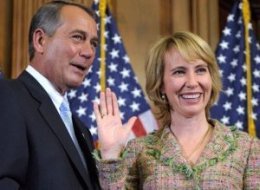
Rep. Giffords, an Arizona Democrat, was first elected to the House in 2006. She represents the state's 8th Congressional District.

Scroll down for live updates.

2:55 PM ET Staffer Dead

AP: At least one Giffords staffer has been killed.

2:48 PM ET Boehner 'Horrified'

Speaker of the House John Boehner issued the following statement about today's shooting:

“I am horrified by the senseless attack on Congresswoman Gabrielle Giffords and members of her staff. An attack on one who serves is an attack on all who serve. Acts and threats of violence against public officials have no place in our society. Our prayers are with Congresswoman Giffords, her staff, all who were injured, and their families. This is a sad day for our country."

2:44 PM ET Giffords' Tweet

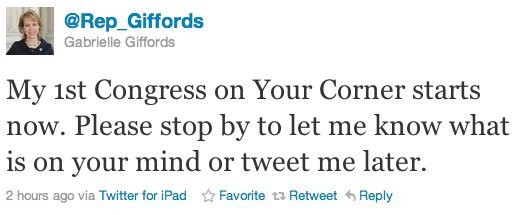
Giffords' last tweet before the shooting: "My 1st Congress on Your Corner starts now. Please stop by to let me know what is on your mind or tweet me later."

2:40 PM ET Death Reports Retracted

CNN, Reuters & NPR no longer report that Giffords is dead.

2:37 PM ET Giffords Alive And In Surgery

A hospital spokeswoman tells MSNBC that Giffords is alive, still in surgery.

2:31 PM ET Still Alive?

MSNBC says a surgeon on the scene claims that Giffords is still alive, in critical condition.

2:30 PM ET Chilling

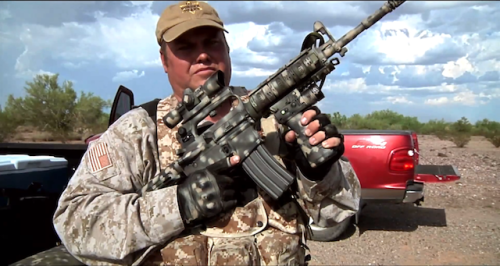
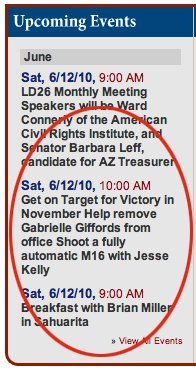
While there is no hard evidence at this point to suggest that the shooting was politically motivated, Matt Yglesias points out that an anti-Giffords event was held in June with the billing: "Get on Target for Victory in November. Help remove Gabrielle Giffords from office. Shoot a fully automatic M16 with Jesse Kelly."

Rep. Giffords was also on Sarah Palin's "target list."

As noted earlier, a gun was dropped at a Giffords event in 2009, and her office was vandalized in March.

2:19 PM ET Six Others Dead

NPR: At least six others have been killed.

2:19 PM ET Office Vandalized After Health Care Vote

The New York Times writes that Giffords' office was vandalized in March "a few hours after the House vote overhauling the nation’s health care system."

2:16 PM ET 'At Least 4 Dead'

University Medical Center says that at least four are dead.

2:15 PM ET Shooter Yelled Names At Targets?

A source tells Ed Espinoza that the shooter "called out names of people as aiming at targets."

2:14 PM ET The Shooter: 'Fringe Character'

A source talks to Gawker about the shooter:

The man was young, mid-to-late 20s, white clean-shaven with short hair and wearing dark clothing and said nothing during the shooting or while being held down. He didn't look like a businessman, but more of a "fringe character," our source said.

2:13 PM ET Confirmed Killed

Reuters, others confirm that Giffords has died.

2:08 PM ET Giffords Reportedly Dead

Rep. Giffords is dead, according to NPR.

2:06 PM ET No Known Threats

According to CNN's Mike Brooks, sources with the U.S. Capitol Police say there were no known threats against Rep. Giffords.

In 2009, a gun was dropped at a Giffords event.

2:02 PM ET Staffers Shot

According to Ed Espinoza, DNC Western States Political Director, Giffords' district director and local press secretary were also shot.

1:59 PM ET Young Shooter

NPR: "Witnesses described him as in his late teens or early 20s."

1:55 PM ET More On Giffords

Rep. Giffords, who is 40, is married to an astronaut. Jonathan Allen of Politico says that Giffords is involved with immigration and armed services issues.

1:51 PM ET At Least 12 Reportedly Shot

A Pima County sheriff's spokesman says at least 12 people were shot at the event. One person is in custody.

1:50 PM ET Medical Response

Pekau also tells CNN that three emergency evacuation helicopters are at the scene of the shooting.

1:46 PM ET 'Two Bodies'

Jason Pekau, a Sprint employee who works near the Safeway where the shooting occurred, tells CNN: "I see two bodies laying on the sidewalk in front of the Safeway."

1:45 PM ET 15-20 Gunshots?

A witness tells CNN that he heard 15-20 gunshots.

1:42 PM ET More On Giffords

Rep. Giffords, an Arizona Democrat, was first elected to the House in 2006. She represents the state's 8th Congressional District.

1:40 PM ET 'Firing Indiscriminately'

According to MSNBC, the shooter ran into a "crowded area" and began "firing indiscriminately."

1:37 PM ET Shooter Reportedly In Custody

More from NPR:

Giffords was talking to a couple when the suspect ran up firing indiscriminately and then ran off, Michaels said. According to other witnesses, he was tackled by a bystander and taken into custody.

1:28 PM ET Congresswoman Reportedly Shot In Head

According to Tucson Citizen, Rep. Giffords was shot "point blank in the head."

1:25 PM ET Safeway Shooting

According to KOLD, a Tucson CBS affiliate, the shooting occurred just after 10:00 AM local time at a Safeway grocery store. KOLD has not confirmed that Rep. Giffords was shot.

1:19 PM ET At Least Five Others Hurt

NPR reports that Giffords was shot at a public event at a grocery store in Tucson, Ariz. Peter Michaels of of Arizona Public Media tells NPR that at least five others, including staff, were hurt as well.


Tags: , , , , , , , , , , , , , , , , , , , , , , , , ,

Saturday, July 17, 2010

Democracy Now! - "Tea Party in Sonora": Ken Silverstein of Harper’s Says Arizona is Laboratory for Radical GOP Policies

http://parkprivatization.com/wp-content/uploads/2010/02/PHP4B807B29E6B57.jpg

Democracy Now! hosted an excellent discussion with Ken Silverstein (of Harper's Magazine), Amy Goodman and Juan Gonzales about the recent article in Harper's: Tea Party in Sonora: For the Future of GOP Governance, Look to Arizona (subscription required).

How crazy are these people in AZ? A state senator, Sylvia Allen, was quoted as saying that trees were stealing Arizona’s water supply -

As a resident of AZ for more than 8 years now, I can honestly say that the GOP's anti-tax, anti-education programs have turned this state into a cesspool. The only kids getting a passable education in this state are those in the handful of wealthy school districts - the rest of the kid's are screwed. The GOP has cut taxes in each of 15 of the last 17 years, bankrupting the state - so what gets cut from the budget? Education, child healthcare programs, all-day kindergarten, and any program aimed at immigrants (legal or otherwise).

Back when Bush passed his No Child Left Behind program, with some really basic standards to meet in reading and math, most students in this state failed - so the GOP legislature lowered the standards. And lest you think I am being hard on the GOP without acknowledging the Democrats, well the Dems could seriously just stay home and it would have zero impact on the GOP passing their programs.

"Tea Party in Sonora": Ken Silverstein of Harper’s Says Arizona is Laboratory for Radical GOP Policies

Silverstein

A new article by Harper’s Magazine Washington editor Ken Silverstein argues that Arizona has become a laboratory not just for immigration policy, but a broad range of issues. It’s a place, he writes, where the Tea Party is arguably the ruling party, and should the Republicans retake nationwide power, "the country might start to resemble the right-wing desert that Arizona has become." [includes rush transcript].

Guest: Ken Silverstein, Washington editor of Harper’s Magazine. His piece in the July edition of Harper’s is Tea Party in Sonora: For the Future of GOP Governance, Look to Arizona.

Rush Transcript

This transcript is available free of charge. However, donations help us provide closed captioning for the deaf and hard of hearing on our TV broadcast. Thank you for your generous contribution.
Donate - $25, $50, $100, More...

AMY GOODMAN: We turn now to Arizona. Juan?

JUAN GONZALEZ: Yes. Well, in Arizona, a state that’s become infamous for its crackdown on undocumented immigrants and racial profiling of Latinos, last week the Department of Justice filed a federal lawsuit over the state’s controversial anti-immigrant law that is scheduled to take effect at the end of this month. The new law requires police officers to stop and interrogate anyone they suspect is an undocumented immigrant.

But in a sign that Arizona may not be alone, on Wednesday nine other states, led by Michigan Attorney General Mike Cox, filed a legal brief supporting the Arizona law. The other states that joined are Michigan, Alabama, Florida, Nebraska, Pennsylvania, South Carolina, South Dakota, Texas and Virginia.

AMY GOODMAN: So, is Arizona a bellwether state on conservative policymaking around immigration? Well, a new article by Harper’s Magazine Washington editor Ken Silverstein argues Arizona is becoming a laboratory not just for immigration policy, but a broad range of issues. It’s a place, he writes, where the Tea Party is arguably the ruling party. Should the Republicans retake nationwide power, quote, "the country might start to resemble the right-wing desert that Arizona has become." The article is in the July issue of Harper’s Magazine. It’s called "Tea Party in Sonora: For the Future of GOP Governance, Look to Arizona." Ken Silverstein joins us now from Washington, DC.

Lay out the political landscape for us in Arizona, Ken Silverstein, and why you’re focusing there.

KEN SILVERSTEIN: Well, I looked at Arizona in a much broader way than merely the immigration issue, because immigration is sort of—it illustrates what’s going on in Arizona, but the problem there, the dysfunction, is far broader. I mean, you have the sort of radical right in control in Arizona. You’ve got every component of the sort of extreme right wing running around, whether it’s the Minutemen, you know, guarding the borders, or the anti-tax crowd, the religious conservatives. They’re all very, very active and vibrant in Arizona.

And I really looked at the economic situation there, because Arizona—I mean, everybody’s focusing on immigration, but you’ve got this economic crisis there that is quite stunning, resembling California in many ways, where the state is just completely bankrupt. It has huge deficits, which they’re addressing by cutting social spending in an extraordinary way, where, you know, they’re doing away with all-day kindergarten, and they’re kicking kids off of healthcare programs, taking very, very dramatic steps in order to control the budget deficit. And meanwhile, because, as I wrote on our web, on the Harper’s site, about Arizona, as well, you know, it was described to me sort of as a Grover Norquist lab experiment run amok, in a way. I mean, you’ve just got this anti-tax fanaticism in Arizona where it doesn’t matter whether the state is doing well or doing poorly, the answer of the legislature is always "Let’s cut taxes." So, fifteen of the last seventeen years, they’ve slashed taxes in Arizona, so you’ve just got this expanding budget deficit. You know, it’s all this sort of Reagan-era belief, or even pre-Reagan, but, you know, where this whole belief took hold during those years that, you know, you cut taxes and the economy will grow. Well, you can look at the record in Arizona, and there’s no real indication that cutting taxes will always make the economy grow. I mean, there are situations where it may help, but it is not a cure-all. But that’s the only thing the legislature there knows how to do. And so they have collectively managed to bankrupt the state and create a crisis that is going to drag on for years and years and years, and they’ve locked themselves, really, into a situation where they can’t fix it, because so many of the lawmakers—it’s a pretty big Republican majority—so many of the Republicans have signed the Norquist anti-tax pledge, so that they—under no circumstances, will they raise taxes. So they’re really locked into a box, and the state is in terrible, terrible shape. And the people of the state are paying the price.

JUAN GONZALEZ: And Ken, I was struck also in your article that you also focused on the impact of the subprime—the housing crisis in Arizona, which is really like ground zero. Sixty-one percent, I think you said, of the homes in Phoenix are underwater; they’re worth less than the mortgages that their owners have on them. So, in essence, the wealth—the collapse of wealth, that many people in America have been faced with as the values of their homes have gone down, has been especially felt in Arizona, hasn’t it?

KEN SILVERSTEIN: Yeah, the housing crash in Arizona was just brutal. And I focused on it, because it’s been key to what’s happened to the state in terms of this recession. I mean, Arizona got by for years. People like to move to Arizona. The climate’s nice. You have a big influx of senior citizens over the years. You’ve had all sorts of people escaping the cold in various parts of the country and flocking into Arizona. And so, the state really has grown on the basis of growth, as people there put it to me. I mean, there hasn’t really been—there’s not a lot of industry. You know, you don’t really have much driving growth other than growth, if that makes sense. You’ve had people coming in, and you’ve had this huge real estate market, and then all the affiliated industries, you know, so it’s—you know, contractors have had a great time. You know, people who install pools have done very well. I mean, anything related to housing, real estate and growth has boomed in Arizona. But it was a bit of a mirage, because, you know, they kept cutting taxes, so that the state was generating less revenue. But it was papered over by the fact that you still had people moving in. You know, even if they cut the sales tax, you had more people buying things, and so the state was getting by. But when the housing market crashed, Arizona, you know, the state economy just completely tanked, because you suddenly—you know, you had this end of this sort of papered-over growth economy. You know, the sales taxes plunged. They had already slashed income taxes, and incomes plunged, as well. So you just had this, you know, cycle of spinning downward.

And it really is amazing when you drive around some of the neighborhoods in Phoenix, where, you know, every other house has got a for-sale sign, and lots of houses are just empty. I mean, people walked away. I was taken on a tour of Maricopa, which was this town that grew out of nowhere forty years ago and boomed into a few hundred thousand people, I believe. Actually, I think that’s too high. I think there may have been 50,000 people, at the maximum. And, you know, you had nothing out there. This town just arose out of the desert. You had a few fast food joints and, you know, some shopping malls, but otherwise there was no sense of community, no movie theaters, no libraries, no nothing. I mean, the town just sort of emerged out of nowhere. And when the real estate crash hit, lots of people just walked out. I mean, their homes suddenly—you know, you had had this enormous real estate inflation, and so people had paid way more than the homes were worth. You had cheap credit, as you did elsewhere in the country. And when the crash hit, I mean, housing values, they fell in half. I mean, you just—you know, in the couple of years, your home’s value had been cut in half. So lots of people just walked away. I mean, you see this in neighborhoods where they’re sort of middle-class neighborhoods and also in these McMansion neighborhoods, where you’ve got, you know, just streets filled with these enormous mansions, swimming pools in the backyard. Everybody walked away. And so, you’ve just—you’ve got neighborhoods that have been decimated, and that killed the state economy. And the legislature has refused to deal with the situation. The only way to deal with it, you know, is, "Oh, we may have to raise taxes." It doesn’t always work to cut taxes. But politically, they can’t get away with it, and so they—

JUAN GONZALEZ: So, Ken, in essence, then—

KEN SILVERSTEIN: —you know, stood by and allowed the state to go under.

JUAN GONZALEZ: So, in essence, then, I guess part of the thesis of your article is that in an effort to sort of get away from the problems they’re not dealing with, the politicians have centered more on the social issue that they can rally the population behind, of immigration, while they are not handling the real problems that are, in essence, creating so much insecurity and sense of crisis in the population?

KEN SILVERSTEIN: Absolutely. I mean, you’ve got these various sideshows going on. You know, I mean, the legislature demanded that President Obama produce his birth certificate if he runs for election again. You know, they granted an exemption in fishing license fees to Eagle Scouts.

AMY GOODMAN: Wait, wait. Give me—

KEN SILVERSTEIN: You know, they passed a bill—

AMY GOODMAN: Ken, the first one, about President Obama having to present his birth certificate?

KEN SILVERSTEIN: Yes, yes. This is—you know, I think it was the entire legislature—I could be wrong; it may have just been the House—that passed a bill demanding that the President show his birth certificate, you know, over this crazy controversy about whether he was actually born in the United States. You know, you have a whole series of things right now. I mean, they passed a bill allowing professors to carry guns onto university campuses, which had previously been banned. You know, the state senator said that—Jack Harper, I believe, was the sponsor of this bill—said that universities had become gun-free zones and that this was creating a climate, you know, conducive to terrorism, and that professors had to be armed in order to make the campuses safe. You can carry your gun into bars. They loosened the restrictions on carrying a loaded gun into bars. They’ve got, you know, any—

AMY GOODMAN: Environmental legislation?

KEN SILVERSTEIN: They declared a constitutional right to hunt. I mean, there are a variety—you know, in addition to immigration, which is the big one that’s gotten most attention, there have been all sorts of sort of cuckoo legislative initiatives that have nothing to do with the state’s economy crisis. It’s just a way—I mean, I don’t even think it’s diversion, in the sense that the people who have been elected in the state of Arizona apparently feel very passionately about these issues, but—

AMY GOODMAN: I wanted to turn, Ken—

KEN SILVERSTEIN: —you know, it’s not going to help the state of Arizona.

AMY GOODMAN: Ken, you mentioned a bill that bars Arizona from entering into any program to regulate greenhouse gases without approval from the legislature. "There are only two ways to vote on this," said Representative Ray Barnes of the latter initiative. "Yes, or face the east in the morning and worship the EPA because they own you." Isn’t there also a bill that’s just been passed around trees?

KEN SILVERSTEIN: I don’t know if there was a bill passed around trees, but there’s a state senator, Sylvia Allen, who said that trees were stealing Arizona’s water supply. She was quoted as saying that. I mean, the rhetoric is really quite stunning. I mean, it’s—I mean, I knew things were bad in Arizona, but if you sit—you spend a day at the state legislature, as I did, and listen to the rhetoric—I mean, they have a Ten Commandments up at the state capitol. The day I was there, they were, you know, passing a bill to authorize putting another Ten Commandments up, because one apparently isn’t sufficient. You know, there’s just all sorts of action in terms of these peripheral issues that don’t make any difference to the people of the state but are pet projects of various Republican lawmakers.

AMY GOODMAN: I wanted to play—

KEN SILVERSTEIN: What’s interesting about Arizona, too, and this is—

AMY GOODMAN: Ken, I wanted to play a campaign ad—

KEN SILVERSTEIN: Sorry, go ahead.

AMY GOODMAN: —for Pamela Gorman, a Republican congressional candidate from Arizona.

    PAMELA GORMAN AD: This year, a lot of folks think this is our best shot at changing Congress. Course, that all depends on the caliber of our candidates. [gunfire] Meet Pamela Gorman, candidate for Congress in Arizona 3, conservative Christian, and a pretty fair shot. [gunfire] The insiders in the state senate wanted to have her hide when she fought against their plan for higher taxes. [gunfire] But Gorman, she can take care of herself. [gunfire] Rated 100 percent by the NRA, conservative Pamela Gorman is always right on target. [gunfire]

    PAMELA GORMAN: I’m Pamela Gorman, and I approve this message. [gunfire]

AMY GOODMAN: And for our listening audience, the bullets you’re hearing, they’re being shot by Pamela Gorman throughout that commercial. Ken Silverstein?

KEN SILVERSTEIN: Well, yeah. I mean, that’s fairly standard, run-of-the-mill stuff in Arizona now. I think I may have mentioned this just a moment ago. If I didn’t, the lawmakers passed a—approved a constitutional right to hunt in Arizona. You know, there’s not really a threat to hunting in Arizona, but they felt the need to pass a constitutional right to hunt, as well.

So, what’s interesting in Arizona is that the population actually is not as right-wing as the legislature. You’ve actually got a pretty even split between Democrats and Republicans, and independents are growing faster than either of the two parties. But what you have is a situation where, because the way that the districts are drawn up in Arizona, it’s been gerrymandered, and so if you win your primary in Arizona, you pretty much win office. I mean, I think there are sixty house districts, and only three of them are competitive between Republicans and Democrats because of the way that the districts have been drawn. And so, in the primaries, the further to the extreme you go, the more likely you are to win the primary. And once you’re through the primary, that’s it. It doesn’t matter if you have a perfectly sane, lucid opponent from the other party; the way the districts are drawn, you’re in. And so, this situation, it encourages candidates to move further and further and further to the extreme, and not only encourages the candidates, but it encourages a type of person, a type of candidate, who is at the extreme. And so, you know, you have—I’m sure there are, you know, another dozen or two dozen Pamela Gormans seeking offices in Arizona this year, because the way that the districts are drawn encourages exactly that sort of candidate.

JUAN GONZALEZ: And Ken, also, the legislature is a part-time legislature. They only make about $24,000 a year. So they’re doing all of this in their spare time, in essence, as they run other businesses or have other occupations. One of the things that struck me was that you said that they sold the capitol building in Arizona and are leasing it back from the person they sold it to?

KEN SILVERSTEIN: Well, they’ve taken all of these desperate steps, because the state, as I mentioned, is completely bankrupt. They have this enormous budget deficit that they have to cover up, and so they’ve taken all sorts of steps to just generate money and throw it into the budget hole and say, "OK, we’ve balanced the budget." So, yeah, they sold off the capitol building, and now they’re leasing it back, which, of course, over the long run is going to cost the state far more than simply maintaining the property. And they’ve sold off dozens of state buildings. They’ve talked about—I don’t think they’ve actually sold off any prisons, but they were talking about privatizing the state prison system, including at one point there was talk of, you know, maximum-security prisons, and even the prisons that hold death row prisoners, they were going to privatize those.

You know, anything that can raise money to paper over the deficit, they’ve done. They also took the state lottery revenues, and they took twenty years’ worth of lottery revenues and securitized it, so they—you know, they raised money by selling bonds, using twenty years’ future state lottery revenues. All sorts of budgetary gimmicks. They’ve raided all sorts of funds that are meant to do—you know, that the state voters have put aside for specific measures. You know, there was a tobacco tax, and this was supposed to go for education, and the state lawmakers have tried to raid that fund and use it to cover up the deficit that they’ve created simply by cutting taxes all these years.

AMY GOODMAN: And of course there’s the—

KEN SILVERSTEIN: And so, you’ve got all sorts of wild schemes.

AMY GOODMAN: There’s the Republican primary August 24th: J.D. Hayworth versus John McCain. I want to turn to the radio talk show host, Arizona congressman J.D. Hayworth, in the Republican primary. In this clip from earlier this year, Hayworth is asked about his ties to the birthers by MSNBC host Chris Matthews on Hardball.

    CHRIS MATTHEWS: Are you as far right as the birthers? Are you one of those who believes that the President should have to prove that he’s a citizen of the United States and not an illegal immigrant? Are you that far right?

    J.D. HAYWORTH: Well, gosh, we all had to bring our birth certificates to show we were who we said we were and we were the age we said we were to play football in youth sports. Shouldn’t we know exactly that anyone who wants to run for public office is a natural-born citizen of the United States and is who they say they are? But let me pause and make another point—

    CHRIS MATTHEWS: Do you think there’s a question out there—

    J.D. HAYWORTH: —Chris, because I’ve read so many hysteric—

    CHRIS MATTHEWS: No, I’m reading your letter that says the President should go back and get his birth certificate from the Governor of Hawaii. You dated this November 6, 2008. I’m just asking, do you stand by this letter?

    J.D. HAYWORTH: Yeah, no, I—sure.

    CHRIS MATTHEWS: Should the Governor of Hawaii produce evidence that the President is one of us, an American? Do you think that’s a worthy pastime for the Governor of Hawaii right now?

    J.D. HAYWORTH: No, no. Look, I think it’s important—

    CHRIS MATTHEWS: Should she do it?

    J.D. HAYWORTH: —for all of us to be—well, I’m just saying the President should come forward with the information. That’s all. Why must we depend on the Governor of Hawaii?

AMY GOODMAN: Well, there you have it. J.D. Hayworth, he’s up against John McCain for the Republican senatorial nomination. Ken Silverstein, final comment about Arizona?

KEN SILVERSTEIN: Well, yeah, Hayworth is sort of, you know, classic Arizona. The guy is a complete knucklehead. He was a member of Congress. He was elected in '94, you know, had very close ties to Jack Abramoff, became known for absolutely nothing other than embarrassing the state and making idiotic comments. And now he's mounting what appears to be a credible challenge to McCain. McCain, of course, you know, in order to fend off his challenge, has not done anything principled like actually stand up and say, you know, "My opponent is undignified," but has simply moved right to try to, you know, appear to be more conservative or equally conservative to Hayworth. So that’s, you know, a classic example of the sort of politician the state of Arizona is producing right now.

AMY GOODMAN: Ken Silverstein, Washington editor of Harper’s Magazine, his latest piece, "Tea Party in Sonora: For the Future of GOP Governance, Look to Arizona." We’ll link to it at democracynow.org.