Showing posts with label randomness. Show all posts

Wednesday, October 15, 2014

Emily Singer - Evolution Is NOT so Random After All - We Evolve Toward Fitness

This is an interesting article on evolution experiments involving yeast and what they tell us about our own history and development. This article originally appeared at Quanta Magazine, under the title,
Evolution’s Random Paths Lead to One Place: A massive statistical study suggests that the final evolutionary outcome — fitness — is predictable.

If the World Started Over, Would Life Evolve the Same Way?


By Emily Singer, Quanta Magazine
10.03.14 | Permalink


Different strains of yeast grown under identical conditions develop different mutations but ultimately arrive at similar evolutionary endpoints.  Daniel Hertzberg for Quanta Magazine

In his fourth-floor lab at Harvard University, Michael Desai has created hundreds of identical worlds in order to watch evolution at work. Each of his meticulously controlled environments is home to a separate strain of baker’s yeast. Every 12 hours, Desai’s robot assistants pluck out the fastest-growing yeast in each world — selecting the fittest to live on — and discard the rest. Desai then monitors the strains as they evolve over the course of 500 generations. His experiment, which other scientists say is unprecedented in scale, seeks to gain insight into a question that has long bedeviled biologists: If we could start the world over again, would life evolve the same way?

Many biologists argue that it would not, that chance mutations early in the evolutionary journey of a species will profoundly influence its fate. “If you replay the tape of life, you might have one initial mutation that takes you in a totally different direction,” Desai said, paraphrasing an idea first put forth by the biologist Stephen Jay Gould in the 1980s.

Desai’s yeast cells call this belief into question. According to results published in Science in June, all of Desai’s yeast varieties arrived at roughly the same evolutionary endpoint (as measured by their ability to grow under specific lab conditions) regardless of which precise genetic path each strain took. It’s as if 100 New York City taxis agreed to take separate highways in a race to the Pacific Ocean, and 50 hours later they all converged at the Santa Monica pier.

The findings also suggest a disconnect between evolution at the genetic level and at the level of the whole organism. Genetic mutations occur mostly at random, yet the sum of these aimless changes somehow creates a predictable pattern. The distinction could prove valuable, as much genetics research has focused on the impact of mutations in individual genes. For example, researchers often ask how a single mutation might affect a microbe’s tolerance for toxins, or a human’s risk for a disease. But if Desai’s findings hold true in other organisms, they could suggest that it’s equally important to examine how large numbers of individual genetic changes work in concert over time.


Michael Desai, a biologist at Harvard University, uses statistical methods to study basic questions in evolution.  Sergey Kryazhimskiy

“There’s a kind of tension in evolutionary biology between thinking about individual genes and the potential for evolution to change the whole organism,” said Michael Travisano, a biologist at the University of Minnesota. “All of biology has been focused on the importance of individual genes for the last 30 years, but the big take-home message of this study is that’s not necessarily important.

The key strength in Desai’s experiment is its unprecedented size, which has been described by others in the field as “audacious.” The experiment’s design is rooted in its creator’s background; Desai trained as a physicist, and from the time he launched his lab four years ago, he applied a statistical perspective to biology. He devised ways to use robots to precisely manipulate hundreds of lines of yeast so that he could run large-scale evolutionary experiments in a quantitative way. Scientists have long studied the genetic evolution of microbes, but until recently, it was possible to examine only a few strains at a time. Desai’s team, in contrast, analyzed 640 lines of yeast that had all evolved from a single parent cell. The approach allowed the team to statistically analyze evolution.


To efficiently analyze many strains of yeast simultaneously, scientists grow them on plates like this one, which has 96 individual wells.  Sergey Kryazhimskiy

“This is the physicist’s approach to evolution, stripping down everything to the simplest possible conditions,” said Joshua Plotkin, an evolutionary biologist at the University of Pennsylvania who was not involved in the research but has worked with one of the authors. “They could partition how much of evolution is attributable to chance, how much to the starting point, and how much to measurement noise.”

Desai’s plan was to track the yeast strains as they grew under identical conditions and then compare their final fitness levels, which were determined by how quickly they grew in comparison to their original ancestral strain. The team employed specially designed robot arms to transfer yeast colonies to a new home every 12 hours. The colonies that had grown the most in that period advanced to the next round, and the process repeated for 500 generations. Sergey Kryazhimskiy, a postdoctoral researcher in Desai’s lab, sometimes spent the night in the lab, analyzing the fitness of each of the 640 strains at three different points in time. The researchers could then compare how much fitness varied among strains, and find out whether a strain’s initial capabilities affected its final standing. They also sequenced the genomes of 104 of the strains to figure out whether early mutations changed the ultimate performance.


Fluid-handling robots like this one make it possible to study hundreds of lines of yeast over many generations. Courtesy of Sergey Kryazhimskiy

Previous studies have indicated that small changes early in the evolutionary journey can lead to big differences later on, an idea known as historical contingency. Long-term evolution studies in E. coli bacteria, for example, found that the microbes can sometimes evolve to eat a new type of food, but that such substantial changes only happen when certain enabling mutations happen first. These early mutations don’t have a big effect on their own, but they lay the necessary groundwork for later mutations that do.

But because of the small scale of such studies, it wasn’t clear to Desai whether these cases were the exception or the rule. “Do you typically get big differences in evolutionary potential that arise in the natural course of evolution, or for the most part is evolution predictable?” he said. “To answer this we needed the large scale of our experiment.”

As in previous studies, Desai found that early mutations influence future evolution, shaping the path the yeast takes. But in Desai’s experiment, that path didn’t affect the final destination. “This particular kind of contingency actually makes fitness evolution more predictable, not less,” Desai said.
Sidebar: Diminishing Returns

Desai’s study isn’t the first to suggest that the law of diminishing returns applies to evolution. A famous decades-long experiment from Richard Lenski’s lab at Michigan State University, which has tracked E. coli for thousands of generations, found that fitness converged over time. But because of limitations in genomics technology in the 1990s, that study didn’t identify the mutations underlying those changes. “The 36 populations we had then would have been much more expensive to sequence than the hundred they did here,” said Michael Travisano of the University of Minnesota, who worked on the Michigan State study.

More recently, two papers published in Science in 2011 mixed and matched a handful of beneficial mutations in different types of bacteria. When the researchers engineered those mutations into different strains of bacteria, they found that the fitter strains enjoyed a smaller benefit. Desai’s study examined a much broader combination of possible mutations, showing that the rule is much more general.
Desai found that just as a single trip to the gym benefits a couch potato more than an athlete, microbes that started off growing slowly gained a lot more from beneficial mutations than their fitter counterparts that shot out of the gate. “If you lag behind at the beginning because of bad luck, you’ll tend to do better in the future,” Desai said. He compares this phenomenon to the economic principle of diminishing returns — after a certain point, each added unit of effort helps less and less.

Scientists don’t know why all genetic roads in yeast seem to arrive at the same endpoint, a question that Desai and others in the field find particularly intriguing. The yeast developed mutations in many different genes, and scientists found no obvious link among them, so it’s unclear how these genes interact in the cell, if they do at all. “Perhaps there is another layer of metabolism that no one has a handle on,” said Vaughn Cooper, a biologist at the University of New Hampshire who was not involved in the study.

It’s also not yet clear whether Desai’s carefully controlled results are applicable to more complex organisms or to the chaotic real world, where both the organism and its environment are constantly changing. “In the real world, organisms get good at different things, partitioning the environment,” Travisano said. He predicts that populations within those ecological niches would still be subject to diminishing returns, particularly as they undergo adaptation. But it remains an open question, he said.

Nevertheless, there are hints that complex organisms can also quickly evolve to become more alike. A study published in May analyzed groups of genetically distinct fruit flies as they adapted to a new environment. Despite traveling along different evolutionary trajectories, the groups developed similarities in attributes such as fecundity and body size after just 22 generations. “I think many people think about one gene for one trait, a deterministic way of evolution solving problems,” said David Reznick, a biologist at the University of California, Riverside. “This says that’s not true; you can evolve to be better suited to the environment in many ways.”

Wednesday, August 27, 2014

Aaron Gordon - Does Randomness Actually Exist?

Does randomness exist? Can we even fathom the question? This is an interesting article from Aaron Gordan at Pacific Standard.

Does Randomness Actually Exist?

By Aaron Gordon • August 25, 2014 

enigma-machine
An Enigma machine. (Photo: Wikimedia Commons)

Our human minds are incapable of truly answering that question.


All week long we’ll be posting stories about randomness and how poorly we tend to deal with it. Check back tomorrow for more.

Pick a number. Any number, one through 100. Got one? OK, so how did you pick it?

Humans are bad at creating and detecting randomness. Perceiving patterns has proven a great survival mechanism—the giant, spotted cats eat my children; this berry doesn’t make me sick—so we have evolved to be good at it. Perhaps too good. We misinterpret data all the time as a result of this desire for order. We believe that when a coin comes up heads five straight times, we are “due” for a tails, or we think that the stock market is predictable. It’s maybe unsurprising, then, that humans aren’t very good random number generators. And because of that, we’ve had to make some.

If you Google “Random Number Generators,” you’ll find several on the first page that are perfectly capable of mimicking a random process. After specifying a range, they will return a number. Do so 100 or 1,000 or 10,000 times, and you won’t find any discernible pattern to the results. Yet despite the name, the results are anything but random.

Computers are hyper-logical machines that can only follow specific commands. As explained by a BBC Radio broadcast from 2011, some of the random number generators you’ll find on Google follow something called the “Middle Squares” method: start with a seed number, which can be any number. Square that number. You’ll now have roughly twice as many digits. Take a few of the digits in the middle of that number and square that. Repeating this process is like shuffling a deck of cards. Still, if you know three basic pieces of information—the seed number, the number of digits taken from the middle of each square, and how many times the process will be repeated—you can calculate this supposedly “random” number every single time without fail.

Mathematicians have a word for this kind of randomness. They cleverly call it “pseudo-randomness”: the process passes statistical tests for randomness, yet the number itself is completely determined. On the BBC Radio broadcast, professor Colva Roney-Dougal of the University of St. Andrews says, “I can never prove that a sequence is random, I can only prove that it looks random and smells random.”

All of which brings us to this: Given the limits of human knowledge, how can we ever know if something is truly random?

A FEW ANCIENT THINKERS, known as Atomists, fathered a line of thought, which claims that, in fact, randomness doesn’t exist. The most deterministic among them, Democritus, believed the entire state of the universe could be explained through cause and effect. In other words, he was only interested in how the past dictated the present and future.

Once you learn about pseudo-randomness, it’s easy to see the world through Democritus’ eyes. Rolling dice isn’t random. Instead, the dice are governed by specific, mathematical laws, and if we knew the exact contours of the desk and the force applied to the dice, we could calculate which sides would come to rest facing upward. The same is true of shuffling cards. If we knew the exact height the cards were lifted, the exact force with which they were released, and the distance from each other, it’s completely feasible to calculate the order of the cards, time and time again. This is true for every game of chance, which are governed by Newtonian, or classical, physics. It all appears completely deterministic.

A lack of true randomness would be a huge problem, just like it was for the Germans during World War II with their revered but ultimately doomed Enigma enciphering machine. With its 150 quintillion different settings, many Allied cryptologists believed the code was unbreakable. Yet, because it was a mere matter of rotor settings and circuitry—or put simply, completely deterministic—the Allies were able to crack the code.

Since Newtonian physics has proven resistant to true randomness, cryptologists have since looked to quantum physics, or the rules that govern subatomic particles, which are completely different than Newtonian physics. Radioactive materials spontaneously throw off particles in a probabilistic manner, but the exact time when each particle will be discarded is inherently random. (We think.) So given a small window of time, the number of radioactive particles discarded can act as the seed for the random number generator.

Every time you buy something with a credit card, you’re relying on your information to be transmitted safely across a perfectly accessible network. This is where the difference between random and pseudo-random becomes vastly important. Pseudo-random patterns, like the ones created by the Enigma machine, are messages begging to be read. Random patterns are the cryptic ideal.

A company called PDH International is one of the patent-holders for Patent US6745217 B2, or “Random Number Generator Based on the Spontaneous Alpha-Decay,” the very process described above. PDH International, with an annual revenue of $10 to $25 million, specializes in the “fields of Privacy Protection, Authentication, Encryption and Electronic Document Protection.” PDH comes up with ways to safely encrypt data using true randomness from quantum physics.

BUT BACK TO THAT number you picked.

As with randomness, the more we learned about the precise nature of brain functions, we began to question whether free will was possible. If everything is the result of precise causal chains like the rolling of dice or shuffling of cards, some wondered how we can really be making genuine choices. However, as we’ve learned more about quantum physics, the possibility of genuine choice has been revitalized due to the break in the causal chain. In a way, quantum physics introduced a giant, unsolvable question mark, and question marks are good for free-will theorists. Ironically, quantum physics simultaneously undermines this line of thought, since randomness is bad for the idea that we are actually making rational choices.

So pick a number, any number. Maybe it is random after all.


Aaron Gordon is a freelance writer living in Washington, D.C. He also contributes to Sports on Earth, The New Yorker, Deadspin, and Slate.

Tuesday, June 17, 2014

A World-Is-Random Model to Explain How Disorder and Chaos Skews Cognitve Scripts


From Frontiers in Psychology: Personality and Social Psychology, this is an interesting cognitive model for understanding how perceived chaos and disorder can create a world-is-chaotic mindset that shapes expectations and one's sense of self-efficacy and personal agency.

Full Citation: 
Kotabe, HP. (2014, Jun 13). The world is random: A cognitive perspective on perceived disorder. Frontiers in Psychology: Personality and Social Psychology; 5:606. doi: 10.3389/fpsyg.2014.00606

The world is random: a cognitive perspective on perceived disorder

Hiroki P. Kotabe
  • Center for Decision Research and Department of Psychology, University of Chicago, Chicago, IL, USA
Abstract

Research on the consequences of perceiving disorder is largely sociological and concerns broken windows theory, which states that signs of social disorder cause further social disorder. The predominant psychological explanations for this phenomenon are primarily social. In contrast, I propose a parsimonious cognitive model (“world-is-random” model; WIR) that may partly account for these effects. Basically, WIR proposes that perceiving disorder primes randomness-related concepts, which results in a reduction to one’s sense of personal control, which has diverse affective, judgmental, and behavioral consequences. I review recent developments on the psychological consequences of perceiving disorder and argue that WIR can explain all of these findings. I also cover select correlational findings from the sociological literature and explain how WIR can at least partly explain them. In a general discussion, I consider possible alternative psychological models and argue that they do not adequately explain the most recent psychological research on disorder. I then propose future directions which include determining whether perceiving disorder causes a “unique psychology” and delimiting boundary conditions.

Most of the research on the possible effects of perceived disorder on humans is sociological and concerns broken windows theory (BWT). BWT basically states that signs of social disorder (e.g., broken windows) cause further social disorder (e.g., more vandalism, theft; Wilson and Kelling, 1982; see also Keizer et al., 2008). Explanations for broken windows effects (BWE) are generally social. They focus on social norms, social signaling, and lack of social monitoring. In contrast, in this article, I propose a cognitive, “inside-one-head” model of the psychological consequences of perceiving disorder. After proceeding with the cognitive analysis, I turn back to the important naturally occurring social phenomena that I believe are partly explained by this cognitive model.

Before reviewing some recent developments relevant to this model, I should operationalize what I mean by “perceived disorder” (and “perceived order”): Perceived disorder is an interpreted state of the world in which things are in non-patterned and non-coherent positions. Oppositely, perceived order is an interpreted state of the world in which things are in patterned and coherent positions. Note that these broad definitions include all animate or inanimate things (i.e., all things that can be represented in mental “chunks”), and thus may apply both to purely physical disorder (e.g., objects randomly scattered about on a computer screen) and social disorder (e.g., littering, crime). The key requirement is that the stimuli are processed as non-patterned and non-coherent chunks.

There seems to be a developing interest among psychologists in the consequences of perceived disorder on human psychology (not necessarily in the context of BWT, however). Recently, some consequences of perceived disorder pertinent to the proposed model were documented by – in chronological order – Heintzelman et al. (2013), Vohs et al. (2013), and Chae and Zhu (2014): Heintzelman et al. (2013) documented a psychological state consequence of disorder. Across four studies, they manipulated perceived disorder either by (a) presenting people with pictures of seasons in temporal sequence (e.g., autumn, winter, spring, summer) or random sequence (e.g., winter, autumn, summer, spring; Experiments 1 and 2) or, in a more stripped-down presentation, (b) presenting people with semantic triads (i.e., Remote Associates Test items; Mednick, 1962) that were either coherent (e.g., “falling, actor, dust”; common associate: star) or incoherent (e.g., “belt, deal, nose”; Experiments 3 and 4). Subsequently, people across all four experiments reported less meaning in life in the disorderly condition than in the orderly condition (ds ranging from 0.37 to 0.54). Vohs et al. (2013) documented some judgment and behavioral consequences of perceived disorder. Across three experiments, they manipulated the immediate lab environment to be either orderly or disorderly. People in disorderly environments donated less (d = 0.73) and chose fewer healthier snacks (φ = 0.37; Experiment 1); they were rated as more creative in coming up with alternative uses for an ordinary object (d = 0.61; Experiment 2); and they showed stronger preference for an unconventional product whereas those in the orderly environment showed stronger preference for a conventional product (interaction, φ = 0.20; Experiment 3). Most recently, Chae and Zhu (2014) documented some other judgment, behavioral, and state consequences of perceived disorder. Across four experiments, they manipulated perceived disorder à la Vohs et al. (2013) – by having people do tasks in either a disorderly or orderly lab environment. Compared with people in the orderly environment, people in disorderly environments reported being willing to pay more for tempting but unnecessary products (d = 0.43; Experiment 1); they reacted slower in a Stroop task (d = 0.46) and reported feeling more depleted (d = 0.69; Experiment 2); and they did not persist as long on an unsolvable puzzle (d = 0.42, Experiment 3; d = 0.73, Experiment 4). Further, and most germane to the proposed model, they found in Experiment 4 that a threat to feeling in control mediated the effects of perceived disorder on persistence.

Perceived disorder apparently has a variety of psychological consequences for affect (broadly defined, see Gross and Thompson, 2007), judgment, and behavior. Is there a common process underlying these effects? Next, I will elaborate on a model that could account for the foregoing experimental findings as well as correlational findings in the sociological literature. In a general discussion, I will discuss three possible alternative psychological models that may explain some but not all of these findings, as well as future directions.

The World is Random


To follow along, see Figure 1 for a diagram of the proposed world-is-random model (WIR): Neglecting randomness, chance, and luck leads us to an illusion of control. WIR proposes that perceiving disorder primes concepts related with randomness/chance/luck (thus creating a “world-is-random” mindset). It may thus lead us to (accurately) believe we have less control over outcomes in low-control/high-chance situations because we weight available representations related to randomness/chance/luck more (Tversky and Kahneman, 1973). Through the same mechanism, it may even lead us to (erroneously) believe we have less control over ourselves when strongly tempted (i.e., when in a state of low-control/high-chance). This sense of losing personal control may have a variety of affective, judgmental, and behavioral consequences.
FIGURE 1
http://www.frontiersin.org/files/Articles/91733/fpsyg-05-00606-HTML/image_m/fpsyg-05-00606-g001.jpg
FIGURE 1. The world-is-random (WIR) model.
WIR can account for the experimental findings discussed earlier. Regarding the investigation on perceived disorder and meaning in life by Heintzelman et al. (2013), WIR explains these results as a negative consequence of losing a sense of personal control. Feeling in control is a fundamental human need (White, 1959; Bandura, 1977; Deci and Ryan, 1985; Higgins, 2011). If not met, humans suffer. One plausible manifestation, according to self-determination theory, is a feeling that life is meaningless because one cannot control outcomes (unfulfilled competence need) or choose their own way (unfulfilled autonomy need).

The sense of losing control resulting from perceiving disorder can also explain the results from the experiments by Vohs et al. (2013). In Experiment 1, people in a disorderly environment (a) donated less and (b) chose fewer healthy snacks. Having personal control means being able to agentically influence outcomes (White, 1959; Deci and Ryan, 1985). Thus, people whose sense of personal control is reduced, by definition, see their actions (e.g., donating) as having less consequence. Similarly, people whose sense of personal control is reduced are likely to see their efforts to control oneself as more in vain, thus it follows that they would exert less self-control. In Experiment 2, people in a disorderly environment were rated as more creative. Research has shown that people are more creative when they enter a state of “flow,” which necessitates, among other operating conditions, a reduction in executive control (Csikszentmihalyi, 1997). WIR proposes that, through priming and increasing the judgment weight of randomness-related concepts, perceived disorder decreases our sense of control over oneself. Such changes to our beliefs may reduce the motivation to exert executive control (Job et al., 2010; Kotabe and Hofmann, submitted), facilitating advancement into a flow state of unshackled creativity. Regarding Experiment 3, people in a disorderly environment more strongly preferred an unconventional product whereas people in an orderly environment more strongly preferred a conventional product. WIR explains these results similar to how it explains the results from Experiment 2. By reducing our sense of personal control and use of control resources, perceived disorder may facilitate a state of flow in which conventional boundaries “disappear.”

World-is-random explains the results from the experiments by Chae and Zhu (2014) in a slightly different way. It assumes that the sense of losing control is threatening, and that this threat, in turn, is depleting to cognitive resources (Glass et al., 1969; Baumeister et al., 2007; Inzlicht and Kang, 2010), thus resulting in more impulsive behaviors across various domains. Accordingly, in Experiment 1, people in a disorderly environment were willing to pay more for tempting products and, in Experiment 2, people in a disorderly environment were slower to react in a Stroop task and reported feeling more depleted. In Experiments 3 and 4, people in a disorderly environment persisted less on an unsolvable puzzle. Moreover, the authors showed that a reduction in and threat to one’s sense of personal control mediated the effect of perceived disorder on persistence in Experiment 4, consistent with the mechanisms I propose.

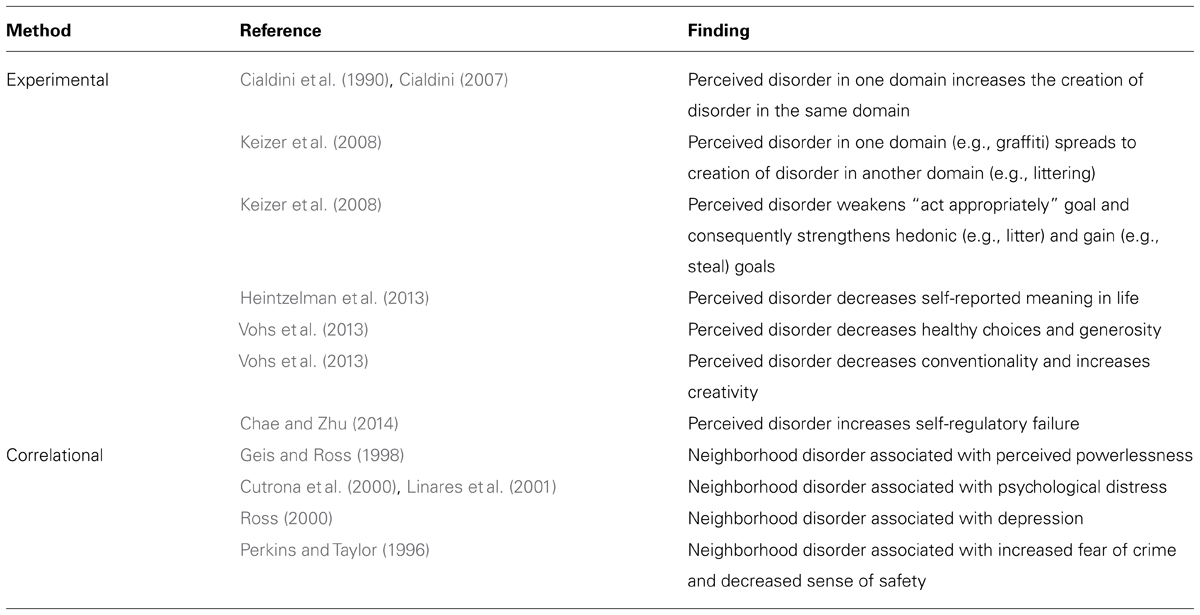
WIR can also (partly) explain a variety of correlational findings in the sociological literature. For brevity, and because this paper does not focus on the sociological consequences of perceived disorder, I will only review select research intended to demonstrate the breadth of findings WIR may at least partly account for (for a summary, see Table 1)1. First, take a cross-sectional study by Geis and Ross (1998). Analyzing data of a representative sample of 2,482 adults, aged 18–92 years, in Illinois (from the 1995 survey of Community Crime and Health), they found that neighborhood-level disorder was associated with perceived powerlessness. WIR can explain this similarly to how it explains the “meaning in life” findings by Heintzelman et al. (2013). That is, by making the world feel random, people start to lose a sense of control which manifests itself in negative outlooks on life such as feeling powerless and meaningless. Another likely manifestation is distress; Cutrona et al. (2000) found that neighborhood-level disorder was associated with distress, and this was moderated by life outlook, temperament, and quality of relationships. Specifically, disorder was associated with higher distress among people with a more negative life outlook, more negative temperament, and low-quality relationships. Importantly, this study suggests that although perceiving disorder may result in negative affect via a reduction in a sense of personal control, it is not inevitable. This is consistent with recent psychological research showing that people sometimes buffer against the threat of losing control through compensatory control mechanisms (Whitson and Galinsky, 2008; Kay et al., 2010). It seems to be currently assumed that people generally possess and use this ability, but future research may find that there are individual differences. This would clearly have implications for the proposed model, and may necessitate including moderators. Ross (2000) analyzed other data from the 1995 survey of Community Crime and Health and found that neighborhood disorder was associated with self-reported depression. Again, these results are consistent with the idea that perceived disorder results in a sense of losing control, which has insidious psychological consequences. Lastly, Perkins and Taylor (1996) surveyed 412 people across 50 neighborhoods in Baltimore to evaluate the relationship between neighborhood disorder and fear of crime. Three methods were used to measure both physical and social dimensions of neighborhood disorder: self-reported resident perceptions, on-site observations by trained raters, and newspaper content analysis. All three measures of neighborhood disorder predicted fear of crime, corroborating the general definition of perceived disorder assumed in WIR. As fear is an affective response to threat (Watson, 2000), these findings can be explained by the sense of threat resulting from losing a sense of control: When we are threatened, we generate a primitive fight-or-flight response in which we pay particular attention to sources of threat in our environment (so we can avoid them or prepare for them), such as lurking criminals. It follows that people would start to lose a sense of security and safety, as documented in this study.
TABLE 1
http://www.frontiersin.org/files/Articles/91733/fpsyg-05-00606-HTML/image_m/fpsyg-05-00606-t001.jpg

TABLE 1. Select experimental and correlational findings on the psychological consequences of disorder.

General Discussion


In the following discussion, I consider possible alternatives to WIR and explain why they may be inadequate. I then discuss some future directions for psychological research on perceived disorder.

Alternative Explanations


Cognitive Disfluency Explanation

Perceived disorder might be cognitively processed more disfluently than perceived order. Disfluency is thought to make people think more deeply and abstractly (Alter, 2013). Therefore, perceived disorder might have effects on judgment and behavior through disfluency, though it is unlikely that disfluency would have as severely negative affective consequences as the sense of losing control proposed by WIR. That said, both accounts could explain how perceived disorder may result in more accurate judgments in low-control/high-chance situations – the difference being the mechanism through which this happens. WIR would make this prediction by stating that disorder in the environment results in priming concepts related to randomness/chance/luck, and thus, through the availability heuristic, these concepts are appropriately weighted more in judgment. The cognitive fluency explanation would make this prediction by stating that people make more accurate judgments in a disorderly environment because they think harder (utilizing more effortful “system 2” processing, Kahneman, 2011). Both mechanisms could jointly work together, however, the recent experimental research reviewed in this article is more consistent with the conditioning/priming account of WIR than a disfluency account, since it seems unlikely that cognitive disfluency would result in the sense of losing control. If anything, it would result in the opposite.

Social/Rational Agent Explanation

This general and prevalent view concerns how perceived disorder may signal information about social norms and social monitoring. It suggests that people’s judgments and behaviors in disorderly environments can be understood as rationally aimed at minimizing expected costs and maximizing expected benefits, given the available social information. Regarding social norms and signaling, environmental disorder (e.g., litter) defines the descriptive norm (“littering is okay here”) which inhibits the effectiveness of the injunctive norm (e.g., no littering policy), thus the perceived costs of littering are lowered and people litter (Cialdini et al., 1990; Cialdini, 2007). Regarding social monitoring, perceived disorder may reduce the perceived costs of crime (e.g., littering) by signaling that monitoring/policing is low and thus punishment is unlikely, thus reducing expected costs of committing crimes. While these explanations can account widely for BWE (thus their popularity), they do not provide a clear account for the recent advances in psychological research on perceived disorder, which has documented that perceived disorder results in threats to and reductions of the sense of control. That being said, I do not doubt that perceived disorder can have such social effects, which is partly why I think that there may be a “unique psychology” (i.e., a distinct constellation of psychological phenomena) caused by perceiving disorder―more on that later.

Goal-Based Explanation

This explanation makes similar predictions to the social/rational agent explanation. Basically, a reduction in the expected costs of a crime (e.g., littering) due to perceived disorder of that form in the environment results in a weakened ‘act-appropriately’ goal and consequently increases the strength of “hedonic” (e.g., littering) and “gain” (e.g., stealing) goals (see Lindenberg and Steg, 2007; Keizer et al., 2008). Thus, people who see litter in the environment also commit other crimes such as illegally using graffiti and stealing. Again, while this can explain BWE and the “spreading of disorder” (see Keizer et al., 2008), it does not seem to relate with the documented reduction in a sense of personal control.

Future Directions


A Unique Psychology?

As mentioned above, one direction for future research is to determine whether there is a distinct cluster of psychological consequences caused by perceiving disorder. Is there more to it than just priming randomness-related concepts and the associated consequences proposed by WIR? To my knowledge, there is no experimental evidence yet to confirm this. Although Keizer et al. (2008) proposed that goals are activated and deactivated in response to perceiving disorder, they did not measure this, and rather it is implied from the behavioral evidence which may be completely accounted for by reduced self-control. However, given the related research on social norms and signaling, I do not doubt that there is indeed more to the story. Further research can determine this conclusively.

Individual Differences?

Cutrona et al. (2000) provides correlational evidence that effects of perceiving disorder may be moderated by individual differences such as negativity and poor relationships. Moving forward, we should experimentally test whether personality measures of negative temperament (e.g., adult temperament questionnaire, Rothbart et al., 2000) and relationship quality (e.g., the positive relations with others scale, Ryff, 1989) have moderating effects and why. One possibility is that some people may not use compensatory control mechanisms (effectively). Further, Vohs et al. (2013) assumes that individual differences in reactions to perceiving disorder may translate into reactions to situational-level disorder. In light of this proposition, it may make sense to test whether there are interactions between classic personality measures regarding reactions to perceived disorder – such as preference for consistency (Cialdini et al., 1995), need for structure (Neuberg and Newsom, 1993), need for closure (Webster and Kruglanski, 1994), and ambiguity tolerance (Norton, 1975) – and perceiving disorder in one’s surroundings.

Dependent Variables

To advance an interdisciplinary connection between the psychology of perceived disorder and the sociology of BWT, it will be important to develop laboratory measures analogous to those interpreted in the sociology of BWT. What would a laboratory analog be for “throwing a rock through the window of an abandoned building?” One may look to the aggression literature for inspiration. For example, research in this domain has employed creative behavioral measures such as serving hot sauce to a confederate (Bushman et al., 2005), blasting a confederate with aversive noise (Bushman et al., 2005), and delivering ostensibly painful shocks (Zillmann, 1971) to assess aggressive tendencies, which may have some parallels with criminal behaviors such as vandalism and theft.

Concluding Remarks

Research on the psychology of perceived disorder is a new and exciting development. In this article, I propose a parsimonious cognitive model possibly explaining a variety of effects and relationships concerning perceived disorder documented across the psychological and sociological literatures. To recap, WIR proposes that perceiving disorder results in a threatening sense of losing personal control (via priming randomness-related concepts), which can account for a variety of affective, judgmental, and behavioral findings in the literatures. Going forward, it is important to further corroborate each link in this model and delineate boundary conditions. It is also important to determine what aspects of this model have to do with BWT and what aspects do not. A broader and more challenging future direction is determining whether there are parallel psychological processes triggered by perceived disorder that collectively define a unique constellation of psychological phenomena.

Conflict of Interest Statement
The author declares that the research was conducted in the absence of any commercial or financial relationships that could be construed as a potential conflict of interest.

Acknowledgments

The author thanks the anonymous reviewers, Reid Hastie, Ayelet Fishbach, and Spike W. S. Lee for their useful feedback.

Footnotes


1. ^Across the selected studies, they control for various community- and individual-level variables such as urban area, neighborhood disadvantage, race, education, and income that may correlate with the dependent variables, yet perceived disorder remained a significant covariate.

Friday, May 02, 2014

Leonard Mlodinow — Randomness and Choice (On Being)

Leonard Mlodinow is the author of Subliminal: How Your Unconscious Mind Rules Your Behavior (2012), among other books. Some of the material in this episode is from Mlodinow's earlier book, The Drunkard's Walk: How Randomness Rules Our Lives (2008).

Leonard Mlodinow — Randomness and Choice

May 1, 2014

Fundamental forces of physics somehow determine everything that happens, as physicist Leonard Mlodinow has written, “from the birth of a child to the birth of a galaxy.” Yet he has intriguing perspective on the gap between theory and reality — and the fascinating interplay between a life in science and life in the world. As the child of two Holocaust survivors, he asks questions about our capacity to create our lives, while reflecting on extreme human cruelty — and courage.


Listen


Voices on the Radio


Leonard Mlodinow is a physicist, and the author of several books including The Drunkard’s Walk: How Randomness Rules Our Lives and Feynman’s Rainbow: A Search for Beauty in Physics and in Life. He's also written for television, including "Star Trek: The Next Generation."

Production Credits


Host/Executive Producer: Krista Tippett
Executive Editor: Trent Gilliss
Senior Producer: Lily Percy
Technical Director: Chris Heagle
Associate Producer: Mariah Helgeson