Showing posts with label panpsychism. Show all posts

Friday, November 07, 2014

Ingenious: Christof Koch Tackles Consciousness and the Self

http://static.nautil.us/4662_f64b2463cf1dba199491c885dff932f3.png

From Nautilus, this is a nice interview with neuroscientist and author (and panpsychism proponent). His recent book is Consciousness: Confessions of a Romantic Reductionist (2012).

https://www.sciencenews.org/sites/default/files/15559

Ingenious: Christof Koch

The neuroscientist tackles consciousness and the self

Consciousness may be the greatest illusion of all. Or at least the greatest mystery. “It is in the brain that the poppy is red, that the apple is odorous, that the skylark sings,” wrote Oscar Wilde. But how does the brain construct conscious experience? For the past 25 years, Christof Koch has been trying to provide an answer. At the Allen Institute for the Brain, where he is chief scientific officer, Koch is steering an ambitious project to map the complex networks of the brain. The goal is nothing short of understanding how we function in the world—how we see, fall in love, feel pain, marvel at a night sky full of stars.
In his most recent book, Consciousness: Confessions of a Romantic Reductionist (2012)Koch writes that “consciousness is a fundamental, an elemental, property of living matter.” He puts forth an “integrated information theory” that he believes provides the first rigorous scientific theory to explain consciousness. On a recent afternoon at the Allen Institute in Seattle, Koch took time to explain the captivating, if not entirely clear, theory. Koch, formerly a professor of cognitive and behavioral biology at the California Institute of Technology, has a capacious mind and a piercing intensity. In our discussion, his explanations ranged across brain biology and artificial intelligence, infamous patient Terri Schiavo and the film Her.

Interview Transcript


Why do you say consciousness is not an emergent property of the brain?

Well, I mean, “emergent” fundamentally means that at some level it’s not there, but then at a different level something is there. So the classical example of an emergent property is the wetness of water. If you take one or two molecules of H2O, they’re not wet. But then you take trillions of them, 1023, and then suddenly you get this property that it clings to surfaces that we know as wetness. With consciousness, for the longest [time] I also believed, well, it’s an emergent property—small brains don’t have it and then once you get to some bigger brains they do have it. But the problem with that assertion is that consciousness is so fundamentally different from anything else. Neurons and neuromechanisms are so different from the perception they can generate. My perception of having pain, or my perception of seeing red, is so radically different from the neurons that support the perception of seeing red or the neurons that support the perception of having pain that it’s totally unclear how we can go from one to the other.

So finally then, I at least came to the conclusion that it is a fundamental property of certain pieces of highly organized matter, that highly organized matter such as brain are capable of, and do have, experiences. We just live in a world with space and time and mass and energy, and also where complex organized matter has conscious experience; and that’s just the character of the world we are in. Now we can study this property; and the property that organized matter has to have in order to have consciousness; and how much consciousness [it has]. And if every piece of organized matter has consciousness, what about a fetus? What about an early born? What about a patient with severely compromised … [with] most of his brain dysfunctional? What about a dog? What about a cat? What about a worm? And then of course, I can ask the same question: If this is true, what about other pieces of organized matter that didn’t evolve but that we built, like computers or like the Internet? To what extent do they have conscious experience? To what extent does it feel like something to be there?

How can a computer or the Internet be conscious?

Well I mean, unless … In some sense it’s fairly obvious. Once you don’t have the notion any more that of course, we have in our culture for thousands of years that there is this magic thing—the soul, right? So if you believe in the thing called a “soul,” and only we have it and nobody else [has] it, right, then of course, you know you can ask what’s the nature of the soul. And of course it’s been impossible to understand what a soul is and what’s it made out of and where it was before I was born and where it’s going to go after I die. But once you get rid of this notion of a soul as just, as not being compatible with anything else I know and not consistent; then if you believe that consciousness is a property of certain types of natural systems, then in principle you should be able to replicate in a different natural system—once you think about it in that way. And yes, so in principle, once a computer is complex enough to begin to rival the human brain, then in principle, why should it not also have conscious experience? 

So was Watson on Jeopardy conscious? 

Well, okay, so there the difference is: So Watson wasn’t conscious, Watson is just very good, was programmed. It doesn’t feel like anything to be Watson, right? Watson was very cleverly programmed by a team of, you know, up to 100 engineers and scientists to answer a particular question. Now of course, you know, if you ask something related like you know, what’s the weather like today, it probably couldn’t answer that. But it was programmed exactly to answer Jeopardy.
But let’s take this process fast, forward. Let’s wait 20 or 30 years, right. In fact, let’s take the recent movie, Her, right. Now you remember Samantha, right? So Samantha was the name of this entity. Think of it like Siri but in 20 years from now, right. So now I have this highly conversant voice that talks like a human and has the same memory and can, you know, remember things and feel things and you have to ask your question: Does it feel like anything to be Samantha? In fact, at some point, she asks herself that in the movie, Her.  Does it feel like anything? Does she actually have feelings or is she just a set of very complicated input-output routines? And this now really depends on your metaphysical stance and it depends on your theory of consciousness. Interestingly, the dominant theory today, the dominant sort of, metaphysical assumption about consciousness that’s known as “functionalism”—and most philosophers these days are functionalists—would say yes, if she replicates all the causal relationships, if she simulates all the causal relationships of a human brain, then there would be no question. She would be conscious.

Now Integrated Information Theory of consciousness takes a somewhat different tack. It says, well, if you build a neuromorphic brain that has, you know, let’s say copper instead of axons, and transistors instead of neurons, then if you have the same cause-effect repertoires as [the] human brain, then this entity would actually be conscious. But if you simulate the brain like Samantha did, you would not be conscious. So the IIT claims that it doesn’t feel like anything to be Samantha. Essentially, for the same reason that a computer simulation of the weather, of a storm, of a tornado is never wet, right? You can simulate these days on modern computers; you can simulate the details of a tornado and of a hurricane. But it’s never wet inside the computer, right. It simulates the effect of water, but it’s never wet. For the same reason, IIT says that you can simulate consciousness, but this system itself will not have consciousness. In order for it to have consciousness, you have to replicate the detail—not simulate, but you have to replicate the actual cause-effect repertoire of the brain.

What is “Integrated Information Theory?”

Integrated Information Theory is the attempt by one particular, very gifted individual—a psychiatrist and a neuroscientist, Giulio Tononi—he’s at the University of Wisconsin, in Madison—to make sense of all this knowledge, know all that we have on the one hand about the philosophy of consciousness, but more importantly, about your conscious experiences and about the neurology of consciousness, and to put that into a rigorous scientific axiomatic theory that tells you quite precisely what consciousness is, how it originates, which systems have it, and which ones do not have it. And which also gives rise to a whole set of predictions that you can test in the lab, in the clinic, to again measure and ascertain which systems are conscious and which ones are not. Because in clinical practice, it is very often problematic, for certain classes of patients, to really be sure that the patient is conscious.
You may remember Terri Schiavo? You know, many years ago in Florida. So, she was a patient whose heart had stopped for 15 minutes, and she was in a so-called persistent vegetative state, or permanent vegetative state, where she clearly was … she had wake-sleep periods but when she was “awake” it was impossible to communicate with her. And so in patients like this, they may look normal. If you just see a picture of them, she may look like she’s smiling, but she doesn’t respond in any meaningful way to you. So here, it is not easy in this patient—and there are a few thousands of these patients in the U.S. alone—to ascertain to what extent do they feel anything. Does it feel like something to be Terri Schiavo? Or is it just sort of a brain mechanism? There still are some brain stem reflexes left so she’s clearly alive but without any conscious experience. Just like you are in a deep sleep. In a deep sleep, you’re clearly alive but you don’t have any conscious experiences.

Do you believe Terri Schiavo was conscious?

No. I mean, together … I looked at, you know, I looked at all the evidence. There were four separate clinical teams of medical experts that went over this question. All the evidence suggests that she, like thousands of sad cases like her, was sort of operating on brain stem mechanism. Yeah, occasionally you know, if you shine a bright light, occasionally she would track. Occasionally, she would, you know, look like she [was trying] to smile. But you know, if I film somebody for hours or days, yes, occasionally I can interpret you know, I can interpret if I really, if I’m hoping for a signal—like if I’m the loved ones, or the parents of this unfortunate patient—I can interpret there is something there but if you do this over a long time and if you’re a little bit more detached from it, you clearly see there doesn’t … there didn’t seem to … All the evidence indicated that there wasn’t anybody home anymore That she literally, Terri Schiavo, her conscious self, had died 14 years earlier. The shell of her self, particularly her brain and the brain stem, was still operating. And at autopsy, it was … the brain showed all the cerebral cortex had shrunk by more than a factor of two. So clearly she couldn’t see anything. All of her visual brain at the back was sort of degenerated. So all of that supports the contention: No, that she was not there. It didn’t feel like anything to be her. She, the her, she wasn’t present anymore.

How does Integrated Information Theory explain consciousness where other theories don’t?

Well I mean, a) there really aren’t that many consistent theories around. There are lots of hypotheses, but if by theory you mean a well formulated axiomatic body of short statements from which you can derive a mathematical calculus that you can then turn into predictions, there really isn’t any good alternative around. So … But that’s exactly what I like about the theory. It seems to be very plausible. It shares many elements of a conceptual framework that people have grappled with over the years. So for example, David Chalmers, a philosopher, he in his work 20 years ago already surmised that there was something key about particular types of information—that’s essentially what the theory says. It says particular types of systems generate a particular type of information called, “integrated information,” and it is integrated information that is experienced as experience. That’s what … it’s an identity relation. The theory essentially says that a particular type of information that makes a difference with the system in and of itself is what experience is. So it’s a fundamental assertion that tells you have a complicated, you have an organized system, it makes a difference to itself, and this difference that it makes to itself you can describe in mathematical terms—that’s what conscious experience is.

In a sense it takes us back to Pythagoras—you know in Sicily, the Greek philosopher and mathematician in Sicily who said that everything is ultimately numbers. It ultimately makes this assertion that consciousness is a particular informational structure in a high dimensional space. We don’t experience it as such. We experience it as sounds and sights and the tastes and the pains and the pleasures of life. But it says conscious is this high dimensional structure in these abstract spaces, and from there I can make predictions and I can turn toward neuroscience and toward the clinic to test to what extent these predictions are valid. And it also makes extrapolation. It also says which types of artificial systems, like which types of computer may or may not be conscious.

How can a subjective sense of blue be reduced to immaterial information?

You do it the other way around. You start with your sense of blue. You ask: What is it that makes a sense of blue, blue? Well for one, there is a sense. I do have experience of blue; it exists. It is the way it is because it’s different from any other experience I could have. So it’s different from black; it’s different from seeing you; it’s different from seeing a frame of the movie Blade Runner; it’s different from tasting, you know, wine. So it’s very different and … But it’s integrated. I cannot … So for example, you know, I see this video on a blue background but while I see the blue background, I see a lot of other things at the same time. I cannot separate that out. It’s holistic, it’s integrated; something philosophers have much remarked upon. It’s also structure. When I see a blue sky, it’s blue above, it’s not blue to the below. It’s blue on the left or blue on the right, so it has a sub-structure. And there’s only one blue. It’s not that I experience blue while simultaneously, there’s another Christof that experiences something very slowly and there’s another Christof that experiences something at an incredibly fast scale. There’s only one conscious experience.

And so, then you ask, given all these different properties about blue or any other experience—a kind of blue—you ask what is the mathematical calculus? How does a system have to be structured in order to support that? And that gives rise to a mathematical calculus. If you now, if you take those sort of, ways of defining your phenomenal experience, if you take them seriously and ask what mechanism can support them, then you turn into this … So you translate into mechanisms and then you give rise, you get out this calculus, that’s this calculus that says well in order to have an experience that has these different properties, you need to have a particular system that makes a difference to itself that is structured in a particular way; there’s only one of these systems and it has to make a difference to itself. So there has to be a mechanism like a neuron or like a transistor, it can be on and off—the type of information it has has to be integrated, has to be highly differentiated and then you get to IIT. So it’s a systematic process of going from the different aspects of conscious experience to a particular mechanism that supports. But you start out with experience. You don’t start out with a mechanism like a brain and ask how does a brain mechanism predict “y” conscious experience. You start with your conscious experiences and you ask what is the underlying mechanism have to be? What property does it have to obey in order to have conscious experiences? 

You write that Integrated Information Theory is “an elaborate form of panpsychism.” What is panpsychism?

So panpsychism is a very ancient philosophical belief. It goes back to, in our culture, to Plato and it’s very widespread. If you talk to Buddhists … I spent last year, a week with His Holiness, the Dalai Lama, so he and his Buddhists have reasons—are certainly all panpsychists—that assumes that consciousness is very widespread. Now it depends exactly what type of panpsychist you are—of course, there are many different forms—but essentially, it says that it’s very, very widespread and certainly may extend throughout the entire animal kingdom or may even extend wider. 
Now as a philosophical position it’s appealing, but it’s very difficult to get anything more out of it. Like you want to ask, well are there all-system conscious? What makes them conscious? Are there any systems that are not conscious? And so panpsychism doesn’t answer these questions. IIT, Integrated Information Theory, does. It makes certain very predictive—it makes some very specific predictions. It says, for instance, probably all complex neurobiological systems—all creatures that have brains—may well have consciousness, including bees and worms and octopi, etc. It may also be possible that if you build a brain out of wires and transistors, that you find consciousness there too.
But it also says that other systems like, for example, digital simulations will not be conscious. And it also says that there isn’t super-consciousness, that if I take a bunch of … For example, clearly answers the question that you and I, although we’re interacting, there’s no super-consciousness, there’s no right now Christof-Kevin or Kevin-Christof super-consciousness. There’s you, your conscious, you have conscious experience; I have conscious experience. We interact, but right now there is no über-consciousness. So [IIT] makes a number of very precise predictions that panpsychism was never able to make so it’s a much richer, more quantitative, more scientific form of panpsychism. But it does share the basic intuition that consciousness is graded and it’s much more widespread than we think in nature.

When you write things like, “the entire cosmos is suffused with sentience, ” you sound pretty New Age-y.

Yes, so here I have to confess that the nice turn of phrase I probably shouldn’t … It’s a beautiful turn of phrase, right? And so as a writer, you want to use it but … So you always have to make a judgment. As a scientist, you know, I ought to be very careful what I say. Yes because IIT again says that you’re conscious, I’m conscious, but it’s not … there isn’t this sort of woven consciousness everywhere. What I meant to say [was] that it’s much more widespread than we think. Many animals may have it; in fact, most animals for all I know will have it and lots of other systems may have it, so that’s what I meant by it. I may be taking too much of a license here as a writer compared to being a very accurate and precise scientist!

It sounds like a contradiction to say consciousness is both panpsychic and quantifiable.

Yeah, but I … So that’s the advantage of IIT. So IIT—finally, we have something that philosophers have not been able to do over the last 2,600 years with a precise mathematical definition of what it is, how to measure it. In fact, that’s … It has this number called ϕ that measures sort of the quantity. It has an informational structure that measures the quality of it so you can now make some very precise statements about consciousness. And while I don’t think Integrated Information Theory is the final word on consciousness, it’s certainly, it’s a big step in the right direction, and those sorts of theories will take us in a direction where we can turn, just like we’ve turned many other subject from metaphysics into physics, and ultimately into scientific subjects, to be able to ultimately explain this most mysterious of all phenomena—how does subjectivity, how do feelings, how does experience get into the physical world.

The self is often called an illusion. How do you define the self?

Well, the self is this sense of ego, this sense of continuity in space and time—that I wake up you know, this morning, I’m the same that I was yesterday, and I’m the same that I was last year, and then when my mom points at a picture of me, you know, where she says, “Well see? That’s you at 2 years old”—I have no idea it’s me, but I believe her. I say, well that’s my self, right. Although I know in the intervening time everything—a molecule in my body—has changed, I still believe that sort of is me.
So partly, it’s an illusion, because of course, we know we’ve changed radically, we have different … we may have different make up—we certainly have different memory—but still, I have this sense, and I think I need this sense in order to act in the world and to continue to act and to take advantage of experiences I’ve stored up over my lifetime. So partly, the Buddhists are right in the sense that it is partly illusory. But ultimately what remains is, and I’d like to end on this, with this phrase, what remains ultimately is my experience of having a self, my experience of having experiences as such. That is the most fundamental observation I can make about the universe and ultimately science has to explain how this feeling of having experiences comes into the physical world.

You write that, “some deep and elemental organizing principle created the universe.” What do you mean?

I find myself in a universe that’s conducive to life, right. This is the discovery over the last 30 years known as the “anthropic principle,” that everything in this particular universe seems to be extraordinarily balanced, so that you can have emergence of stable elements, you can have stable stars around which you can have stable planets and then you have natural evolution that gives rise to complex features. We also live in a universe where complexity begets conscious experience—that’s the heart of something like Integrated Information Theory, that complex piece of organized matter gives rise to consciousness. So isn’t it amazing that we are in this universe. Is that a chance event? Is there an infinite number of universes and we just happened to find ourselves in this one particular universe? So now for a reason I’m utterly unable to justify, I find this all deeply mysterious and deeply beautiful—that I do live in this universe, that is conducive to life, that is conducive to conscious experience. And I see looking back over the last 13 billion years of cosmic evolution, and then 4.3 billion years of terrestrial evolution, and then maybe 4 billion years of biological evolution, that here, we are very complicated creatures and the evolution is ongoing. So it’s all very mysterious, but it’s all very beautiful to me. In that sense, I guess I was born with this sense of mystery. I find that very, very surprising.

What would you be if you weren’t a scientist?

A climber. A professional climber. Climbing’s very addictive because in climbing, you can certainly experience … It’s all about conscious experience. You’re out there on the edge, you’re out there on the sharp end of a rope, and you’re hyper-conscious of the world. Your ego sort of recedes. It’s a form of meditation because you are engaged to such an extent with the world, with the environment, you have to pay such attention to every little unevenness in the rock, that your inner voice—this constant critic that’s always in your head—is completely silent and you just experience the raw feels of the world. It’s a wonderful, it’s an ego-loss, it’s a very addicting experience so I wish in a different life, I could just be a climber all the time.

Monday, May 19, 2014

Robert Berezin - Do Lower Life Forms and Inanimate Matter have Consciousness?


Robert Berezin is the author of Psychotherapy of Character: The Play of Consciousness in the Theater of the Brain (2013). This is from his personal blog - a post that offers a basic outline of his views on consciousness inspired by a video on panpsychism and complexity theory.

His views  are very close to my own, as far as I can tell from this post.

Do Lower Life Forms and Inanimate Matter have Consciousness?

images-1

Regarding the question whether consciousness is a property of animal brains vs. pansychism I come down 100% that consciousness exists solely as a brain function that is created by the limbic cortex. Pansychism is the belief that all life forms, and even molecular, atomic, and sub atomic particles have consciousness. Neil Theise, MD, makes the case for pansychism in his brilliant video “Complexity Theory & Panpsychism”. His illumination of fractals, and the centrality of interactions with the environment throughout the quantum levels going through invertebrates, single celled organisms, DNA, molecules, atoms, and subatomic particles is illuminating. I agree with all of his observations with one major exception.

I differ from his conclusion that they have sentience and consciousness. Sentient means capable of feeling. It comes from the Latin sentientemfeeling, and sentire – to feel. It came to mean conscious in 1815. Theise believes that an organism or particle has sentience because it has interactive relatedness with its environment. He claims that they ‘sense’ other particles which implies consciousness. I will present my understanding of sentience and consciousness. Then I will address how it is a fantasy to attribute consciousness to automatic functioning and environmental adaptation.
Human consciousness begins when an infant is approximately six weeks old. Its development begins with the fetal limbic system. The function of the fetal amygdala and limbic system is to map the survival interactions with the maternal environment. This brain circuitry links the body, hormones, subcortical brain, and the cortex—the amygdala for impulses of fear and pleasure; the hippocampus for gluing memories; the cingulate gyrus for attention and autonomic functions, such as heart rate and blood pressure; the hypothalamus for regulating the autonomic nervous system; and the thalamus, the relay station from the sub cortex.

The morphogenesis of the limbic system is progressive and continues in the newborn. At six weeks old, the newborn’s foundational appetites and rudimentary emotions morph a sufficiently high level of order to crystallize into a feeling of tenderness and sweetness. This constitutes the cohered feeling of the being of the baby. Yesterday there was no feeling of the baby. And suddenly it is here. Yesterday, he was simply an infant. Today, he is a human being. This ‘feeling of the being’ is a synthetic creation of extremely high levels of order in the limbic cortex which has been maturing through fetal life and the first six weeks after birth, during which the infant continues to map his survival environment with his mother.

And so it begins. Consciousness is born. The baby is now a sentient being. The ‘feeling’ of the baby is a synthetic persona created by the limbic cortex. This ‘self’ has no representational form. It is not knowable through the senses, thinking, or imagination. It cannot be seen. It is not an idea. It does not lend itself to being understood or comprehended. It only touches and is touched by feeling. The litmus test for the presence of this ‘feeling’ is that the mother (and others) are now touched by the presence of a tender feeling from the baby. Prior to this, the mother is predisposed to love her baby, and does, but there is no actual feeling relatedness. Then everything changes and she does feel him. It is analogous to the appearance of the embryonic heart. At one point there is no heart. And then it is there beating and pumping blood. At one point there is no feeling of the being and then it coalesces and there it is.

This is the beginning of consciousness, which is organized as a rudimentary play in the theater of the brain. This play is composed of a non-representational feeling persona of the baby in relationship with a non representational feeling persona of the mother, also a synthetic creation of the limbic cortex. Over the next three years higher and higher levels of symbolic form develop in the limbic cortex. When sufficiently mature, the personas then have form as representational images of self and others. This is the way we ordinarily know ourselves. However, even though the original ‘being’ of the baby is supplanted, its mapped circuits remain throughout life as the agency that generates the feeling of our being. It is the anchor of our loving. It is the quiet voice inside of us. It is our innocence. It is the source of our creativity. It is the source of our conscience. It is the fountain of our aliveness. None of this is mystical or magical. It is just the way consciousness is organized in the brain.

Consciousness is anchored in feeling – judgment, thinking, and relatedness are all anchored in feeling. Antonio Damasio illuminates this in his brilliant book, Descartes’ Error, Emotion, Reason, and the Human Brain. The rest of the body operates automatically, autonomically through the subcortical brain and has no consciousness – the uterus, the liver, intestines, etc. They function responsively, but they are not conscious and have no consciousness. Like Dr. Theise, I discuss the life functions of an ameba in chapter five of my book. There is certainly a distinction between an alive organism and inert matter. I agree that there is rudimentary ‘isness’ in the ameba and all life forms. The live ameba exercises its life functions and reproduces under the directions of its DNA. It is different from a dead thing. If it dies, then it no longer ‘is’. However, the ameba has a discrete repertoire of actions that it exercises automatically in relation to its environment. Even though it is alive. It is an automaton. It operates purely automatically, like our liver. It has no brain. It has no intention. It has no self awareness. Aliveness, ‘isness’ does not mean there is consciousness. There is no limbic-cortex to synthesize a feeling-being. Consciousness is the result of evolution. It emerged as an adaptational creation of the brain to interact effectively with the salient environments of the organism, and was selected for.

To attribute sentience to automatic functioning is the result of speculative imagination. And there is no actual evidence that this true. There is no evidence that an ameba has consciousness. Similarly, trees, clams, grass, worms, lobsters operate their life functions with a larger repertoire of automatic actions. But they too have no consciousness. You can physically touch a tree but it does not feel you. You can take a hatchet to a tree and it employs self preservative mechanisms to seal off the wound. But these are automatic processes. There is no consciousness.

I am by no means an expert on ant colonies and bee hives. And I certainly understand that they operate in many ways as if they are one organism. Nonetheless, their complex group behavior does not imply that they are anything but complicated automaton-drones surviving and replicating. It remains a leap to attribute consciousness to their organized behavior. Richard Dawkins in the “Selfish Gene” repeatedly says the attribution of selfishness to a gene is a device, and it in no way implies that they actually have consciousness. Nonetheless people leap to the false conclusion that genes are sentient. They are not. When sixty million human sperm are injected into a female and they race to mate with an egg cell floating in the fallopian tube, this is just automaton activity. The sperm certainly are in a competitive race. This is what they do. But they are not thinking, “Oh my god, Larry is catching up with me, I better step on it.”

Mammals and birds do have limbic cortical brains. Although, different from ours, they have consciousness. They are sentient beings. Furthermore, when considering non-alive entities like DNA and molecules and atoms, we cannot attribute sentience. Dr. Theise conclusion that they are ‘sensing’ other particles is a fantasy leap. Sub atomic particles don’t ‘sense’ things. They automatically react to their environment according to the laws of physics. Theise goes one step further which raises a caution flag to my mind. He utilizes string theory. String theory is very attractive to many people. But it has no actual proof. Just because one can conceive of things outside our experience or imagine other dimensions, does not make them true. Such believed imaginings are not any different from other beliefs which have no proof. To then operate as if string theory is true and to derive implications leads to the construction of a misleading house of cards. Higgs-Bosons are valid, quantum foam has no evidence whatsoever.

All of existence formed from the collision of randomness and order. Both inanimate particles as well as life forms evolve and take hold as a result of natural selection and the laws of physics. The idea that all matter has sentience has no foundation. Its like a modern form of Lamarckism. Everything in the universe interacts with an environment. It is no more credible that evolution comes from acquired characteristics than the idea that everything has consciousness. This inevitably leads to the conclusion that everything has Mind, and then that there is a universal Mind.

Sunday, January 05, 2014

Christof Koch - Is Consciousness Universal? (on Panpsychism)

Panpsychism is the belief that everything is “enminded.” Everything - no matter if it is a "brain, a tree, a rock or an electron." Everything that is physical also possesses interiority. The physical is objective and available to everybody — interiority is phenomenal and available only to the subject.

This is still a marginal perspective, but it has been increasing in popularity over the last decade or two, with David Skrbina's Panpsychism in the West (2007) being the best philosophical treatment and B. Alan Wallace's work in Buddhism and physics being the best known spiritual approach to panpsychism (see Hidden Dimensions: The Unification of Physics and Consciousness, 2007 - my review at Wildmind Buddhist Meditation outlines my issues with his model).

I like Koch - and I like that he seems to be offering an alternative model of panpsychism, even though I remain highly skeptical.

Please note that Koch references several of his previous SA articles with their titles. I have provided links to those articles, but the titles in most cases have been revised as they entered the archives.


Is Consciousness Universal?


Panpsychism, the ancient doctrine that consciousness is universal, offers some lessons in how to think about subjective experience today


By Christof Koch | Consciousness Redux

Scientific American | January 1, 2014


For every inside there is an outside, and for every outside there is an inside; though they are different, they go together.
—Alan Watts, Man, Nature, and the Nature of Man, 1991
I grew up in a devout and practicing Roman Catholic family with Purzel, a fearless and high-energy dachshund. He, as with all the other, much larger dogs that subsequently accompanied me through life, showed plenty of affection, curiosity, playfulness, aggression, anger, shame and fear. Yet my church teaches that whereas animals, as God's creatures, ought to be treated well, they do not possess an immortal soul. Only humans do. Even as a child, to me this belief felt intuitively wrong. These gorgeous creatures had feelings, just like I did. Why deny them? Why would God resurrect people but not dogs? This core Christian belief in human exceptionalism did not make any sense to me. Whatever consciousness and mind are and no matter how they relate to the brain and the rest of the body, I felt that the same principle must hold for people and dogs and, by extension, for other animals as well.

It was only later, at university, that I became acquainted with Buddhism and its emphasis on the universal nature of mind. Indeed, when I spent a week with His Holiness the Dalai Lama earlier in 2013 [see “The Brain of Buddha,” Consciousness Redux; Scientific American Mind, July/August 2013], I noted how often he talked about the need to reduce the suffering of “all living beings” and not just “all people.” My readings in philosophy brought me to panpsychism, the view that mind (psyche) is found everywhere (pan). Panpsychism is one of the oldest of all philosophical doctrines extant and was put forth by the ancient Greeks, in particular Thales of Miletus and Plato. Philosopher Baruch Spinoza and mathematician and universal genius Gottfried Wilhelm Leibniz, who laid down the intellectual foundations for the Age of Enlightenment, argued for panpsychism, as did philosopher Arthur Schopenhauer, father of American psychology William James, and Jesuit paleontologist Teilhard de Chardin. It declined in popularity with the rise of positivism in the 20th century.

As a natural scientist, I find a version of panpsychism modified for the 21st century to be the single most elegant and parsimonious explanation for the universe I find myself in. There are three broad reasons why panpsychism is appealing to the modern mind.

We Are All Nature's Children


The past two centuries of scientific progress have made it difficult to sustain a belief in human exceptionalism.

Consider my Bernese mountain dog, Ruby, when she yelps, whines, gnaws at her paw, limps and then comes to me, seeking aid: I infer that she is in pain because under similar conditions I behave in similar ways (sans gnawing). Physiological measures of pain confirm this inference—injured dogs, just like people, experience an elevated heart rate and blood pressure and release stress hormones into their bloodstream. I'm not saying that a dog's pain is exactly like human pain, but dogs—as well as other animals—not only react to noxious stimuli but also consciously experience pain.

All species—bees, octopuses, ravens, crows, magpies, parrots, tuna, mice, whales, dogs, cats and monkeys—are capable of sophisticated, learned, nonstereotyped behaviors that would be associated with consciousness if a human were to carry out such actions. Precursors of behaviors thought to be unique to people are found in many species. For instance, bees are capable of recognizing specific faces from photographs, can communicate the location and quality of food sources to their sisters via the waggle dance, and can navigate complex mazes with the help of cues they store in short-term memory (for instance, “after arriving at a fork, take the exit marked by the color at the entrance”). Bees can fly several kilometers and return to their hive, a remarkable navigational performance. And a scent blown into the hive can trigger a return to the site where the bees previously encountered this odor. This type of associative memory was famously described by Marcel Proust in À la Recherche du Temps Perdu. Other animals can recognize themselves, know when their conspecifics observe them, and can lie and cheat.

Some people point to language and the associated benefits as being the unique defining feature of consciousness. Conveniently, this viewpoint rules out all but one species, Homo sapiens (which has an ineradicable desire to come out on top), as having sentience. Yet there is little reason to deny consciousness to animals, preverbal infants [see “The Conscious Infant,” Consciousness Redux; Scientific American Mind, September/October 2013] or patients with severe aphasia, all of whom are mute.

None other than Charles Darwin, in the last book he published, in the year preceding his death, set out to learn how far earthworms “acted consciously and how much mental power they displayed.” Studying their feeding and sexual behaviors for several decades—Darwin was after all a naturalist with uncanny powers of observation—he concluded that there was no absolute threshold between lower and higher animals, including humans, that assigned higher mental powers to one but not to the other.

The nervous systems of all these creatures are highly complex. Their constitutive proteins, genes, synapses, cells and neuronal circuits are as sophisticated, variegated and specialized as anything seen in the human brain. It is difficult to find anything exceptional about the human brain. Even its size is not so special, because elephants, dolphins and whales have bigger brains. Only an expert neuroanatomist, armed with a microscope, can tell a grain-size piece of cortex of a mouse from that of a monkey or a human. Biologists emphasize this structural and behavioral continuity by distinguishing between nonhuman and human animals. We are all nature's children.

Given the lack of a clear and compelling Rubicon separating simple from complex animals and simple from complex behaviors, the belief that only humans are capable of experiencing anything consciously seems preposterous. A much more reasonable assumption is that until proved otherwise, many, if not all, multicellular organisms experience pain and pleasure and can see and hear the sights and sounds of life. For brains that are smaller and less complex, the creatures' conscious experience is very likely to be less nuanced, less differentiated and more elemental. Even a worm has perhaps the vaguest sense of being alive. Of course, each species has its own unique sensorium, matched to its ecological niche. Not every creature has ears to hear and eyes to see. Yet all are capable of having at least some subjective feelings.

The Austere Appeal of Panpsychism

Taken literally, panpsychism is the belief that everything is “enminded.” All of it. Whether it is a brain, a tree, a rock or an electron. Everything that is physical also possesses an interior mental aspect. One is objective—accessible to everybody—and the other phenomenal—accessible only to the subject. That is the sense of the quotation by British-born Buddhist scholar Alan Watts with which I began this essay.

I will defend a narrowed, more nuanced view: namely that any complex system, as defined below, has the basic attributes of mind and has a minimal amount of consciousness in the sense that it feels like something to be that system. If the system falls apart, consciousness ceases to be; it doesn't feel like anything to be a broken system. And the more complex the system, the larger the repertoire of conscious states it can experience.

My subjective experience (and yours, too, presumably), the Cartesian “I think, therefore I am,” is an undeniable certainty, one strong enough to hold the weight of philosophy. But from whence does this experience come? Materialists invoke something they call emergentism to explain how consciousness can be absent in simple nervous systems and emerge as their complexity increases. Consider the wetness of water, its ability to maintain contact with surfaces. It is a consequence of intermolecular interactions, notably hydrogen bonding among nearby water molecules. One or two molecules of H2O are not wet, but put gazillions together at the right temperature and pressure, and wetness emerges. Or see how the laws of heredity emerge from the molecular properties of DNA, RNA and proteins. By the same process, mind is supposed to arise out of sufficiently complex brains.

Yet the mental is too radically different for it to arise gradually from the physical. This emergence of subjective feelings from physical stuff appears inconceivable and is at odds with a basic precept of physical thinking, the Ur-conservation law—ex nihilo nihil fit. So if there is nothing there in the first place, adding a little bit more won't make something. If a small brain won't be able to feel pain, why should a large brain be able to feel the god-awfulness of a throbbing toothache? Why should adding some neurons give rise to this ineffable feeling? The phenomenal hails from a kingdom other than the physical and is subject to different laws. I see no way for the divide between unconscious and conscious states to be bridged by bigger brains or more complex neurons.

A more principled solution is to assume that consciousness is a basic feature of certain types of so-called complex systems (defined in some universal, mathematical manner). And that complex systems have sensation, whereas simple systems have none. This reasoning is analogous to the arguments made by savants studying electrical charge in the 18th century. Charge is not an emergent property of living things, as originally thought when electricity was discovered in the twitching muscles of frogs. There are no uncharged particles that in the aggregate produce an electrical charge. Elementary particles either have some charge, or they have none. Thus, an electron has one negative charge, a proton has one positive charge and a photon, the carrier of light, has zero charge. As far as chemistry and biology are concerned, charge is an intrinsic property of these particles. Electrical charge does not emerge from noncharged matter. It is the same, goes the logic, with consciousness. Consciousness comes with organized chunks of matter. It is immanent in the organization of the system. It is a property of complex entities and cannot be further reduced to the action of more elementary properties. We have reached the ground floor of reductionism.

Yet, as traditionally conceived, panpsychism suffers from two major flaws. One is known as the problem of aggregates. Philosopher John Searle of the University of California, Berkeley, expressed it recently: “Consciousness cannot spread over the universe like a thin veneer of jam; there has to be a point where my consciousness ends and yours begins.” Indeed, if consciousness is everywhere, why should it not animate the iPhone, the Internet or the United States of America? Furthermore, panpsychism does not explain why a healthy brain is conscious, whereas the same brain, placed inside a blender and reduced to goo, would not be. That is, it does not explain how aggregates combine to produce specific conscious experience.

Integrated Panpsychism

These century-old arguments bring me to the conceptual framework of the integrated information theory (IIT) of psychiatrist and neuroscientist Giulio Tononi of the University of Wisconsin–Madison. It postulates that conscious experience is a fundamental aspect of reality and is identical to a particular type of information—integrated information. Consciousness depends on a physical substrate but is not reducible to it. That is, my experience of seeing an aquamarine blue is inexorably linked to my brain but is different from my brain.

Any system that possesses some nonzero amount of integrated information experiences something. Let me repeat: any system that has even one bit of integrated information has a very minute conscious experience.

IIT makes two principled assumptions. First, conscious states are highly differentiated; they are informationally very rich. You can be conscious of an uncountable number of things. Think of all the frames from all the movies that you have ever seen or that have ever been filmed or that will be filmed! Each frame, each view, is a specific conscious percept.

Second, each such experience is highly integrated. You cannot force yourself to see the world in black and white; its color is an integrated part of your view. Whatever information you are conscious of is wholly and completely presented to your mind; it cannot be subdivided. Underlying this unity of consciousness is a multitude of causal interactions among the relevant parts of your brain. If parts of the brain become fragmented and balkanized, as occurs in deep sleep or in anesthesia, consciousness fades.

To be conscious, then, you need to be a single, integrated entity with a large repertoire of highly differentiated states. Even if the hard disk on my laptop exceeds in capacity my lifetime memories, none of its information is integrated. The family photos on my Mac are not linked to one another. The computer does not know that the boy in those pictures is my son as he matures from a toddler to an awkward teenager and then a graceful adult. To my computer, all information is equally meaningless, just a vast, random tapestry of 0s and 1s. Yet I derive meaning from these images because my memories are heavily cross-linked. And the more interconnected, the more meaningful they become.

These ideas can be precisely expressed in the language of mathematics using notions from information theory such as entropy. Given a particular brain, with its neurons in a particular state—these neurons are firing while those ones are quiet—one can precisely compute the extent to which this network is integrated. From this calculation, the theory derives a single number, &PHgr; (pronounced “fi”) [see “A Theory of Consciousness,” Consciousness Redux; Scientific American Mind, July/August 2009]. Measured in bits, &PHgr; denotes the size of the conscious repertoire associated with the network of causally interacting parts being in one particular state. Think of &PHgr; as the synergy of the system. The more integrated the system is, the more synergy it has and the more conscious it is. If individual brain regions are too isolated from one another or are interconnected at random, &PHgr; will be low. If the organism has many neurons and is richly endowed with synaptic connections, &PHgr; will be high. Basically, &PHgr; captures the quantity of consciousness. The quality of any one experience—the way in which red feels different from blue and a color is perceived differently from a tone—is conveyed by the informational geometry associated with &PHgr;. The theory assigns to any one brain state a shape, a crystal, in a fantastically high-dimensional qualia space. This crystal is the system viewed from within. It is the voice in the head, the light inside the skull. It is everything you will ever know of the world. It is your only reality. It is the quiddity of experience. The dream of the lotus eater, the mindfulness of the meditating monk and the agony of the cancer patient all feel the way they do because of the shape of the distinct crystals in a space of a trillion dimensions—truly a beatific vision. The water of integrated information is turned into the wine of experience.

Integrated information makes very specific predictions about which brain circuits are involved in consciousness and which ones are peripheral players (even though they might contain many more neurons, their anatomical wiring differs). The theory has most recently been used to build a consciousness meter to assess, in a quantitative manner, the extent to which anesthetized subjects or severely brain-injured patients, such as Terri Schiavo, who died in Florida in 2005, are truly not conscious or do have some conscious experiences but are unable to signal their pain and discomfort to their loved ones [see “A Consciousness Meter,” Consciousness Redux; Scientific American Mind, March/April 2013].

IIT addresses the problem of aggregates by postulating that only “local maxima” of integrated information exist (over elements and spatial and temporal scales): my consciousness, your consciousness, but nothing in between. That is, every person living in the U.S. is, self by self, conscious, but there is no superordinate consciousness of the U.S. population as a whole.

Unlike classical panpsychism, not all physical objects have a &PHgr; that is different from zero. Only integrated systems do. A bunch of disconnected neurons in a dish, a heap of sand, a galaxy of stars or a black hole—none of them are integrated. They have no consciousness. They do not have mental properties.

Last, IIT does not discriminate between squishy brains inside skulls and silicon circuits encased in titanium. Provided that the causal relations among the circuit elements, transistors and other logic gates give rise to integrated information, the system will feel like something. Consider humankind's largest and most complex artifact, the Internet. It consists of billions of computers linked together using optical fibers and copper cables that rapidly instantiate specific connections using ultrafast communication protocols. Each of these processors in turn is made out of a few billion transistors. Taken as a whole, the Internet has perhaps 1019 transistors, about the number of synapses in the brains of 10,000 people. Thus, its sheer number of components exceeds that of any one human brain. Whether or not the Internet today feels like something to itself is completely speculative. Still, it is certainly conceivable.

When I talk and write about panpsychism, I often encounter blank stares of incomprehension. Such a belief violates people's strongly held intuition that sentience is something only humans and a few closely related species possess. Yet our intuition also fails when we are first told as kids that a whale is not a fish but a mammal or that people on the other side of the planet do not fall off because they are upside down. Panpsychism is an elegant explanation for the most basic of all brute facts I encounter every morning on awakening: there is subjective experience. Tononi's theory offers a scientific, constructive, predictive and mathematically precise form of panpsychism for the 21st century. It is a gigantic step in the final resolution of the ancient mind-body problem.

Further Reading

Panpsychism in the West. David Skrbina. MIT Press, 2005.
Consciousness: Confessions of a Romantic Reductionist. Christof Koch. MIT Press, 2012.
Integrated Information Theory of Consciousness: An Updated Account. Giulio Tononi in Archives Italiennes de Biologie, Vol. 150, No. 4, pages 293–329; December 2012.

Saturday, December 07, 2013

A Neuroscientist's Radical Theory of How Networks Become Conscious (WIRED U.K.)

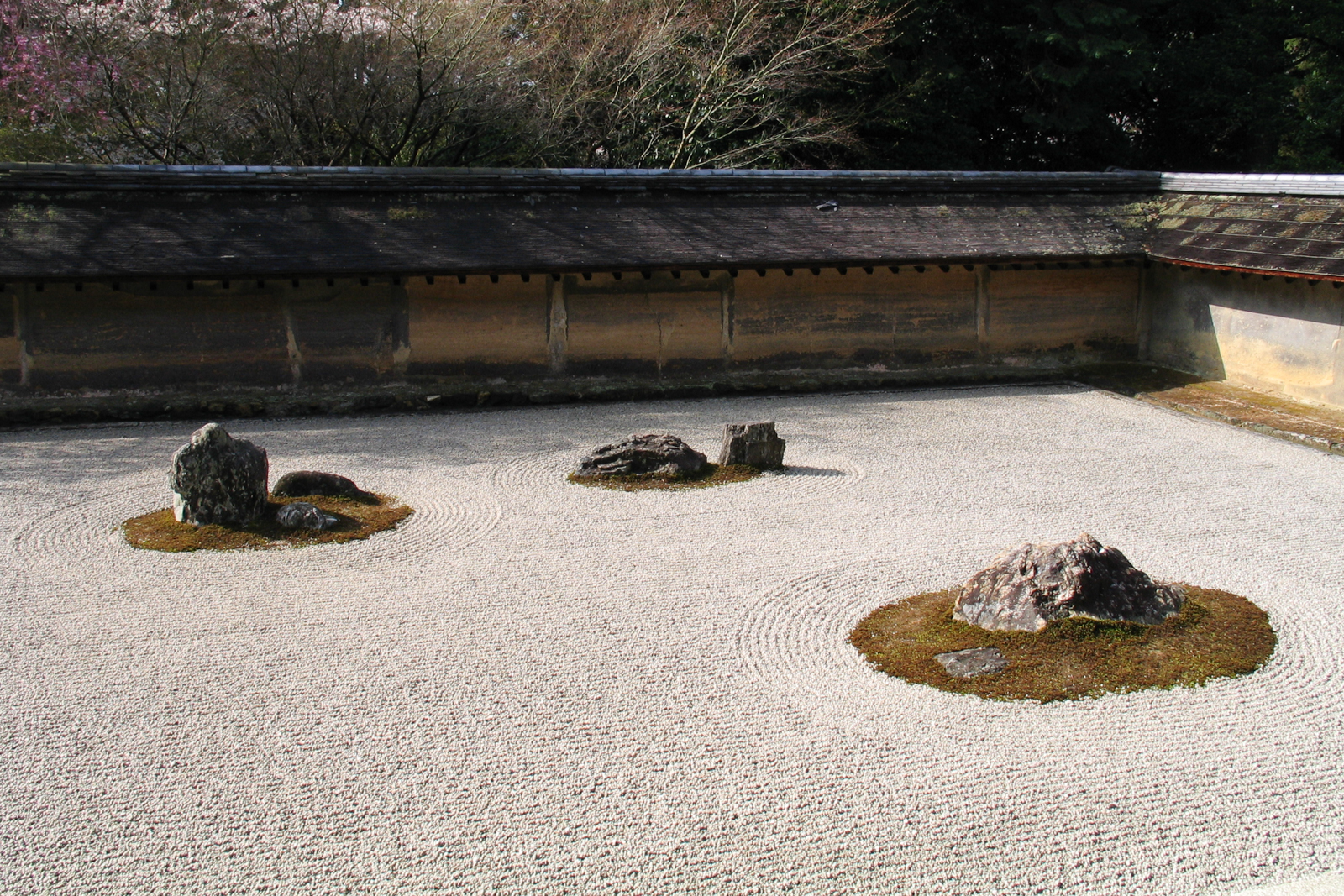
File:RyoanJi-Dry garden.jpg
In the Japanese art of the rock garden, the artist must be aware 
of the rocks' "ishigokoro" (‘heart,’ or ‘mind’)


Neuroscientist Christof Koch, chief scientific officer at the Allen Institute for Brain Science, has progressively become less hyper-rational in his understanding of consciousness and more Buddhist - and it's not clear yet if this is a good thing.

His newest pronouncement is his belief in panpsychism, defined below by Wikipedia:
In philosophy, panpsychism is the view that mind or soul (Greek: ψυχή) is a universal feature of all things, and the primordial feature from which all others are derived. The panpsychist sees him or herself as a mind in a world of minds.

Panpsychism is one of the oldest philosophical theories, and can be ascribed to philosophers like Thales, Plato, Spinoza, Leibniz and William James. Panpsychism can also be seen in eastern philosophies such as Vedanta and Mahayana Buddhism. During the 19th century, Panpsychism was the default theory in philosophy of mind, but it saw a decline during the latter half of the 20th century with the rise of logical positivism.[1] The recent interest in the hard problem of consciousness has once again made panpsychism a mainstream theory.
 Says Koch, "I argue that we live in a universe of space, time, mass, energy, and consciousness arising out of complex systems." This sounds like emergence to me, and less like panpsychism, which is the belief that mind/consciousness is inherent in the universe. I'm more likely to accept emergence as an explanation of consciousness that avoids issues of duality.

See the Stanford Encyclopedia of Philosophy entry on panpsychism for a better understanding of the arguments for and against, as well as its history in philosophy.

A neuroscientist's radical theory of how networks become conscious


15 November 13
by Brandon Keim


A map of neural circuits in the human brain - Human Connectome Project

It's a question that's perplexed philosophers for centuries and scientists for decades: where does consciousness come from? We know it exists, at least in ourselves. But how it arises from chemistry and electricity in our brains is an unsolved mystery.

Neuroscientist Christof Koch, chief scientific officer at the Allen Institute for Brain Science, thinks he might know the answer. According to Koch, consciousness arises within any sufficiently complex, information-processing system. All animals, from humans on down to earthworms, are conscious; even the internet could be. That's just the way the universe works.

"The electric charge of an electron doesn't arise out of more elemental properties. It simply has a charge," says Koch. "Likewise, I argue that we live in a universe of space, time, mass, energy, and consciousness arising out of complex systems."

What Koch proposes is a scientifically refined version of an ancient philosophical doctrine called panpsychism -- and, coming from someone else, it might sound more like spirituality than science. But Koch has devoted the last three decades to studying the neurological basis of consciousness. His work at the Allen Institute now puts him at the forefront of the BRAIN Initiative, the massive new effort to understand how brains work, which will begin next year.

Koch's insights have been detailed in dozens of scientific articles and a series of books, including last year's Consciousness: Confessions of a Romantic Reductionist. Wired talked to Koch about his understanding of this age-old question.

Wired: How did you come to believe in panpsychism?

Christof Koch: I grew up Roman Catholic, and also grew up with a dog. And what bothered me was the idea that, while humans had souls and could go to heaven, dogs were not supposed to have souls. Intuitively I felt that either humans and animals alike had souls, or none did. Then I encountered Buddhism, with its emphasis on the universal nature of the conscious mind. You find this idea in philosophy, too, espoused by Plato and Spinoza and Schopenhauer, that psyche -- consciousness -- is everywhere. I find that to be the most satisfying explanation for the universe, for three reasons: biological, metaphysical and computational.

Wired: What do you mean?

Koch: My consciousness is an undeniable fact. One can only infer facts about the universe, such as physics, indirectly, but the one thing I'm utterly certain of is that I'm conscious. I might be confused about the state of my consciousness, but I'm not confused about having it. Then, looking at the biology, all animals have complex physiology, not just humans. And at the level of a grain of brain matter, there's nothing exceptional about human brains.

Only experts can tell, under a microscope, whether a chunk of brain matter is mouse or monkey or human -- and animals have very complicated behaviours. Even honeybees recognise individual faces, communicate the quality and location of food sources via waggle dances, and navigate complex mazes with the aid of cues stored in their short-term memory. If you blow a scent into their hive, they return to where they've previously encountered the odor. That's associative memory. What is the simplest explanation for it? That consciousness extends to all these creatures, that it's an imminent property of highly organised pieces of matter, such as brains.

Wired: That's pretty fuzzy. How does consciousness arise? How can you quantify it?

Koch: There's a theory, called Integrated Information Theory, developed by Giulio Tononi at the University of Wisconsin, that assigns to any one brain, or any complex system, a number -- denoted by the Greek symbol of Φ -- that tells you how integrated a system is, how much more the system is than the union of its parts. Φ gives you an information-theoretical measure of consciousness. Any system with integrated information different from zero has consciousness. Any integration feels like something

It's not that any physical system has consciousness. A black hole, a heap of sand, a bunch of isolated neurons in a dish, they're not integrated. They have no consciousness. But complex systems do. And how much consciousness they have depends on how many connections they have and how they're wired up.

Wired: Ecosystems are interconnected. Can a forest be conscious?

Koch: In the case of the brain, it's the whole system that's conscious, not the individual nerve cells. For any one ecosystem, it's a question of how richly the individual components, such as the trees in a forest, are integrated within themselves as compared to causal interactions between trees.

The philosopher John Searle, in his review of Consciousness, asked, "Why isn't America conscious?" After all, there are 300 million Americans, interacting in very complicated ways. Why doesn't consciousness extend to all of America? It's because integrated information theory postulates that consciousness is a local maximum. You and me, for example: we're interacting right now, but vastly less than the cells in my brain interact with each other. While you and I are conscious as individuals, there's no conscious Übermind that unites us in a single entity. You and I are not collectively conscious. It's the same thing with ecosystems. In each case, it's a question of the degree and extent of causal interactions among all components making up the system.

Wired: The internet is integrated. Could it be conscious?

Koch: It's difficult to say right now. But consider this. The internet contains about 10 billion computers, with each computer itself having a couple of billion transistors in its CPU. So the internet has at least 10^19 transistors, compared to the roughly 1000 trillion (or quadrillion) synapses in the human brain. That's about 10,000 times more transistors than synapses. But is the internet more complex than the human brain? It depends on the degree of integration of the internet.
 
For instance, our brains are connected all the time. On the internet, computers are packet-switching. They're not connected permanently, but rapidly switch from one to another. But according to my version of panpsychism, it feels like something to be the internet -- and if the internet were down, it wouldn't feel like anything anymore. And that is, in principle, not different from the way I feel when I'm in a deep, dreamless sleep.

Wired: Internet aside, what does a human consciousness share with animal consciousness? Are certain features going to be the same?

Koch: It depends on the sensorium [the scope of our sensory perception -ed.] and the interconnections. For a mouse, this is easy to say. They have a cortex similar to ours, but not a well-developed prefrontal cortex. So it probably doesn't have self-consciousness, or understand symbols like we do, but it sees and hears things similarly.

In every case, you have to look at the underlying neural mechanisms that give rise to the sensory apparatus, and to how they're implemented. There's no universal answer.

Wired: Does a lack of self-consciousness mean an animal has no sense of itself?

Koch: Many mammals don't pass the mirror self-recognition test, including dogs. But I suspect dogs have an olfactory form of self-recognition. You notice that dogs smell other dog's poop a lot, but they don't smell their own so much. So they probably have some sense of their own smell, a primitive form of self-consciousness. Now, I have no evidence to suggest that a dog sits there and reflects upon itself; I don't think dogs have that level of complexity. But I think dogs can see, and smell, and hear sounds, and be happy and excited, just like children and some adults.

Self-consciousness is something that humans have excessively, and that other animals have much less of, though apes have it to some extent. We have a hugely developed prefrontal cortex. We can ponder.

Wired: How can a creature be happy without self-consciousness?

Koch: When I'm climbing a mountain or a wall, my inner voice is totally silent. Instead, I'm hyperaware of the world around me. I don't worry too much about a fight with my wife, or about a tax return. I can't afford to get lost in my inner self. I'll fall. Same thing if I'm traveling at high speed on a bike. It's not like I have no sense of self in that situation, but it's certainly reduced. And I can be very happy.

Wired: I've read that you don't kill insects if you can avoid it.

Koch: That's true. They're fellow travelers on the road, bookended by eternity on both sides.

Wired: How do you square what you believe about animal consciousness with how they're used in experiments?

Koch: There are two things to put in perspective. First, there are vastly more animals being eaten at McDonald's every day. The number of animals used in research pales in comparison to the number used for flesh. And we need basic brain research to understand the brain's mechanisms. My father died from Parkinson's. One of my daughters died from Sudden Infant Death Syndrome. To prevent these brain diseases, we need to understand the brain -- and that, I think, can be the only true justification for animal research. That in the long run, it leads to a reduction in suffering for all of us. But in the short term, you have to do it in a way that minimises their pain and discomfort, with an awareness that these animals are conscious creatures.

Wired: Getting back to the theory, is your version of panpsychism truly scientific rather than metaphysical? How can it be tested?

Koch: In principle, in all sorts of ways. One implication is that you can build two systems, each with the same input and output -- but one, because of its internal structure, has integrated information. One system would be conscious, and the other not. It's not the input-output behavior that makes a system conscious, but rather the internal wiring.

The theory also says you can have simple systems that are conscious, and complex systems that are not. The cerebellum should not give rise to consciousness because of the simplicity of its connections. Theoretically you could compute that, and see if that's the case, though we can't do that right now. There are millions of details we still don't know. Human brain imaging is too crude. It doesn't get you to the cellular level.

The more relevant question, to me as a scientist, is how can I disprove the theory today. That's more difficult. Tononi's group has built a device to perturb the brain and assess the extent to which severely brain-injured patients -- think of Terri Schiavo -- are truly unconscious, or whether they do feel pain and distress but are unable to communicate to their loved ones. And it may be possible that some other theories of consciousness would fit these facts.

Wired: I still can't shake the feeling that consciousness arising through integrated information is -- arbitrary, somehow. Like an assertion of faith.

Koch: If you think about any explanation of anything, how far back does it go? We're confronted with this in physics. Take quantum mechanics, which is the theory that provides the best description we have of the universe at microscopic scales. Quantum mechanics allows us to design MRI and other useful machines and instruments. But why should quantum mechanics hold in our universe? It seems arbitrary! Can we imagine a universe without it, a universe where Planck's constant has a different value? Ultimately, there's a point beyond which there's no further regress. We live in a universe where, for reasons we don't understand, quantum physics simply is the reigning explanation.

With consciousness, it's ultimately going to be like that. We live in a universe where organised bits of matter give rise to consciousness. And with that, we can ultimately derive all sorts of interesting things: the answer to when a fetus or a baby first becomes conscious, whether a brain-injured patient is conscious, pathologies of consciousness such as schizophrenia, or consciousness in animals. And most people will say, that's a good explanation.

If I can predict the universe, and predict things I see around me, and manipulate them with my explanation, that's what it means to explain. Same thing with consciousness. Why we should live in such a universe is a good question, but I don't see how that can be answered now.

Tuesday, February 05, 2013

The Online Consciousness Conference 2013


It's that time of year again, The Online Consciousness Conference has posted the primary papers from this year's conference. Daniel Dennett is giving the invited talk, "A Phenomenal Confusion About Access and Consciousness."
The program for the Fifth Online Consciousness Conference is (nearly) finalized! The conference will begin on Friday February 15th sometime around noon EST (the names of the papers on this page will turn into links to the sessions once the conference begins). The papers for this year’s conference are available here in order to facilitate discussion at the conference.
Here are the primary papers from this year's conference.

CO5 Papers

The program for CO5 is nearly finalized. The conference will begin on Friday February 15th at which point the sessions will become live (the name of the paper on the program will become a link to the session when the conference begins). Below are the papers (not commentaries) for this year’s participants. So, please read and think about these papers at your leisure and be sure to join us Feb 15-March 1st for the discussion.

Friday, February 01, 2013

Philosopher Graham Harman - Speculative Realism and the Philosophy of Tristan Garcia


This is an interesting talk from Graham Harman, a leader in the Speculative Realism movement (the other three core members of this movement are Ray Brassier, Iain Hamilton Grant and Quentin Meillassoux). Harman (professor, American University in Cairo, Egypt) has his own unique version of speculative realism, object-oriented philosophy (OOP).

This synopsis of OOP comes from Wikipedia:
Object-oriented philosophy

The central tenet of object-oriented philosophy (OOP) is that objects have been given short shrift for too long in philosophy in favour of more “radical approaches.” Graham Harman has classified these forms of “radical philosophy” as those that either try to “undermine” objects by saying that objects are simply superficial crusts to a deeper underlying reality, either in the form of monism or a perpetual flux, or those that try to “overmine” objects by saying that the idea of a whole object is a form of folk ontology, that there is no underlying “object” beneath either the qualities (e.g. there is no “apple,” only “red,” “hard,” etc.) or the relations (as in both Latour and Whitehead, the former claiming that an object is only what it "modifies, transforms, perturbs, or creates"[10]). OOP is notable for not only its critique of forms of anti-realism, but other forms of realism as well. Harman has even claimed that the term "realism" will soon no longer be a relevant distinction within philosophy as the factions within Speculative Realism grow in number. As such, he has already written pieces differentiating his own OOP from other forms of realism which he claims are not realist enough as they reject objects as "useless fictions."

According to Harman, everything is an object, whether it be a mailbox, electromagnetic radiation, curved spacetime, the Commonwealth of Nations, or a propositional attitude; all things, whether physical or fictional, are equally objects. Expressing strong sympathy for panpsychism, Harman proposes a new philosophical discipline called "speculative psychology" dedicated to investigating the "cosmic layers of psyche" and "ferreting out the specific psychic reality of earthworms, dust, armies, chalk, and stone."[11]

Harman defends a version of the Aristotelian notion of substance. Unlike Leibniz, for whom there were both substances and aggregates, Harman maintains that when objects combine, they create new objects. In this way, he defends an apriori metaphysics that claims that reality is made up only of objects and that there is no “bottom” to the series of objects. In contrast to many other versions of substance, Harman also maintains that it need not be considered eternal, but as Aristotle maintained, substances can both come to be and pass away. For Harman, an object is in itself an infinite recess, unknowable and inaccessible by any other thing. This leads to his account of what he terms “vicarious causality.” Inspired by the occasionalists of Medieval Islamic Philosophy, Harman maintains that no two objects can ever interact save through the mediation of a “sensual vicar.”[12] There are two types of objects, then, for Harman: real objects and the sensual objects that allow for interaction. The former are the things of everyday life, while the latter are the caricatures that mediate interaction. For example, when fire burns cotton, Harman argues that the fire does not touch the essence of that cotton which is inexhaustible by any relation, but that the interaction is mediated by a caricature of the cotton which causes it to burn.
Abstract: The young French philosopher Tristan Garcia, born in Toulouse in 1981, gained attention in 2011 for his book Forme et objet: Un traité des choses (Form and Object: A Treatise on Things, forthcoming 2013 from Edinburgh University Press). In this lecture I will cover the major themes of Garcia’s book and offer a brief critical analysis.

To know more about novelist, author, and philosopher Tristan Garcia, check out this article by Harmon on Garcia for Continent.

Speculative Realism and the Philosophy of Tristan Garcia

 
Graham Harman - Purdue Talk (Jan.14.2013) from Andrew Iliadis on Vimeo.