Showing posts with label worldview. Show all posts

Friday, August 29, 2014

Artur Nilsson - A Non-Reductive Science of Personality, Character, and Well-Being Must Take the Person's Worldview into Account


This brief opinion paper from Frontiers in Psychology: Personality and Social Psychology offers a moderately integral model of personality assessment, one that incorporates worldviews, but more importantly, also includes inner sense (subjectivity) and experience, his version of non-reductive materialism. 

Interesting stuff.

Full Citation: 
Nilsson A. (2014). A non-reductive science of personality, character, and well-being must take the person's worldview into account. Frontiers in Psychology: Personality and Social Psychology; 5:961. doi: 10.3389/fpsyg.2014.00961

A non-reductive science of personality, character, and well-being must take the person's worldview into account


Artur Nilsson
  • Department of Psychology, Lund University, Lund, Sweden
In his foundational work for personality psychology, Allport (1927, 1937) distinguished personality from character. Personality was, on Allport's account, a descriptive concept referring to a psycho-physical structure, whereas character was personality evaluated in accordance with moral norms. When he introduced the paradigmatic “lexical” method of deriving personality trait terms from the dictionary, he therefore sought to exclude all trait terms with ostensive normative content. This approach had a profound effect upon the field, and researchers are still today working on how to optimally purge personality of normative content (e.g., Bäckström et al., 2009; Pettersson and Turkheimer, 2010). Its appropriateness as a paradigm for the entire field of personality psychology can, however, be questioned (Kristjánsson, 2012; Nilsson, 2014). It is plausible that some personality characteristics particularly relevant to psychic illness, human flourishing, and moral behavior are intrinsically value-laden (Cloninger et al., 1993; Cawley et al., 2000; Peterson and Seligman, 2004).

I will focus on Cloninger's approach here, because he has, in addition to introducing an influential model of character, discussed the philosophical foundations of the study of character and well-being. For Cloninger (2004), character is not only value-laden; it refers to uniquely human aspects of personality representing “what people make of themselves intentionally” (p. 44), as contrasted with their animalistic temperament. He wants the science of character and well-being to transcend the dichotomy between materialist reductionism and Cartesian dualism, by taking the person's consciousness, agency, and processes of self-growth seriously while integrating this with knowledge about the human physical and biological constitution. Although I agree with this idea of having a non-reductive psychological science, I disagree with Cloninger about what it entails. I will therefore review Cloninger's (2004) approach from a philosophical perspective, in a critical and, hopefully, constructive way. I will defend a notion of non-reductive psychology based upon contemporary academic philosophy and argue that Cloninger's approach is not genuinely non-reductive. I will suggest that a non-reductive psychological science must take the person's worldview into account and argue that Cloninger's approach limits our understanding of human psychology by not considering the role of worldviews in the development of character and well-being.

Non-Reductive Materialism

Today, philosophers who seek to transcend the dichotomy between reductive materialism and Cartesian dualism generally adopt some version of non-reductive materialism (Davidson, 1963, 1970; Fodor, 1974; Searle, 1983, 1992; Chalmers, 1996), claiming that although all mental states and events are causally realized in the brain, there is not a particular type of brain state corresponding to each type of mental state. The reason for this is that we identify and individuate mental states in terms of a folk psychological language of “attitudes,” “beliefs,” “desires,” “emotions,” “goals,” etc., which is holistic, insofar as it describes mental states as partly constituted by their relations to each other and their neurophysiological realization and behavioral manifestation as therefore dependent upon the entire network of mental states. In other words, on non-reductive materialism, no particular belief, goal, desire, or other intentional state, let alone a more complex folk psychological concept such as “personality,” “character,” or “well-being,” can even in principle be isolated and reduced to neurophysiology or behavior, and these irreducible folk psychological concepts are crucial for understanding human psychology.

A key implication of non-reductive materialism is that human experiences and actions are imbued with meaning; to treat human beings as persons, rather than mere mechanical systems or animals, is to treat them as linguistic beings, who construct reasons and act upon them (Hacker, 2007), partly driven by needs to create and sustain meanings and to assuage fears and anxieties fueled by their uniquely human awareness of their existential condition (Nilsson, 2013). Although meaning-making is today studied in such different fields as the psychology of adaptation and well-being (Janoff-Bulman, 1992; Wong, 2012), social psychology (Greenberg et al., 1986; Heine et al., 2006), and neuropsychology (Gazzaniga, 2005), researchers rarely take into consideration the fact that meaning is constructed within a worldview—the person's most basic beliefs, values, constructs, and scripts for understanding, evaluating, and acting upon reality, which ground the network within which more specific beliefs, goals, intentions, etc., are embedded. A person necessarily lives through a worldview—s/he can only, for example, act, morally or immorally, upon a worldview, and experience well-being, in its distinctly human form, through a worldview. A non-reductive psychological science must therefore treat the person's worldview as an aspect of personality in its own right, not reducible to behavioral or mental regularities (i.e., traits; Nilsson, 2014). Although personalists (Allport, 1937; Stern, 1938; Mounier, 1952; Lamiell, 1987), narrative psychologists (Tomkins, 1965, 1979; McAdams, 1992, 2008), and construct psychologists (Kelly, 1955; Little, 2005) have contributed to such an endeavor, worldviews do not receive the attention they deserve in contemporary psychology (Koltko-Rivera, 2004; Nilsson, 2013, 2014).

Cloninger's Transcendentalism

Cloninger's (2004) approach instead merges elements of folk spirituality (cf. Forman, 2004), Eastern thought, Hegelian metaphysics, and quantum physics. He suggests that a person's consciousness can be developed, through a process catalyzed by meditation, reflection, and contemplation, toward increasing self-awareness, wisdom, goodness, and well-being. In the final, self-transcendent stage, the person is freed of all “dualistic” thought of body, mind, and spirit as separate and recognizes that “the individual mind is like a node in a universal Internet of consciousness” (p. 36), thereby attaining “coherence” of body, mind, and spirit, unconditional well-being, potential access to other minds, and “direct self-aware perception of what is real and true without misunderstanding as a result of preconceptions, prejudices, fears, desires, and conflicts” (p. 325). Cloninger (2004) also draws parallels between self-transcendent consciousness and quantum phenomena, including the impossibility of precisely determining the state and location of quantum particles (“non-locality”) and the Higgs field within which particles acquire mass, and he claims, furthermore, that the unpredictability (“non-causality”) of quantum physical events is “another way of talking about freedom” (p. 73) and that “the thought of gifted people involves intuitive leaps or quantum jumps, not deductive algorithms” (p. 65; cf. Capra, 1975).

Cloninger (2004, p. 317) makes clear that what he is proposing is not just a psychological theory, but also a philosophy of science:
The science of well-being is founded on the understanding that there is an indissoluble unity to all that is or can be. The universal unity of being is recognized widely as an empirical fact, as well as an essential organizing principle for any adequate science [..] the universal unity of being is the only viewpoint consistent with any coherent and testable science.
This passage is puzzling insofar as it describes the postulated unity of being both as empirical fact, which implies that it is open to empirical refutation, and as essential organizing principle constitutive of research in this area, which implies that it is, in Quine's (1953) terminology, close to the center of the scientific field and therefore not easily changed. Given that Cloninger (2004) suggests that recognition of the unity of being-thesis is ultimately intuitive and not amenable to rational argumentation or objective test, and that its critics lack self-awareness, this thesis is more properly treated as a presupposition and interpretive framework than as an empirical fact (Popper, 1959).

But whether this is an appropriate, non-reductive foundation for the study of persons is questionable. On the non-reductive account I am proposing, what is essential is that we take the person's subjective experiences and their meanings seriously, in psychological terms, treating them as real and irreducible; not that we assume that special forms of experience convey true insight into the nature of reality. One problem with Cloninger's approach is precisely that it does not give meaning-making the role that it deserves in personality measurement and explanation of experience and action. Cloninger (2004) offers parallels to quantum physics rather than an account of reason-based explanation (Davidson, 1963; Searle, 1983) and Cloninger et al. (1993) measure character with traditional trait-type items which focus on typical behaviors and experiences, rather than worldview-type items which ask persons about their most basic beliefs, values, goals, and so on (Nilsson, 2014). Cloninger's use of quantum physics to describe the mind is, furthermore, whether interpreted as an “analogy” (p. 65) or as an explanation of “actual” processes underlying self-aware consciousness (p. 328), difficult to reconcile with non-reductive materialism. Although it is conceivable that the hitherto unidentified mechanisms through which the brain causes consciousness, agency, and certain qualitative feels operate at the quantum level (Chalmers, 1996; Searle, 1997), the folk psychological concepts that render our experiences and actions meaningful and agentic are, because of their logical holism, as irreducible to quantum physics as to classical physics, and we have little reason to assume that the causes of conscious experiences are isomorphic with their qualitative feels (Stenger, 1993; cf. Brown et al., 2013). Similar to this, Cloninger's (p. 38) invocation of Allport's definition of personality as a “psycho-physical system” is inconsistent with non-reductive materialism, insofar as it is understood as implying that personality can be reduced to a neuro-physiological causal system (Nilsson, 2013). Finally, the Hegelian monist metaphysics Cloninger (2004) draws upon is rejected today even by Hegelians. For example, Pippin (1989, p. 4)—one of several philosophers reinterpreting Hegel in non-metaphysical terms in order to rehabilitate his philosophy—thinks that the “metaphysical monist or speculative, contradiction-embracing logician [..] is not the historically influential Hegel.”

Implications for Research

Cloninger et al. (1993) model divides character into: (1) self-directedness, or agency, which incorporates acting deliberatively on personal goals and values, taking responsibility for actions, and developing resources for goal pursuit and self-acceptance, (2) cooperativeness, or communion, which incorporates compassion, empathy, helpfulness, acceptance of others, and acting on moral principles rather than self-interest, and (3) self-transcendence, which incorporates a sense of unity underlying the universe and connecting the self with the world around it, intuitive apprehension of relationships that cannot be explained rationally or observed objectively, and experiences of flow, absorption, and self-forgetfulness. These aspects of character correspond, respectively, to the person's relation to the self, to others, and to the universe. As such, they undoubtedly refer to basic aspects of our intentional engagement with the world. But the model does not take different worldviews into account. Self-transcendence, in particular, appears conflated with spiritual self-transcendence—that is, self-transcendence through spirituality. Self-transcendence, in a more general sense, can be understood as the pursuit of meaning and identity through participation in, and selfless contribution to, something larger than the self, whether this is a divine or spiritual reality, a community of persons or sentient beings, or an ideological ideal (Schwartz, 1992; MacDonald et al., 1998; Koltko-Rivera, 2004). It requires only that the person is connected to the outside world through intentional directedness at, and engagement with, that world; it does not require an actual physical or spiritual connection between the person and that toward which s/he directs him-/herself.

More generally, I suggest that character can be understood in terms of the interaction between the three proposed dimensions and the person's worldview, and that researchers therefore need to investigate how different worldviews facilitate and inhibit the development of character. Because character is an intrinsically normative concept, what counts as character is partly an empirical question—character is what turns out to produce desirable psychological, moral, and social consequences. We might ask, for example, if, and if so how, different worldviews can be reconciled with ethical self-transcendence, selfless love, genuine happiness, tolerance, creativity, autonomy, and experiences of wonder, beauty, and awe. It is, I suggest, unlikely that there is one ultimate path of character development suitable for all persons. Cloninger's (2004, p. 29) own observation that “outstanding exponents of positive philosophy have often had limited success in helping their followers develop coherence” is true, I suggest, partly because neither worldview nor the development of character and well-being is a one-size-fits-all. By considering the full potential range of personalities emerging from the diversity of human worldviews, we can, I contend, better understand and encourage the development of character and well-being, thus potentially harnessing the full positive potentials of humanity for cultural and social progress (cf. Cloninger, 2004, 2008, 2013).

Conflict of Interest Statement

The author declares that the research was conducted in the absence of any commercial or financial relationships that could be construed as a potential conflict of interest.

References at the Frontiers site

Tuesday, January 07, 2014

Witches, Psychiatrists, and Evangelicals with Tanya Luhrmann - Conversations with History


From the UC Berkeley graduate lectures page:
Tanya Marie Luhrmann's work focuses on the way that objects without material presence come to seem real to people, and the way that ideas about the mind affect mental experience.  Her previous studies have analyzed phenomena such as witchcraft, charismatic Christians, and psychiatrists.  Her widely acclaimed third book, Of Two Minds: The Growing Disorder in American Psychiatry (2001), offered an ethnographic study of the American psychiatric community and examined how economic and ideological pressures in psychiatry shape the experiences of psychiatrists and patients alike.  Of Two Minds was awarded the Victor Turner Prize for Ethnographic Writing and the Boyer Prize for Psychological Anthropology.  In her most recent book, When God Talks Back: Understanding the American Evangelical Relationship with God (2012), Luhrmann looks at the ways in which practitioners within American evangelical Christian communities come to experience God as a being with whom they can engage in direct communication with through acts of prayer and visualization.  When God Talks Back was named both a New York Times Notable Book and a Kirkus Reviews Book of the Year.
Enjoy - this is an interesting talk.

Witches, Psychiatrists, and Evangelicals with Tanya Luhrmann - Conversations with History


Published on Jan 6, 2014

(Visit: http://www.uctv.tv/) Conversations host Harry Kreisler welcomes Stanford's Tanya Luhrmann for a discussion of her work as a psychological anthropologist. Professor Luhrmann looks back at her formative experiences and reviews her insights on how different communities—witches, psychiatrists, and evangelicals—learn to experience their world through practice and adjustment to the ambiguities of the modern world. Series: "Conversations with History" [1/2014]

Sunday, February 24, 2013

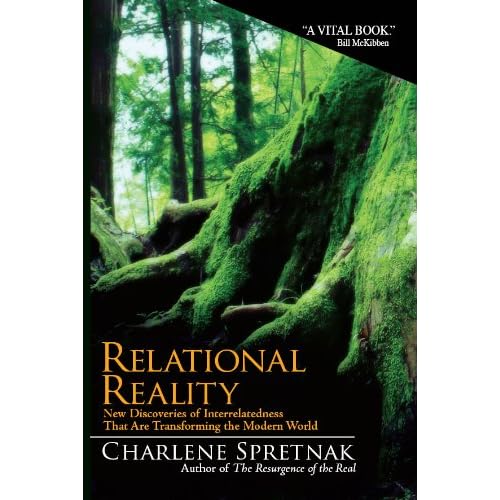
Charlene Spretnak - Relational Reality: New Discoveries of Interrelatedness that Are Transforming the Modern World


Back in November (2012), Michel Bauwens (at the P2P Foundation blog) posted a review of Charlene Spretnak's 2011 book, Relational Reality: New Discoveries of Interrelatedness That Are Transforming the Modern World. I have been meaning to share this ever since the original post, and finally, almost 4 months later, here it is.

This looks to be an interesting book.


photo of Michel Bauwens
Michel Bauwens
3rd November 2012

Spretnak, C. Relational Reality: New discoveries of Interrelatedness That Are Transforming the Modern World. Topsham: Green Horizon Books, 2011

What is the book about?

1. “Ms. Spretnak’s eighth book, Relational Reality: New Discoveries of Interrelatedness That Are Transforming the Modern World was published in 2011. Noting that our hypermodern societies, currently possess only a kindergarten understanding of the deeply relational nature of reality, she illuminates the coherence of numerous recent discoveries that are moving the relational worldview from the margins into the mainstream. The central realization, with myriad manifestations, is that all entities in this world, including humans, are thoroughly relational beings of great complexity who are both composed of and nested within contextual networks of creative, dynamic interrelationships. Nothing exists outside of those relationships. She presents newly created relational approaches that are already transforming the way we educate our children, attend to our health, green our communities, and rethink economic activity. New analysis of the crises of modernity and bountiful new solutions are the result.”

2. “Relational Reality reveals the coherence among numerous surprising discoveries of the interrelated nature of reality. These discoveries have resulted in a new perspective that has been emerging gradually for the past several decades but has gained momentum and is now transforming every mainstream field of human endeavor. All our basic assumptions (built on the old idea that everything in the physical world is essentially separate and functions mechanistically) are being reconsidered. No longer a marginal perspective, the Relational Shift is based on the realization that all entities in this world, including humans, are thoroughly relational beings of great complexity who are both composed of and nested within networks of creative, dynamic interrelationships. Nothing exists outside of those relationships. As we try to grasp the interrelated nature of reality, emergent relational approaches are already transforming the way we educate our children, attend to our health, green our communities, and rethink economic activity. New analyses of the crises of modernity and abundant new solutions are the result.”

Here are some excerpts, by Charlene Spretnak:

“Our hypermodern societies currently possess only a kindergarten-level understanding of the deeply relational nature of reality. It may seem unlikely that such advanced cultures could have missed “the way the world works,” but it was simply a matter of habit. Our cultural tendency has been to perceive the physical worlds as an aggregate of separate entities. We noticed some relationships between and among things, of course, but those seemed of marginal significance compared to what things are made of and how they function. The failure to notice that reality is inherently dynamic and interrelated at all levels – including substance and functioning – has caused a vast range of suffering: our medical system designed treatments as if our bodies were biomachines with independently functioning parts; our education systems regarded students as essentially isolate units into which learning can be implanted; our psychologists authoritatively conveyed to patients the Freudian notion that separating from core family relationships is the key to healthy maturation; and our workplaces and dwellings were designed with no inkling of the relationship between human health and natural light. Moreover, our communities have become fragmented and alienating, as the focus of modern life has largely contracted to the sphere of the Individual Consumer, a disintegration that has not been countered by support for the social fabric. Even more tragically, the entire planet is now imperilled by climate destabilization and ecological degradation, resulting from the modern assumption that highly advanced societies could throw toxic substances “away” somewhere and could exude staggeringly unnatural levels of carbon dioxide and other greenhouse gases into our atmosphere without ill effect… ” (Spretnak, C. Relational Reality: New discoveries of Interrelatedness That Are Transforming the Modern World; Topsham: Green Horizon Books p. 1-2)

The relational shift and the effect on our children

“Of all the areas being revitalized by the Relational Shift, the education of our children may well be the most poignant. While the relational perspective is, as yet, more influential in the academic disciplines at universities than it is in elementary and secondary schools, this is a moment of tremendous potential for reshaping the educational experience of young children starting out on their journey from kindergarten to high school graduation – and beyond. For the first time in the modern era, they are increasingly likely to be taught not the misleading mechanistic worldview but, rather, a coherent presentation of the relational nature of reality, a study of the fundamental relationships of the physical world and the cultures of the human family.

An organic progression would begin for very young children with a focus on the internal relationships that allow their own bodies to work so well (that is, a version for 5- and 6-year olds of the recent discoveries in relational physiology that reveal how creative and smart our internal bodymind relationships are).

This would lead to a focus on the relationships between their bodies and the sun, the weather, and water and subsequently to relationships between oxygen and breathing, between sunlight and photosynthesis for plants, between bees and pollination, and between juveniles and their parents in all animal and human families. From the early years of elementary education the children would enter into an understanding that the various areas of study are specific ways of grasping the relationships that constitute the world. They would learn about relationships among numbers (arithmetic); relationships among letters and words (reading, writing, and storytelling); relationships among the sun, the Earth, the moon, and the other planets (science); relationships among people who constitute a culture (social studies), and so on.

As the children mature, through high school, their understanding of the dynamic, creative relationships that constitute life becomes increasingly advanced, in areas such as literature, mathematics, science, history, art, music, social studies and political science (what used to be called civics). These would no longer be viewed as isolated fields, from which students readily disengage. They would comprise ways for students to grasp the relationships in which they themselves exist. In each area, understanding one level of relational analysis opens students’ eyes to the presence of further levels and developments.

Surely the shaping of a child’s consciousness would be enhanced by learning from the very beginning that she or he exists as an inherent part of more richly complex relationships – physical and mental, organic and cultural, creative and open-ended – than anyone could ever map. Along the way, children would also be taught the relational keys to happiness, resilience, responsibility, and what Edith Cobb called “compassionate intelligence.” By that Cobb meant a “generous worldview and process of understanding” involving a sense of relational identity that transcends a narrow focus on the self and that benefits from “humility as the creative tool.” She observed that a child’s development is ‘regulated by the meanings of nature imparted to him by the culture of his particular period in history.”

In modern Western culture she noted that a very young child “perceives preverbally the logic of relationships that are overlooked in later, more formally fixed and intellectualized systems of knowledge.” Cobb made that observation long before the relational critique of modernity illuminated the problem: the relational aspect of reality is not simply “overlooked” but brusquely shoved aside by the inculcation of a mechanistic worldview into the minds of children once they enter modern schooling.

The exciting potential in K-12 education today is not only that we might finally get it right in terms of accurately bringing our mechanistic knowledge systems up to date with the myriad recent discoveries in science about the deeply relational nature of the physical world. The relational orientation, in fact, contains all the best of several recently proposed educational reforms, including a focus on getting our children more interested in math and science so they will not be shut out of 21st-century jobs – but this overarching approach offers much more.

For our children to come of age securely situated in the understanding of organic and cultural interconnectedness might, just might, rescue them from the contagion of narcissism, aimlessness, and alienation that plagues so many of our young adults. It might well give them back their birth right as human organisms fully engaged with the embodied, embedded, organic interconnections needed to be healthy and to thrive, no longer isolate units of “coolness” and consumption but linked in their very cells with the dynamics of the entire Earth community.”

Andre Ling has the following critique, i.e. “Objects are Real”:

‘I must admit I get a bit frustrated by statements like ‘everything is interconnected’ or, more specifically this: ” the realization that all entities in this world, including humans, are thoroughly relational beings of great complexity who are both composed of and nested within networks of creative, dynamic interrelationships. Nothing exists outside of those relationships.” There has been a vibrant ongoing philosophical debate online about the relational vs. object-oriented approaches to philosophy. The relationalists believe that all entities can be reduced to their relationships. Reality is then a giant tangle of relations and entities are entangled clusters of these relations; the points where multiple relations converge into a dense nucleus. Key philosophical influences here include Deleuze (used by both camps), Whitehead and William James and some leading lights here are Brian Massumi and Erin Manning. Those in the object-oriented camp insist that objects cannot be reduced to their relations to other objects. Rather it is objects that enter into relationships with each other. There is a consensus in both camps in the understanding of reality as ecological (prompting Stengers, for example, to propose the term ‘ecosophy’ as an alternative to philosophy) but the critical gap is in the autonomous, irreducible status the object-oriented philosophers give to objects (which include both physical objects and ideas). If objects can enter into and exit various relationships without themselves undergoing change then surely they cannot be reduced to those relationships. Objects also enjoy a certain degree autonomy from their parts: if you cut off my leg I am still me. Furthermore, objects are understood to have withdrawn powers/capacities, which is precisely what enables them to introduce novelty, to be available to different kinds of uses and, indeed, what makes any kind of change possible at all: if all entities were already fully deployed as bundles of entirely external relationships, the universe would resemble a grid-lock with no possibility of change/movement. OOO-ers hold that it is the inner reality of objects – the fact that they are never fully deployed or expressed through their relationships with other entities, that opens up possibilities for change, movement and novelty. Furthermore, a fully relational ontology is most probably also necessarily one that depends on what OOO-ers call ontotheology: the belief that everything, ultimately, can be reduced to one, the source, the ground of being, God – a kind of singular universal relational web, with everything else (entities) being a kind of transitory or surface appearance/expression of that underlying reality. OO philosophy challenges this kind of thinking which is often a source of heated debate amongst both camps. OOO holds that there is no fundamental ground of being; there are just myriad kinds of objects, a kind of epic list of things that populate the cosmos, entering into and exiting their relationships with each other, being created, being destroyed, transforming and being transformed by each other. This in no way means that the relationships are not important, or even a central question (which is why I am so obsessed with Stengers’ ideas of ‘ecology of practices’, ‘ecosophy’ and ‘cosmopolitics’) and matter of concern for us in the contemporary period. The hegemonic patterns of relationships that have been established amongst the myriad entities that populate our world can be characterised as structural injustices, as capitalism, as a direct threat to continued human survival. Our practices, our world-views, our institutions, the way we relate to each other and the other entities around us are sick. However, to write-off entities as mere epiphenomena, secondary to relationships, with no autonomy (ontological, physical or otherwise) of their own, seems to be a bit of a case of throwing the baby out with the bathwater.”