Showing posts with label theater. Show all posts

Wednesday, November 13, 2013

The Black Rider: A Theatrical Production by Tom Waits, William S. Burroughs & Robert Wilson (1990)


Awesome! Open Culture rocks.

I have had the soundtrack to this production (or at least an edited version of it) since I was in college the first time. It's great to see the video of the production. The Black Rider has been a relatively unknown entity outside of the small by loyal following of Tom Waits and William Bourroughs.
The Black Rider: The Casting of the Magic Bullets is a self-billed "musical fable" in the avant-garde tradition created through the collaboration of theatre director Robert Wilson, musician Tom Waits, and writer William S. Burroughs. Wilson was largely responsible for the design and direction. Burroughs wrote the book, while Waits wrote the music and most of the lyrics. The project began in about 1988 when Wilson approached Waits. The story is based on a German folktale called Der Freischütz, which had previously been made into an opera by Carl Maria von Weber. It premiered at Hamburg's Thalia Theatre on 31 March 1990. November Theatre produced its world English-language premiere in 1998 at the Edmonton International Fringe Festival in Canada, and the American English-language premiere at the New York International Fringe Festival in 1999. Det Norske Teatret in Oslo staged a Norwegian (Nynorsk) version in 1998, with Lasse Kolsrud as Pegleg.[1] Only the dialogue was translated, the songs were performed in English.

Waits recorded much of the music from the play in different arrangements under the eponymous title, The Black Rider.
Enjoy!

The Black Rider: A Theatrical Production by Tom Waits, William S. Burroughs & Robert Wilson (1990)


November 13th, 2013


Yes, you read correctly: there exists a piece of theater whose production brought together three of the most ardently-followed, iconoclastic creators of recent decades. First staged in 1990 at Hamburg’s Thalia Theater, The Black Rider: The Casting of the Magic Bullets appeared as the fruit of multidisciplinary labor from renowned avant-garde director Robert Wilson, best known for extra-long-form productions like Einstein on the Beach, created with Philip Glass; raggedly American singer-songwriter Tom Waits, a musician with no small theatrical bent himself; and William S. Burroughs, writer of Naked Lunch, Junkie, and other texts that have blown away generations of counterculturally inclined reading minds. They based their tale of a hapless young file clerk in love and his fateful pact with the devil on the German folktale-cum-opera Der Freischütz. Hence the work’s premiere in Germany, and the German dialogue in the television version of the full production above.


But worry not, non-Germanophones; the Waits-composed songs remain in English, and as with anything directed by Wilson, you buy the ticket as much to a striking pure visual experience as to anything else. You can hear and see more from Waits and Wilson about what went into The Black Rider in the half-hour TV documentary just above. (The narrator may speak German, but everyone else involved speaks English.) For a pure musical experience of The Black Rider, pull up Waits’ eponymous album, released in 1993. (See also the bootleg The Black Rider Outtakes.) And now, with twenty years’ distance from The Black Rider’s American debut, maybe we can put the question to ourselves of whether it counts as a streak of poor taste or a stroke of artistic genius to have Burroughs, of all people, pen his own version of a story that — spoiler alert — ends with the protagonist fated to shoot his own bride.

Related Content:

~ Colin Marshall hosts and produces Notebook on Cities and Culture and writes essays on literature, film, cities, Asia, and aesthetics. He’s at work on a book about Los Angeles, A Los Angeles Primer. Follow him on Twitter at @colinmarshall.

Friday, November 30, 2012

Peter Meineck - Cognitive Science and Ancient Greek Drama


From Stanford University, this is a very interesting lecture by Peter Meineck on how cognitive science can enhance or shape our understanding of Greek drama. This is the autumn quarter 2012 Lorenz Eitner Lecture on Classical Art and Culture sponsored by the Classics Department.

Cognitive Science and Ancient Greek Drama

(November 8, 2012) In this illustrated talk incorporating live demonstrations, Peter Meineck will suggest a new method for approaching ancient drama using research drawn from the cognitive sciences. Can neuroscientific studies and modern cognitive theories be applied to the ancient Athenian brain? Can recent advances from the affective sciences offer us an array of new tools for better understanding the experience of ancient performance? This talk will suggest that the dramatic mask operating in a multisensory dynamic environment provided a deeply personal emotional anchor to music, narrative and movement of ancient drama and that new research in face recognition, neuroaesthetics, eye-tracking, human proprioception, and sensory processing can indeed illuminate important aspects of the ancient world. 
This is the autumn quarter 2012 Lorenz Eitner Lecture on Classical Art and Culture sponsored by the Classics Department. 
Dr. Peter Meineck is Clinical Associate Professor of Classics at New York University, Honorary Professor of Classics at the University of Nottingham and Founder on Aquila Theatre (www.aquilatheatre.com). He has published several translations of ancient plays with Hackett and is currently completing a new book on cognitive science and Greek drama. He has directed and produced over 60 professional theatre productions and written several stage adaptations of classical works from Homer to Rostand.

Saturday, October 27, 2012

Shrink Rap Radio #323 – Aikido, Empathy, and Neurodiversity with Sensei Nick Walker, M.A.

Very cool discussion.

[NOTE: As of 11 am this morning, Oct. 27, Shrink Rap Radio seems to be offline - hopefully they will resolve whatever issues they are having soon.]

[UPDATE: 6:30 pm and it seems to be working again.]

Nick Walker, the subject of this interview with Dr. Van Nuys, is part of Antero Alli's Paratheatrical Research spiritual exploration and performance group - a medium "that combines techniques of physical theater, voice, and meditation to access and express the internal landscape in non-performance labs and various types of  performance vehicles." I spoke with Alli a few times when he lived in Seattle and was publishing a little poetry and spirituality newspaper called Talking Raven (191-1995) - interesting human being.

The videos mentioned below are available through the Paratheatrical Research site linked to above.


Shrink Rap Radio #323 – Aikido, Empathy, and Neurodiversity with Sensei Nick Walker, M.A.

Dr. David Van Nuys
Posted on October 26, 2012


Nick Walker received his M.A. in Somatic Psychology from California Institute of Integral Studies, where he now teaches in the undergraduate Interdisciplinary Studies program. He holds the rank of 6th Dan (6th degree black belt) in aikido, and has taught the art of aikido to adults, teens, and children for over 30 years. He is founder and senior instructor of the Aikido Shusekai dojo in Berkeley, California. Since 1996, he has been a core member of the experimental physical theatre group Paratheatrical Research. Some of his work with Paratheatrical Research is chronicled in director Antero Alli’s documentary films Crux (1999), Orphans of Delirium (2004), and Dreambody/Earthbody (2012). He is a dedicated autism rights activist, and has been deeply involved with the Neurodiversity Movement for over a decade. He is a teacher, trainer, speaker, and consultant on a wide range of topics, including somatics, embodiment, autism, neurodiversity, conflict transformation, creativity, and transformative learning.

A psychology podcast by David Van Nuys, Ph.D.
copyright 2012: David Van Nuys, Ph.D.


Check out the following Psychology CE Courses based on listening to Shrink Rap Radio interviews:


Thursday, October 11, 2012

Samuel Beckett Directs His Masterpiece, "Waiting for Godot" (1985)


Via Open Culture, Samuel Beckett directed this 1985 version of his classic absurdist play, Waiting for Godot, which is probably my favorite play of all time. It's great the see how the author envisioned the production of his own play, especially in light of his frequent sense that other directors were misunderstanding the text.

Samuel Beckett Directs His Absurdist Play Waiting for Godot (1985)

October 10th, 2012


Samuel Beckett’s absurdist play, Waiting for Godot, premiered in Paris in 1953, at the Théâtre de Babylone, under the direction of French actor, Roger Blin. Many other directors staged the play in the years to come, each time interpreting it in their own way. All the while, Beckett complained that the play was being subjected to “endless misunderstanding.” However, when an actor, Peter Woodthrope, once asked him to explain what Godot is all about, Beckett answered quixotically: “It’s all symbiosis, Peter; it’s symbiosis.” Thanks for the clarification, Sam.

Beckett never gave a clear explanation. But perhaps he offered up something better. In 1985, Beckett directed three of his plays — Waiting for Godot, Krapp’s Last Tape and Endgame — as part of a production called “Beckett Directs Beckett.” The plays performed by the San Quentin Players toured Europe and Asia with much fanfare, and with Beckett exerting directorial control. Act 1 of Waiting for Godot appears above; Act 2 below. And do keep this in mind. Beckett paces things slowly. So you won’t hear your first sound until the 2:00 mark.

Find the text of Waiting for Godot in our collection of Free eBooks.


Saturday, April 14, 2012

Open Culture - Celebrate Samuel Beckett’s Birthday with Waiting For Godot (the Film)


Yesterday was the 106th anniversary of the birth of Samuel Beckett, one of my favorite novelists and certainly my favorite playwright. During my first year after grad school (the first time) I read everything by Beckett that I could get my hands on - for a while I tried to write plays, but I realized I was just trying to write Beckett for the late 20th century.


Celebrate Samuel Beckett’s Birthday with Waiting For Godot (the Film)

Samuel Beckett's pared-down prose and plays are among the greatest achievements of late modernism.

At a young man Beckett moved to Paris, where he befriended another Irish exile, James Joyce. As a writer, Beckett realized early on that he would never match Joyce’s “epic, heroic” achievement. Where Joyce was a synthesizer, Beckett once said, he was an analyzer. “I realized that my own way was impoverishment,” he said, “in lack of knowledge and in taking away, subtracting rather than adding.”

To celebrate Beckett’s birthday we bring you a pair of videos, including an excellent 2001 film version (above) of the most famous of his enigmatic creations, Waiting for Godot. It’s the centerpiece of Beckett on Film, a series of adaptions of all 19 of Beckett’s plays, organized by Michael Colgan, artistic director of the Gate Theatre in Dublin. The film features Barry McGovern as Vladimir, Johnny Murphy as Estragon, Alan Stanford as Pozzo and Stephen Brennan as Lucky. It was directed by Michael Lindsay-Hogg, who describes Waiting for Godot as being “like Mozart–too easy for children, too difficult for adults.” He goes on:
The play is what it is about. Samuel Beckett would have said it’s about two men waiting on the side of the road for someone to turn up. But you can invest in the importance of who is going to turn up. Is it a local farmer? Is it God? Or is it simply someone who doesn’t show up? The important thing is the ambiguity–the fact that it doesn’t really state what it is. That’s why it’s so great for the audience to be part of–they fill in a lot of the blanks. It works in their imaginations.
You can order the 19-film boxed set of Beckett on Film here, and read the full text of Waiting for Godot while listening to a CBC audio recording of the play, read by the Stratford Festival Players, starting here.

For fans of Harold Pinter, there is also a film clip of him talking about his first meeting with Beckett, his mentor and friend.

Monday, November 03, 2008

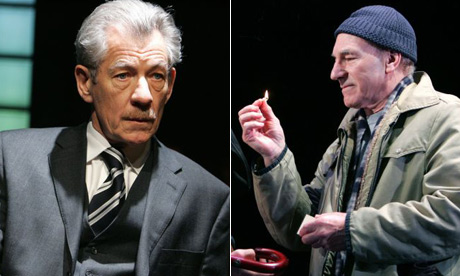
Ian McKellen and Patrick Stewart to Boldly Godot

Damn I wish I could see this! One of my favorite plays and two of my favorite actors.

Ian McKellen and Patrick Stewart to boldly Godot

Ian McKellen in The Cut and Patrick Stewart in A Life in the Theatre

Ian McKellen in The Cut and Patrick Stewart in A Life in the Theatre. Photograph: Tristram Kenton

Rumours have been circulating on the internet for some time, but it has been confirmed today that Godot will be turning up in British theatres next year, courtesy of Ian McKellen and Patrick Stewart.

The two venerable stage actors, still most widely know for their film and TV work - separately, and together in the X-Men films - will be taking a new production of Samuel Beckett's Waiting for Godot on a short regional tour in the new year, before opening for a longer run at the Theatre Royal Haymarket in London's West End.

During their initial discussions with director Sean Mathias, McKellen and Stewart toyed with the idea of sharing the two lead roles, swapping characters on alternate nights. But it has now been settled that McKellen will play Estragon, the earthier half of existentialism's odd couple, while Stewart will play the dreamier of Beckett's famous tramps, Vladimir.

McKellen said: "When the National Theatre of Great Britain announced in its close-of-millennium poll that Waiting for Godot was the most significant English language play of the 20th century I agreed. After all, I was one of the voters. I first saw it when I was a student 50 years ago and the play was on tour through Manchester after it's tumultuous West End run, baffling, infuriating and astounding by turns."

The dates for the production are:

March 5-14 2009 Malvern Theatres
March 16-21 Milton Keynes
March 23-28 Brighton Theatre Royal
March 30-April 4 Bath Theatre Royal
April 6-11 Norwich Theatre Royal
April 13-18 Edinburgh Kings Theatre
April 20-25 Newcastle Theatre Royal
From 30 April (currently booking until June) Theatre Royal, Haymarket, London


Thursday, June 12, 2008

TED Talk - Julie Taymor: Theater and the Imagination

A great TED Talk on the artist and the need to respect the imagination of the audience. The Lion King is one of the most successful Broadway plays of all time.

She talks, in the beginning of the lecture, about an initiation ceremony she witnessed in Indonesia, which seem to me a living example of the origins of theater in ritual.

Here is a brief piece on the origins of Western Theater:
The earliest days of western theatre remain obscure, but the oldest surviving plays come from ancient Greece. Most philologists agree that Greek theatre evolved from staged religious choral performances, during celebrations to Dionysus the Greek God of wine and ecstasy (Dithyrambos). There are, however, findings suggesting the possible existence of theatre-like performances much earlier, such as the famous "Blind Steps" of the Minoan Palace at Knossos: a broad stone stairway descending to a flat stone courtyard that leads nowhere - an arrangement strongly suggesting that the courtyard was used for a staged spectacle and the stairway was in fact used as seating.
And here is some biography on Julie Taymor:
Director/designer Julie Taymor talks about her boundary-shattering theater work -- such as turning The Lion King into an astonishing live musical. The key? Always respect, and rely on, the audience's imagination.

Working in musicals, Shakespeare, film and opera, Julie Taymor is a wildly imaginative and provocative director and designer. She is perhaps best known for having translated the film The Lion King to Broadway, a still-running show for which she also designed costumes, masks and puppets, wrote music and lyrics -- and won two Tony Awards. (She is the first woman to win a Tony for directing a musical.) She's also received MacArthur and Guggenheim fellowships, as well as two Obies, an Emmy and an Oscar.

Her recent stage work has focused on opera, with a production of Mozart's The Magic Flute in New York in 2005, and Grendel, which she co-wrote, in Los Angeles and New York in 2006. Meanwhile, she has developed a fascinating career in the movies. Her most recent film is 2007's Across the Universe, a romp through the music of the Beatles. Add this to 1999's Titus, a visually remarkable adaptation of Shakespeare's Titus Andronicus, and the glorious Frida, a 2002 film about Frida Kahlo. Taymor is now working on a Broadway musical in collaboration with Bono based on Marvel Studios' Spider-Man.