Showing posts with label stars. Show all posts

Saturday, April 12, 2014

Scientists Detect A Particle That Could Be A New Form Of Matter (the Tetraquark)


This was posted on io9 this morning, and it comes originally from Universe Today. Researchers at the
Large Hadron Collider have discovered a new particle that may be the theoretical tetraquark, and its discovery would mean that of a new form of matter. It also the raises a lot of new possibilities, including the "quark star," for both physics and cosmology.
"Very simply, the traditional model of a neutron star is that it is made of neutrons. Neutrons consist of three quarks (two down and one up), but it is generally thought that particle interactions within a neutron star are interactions between neutrons. With the existence of tetraquarks, it is possible for neutrons within the core to interact strongly enough to create tetraquarks. This could even lead to the production of pentaquarks and hexaquarks, or even that quarks could interact individually without being bound into color neutral particles. This would produce a hypothetical object known as a quark star."
Very cool stuff.

Scientists Detect A Particle That Could Be A New Form Of Matter


Brian Koberlein — Universe Today

Physicists working at the Large Hadron Collider have spotted a long sought-after exotic particle that's the strongest evidence yet for a new form of matter called a tetraquark. Here's what the discovery could mean to astrophysics.


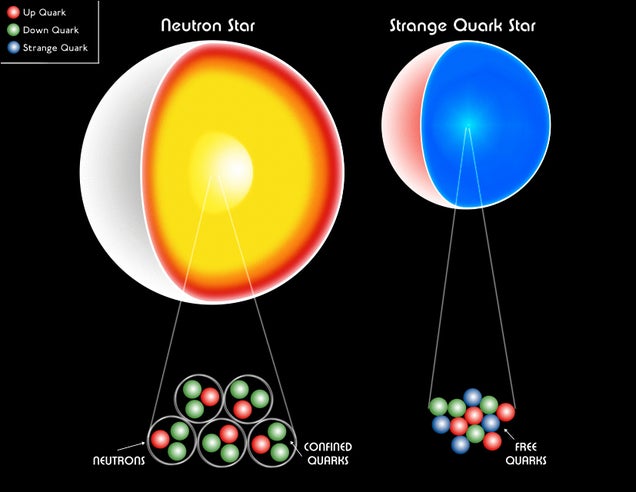
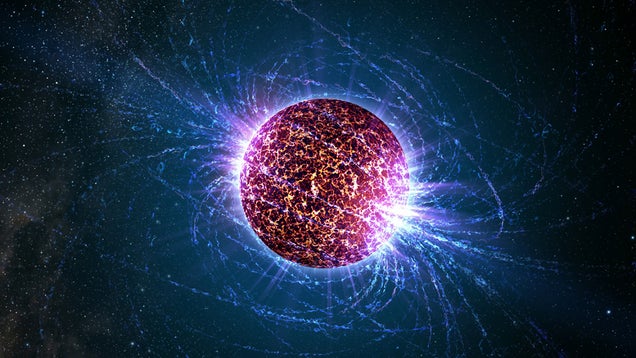
Above: A neutron star. Credit: Casey Reed/Penn State University.

You may have heard that CERN announced the discovery of a strange particle known as Z(4430). A paper summarizing the results has been published on the physics arxiv, which is a repository for preprint (not yet peer reviewed) physics papers.

The new particle is about four times more massive than a proton, has a negative charge, and appears to be a theoretical particle known as a tetraquark. The results are still young, but if this discovery holds up it could have implications for our understanding of neutron stars.

Image: Chandra.

A Horse Of A Different Color

The building blocks of matter are made of leptons (such as the electron and neutrinos) and quarks (which make up protons, neutrons, and other particles). Quarks are very different from other particles in that they have an electric charge that is 1/3 or 2/3 that of the electron and proton. They also possess a different kind of "charge" known as color. Just as electric charges interact through an electromagnetic force, color charges interact through the strong nuclear force. It is the color charge of quarks that works to hold the nuclei of atoms together. Color charge is much more complex than electric charge. With electric charge there is simply positive (+) and its opposite, negative (-). With color, there are three types (red, green, and blue) and their opposites (anti-red, anti-green, and anti-blue).

Because of the way the strong force works, we can never observe a free quark. The strong force requires that quarks always group together to form a particle that is color neutral. For example, a proton consists of three quarks (two up and one down), where each quark is a different color. With visible light, adding red, green and blue light gives you white light, which is colorless. In the same way, combining a red, green and blue quark gives you a particle which is color neutral. This similarity to the color properties of light is why quark charge is named after colors.
The Tetraquark

Combining a quark of each color into groups of three is one way to create a color neutral particle, and these are known as baryons. Protons and neutrons are the most common baryons. Another way to combine quarks is to pair a quark of a particular color with a quark of its anti-color. For example, a green quark and an anti-green quark could combine to form a color neutral particle. These two-quark particles are known as mesons, and were first discovered in 1947. For example, the positively charged pion consists of an up quark and an antiparticle down quark.

Under the rules of the strong force, there are other ways quarks could combine to form a neutral particle. One of these, the tetraquark, combines four quarks, where two particles have a particular color and the other two have the corresponding anti-colors. Others, such as the pentaquark (3 colors + a color anti-color pair) and the hexaquark (3 colors + 3 anti-colors) have been proposed. But so far all of these have been hypothetical. While such particles would be color neutral, it is also possible that they aren't stable and would simply decay into baryons and mesons.

The Quark Star

There has been some experimental hints of tetraquarks, but this latest result is the strongest evidence of four quarks forming a color neutral particle. This means that quarks can combine in much more complex ways than we originally expected, and this has implications for the internal structure of neutron stars.

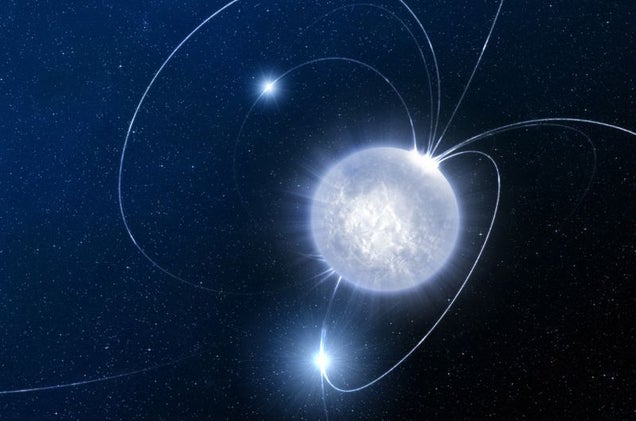
ESO/Luís Calçada.

Very simply, the traditional model of a neutron star is that it is made of neutrons. Neutrons consist of three quarks (two down and one up), but it is generally thought that particle interactions within a neutron star are interactions between neutrons. With the existence of tetraquarks, it is possible for neutrons within the core to interact strongly enough to create tetraquarks. This could even lead to the production of pentaquarks and hexaquarks, or even that quarks could interact individually without being bound into color neutral particles. This would produce a hypothetical object known as a quark star.

This is all hypothetical at this point, but verified evidence of tetraquarks will force astrophysicists to reexamine some the assumptions we have about the interiors of neutron stars.

This article originally appeared at Universe Today.
Monday, March 10, 2014

Daniel Wolf Savin - Before There Were Stars (via Nautilus)

This article from Nautilus Magazine offers some insight into the two unlikely heroes of the formation of the stars and planets that made our universe the way it is - dark matter and molecular hydrogen.


Before There Were Stars

The unlikely heroes that made starlight possible.

By Daniel Wolf Savin | Illustration by Jon Han | February 27, 2014

http://static.nautil.us/2665_e727fa59ddefcefb5d39501167623132.png

THE UNIVERSE is the grandest merger story that there is. Complete with mysterious origins, forces of light and darkness, and chemistry complex enough to make the chemical conglomerate BASF blush, the trip from the first moments after the Big Bang to the formation of the first stars is a story of coming together at length scales spanning many orders of magnitude. To piece together this story, scientists have turned to the skies, but also to the laboratory to simulate some of the most extreme environments in the history our universe. The resulting narrative is full of surprises. Not least among these, is how nearly it didn’t happen—and wouldn’t have, without the roles played by some unlikely heroes. Two of the most important, at least when it comes to the formation of stars, which produced the heavier elements necessary for life to emerge, are a bit surprising: dark matter and molecular hydrogen. Details aside, here is their story.


Dark Matter


The Big Bang created matter through processes we still do not fully understand. Most of it—around 84 percent by mass—was a form of matter that does not interact with or emit light. Called dark matter, it appears to interact only gravitationally. The remaining 16 percent, dubbed baryonic or ordinary matter, makes up the everyday universe that we call home. Ordinary matter interacts not only gravitationally but also electromagnetically, by emitting and absorbing photons (sometimes called radiation by the cognoscenti and known as light in the vernacular).

As the universe expanded and cooled, some of the energy from the Big Bang converted into ordinary matter: electrons, neutrons, and protons (the latter are equivalent to ionized hydrogen atoms). Today, protons and neutrons comfortably rest together in the nuclei of atoms. But in the seconds after the Big Bang, any protons and neutrons that fused to form heavier atomic nuclei were rapidly blown apart by high-energy photons called gamma rays. The residual thermal radiation field of the Big Bang provided plenty of those. It was too hot to cook. But things got better a few seconds later, when the radiation temperature dropped to about a trillion degrees Kelvin—still quite a bit hotter than the 300 Kelvin room temperature to which we are accustomed, but a world of difference for matter in the early universe.

Heavier nuclei could now survive the gamma-ray bombardment. Primordial nucleosynthesis kicked in, enabling nuclear forces to bind protons and neutrons together, until the expansion of the universe made it too cold for these fusion reactions to continue. In these 20 minutes, the universe was populated with atoms. The resulting elemental composition of the universe weighed in at roughly 76 percent hydrogen, 24 percent helium, and trace amounts of lithium—all ionized, since it was too hot for electrons to stably orbit these nuclei. And that was it, until the first stars formed and began to forge all the other elements of the periodic table.

Before these stars could form, however, newly-formed hydrogen and helium atoms needed to gather together to make dense clouds. These clouds would have been produced when slightly denser regions of the universe gravitationally attracted matter from their surroundings. The question is, was the early universe clumpy enough for this to have happened?

To answer the question, we can look to the modern-day night sky. In it, we see a faint glow of microwave radiation that has an even fainter pattern in it. This so-called cosmic microwave background structure dates back to 377,000 years after the Big Bang, a mere fraction of the universe’s current age of 13.8 billion years, and analogous to less than a day in the 81-year life expectancy for a woman living today in the United States.

At that time, the universe had just cooled to about 3,000 Kelvin. Free electrons started to be captured into orbit around protons, forming neutral hydrogen atoms. Photons from the flash of the Big Bang, whose progress had been impeded by their scattering off of unbound electrons, could now finally stream throughout the cosmos, essentially free. These photons continue to permeate the universe today, at a frigid temperature of only 2.7 Kelvin, and constitute the cosmic microwave background that we have measured using an array of ground-based, balloon-born, and satellite telescopes.

These sky maps suggested something surprising: The intensity of the residual heat from the Big Bang made the early universe too smooth for gas clouds to form.

Enter dark matter. Because it does not interact directly with light, it was unaffected by the same radiation that smoothed out ordinary matter. Therefore it was left with a relatively high degree of clumpiness. It, rather than regular matter, initiated the formation of the stars and galaxies that make up the modern structure of the universe. Regions of space with an above-average density of dark matter gravitationally attracted matter from regions with lower densities. Halos of dark matter formed and merged with other halos, bringing ordinary matter along for the ride.


Molecular Hydrogen


Once the universe went neutral, gas began to form into clouds. As ordinary matter accelerated into the gravitational wells of dark matter, gravitational potential energy converted into kinetic energy, creating a hot gas of fast-moving particles with high kinetic energies embedded within halos of dark matter. Starting from temperatures around 1,000 Kelvin, these gas clouds eventually gave birth to the first stars when the universe was roughly half a billion years old (about four years into the lifespan of the typical U.S. woman).

For a star to form, a gas cloud needs to reach a certain density; but if its constituent molecules are too hot, zipping around in every direction, this density may be unreachable. The first step toward making star-forming clouds was for gas atoms to slow down by radiating their kinetic energy out of the cloud and into the larger universe, which by this time had cooled to below 100 Kelvin.

But they can’t cool themselves: As atoms collide like billiard balls, they exchange kinetic energy. But the total kinetic energy of the gas remains unchanged. They needed a catalyst to cool off.

This catalyst was molecular hydrogen (two hydrogen atoms bound together by sharing their electrons). Hot particles colliding with this dumbbell-shaped molecule transferred some of their own energy to the molecule, causing it to rotate. Eventually these excited hydrogen molecules would relax back to their lowest-energy (or ground) state by emitting a photon that escaped from the cloud, carrying the energy out into the universe.

To make molecular hydrogen, the atomic gas clouds needed to do some chemistry. It might be surprising to hear that any chemistry was going on at all, given that the entire universe had just three elements. The most sophisticated chemical models of early gas clouds, however, include nearly 500 possible reactions. Fortunately, to understand molecular hydrogen formation, we need concern ourselves with only two key processes.

Chemists have named the first reaction associative detachment, a name fit for a psychiatric condition out of the DSM-V for which a clinician might prescribe some primordial lithium. Initially, most of the hydrogen in a gas cloud was in neutral atomic form, with the positive charge of a single proton cancelled out by the negative charge of a single orbiting electron. However, a small fraction of its atoms captured two electrons, creating a negatively charged hydrogen ion. These neutral hydrogen atoms and charged hydrogen ions “associated” with each other, causing the extra electron to detach and leaving behind neutral molecular hydrogen. In chemical notation, this can be represented as H + H- → H2 + e-. Associative detachment converted only about 0.01 percent of atomic hydrogen to molecules, but that small fraction allowed the clouds to begin to cool and become denser.

When the cloud had become sufficiently cool and dense, a second chemical reaction began. It is called three-body association, and written as H + H + H → H2 + H. This ménage-à-trois begins with three separate hydrogen atoms, and ends with two of them coupled and the third one left out in the cold. Three-body association converted essentially all of the cloud’s remaining atomic hydrogen into molecular hydrogen. Once all of the hydrogen was fully molecular, the cloud cooled to the point where its gas could condense enough to form a star.


Stars


From the formation of a dense cloud to the ignition of fusion at the heart of a star is a process whose complexity far exceeds what came before it. In fact, even the most sophisticated computer simulations available have yet to reach the point where the object becomes stellar in size, and fusion begins. Simulating most of the 200-million-year process is relatively easy, requiring only about 12 hours using high speed, parallel processing computer power. The problem lies in the final 10,000 years. As the density of the gas goes up, the structure of the cloud changes more and more rapidly. So, whereas for early times one needs only to calculate how the cloud changes every 100,000 years or so, for the final 10,000 years one must calculate the change every few days. This dramatic increase in the required number of calculation translates into more than a year of non-stop computer time on today’s fastest machines. Running simulations for the full range of possible starting conditions in these primordial clouds exceeds what can be achieved in a human lifetime. As a result, we still do not know the mass distribution for the first generation of stars. Since the mass of a star determines what elements it forges in its core, this hinders our ability to follow the pathway by which the universe began to synthesize the elements needed for life. Those of us who cannot wait to know the answer are counting on yet another hero: Moore’s Law.


~ Daniel Wolf Savin is a contrabass-playing astrophysicist at Columbia University

Tuesday, April 23, 2013

How to Build a Multiverse

From The Economist, a little lesson on "table-top astrophysics." Physicists are not able to bring black holes or white dwarfs to their labs, so they are recreating them at the molecular level to advance our knowledge of these phenomena.

How to build a multiverse


Small models of cosmic phenomena are shedding light on the real thing


Mar 16th 2013  |  From the Edition


THE heavens do not lend themselves to poking and prodding. Astronomers therefore have no choice but to rely on whatever data the cosmos deigns to throw at them. And they have learnt a lot this way. Thus you can even (see article) study chemistry in space that would be impossible in a laboratory. Some astronomers, though, are dissatisfied with being passive observers. Real scientists, they think, do experiments.

It is impossible—not to mention inadvisable—to get close enough to a star or a black hole to manipulate it experimentally. But some think it might be possible to make meaningful analogues of such things, and even of the universe itself, and experiment on those instead.

Ben Murdin of the University of Surrey, for example, has been making white dwarfs. A white dwarf is the stellar equivalent of a shrunken but feisty old-age pensioner. It has run out of fuel and is contracting and cooling as it heads towards oblivion—but taking its time about it. As they shrink white dwarfs pack a mass up to eight times the sun’s into a volume the size of Earth. A consequence of stuffing so much matter into so little space is that white dwarfs have powerful magnetic fields. Many aspects of a white dwarf’s mechanics, including how long it will last, are thought to depend on its magnetism. But it is hard to measure.

To make estimates, scientists examine the light a white dwarf emits for telltale patterns left by stellar ingredients like hydrogen. They then compare this spectrum with a theory, based on calculations from first principles, of how magnetic fields effect light emitted by hydrogen. The predictions agree with experiments up to the strongest fields mankind can muster—about 1,000 tesla, generated in a thermonuclear detonator. The problem is that the theory puts white dwarfs’ magnetic fields at 100,000 tesla or more, well beyond humanity’s reach.

Dr Murdin built his own little white dwarf to see if the theory looked good. It consists of a silicon crystal sprinkled with phosphorus atoms. A silicon atom has four electrons in its outer shell. In a crystal, all four are used to bind it to neighbouring atoms. Phosphorus has five outer electrons. Insert a phosphorus atom into the silicon lattice and you are left with an unused electron. Since phosphorus also has one more proton in its nucleus than silicon does, taken together the extra particles resemble a hydrogen atom: a single electron tethered to a single proton.

However, the extra electron is much less tightly held by the extra proton in this pseudo-hydrogen than it would be in real hydrogen. This weaker grasp means that it takes much less magnetism to make a given change in the pseudo-hydrogen’s spectrum than it would for real hydrogen. So when Dr Murdin placed the crystal in a 30-tesla magnet at Radboud University in the Netherlands (his lab in Guildford lacks the necessary kit), he was mimicking the conditions in a 100,000-tesla white dwarf. And the spectrum came out looking just the way the theory predicted.

A black hole in a bath…

Creating a star in a laboratory is small beer compared with creating a black hole. This is an object that is so massive and dense that not even light can flee its gravitational field. Looking inside one is therefore, by definition, impossible. All the more reason to try, says Silke Weinfurtner of the International School for Advanced Studies, in Trieste, Italy.

Dr Weinfurtner plans to make her black hole in the bath. The bath in question, properly called a flume, is a water-filled receptacle 3 metres by 1.5 metres and 50cm deep, across which carefully crafted trains of ripples can pass. In the middle of the tank is a plug hole. If the water going down the hole rotates faster than the ripples can propagate, the ripples which stray beyond the aqueous “event horizon” (a black hole’s point of no return) will not make it out. They are sucked down the drain.

Then the researchers will check whether the simulacrum affects water waves in a way analogous to that which general relativity predicts for light—itself a wave—approaching an astrophysical black hole. According to Albert Einstein’s theory, a region immediately outside the event horizon of a rotating black hole will be dragged round by the rotation. Any wave that enters this region but does not stray past the event horizon should be deflected and come out with more energy than it carried on the way in. To detect this super-radiant scattering, as the effect is called, Dr Weinfurtner will add fluorescent dye to the water and illuminate the surface waves with lasers. The waves, often no bigger than one millimetre, can then be detected using high-definition cameras.

Stefano Liberati, Dr Weinfurtner’s colleague in Trieste, reserves the greatest enthusiasm for another aspect of the experiment. It might, if the researchers are lucky enough, offer clues to the nature of space-time. Could the cosmic fabric be made up of discrete chunks, atoms of space if you like, rather than being continuous, as is assumed by relativity? This problem has perplexed physicists for decades. Many suspect black holes hold the answer, because they are sites where continuous relativity meets chunky quantum physics.

Waterborne holes serve as a proxy. Water is, after all, made up of just such discrete chunks: molecules of H₂O. As wavelengths fall—equivalent to rising energy—waves reach a point where the size of molecules may begin to influence how they behave. If Dr Weinfurtner and Dr Liberati observe some strange behaviour around their event horizons, theorists will be thrilled.

…and home-brewed universes

Even benchtop black holes, though, are nothing compared with the ambitions of Igor Smolyaninov of the University of Maryland. For Dr Smolyaninov wants to create entire universes.

The way light travels through the four dimensions of space-time is mathematically akin to how it moves through “metamaterial”. These are substances with features measured in nanometres, or billionths of a metre, which let them bend light in unusual ways. For example they can force light to skirt along the outside of an object, hiding it from view as if behind an invisibility cloak. Space-time, too, bends light, in ways that depend on how mass is distributed within it.

In principle, then, metamaterials ought to be able to mimic how light moves not just through the space-time scientists on Earth are familiar with, but also other possible space-times to which they do not, and never will, have access. Two years ago Dr Smolyaninov suggested an experiment with various metamaterials, corresponding to universes with different properties lashed together into a home-brewed multiverse. In a paper to be published inOptics Express, he and his colleagues report that they have succeeded.

Rather than fine-tune metamaterial to exact specifications, which is finicky and expensive, the researchers used nanoparticles of cobalt, which are relatively easy to get hold of, and suspended them in kerosene. They then applied a magnetic field which, thanks to cobalt’s ferromagnetic nature, arranged the particles into thin columns. In space-time terms the length of the columns is time and the two axes perpendicular to the length represent the three spatial dimensions in a real universe.

To build his multiverse, Dr Smolyaninov added slightly less cobalt to the kerosene, about 8% by volume, than was needed to maintain stable nanocolumns. Natural fluctuations in the density of the fluid then lead to the spontaneous erection of transient nanocolumns—equivalent to space-times popping up only to fizzle and re-emerge elsewhere in the multiverse. They could be detected by their effect on polarised light shone through the material.

Whether all this ingenuity unravels any cosmic truth is uncertain. Cliff Burgess, a theorist at Perimeter Institute for Theoretical Physics in Ontario, has his doubts. But he thinks that such experiments are nevertheless worth pursuing. “Like tap-dancing snakes,” he says, “the point is not that they do it well, it is that they do it at all.”

From the print edition: Science and technology

Thursday, November 29, 2012

Whatever Reality Is . . . Bookforum Omnivore

Another interesting collection of links form the god folks at Bookforum's Omnivore blog - on space, quantum physics, cosmology, the universe, and everything.