Showing posts with label social networking. Show all posts

Thursday, February 27, 2014

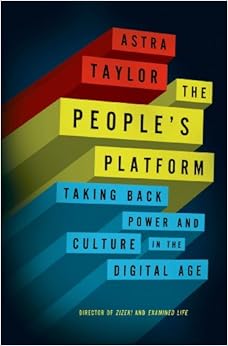
Astra Taylor - The People’s Platform: Taking Back Power and Culture in the Digital Age


Astra Taylor is the author of The People’s Platform: Taking Back Power and Culture in the Digital Age, which is due out in April, 2014. Unlike Nicholas G. Carr and Jaron Lanier, Taylor sees the internet as a platform for transformation, and maybe even taking back power from the elites. This is an interesting read from Full Stop.

TL;DR: Astra Taylor


by The Editors  |  Full Stop


For years, conversation about the changing ways we take in information has been characterized by polemics and a general sense of doom: Is Google making us stupid? Is Facebook making us narcissists? We keep trying to pinpoint what, exactly, is changing, because something surely is. But rather than strategize about how to wage war on distraction, or rebuild dissolved attention spans, Full Stop has decided to jump out of our poorly constructed lifeboat and wallow in the vast and undulating sea of information. With this questionnaire, we would like to explore, yes, how the internet is changing the ways in which we create, curate, and consume information (be it in the form of fiction, non-fiction, or criticism) but with an eye open for the pockets of potential in such changes.

Astra Taylor is a writer, political organizer, and documentary filmmaker whose works include Zizek! and Examined Life. Her book The People’s Platform: Taking Back Power and Culture in the Digital Age will be published in April.

Where does the most interesting (innovative in form and content) writing find its home right now?


I’m tempted to say books, if only to be a bit contrarian. If we are talking about writing for a wide public, not for small groups of friends or comrades, then I think books are it. There’s a lot of interesting ephemeral writing online, but much of it is intended for specific recipients (like the weird SnapChats I send my little sister from the road) and not broad audiences. The notes I used to pass to my classmates were innovative in a similar sense. I’m standing by books because they offer writers the space to dig in, to see if formal innovations and experiments can hold up, and provide the space for authors to take ideas to their limits. (I know space is unlimited online, but paradoxically the consensus is that stuff must be short and punchy to thrive; meanwhile, the constraints of the printed book actually focus reader attention and offer boundaries for writers to push against and subvert.)

There are other examples I could point to, but one genre that exists online, and which I don’t think really had a print counterpart, and that I gravitate toward and am excited about, is the type of informal academic commentary you see on scholars’ personal websites. This type of writing has probably come to life partly because the Internet frees the people who produce it from the rigmarole of academic publishing (impossibly slow scheduling, editing by committee, paywalls/obscurity, limited audiences). So you can read Corey Robin or Zeynep Tufekci or Tressie McMillan Cottom or Aaron Bady’s blogs. Related but different, there are articles like “Further Materials Toward a Theory of the Man-Child” in The New Inquiry, which is a fascinating example of a direction a similar kind of work can go. It was a sassy, entertaining, and ultimately extremely smart and spot on critique of Tiqqun’s Preliminary Materials for a Theory of the Young-Girl. I remember liking the magazine Lingua Franca for the brief flash I was aware of it before it folded, and there’s stuff that approximately fills that space but is more direct and edgier, and I’d like to see even more of it.

Today, we’re flooded with stories via the internet — on personal Tumblrs, Facebook and Twitter statuses, the abundance of magazines and newspapers that make their content free online. With so many narratives all around us, why do we still read (and pay for) novels?

I might be the wrong person to pose this question to, given the fact I don’t read many novels, at least compared to how much non-fiction I read. That said, I have read a few this last couple of months, but I’ve been making a concerted effort to do so. Instinctively I prefer non-fiction when it comes to both books and cinema, and I don’t understand those who hold up fiction as somehow a higher art form — though there are many novels I love deeply. In my opinion, non-fiction can do everything fiction can do formally and aesthetically (given a writer with the impulse and ability), while to me the fact non-fiction remains somehow bound and beholden to reality only makes it more powerful and potentially profound.

That said, I can at least share why I have been making a concerted effort to read more fiction. It had more to do with a kind of mental rigidity I felt coming on and that I wanted to shake off. Almost three years of intense critical writing working on my book and intensive political organizing (through the Occupy offshoot Strike Debt) had created some habits of mind and judgment. With the hope of opening up other avenues of experience and expression I’ve been trying to read more fiction, and I’ve been doing other things like playing music with friends. I’ve enjoyed these excursions, but my heart remains with non-fiction nevertheless.

What do you think is good about the way we interact with information today? How has your internet consumption changed your brain, and writing, for the better?

First the good: There’s a lot that’s positive and worth celebrating compared to the olden days of the nineties, when I had to go to the library to find stuff and I was too young and broke and ignorant to subscribe to any decent magazines (I remember this line cook at a vegetarian restaurant I worked at in Athens, GA reading a copy of The Nation and it being a revelation that such things existed, but it still didn’t occur to me to check out their website or subscribe so I didn’t see another issue for a few years). But this is the story we all know so well: Thanks to the Internet it’s never been easier to glean preliminary information about a given topic, whether through a simple search or following Wikipedia links, or finding experts or obsessives or articles on whatever subject has caught your fancy. The challenge is going deeper, beyond the first few pages of Google results and other obvious discoveries. That said, going deeper and having the discipline to do real research always required conscientious labor, so what’s new? You have to put in the time and be extra vigilant about resisting the bandwagon effect.

As a documentarian and sometimes journalist, I’m biased towards reportage and investigating things for myself, towards moving from information to first hand experience, and sometimes I feel it’s too easy to read a few op-eds or breeze through some links and feel like I have a subject covered. I’m still regularly surprised by topics I think I know a lot about when I go out and ask some questions. It usually turns out I don’t know nearly as much as I believed I did.

On how my brain has been changed, I’d say Internet consumption has had an effect, but how can one really know for sure? My attempts to seriously engage with information and to try my hand at writing coincided with the Internet becoming an ever stronger and more constant presence in my life, so it’s impossible to really separate the two. Over that time I’ve also grown up and become more knowledgeable and confidant in my work and my writing — my brain has become more capable in lots of ways, but as I mentioned earlier I fear a kind of sedimentation or rigidity that can come with age and figuring out one’s general perspective on things. I know what I think about something before I even know what the thing is I’m thinking about, if that makes sense. On that front, I’m not sure my information gathering habits do much to expand my conceptual horizons, and perhaps that’s a problem that has to do with the structure of our networked communications system — that’s a topic of lively debate. And like a lot of others, I wrestle with distraction and the feeling that it’s easier to ingest info-pellets than commit to sustained, deep reading and reflection. But I don’t blame the Internet for that problem, I blame myself — and the fact that so many of the platforms we use are engineered to be irresistible because that’s the path to profitability.

How does writing online become significant?

It depends on what you mean by significant. If you mean worthy of attention and admiration or that something is particularly relevant or insightful, then a lot of timeless advice applies. Advice about writing on difficult subjects, writing about things that matter even if they are unpopular, writing without dumbing things down or cutting corners, and just doing the work and putting in the time. This kind of significance applies to writing whether it is online or offline or both or whatever. But if you mean significant in the sense of having garnered attention, as in “that piece was really significant because it was read by tons of people” — which is what the “become” in “become significant” implies — then my answer is more ambivalent. There are lots of tricks to making things more shareable and infectious online (and, to be clear, many of them are tricks carried over from less than venerable print publications, so we can’t blame “the Internet” for inventing them). Of course those tricks have evolved, egged on by those in the virality business. There are click-baity traffic-ginning techniques, and there are the ways individuals fish for attention online (like picking fights — or starting “argumercials,” to use Caleb Crain’s apt neologism — or writing about already trending topics). What that means is that there’s plenty of good writing that is at a disadvantage in the current media ecosystem.

The more interesting and less cynical answer to your question would ponder how to make things that are significant in the first sense significant according to the second one. How do you help good writing reach the people? This can happen in various ways, but the first step is finding ways to support people to write serious or “significant” work to begin with — not easy to do given the realities of the marketplace, but necessary — and then, alongside that, to build communities that can help amplify worthwhile work, which is what many of the interesting small magazines (The Baffler, n+1, The New Inquiry, Jacobin) are doing, by engaging readers through all available means, whether by social media or by convening people away from their keyboards through events and conferences, et cetera. Building institutions and community are both key.

Information online is both supremely malleable and under unprecedented scrutiny. How has the Internet changed non-fiction writing?

It’s hard to generalize, and there are lots of contradictions. One can write about anything under the sun, but there always seems to be some scandal or outrage that everyone is piling on. One can toss something off in the blink of an eye, but it will remain posted forever, or at least the foreseeable future. On the one hand texts online are easily updatable and correctable compared to print, but there seems to be an endless stream of errors and falsehoods. What these examples point to is a pressure to be of the moment and relevant, to be “now” — certainly that pressure has always been felt by writers but it seems to have intensified.

How is quality writing on the internet facilitated? How is the role of an online editor different than that of an editor for print?

Quality takes many forms and can be found all over the place, from a long review in the LRB or the LARB to those hit-the-nail-on-the-head pithy Tweets that some people (not me) regularly come up with. Nonetheless, I still think a certain kind of quality writing, especially the kind that requires deep reportage, needs to be facilitated by institutions that can support writers (and editors too), by paying them to go out and report, supporting them financially and also legally so they can take risks and challenge powerful entities (all the cliches of what journalism can and must do, which I still believe in, at least in theory).

As a writer I just want an editor who edits smart and hard, whether they are editing for a website or for print. Look at something like TomDispatch, edited by the estimable Tom Englehardt. Everything he posts is fantastic and meticulously edited; he’s someone who honed his skills as an editor of books. He understands the logic of Internet publishing but doesn’t pander to it, or rather he caters to its better tendencies. As a result, the articles he releases have a surprisingly wide reach, especially given their challenging themes and how lengthy and dense they can be.

The internet makes possible new forms of collaboration and discussion. How has this changed the concept of authorship online?

It’s interesting how people often assert that digital technologies have challenged the notion of the author and authorship. There may be some truth to this claim, but it also seems to me the idea of authorship has metastasized in some ways. Now curators are authors of a sort, which I understand and am sympathetic to, but people also get credit (hat tips or vias or whatever) for unearthing or just posting links. I admit to finding it a bit strange when someone credits me for posting an article that is sitting on the Guardian’s homepage, and to having been surprised when I’ve seen folks upset at others for sharing “their content” without acknowledging them. I guess the answer is, I don’t know. Authorship is a fraught concept that emerged against the background of industrialization, and it’s evolving and mutating as digital capitalism comes into its own. Seeing ourselves as authors — even if it’s just in our curating of our personal news streams — seems to me crucial to the expansion of the whole social media bubble.

Anyway, there’s a lot of hype around writing collaboratively these days, and often it comes from individuals steeped in Silicon Valley rhetoric, so my skeptical instincts kick in. Still, on another level, I see the appeal of this idea, particularly when there is a clear political imperative. One project I played a small role in through Strike Debt is The Debt Resistors’ Operations Manual, which we self-published in late 2012, giving away over ten thousand printed copies and many more free PDFs. A new edition is coming out next month through Common Notions press. We are advocating for a collective solution to the current debt crisis, which is typically very isolating and demoralizing to people being crushed by housing, medical, or student debt; it made sense to try to write collectively given our ambition of inspiring a resistance movement. In my limited experience it is actually harder to write well collaboratively than it is to write alone (alone with the help of a talented editor, ideally). Not just in terms of sense making, but also putting your ego aside and allowing yourself to be edited or erased. It can be a healthy exercise and worth it creatively, should circumstances call for such an approach.
Friday, February 14, 2014

4 Ways to Make Your Brain Work Better - Chris Mooney at Mother Jones


Maria Konnikova is the author of Mastermind: How to Think Like Sherlock Holmes (2013) and her writing has appeared in The New Yorker, The Atlantic, The New York Times, Slate, The Paris Review, The Wall Street Journal, The New Republic, The Boston Globe, The Observer, Scientific American MIND, and Scientific American, among numerous other publications.

She is the guest for this episode of the Inquiring Minds Podcast with Chris Mooney and Indre Viskontas (via Mother Jones).

4 Ways to Make Your Brain Work Better

The New Yorker's Maria Konnikova explains the science behind why we need to sleep more, waste less time on the internet, and stop multitasking.


—By Chris Mooney
Friday, Feb. 7, 2014

michaeljung/Shutterstock

You're a busy person. Keeping up with your job, plus your life, has you constantly racing. It doesn't help that when working, you're distracted not only by your mobile devices, but also by your computer. You average 10 tabs open in your browser at any one time, and you compulsively click amongst them. One's your email, which never stops flowing in. At the end of the day, you sleep less than you know you should, but as you tell yourself, there's just never enough time.

If this is how you live, then Maria Konnikova has a simple message for you: Pause, step back, and recognize the actual costs of your habits. A psychology Ph.D. and popular writer for The New Yorker, Konnikova circles back, again and again, to a common theme: how we thwart our own happiness, and even sometimes harm our brains, in our quest for a simply unattainable level of productivity. "The way that we've evolved, the way our minds work, the way we work at our most optimal selves, is really not the way we have to operate today," Konnikova explained on this week's Inquiring Minds podcast. "I feel like I'm fighting a losing battle, but I hope that if there are enough voices out there, someone will finally hear that, 'Hey, this attempt at hyperproductivity is making us much less productive.'"


Based on Konnikova's writings, here are four ways that we can change our lifestyles so as to also improve our brains and how they function:

Maria Konnikova (Margaret Singer and Max Freedman.)

Sleep more. Science still has a lot to learn about how sleep deprivation affects us. But the research is starting to look pretty grave, especially in light of new studies (Konnikova has written about them here) suggesting that a crucial function of sleep is to purge the brain of biochemical waste products that are the result of conscious brain activity. This means that not sleeping enough could be contributing to the buildup of harmful proteins like beta-amyloids, which could in turn predispose us to neurodegenerative diseases like Alzheimer's.

So how do you fix your bad sleep habits? Not easily: It requires nothing less than a major lifestyle change. "You can't just think that, 'Well, I'm not ever going to get enough sleep, but on the weekends I'll sleep in and I'll be okay,'" says Konnikova. "It doesn't work that way." Recovering from one night with too little sleep is easy, but recovering from chronic sleep deprivation requires nothing less than chronic sleep, er, restoration.

How much sleep? People vary, but the National Sleep Foundation says adults need seven to nine hours per night.

Stop being an internet junkie. You've probably wondered what the internet is doing to your brain. And especially if you can actually remember the era before the internet's existence, you've probably noticed how the widespread availability of things like email has changed you. It might even have made you into a kind of addict, habituated to constant switching from task, to task, to task: Facebooking, tweeting, emailing, reading…and whatever else arises.

Using the internet in this frenetic way is just bad for us, says Konnikova. "Where the problem comes in is when we start to do it all simultaneously, when we start to multitask and really very quickly switch our attention from an article, to a tweet, to a Facebook post, and we're just all over the place," she explains. "Because that's very cognitively demanding, and that makes us less able to engage with what we're reading and what we're doing, and it also just makes us exhausted and worse at the tasks that we do have to accomplish."

So how do you use the internet better? Set rules for yourself, advises Konnikova: a half-hour of email, followed by a half-hour of Twitter, and so on. You can force yourself to have this kind of discipline, or, you can use a tool to help you with it. To get writing done, Konnikova herself uses an app that blocks you from using the internet for a set period of time, forcing you to work and focus.

ollyy/Shutterstock

Put a check on your multitasking. Our problems with using the internet productively are just a subset of a broader problem: multitasking. We have a culture that encourages it, even though it forces us to use our brains suboptimally (at best). "How many job descriptions have you seen where it says, 'Good at multitasking,' or, 'We need someone who's a good multitasker'?" asks Konnikova. "It's just this mindset that this is a very very good thing."

It isn't. Konnikova wrote recently about how open offices, which are widespread, distract us and leave us stressed out and less productive. It's because they thwart our ability to focus; the space itself is structured for multitasking and a lot of distractions and interruptions. And yet, being able to focus is closely related to happiness. "There's really interesting work showing that when you're focused on what you're doing, you become happier, even if what you're doing is incredibly boring," says Konnikova. "And even if you're doing something very fun, it will be less fun for you if you're not paying attention to it."

So how do you stop multitasking? First, try to make a habit of noticing how much you do it, Konnikova says. And instead, as with the internet, try to discipline yourself, so that you do only one thing at a time.


Practice mindfulness. But there's also a broader solution. It's called mindfulness, and it's outlined in detail in Konnikova's bestselling book Mastermind: How to Think Like Sherlock Holmes.

The most striking thing about Arthur Conan Doyle's character is his supreme attentiveness, his ability to perceive the details that everybody else misses. And yet Konnikova notes that Holmes solves his crimes, in significant part, through inactivity. "He often just sits in his armchair and does a lot of nothing," says Konnikova. "He has his eyes closed, or is playing the violin, but often just does nothing at all." It is this rest, this calm, that enables Holmes to be such a hyperfocused and attentive detective when he's actually on the case.

So how do you think like Sherlock Holmes? Konnikova says you need to mimic the detective in his armchair: Take 10 to 15 minutes each day, set them aside, and designate them as your time for not doing anything. "All you really need to do, for instance, is sit in your chair in your office, and close your eyes for 10 minutes, and focus on your breath, just on the ins and outs of your breath," says Konnikova. "And that's it."

Research shows that such mindfulness exercises help improve your attention, your focus. "It's like a muscle, it starts growing stronger, bigger," says Konnikova. "You start being able to focus much more easily, and for longer stretches of time."

But, you might be thinking, making these changes would be so hard! Yet that very way of thinking is itself the problem. "It's this mindset that this is the way we need to operate, but it's really counterproductive," says Konnikova. "And what we don't realize is that it's making us less creative, it's making us unhappy, and it's not using humans to the best of their capacity on both a mental and physical level."

You can listen to the full interview with Maria Konnikova here:


This episode of Inquiring Minds, a podcast hosted by neuroscientist and musician Indre Viskontas and best-selling author Chris Mooney, also features a report by Climate Desk's Tim McDonnell on how climate change is threatening winter sports, and a special guest appearance by science communicator Dr. Kiki Sanford, who helps us break down what happened in the widely watched Bill Nye vs. Ken Ham creationism debate earlier this week.

To catch future shows right when they are released, subscribe to Inquiring Minds via iTunes or RSS. We are also available on Stitcher and on Swell. You can follow the show on Twitter at @inquiringshow and like us on Facebook. Inquiring Minds was also recently singled out as one of the "Best of 2013" shows on iTunes—you can learn more here.

Sunday, September 22, 2013

Susan Greenfield - The Internet and "Mind-Change"


In the video below, which I discovered at IEET (Institute for Ethics and Emerging Technology), Oxford University's Professor of pharmacology Susan Greenfield talks about how the internet is changing our brains/minds. Specifically, she believes the ubiquity of the internet is rewiring our "frontal cortex - the area of the brain responsible for cognitive analysis and abstract thought."

Here is an outline of what she believes in this area, from her own site:

What impact are technologies such as computer games, the Internet and social media having on the brain? Is Mind Change the new Climate Change?

Thirty years ago, the term ‘Climate Change’ meant little to most people. Today, it is widely understood as the umbrella term encompassing a wide variety of environmental issues such as carbon sequestration, alternative energy sources, or water use. Some feel that we’re doomed, others that the issues are exaggerated. Many believe that science can still help.

Susan Greenfield suggests there could be an unprecedented feature unique to the 21st Century that, like Climate Change, covers a diverse range of questions and invites controversy and differing views as to how to dealt with it. This time it relates to how future generations will think and feel: ‘Mind Change’.

Technology and the brain

Susan is fascinated as to how screen technologies such as computer games, the Internet and social media may be changing the human brain, both for good and bad. Humans occupy more ecological niches than any other species on the planet because of the superlative ability of our brains, to adapt to their environment.

As the 21st Century delivers a vast range of new technologies that are transforming our environment in unprecedented ways, it follows that the human brain, and thus our minds, could also be undergoing unprecedented changes.

The future of the mind

Today’s screen technologies create environments that could alter how we process information, the degree to which we take risks, how we socialise and empathise with others and even, how we view our own identity. This is the primary focus of Susan Greenfield’s work into the impact of modern screen technologies on the human brain.

Reading List

Click here, for references to various publications on social networking, gaming and surfing. Please note that this is a reference list that will enable you to survey the area and reach your own conclusions. It is not exhaustive but gives examples of current literature.
Susan Greenfield is the author of 2121 (2013) and ID: The Quest for Meaning in the 21st Century (2011), among other books.

So, then, here is the talk with the brief introduction offered by IEET.

The internet and ‘mind-change’


iq2 If Conference
Posted: Sep 20, 2013
 

Susan Greenfield


Professor Susan Greenfield argues that new digital technologies are rewiring the brain's frontal cortex - the area of the brain responsible for cognitive analysis and abstract thought. Greenfield suggests that 'mind change', brought on by increasing internet use and the popularity of social media sites like Twitter and Facebook, will be the new climate change.

The inaugural If Conference, from debate forum Intelligence Squared, took place on November 25-26th November in London. More than 30 celebrated scientists, award winning architects, farsighted futurologists and other brilliant minds shed light on the excitements and the dangers of tomorrow's world. Visit http://www.iq2if.com for video and picture highlights and to sign up for information about If Conference 2012.


Here is a description of the whole iq2 "If Conference," which I found at Contagious Magazine.


London-based debating forum, Intelligence Squared, is hosting hosted the IQ2 If Conference, bringing together a range of entrepreneurs, inventors and thinkers on 25-26th November (2011) in London.
Speakers include author and game theorist Tom Chatfield, Oxford University's James Martin Professor of Science and Civilisation Steve Rayner, futurologist Ian Pearson, Oxford University's Professor of pharmacology Susan Greenfield, Contagious' co-founder and editorial director Paul Kemp-Robertson, design guru Stephen Bayley and living architecture expert Rachael Armstrong, amongst others.

Together with the other speakers, listed here, they will cover topics as diverse as architecture, design, cities, virtual worlds, space, economics, personal data, energy, sex, play, food and scarcity, and address why they will be important for everyone from CEOs and entrepreneurs to investors, designers, scientists and advertisers.

IQ2 founder, John Gordon, explains: 'Globalisation has not made the world flat - it has made it unbelievably complex. Disciplines interact in completely unexpected ways: biology with architecture, demographics with privacy law... Businesses and citizens need a multi-disciplinary approach to get a handle on all of this. That's why we decide to offer such a wide range of interconnected fields at iq2 If. It will allow delegates to broaden their minds and their networks - designers will benefit from meeting sociologists, advertisers will compare notes with lawyers and biologists will cross-fertilise with artists.'

Saturday, October 06, 2012

Authors@Steven Johnson | "Future Perfect: The Case For Progress In A Networked Age"


I know Steven Johnson as the author of Emergence: The Connected Lives of Ants, Brains, Cities, and Software and Mind Wide Open: Your Brain and the Neuroscience of Everyday Life - two of his earlier books, and two areas in which I am more deeply interested.

He is also the author of Where Good Ideas Come From: The Natural History of Innovation and Everything Bad is Good for You: How Today's Popular Culture is Actually Making Us Smarter - which I suspect are his better known books.

His newest book (which he discusses here) is Future Perfect: The Case For Progress In A Networked Age.


"Future Perfect: The Case For Progress In A Networked Age"


Combining the deft social analysis of Where Good Ideas Come From with the optimistic arguments of Everything Bad Is Good For You, New York Times bestselling author Steven Johnson's Future Perfect makes the case that a new model of political change is on the rise, transforming everything from local governments to classrooms, from protest movements to health care. Johnson paints a compelling portrait of this new political worldview -- influenced by the success and interconnectedness of the Internet, but not dependent on high-tech solutions -- that breaks with the conventional categories of liberal or conservative thinking.

With his acclaimed gift for multi-disciplinary storytelling and big ideas, Johnson explores this new vision of progress through a series of fascinating narratives: from the "miracle on the Hudson" to the planning of the French railway system; from the battle against malnutrition in Vietnam to a mysterious outbreak of strange smells in downtown Manhattan; from underground music video artists to the invention of the Internet itself.

At a time when the conventional wisdom holds that the political system is hopelessly gridlocked with old ideas, Future Perfect makes the timely and inspiring case that progress is still possible, and that new solutions are on the rise. This is a hopeful, affirmative outlook for the future, from one of the most brilliant and inspiring visionaries of contemporary culture.

Friday, January 06, 2012

Sunday, April 03, 2011

TEDxSanDiego - James Fowler - Back to the Village


This is not the "Stages of Faith" James Fowler, this is medical geneticist and social scientist James Fowler, author of Connected: The Surprising Power of Our Social Networks and How They Shape Our Lives (with Nicholas A. Christakis). According to Wikipedia:
Connected draws on previously published and unpublished studies, including the Framingham Heart Study and makes several new conclusions about the influence of social networks on human health and behavior.[27] In Connected, they put forward their "Three Degrees of Influence" rule about human behavior, which theorizes that each person's individual social influence stretches three degrees before it fades out.[28][29]
This is a good talk on how our actions ripple out into the world, even more so with social networking.
James Fowler - Back to the Village

James Fowler has been studying the power that real and virtual social networks have to influence our behavior. For thousands of years, human beings were conditioned to living in villages with a social sphere of about 150 other people. It's only recently that we have become isolated and anonymous. Online social networks are a return to the village where our actions have consequences on others around us. Fowler's work shows that our life actions, positive and negative, affect the people we know personally, their friends, and even their friends' friends.


Saturday, February 26, 2011

Are we hard-wired to continuously connect?

http://nationalpostarts.files.wordpress.com/2011/02/hal.jpg?w=620

Here is another article that purports to look at the impact of technology on our lives - both good and bad. The focus of the article is on Hal Niedzviecki and his book & documentary, Peep Culture, which observes that . . .
pop culture has morphed into peep culture, where voyeurism becomes an entertainment in which we watch ourselves or strangers in unscripted moments. Or days. Through this, he says, ordinary people become objects of entertainment, not of empathy.
He goes further however . . .
In The Peep Diaries he describes how he tracked his wife’s progress to work on a Google map. She had a GPS in her purse. He saw how easily he became obsessed with his wife and child’s whereabouts, just because he had the technology that allowed him to follow them.
So he reluctantly became the subject of his own reality show and documentary which aired on CBC back on February 16 (the show is called The Passionate Eye). If you live in Canada, you can watch the show online, if you are in the US, you're sol. For the rest of us, here is the trailer:


The article also looks at Sherry Turkle's Alone Together: Why We Expect More from Technology and Less from Each Other, a new book that explores the intrusion of the digital world into modern life.

You can read more from Niedzviecki's perspective in this "first person" article from the National Post.

Are we hard-wired to continuously connect?

Leslie Scrivener, Feature Writer
Published On Sun Jan 30 2011

“It’s an old, outmoded concept to say we’re only friends if we spend time together in real life.”

— Adam, in the documentary Peep Culture

Hal Niedzviecki reflects on who he is, acerbic but loving, a loner with a handful of friends, a wife and a child. A writer — nine books — he works from home in his basement office. He’s active on the Internet but has no cellphone; he’s says he likes to be alone with his thoughts when he walks.

The 40-year-old is content not to be connected, but curious about how technology changes the way people — the Tweeters, texters, bloggers, peepers, Facebook posters and reality show wannabes — relate to one another.

Not really the kind of man who would want to be on a reality show, you’d think. But there he is, in a documentary film looking hopeful, keen even, at a reality TV casting call.

“Interesting look, the glasses, the hair — but not hot,” says one casting agent viewing Niedzviecki’s audition video.

“Schlubby look,” says another.

“All talk and no action,” says the first.

Why expose oneself to this embarrassment?

In 2009 Niedzviecki wrote a book called The Peep Diaries, in which he argues that pop culture has morphed into peep culture, where voyeurism becomes an entertainment in which we watch ourselves or strangers in unscripted moments. Or days. Through this, he says, ordinary people become objects of entertainment, not of empathy. Researching the book, he discovered how hard it is to resist snooping around in other people’s lives.

RELATED: Is the Internet detrimental to human relationships?

In The Peep Diaries he describes how he tracked his wife’s progress to work on a Google map. She had a GPS in her purse. He saw how easily he became obsessed with his wife and child’s whereabouts, just because he had the technology that allowed him to follow them.

It was similar, though less compelling, watching what was going on in his back alley, where he’d installed a surveillance camera. His wife, Rachel Greenbaum, got the bug too, saying, “Nothing ever happens, but I can’t stop looking at it.”

Pursuing this theme, he became the subject and narrator of a documentary film called Peep Culture, for which he reluctantly — he is a private person — installed web cameras in his west Toronto semi for nearly two months, starring in his own on-line reality show. How would he respond to being followed, to having fans who could comment, uncensored, on his quiet life, which is often dull? After all, he is a writer, not a lion tamer.

The film, to be broadcast Feb. 16 on CBC’s The Passionate Eye, coincides with the publication of a new book by Massachusetts Institute of Technology psychologist and ethnographer Sherry Turkle. Alone Together: Why We Expect More from Technology and Less from Each Other, explores the intrusion of the digital world into modern life.

Turkle pares down the hope and optimism she had in the mid ’80s about the Internet and other technologies. Now it’s time for a correction, she says, since we’ve come to use technology as a substitute for face-to-face connections, and to create “the illusion of companionship without the demands of friendship.”

Niedzviecki was surprised to see how quickly he yearned for this “illusion of companionship.” He wanted fans, and he wanted them to watch him.

“I began to be very interested in who was watching me and what they had to say. I began to have this nagging sense if I wasn’t on line, sharing some aspect of my life in as dramatic as possible a form, I was wasting my time.”

Then he began altering his behaviour to make the watching more interesting, once even putting a pot on his head and dancing around his kitchen for no reason other than a fan urged him to do it. “Even though I knew what I was doing, I couldn’t stop myself. It is a really powerful addiction and it taps into this human need for connectivity that modern society has made very difficult.

“That was the insidious, really scary aspect of it — someone like me with a lot of resistance gets sucked into.”

Niedzviecki (whose parents called him Hal after his great-grandfather and the computer in 2001: A Space Odyssey) does get out of the house — to the reality TV casting call, to a lonely man in San Francisco who finds community in the people who follow him on his home webcam as he vacuums or endures insomnia, and to Vancouver, where he meets a group of 20-ish hipsters who have no reservations about making their private lives public.

There’s Adam, who works in IT and records lists of every aspect of his life — from buying a hot dog to sex acts, given and received — on a website. Anyone can read them.

The film’s director, Sally Blake, says for high users such as Adam there’s no line between physical and online reality.

“He really scoffs at people who use the word ‘real’ life,” she says. “That’s so 1995. It’s such an outmoded way to think of your real life and online life. It’s so integrated. He knows so many people because he met them on the Internet. It’s so natural. It’s kind of fourth dimension.”

Since Adam — who was Tweeting constantly throughout the filming, “without thought” — volunteers so much about his life, it doesn’t bother him that strangers know a lot about him, Blake says. “He wasn’t defensive about privacy.I felt the whole paradigm of privacy has shifted. He was getting more out of participating in these networks than not . . . He doesn’t really have a choice. If you don’t participate, you don’t actually have a social life.”

This blurring of real and digital friendship is worrisome to psychologist Turkle. “Does virtual intimacy degrade our experience of the other kind and, indeed, of all encounters?” she asks.

American teens from 13 to 17 now text about 120 messages every day, according to a Nielsen report released this month. And this at a time when, as Turkle observes, teens should be developing not only their identity but also empathetic skills. They need stillness, they need down time, they need to have secrets, she writes, and they need to separate. And yet she says, they are constantly “tethered . . .

“The text driven world of rapid response does not make self-reflection impossible but does little to cultivate it.”

But it’s not only a generational compulsion. Who hasn’t been annoyed by a friend’s attention to his cellphone rather than the conversation he’s meant to be part of?

Turkle attends a funeral and to her dismay sees mourners around her texting during the service. “I couldn’t stand to sit that long without getting on my phone,” one of the texters, a woman in her 60s, explained.

Some find constant connection a tyranny and admit the triteness of much that’s said. In an extreme example of text overload, a 16-year-old interviewed by Turkle politely turned off his cellphone while they were speaking, then found he had 100 texts when he turned it back on an hour later. As he walks away, he murmurs to himself, “How long do I have to continue doing this?”

Maddy Hope-Fraser, a 19-year-old fine arts student from Toronto, recalled for the Star the freedom she experienced last summer when her phone was broken. “I felt sort of released,” she says. “I didn’t have the responsibility to be in touch and always texting to show I was still their friend. When I went back to school I had to get a cellphone and I was dreading it.”

There are practical reasons for texting — it’s free, and young people also say it poses less risk. “You can feel more comfortable texting someone you’re less close with,” says Elizabeth May, a 21-year-old MBA student who has studied social media. “Talking on the phone is a much more personal interaction.”

Sonia Wong, a fourth-year Montreal economics student, knows the strategies behind texting. “In the first stage of dating, in terms of ‘the game,’ texting works better than meeting the person. It reinforces that distance, builds a mystique or wall.”

Yet many people, especially the young, use texting and social media to stay constantly connected. “That’s what all our friends are doing,” Hope-Fraser says. “That’s where the updates are, because all our friends are in the loop and you want to be in the loop and not missing out things. There’s a bit of addiction. You open your computer and the first thing you do is check Facebook. I realize I don’t need to.”

The banalities of the postings surprise even the posters. “It’s where I put instantaneous ideas,” says May. “This morning I posted ‘caffeine is fantastic.’ Why would I do that? You think about it after the fact — well, that was not really necessary.”

Niedzviecki says he was surprised that the most ho-hum experiences seemed to attract the most viewers to his webcam footage. “That’s the allure of peep culture. . . It is so banal, you’re fascinated by its nothingness.”

He recalls that when he disconnected the video cameras he felt a little lost without his online fans. First there was the elation of being freed from the bonds of constant surveillance. Then, he says, “I fell into a kind of depressed state as I missed my followers and their constant presence watching every move of my life.”

He did not confuse friendship with followers. “I thought of them as people in my life, background. It’s not a real community and it’s not real friendship.”


Saturday, February 19, 2011

We Are the Social Network - The End of Privacy


From Wired UK:

Today, as social media continues radically to transform how we communicate and interact, I can't help thinking with a heavy heart about The Woman in Blue. You see, in the networking age of Facebook, Twitter and Foursquare, the social invisibility that Vermeer so memorably captured is, to excuse the pun, disappearing. That's because, as every Silicon Valley notable, from Eric Schmidt to Mark Zuckerberg, has publicly acknowledged, privacy is dead: a casualty of the cult of the social. Everything and everyone on the internet is becoming collaborative. The future is, in a word, social.

On this future network, we will all know what everyone is doing all the time. It will be the central intelligence agency for 21st century life. As Don Tapscott and Anthony D Williams argue in their 2010 book Macrowikinomics, today's "age of network intelligence" represents a "turning point in history" equivalent to the Renaissance. They are, in a sense, right. On today's internet everything we do -- from our use of ecommerce, location services and email to online search, advertising and entertainment -- is increasingly open and transparent. And it is this increasingly ubiquitous social network -- fuelled by our billions of confessional tweets and narcissistic updates -- that is invading the "sacred precincts" of private and domestic life.

Read all of Your Life Torn Open, essay 1: Sharing is a trap, by Andrew Keen


Wednesday, October 13, 2010

RSA Report - Connected Communities: How social networks power and sustain the Big Society


Another cool research report from The RSA - this time of connected communities, which is the necessary future of human relational experience, in my opinion.

Connected Communities

Report: Connected Communities: How social networks power and sustain the Big Society

By Jonathan Rowson, Steve Broome and Alasdair Jones

Traditional approaches to community regeneration which define communities in solely geographic terms have severe limitations. They often failed to deliver on key social capital improvements such as improving trust between residents or fostering a greater sense of belonging.

In this report we argue for a new approach to community regeneration, based on an understanding of the importance of social networks, such an approach has the potential to bring about significant improvements in efforts to combat isolation and to support the development of resilient and empowered communities.

Download Connected Communities: How social networks power and sustain the Big Society (PDF, 1.5MB)


Key points

  • Traditional approaches to community regeneration which define communities in solely geographic terms have severe limitations.
  • These traditional approaches have failed to deliver on key social capital improvements such as improving trust between residents or fostering a greater sense of belonging.
  • We argue for a new approach to community regeneration, based on an understanding of the importance of social networks.
  • This approach utilises the powerful diagnostic power of social network analysis; an approach which helps respondents as well as public sector workers to understand communities as a complex series of relationships.
  • Such an approach has the potential to bring about significant improvements in efforts to combat isolation and to support the development of resilient and empowered communities.
  • Efforts to build the ‘Big Society’, such as training for community organisers or initiatives aimed at increasing the membership of community groups, should draw heavily on social network analysis. If they fail to do so they risk replicating existing inequalities within communities.
  • While we believe social networks offer a powerful tool that may well enable communities to solve problems and shape circumstances more effectively, no social network can provide a substitute for capital investment, or form the rationale for significantly withdrawing support and funding from areas where entrenched disadvantage is acute.

The research

The Connected Communities project at the RSA has produced a report based on the first year of its work. This report is based on an analysis of academic literature on social networks, specifically the striking importance of social networks in determining our behaviour and wellbeing. It is also based on an extensive research project undertaken in New Cross Gate in southeast London, and in Knowle West, Bristol.

We undertook door-to-door surveys in New Cross Gate to understand local social networks, together with in-depth interviews of key hubs in the network. We constructed a network map of some 1,400 nodes (local people and institutions) as an indicative blueprint for how the community works. In Knowle West, we interviewed local key connectors and influencers and surveyed users of the Knowle West Media Centre.

Find out more information on the Connected Communities project.
Here is a little piece from the last link above that explains the nature of this project:

What is the Connected Communities project?

The Connected Communities projected is multi-faceted comprising several interrelated research projects, through which we aim to gain a better understanding of the conditions under which a new civic collectivism, or social productivity, may emerge - one that is organic, spontaneous, and bottom-up.

Connected Communities is an action research programme that employs social network analysis as a means to understand, plan for and foster the kind of communities that residents want to live in.

The project, which currently focuses primarily on New Cross Gate and to a lesser extent on Knowle West and Peterborough, involves producing social and organisational network maps (such as the image above right) of the local areas concerned by surveying and interviewing local people. Drawing on these responses, our maps and research are then used to inform bespoke community development strategies that are directed towards regenerating neighbourhoods in inclusive, efficient, locally-owned and embedded ways.

This work is being done up by a joint Research Team of Fellows and staff.

Further information

Find out more about

Mailing list

To join our mailing list, please email your full contact details to Connected Communities. Subscribers will receive monthly updates on the Connected Communities programme, including news of our research projects and related events.


Thursday, October 07, 2010

John Hagel - Reviewing "The Social Network" - Constructing Grand Narrative

http://www.onlinemovieshut.com/wp-content/uploads/2010/09/watch-the-social-network-online.jpg

At his Edge Perspectives blog, John Hagel takes a look at the new Aaron Sorkin/ David Fincher (they are among my favorite writers/directors) movie about Mark Zuckerberg and the birth of Facebook. Hagel believes the film has a social agenda in its narrative more than the desire to tell Zuckerberg's story:
Here is Peter Travers: “Fincher and Sorkin . . . define the dark irony of the past decade. The final image of solitary Mark at his computer has to resonate for a generation of users (the drug term seems apt) sitting in front of a glowing screen pretending not to be alone.” A key part of the grand narrative is to explain the large and growing following of social networks in terms of addiction. In fact, one of the characters in the movie, observing the rapid adoption of Facebook exclaims: "1,000 people overnight? If I was a drug dealer I couldn't give away drugs to that many people!"

Or, here is David Denby: “ After all, Facebook, like Zuckerberg, is a paradox: a Web site that celebrates the aura of intimacy while providing the relief of distance, substituting bodiless sharing and the thrills of self-created celebrityhood for close encounters of the first kind.”

An historical tragedy of epic proportions

This is the image many people have social network users and programmers - isolated, socially inept, and pathetic. With a half a billion users on Facebook now, as well as the proliferation of so many other social networking sites, this image is no longer as accurate as it was in the late 80s and 1990s.

In my experience (and certainly there are exceptions), social networking sites are technological extensions of our "meat space" lives into a global community. I have "friends" all over the world who I would not know if not for the internet and global cafes like Facebook.

All of which is to say that I (not having yet seen the film) agree with Hagel.

Reviewing "The Social Network" - Constructing Grand Narrative

The debate has begun. Many who know Mark Zuckerberg and his company are upset about the inaccuracies in The Social Network. Movie critics on the other hand love the movie. Few, though, are reflecting on what these two sets of reactions tell us about the moment we are living in.

We live in the midst of a social revolution and this movie represents the effort of mass media to make sense of the changes going on around them. Facts are not important. It is about symbols, metaphors and mythologies. It is about constructing grand narratives to shape our understanding of why things are happening.

And in this corner of the ring . . .

Let’s start by addressing at face value the two sides. The Social Network is full of inaccuracies according to those who are close to the personalities and the companies. David Kirkpatrick, author of the now definitive book on Zuckerberg’s company, does a great job of summarizing the major inaccuracies that underlie the entire film in his commentary here.

The response of the movie creators is that this is not a documentary and not meant to be accurate in all dimensions. Entertainment must be served first and foremost. This strikes me as a bit disingenuous, although all too common of Hollywood, given that the movie purports to be about real people and real historical events, down to the final trailers telling us what happened to each of the major characters. In fact, none of the key players in the making of this film has ever met Mark Zuckerberg, the subject of the movie. And neither the Director nor the scriptwriter has ever participated in his online social network. As we will see, though, the core inaccuracy of the film is key to supporting the mainstream media view of what is going on.

On the other side of the fence, we have the movie reviewers in the mainstream media who have, almost without exception, been ecstatic about the movie. In fact, the website Metacritic indicates that the movie now has a metascore of 97, based on 40 movie reviewers, the highest score of any movie currently showing. In fact, this metascore puts it into the top 20 of movies of all time, along with The Godfather and Lawrence of Arabia.

Roger Ebert calls it “the film of the year...so far” and gives an ecstatic review here. David Denby calls it “brilliantly entertaining.” Peter Travers gushes “The Social Network lights up a dim movie sky with flares of startling brilliance” and “it gets you drunk on movies again.”

Now, admittedly, this is a very good movie. It is well acted, the dialogue is wonderful and fast-paced, visually it captures and holds the attention, the music score reinforces the dramatic arc – all in all, it is well constructed and deeply entertaining. Everyone should see the movie as a compelling and beautiful example of story- telling. But is it really up there with The Godfather and Lawrence of Arabia?

Who's got status?

Read the whole post.


Wednesday, September 29, 2010

Buddhist Geeks #189: The Tao of Twitter (Lama Surya Das)

Lama Surya Das is an excellent teacher, able to make traditional Tibetan Buddhism accessible to the West.

Buddhist Geeks #189: The Tao of Twitter

BG 189: The Tao of Twitter

28. Sep, 2010
by Lama Surya Das

Episode Description:

When it comes to leveraging the technologies of our time, Lama Surya Das is one of the most active American Buddhists around. He blogs, tweets, skypes, hosts webinars, and participates in virtual retreats. And yet he acknowledges that if it were completely up to him, he’d be leading meditation retreats in-person and writing books.

We speak with Surya Das on why he has decided to engage these technologies, as opposed to treating them merely as distractions or as “necessary evils,” as so many teachers do. We explore both the upsides and downsides of what he refers to as, “beaming, streaming media.” As he points out during the interview, he feels he has two feet firmly planted in the old tradition, and two feet firmly planted in the new. What happens when someone is immersed in both?

This is part 1 of a two-part series.

Episode Links:

Transcript


Sunday, December 27, 2009

Michel Bauwens - Should P2P Metaphysics adhere to the spiritual concept of Manifoldness instead of Oneness/Wholeness?

Interesting article from Michel Bauwens at the P2P Foundation. I am intrigued by the discussion, and strangely for me, have no solid opinion either way this morning.

Should P2P Metaphysics adhere to the spiritual concept of Manifoldness instead of Oneness/Wholeness ?

photo of Michel Bauwens
Michel Bauwens
26th December 2009

= should a P2P metaphysics move away from conceptions of oneness/wholeness and instead opt for a manifoldness?

This contribution by Mushin shows how conversation by social media, including Twitter, can lead to collective insights into complex philosophical matters.

So his contribution is of interest both regarding content and form.

See also the comments for an elaboration of a discussion relating this poly-theistic worldview to Rupert Sheldrake’s concept of the morphic fields.

Mushin:

“Here is the thing: A great many people on the front of the new social movements are 'spiritually’ – and by that I mean the way they are making sense of (their) life, reality and everything – influenced by ideas that center around wholeness, Oneness, unity, a fundamental truth and similar notions or ‘philosopies’ or ‘myths’.

Some of them we’ll be encountering as we look at people’s responses on Twitter and elsewhere to a tweet I sent one evening after contemplating reality as it presents itself to me:

What if there is no unity connecting all and everyone but “polithy”? What if it’s not Wholeness but Manifoldness? What if fantasy is more fundamental than reality? What if we aren’t here to grow but to bloom? What if we’re not here to learn but to deepen?

The word “polithy” I’m using in that tweet derives from the Greek ‘poly’, as in Polytheism – the belief in many gods, which stands over against monotheism, the belief in one supreme deity – or ‘Polyverse’, which in my mind stands over against universe, the one or singular cosmos that is thought to be our basic reality.

A first response came from my friend Matej Forman:

To grow brings the question where to, to what extend. To bloom brings the answer: to full beauty. That’s what makes sense to me.

And then Christy brought up this:

What if it’s both, always and inseparably? The One manifesting as the Many, the Many rooted always in the One?

This required a longer answer than Twitter allows so I answered using Posterous:

I’m saying that the One without an outside is an egoic or heroic invention that dominates our culture. I’m saying that this One is not fact but an imagination, a repressing image or concept or - and I’ve experienced it’s reality first hand often - a dominating myth. It is positioning itself as the One beneath it all that everything and everyone is rooted in. This is the conviction that it comes with. And I am saying that, really, we live in a Polyverse that does NOT require or have an underlying unity. And that I feel that this is good, beautiful and true.

I was happy that Christy didn’t let me get away with this so easy, and she responded:

I think I still don’t quite understand - it seems to me that the gorgeous Polyverse, where we all live, is composed of parts that must remain separate parts - though in some kind of relationship perhaps - if their belonging together, arising from singularity, is denied. Is this not the reductionist perspective? The viewpoint of current conventional science that says that the universe is composed of parts? My experience is shaped by working for years within the Taoist perspective, beholding each arising phenomenon (the 10,000 things) as a unique expression of a single whole.

Again, happy that Chrissy gave me the opportunity to delve in deeper along the lines she indicated I came up with this response....

Read the whole article.


Tuesday, December 22, 2009

The Baroness, Consciousness, and the Twitterverse - A Conversation with Susan Greenfield

Interesting conversation.
Baroness Susan Greenfield is a British scientist, writer, broadcaster and a member of the House of Lords. She is known as a popularizer of science, with her research focusing on brain physiology, particularly in the areas of Parkinson’s and Alzheimer’s diseases. She was the first female director of the Royal Institution and has received numerous awards, including the Michael Faraday medal from the Royal Society for her contributions to the public understanding of science.
48 minutes
Susan Greenfield