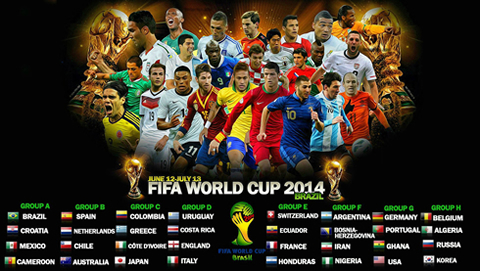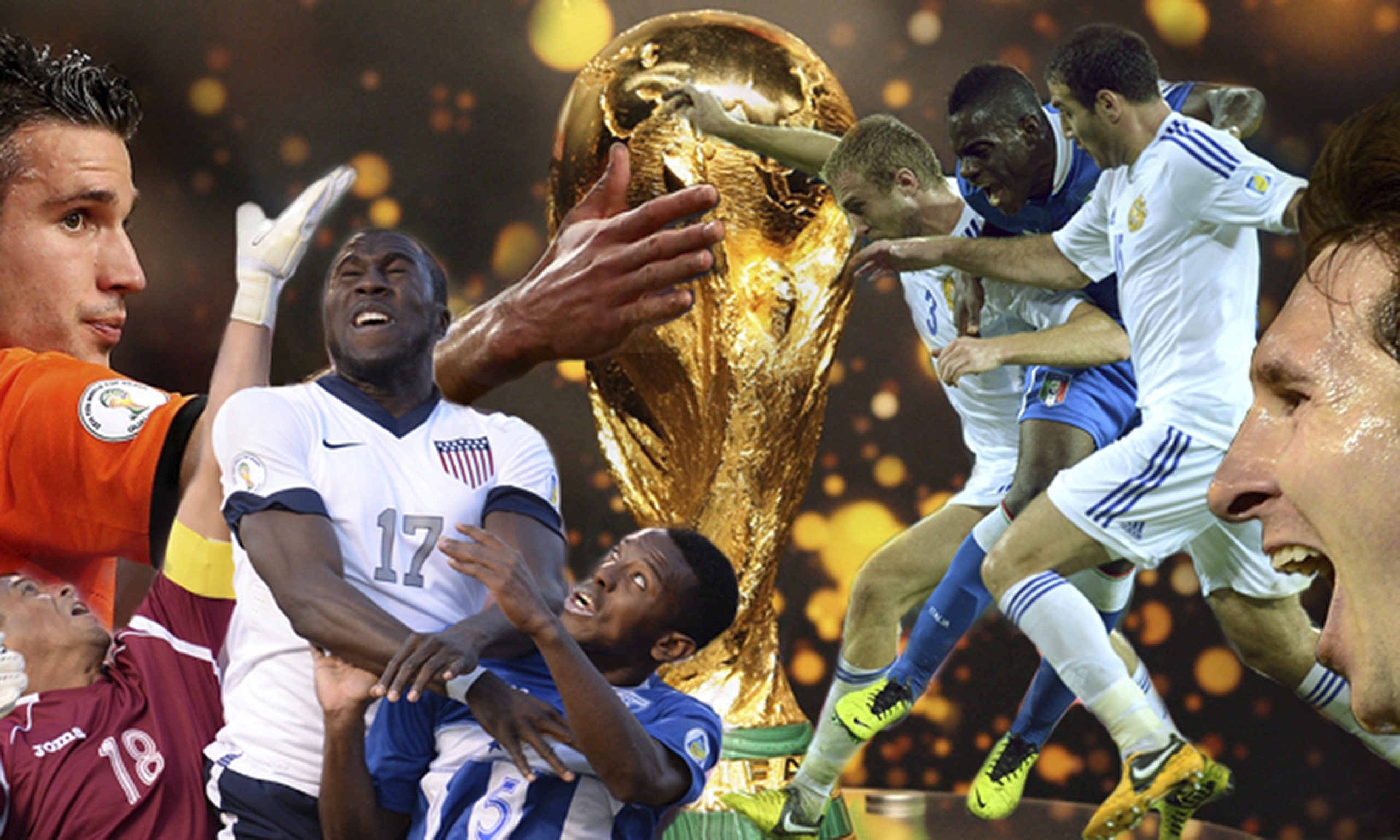
When the U.S. played Portugal on Sunday, a painful 2-2 draw when Portugal scored in the 95th minute (stoppage time), it was the most viewed soccer game in U.S. history. Tomorrow morning (Thursday), the U.S. plays Germany and must win to secure a spot in the knock-out round of 16.
Unfortunately for many American soccer fans, the game airs at noon EDT and 9 am PDT, making it difficult to watch unless we play hooky from work. Even so, if the Americans can pull out a miraculous win (Germany came into the World Cup as one of the two or three favorites, along with Brazil and Argentina), will soccer be guaranteed a bright future in the U.S.? Tom Ashbrook's On Point (NPR) looks at the future of soccer in the U.S.
And, while we're discussing it, why the hell do Americans call it soccer instead of futbol (football), as it is in most of the rest of the world? Turns out that it's a story, like all good stories, that begins in a pub (The Atlantic).
First up, a collection of links on soccer and the World Cup, then the future of U.S. soccer from On Point.
Theory of soccer
Jun 24 2014
9:00AM

- Alda Carvalho (ISEL), Carlos Pereira dos Santos (ISEC), and Jorge Nuno Silva (FCUL): Mathematics of Soccer.
- Ozgur Dirim Ozkan (METU): Perception of Bosnia and Herzegovina’s Qualification to FIFA World Cup 2014 by Different Ethnic Groups.
- In his 35-year presidency of Real Madrid, Santiago Bernabeu transformed a middling team into the greatest club of the 20th century.
- The end of the World Cup as we know it: Club soccer has surpassed the international version of the sport in just about every way — better pay, better players, better teams.
- Jacqueline S. Gehring on how the left and the right talk differently about the ethnicity of German soccer players.
- Uri Friedman on why Americans call soccer “soccer”.
- Eric Wills reviews Why Soccer Matters by Pele.
- The introduction to Beautiful Game Theory: How Soccer Can Help Economics by Ignacio Palacios-Huerta.
- The cyborg era begins at the World Cup.
- A philosopher's theory of soccer fandom: Simon Critchley on why there is no such thing as a bad World Cup.
- James Dawson on why the World Cup is not a reliable political football.
- The beautiful data set: Ignacio Palacios-Huerta on how the World Cup can help test economic theories.
- Why did Borges hate soccer? Shaj Mathew on how mass culture was anathema to the Argentine writer.
- Omer Aziz on how the World Cup doesn’t bring people together — it tears them apart.
- Pele, Cruyff, Best, Maradona, Zidane — and Pindar: Brian Cummings on football’s offer of hope against experience, and its roots in a classical past.
- David Runciman on why goalkeepers don’t catch the ball.
- How much do Americans really hate soccer? Nicholas Hune-Brown wonders.
- The not-so-beautiful game: As it becomes trendy, soccer is losing its old frisson of hooliganism.
- Poor, poor pitiful you: Nick Paumgarten on diving at the World Cup.
- Aaron Gordon on how the U.S. military shaped American soccer.
* * * * *
The Future Of Soccer In The United States
What would it take for the United States to become a world soccer powerhouse? We’ll kick it around.
On Point with Tom Ashbrook | June 25, 2014
US players kick off the World Cup soccer match between the USA and Portugal at the Arena da Amazonia in Manaus, Brazil, Sunday, June 22, 2014. (AP)
World Cup fever has hit, of all places, the United States of America. The big global latecomer to soccer. Millions of American hearts went way up the Amazon Sunday night for the heartbreaking tie with Portugal. Millions celebrated the nifty first game win over Ghana. Millions more will tune in tomorrow for the big game with Germany. Team USA is performing better than expected. Of course, US women took the World Cup in ’91, ’99. What would it take to put US men’s soccer firmly up in that top tier? This hour, On Point: World Cup fever, and building an American soccer powerhouse.
– Tom Ashbrook
Guests
From Tom’s Reading List
- Andrew Das, assistant sports editor for the New York Times. (@AndrewDasNYT)
- Paul Kennedy, Editor-in-chief and General Manager of Soccer America, a US Soccer magazine. (@pkedit)
- Andrew Lewellen, writer for Grantland and former college soccer player. (@AndrewHLewellen)
- Mike Burns, general manager for the New England Revolution.
New York Times: How Jurgen Klinsmann Plans to Make U.S. Soccer Better (and Less American) — “‘We cannot win this World Cup, because we are not at that level yet,’ Klinsmann told me over lunch in December. ‘For us, we have to play the game of our lives seven times to win the tournament.’”
Fusion: When the U.S. Made A Baby Step in Basel — “As good as the Swiss looked against Austria was as bad as they looked against the U.S. Only 16,500 showed up in the Herzog & de Meuron-designed St. Jakob’s Park—all the starchitecture was in Basel—and they booed their team off at half time and full time. Michael Bradley scored the only goal in the eighty-sixth minute in an ugly game but a brave performance for the U.S. team. Winning ugly was something it needed to learn how to do—the hell with wining over new fans.”
The Wall Street Journal: At World Cup, South America Is Ascendant – “South American sides haven’t had the pleasure of playing on home soil since 1978, and they are taking full advantage of it. Thursday, Uruguay pushed England to the brink of elimination with a 2-1 win that came just hours after Colombia notched a 2-1 win over Ivory Coast in front of thousands of delirious yellow-and-blue clad fans at Estadio Nacional in Brasilia.”
Video
Soccer fans in Kansas City celebrating John Brooks’ goal in the US match against Ghana at the World Cup in Brazil.