True secrets of psychedelics: Are they everything they’re cracked up to be?
Mind-altering drugs can open us up to the amazing possibilities of the universe — but true self-discovery is harder
Sunday, Jun 8, 2014 | Nathan A. Thompson
A still from the movie "Enter the Void" of a DMT hallucination. (Credit: IFC Films)
The cactus skin arrived in the mail in a packet marked “for botanical examination only.” We whizzed it up in a blender. Two truant teenagers in an empty kitchen. We tried mixing the resulting green powder with water and drinking it. The taste was so foul it was all we could do to stop ourselves vomiting. In the end we mixed it with Cherry Coke to ameliorate the flavor and then we drank it all up.
The skin contained a naturally occurring psychedelic drug called mescaline. Soon, everything seemed to vibrate. It was as if the walls, windows, even the chairs were humming a low, beautiful melody. Then I noticed that we were speaking in colors. My friend’s words were blue swirls and mine were green. Our conversation curled and twisted in front of my eyes like smoke in a vacuum chamber. Later I held a glass of water, gazing at it for what seemed like an immensely long time, its utility swallowed up in its beauty and it seemed that the whole Earth existed within that glass and the thought occurred to me: “I’m in the presence of God.”
Ten years later I was staying in a tiny monastery deep in a Thai forest. I had been living and meditating there for close to a month. My mind was still — still in the way a tuning fork rests after being struck for a long time. I sat outside watching the fading light graze the trees, feeling egoless and empty of thought. Butterflies erupted from the green foliage in a movement that seemed so excessively beautiful I was thunderstruck and as I looked, I thought: “Damn, this is exactly like mescaline.”
It’s not just me who has made the link between psychedelic drugs and meditation. Indeed, the link between psychedelics and spiritual experience was the first line of inquiry Timothy Leary and his cohorts pursued in their 1960s Harvard experiments. In the 1990s, Dr. Rick Strassman ran a series of experiments using a powerful psychedelic known as DMT, and he too noticed the similarity: “[The effect of] DMT has a similarity with experiences that are possible with a lot of meditation,” he said.
Scientists are currently conducting separate studies on psychedelics and meditation — both are being trialed to treat the same conditions. A review study by the Journal of the American Medical Association, released in March this year, found that meditation may be as effective as medication in treating conditions such as depression and anxiety. Hot on the heels of this study was the Psilocybin Cancer Anxiety Study at NYU’s Bluestone Center for Clinical Research, which found that Psilocybin (the active drug in “magic mushrooms”) was effective in treating anxiety and depression in terminal cancer patients. There are now dozens of studies that document how both meditation and psychedelics can treat depression, addiction, anxiety and PTSD.
So if psychedelics produce similar effects to long periods of meditation and other austere religious practices, could we have stumbled upon what Strassman calls “the spirit molecule”? Are psychedelics an alternative to spiritual practices?
Hardly, say the Buddhists. The second noble truth of the Buddha is that “the origin of suffering is the attachment to desire.” Psychedelics are by their nature an experience, a strange and beautiful one but often elusive. This creates a craving to have the experience again. It is this craving that is the Buddhist definition of discontent. Rather than freeing the mind from attachment, psychedelics create more.
Perhaps the gold standard to measure whether psychedelics are a good substitute for meditation is to see whether fundamental changes in character occur. A meditation instructor once told me: “When I took LSD in the ’60s, it was profound, but it didn’t help me develop the character to live from that truth day by day – without grounding in morality and mindfulness it was merely a flash of insight.”
Richard Alpert, who was one of the first psychologists to study LSD, and later became the spiritual teacher Ram Dass, has a similar view, “I see them [psychedelics] as a door opener and a catalyst and a facilitator; I don’t see them as a full path.” Alpert also describes what his Indian guru told him after trying LSD himself: “Your drug is useful. It would allow you to come in and have the darshan [vision] of Christ, but you can only stay for two hours and then you’ve got to leave. It would be better to become Christ than visit him, but your medicine won’t do that, because it’s not the true samadhi [enlightenment].”
But psychedelics are a catalyst for change, according to writer Graham Hancock. According to Hancock, the means you use to gain insight (whether they are psychedelics or meditation) are the least important aspect; “what matters is what you do with visionary experiences once you have had them, how you integrate them into your life, what lessons you learn from them and how you act on those lessons.” Indeed, according to follow-up studies from the scientific literature, the effect of the psychedelic experience does seem to sustain a positive change without the need to repeat it. Researchers at New York University reported in the Archives of General Psychiatry that their subjects reported a significant improvement in mood and outlook after six months.
This may be true of those individuals who have taken medical-grade psychedelics in a clinical setting, but what of the thousands of people who are doing so haphazardly, procuring them from the black market? Personally, I had a hard time integrating my visionary experiences with my real life. I was sometimes confused and frightened by what I saw. It was a relief then to find the well-trodden Buddhist path. Indeed, most mystical traditions have detailed maps covering the kind of mental and metaphysical spaces you pass through on the way to God. Buddhism has the “Jhanas,” yoga has stages of “Samhadi” and Sufism has “four stages”. These maps allow a teacher to help you process what comes up in your spiritual practice. Strict morality is always a prerequisite to walk such paths or they won’t teach you. These kind of healthy boundaries are what is lacking when you take psychedelics.
But supposing you don’t have the time to pursue rigorous meditation? Why spend years and (some would say) lifetimes rotting our butts on the meditation cushion when we can take the red pill and get it all at once?
I heard Zen priest Kokyo Henkel describe it this way: Imagine spiritual development is a mountain. Psychedelics will take you on a helicopter ride to the top, you will see tumbling clouds and vast craggy distances but when the ride is over you are back where you started. Meditation is a way to climb the mountain, slowly, sometimes painfully, but when you reach the summit it is completely different from the summit-top you saw on your helicopter ride, because the journey has transformed you.
Perhaps this is idealistic, and I certainly wouldn’t deny anyone the use of psychedelics for medical reasons or for spiritual advancement, if done so with wisdom and respect. Indeed, given the dire state of the biosphere and the ecological crisis, perhaps the human race is out of time to meditate ourselves into the enlightened consciousness needed to instigate change. Given that psychedelics tend to assure people of the fact that we are part of nature and connected to every person, plant and animal on Earth, perhaps we should be using them to create happier, more responsible citizens now.
Meditation and yoga have a long history of creating such people, and both have the advantage of being legal and safe as any intense religious activity can be. The immediacy of the psychedelic experience and its profound effects make these substances deserving of interest and study but we can’t yet say they are a viable alternative to the tried and tested spiritual paths.
When I look back on that mescaline-laced afternoon when I was a teenager, I remember a life-altering experience, something the mystics would call an “awakening.” But it was meditation that allowed me to begin to awaken permanently. Alan Watts summed it up when he said:
“The psychedelic experience is only a glimpse of genuine mystical insight, but a glimpse which can be matured and deepened by the various ways of meditation in which drugs are no longer necessary or useful. If you get the message, hang up the phone.”
Read more from Nathan A. Thompson.
Showing posts with label self exploration. Show all posts
Showing posts with label self exploration. Show all posts
Sunday, June 08, 2014
Nathan A. Thompson - True Secrets of Psychedelics: Are They Everything They’re Cracked Up to Be?
On the heals of the Sam Harris article on hallucinogens I posted earlier today, here is a similar article from Salon. This article, however, focuses on psychedelics as a vehicle to open us up to the spiritual. But once we get a taste, the recommendation is to take up a practice that can provide continuous spiritual openness, not just for a few hours, until the drug wears off. In many ways, this too is what Sam Harris was suggesting.


Monday, October 01, 2012
Get a FREE Copy of Dr. Brené Brown's New Book, "Daring Greatly"

Dr. Brené Brown has an excellent new book out, Daring Greatly: How the Courage to Be Vulnerable Transforms the Way We Live, Love, Parent, and Lead, and I have been given one copy by the promotion team to give to one of you.
Book Give Away:
So this is how it works: Everyone who is interested just needs to comment with "Pick Me" or some similar statement either here or at Facebook. After 48 hours, I will put all of the names into a bowl and pick one. I will try to contact the winner and get your snail-mail address and send it to you.I have been reading Daring Greatly and enjoying it quite a lot. It is every bit as good as The Gifts of Imperfection: Let Go of Who You Think You're Supposed to Be and Embrace Who You Are, a book that I found personally relevant, and her 2007 book, I Thought It Was Just Me (but it isn't): Making the Journey from "What Will People Think?" to "I Am Enough", which also was personally useful in light of my social anxiety and hyperactive inner critic.

I was going to offer a brief review of the book, but the promotion folks sent me this Q and A with Dr. Brown in which she talks about Daring Greatly. In it she discusses some of the major ideas and does so far better than could I.
I particularly like the "never _________ enough" part below. In every one of my clients (not so mention my own life), there is some sense of not enough that came from parents, siblings, peers, teachers, and coaches. When that sense of not being enough remains an unconscious part of our psyche, we will live through our defenses (erected to avoid that feeling) and never quite know why we are not happy.
Here are some useful links for those of you who would like to read Dr. Brown's blog or see any of the TED Talks you may have missed.DARING GREATLY BY BRENÉ BROWN, PH. D., LMSW
Q&A WITH BRENÉ
1. What does it mean to “Dare Greatly?”
The phrase ‘Daring Greatly’ is from Theodore Roosevelt’s speech, Citizenship in a Republic. This is the passage that made the speech famous:
“It is not the critic who counts; not the man who points out how the strong man stumbles, or where the doer of deeds could have done them better.The first time I read this quote, I thought, “This is vulnerability. Everything I’ve learned from over a decade of research on vulnerability has taught me this exact lesson. Vulnerability is not knowing victory or defeat, it’s understanding the necessity of both; it’s engaging. It’s being all in.”
The credit belongs to the man who is actually in the arena, whose face is marred by dust and sweat and blood; who strives valiantly; who errs, who comes short again and again,
because there is no effort without error and shortcoming; but who does actually strive to do the deeds; who knows great enthusiasms, the great devotions; who spends himself in a worthy cause;
who at the best knows in the end the triumph of high achievement, and who at the worst, if he fails, at least fails while daring greatly . . .”
Vulnerability is not weakness, and the uncertainty, risk and emotional exposure we face every day are not optional. Our only choice is a question of engagement. Our willingness to own and engage with our vulnerability determines the depth of our courage and the clarity of our purpose.
2. Why do you think we’re living in a culture of “never enough?”
Scarcity thrives in a culture where everyone is hyper-aware of lack. Everything from safety and love to money and resources feels restricted or lacking. We spend inordinate amounts of time calculating how much we have, want, and don’t have, and how much everyone else has, needs, and wants. The greatest casualties of a scarcity culture are our willingness to own our vulnerabilities and our ability to engage with the world from a place of worthiness.
After doing this work for the past twelve years and watching scarcity ride roughshod over our families, organizations, and communities, I’d say the one thing we have in common is that we’re sick of feeling afraid. We want to dare greatly. We’re tired of the national conversation centering on “What should we fear?” and “Who should we blame?” We all want to brave.
Our culture of scarcity is defined by this sentence:
Never _______________enough.
It only takes a few seconds before people fill in the blanks with their own version:
• Never good enough.The three components of scarcity are shame, comparison, and disengagement. To transform scarcity we need to Dare Greatly; we need to cultivate worthiness, a clear sense of purpose, and we need to re-engage.
• Never perfect enough.
• Never thin enough.
• Never powerful enough.
• Never successful enough.
• Never smart enough.
• Never certain enough.
• Never safe enough.
• Never extraordinary enough.
3. What are the greatest myths about vulnerability?
I define vulnerability as exposure, uncertainty, and emotional risk. Yes, feeling vulnerable is at the core of difficult emotions like fear, grief, and disappointment, but it’s also the birthplace of love, belonging, joy, empathy, innovation, and creativity. When we shut ourselves off from vulnerability, we distance ourselves from the experiences that bring purpose and meaning to our lives.
Myth #1: Vulnerability is weakness.
The perception that vulnerability is weakness is the most widely accepted myth about vulnerability and the most dangerous. We love seeing raw truth and openness in other people, but we’re afraid to let them see it in us. We’re afraid that our truth isn’t enough – that what we have to offer isn’t enough without the bells and whistles, without editing, and impressing.
Myth #2: “I Don’t Do Vulnerability”
Regardless of our willingness to do vulnerability, it does us. When we pretend that we can avoid vulnerability we engage in behaviors that are often inconsistent with who we want to be. Experiencing vulnerability isn’t a choice - the only choice we have is how we’re going to respond when we are confronted with uncertainty, risk, and emotional disclosure.
Myth #3: We Can Go It Alone
Going it alone is a value we hold in high esteem in our culture, ironically even when it comes to cultivating connection. The vulnerability journey is not the kind of journey we can make alone. We need support. We need folks who will let us try on new ways of being without judging us.Myth #4: Trust Comes Before Vulnerability
There is no trust test, no scoring system, no green light that tells us that it’s safe to let ourselves be seen. Trust is a product of vulnerability that grows over time and requires work, attention, and full engagement. The research participants described trust as a slow-building, layered process that happens over time.
4. What do you think the key to combating vulnerability is?
The courage to be vulnerable means taking off the armor we use to protect ourselves, putting down the weapons that we use to keep people at a distance, showing up, and letting ourselves be seen.
As children we found ways to protect ourselves from vulnerability, from being hurt, diminished, and disappointed. We put on armor; we used our thoughts, emotions, and behaviors as weapons; and we learned how to make ourselves scarce, even to disappear. Now as adults we realize that to live with courage, purpose, and connection —to be the person whom we long to be—we must again be vulnerable. We must take off the armor, put down the weapons, show up, and let ourselves be seen. In Daring Greatly I talk about going inside the armory to identify the shields we use to protect ourselves and provide some strategies that can help transform the way we live, love, parent and lead.
5. What is one of your favorite examples of how you or someone you know has “Dared Greatly?”
I hear and see examples of daring greatly everyday. Sometimes people think that “daring greatly” means parachuting from a plane or climbing a mountain. Practicing vulnerability is about raising your hand at a PTO meeting and asking a tough question. It’s sharing an innovative (and seemingly strange) idea at work. It’s setting a boundary, asking for help, or offering support to someone who is struggling. If we want to change our lives, our families, or our community, we need a critical mass of ordinary courage. We need to dare to show up and be seen.
There is also a Reader's Guide for the book - which is especially useful for reading groups who want to read and discuss the book together.
Blog: http://ordinarycourage.com
Daring Greatly book trailer and purchasing options:
http://www.brenebrown.com/books/2012/5/15/daring-greatly.html
More information on the online Daring Greatly Read-Along:
http://www.ordinarycourage.com/my-blog/2012/9/6/daring-greatly-read-along.html
The TEDx Houston “Power of Vulnerability”
http://www.ted.com/talks/brene_brown_on_vulnerability.html
TED 2012 “Listening to Shame”
http://www.ted.com/talks/brene_brown_listening_to_shame.html
The Daring Greatly t-shirts (benefiting charity: water)
http://www.brenebrown.com/shop
Download the Daring Greatly Manifestos
http://www.brenebrown.com/downloads-badges
Wednesday, November 23, 2011
TEDxNewEngland | John Hunter, Unknowing Can be the Beginning of Wisdom
An open mind is beginner's mind - unknowing is an opening.
TEDxNewEngland - John Hunter, Unknowing Can be the Beginning of Wisdom
Acceptance of reality is often a beginning step in mastering one's self. How does one live in this vast sea of uncertainty without fear, and with ease and happiness? John Hunter helps school children reveal these secrets to carry through their whole lives. He will show how we can learn from children that, unknowing is the beginning of wisdom, and that our most glaring weakness may be the pointer to our greatest strengths.
Sunday, June 19, 2011
Burning Brightly - Allowing Your Soul to Shine

This is the Daily Om from a week or two ago. I've been letting it sit for some reason, perhaps because it feels too relevant to my life right now. As I begin my work as a therapist, I feel like there is so much to learn, and at the same time, when I am sitting with clients I feel like this is what I should have been doing years ago (even though I know I was not ready then).
I have spent much of my life trying to be invisible. Social anxiety does that to a person. And as this article mentions, making myself invisible also has the unintentional result of preventing me from living in and owning my own talents and skills.
Blogging without a pseudonym was a first step in the direction of living more publicly, and then attending conferences and speaking at them, all of which has moved me to this point where I participated as a speaker in a large teleconference for men this last week, the same week in which I began to see clients.
Burning Brightly
Allowing Your Soul to ShineWhen we hide and try to be invisible and unseen by all
we are only really hiding from ourselves.
At times, we’ve all wanted to crawl under a rock and hide away from the world. We may have preferred to be invisible rather than let other people see us or notice that we exist. This desire not to be seen often happens when we are feeling very hurt, angry, or simply weary of the world. And while we may console ourselves with the defense that we are shy, an introvert, or a loner, we may actually be hiding.
When we hide and make believe that we are invisible, we can think that we no one sees us even though, truthfully, we are only really hiding from ourselves. And while we may try to live life as inconspicuously as possible, we only succeed in becoming more conspicuous because people can’t help but notice that we are trying to hide our light. None of us are meant to hide; each one of us radiates a unique brilliance that is meant to illuminate the world. When we try to dim our light, we diminish the natural radiance of the Universe, and we deprive the people around us of the unique gifts and talents that we are here to share.
Stepping out of the wings and letting your light shine is actually a way to serve the planet. We each have a responsibility to contribute to our community, and we do this when we let ourselves be seen. It doesn’t do anyone any good when we try to hide. We are all beings of light and we are here to light the way for each other. When we let ourselves shine, we become a bright mirror that others can see their own reflected brilliance through, and they can’t help but want to shine also. Shine your light out into the world, bless those around you by sharing your gifts, and watch the universe glow.
Tags:
Monday, April 18, 2011
Shrink Rap Radio - #261 – Practical Life Philosophy with Brian Johnson

Brian Johnson is quite the entrepreneur - he created and sold the social networking sites eteamz (about to go public) and Zaadz (I hung out at Zaadz, but it no longer exist). He then founded PhilosopherNotes and now he has expanded that venture as the Philosopher & CEO of en*theos Enterprises.
He recently spoke with David Van Nuys at Shrink Rap Radio.
#261 – Practical Life Philosophy with Brian Johnson
Brian Johnson is the Philosopher & CEO of en*theos Enterprises where he has fun integrating his passion for practical philosophy with his passion for creating cool businesses that inspire and empower people to live their most authentically awesome lives.
A few years ago Brian decided to sell the business he was running and give himself a Ph.D. in Optimal Living. He couldn’t find a program that integrated everything he wanted to study—from old school philosophy, positive psychology and spirituality to nutrition, health & fitness, creativity, business and modern self-development. So, he decided to create his own doctoral program.
He created PhilosophersNotes where he shares “More Wisdom in Less Time” by distilling the Big Ideas from his favorite optimal living classics into fun, inspiring and super practical 6-page PDFs, 20-minute MP3s and 10-minute PNTV episodes. His dissertation came in the form of a little book called A Philosopher’s Notes where he distilled his favorite 100 Big Ideas on optimal living.
In his past lives, Brian built and sold the social networking sites eteamz and Zaadz. He’s a proud law school dropout and a Phi Beta Kappa graduate of UCLA where he studied Psychology and Business. He enjoys spooning with his Goddess when he’s not reading, hiking, creating or otherwise enjoying himself.
A psychology podcast by David Van Nuys, Ph.D.


Tags:
Wednesday, April 06, 2011
TEDxDUCTAC - Dr. Menis Yousry - The Social Brain
 Menis Yousry is a systems and family psychologist who specializes in personal growth technologies - he is founder of the Essence Foundation, a a non-profit personal development organization staffed almost entirely by volunteers. They offer a variety of personal development courses.
Dr. Yousry delivers a lecture on the relationship between our conscious and unconscious memories as a cause of conflict between human intentions and actions. Specifically, the lecture focuses on how the social brain influences identity, and defines 'Who We Think We Are' as an image that is often distinctly different from whom we really are.
Dr Menis YousryRead more at the Foundation website.
Founder and lead facilitator of the Essence Foundation, Dr Yousry is a Family & Systemic Psychotherapist and Psychologist with BSc, MSc and PhD degrees from the University of London. He worked as a Family Therapist supervisor within the National Health Service for twelve years.
Over the last 20 years he has designed and facilitated personal development courses in the USA, UK, Bulgaria, Hungary, Sweden, Spain, Germany and Russia, appearing on television and radio.
Essence
By weaving together his interest in human potential, art, culture and developmental psychology with a thorough grounding in research he developed a simple, sensitive and unique approach to personal development – an approach grounded in transferring intellectual and theoretical understanding to our day-to-day living experience.
Tags:
Thursday, March 24, 2011
Feeling Threatened - Afraid of the Truth
The Daily Om from a March 14, 2011.

Feeling Threatened
Afraid of the TruthWe avoid the truth because it scares us, or makes us angry, or makes us feel like we don’t know what to do.
Most of us have had the experience of being in possession of a piece of truth that we were afraid to share because we knew it would not be well received. There are also instances in which we ourselves have been unable to handle some truth confronting us. This might be a small truth, such as not wanting to see that our car needs repairs because we don’t want to pay for them, or a large truth, such as not fully accepting that someone close to us is pushing us away. Usually the truth is evident, and we can see it if we choose, but we have elaborate ways of hiding the truth form ourselves, no matter how apparent it is.
For the most part, we avoid the truth because it scares us, or makes us angry, or makes us feel like we don’t know what to do. We often create our lives based on a particular understanding, and if that understanding turns out to be fully or even partially incorrect, we may feel that our whole sense of reality is being threatened. It takes a strong person to face the truth in circumstances like these, and many of us run for cover instead. Nevertheless, we can only avoid the truth for so long before it begins to make itself known in ever more forceful ways.
Ultimately, there is no way to avoid the truth, no matter how painful it is, so the sooner we let down our defenses, the better. When we know the truth and accept that we may have to adjust our lives to accommodate, we are in alignment with reality. At the same time, we can be patient with people around us who have a hard time seeing the truth, because we know how painful it can be. Whatever the truth is, we make a sincere effort not to close our eyes to it, but instead to be grateful that we have access to it.
Tags:
Thursday, November 18, 2010
Daily Om: Living Outside the Comfort Zone
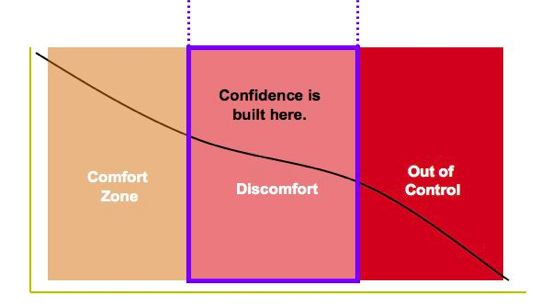
A little reminder that when we stretch ourselves beyond our comfort zone is when we tend to grow. When we are faced with things that challenge our safe zones, we tend to put them off or avoid them - I know all about this because I do it.
In the past four months, my life has shifted into a much more public and involved place that pushes my buttons around being invisible (a goal I have held for decades). But I don't want to be invisible, even though one of my parts seeks this as a form of safety.
For me, (gently) pushing through discomfort requires acknowledging those parts that are resistant, trying to honor their needs, and being respectful of the role they play in wanting to keep me safe.
Outside the Comfort Zone
Things We Don’t Want to Do
Putting off doing what scares us and brings up fear only creates more obstacles in our lives.
Most of us have had the experience of tackling some dreaded task only to come out the other side feeling invigorated, filled with a new sense of confidence and strength. The funny thing is, most of the time when we do them, we come out on the other side changed and often wondering what we were so worried about or why it took us so long. We may even begin to look for other tasks we’ve been avoiding so that we can feel that same heady mix of excitement and completion.
Whether we avoid something because it scares us or bores us, or because we think it will force a change we’re not ready for, putting it off only creates obstacles for us. On the other hand, facing the task at hand, no matter how onerous, creates flow in our lives and allows us to grow. The relief is palpable when we stand on the other side knowing that we did something even though it was hard or we didn't want to do it. On the other hand, when we cling to our comfort zone, never addressing the things we don't want to face, we cut ourselves off from flow and growth.
We all have at least one thing in our life that never seems to get done. Bringing that task to the top of the list and promising ourselves that we will do it as soon as possible is an act that could liberate a tremendous amount of energy in our lives. Whatever it is, we can allow ourselves to be fueled by the promise of the feelings of exhilaration and confidence that will be the natural result of doing it.
Tags:
Sunday, September 05, 2010
Shrink Rap Radio - #244 – Stories of The Middle Passage with Jungian Analyst, James Hollis
Nice discussion. James Hollis's most recent book, I believe, is What Matters Most: Living a More Considered Life, which looks like a good book for those seeking to live a more considered and purposeful life.
As always, your host at Shrink Rap Radio is David Van Nuys.
As always, your host at Shrink Rap Radio is David Van Nuys.
Shrink Rap Radio #244 – Stories of The Middle Passage with Jungian Analyst, James Hollis
James Hollis, Ph.D. is a Zurich-trained Jungian analyst in private practice in Houston, TX where he is also the Director of the Jungian Studies doctoral program of Saybrook University of San Francisco. He is the author of thirteen books, including, Finding Meaning in the Second Half of Life and What Matters Most: Living a More Considered Life.
Dr. Hollis is also Executive Director of the Jung Educational Center of Houston. He is also Senior Training Analyst for the Inter-Regional Society of Jungian Analysts, was the first Director of Training of the Philadelphia Jung Institute, and is vice-president of the Philemon Foundation, which is dedicated to the publication of the complete works of Jung.
Discover these discount codes for you!: Angie’s List and 10% off on printer ink at 4inkjets.

Tags:
Tuesday, June 29, 2010
Does Maslow’s Pyramid Need a Makeover?
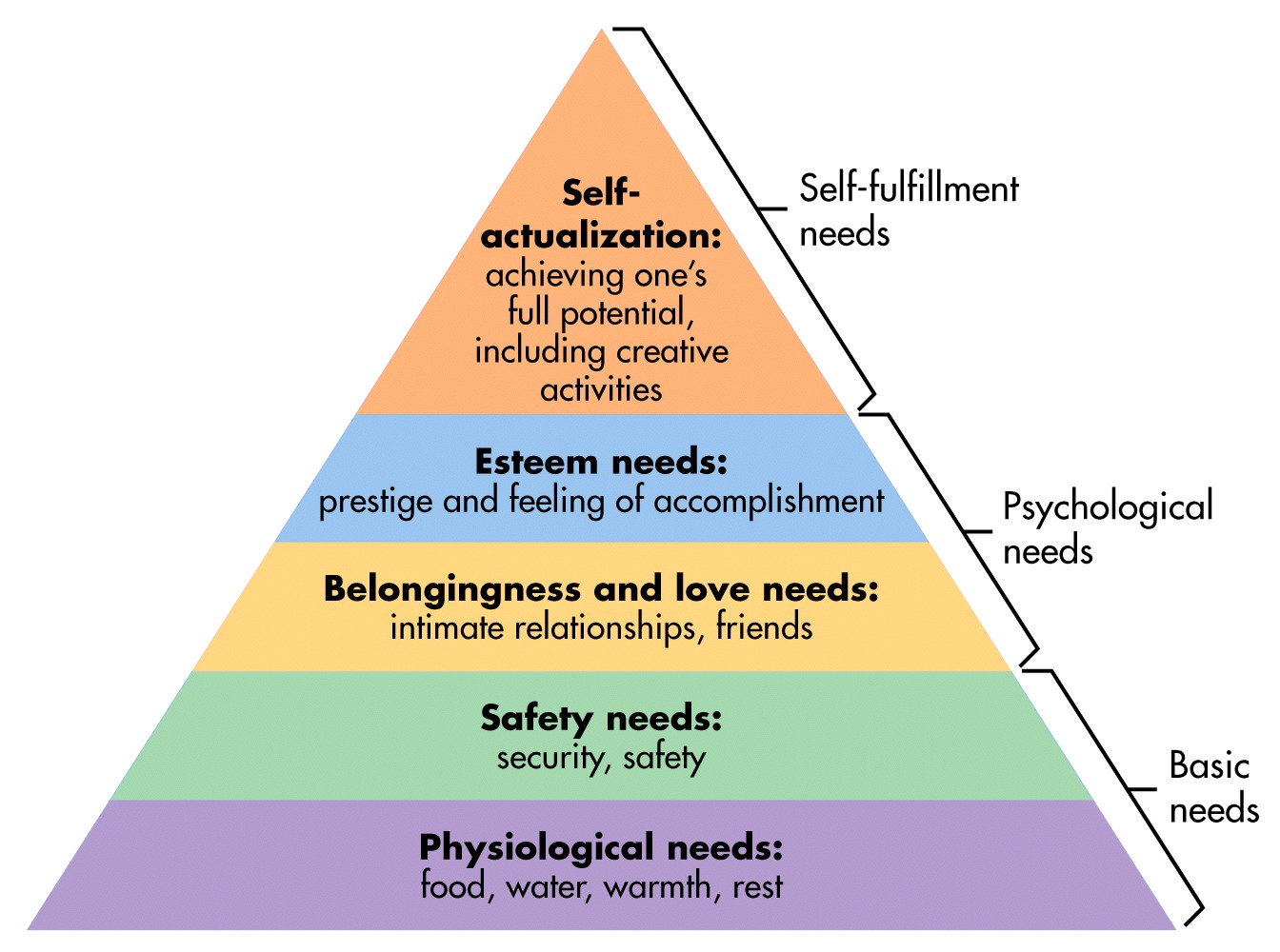
Just in case you slept through Psych 101, Abraham Maslow was one of the founders of the humanist/transpersonal psychology movements (the Third and Fourth Waves, after psychoanalysis and behaviorism). One of Maslow's great legacies is his Hierarchy of Needs:
While some people have questioned the hierarchy in part, few have advocated for a complete reassessment - until now.
A team of evolutionary psychologists led by Douglas Kenrick of Arizona State University published an article, in the new issue of Perspectives on Psychological Science, proposing a revised pyramid, one informed by recent research defining our deep biological drives.
Here is some of the report on this article from Miller-McCune.
Once those lower level or basic needs are satisfied, we then can seek out a partnership so satisfy our bonding and relational needs, as well as our more individual needs for self-esteem and self-achievement. These are often family needs, as well as relational needs.
From there (although not everyone feels the need for interpersonal connections as strongly as others, and they may skip directly to a devotional life or an academic life) people then seek self-actualization, becoming the best, healthiest, most whole person possible. We may devote ourselves to art, to teaching, to spiritual practice, and so on, depending on what we find most valuable in life.
Despite the popularity of Maslow's model, Kenrick and his colleagues — Vladas Griskevicius, Steven Neuberg and Mark Schaller — felt the model needed to be updated with the recent findings from evolutionary psychology in mind.
From my perspective, what they have done is eliminate psychological needs and made the pyramid all biological and social - to the point that in their model status is necessary before mate acquisition. Even that term, "mate acquisition," reduces a romantic partner to an object of reproduction.
Yes, human beings are part of the animal kingdom, but we have evolved to experience complex emotions and experiences including love, spirituality, and self-transcendence. To me, this proposed model, while it may hold some merit in what is covers, is too reductionist to be a true hierarchy of values.
The basic argument of evolutionary psychology is that all human behaviors are simply complex ways of acquiring a mate and reproducing. However, spiritual experiences such as self-transcendence and nonduality confer no discernible reproductive advantage and may even be a hindrance.
One other issue is development - for survival stages of development (essentially the first four of Wilber's stages or Spiral Dynamics stages) reproduction and survival are the prime concerns - but this becomes less and less true as people increase their developmental stages.
While some people have questioned the hierarchy in part, few have advocated for a complete reassessment - until now.
A team of evolutionary psychologists led by Douglas Kenrick of Arizona State University published an article, in the new issue of Perspectives on Psychological Science, proposing a revised pyramid, one informed by recent research defining our deep biological drives.
Here is some of the report on this article from Miller-McCune.
Maslow's model is based on the idea that we need to satisfy survival needs first and foremost - if we are worried about our basic food, shelter, and safety then there is not much hope of working on or even being aware of higher order needs.Maslow’s Pyramid Gets a Makeover
What are the fundamental forces that drive human behavior? A group of evolutionary thinkers offer an answer by revising one of psychology’s most familiar images.
By Tom Jacobs
What's the true function of peacocking? A group of evolutionary thinkers offer up a new theory for what motivates human behavior by revising one of psychology’s most familiar images. (Jean Carneiro / stockxchange.com)Abraham Maslow’s Pyramid of Needs is one of the iconic images of psychology. The simple diagram, first introduced in the 1940s, spells out the underlying motivations that drive our day-to-day behavior and points the way to a more meaningful life. It is elegant, approachable and uplifting.
But is it also out of date?
That’s the argument of a team of evolutionary psychologists led by Douglas Kenrick of Arizona State University. In the latest issue of the journal Perspectives on Psychological Science, they propose a revised pyramid, one informed by recent research defining our deep biological drives.
Their new formulation is intellectually stimulating, but emotionally deflating. “Self-actualization,” the noble-sounding top layer of Maslow’s hierarchy, in their model has not only been dethroned, it has been relegated to footnote status. It has been replaced at the top with a more mundane motivation Maslow didn’t even mention: “Parenting.”
The new pyramid is based on the premise that our strongest and most fundamental impulse, which shapes our day-to-day desires on an unconscious level, is to survive long enough to pass our genes to the next generation. According to this school of thought, backed by considerable — though not irrefutable — evidence, all our achievements are linked in one way or another to the urge to reproduce.
In other words, aside from our powerful brains, we’re pretty much like every other living creature.
Given that we humans like to think of ourselves as special, this new pyramid will surely encounter strong resistance. But it could also become a shorthand way to clarify the often-misunderstood concepts of evolutionary psychology, which, its advocates insist, are not as meaning-denying and ego-deflating as we might think.
“There is such a thing as self-actualization, developing your inner potential, a self-need to become brilliant at whatever you’re doing,” says Kenrick, who studied classical guitar before devoting his professional life to academic research. “I just don’t think it’s divorced from biology.
“The reason our brains work this way — the reason we’re always so curious, we’re trying to solve problems, we’re trying to perfect the product of our creativity — it’s because when our ancestors used their big cerebral cortexes in those ways, the result was an increase in reproductive success.”
That’s on average, of course; individual results may vary. J.S. Bach fathered 20 children. Beethoven had none.

Once those lower level or basic needs are satisfied, we then can seek out a partnership so satisfy our bonding and relational needs, as well as our more individual needs for self-esteem and self-achievement. These are often family needs, as well as relational needs.
From there (although not everyone feels the need for interpersonal connections as strongly as others, and they may skip directly to a devotional life or an academic life) people then seek self-actualization, becoming the best, healthiest, most whole person possible. We may devote ourselves to art, to teaching, to spiritual practice, and so on, depending on what we find most valuable in life.
Despite the popularity of Maslow's model, Kenrick and his colleagues — Vladas Griskevicius, Steven Neuberg and Mark Schaller — felt the model needed to be updated with the recent findings from evolutionary psychology in mind.
What they have done, in essence, is throw out the top two tiers of Maslow's model and focus all their attention on expanding the bottom three stages into their seven stages (all of which are based on survival and reproduction - none of which are focused on self-actualization in any form) with a nod toward esteem as an issue (in terms of status).This notion of human beings aspiring to ever-higher levels of meaning has had lasting appeal. University of Michigan psychologist Christopher Peterson found more than 766,000 images of Maslow’s pyramid on the Internet. MIT psychologist Joshua Ackerman suspects its allure is based on several factors.
“One is that it fits people’s notions of the kinds of the goals that are important to them,” he says. “Second, it gives people a track on which to proceed through life. People everywhere tend to search for meaning in life. This gives people a structure by which to do that.”
Despite the pyramid’s continuing popularity, Kenrick and his colleagues — Vladas Griskevicius, Steven Neuberg and Mark Schaller — note some modern researchers consider it “quaint” and largely irrelevant. But during the years they spent studying deep-seated human motivations from an evolutionary perspective, Kenrick and his colleagues realized many of their findings lined up quite nicely with Maslow’s concepts. The lower rungs of his hierarchy — immediate physiological needs, safety and, a bit higher up, esteem — appeared quite solid in light of this new evidence.
But they also found several problems with the pyramid. We now know that needs, once they are met, don’t simply disappear; rather, they reappear when prompted by certain environmental cues. Watching a news report about a crime spree will trigger fears for our own safety, which can influence our opinions and behaviors even if that need is being effectively met. (More fancifully, Kenrick notes that many well-fed people love to watch cooking shows. Having a full belly doesn’t negate our fascination with food.)
So Kenrick and his colleagues created a new pyramid in which the needs overlap, rather than completely replace, one another.
“When a new one comes in, it doesn’t just cover up the old one the way a new city is built on ancient ruins,” he says. “The old and new continue to coexist.”
While few will take issue with that refinement, the other major change Kenrick and his colleagues propose is more problematic. They note that, from an evolutionary perspective, the idea that “self-actualization” would be at the top of the pyramid makes no sense. For our genes to survive and live on in the next generation, we don’t have to meet or exceed our potential: We just need to survive, attract a mate and have a child. From a genetic perspective, that’s plenty good enough.
So Kenrick and his colleagues revised the hierarchy to reflect this selfish-gene hypothesis. While their bottom four levels are highly compatible with Maslow’s — immediate psychological needs, self-protection, affiliation, status/esteem — their top three differ enormously. They are mate acquisition, mate retention and parenting.
“I think the biggest mistake Maslow made was he considered sexual gratification to be down there with the physiological needs, like hunger and thirst,” Kenrick says. “But we feed ourselves to survive; we have sexual relations for another reason. [The sex drive] has an intrinsic connection to what evolutionary theorists believe makes life go around, which is replication of genes. He kind of missed the boat on that.”
From my perspective, what they have done is eliminate psychological needs and made the pyramid all biological and social - to the point that in their model status is necessary before mate acquisition. Even that term, "mate acquisition," reduces a romantic partner to an object of reproduction.
Yes, human beings are part of the animal kingdom, but we have evolved to experience complex emotions and experiences including love, spirituality, and self-transcendence. To me, this proposed model, while it may hold some merit in what is covers, is too reductionist to be a true hierarchy of values.
The basic argument of evolutionary psychology is that all human behaviors are simply complex ways of acquiring a mate and reproducing. However, spiritual experiences such as self-transcendence and nonduality confer no discernible reproductive advantage and may even be a hindrance.
One other issue is development - for survival stages of development (essentially the first four of Wilber's stages or Spiral Dynamics stages) reproduction and survival are the prime concerns - but this becomes less and less true as people increase their developmental stages.
Journal Reference:
Kenrick, D.T., Griskevicius, V., Neuberg, S.L. & Schaller, M. (2010). Renovating the Pyramid of Needs: Contemporary Extensions Built Upon Ancient Foundations. Perspectives on Psychological Science; Vol. 5 No. 3: 292-314. doi: 10.1177/1745691610369469
Tags:
Wednesday, November 18, 2009
Daily Om - Owning Your Emotions: Name It and Claim It
I linked to this article the other day in my Friendfeed/Twitter feeds, but I like it, so I am posting the whole thing. Too many people do NOT own their emotions and then project the ones they are not comfortable with onto others.
Owning Your Emotions
Name It and Claim ItOur feelings can sometimes present a very challenging aspect of our lives. We experience intense emotions without understanding precisely why and consequently find it difficult to identify the solutions that will soothe our distressed minds and hearts. Yet it is only when we are capable of naming our feelings that we can tame them by finding an appropriate resolution. We retake control of our personal power by becoming courageous enough to articulate, out loud and concisely, the essence of our emotions. Our assuming ownership of the challenges before us in this way empowers us to shift from one emotional state to another—we can let go of pain and upset because we have defined it, examined the effect it had on our lives, and then exerted our authority over it by making it our own. By naming our feelings, we claim the right to divest ourselves of them at will.
As you prepare to acknowledge your feelings aloud, gently remind yourself that being specific is an important part of exercising control. Whatever the nature of your feelings, carefully define the reaction taking place within you. If you are afraid of a situation or intimidated by an individual, try not to mince words while giving voice to your anxiety. The precision with which you express yourself is indicative of your overall willingness to stare your feelings in the face without flinching. Naming and claiming cannot always work in the vacuum of the soul. There may be times in which you will find the release you desire only by admitting your feelings before others. When this is the case, your ability to outline your feelings explicitly can help you ask for the support, aid, or guidance you need without becoming mired in the feelings that led you to make such an admission in the first place.
When you have moved past the apprehension associated with expressing your distressing feelings out loud, you may be surprised to discover that you feel liberated and lightened. This is because the act of making a clear connection between your circumstances and your feelings unravels the mystery that previously kept you from being in complete control of your emotional state. To give voice to your feelings, you must necessarily let them go. In the process, you naturally relax and rediscover your emotional equilibrium.
Tags:
Wednesday, November 11, 2009
Jason Rentfrow, Ph.D - The Big 5 Model of Personality
Nice article from World of Psychology, a great site if you have never been here.
If you’ve taken a college psychology course or have any interest in personality, you’ve more than likely come across the term “Big Five” personality dimensions or personality traits. These have been gathered through the result of decades’ worth of psychological research into personality. While they don’t capture the idiosyncrasies of everyone’s personality, it is a theoretical framework in which to understand general components of our personality that seem to be the most important in our social and interpersonal interactions with others.
Decades of research on personality has uncovered five broad dimensions of personality. These so-called Big Five dimensions are called:
- Extraversion (your level of sociability and enthusiasm)
- Agreeableness (your level of friendliness and kindness)
- Conscientiousness (your level of organization and work ethic)
- Emotional Stability (your level of calmness and tranquility)
- Intellect (your level of creativity and curiosity)
These are not “types” of personalities, but dimensions of personality. So someone’s personality is the combination of each of their Big Five personality characteristics. For example, someone may be very sociable (high Extraversion), not very friendly (low Agreeableness), hard working (high Conscientiousness), easily stressed (low Emotional Stability) and extremely creative (high Intellect).
A considerable amount of research suggests that personality is stable throughout life and associated with a range of important life outcomes, from academic and occupational success, to marital stability and physical health.
The AB5C Model of Personality
The Big Five personality dimensions provide a very broad overview of someone’s personality. Of course, there is much more to personality than someone’s scores on just these five dimensions.
The Abridged Big 5 Circumplex (AB5C) is a circular model of personality where psychologists examine traits or “facets” that are essentially blends of any two of the Big 5 dimensions.
Consider, for instance, someone who is high in Intellect and high in Extraversion. This person would be both sociable and creative. But the combination of high Extraversion and high Intellect reveals the more subtle characteristic of being witty or humorous. In contrast, suppose someone is high in Intellect but low in Extraversion. The combination of these two characteristics reveals the quality of being reflective.
Because people can be high or low on each of the Big Five dimensions, when we combine the different possible combinations, we end up with 45 personality facets from which we can compute Big Five personality scores.
Want to learn more?
Take the free Personality Patterns test now to see how you score on the Big 5 personality dimensions.

Tags:
Thursday, November 05, 2009
Rande Howell - The Internal Dialogue: Mastering the Unseen Forces That Shape Our Destiny
Great article from Pick the Brain - we all have an internal dialogue. The real question is do we have it, or does it have us? For many of us, that voice rambles on day after day, unquestioned, making our lives much more challenging and difficult than they need be.
Identifying these voices is a key element in parts work.
Identifying these voices is a key element in parts work.
Read the whole article to get to the good stuff.The Internal Dialogue: Mastering the Unseen Forces That Shape Our Destiny
October 29th, 2009 by Rande Howell
Though a positive, successful, and engaging person, Pam avoided prolonged looks into her mirror. When she was brushing her hair or applying make-up, she stayed focused on the activity – but would intentionally not make eye contact with herself. Except sometimes. On those occasions a tirade of negative judgments erupted in her thoughts.
If she didn’t avoid the negative assessment machine in her mind by distraction or busyness, the stream of thoughts that flooded into Pam’s awareness would chide her, “Your nose is too crooked. Your skin is a mess. You’re getting wrinkles under your eyes. You’re too fat. Nobody would give you a second look. You need surgery to look better.” In these moments, Pam would cringe and feel the familiar black pit in her stomach suck the positive energy right out of her. And she would begin to doubt herself and her ability to create a rewarding life.
The strange part of this internal conversation going on in her mind was that Pam knew there was no truth to the accusations. Pam has a dancer’s body and is a highly accomplished dancer. In addition, she teaches dance to serious students. She also is a sought-after model due to her beauty and flawless complexion. Over the course of time, she has attempted to debate the negative voice and has tried thought stopping, positive affirmations, and positive thinking. And for awhile these techniques worked – then, like a thief in the middle of the night, the character assassinations would creep back into her thoughts and cast seeds of doubt in her mind.
Pam’s current stategy, common for many people, for dealing with this discomfort was to avoid the discomfort of this internal dialogue by busying herself with work, activities, or friends – anything to distract herself from listening to the critical Judge living within her.
The Internal Dialogue: You and Your Thoughts are Different From One Another
What Pam is experiencing in the example above is her internal dialogue masquerading as thoughts in her mind. This particular conversation is between a harsh critical voice and her self doubt. And like Pam, all of us have some variation of this internal struggle, whether we like to acknowledge it or not. The key is whether we identify with it as who we are.
If you have ever been conflicted about something and were of two minds about it, you have experienced the internal dialogue first hand. Most of us simply pay it no mind and believe that “it is only our thoughts running through our mind”. However, not being aware of it or not understanding it does not stop the force it exerts over your life. It drives our lives. It is like driving on a freeway while looking through binoculars. You are at the mercy of chance to see and understand the world you are attempting to negotiate.
The Internal Dialogue Goes Underground
Most of us are aware of this internal dialogue, but we push it away (much like Pam in the example above). We never mention it to others because of what they might think. This is our loss. Gaining a window into this internal dialogue is essential if we want to discover a deeper purpose, meaning, and joy for our lives. As we learn to observe the voices that lie beneath our thoughts, the transformation of body, mind, and Spirit becomes possible. Learning about these voices within the self is crucial for creating lasting transformation.
There is a lot at stake in this inner struggle going on within the internal dialogue. Staying mindless keeps Pam (and us) aimlessly drifting in the currents of life. Things happen repetitively that we do not understand. What is revealed in Pam’s internal dialogue is that the self is composed of a number of voices – some good, some bad. Let us explore this further.
Like Pam, many of us don’t even realize that an internal dialogue is happening in our mind. This is what I call “mindlessness”. To be blind to the internal dialogue of the mind is to be swept along on the unseen currents of life. Those who are swept along are blind to it – and to its power. Others hear an almost inaudible whisper that is moving too fast to comprehend. Still others hear the internal dialogue and it makes them uncomfortable and they do not understand it. So they avoid listening to it, and this limits their lives.
The Internal Dialogue Creates the Box of Our Comfort Zone
Instead they will distract themselves so that they are not aware of it. They busy themselves with work, conquest, exercise, drugs, sex, the latest toy, or whatever is necessary to distance themselves from the discomfort of getting out of their comfort zone. Others come to live in fear of the negative assessment machine in their mind and shrink their lives into a comfort zone so that they will not be noticed. The comfort zone locks them into familiar, habitual ways and they get stuck in old repeating patterns. This is called a self-fulfilling prophesy.
Very few people learn how to observe the internal dialogue, question it, and explore the design of its nature. It is through the exploration of these voices within the mind that we set ourselves free of their control over our lives and tap into the potential that lies buried within us. There are some negative aspects of the self that have to be observed and confronted, and there are some powerful parts of the self that we need to awaken. It is in awakening these empowering parts of the self that we change the historical script of our life and find new life.
We have to become aware of the war being waged in our minds. Once we grasp that thinking is simply a biological activity, a powerful question can surface – who, or what, is in control of the perception and thinking apparatus of our mind? The answer will surprise you. Thought is important, but it is the voice (or aspect of the self) that controls the thought that keeps us from becoming who we were born to be and transforming the potential of our lives.

Tags:
Tuesday, October 13, 2009
Jonah Lehrer - The Limits of Self-Knowledge
Interesting to see what experts think about in terms of self-knowledge at an intimate, personal level.
Here is some more from BPS Research Digest.
Read the whole post.The Limits of Self-Knowledge
Posted on: October 12, 2009 11:57 AM, by Jonah Lehrer
Over at the BPS Research Digest, a number of researchers respond to a very interesting question: "What's one nagging thing you still don't understand about yourself?" All of the replies are intriguing, but my favorites answers concerned the limitations of self-knowledge. Here, for instance, is David Buss:
One nagging thing that I still don't understand about myself is why I often succumb to well-documented psychological biases, even though I'm acutely aware of these biases. One example is my failure at affective forecasting, such as believing that I will be happy for a long time after some accomplishment (e.g. publishing a new book), when in fact the happiness dissipates more quickly than anticipated. Another is succumbing to the male sexual overperception bias, misperceiving a woman's friendliness as sexual interest. A third is undue optimism about how quickly I can complete work projects, despite many years of experience in underestimating the time actually required. One would think that explicit knowledge of these well-documented psychological biases and years of experience with them would allow a person to cognitively override the biases. But they don't.And it's not just psychologists who experience the limitations of self-knowledge. Just consider Harry Markowitz, a Nobel Prize winning economist who practically invented the field of investment portfolio theory. In the early 1950's, while working at the RAND Corporation, Markowitz became intrigued by a practical financial problem: how much of his savings should he invest in the stock market? Markowitz's breakthrough was to derive a complicated mathematical equation that could calculate the optimal mix of assets. He had come up with a rational solution to the old problem of risk versus reward.
Here is some more from BPS Research Digest.
One nagging thing you still don't understand about yourself
The email edition of the British Psychological Society's Research Digest has reached the milestone of its 150th issue. That's over 900 quality, peer-reviewed psychology journal articles digested since 2003. To mark the occasion, the Digest editor has invited some of the world's leading psychologists to look inwards and share, in 150 words, one nagging thing they still don't understand about themselves. Their responses are by turns candid, witty and thought-provoking. Here's what they had to say:
Susan Blackmore: Consciousness
Paul Broks: What should I do?
David Buss: Overcoming irrationality
Robert Cialdini: Over-commitment
Marilyn Davidson: Lost opportunities
Elizabeth Loftus: Nightmares
Paul Ekman: Death and forgiveness
Sue Gardner: Dark places
Alison Gopnik: Parenthood
Jerome Kagan: Methodological flaws
Stephen Kosslyn: Satiators and addicts
Ellen Langer: Optimism
David Lavallee: Sporting rituals
Chris McManus: Beauty
Robert Plomin: Nature, nurture
Mike Posner: Learning difficulties
Stephen Reicher: Who am I?
Steven Rose: The explanatory gap
Paul Rozin: Time management
Norbert Schwarz: Incidental feelings
Martin Seligman: Self-control
Robert Sternberg: Career masochism
Richard Wiseman: Wit
I'd like to extend my sincere thanks to the contributors for baring their psyches and sacrificing their time. Thanks also to The Independent for helping spread the word. Here's to the next 150 issues of the Research Digest!
This special Research Digest feature was brought to you by the the British Psychological Society, the representative body for psychology and psychologists since 1901.

Tags:
Subscribe to:
Comments (Atom)