
Trauma Recovery is a site dedicated to exactly what you might guess, recovery from trauma. Eva Alisi, Ph.D. is the blogger and trauma therapist who has created this blog for "psychologists, researchers, and other professionals working with children & adolescents" - and I might add, those who work with survivors of childhood incest and sexual abuse.
Recently she posted a collection of the 20 most influential papers on posttraumatic stress, a collection that I find very useful because my readings have been in a whole other realm. Few of the authors in this list were familiar to me - and she only knew about half of them (which makes me feel better). I hope you will find some useful material here as well. There will be a discussion on Twitter tomorrow on this topic - see the info in her article.
And by the way, she is currently soliciting suggestions for the 20 most inspiring/enthusiasm-producing papers. A few of mine are below.
For what it's worth, here are a few of the most "inspiring" articles for me (in no particular order).The 20 most influential papers on posttraumatic stress
Which papers have shaped your thoughts on traumatic stress and recovery? Which articles do you often refer to? These questions will be the starting point for the next #traumaresearch chat on Twitter in exactly a week (March 28th in the US, 29th in Australia; see your local time).
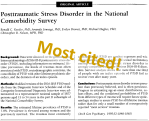
Meanwhile, I have had a look at which publications have been most influential in terms of citations. For the methods (e.g., I have excluded articles focused on measures), see below. These are the most cited papers, with links to free full-text pdfs or abstracts:
I knew only about half of this list…so I’ll have to catch up on some reading A number of articles describe the epidemiology of posttraumatic stress, while others are more theoretical in nature or review a body of literature. For me, I think the second and third types have been more influential than the first. I’ll do a specific search for papers on children and adolescents, and compare them with my personal list next week.
- Kessler et al. (1995) Posttraumatic stress disorder in the national comorbidity survey. Archives of General Psychiatry. 3437 citations
- Breslau et al. (1991) Traumatic events and posttraumatic stress disorder in an urban population of young adults. Archives of General Psychiatry. 1181 citations
- Kendall-Tackett et al. (1993) Impact of sexual abuse on children: A review and synthesis of recent empirical studies. Psychological Bulletin. 981 citations
- Ehlers & Clark (2000) A cognitive model of posttraumatic stress disorder. Behaviour Research and Therapy. 978 citations
- Brewin et al. (2000). Meta-analysis of risk factors for posttraumatic stress disorder in trauma-exposed adults. Journal of Consulting and Clinical Psychology. 976 citations
- Hoge et al. (2004). Combat duty in Iraq and Afghanistan, mental health problems, and barriers to care. New England Journal of Medicine 351. 965 citations
- Resnick et al. (1993). Prevalence of civilian trauma and posttraumatic stress disorder in a representative national sample of women. Journal of Consulting and Clinical Psychology. 887 citations
- Breslau et al. (1998). Trauma and posttraumatic stress disorder in the community: The 1996 Detroit area survey of trauma. Archives of General Psychiatry. 824 citations
- Sapolsky (2000). Glucocorticoids and hippocampal atrophy in neuropsychiatric disorders. Archives of General Psychiatry. 806 citations
- Bremner et al. (1995). MRI-based measurement of hippocampal volume in patients with combat- related posttraumatic stress disorder. American Journal of Psychiatry. 798 citations
- Ozer et al. (2003). Predictors of posttraumatic stress disorder and symptoms in adults: A meta-analysis Psychological Bulletin. 726 citations
- Galea et al. (2002). Psychological sequelae of the September 11 terrorist attacks in New York City. New England Journal of Medicine. 713 citations
- Campbell (2002). Health consequences of intimate partner violence. Lancet. 689 citations
- McEwen (2000). The neurobiology of stress: From serendipity to clinical relevance. Brain Research. 661 citations
- Heim et al. (2000). The potential role of hypocortisolism in the pathophysiology of stress-related bodily disorders. Psychoneuroendocrinology. 627 citations
- Nolen-Hoeksema (1991). A Prospective Study of Depression and Posttraumatic Stress Symptoms After a Natural Disaster: The 1989 Loma Prieta Earthquake. Journal of Personality and Social Psychology. 615 citations
- Foa et al. (1991). Treatment of posttraumatic stress disorder in rape victims: A comparison between cognitive-behavioral procedures and counseling. Journal of Consulting and Clinical Psychology. 571 citations
- Helzer et al. (1987). Post-traumatic stress disorder in the general population: Findings of the epidemiologic catchment area survey. New England Journal of Medicine. 564 citations.
- Bremner et al. (1997). Magnetic resonance imaging-based measurement of hippocampal volume in posttraumatic stress disorder related to childhood physical and sexual abuse – A preliminary report. Biological Psychiatry. 549 citations
- Rauch et al. (1996). A symptom provocation study of posttraumatic stress disorder using positron emission tomography and script-driven imagery. Archives of General Psychiatry. 534 citations
(Method: I did a search in Scopus (“posttraumatic stress” OR “post-traumatic stress” OR “traumatic stress” OR “post-trauma stress” OR “traumatised” OR “traumatized” OR ”PTSD” in the title or abstract), had them listed according to number of citations and selected the papers that focused on posttraumatic mental health, excluding articles on instruments.)

- van der Kolk, BA, Pelcovitz, D, Roth, S, Mandel, FS, McFarlane, A, and Herman, JL. (1996). Dissociation, Affect Dysregulation and Somatization: The complex nature of adaptation to trauma. American Journal of Psychiatry, 153(7), Festschrift Supplement, 83-93.
- Shore, AN. (2001). The Effects of Early Relational Trauma on Right Brain Development, Affect Regulation, and Infant Mental Health. Infant Mental Health Journal, 22; 201-269.
- Tedeschi, RG, and Calhoun, LG. (2004). Posttraumatic Growth: Conceptual Foundations and Empirical Evidence. Psychological Inquiry, Vol. 15, No 1; 1-18.
- Porges, SW. (1995). Orienting in a defensive world: Mammalian modifications of our evolutionary heritage. A Polyvagal Theory. Psychophysiology, 32; 301-318.
- Lamagna, J and Gleiser, KA. (2007). Building a Secure Internal Attachment: An Intra-Relational Approach to Ego Strengthening and Emotional Processing with Chronically Traumatized Clients. Journal of Trauma & Dissociation, Vol. 8(1); 25-52. doi:10.1300/J229v08n01_03


 ,
by Stephen Joseph, on the other hand, looks at the potential benefits
of using trauma as a springboard for furthering personal growth.
,
by Stephen Joseph, on the other hand, looks at the potential benefits
of using trauma as a springboard for furthering personal growth.