Ravel Plays Ravel: The Haunting, Melancholy ‘Oiseaux Tristes,’ 1922
January 17th, 2013
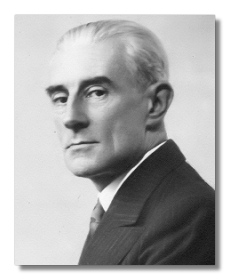
Yesterday we featured a piano-roll recording of the French composer Claude Debussy playing his “La soirée dans Grenade” in 1913. Today we bring you a lyrical and melancholy work recorded in 1922 on a similar device by Debussy’s younger friend and rival, Maurice Ravel. It’s called ”Oiseaux tristes,” or “Sad birds.”
The impetus for composing the piece came in 1904, when Ravel heard a second-hand account of something Debussy had said. According to Alexis Roland-Manuel, Ravel’s friend and biographer, Debussy had told the pianist Ricardo Viñes that when writing his experimental piece, “D’un cahier d’esquisses,” he had been “dreaming of a kind of music whose form was so free that it would sound improvised, of works which would seem to have been torn out of a sketchbook.” Viñes recounted Debussy’s statement at a meeting of “Les Apaches,” a group of radical writers, artists and musicians, of which Ravel was a member. Ravel responded by saying that he was ready to put Debussy’s dream into action. He drew his inspiration from an experience he had one morning in the forest at Fontainbleau. Ravel’s friend and former music school classmate Émile Vuillermoz remembered:
He was staying with friends and one morning he heard a blackbird whistling a tune and was enchanted by its elegant, melancholy arabesque. He had merely to transcribe this tune accurately, without changing a note, to produce the limpid, poetic piece which spiritualises the nostalgic call of this French brother of the Forest Bird in Siegfried.After the meeting, Ravel set to work on the E-Flat Minor “Oiseaux tristes,” which he dedicated to Viñes and included in his five-piece suite, Miroirs. “Oiseaux tristes is the most typical of my way of thinking,” Ravel wrote in his 1928 autobiographical sketch. “It evokes birds lost in the oppressiveness of a very dark forest during the hottest hours of summer.”
Ravel recorded “Oiseaux tristes” and four other pieces in London on June 30, 1922, using a Duo-Art reproducing piano. Unlike the Welte-Mignon machine used by Debussy in 1913 (Ravel also made a pair of recordings on the Welte-Mignon at about the same time as Debussy) the Duo-Art system did not automatically record the dynamics of the performance. So when Ravel played “Oiseaux tristes” at the studio in London, there was an engineer seated next to him at a console, turning dials to capture the dynamic modulations in his playing. Afterward, Ravel listened to a playback on a pianola and, satisfied with the results, signed his name on the original roll.
Maurice Ravel: Piano Concreto in G Major, Hélène Grimaud, pianist.