Showing posts with label mystical states. Show all posts

Tuesday, February 26, 2013

This is Your Brain on Sex and Religion: Experiments in Neuroscience


This is an older video from Open Culture (from December, 2011), but I had never seen it and it's pretty cool. There are 80 brain regions involved in the female orgasm - that's pretty amazing.

This is Your Brain on Sex and Religion: Experiments in Neuroscience


December 6th, 2011


Female Brain Orgasm Video

If you attended the recent Society for Neuroscience conference, you had the chance to see some unprecedented 3D imaging of the brain — images that showed the exact order in which women’s brain regions (80 in total) are activated in the sequence leading to an orgasm. For Barry Komisaruk (professor of psychology at Rutgers University), this imaging isn’t gratuitous. The whole point is to demystify how the brain experiences pleasure, something that could eventually inform our understanding of addiction and depression. Komisaruk said:

It’s a beautiful system in which to study the brain’s connectivity. We expect that this movie [above], a dynamic representation of the gradual buildup of brain activity to a climax, followed by resolution, will facilitate our understanding of pathological conditions such as anorgasmia by emphasizing where in the brain the sequential process breaks down.


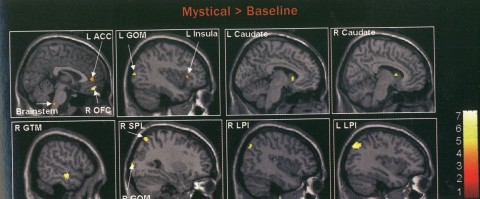
Meanwhile, back at the neuroscience ranch, researchers are also using imaging technology to observe the human brain in another state, the state where people experience mystical awakenings during prayer and meditation or other spiritual epiphanies. Scientific American took a fairly deep look at this cutting-edge field several years ago (read the full piece here), and now NPR has produced a multimedia glimpse into the evolving science of spirituality. The presentation (click here or the image above) combines audio, video, articles, book excerpts, etc. and delves into the fundamental question: Is God a delusion created by brain chemistry, or is brain chemistry a necessary conduit for people to reach God?

If you want to learn more about the brain and neuroscience, don’t miss the courses listed in the Psychology/Neuroscience section of our big collection of Free Online Courses.

Time and The Guardian have more on the first story above here and here.
Sunday, November 04, 2012

Psilocybin, Personality, the Brain, and Terminal Illness

A recent study from John Hopkins University looked at the possibility of personality change (using the Big 5 Personality Measure) after 2-5 sessions of psilocybin experience. The original paper, which is available online (citation below), found that only one of the Big 5 traits (extroversion, neuroticism, agreeableness, openness, and conscientiousness) was affected - openness - and only if the subject reported a “complete mystical experience” while on the drug. The change was still present at an 14-month follow-up.

Below are several related articles - first a brief summary of the research from Raw Story, then three diffetrent responses from . I have also included links to some relevant articles mentioned in the posts. 

Please follow the title links to Scott McGreal's articles - he's asked that they not be reproduced here. I have included two paragraphs from each to torque your interest.

Main Article:
MacLean, KA, Johnson, MW, and Griffiths, RR. (2011) Mystical experiences occasioned by the hallucinogen psilocybin lead to increases in the personality domain of openness. Journal of Psychopharmacology, 25(11) 1453–1461. DOI: 10.1177/0269881111420188

Other Articles of Interest:
* * * * *

Study finds ‘magic mushrooms’ may improve personality long-term

By David Edwards
Thursday, September 29, 2011


A new study suggests that a single dose of psilocybin — the active ingredient in “Magic Mushrooms” — can result in improved personality traits over the long term.

Researchers at the Johns Hopkins University School of Medicine found that individuals who received the drug once in a clinical setting reported a greater sense of “openness” that often lasted 14 months or longer, according to study published this week in the Journal of Psychopharmacology.

The study defined openness as a personality trait that “encompasses aesthetic appreciation and sensitivity, imagination and fantasy, and broad-minded tolerance of others’ viewpoints and values.” It is one of five main personality traits that are shared among all cultures worldwide.

Of the 51 participants, 30 had personality changes that left them feeling more open. Other personality traits (extroversion, neuroticism, agreeableness and conscientiousness) were not impacted. Only the participants who said they had a “complete mystical experience” while on the drug registered an increased sense of openness.

“The mystical experience has certain qualities,” lead author Katherine MacLean said. “The primary one is that you feel a certain kind of connectedness and unity with everything and everyone.”

Because personality traits are generally considered to remain stable throughout a persons lifetime, researchers are excited about therapeutic implications of the study.

“[T]his study shows that psilocybin actually changes one domain of personality that is strongly related to traits such as imagination, feeling, abstract ideas and aesthetics, and is considered a core construct underlying creativity in general,” study author Roland R. Griffiths told USA Today. “And the changes we see appear to be long-term.”

Griffiths is researching whether the drug can help cancer patients deal with depression and anxiety or help smokers curb their habit.

“Certainly we want to underscore do not try this at home,” he added. “Because clearly there are several kinds of potential downsides. One is that personality changes are personality changes. Now, we don’t have any reason to think that the changes we see are toxic in any way. It appears to be a change that people value in a positive way. But certainly more research needs to be done.”

In a smaller study published earlier this year, Johns Hopkins scientists determined the the proper dose levels needed to create positive changes in attitudes, mood, life satisfaction, and behavior.

* * * * *

Psychedelics research sheds new light on the biological basis of personality.

Psilocybe mexicana, a source of psilocybin

Recent research suggests fascinating connections between the effects of the psychedelic drug psilocybin and personality traits related to inner experience. Personality appears to influence response to psilocybin and psilocybin can promote changes in personality, suggesting a reciprocal relationship. Further research in this area could lead to new insights into the basis of human personality and creativity.
A review of studies on factors affecting response to psilocybin found that after dosage, the strongest predictor of alterations in consciousness was the personality trait of absorption (Studerus, Gamma, Kometer, & Vollenweider, 2012). Absorption is defined as a person’s tendency to have episodes of “total” attention where a person’s awareness is fully engaged in whatever has their interest. The degree to which people had “mystical” type experiences while on psilocybin was related to their individual proneness to absorption. Absorption is associated with the broader personality trait openness to experience, which relates to a person’s receptiveness to new ideas and experiences.

* * * * *

A brain imaging study of psilocybin revealed unexpected findings.

This post is a response to Psilocybin and Personality by Scott A. McGreal, MSc.

As reported in a previous article, a number of fascinating studies recently have focused on the effects of the drug psilocybin, a classic psychedelic drug. Scientists still do not have a good understanding of the brain mechanisms by which psilocybin produces its effects. A recent study used brain scanning (specifically, functional magnetic resonance imaging) to obtain a window into the brain of 30 volunteers injected with this drug in order to understand what happens during the transition between normal waking consciousness and the onset of drug effects (Carhart-Harris et al., 2012). The researchers were surprised to discover that drug effects were associated with decreases in activity in a number of key brain areas, rather than the expected increase. This finding has led to speculations about the relationship between brain activity and mystical states experienced under psychedelic drugs. However, the actual implications of the study’s findings are far from clear.


In this study, participants received two brain scans each, once after receiving a saline injection, and once after receiving a psilocybin injection. The effects on brain activity were then compared. After receiving psilocybin brain blood flow decreased, indicating reduced activity. In particular, activity in areas regarded as important network hubs that maintain the connectivity of the various areas of the brain showed the most consistent deactivation. These areas are known as the medial prefrontal cortex (mPFC) and the posterior cingulate cortex (PCC). (If you’re put off by neuroscience please don’t quit reading just yet! I’ll try to keep the brain science as simple as possible.) These two areas appear to play important roles in the regulation of self-awareness as they are particularly activated when people are asked to think about themselves for example (Wicker, Ruby, Royet, & Fonlupt, 2003). The authors thought it was quite interesting that these areas actually show much higher activity than other parts of the brain under normal conditions, yet showed the greatest deactivation under the drug. Additionally, the intensity of the alterations of conscious experience reported by the volunteers was proportional to the decrease in brain activity. That is, the more brain activity decreased, the more vivid the “trip” experienced.

    * * * * *

    Psilocybin may help improve quality of life in terminally ill people. 

    This post is a response to Psilocybin and Brain Function by Scott A. McGreal, MSc. 
    A recent study of people with advanced-stage cancer found that a single dose of psilocybin led to lasting improvements in anxiety and depression. Psilocybin might enhance mood by shifting attention away from negative and towards positive emotional information. Mystical experiences occurring under the influence of psilocybin could help ease existential anxiety by changing a person’s attitudes towards death and dying. Although these results are promising, research studies in this area have not used adequate experimental controls and therefore these results should be considered tentative until more rigorous research has been conducted.  

    A pioneering study in the 1970s found that psychotherapy combined with the use of psychedelic drugs such as LSD appeared to help to reduce depression, physical pain and anxiety about death in people with terminal cancer (Grof, Goodman, Richards, & Kurland, 1973). The authors’ impression was that the patients who made the most dramatic changes were those who had a “peak mystical experience” of oneness with the universe usually preceded by an experience of spiritual “death and rebirth”. Profound experiences of this nature were seen in 25% of sessions. The authors argued that profound religious and spiritual experiences, such as a “peak mystical experience” were particularly effective in helping patients accept death. However, they also noted that other kinds of emotional improvements frequently occurred even without the presence of a mystical experience.

    Tuesday, May 15, 2012

    IONS Teleseminar - "Psilocybin and Quantum Change in Attitude and Behavior" with Roland Griffiths

    Very cool teleseminar from IONS (Institute of Noetic Sciences) featuring Dr. Roland Griffiths, Professor in the Departments of Psychiatry and Neurosciences at the Johns Hopkins University School of Medicine. He is the author of more than 325 papers and book chapters (as of March, 2011), with areas of specialization in behavioral pharmacology, drug self-administration, anxiolytics/sedatives, caffeine, and - most relevant to this podcast - hallucinogens.

    According to the IONS site for Griffiths:
    He has an interest in meditation and is the lead investigator of the psilocybin research initiative at Johns Hopkins, which includes studies of psilocybin occasioned mystical experience in healthy volunteers and cancer patients, and a pilot study of psilocybin-facilitated smoking cessation.

    Enjoy the podcast.

    "Psilocybin and quantum change in attitude and behavior" with Roland Griffiths


    "Psilocybin and quantum change in attitude and behavior" with Roland Griffiths


    Visionary: Roland Griffiths

    Quantum change refers to sudden, distinctive, benevolent, and enduring experiences resulting in personal transformations that affect a broad range of personal emotions, cognitions and behaviors.  Although the phenomenon of quantum change has been well described for over 100 years, it has rarely been addressed within modern psychology and there are few meaningful prospective experimental studies because such experiences usually occur at low rates and often unpredictably.  Two recent double-blind studies have shown that under carefully controlled conditions psilocybin can cause profound personally and spiritually meaningful experiences (i.e., mystical-type experiences) in the majority of healthy participants.  The experiences mediate sustained positive changes in behavior and attitudes.  As assessed with questionnaires, most volunteers had a “complete” mystical-type experience after a high dose of psilocybin, although more than a third of volunteers also indicated they had experiences characterized by fear, anxiety, or unpleasant psychological struggle sometime during the session.
    The overall finding that psilocybin can occasion, in most people studied, mystical-type experiences having sustained personal meaning and spiritual significance, indicates that such experiences and the changes they produce are now amenable to rigorous prospective scientific study.  Several ongoing studies are discussed, including a study of psilocybin on meditation and spiritual practice in healthy volunteers, a study of psilocybin in psychologically distressed cancer patients, and a study of psilocybin-facilitated treatment of drug cigarette smoking cessation.

    "Shifting Paradigms" Teleseminar Series

    Download as mp3

    Publication Date: 2011-02-09

    Length: 00:57:12