Showing posts with label lucid dreams. Show all posts

Wednesday, May 20, 2015

Arthur Gillard Interviews the Creators of the SF / Lucid Dreaming Web Series "Anamnesis"

http://www.world-of-lucid-dreaming.com/image-files/anamnesis-the-lucid-dreaming-web-series.jpg

The following is a guest post from my friend Arthur Gillard. He recently interviewed the creators of the science fiction/lucid dreaming web series, Anamnesis. Here is a brief synopsis of the series, from the website:
When a woman dreams of her boyfriend’s death on the same night he’s murdered, she and a group of strangers begin to unravel a greater mystery by journeying into their subconscious.
An abbreviated version of this interview will appear soon in Lucid Dreaming Experience, a free online journal.

Enjoy the FULL interview!

Photo original

* * * * *

Interview with the Creators of the SF/ Lucid Dreaming Web Series Anamnesis by Arthur Gillard

Anamnesis is a science fiction web series about lucid dreaming based on an original short film of the same name. It has been getting a great deal of positive attention in the lucid dreaming community based on its accurate and realistic portrayal of lucid dreaming, as well as its compelling storyline, good acting, professional production values, and gorgeous cinematography. I had a chance recently to interview Alex Calleros, writer and director of the original short, and Michael Tucker, who co-wrote and co-directed the web series with Alex. 

The following interview may contain some spoilers, so I recommend watching the original short and the five episode web series before reading the interview. You can see the original short here, and the web series here. Altogether it takes a little over an hour to watch. 

You can find out more about the series by following them on Google Plus, Twitter [@AnamnesisSeries], or Facebook, or via email at info@finite-films.com

(Disclosure: I've agreed to manage the Anamnesis Google Plus page on a volunteer basis, without compensation.)

Arthur Gillard: Why did you decide to make a film/web series about lucid dreaming? Was it inspired by your own experiences with lucidity, or did you simply find the subject intriguing?

Alex Calleros: I’ve always been intrigued by the relationship between cinema and dreams. The experience of watching a film is often thought of as entering a sort of dream-state, and many of my favorite films play with questions of reality, consciousness, etc. The Matrix, Inception, Eternal Sunshine of the Spotless Mind—these films were huge influences for me as a filmmaker and I had always wanted to play in the world of dreams using cinema. So, when I had the opportunity to write and direct the short film in 2012, it was a chance to finally make a film that essentially takes place entirely in the dream world. One of my favorite films is The Fountain, which explores the theme of death in an incredibly profound way, and that was also a huge influence on the short film.

Michael Tucker: When we began thinking of how to continue the short film (which has a pretty definite conclusion), we played around with a lot of ideas. Alex’s close friend Gary Ruiz was very into lucid dreaming and had talked to Alex about it. The idea of becoming lucid within a dream world and being able to manipulate your surroundings fascinated us and seemed like a great concept to play with cinematically, as well as an idea we hadn’t seen done before. So we spent time researching lucid dreaming techniques and experiences, and grew attached to the idea of trying to portray the sensation of dreaming as accurately as possible. We didn’t want it to be blurry and fuzzy like how dreaming is often shown in TV shows, but we also didn’t want it to be as rigid and straight-forward as Inception. So finding that balance was our guiding light, and hopefully we achieved that to some degree.

Arthur: Could you explain the meaning of the word “anamnesis,” and how that relates to the themes explored in the series and the original short film?

Alex: The Google definition of anamnesis is:
1) recollection, in particular
2) the remembering of things from a supposed previous existence

I first discovered the word being used in a philosophical / spiritual context—anamnesis was used to describe the process of “awakening to” or “remembering” one’s true nature or identity. The original short film explores the theme of identity—who are you, really? That’s the question being asked of the main character, Adam, throughout the short. His process of remembering what he had forgotten forms the arc of the story, and I thought the word “anamnesis” represented that arc perfectly.

Arthur: How does the web series relate to the original short? Is it a straightforward continuation, or is it more like a reboot, a variation on a theme?

Michael: We wanted the web series to stand on its own for anyone who hadn’t seen the original short, but we also wanted people that had seen the short to be able to watch it as a continuation. So even though stylistically-speaking there are differences between them, story-wise we tried to make it as directly connected as we could.

Arthur: I understand that lucid dreaming expert and author Daniel Love consulted on the show. How did he get involved, and how closely did he work with you? Did he review scenes in the script and suggest changes? Did he suggest any details or scenes to include?

Michael: Daniel Love contacted us after he stumbled upon our Kickstarter campaign. He had just finished his book on lucid dreaming, “Are You Dreaming?” and sent us free copies to check out. We also took him up on his offer to look over the scripts as we were finalizing them, and he made several suggestions of how to tweak things so that they would be more accurate. He explained some reality tests that we hadn’t heard of, and helped us pinpoint exactly where and when the characters might use them. And since the series has released, he’s connected us with a lot of the lucid dreaming community, which has been amazing. So overall Daniel Love was a really big help.

Arthur: Who among the cast and crew of Anamnesis is a lucid dreamer? Could you share some of your own lucid dreams? Please go into as much detail as you are willing. To what extent did lucid dreams of the cast and crew influence how dreams are portrayed? Did working on Anamnesis influence your dreams?

Alex: Brad C. Wilcox, who plays Noah, had frequent lucid dreams for a period of his life. In fact, they had gotten so constant that he had to “cut back,” as he wasn’t feeling properly rested in the morning.

Michael: Zach Brown plays Sean, the show’s expert lucid dreamer. To prepare for the role, Zach researched lucid dreaming and practiced it in his daily life. He would actually draw the letter “A” on his hand, as Sean does in the show, as a reminder to ask himself, “Am I awake?” He told us about a lucid dream he had in which Whoopi Goldberg was his dream guide. It sounded pretty awesome.

Alex: I had a really striking wake-induced lucid dream during the production of Anamnesis. I had woken up extra-early one morning, and as I was falling back asleep I managed to maintain awareness. I’ll never forget the moment I passed into the dream state: all at once, I felt my body launch off the bed and hover for a moment near the ceiling of my bedroom. I passed through some sort of portal and found myself floating above the swimming pool in my childhood backyard in Arizona. I didn’t really have any control over what was happening; I was just along for the ride. My dream body plunged into the pool, where I was delighted to find I could breathe underwater. I looked up and watched in awe as raindrops created thousands of intricate ripples on the surface of the water. A red Arizona dust storm colored the sunlight filtering into the water. It was one of the most vibrant, beautiful visions I’ve ever had...so beautiful that I got excited and promptly woke up. But that one really stuck with me.

Michael: The only lucid dream that I can for sure say was me becoming lucid happened during the midst of shooting the series. Between researching lucid dreaming, and writing the scripts, and then filming all the scenes, all of that information was swirling around in my head all the time. In my dream, I was in my high school cafeteria, looking around, when suddenly I remembered one of the reality tests that the character Hannah does in the show. She pinches her nose with her fingers in such a way that she shouldn’t be able to breathe in—but she can. So I thought, “eh, may as well give it a try and see what happens.” So I pinched my nose and then breathed in—and it worked! I suddenly realized I was dreaming, and immediately did a slow-motion backflip into the air and started to fly. I remember I knew exactly how to control my body in flight, how to turn, spin, everything. Unfortunately I became really overwhelmed by the excitement of it all. I tried to calm myself down so I wouldn’t wake up, but it was all too much and I woke up almost immediately after I started flying. It was a pretty awesome experience.

Arthur: I found the original short film particularly moving. The repeated inquiries into Adam's true identity and the suggestion that he was now “who he had always been” were suggestive and yet open to interpretation by the viewer—almost like a Zen koan, inviting a deeper look at one's own ultimate identity. Did any particular spiritual tradition or school of thought inform the original short film?

Alex: We made the short film as part of this year-long project where we asked our audience to send us 1-sentence constraints that we’d have to follow in our next film. One of the constraints for Anamnesis was: “The dialogue from one scene must be exactly the same in one scene as it is in another,” which fortuitously led to the idea of posing this question “Who are you?” to Adam throughout the movie. I definitely wanted to tap into a “Zen koan” feel with those repeated inquiries. Only at the end does he understand the at-first puzzling answer, “You’re who you’ve always been.”

Over the past several years, I’ve been really interested in Western-born philosophers who take the deep wisdom embedded in Eastern religions (Buddhism in particular) and translate/update them for the modern age. Alan Watts was one of the first to do this in the 50’s and 60’s, and hundreds of audio recordings of his wonderful lectures are widely available online today. Listening to him speak is both enlightening and incredibly fun (he’s got a delightful British accent and a sharp sense of humor). I’m also very interested in the work of American philosopher Ken Wilber, who has pioneered a movement to see the world “integrally,” integrating the truths of science, psychology, art, spirituality, etc. I believe I actually discovered the word “anamnesis” while reading an article by Wilber.

Arthur: In the original short, Hannah is seemingly portrayed as a powerful lucid dreamer, for example creating portals from one dream scene to another. “I know my way around in here,” she remarks to Adam at one point. In the series, it's less clear that she's lucid dreaming. Based on the short film I see her in the series as dreaming lucidly, probably assuming that Sean is a character in her dreams. Is that an accurate interpretation? Will we see Hannah coming forth again as a powerful lucid dreamer in her own right in future episodes?

Alex: I’ll be honest, when we made the short film, we weren’t even sure Hannah was a “real” character or simply a figment of Adam’s imagination fashioned after his memory of Hannah. Once we had the opportunity to create a web series based on the short, we came up with the premise that it was actually the real Hannah, and that she was somehow sharing a dream with Adam.

All that said, I’d argue that Hannah wasn’t particularly lucid in the short film. She “knew her way around” and kind of went with the flow, but really it was Adam’s subconscious driving the whole dream forward, she was just along for the ride. When she wakes up in Episode 01 of the web series, Hannah has a very foggy memory of the dream, and only remembers it in flashes when she comes across dream signs in her waking life (the water glass spilling, the copy shop, etc.), which further suggests she wasn’t fully lucid.

The first time I think Hannah actually becomes lucid in the series is Episode 04, when Sean calls to her attention that they’re in a dream and teaches her about reality tests. In a lot of ways, the long-term trajectory we see for the characters in Anamnesis is a journey from being “asleep” to becoming “lucid” or “awake”—in more ways than one.

Arthur: I've recently finished re-reading Patricia Garfield's excellent book The Dream Messenger: How Dreams of the Departed Bring Healing Gifts, which explores the various kinds of dreams people have after a loved one has died, and the role such dreams play in the healing process. This seems like a rich potential territory to explore in Anamnesis. Might Adam start showing up in Hannah's or Vera's dreams in future episodes?

Alex: We’ve definitely talked about this as a possibility. We’d love to bring Adam back in some fashion. If Hannah continues to become more lucid in the dream world, it’s kind of inevitable that he’ll show up in some form or another.

Arthur: Is there any significance to the names of the characters? “Vera,” for example, reminded me of veritas, truth, the idea that “the truth shall set you free.” She certainly seems happy to break rules in an attempt to uncover the truth.

Michael: In general we didn’t choose the character names specifically because of their meanings. For the most part, we based it on which names sounded good and felt like they matched the characters. Vera is a name I’ve always liked, both because of how it sounds and because of its meaning, and I think it fits Vera’s character really well for exactly the reason you mentioned. Noah’s name is also an obvious reference, but that wasn’t the only reason we chose it for him. We love it when elements of a story can have deeper meanings, but I also think you can go overboard with that to the point that it’s hitting the audience over the head with it. Inception, for instance, is not subtle at all when it comes to character names having deeper meanings—which while cool, I found more distracting than anything else.

Arthur: Whereas the original short is completely self-contained, the series continues to get more complex and mysterious episode-by-episode, leaving the viewer hungry for more. Are you planning to make more episodes? If so, do you have an overall story arc in mind for the show? Can you say anything about specific ideas or themes you'd like to explore in future episodes?

Alex: When we were brainstorming what we wanted to do with the web series, one of our main inspirations was Lost, which unraveled an incredibly intricate mystery over several seasons. We wanted to see if we could pull off the same kind of science-fiction mystery in the world of lucid dreaming—but actually know where it was all going, from the very first episode. So yes, we definitely have an overall story arc in mind for the show. It will probably change and evolve if we get to make more episodes, but there are clues hidden as early as Episode 01 as to what’s coming next.

Arthur: You explore a number of dream themes in the series—lucid dreaming, of course, but also night terrors and out-of-body experiences. In future episodes, do you plan to explore a greater variety of dream and dreamlike states, such as false awakenings, sleep paralysis, hypnagogia?

Michael: If we get to make more episodes we would absolutely want to explore more of these dream / dreamlike states. I get excited about there being so many interesting experiences to be played with, that they all lend themselves so well to film. The medium of film can convey the dream experience better than any other, in my opinion, and we have a lot of fun as filmmakers coming up with ways to translate these dream experiences to the screen. In particular, I find the idea of sleep paralysis terrifying...so it’d be fun to play with that on screen.

Arthur: The first season of Anamnesis was made possible through a highly successful Kickstarter campaign, in which you raised 151% of the money you were asking for. If you make more episodes, how do you plan to finance them? How can fans of the series support you in making more episodes?

Michael: Figuring out how to finance more episodes is the main challenge we’re facing right now. It blew us away that we surpassed our funding goal on Kickstarter, and we combined that with funding from FilmSkillet.com, whose founder, Jeremy Norris, reached out to us and essentially convinced us to make the web series in the first place. But even with these combined funds, Anamnesis was primarily a labor of love. We didn’t have enough to pay most of the cast and crew, and almost all of the money went to locations, food, and equipment rentals.

If we were to make more, we would have to be able to pay all the cast and crew for the excellent work that they do. And considering the first five episodes are about 70 minutes long, each season is essentially a feature film. So we would need the budget of an indie feature film. Crowdfunding a next season would definitely be an option, but we’re also trying to reach out to websites like Vimeo, for example, who are getting into the original content market. Having a distributor for the series that could also help fund another season would be absolutely great. So the best thing fans can do to help us make more episodes is share the series with anyone and everyone. The more we can show that we have a large group of dedicated fans, the more likely we can raise money via crowdfunding and the easier it would be to convince a potential distribution partner.

Arthur: What do you think of YouTube's plan to start offering an ad-free subscription service? How might that affect Finite Films?

Michael: I understand that YouTube has been trying to figure out how to make a profit since they first began, but this feels somewhat like a betrayal of what has made YouTube so popular in the first place. There is a freedom and accessibility that YouTube has (which admittedly comes with some chaos and a lot of junk) that I think may be tainted by a subscription fee. Especially if they keep forcing unskippable ads onto every video to make the viewing experience more unpleasant in order to convince people to pay the subscription fee.

On the other hand, if it means that they’re helping content creators like ourselves get something more out of it (financially speaking), then perhaps they’re incentivizing and enabling people to make more quality content. Ultimately I think it will depend largely on how much the subscription fee is, and how optional they make it feel. If it’s $2.99 a month, maybe that’s an okay deal that feels worthwhile; if it’s $19.99 a month and every YouTube video has a 2-minute unskippable ad—then I think that will be bad for views, for content creators, and for YouTube. I guess we’ll just have to wait and see.

Arthur: What has been the reaction of the lucid dreaming community to Anamnesis? How do people without prior experience with lucid dreaming react to the show?

Alex: Honestly, we’ve been blown away by the reception we’ve had in the lucid dreaming community. We wanted Anamnesis to represent the experience of lucid dreaming in a more accurate way than we’d seen in other films and TV shows, and so to have such a positive response from the community has been incredible. Our fans in the lucid dreaming community really are the primary reason we want to find a way to finance and produce more episodes. We’ve also had great responses from our non-lucid-dreamer fans, and we’re now looking to try to expand our audience beyond the lucid dreaming niche into communities that value thoughtful science fiction / drama storytelling.

Arthur: Are there any particular resources—books, websites, etc.—that you would recommend to people wanting to more deeply explore lucid dreaming?

Alex: Are You Dreaming by Daniel Love provides a great introduction to the world of lucid dreaming. He developed the CAT (Cycle Adjustment Technique) for generating frequent lucid dreams, which he outlines in his book. Our friend Jay Mutzafi (aka Lucid Sage and host of The Lucid Dreaming Podcast) highly recommends Stephen LaBerge’s Lucid Dreaming: AConcise Guide to Awakening in Your Dreams and in Your Life as a great place to start one’s lucid dreaming practice. And finally, www.world-of-lucid-dreaming.com has a ton of resources for anyone looking to lucid dream.

Arthur: Thank you for producing such an excellent short film and web series, and in particular for the realistic portrayal of lucid dreaming. I wish you great success and will certainly be doing my part to help spread the word. Is there anything we haven't covered in the interview that you would like to add?

Alex: We’ve had a lot of people ask us if they can buy Season One of the series on DVD, and we’re currently putting together a DVD / Digital Download package that will include some exclusive special features. For updates on all things Anamnesis, people can follow us on Facebook, Twitter [@AnamnesisSeries], and Google Plus (and subscribe to our channel, Finite Films, on YouTube).

From the very beginning, Anamnesis has been a true labor of love and we’ve only made it this far because of the support of our fans. If anyone has any ideas or suggestions for how we can continue to reach out to the lucid dreaming community and rally support for future seasons, don’t hesitate to shoot us an email at info@finite-films.com.

Monday, November 03, 2014

Dreams—The Lucid Experience

http://humanityhealing.omtimes.netdna-cdn.com/wp-content/uploads/2010/11/humanityhealing_lucid-Dreams.jpg

From Australia's  Radio National All in the Mind, this is an interesting discussion of lucid dreaming.

Dreams—the lucid experience


Sunday 2 November 2014
Presenter: Lynne Malcolm

Image: Your dreams can take you anywhere (Paula Danielse, Getty Images)

Have you ever had a dream in which you are aware that you are dreaming? These seemingly altered states of consciousness are called lucid dreams. If you’re not sure of what they are they can be disturbing, but many people use them to solve the problems of their waking lives, or even just for fun. We’ll hear about this experience from a couple of dreamers, and find out about the science of lucid dreaming from one of the world’s leading researchers in the field.

Joining in? We'd love to hear about your own lucid dream experience. Has it had an impact on your waking life?

Transcript Show

Guests
  • Stephen La Berge: Founder, Lucidity Institute 
  • Paul Davies: AM Director of the Beyond Center, Arizona State University 
  • Nano Daemon: Author: 'Fate or destiny?'
Publications

  • Lucid Dreaming: A Concise Guide to Awakening in Your Dreams and in Your Life by Stephen La Berge (01 Feb 2008)
  • Exploring the World of Lucid Dreaming by Stephen La Berge, Howard Rhinegold (27 Oct 1990)
  • The Goldilocks Enigma: Why is the Universe just Right for Life? by Paul Davies (27 Oct 2006)
  • The Eerie Silence: Renewing our Search for Alien Intelligence by Paul Davies (27 Oct 2010)
  • Fate or Destiny? by Nano Daemon (11 Jul 2014)
Further Information 

Sunday, May 18, 2014

Christian Jarrett Questions the Recent Brain Stim-Lucid Dream Article

Last Tuesday (May 13), I posted on the new research in Nature Neuroscience that suggests low-current (gamma range) brain stimulation can induce lucid dreams. Perhaps all of us who jumped on that story were a little hasty.

Shortly after the original research came out, cognitive neuroscientist Christian Jarrett, writing at his WIRED blog, Brain Watch, posted a serious critique of the research and the conclusions reached.

Too bad - it seemed promising, and maybe it still is when the technology is more refined.

Psychologists Give People Control of Their Dreams Using Brain Stimulation. Really?

05.12.14 | By Christian Jarrett


Image: Old Visuals Everett Collection/Getty

My dreams are often like a bad TV night – full of repeats that I’ve slept through many times before. Other people are luckier. Their dreams are more like a movie experience, but one where they not only get to choose the film, they can also take directorial control and influence the course of events. This is known as “lucid dreaming” and considered a half-way house between sleep and wakefulness.

In a study out this week, a team of psychologists led by Ursula Voss at the J.W. Goethe University in Frankfurt, claim to have given non lucid-dreamers the power of lucid dreaming by applying weak electrical current to the surface of their scalps and into their brains.

The rationale behind the study is simple. Past research has associated lucid dreaming with electrical brain activity in the low gamma range – around 40Hz. Voss and colleagues therefore used transcranial alternating current stimulation (tACS) to promote gamma activity in frontal and temporal regions of their participants’ brains, in the hope that this would provoke lucid dreaming (tACS is similar tDCS, which I’ve written about on this blog before).

I have to admit this reasoning tickled my BS-detector a little. Neurobunk research conducted in the 1960s made the mistake of assuming that because experienced meditators exhibit brain activity in the alpha range (around 10Hz), then teaching people to express alpha brainwaves would give them a shortcut to the peace and enlightenment associated with years of meditative practice. It was an elementary case of confusing correlation for causality and results were disappointing.

Despite my initial skepticism, it turns out that, aside from a small sample, this new dream research is well conducted. Voss and her team tested 27 healthy volunteers (15 women, 12 men, none of whom usually have lucid dreams) on four successive nights. Each night, the participants were zapped with electricity in a different frequency range or – and it’s important they included this condition – with no electricity at all (known as a “sham” treatment). The stimulation was delivered after between two and three minutes of uninterrupted REM sleep. Shortly afterwards the participants were woken and they answered questions about the dream they’d just had.

The main result is that stimulation specifically delivered in the low gamma range, at 40Hz, and to a lesser extent at 25Hz, was associated with a greater experience of lucid dreaming, as compared to stimulation at other higher and lower frequencies or to sham treatment. “Our experiment is, to the best of our knowledge, the first to demonstrate altered conscious awareness as a direct consequence of induced gamma-band oscillations during sleep,” the researchers concluded. Excitable headlines have followed, such as “Brain Zap Could Help You Control Your Dreams” and “Having Nightmares? Control Your Dreams With Electric Currents“.

Despite the robust methodology, I think these headlines are getting carried away. Here’s why. Lucid dreaming was defined by higher scores in participants’ feelings of insight (knowing that they were dreaming); dissociation (taking a third person perspective); and control (being able to shape events). I looked up the paper where the researchers first described their scale for measuring these factors. If I understand correctly, the participants rated their experience of these three factors on a scale of 0 (strongly disagree that I had such an experience) to 5 (strongly agree). Now if we look to see the scores they gave for how much dream insight, dissociation and control they had, we find that the averages for the gamma stimulation condition are around 0.6, 1.3, and 0.5 respectively.

Yes, these scores are significantly higher compared with stimulation at other frequencies and with sham treatment, but they are nonetheless incredibly low. A real life creation of the dream control depicted in the movie Inception, this is not! I suppose this study is a proof of principle, so let’s wait and see what comes from future research.

But actually one more thing – these kind of studies that examine the impact of brain stimulation seem so crude. Do the researchers really know what neural effect the stimulation is having and why? I don’t think they do – the explanation in this paper is typically sketchy. “We assume that lower gamma activity is mediated by activation of fast-spiking interneurons that are known to generate gamma oscillations in cortical networks … These networks have been proposed to gate sensory processing, which might also enable lucid dreaming in a temporarily specific manner.” Got that? No, me neither.

Tuesday, May 13, 2014

Induction of Self-Awareness in Dreams Through Frontal Low-Current Stimulation of Gamma Activity

New research released on Sunday suggests that lucid dreaming may be triggered by a non-invasive neural stimulation method called transcranial alternating current stimulation (tACS), which targets low-intensity electricity through the frontal and temporal lobes of the dreamer.

I can see this rapidly becoming a DIY product for the spiritual and self-enhancement markets. But there is also potential (especially in PTSD) to give those suffering nightmares a way to "reframe" the dreamscape.

Pretty cool.

As usual, the full article is safely ensconced behind a paywall to keep the riffraff from having access, so here is the abstract, followed by a summary from IEEE Spectrum.

Full Citation:
Voss, U, Holzmann, R, Hobson, A, Paulus, W, Koppehele-Gossel, J, Klimke, A & Nitsche, MA. (2014, May 11). Induction of self awareness in dreams through frontal low current stimulation of gamma activity. Nature Neuroscience; doi:10.1038/nn.3719

Induction of self awareness in dreams through frontal low current stimulation of gamma activity

Ursula Voss, Romain Holzmann, Allan Hobson, Walter Paulus, Judith Koppehele-Gossel, Ansgar Klimke & Michael A Nitsche

Abstract

Recent findings link fronto-temporal gamma electroencephalographic (EEG) activity to conscious awareness in dreams, but a causal relationship has not yet been established. We found that current stimulation in the lower gamma band during REM sleep influences ongoing brain activity and induces self-reflective awareness in dreams. Other stimulation frequencies were not effective, suggesting that higher order consciousness is indeed related to synchronous oscillations around 25 and 40 Hz.
Here is the summary of the research from IEEE Spectrum:

Zapping Sleepers' Brains Causes Lucid Dreaming

By Eliza Strickland
Posted 12 May 2014

Illustration: Randi Klett

Lucid dreams offer us the heady chance to shape our own fates in a fantasy world. In these dreams, sleepers realize they're dreaming and can sometimes take over their dreams' plots, allowing them to turn the tables on their enemies, soar into the sky, or embrace that special someone. Now, researchers in Germany have demonstrated that they can trigger lucid dreams by zapping sleeping people's brains with electricity.

The researchers used a non-invasive neural stimulation method called transcranial alternating current stimulation (tACS) to send low-intensity electricity through the frontal and temporal lobes of 27 sleepers' brains. These portions of the cerebral cortex are associated with higher order cognitive functions, the researchers write, such as self-reflective awareness, abstract thinking, volition, and metacognition (thinking about thinking). Prior studies have shown that these brain regions are dormant during typical REM sleep, when dreams occur, yet are active during lucid dreams.

The tACS stimulation doesn't cause any noise or sensation, so it could be applied to the sleepers without waking them up. The researchers waited until their monitors showed that the subjects were in REM sleep, turned on the current, then woke them up and asked them about the dreams they were having. The test subjects, none of who had experience with lucid dreaming, rated their dreams on factors like insight into the fact that they were dreaming, control of the dream plot, and dissociation, as if they were watching the dream from a third-person perspective.

Not every jolt of electricity produced a lucid dream report. Crucially, the researchers discovered that the effect depended on the frequency of the stimulation. Using the frequency of 40 Hz, researchers found that 77 percent of the reported dreams were rated lucid. At the frequency of 25 Hz, 58 percent of dreams met the criteria, while other frequencies (2, 6, 12, 70, and 100 Hz) produced a much smaller effect or no effect at all. This makes sense, the researchers say, because prior studies that have recorded the activity of the fronto-temporal lobes during lucid dreams have detected neural oscillations (patterns of neural activity) at the gamma frequency band, centered around 40 Hz. It seems stimulation at that frequency mimicked the brain mechanism that can naturally cause lucid dreams.

But enough with the science, let's hear about those test subjects' dreams. Here are two reports from the paper:
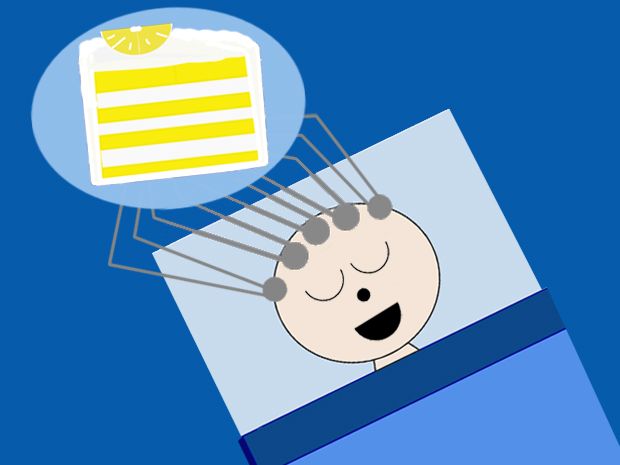
Example of lucid dream report following 40-Hz stimulation: I was dreaming about lemon cake. It looked translucent, but then again, it didn’t. It was a bit like in an animated movie, like The Simpsons. And then I started falling and the scenery changed and I was talking to Matthias Schweighöfer (a German actor) and two foreign exchange students. And I was wondering about the actor and they told me “yes, you met him before,” so then I realized “oops, you are dreaming.” I mean, while I was dreaming! So strange!

Example of a non-lucid dream report (6 Hz): I am driving in my car, for a long time. Then I arrive at this place where I haven’t been before. And there are a lot of people there. I think maybe I know some of them but they are all in a bad mood so I go to a separate room, all by myself.
Neural stimulation is all the rage these days. A DIY community has sprung up around transcranial direct current stimulation (tDCS), a method similar to that used by the German researchers. Brain hackers are experimenting with using tDCS to tweak their cognition in various ways, such as improving memory and speeding up learning. In labs around the world, researchers are also investigating whether tDCS can be used to treat a wide variety of disorders, including depression, ADHD, and chronic pain. The age of brain zapping is upon us!

Monday, May 05, 2014

Vaughan Bell - The Mysteries of 'Lucid' Dreaming

This recent article from Vaughan Bell at The Observer discusses an older article (2012) on lucid dreaming. The researchers were looking primarily at induction techniques and their effectiveness. The induction means included cognitive methods, external stimulation, and drug application, although none of the induction techniques worked on demand. The authors also create a taxonomy of induction methods with the effectiveness evidence levels.
In Bell's summary of the article, he looks more specifically at those subjects who can reliably induce lucid dreaming and what they can teach us about consciousness.

The mysteries of 'lucid' dreaming

Recent research into a kind of consciousness within the dream state is beginning to tell us more about the brain

Vaughan Bell
The Observer, Saturday 26 April 2014


Active participation in experiments is hard when separated from the world by the blanket of sleep. Photograph: Alamy

One of our most mysterious and intriguing states of consciousness is the dream. We lose consciousness when we enter the deep waters of sleep, only to regain it as we emerge into a series of uncanny private realities. These air pockets of inner experience have been difficult for psychologists to study scientifically and, as a result, researchers have mostly resorted to measuring brain activity as the sleeper lies passive. But interest has recently returned to a technique that allows real-time communication from within the dream world.

The rabbit hole between these worlds of consciousness turns out to be the lucid dream, where people become aware that they are dreaming and can influence what happens within their self-generated world. Studies suggest that the majority of people have had a lucid dream at some point in their life but that the experience is not common. As a result, there is now a minor industry in technologies and training techniques that claim to increase your chance of having a lucid dream although a recent scientific review estimated that the effect of any particular strategy is moderate at best. Some people, however, can reliably induce lucid dreams and it's these people who are allowing us to conduct experiments inside dreams.

When trying to study an experience or behaviour, cognitive scientists usually combine subjective reports, what people describe about their experience, with behavioural experiments, to see what effect a particular state has on how people reason, act or remember. But both are difficult in dreamers, because they can't tell you much until they wake up and active participation in experiments is difficult when you are separated from the world by a blanket of sleep-induced paralysis.

This paralysis is caused by neurons in the brainstem that block signals from the action-generating areas in the brain to the spinal nerves and muscles. The shutdown happens when Rapid Eye Movement or REM sleep starts, meaning that dreaming of even the most energetic actions results in no more than a slight twitch. One of the few actions that are not paralysed, however, is eye movement. This is where REM sleep gets its name from and this window of free action provides the lucid dreamer a way of signalling to the outside world.

Using a procedure first verified by sleep researcher Stephen LaBerge, the sleeper can signal to researchers when they have begun their lucid dream by using pre-arranged eye movements. The person moves their eyes in the agreed way in the dream, which occur as genuine eye movements, which are recorded and verified by electrodes that are placed around the eye sockets.

This simple but ingenious technique has allowed a series of experiments on the properties of the dream world and how they are reflected in brain function. These neuroscientific studies have been important for overcoming an initial objection to the concept of lucid dreaming: that lucid dreamers were awake but just relaxed, or perhaps even fraudulent, claiming to be experiencing a dream world when they were not. Studies led by neuropsychologists Ursula Voss and Martin Dresler have shown that the brain activity during lucid dreaming bears the core features of REM sleep but is distinct from both non-lucid dreaming and the awake state, suggesting that it is not just a case of wishful thinking on the part of either the participants or the researchers.

Some of the most interesting studies involve in-dream experiments, where participants are asked to complete pre-arranged actions in their lucid dreams while using eye movements to signal the beginning and end of their behavioural sequences. A recent study by neuroscientist Daniel Erlacher and his colleagues at the University of Bern compared how long it took to complete different tasks while lucid dreaming and while awake. These included counting, walking a specified number of steps, and a simple gymnastics-like routine. They found that the "mental action" of counting happened at the same speed regardless of whether volunteers were dreaming or awake, but the "physical actions" took longer in dreams than in real life. The research team suggested that this might be due to not having the normal sensory feedback from the body to help the brain work out the most efficient way of coordinating itself.

There is also an amateur community of lucid dream enthusiasts keen to explore this unique form of virtual reality. This stretches from the fringes of the New Age movement who want to use lucid dreams to access other planes of existence (best of luck with that), to a more technologically oriented community of dream hackers who sample scientific research to try to find reliable methods for triggering lucidity. The connection with established studies can be a little haphazard and methods veer between the verified and the barely tested. In some online discussion boards, there have been reports of people using medications intended for Alzheimer's sufferers, which have the side-effect of causing vivid dreams, based on little more than hearsay and data reported in a patent application.

Some researchers have highlighted the potential of lucid dreaming to advance the science of consciousness but it's a difficult area to study. The currents of consciousness run unpredictably through the tides of sleep and the science of dreaming is still very much in the age of exploration. It's also a conceptual problem that some feel unequipped to tackle. After all, what can we make of consciousness when it creates a new world and our experience of it?
* * * * *

Here is the original abstract with a list of article highlights.

Full Citation:
Stumbrys, T, Erlacher, D, Schädlich, M, Schredl, M. (2012, Sep). Induction of lucid dreams: A systematic review of evidence. Consciousness and Cognition; 21(3): 1456–1475.

Induction of lucid dreams: A systematic review of evidence

Tadas Stumbrysa, Daniel Erlacherb, Melanie Schädlichc, Michael Schredl

Abstract

In lucid dreams the dreamer is aware of dreaming and often able to influence the ongoing dream content. Lucid dreaming is a learnable skill and a variety of techniques is suggested for lucid dreaming induction. This systematic review evaluated the evidence for the effectiveness of induction techniques. A comprehensive literature search was carried out in biomedical databases and specific resources. Thirty-five studies were included in the analysis (11 sleep laboratory and 24 field studies), of which 26 employed cognitive techniques, 11 external stimulation and one drug application. The methodological quality of the included studies was relatively low. None of the induction techniques were verified to induce lucid dreams reliably and consistently, although some of them look promising. On the basis of the reviewed studies, a taxonomy of lucid dream induction methods is presented. Several methodological issues are discussed and further directions for future studies are proposed.

Highlights

► We carried out a systematic review of lucid dream induction techniques. ► Induction means include cognitive methods, external stimulation and drug application. ► None of the induction techniques work on demand but some look promising. ► Taxonomy of induction methods is presented with the effectiveness evidence levels. ► Methodological considerations and future directions are provided.

Friday, March 14, 2014

Lucid Dreaming with David Eagleman and Henry Rollins


This is an interesting talk between punk musician, author, and all-around interesting guy, Henry Rollins and neuroscientist David Eagleman, author of Incognito: The Secret Lives of the Brain (2011). Thanks to the IEET (Institute for Ethics and Emerging Technologies) for posting this on their site.

Lucid Dreaming


Brainwave 2011 | Posted: Mar 13, 2014


Henry Rollins + David Eagleman


"The assassin of my dreams comes to destroy from the inside"
–Henry Rollins, Hot Animal Machine 2
Punk band original and (out)spoken-word artist Henry Rollins hunts down the assassin of his dreams with neuroscientist David Eagleman.
Henry Rollins joined the Southern California punk band Black Flag as vocalist in 1981. Upon the demise of the legendary rock group he formed Rollins Band and has been making records and touring the world ever since. Beyond taking the stage as a musician, Rollins does speaking dates all over the world and, along with the band dates, has averaged over one hundred shows a year for over thirty years. His most recent tour, Frequent Flyer, spanned seven months and fourteen countries.
A Grammy winner for the performance of his book Get in the Van, Rollins is not one to confine his performances strictly to the stage. He has performed in movies (Bad Boys II, Heat, and the just released The Devil's Tomb) and television shows (IFC's The Henry Rollins Show and FX's Sons of Anarchy). Henry recently filmed a few documentaries for the National Geographic Channel. hosts a weekly Los Angeles-based radio show, and runs 2-13-61, a publishing company he created to release books, CDs, and DVDs.
David Eagleman holds joint appointments in the Departments of Neuroscience and Psychiatry at Baylor College of Medicine in Houston, Texas. His areas of research include time perception, vision, synesthesia, and the intersection of neuroscience with the legal system. He directs the Laboratory for Perception and Action and is the Founder and Director of Baylor College of Medicine's Initiative on Neuroscience and Law. Eagleman has written several neuroscience books, including Incognito: The Brains Behind the Mind (Pantheon, 2011), Wednesday is Indigo Blue: Discovering the Brain of Synesthesia (co-authored with Richard Cytowic, MIT Press), and the upcoming Live-Wired: How the Brain Rewrites its own Circuitry (Oxford University Press, 2012). He has also written an internationally best-selling book of literary fiction, Sum, which has been translated into twenty-two languages and was named a best book of the year by Barnes and Noble, New Scientist, and the Chicago Tribune. Eagleman has written for the New York Times, Discover Magazine, Slate, Wired, and New Scientist, and he appears regularly on National Public Radio and BBC to discuss both science and literature.
Listen/View

Friday, March 07, 2014

Time for Actions in Lucid Dreams: Effects of Task Modality, Length, and Complexity


From Frontiers in Psychology: Consciousness Research, this recent article looks at the nature of time in task performance in lucid dreams vs. waking space. They found that any motor task such as squats (previous study), walking, or gymnastics takes more time in lucid dreams than in the waking world.

Among the questions raised by this study:
Longer durations in lucid dreams might be related to the lack of muscular feedback or slower neural processing during REM sleep. Future studies should explore factors that might be associated with prolonged durations.
I would wager that a significant portion of the difference in time is a result of the lack of muscular feedback in performing the motor task.

Full Citation:
Erlacher D, Schädlich M, Stumbrys T andSchredl M. (2014, Jan 16). Time for actions in lucid dreams: Effects of task modality, length, and complexity. Frontiers in Psychology: Consciousness Research; 4:1013. doi: 10.3389/fpsyg.2013.0101

Time for actions in lucid dreams: effects of task modality, length, and complexity

Daniel Erlacher [1], Melanie Schädlich [2], Tadas Stumbrys [2], and Michael Schredl [3]
1. Institute of Sport Science, University of Bern, Bern, Switzerland
2. Institute of Sports and Sports Sciences, Heidelberg University, Heidelberg, Germany
3. Medical Faculty Mannheim, Central Institute of Mental Health, Heidelberg University, Mannheim, Germany

The relationship between time in dreams and real time has intrigued scientists for centuries. The question if actions in dreams take the same time as in wakefulness can be tested by using lucid dreams where the dreamer is able to mark time intervals with prearranged eye movements that can be objectively identified in EOG recordings. Previous research showed an equivalence of time for counting in lucid dreams and in wakefulness (LaBerge, 1985; Erlacher and Schredl, 2004), but Erlacher and Schredl (2004) found that performing squats required about 40% more time in lucid dreams than in the waking state. To find out if the task modality, the task length, or the task complexity results in prolonged times in lucid dreams, an experiment with three different conditions was conducted. In the first condition, five proficient lucid dreamers spent one to three non-consecutive nights in the sleep laboratory. Participants counted to 10, 20, and 30 in wakefulness and in their lucid dreams. Lucidity and task intervals were time stamped with left-right-left-right eye movements. The same procedure was used for the second condition where eight lucid dreamers had to walk 10, 20, or 30 steps. In the third condition, eight lucid dreamers performed a gymnastics routine, which in the waking state lasted the same time as walking 10 steps. Again, we found that performing a motor task in a lucid dream requires more time than in wakefulness. Longer durations in the dream state were present for all three tasks, but significant differences were found only for the tasks with motor activity (walking and gymnastics). However, no difference was found for relative times (no disproportional time effects) and a more complex motor task did not result in more prolonged times. Longer durations in lucid dreams might be related to the lack of muscular feedback or slower neural processing during REM sleep. Future studies should explore factors that might be associated with prolonged durations.


Introduction


The question of time in dreams is frequently debated in science, philosophy and recently also by Hollywood film makers. For instance, in the movie Inception (Nolan and Thomas, 2010), dream time runs much slower than real time, 5 min of real time equaling 1 h of dream time. The idea, which inspired Christopher Nolan, the director of Inception, that time is scaled down during dreams, can be traced back a century and a half to the work of the French scholar Alfred Maury (1861), who was convinced that dreams are created at the moment of waking up. He based this assumption on a subjectively long-lasting dream about the French Revolution, at the end of which the dreaming Maury was to be beheaded under the guillotine. When he was roughly awoken by a piece of his bed (la flèche de mon lit) which had fallen on his neck, Maury assumed that the whole dream had been created at that very moment, leading up to the guillotine scene.

Maury's dream explanation led to the so-called Goblot hypothesis. In 1896 the French logician Edmond Goblot (1896) proposed that remembered dreams occur during the process of awakening and that a difference exists, therefore, between the time experienced in a dream and the time which actually passes while the dream is taking place. Hall (1981) tried to find evidence to support the Goblot hypothesis by showing that stimuli of a sleeper's surrounding as well as internal stimuli, such as hunger, were represented in the dreams of his subject who had recorded his dreams for two years. While such correspondence was found to some extent, Hall admitted himself that this does not prove that these dreams are generated during awakening, as external and internal stimuli “… are or may be present while we are asleep or before we go to sleep” (Hall, 1981, p. 245). In this approach the assumptions concerning time in dreams were indirect implications of a hypothesis on the origin of dreams in general. The idea that dreams are instantaneous memory insertions experienced at the moment of awakening also plays a major role in philosophical debates, for example in Dennett's cassette-theory of dreaming (Dennett, 1976).

A few years after the discovery of rapid-eye movement (REM) sleep and its initial association with dreaming (Aserinsky and Kleitman, 1953), Dement and Kleitman (1957) explored more precisely the relationship between REM sleep and dream activity. In one of their experiments, they wanted to demonstrate the relation between the lengths of periods of rapid eye movements and the subjects' estimations of how long they had been dreaming. In their study, participants were awakened randomly, either 5 or 15 min after REM onset, and were then asked if they had dreamed 5 or 15 min. In 92 out of 111 awakenings (83%) the participants judged correctly. The authors also found a correlation between the elapsed amount of time and length of dream reports (r = 0.40 to r = 0.71). These results were replicated by other researchers (e.g., Glaubman and Lewin, 1977; Hobson and Stickgold, 1995) and nowadays it is a widely accepted hypothesis that subjectively experienced time in dreams corresponds with the actual time. Yet, a study conducted by Moiseeva (1975) found that in dreams with a complex and bizarre structure or in very emotional dreams, time can be perceived as flowing much faster, exceeding the absolute time span of a dream by 2–10, 25–50 or even 100 times.

While in regular dream studies, this correspondence can only be explored on a correlational basis and retrospectively, a completely different approach opens when conducting studies with lucid dreamers. A lucid dream is defined as a dream during which dreamers, while dreaming, are aware they are dreaming (LaBerge, 1985). Lucid dreams are considered to be mainly REM sleep phenomena (LaBerge, 1990). Lucid dreamers can consciously influence the dream content and are thus able to carry out prearranged tasks while dreaming (e.g., Fenwick et al., 1984; Erlacher and Schredl, 2008a, 2010). In order to mark events or actions in a lucid dream, lucid dreamers can produce a specific pattern of eye movements (e.g., left-right-left-right) that can be objectively identified on an electrooculogram (EOG) recording (cf. Erlacher et al., 2003). Lucid dreams are especially useful for studying time intervals in the dream state because the beginning and end of a certain action can be marked with eye signals while the sleep is recorded using standard polysomnography.

In general, lucid dream studies conducted in sleep laboratories demonstrated that a certain time is needed during the recorded REM period. However, only two studies explored time in lucid dreams explicitly. In a pilot study, LaBerge (1985) demonstrated that the time interval for counting from one to ten in a lucid dream is about the same compared to that of wakefulness. Erlacher and Schredl (2004) investigated the duration of a sequence of squats (deep knee bends) compared to what would have been necessary in wakefulness. Five participants performed the following task both in wakefulness and while dreaming lucidly: Counting five seconds, performing ten squats and counting five seconds again. By means of eye signals, the durations of each counting or squat sequence could be determined and compared to the duration of waking performances. While there was no significant difference between wakefulness and dream state for the counting intervals, participants required about 40% more time for performing squats in lucid dreams than in the waking state. This finding contradicts the results of prior studies which supported equivalence of dream time and physical time.

Different explanations can be used to explain why more time was required for performing squats in the dream state. Firstly, there might be a difference between the task modalities. For example, tasks that involve an activation of the body concept in the dream could require more time due to a more complex simulation of this body schema. Secondly, there might be a difference due to the task duration: In the study described above by Erlacher and Schredl (2004), the motor task (M = 17.84 s, SD = 6.8) lasted almost three times as long as the counting task (first counting: M = 6.26 s, SD = 1.7; second counting: M = 6.48 s, SD = 1.0), when measured in wakefulness. Therefore it might be possible that longer tasks generally lead to increased durations in the dream state. Further, if there is indeed a need for more complex simulation to take more time in the dreaming state, then more complex actions in the dream should also lead to longer durations.

In the present study we conducted further experiments to explore the effects of task modality (involving motor activity vs. not involving motor activity), length (intervals of 10, 20, or 30 s/steps), and complexity (simple motor task vs. complex motor task) on task durations in lucid dreams. The durations of three different tasks were compared in wakefulness and in lucid dreams: counting, walking and a gymnastic routine.


Materials and Methods 


Participants

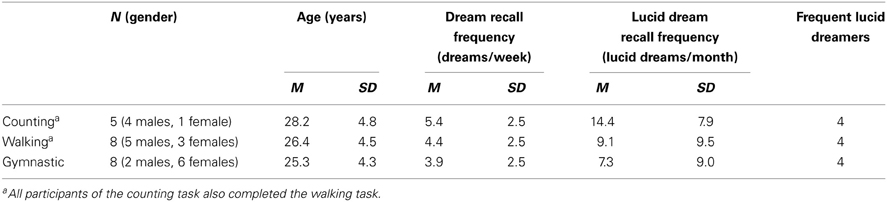
Participants were recruited either from previous studies or by advertisement via different media about lucid dreaming, including a German web page (http://klartraum.de), or from lucid dream induction studies in which specific techniques were applied in order to induce lucidity (e.g., MILD, LaBerge, 1980). Table 1 depicts the participants who successfully finished one of the three experimental protocols (the walking and gymnastic tasks included not only lucid dreamers but also sports students who participated in a lucid dream induction study. The average lucid dream frequency in these groups was thus somewhat lower). Informed consent was obtained from the participants and participation was paid.


TABLE 1
http://www.frontiersin.org/files/Articles/53483/fpsyg-04-01013-HTML/image_m/fpsyg-04-01013-t001.jpg

Table 1. Participants characteristics.

Experimental Conditions

The task descriptions for the three conditions:

Counting

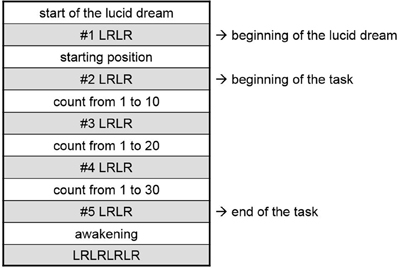
For the counting task, participants had to count from 1 to 10, from 1 to 20, and from 1 to 30 at their own regular pace. During counting, participants were asked not to move (see Figure 1 as an example).


FIGURE 1
http://www.frontiersin.org/files/Articles/53483/fpsyg-04-01013-HTML/image_m/fpsyg-04-01013-g001.jpg

Figure 1. Experimental protocol for the lucid dream task (counting).

Walking

For the walking task, participants had to walk 10 steps, 20 steps, and 30 steps at their own regular pace.

Gymnastic routine

The gymnastic routine consisted of four consecutive elements starting in an upright position with feet together. Participants were instructed to count along while performing the elements (see Supplement 1):

Count 1, 2: Straight jump, landing with feet apart to the left and right, straight jump, putting feet together again

Count 3, 4: Straight jump, landing with feet apart to front and back, straight jump, putting feet together again

Count 5, 6, 7, 8: roll forward, standing up

Count 9, 10: Straight jump with half turn (180°)

For the counting and walking task, participants performed the task at their own regular pace. The gymnastic routine was developed to match the walking 10 steps condition regarding the task duration in wakefulness. The task was presented by the experimenter and the participants were asked to perform the task at the same speed and pace.

Sleep Recordings

In all studies, polysomnography was conducted to register the sleep stages. Sleep was recorded by means of the following standard procedures: electroencephalogram (EEG; C3 and C4 for counting and walking; F3, F4, C3, C4, O1, and O2 for gymnastic), EOG, submental electromyogram (EMG) and electrocardiogram (ECG). The data was recorded during the entire night (or during afternoon nap for one participant) by a standard recording device (XLTEK Trex Longtime EEG recorder or Schwarzer ComLab 32). Sleep stages for the counting and walking conditions were scored according to Rechtschaffen and Kales (1968) while those for the gymnastic condition were scored in accordance to the Manual of the American Academy of Sleep Medicine (2008).

Procedure

The participants spent one to three non-consecutive nights in a sleep laboratory. One participant was recorded twice during an afternoon nap at about 3 pm.

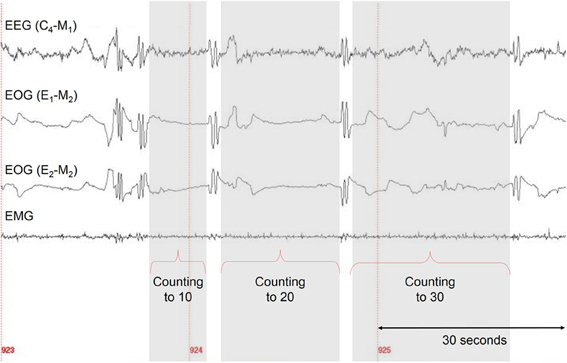
Before sleep, participants received task instructions (see above) in written and oral forms. Afterwards, participants were instructed about left-right-left-right (LRLR) eye signals to mark task events in a lucid dream. The first signal was always to mark the onset of lucidity. In the counting and walking task participants had to mark the beginning of each task sequence as well as the end of the task (five signals for each successful dream). As an example, the exact protocol for the counting task is depicted in Figure 1. In the gymnastic routine, apart from the first signal for the onset of lucidity, only the beginning and the end of the task had to be marked (three signals for each successful dream).

After the participants were familiar with the task and eye signaling, they carried out the task five times in wakefulness (including eye signals). In order to determine the duration of the task in wakefulness, in the counting and walking task the participants measured the times by themselves using a stopwatch—starting after the first eye signal and stopping with the onset of the second one. Because in the gymnastic routine it was not practical for the participants to handle the stopwatch, the experimenter started and stopped the times, according to a verbal signal from the participant, which was given immediately after and before the respective eye signal. For lucid dreams the time intervals were defined as the interval from the end of one LRLR eye signal to the beginning of the next LRLR and so on (see Figure 2).


FIGURE 2
http://www.frontiersin.org/files/Articles/53483/fpsyg-04-01013-HTML/image_m/fpsyg-04-01013-g002.jpg

Figure 2. A sample of one correctly signaled lucid dream for the counting task. Five LRLR eye signals are depicted. The interval between two LRLR eye signals corresponds to the counting interval (gray area).

During the night the experimenter monitored the recordings and woke participants up when recordings showed any of the following criteria: (1) A false awakening, i.e., the recording showing LRLRLRLR eye movements (signal for being awake, see below) but the EEG and EMG channel still showing characteristics for REM sleep. (2) Loss of lucidity, i.e., the recording showing five correct LRLR eye movements in the EOG channel, but no further eye signals occurring 30 s after the previous signal. These criteria were set in order to keep participants from sleeping on and forgetting specific parts of their lucid dreams (Erlacher and Schredl, 2008a). After accomplishing the task successfully in one lucid dream, the participants were to wake themselves up by the technique of focusing on a fixed spot in the lucid dream as described by Tholey (1983). In two cases the experimenter had to wake up participants after false awakening; in all other cases the participants woke up by themselves after finishing the lucid dream task (no cases of loss of lucidity).

The awakening had to be signaled by left-right-left-right-left-right-left-right eye movements (LRLRLRLR). After each lucid dream, participants wrote down a complete and precise dream report. Also they were asked whether they had been lucid and the task had been performed correctly by using a protocol which checked for each element of the task (e.g., eye signals). Any deviations from the protocol were highlighted (e.g., “only a single LR eye movement instead of a pair”) and evaluated to determine whether the data should be excluded. The complete set of dream reports used for data analysis can be found in Supplement 2.

Excluded Data

Out of n = 37 recorded lucid dreams n = 16 cases (counting: n = 2; walking: n = 4; gymnastic routine: n = 10) could not be used for the analysis. The criteria for inclusion of a data set were strict, in order to ensure that only lucid dreams conforming exactly to the protocol were used. A data set was excluded for one or more of the following reasons:
● One or more LR eye signals were not detectable in the recording (counting: n = 2; walking: n = 3; gymnastic routine: n = 5)
● An element of the task was skipped or the participant was unsure about having performed one or more of the elements (gymnastic routine: n = 1)
● The participant stated in the dream report that he or she had imagined the performance rather than carried it out “physically” (gymnastic routine: n = 2)
● The dream report showed that there was a delay between eye signal and task performance, e.g., one participant stated in the protocol that she had hesitated for a moment between the second eye signal and the start of the motor routine to recall the exact sequence of the task (gymnastic routine: n = 1)
● The dream content directly influenced the time of the task performance (walking: n = 1; gymnastic routine: n = 1).
To illustrate the last category, the two dream reports will be presented in detail (Original dream reports were in German, translations were done by the authors):

Dream example 1 Slow motion in the dream (gymnastic routine)

[longer dream sequence before] Then I did the LRLR and then I was here, the water was gone, but the floor was dark. I also felt that after this eye signal suddenly it was blurry again. I waited until it got better and then I walked around, wanting to find a brighter spot where I could see better and have more space. I went to a garden where it was bright and I thought, “Okay, I am doing the experiment now.” I gave a LRLR and I jumped and I felt immediately that jumping was very different compared to wakefulness. Just a different perception of the body, also slower. I continued and I did the forward roll—which lasted almost eternally. When I finished the task I gave a LRLR again”

The task duration was indeed 163% longer than in wakefulness (14.8 vs. 5.6 s).

Dream example 2: Running in the dream (walking)

[longer dream sequence before] We talked for about 5 min about the dream I had and that I often have nightmares. Suddenly, I was back at the party and saw the lights again but this time I realized that I was dreaming and did the LRLR. Afterwards I did the protocol but I was running instead of walking the steps. First 10, then 20 and then 30 steps. Finally I woke up”

The task duration was indeed significantly shorter than in wakefulness and therefore the data set was excluded for the statistical comparison of absolute times between wakefulness vs. lucid dream state (3.2). However, the data set is of special interest for the relative time and therefore it was included in the comparison of the relative timing analysis (3.1).

Statistical Analysis

Due to the small sample sizes, individual data are presented and analysis focuses mainly on a descriptive level. Furthermore, for the comparison of times between wakefulness and lucid dreaming, no predictions were made and, therefore, two-tailed statistical t-tests (dependent samples) as well as Wilcoxon tests were applied. For the comparison of task complexity, time differences between wakefulness and lucid dreaming for walking 10 steps and the gymnastic routine were calculated and two-tailed statistical t-test (independent samples) as well as Mann-Whitney-test applied. For all statistical tests a significance level of alpha = 0.05 was used. SPSS Statistics 20 software was used for the statistical analysis. For differences in times between wakefulness and lucid dreaming effect sizes d (Cohen, 1988) were calculated by the open-source software G∗Power V 3.1.3 (Faul et al., 2007). Cohen (1988) differentiated between small (d = 0.2), medium (d = 0.5), and large (d = 0.8) effect sizes.


Results 


Absolute and Relative Times for Counting, Walking and Gymnastics

Figure 2 shows a sample of a correctly signaled lucid dream for the counting task with five LRLR eye signals. The participant reported the following dream after awakening:

Dream example 3. Correctly signaled lucid dream (counting)

“I was awake and tried WILD [WILD stands for Wake-Initated Lucid Dream which is a technique to induce lucid dreams] which did not induce lucidity immediately. There was a long dream sequence where I had barbecue with some friend. Then I was in a basement with some cupboards and I played with some kids and adults. I knew that I was dreaming and I started to do the protocol: 1. LRLR for “I'm lucid,” 2. LRLR for counting from 1 to 10, 3. LRLR for counting from 1 to 20, 4. LRLR for counting from 1 to 30. After finishing the protocol I waited for a couple of seconds and the dream started to dissolve.”

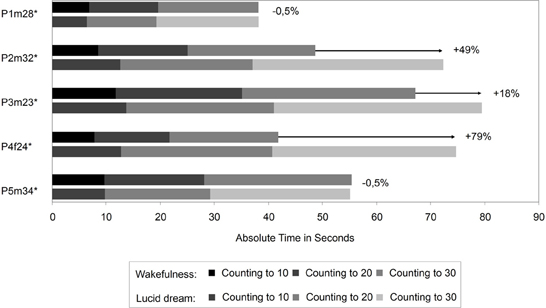
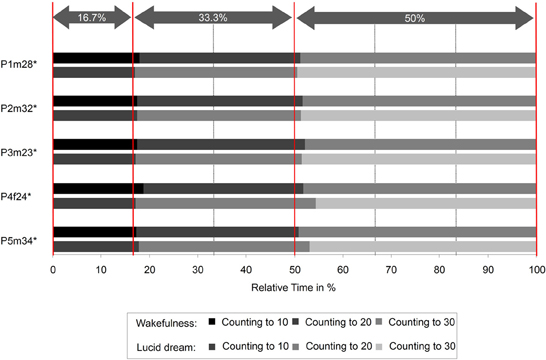
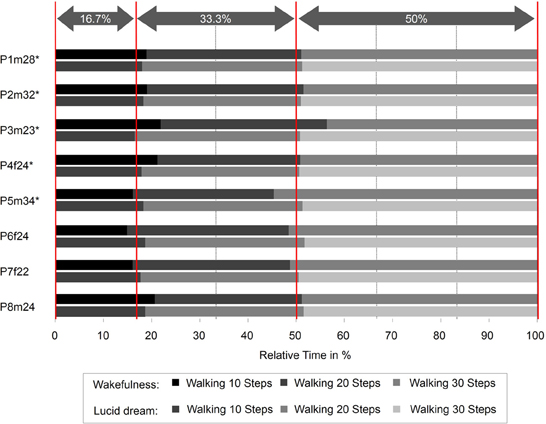
The interval between two LRLR eye signals corresponds to the counting interval (gray area). Figure 3 depicts the absolute times for the counting task during wakefulness and lucid dreaming. In three cases (P2m32, P3m23, P4f24) the absolute time was longer during lucid dreaming than in wakefulness. Figure 4 depicts the relative times for the counting task during wakefulness and lucid dreaming, e.g., the total time for the whole task equals 100%. Because the ratio for the three parts are 1/6 the expected relative time for counting from 1 to 10 is 16.7%, for counting from 1 to 20 is 33.3% and for counting from 1 to 30 is 50% (marked with the red lines in Figure 4). The differences between the expected percentage and the relative time structure of the counting task in wakefulness are M = 1.1% (SD = 0.6%), M = 0.5% (SD = 0.7%) and M = −1.5% (SD = 0.6%) and in lucid dreaming are M = 0.6% (SD = 0.3%), M = 1.6% (SD = 1.5%) and M = −2.2% (SD = 1.6%) (for counting to 10, 20, and 30, respectively).


FIGURE 3
http://www.frontiersin.org/files/Articles/53483/fpsyg-04-01013-HTML/image_m/fpsyg-04-01013-g003.jpg

Figure 3. Absolute durations for the counting task during wakefulness and lucid dreaming (Labels: e.g., P1m28 = Participant 1, male, 28 years. ∗Participants of the counting task also completed the walking task). 
FIGURE 4
http://www.frontiersin.org/files/Articles/53483/fpsyg-04-01013-HTML/image_m/fpsyg-04-01013-g004.jpg

Figure 4. Relative durations for the counting task during wakefulness and lucid dreaming (Labels: e.g., P1m28 = Participant 1, male, 28 years. ∗Participants of the counting task also completed the walking task).

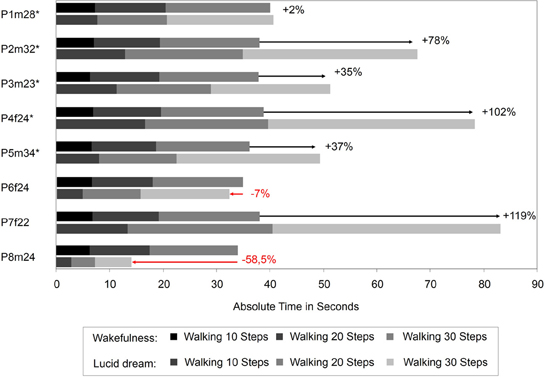
Figure 5 depicts the absolute times for the walking task during wakefulness and lucid dreaming. In five cases (P2m32, P3m23, P4f24, P5m34, P7f22) the absolute time was longer during lucid dreaming than in wakefulness. P8m24 exhibits significantly shorter time; however, the participant in this experiment experienced his first lucid dream and reported he was running instead of walking in the steps. Figure 6 depicts the relative times for the walking task during wakefulness and lucid dreaming, e.g., the total time for the whole task equals 100%. Again, the ratio for the three parts are 1/6 and the expected relative time for walking 10 steps is 16.7%, walking 20 steps is 33.3% and walking 30 steps is 50% (marked with the red lines in Figure 6). The differences between the expected percentage and the relative time structure of the walking task in wakefulness are M = 1.2% (SD = 0.8%), M = −0.2% (SD = 0.6%) and M = −1.0% (SD = 0.5%) and in lucid dreaming are M = 1.8% (SD = 2.7%), M = −1.5% (SD = 1.9%) and M = −0.3% (SD = 3.2%) (for walking 10, 20, and 30 steps, respectively).


FIGURE 5
http://www.frontiersin.org/files/Articles/53483/fpsyg-04-01013-HTML/image_m/fpsyg-04-01013-g005.jpg
Figure 5. Absolute durations for the counting task during wakefulness and lucid dreaming (Labels: e.g., P1m28 = Participant 1, male, 28 years. ∗Participants of the counting task also completed the walking task). 
FIGURE 6
http://www.frontiersin.org/files/Articles/53483/fpsyg-04-01013-HTML/image_m/fpsyg-04-01013-g006.jpg
Figure 6. Relative durations for the counting task during wakefulness and lucid dreaming (Labels: e.g., P1m28 = Participant 1, male, 28 years. ∗Participants of the counting task also completed the walking task).

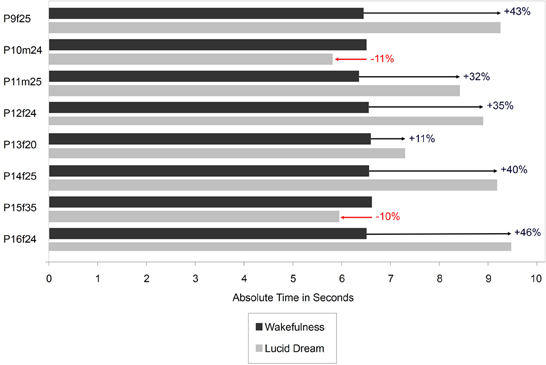
Figure 7 depicts the absolute times for the gymnastic task during wakefulness and lucid dreaming. In six cases (P9f25, P11m25, P12f24, P13f20, P14f25, P16f24) the absolute time was longer during lucid dreaming than in wakefulness. In the other two cases (P10m24, P15f35) the duration of the gymnastic routine was slightly shorter in the lucid dream state than in wakefulness.


FIGURE 7
http://www.frontiersin.org/files/Articles/53483/fpsyg-04-01013-HTML/image_m/fpsyg-04-01013-g007.jpg
Figure 7. Absolute durations of the gymnastic routing during wakefulness and lucid dreaming (Labels: e.g., P1f25 = Participant 1, female, 25 years). 

Comparison of Absolute Times between Wakefulness vs. Lucid Dream State

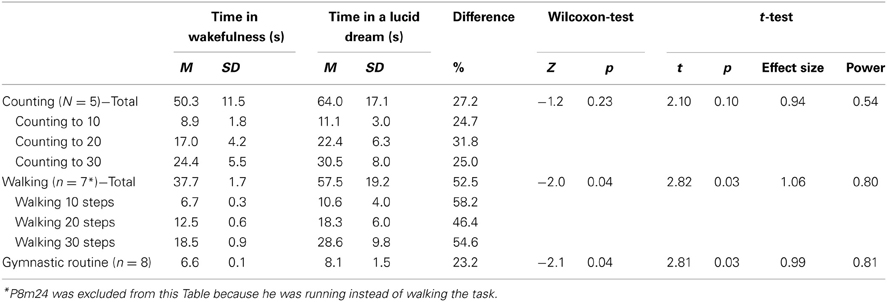
Table 2 summarizes the absolute times required for the counting, walking and the gymnastic task during wakefulness and lucid dreaming. For the counting and walking tasks, the total time is calculated by sum of counting to 10, 20, and 30 or walking 10, 20, and 30 steps. P8m24 was excluded for this statistical analysis because he was running instead of walking the 10, 20, and 30 steps. Statistically significant differences were found for the two tasks with motor activity, walking (p = 0.03) and gymnastics (p = 0.03) but not for the counting task (p = 0.10) (for statistical details see Table 2). In the lucid dream condition, the durations for counting were 27.2%, for walking 52.5% and for the gymnastic routine 23.2% longer than in wakefulness. The effect sizes for all three conditions were quite high (between 0.94 and 1.06), but for the counting task the statistical power was low (0.54).


TABLE 2
http://www.frontiersin.org/files/Articles/53483/fpsyg-04-01013-HTML/image_m/fpsyg-04-01013-t002.jpg

Table 2. Comparisons of times in wakefulness and lucid dreaming. 

Comparison of Walking 10 Steps vs. Gymnastic Routine

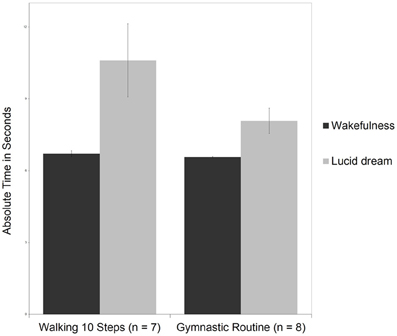
Figure 8 depicts means and standard deviations for the walking 10 steps and the gymnastic routine during wakefulness and lucid dreaming. In wakefulness the gymnastic routine lasted M = 6.6 s (SD = 0.1) and therefore matched the time for walking 10 steps (M = 6.7 s, SD = 0.3). Comparing the two tasks with motor activity but different complexity, no statistically significant effects were found, t(13) = 1.6, p = 0.14, d = 0.78, power = 0.42; Mann-Whitney-U: Z = 1.04, p = 0.30. Moreover, the more complex gymnastic routine required less time (8.1 s) than walking 10 steps (10.6 s) during lucid dreaming. Again, for this statistical analysis P8m24 was excluded because he was running instead of walking the 10, 20, and 30 steps.


FIGURE 8
http://www.frontiersin.org/files/Articles/53483/fpsyg-04-01013-HTML/image_m/fpsyg-04-01013-g008.jpg

Figure 8. Means and standard deviations for walking 10 steps and the gymnastic routine during wakefulness and lucid dreaming.


Discussion


In this study, longer durations were observed for all types of tasks in lucid dreams as compared to those when awake. The greatest increase in time was for walking (52.5%) while the lowest increase was for gymnastics (23.2%). The increase for counting was 27%, but did not reach statistical significance. The differences in time, however, were observed only for the absolute durations of the task, but not for the relative durations.

Before discussing the results, some limitations of the present study should be acknowledged. One of the biggest limitations is the small sample sizes. Small sample size is always related to statistical drawbacks because it is hard to determine if the data meet all prerequisites for parametrical testing (e.g., normality). In order to account for such statistical problems we, firstly, concentrated on presenting sufficient descriptive statistics and, secondly, ran additional non-parametric tests (Wilcoxon test). The obvious advantage of t-tests is that effect size (Cohens d) and test power can be calculated and therefore those results are presented in Table 2. Because in this study effect sizes are large (d > 0.8) and test power ranges from 0.5 to 0.8 the probability for type II error is high (as in the case of counting).

Increasing sample size in lucid dream studies is not easy because the enrolment of proficient participants is always complicated. In a representative survey by Schredl and Erlacher (2011) it was shown that about 50% of the population experienced at least one lucid dream, however only 1.2% have lucid dreams on a very frequent basis (e.g., several times a week) which is necessary for sleep laboratory studies. Further, in addition to becoming lucid, participants also need to remember the task, accomplish it, and produce unambiguous eye signals. A recent survey of lucid dreamers (Stumbrys et al., in press) showed that lucid dreamers are able to remember their waking intentions in lucid dreams in only about half of the occasions and only less than half of those remembered intentions can be successfully accomplished in lucid dreams (failures most often occur due to awakening or hindrances within the dream environment). This seems to be borne out by our own study: Recall that half of the data sets had to be excluded because dreamers failed to carry out the task.

Next, the sleep recordings for the present study were conducted over the period of several years and the electrode montage has slightly changed over the time. The first two conditions (counting and walking) were recorded in accordance with the guidelines by Rechtschaffen and Kales (1968), while the third condition (gymnastic) was recorded in accordance with the American Academy of Sleep Medicine (2008) guidelines.

It should also be mentioned that in the present study lucid dreams were used to explore a special feature of a motor routine and that the results and conclusion should not be generalized to “the dream state” as a matter of course. Dreams in general—referring to REM dreams—also include non-lucid dreams. An EEG study by Voss et al. (2009) indicated that there might be a difference between lucid and non-lucid REM sleep concerning frontal lobe activation. These findings are supported by Dresler et al. (2012) who demonstrated in an EEG/fMRI study that during the lucid dream state a network of different brain areas appear to be reactivated which are normally deactivated during REM sleep (including prefrontal, occipito-temporal cortices, precuneus, cuneus, parietal lobules). These studies do not indicate differences between lucid and non-lucid dreams concerning motor activity per se. However, we cannot simply exclude such a difference a priori. Future studies using EEG/fMRI recordings should also investigate motor activation during non-lucid dreams, based upon the correlation of activation patterns and reported motor activity.

It is also worth mentioning that in our study the counting and walking task was performed at the participants' own regular pace, e.g., counting to 10 did not match 10 s of physical clock time (see also Table 2). LaBerge (1985) for example explicitly trained his participants to estimate a specific interval of time as accurately as possible, namely 10 s by counting “One thousand and one, one thousand and two, … one thousand and ten” at a rate attempting to match 10 s of physical clock time. In our study for the counting and walking condition, we did not intend to match the lucid time durations exactly to physical clock time (e.g., 10 s). This allows participants to do the task at their own pace and has the advantage that they don't have to pay attention to this additional demand of concentrating to match a certain time interval. However, for the gymnastic routine the participants were trained to match the walking 10 steps condition regarding the task duration in wakefulness.

Effects of Task Modality

Two different task modalities were used in the present study: those involving motor activity (walking and gymnastic conditions) and those not involving motor activity (counting condition). While increased durations in lucid dreams were observed for both modalities, only tasks with motor activity resulted in significant increases in time (with the caution of possible type II error for counting). These findings are in accordance with Erlacher and Schredl (2004) who also demonstrated that a task involving motor activity (performing squats) yielded an increased duration in lucid dreams. In contrast, tasks which did not involve motor activity (counting) led to negligible differences between wakefulness and lucid dreaming (3.5 and 9.6%). Also no differences were found in study by LaBerge (1985). However, in the present study the difference for counting was considerably higher (27.2%) and it is possible that only the small sample size did not allow it to reach statistical significance. Thus, while prolonged times are quite consistent across the range of different tasks involving motor activity (walking, gymnastics, performing squats), the findings regarding tasks without motor activity (counting) are still inconclusive.

It is important to note that all our conditions actually involved counting. Thus it is possible that the counting itself had an influence on the duration of the motor tasks. Therefore motor tasks which do not involve counting should be investigated in future studies in order to find out if the prolonged durations can still be found and if the extent of a probable increase is smaller or higher than when counting is involved.

Taking a closer look, there was also motor activity in the counting condition because participants were asked to count aloud. Even though the motor activation of the muscles involved during counting seems negligible in contrast to the gross motor activation during walking or the gymnastic routine, future studies should explore the difference for counting aloud and silent.

Effects of Task Length

In two conditions (counting and walking), in addition to the absolute task time, also interim task times (after counting to 10 and to 20; and after walking 10 and 20 steps) have been measured. The analysis showed that relative times for both conditions did not differ between wakefulness and the lucid dream state. This was also true for one participant who accidentally ran the 10, 20, and 30 steps in his dream. Therefore it appears that extended durations in lucid dreams are not dependent on the task length or, in other words, there is not a disproportional time effect when accomplishing longer tasks.

It is worth mentioning that we did not randomize the order of lengths (e.g., P1: 10, 20, 30; P2: 30, 20, 10; etc.). This might confound the results with respect to order effects, however, one might speculate that possible order effects should have distorted the relative times in a systematic proportional way, but this was not the case.

Effects of Task Complexity

Two different tasks with motor activity were included in the present study: a simple motor task (walking) and a complex motor task (gymnastic routine). While both motor tasks resulted in increased durations in lucid dreams, greater complexity of the task was not associated with greater increases in time. In fact, the trend was even in the opposite direction: Highest increases were observed for the most simple task, walking (52.5%), followed by somewhat more complex task from a previous study, performing squats (39.9%; Erlacher and Schredl, 2004), and finishing with the lowest increases for the most complex task, gymnastic routine (23.3%). While it is not clear if these differences just occurred by chance or there is indeed some inverse relationship between the task complexity and prolonged durations in lucid dreams, from the present data we conclude that more complex actions do not lead to longer durations.

However, it is important to acknowledge, that it is nearly impossible to provide an exact definition of “complexity” (Wulf and Shea, 2002) and the concept has been used in various ways. For example, Guillot and Collet (2005) use this notion in the sense of highly automatic movements (simple) in comparison to cyclical closed movements (complex). The gymnastic routine task, which has been employed in the present study, can be termed complex in several ways: it consisted of a sequence of different elements and was therefore a discrete as opposed to a continuous (walking) motor task. Also the various elements required higher levels of motor coordination and balance. It is still to be investigated whether and to what extent motor tasks which are complex in other ways than the gymnastic routine (e.g., regarding attention, task difficulty) affect dream state durations.

Explaining Extended Durations

Since the difference in duration between wakefulness and the dream state was observed only for the tasks which involved motor activity, it is worth taking a look into studies which investigated the durations of motor tasks which were mentally simulated by participants while awake. Both in mental simulations and in the dream state motor activity is performed only in one's mind, without moving the physical body. Some mental simulation studies indeed found prolonged durations for mental simulations of walking tasks (Decety et al., 1989; Decety and Jeannerod, 1995) as well as in golf, swimming and weight lifting (for overview see Guillot and Collet, 2005). The difficulty of task, perceived force and skill complexity seem to be time-enhancing factors (Guillot and Collet, 2005). However, the findings from mental simulation studies are ambiguous: Some authors report equivalence of time (e.g., Munzert, 2002), others found shortened durations (Calmels and Fournier, 2001).

One possible explanation from mental stimulation studies for the prolonged durations might be centrally encoded force (Jeannerod, 1994). In the experiment by Decety et al. (1989) the participants who mentally simulated a walking task with an actual 25-kg weight on their back had increased mental simulation durations by about 30%. Jeannerod (1994) suggests that somehow the programmed increased level of force—as a reaction to the actual weight perceived—could not be used to overcome physical resistance and was thus misread by participants as a longer duration. Physically perceived force thus led to the program “increased effort required.” In dreams the perceived force, in the sense of gravity or resistance, might not correspond to the ordinary gravity force in wakefulness, because no real gravity force exists in the dream simulation and muscular feedback is lacking due to REM sleep atonia. Therefore the movements may also be programmed with “increased effort” to compensate for the lack of muscular feedback.

Another possible explanation might be related to neural specifics of REM sleep. Louie and Wilson (2001) found that when rats were trained in a behavioral task their hippocampal activity during the task in wakefulness was replayed in REM sleep but with a somewhat different temporal scaling factor. Most scaling factors were bigger than 1.0 (i.e., there was a slower corresponding activity during REM sleep) and the average was 1.4 ± 0.6. This average duration increase by 40% in REM sleep are in line with our findings on increased duration of motor tasks in lucid dreams (gymnastic: 23.3%; squats: 39.9%; walking: 52.5%). However, it is not clear if the observed replayed neural patterns are indeed linked to (dreamed) motor activity or if they rather represent learning procedures regarding temporal-spatial orientation. The task for the rats involved motor activity and therefore it is possible that the observed neural activity during REM sleep was connected to motor learning, although it is impossible to say if the rats actually dreamed of accomplishing the task. Louie and Wilson (2001) also found that the theta EEG rhythm during REM sleep was about 1.2 times slower compared to the practice in wakefulness and therefore provides two possible explanations. Firstly, this might reflect a globally slower neural processing during sleep due to lower brain temperature. Further, the theta rhythm itself might serve as a pacing mechanism to coordinate interactions during information processing across multiple brain regions.

Finally, it is important to underline that in each condition two participants also produced quite similar time or even slightly shorter times compared to wakefulness. Unfortunately, from our data it is not possible to conclude why those participants performed differently. For example, P1m28 was a highly frequent lucid dreamer and he showed very exact times in his lucid dreams. On the other side, P6f24, who also showed quite exact yet slightly shorter time in the walking condition during her lucid dream, was a very infrequent lucid dreamer.

Implications for Sports Science

The relative timing of motor skills plays an important role in motor control theories. Schmidt (1975), for example, proposed in the motor schema theory that the relative time (e.g., the temporal structure of a motor skill) is an invariant component of a so-called generalized motor program and that parameters could scale this structure proportionately in time. For example, throwing a ball can be done fast or slow, however, the relative timing of the involved force impulse need to be proportional in order to speak of the same motor skill. If the relative time structure is not rigidly structured within a certain motor skill then this action is just something else but not the motor skill at hand (e.g., throwing a ball is no longer throwing but something else). The present findings of this study demonstrate that despite the longer absolute durations for tasks involving motor activity, the relative durations remain the same. This finding has important implications for lucid dream applications, such as using lucid dreams for motor skill practice: Athletes practicing long movement sequences seem to practice the same movement sequences as in wakefulness because the temporal structure is still given in their lucid dreams. With respect to relative time issues, it seems that lucid dreaming can be successfully applied for motor skill learning in sports (cf. Erlacher, 2007).

Practice in lucid dreams is similar to mental rehearsal in wakefulness: Movements are rehearsed with an imagined body on a cognitive level. Mental rehearsal is a well-established and widely used technique in sports science and practice. Meta-analyses (Feltz and Landers, 1983; Driskell et al., 1994) demonstrated that it has a positive and significant effect on performance. The evidence suggests that imagined and executed actions to some extent seem to share the same central neural structures. Decety (1996) presented three lines of evidence in support of this correspondence hypothesis: measurement of central nervous activity, autonomic responses, and mental chronometry. Similar correspondence can be demonstrated between dreamed actions in REM sleep and executed actions in wakefulness (Fenwick et al., 1984; LaBerge, 1990; Erlacher and Schredl, 2008b). The present study provides further evidence about the correspondence of mental chronometry (albeit with some scaling factor).

Previous studies with lucid dreamers demonstrated that complex sports skills, such as skiing or gymnastics, can indeed be successfully practiced in lucid dreams (Tholey, 1981). Also in this study, the participants were able to memorize a gymnastic routine and to recall and perform it within a lucid dream. It seems that athletes indeed are able to perform their sports in lucid dreams (Erlacher et al., 2011–2012) and that practice in lucid dreams can increase performance in wakefulness (Erlacher and Schredl, 2010).

Future Directions

The present findings should be replicated in future studies by using bigger sample sizes. It might be possible that not only experienced lucid dreamers can be involved, but also novices, supported by a lucid dream induction technique. In the third condition of the present study, some participants were not experienced lucid dreamers but sport students who took part in a lucid dream induction study. Nevertheless some of them were able to have their first lucid dream and successfully accomplished the requested task in it. A plethora of different methods have been suggested for lucid dream induction and some of them do look promising (see Stumbrys et al., 2012).

Future studies should explore the discrepancies found in the counting condition, as well a possible negative relation between the task complexity and prolonged times, i.e., that more simple motor tasks for some reason lead to longer durations. Further, measures of perceived effort (e.g., Borg, 1982) could be included to explore the relationship between prolonged durations and perceived effort when accomplishing a motor task. Also it might be worth investigating other possible influencing factors that were found to have an effect on durations in mental simulations, e.g., the level of expertise and task familiarity (Guillot and Collet, 2005). Concerning the features of the tasks used in our own studies, it might also be worth exploring possible differences between continuous (walking, squats) and discrete (gymnastic routine) motor tasks.

One of the difficulties with chronometric lucid dream research is that it mainly relies on subjective time perception. Therefore it would be interesting to approach this problem with another way of measuring the durations of dreamed actions by incorporating physical time intervals into lucid dreams with external auditory signals. In a recent study Strelen (2006) showed that in a lucid dream the dreamer can hear and distinguish an externally provided acoustic stimulus. These audio cues could serve as a start and stop signal of an interval, during which lucid dreamers, for example, could count numbers or count their steps while walking. The problem of subjectivity within dreams of course could not be avoided, however, this would allow another comparison of physical clock time with subjective time experience in lucid dreams.


Conclusion


In summary, the present study confirms the findings of Erlacher and Schredl (2004) that motor actions lead to prolonged durations in lucid dreams. The findings for the durations of cognitive actions (without motor activity) are as yet inconclusive. The relative time structure of motor tasks that last longer in the dream state than in wakefulness do not result in disproportional task durations in the dream state. Lucid dreams, therefore, can be successfully applied for motor skill practice in sports, music and other areas. Prolonged durations might be related to the lack of muscular feedback or slower neural processing during REM sleep. Future studies should explore factors that might be associated with prolonged durations (e.g., level of perceived effort, continuous vs. discrete tasks, motor task with counting vs. without counting) and try to incorporate physical time intervals within the dream by external auditory signals (e.g., implementing audio cues as start and stop signals).

Conflict of Interest Statement

The authors declare that the research was conducted in the absence of any commercial or financial relationships that could be construed as a potential conflict of interest.

Acknowledgments

This project was funded by the BIAL Foundation, Portugal (Grant 72/06).

Supplementary Material

The Supplementary Material for this article can be found online at: http://www.frontiersin.org/journal/10.3389/fpsyg.2013.01013/abstract


References are available at the Frontiers site.