 David Koch is one-half of politically and economically powerful duo known as the Koch brothers. He and his brother, Charles, are tied in sixth place on the list of the wealthiest men on the planet. Phelan M. Ebenhack/APBrothers Charles and David Koch are the subject of the new book Sons of Wichita: How the Koch Brothers Became America's Most Powerful and Private Dynasty. The author, Daniel Schulman, describes the Kochs as having pumped hundreds of millions into remaking the American political landscape, trying to bring their libertarian views into the mainstream.
In addition to backing individual candidates who reflect their views, the Koch brothers have played key roles in the Libertarian Party and in the formation of the Tea Party. Their father, who founded Koch Industries, was also a founding member of the far right group the John Birch Society.
Koch Industries is now the second largest private corporation in the U.S., with $115 billion in annual revenue and a presence in 60 countries. Charles and David are tied in sixth place on the list of the wealthiest men on the planet.
Daniel Schulman is a senior editor in the Washington bureau of Mother Jones, and a founding member of the magazine's investigative journalism team. He tells Fresh Air's Terry Gross about how the Kochs have contributed to today's political landscape.

Interview Highlights
On the Kochs' political stances
Their ideology is very much a libertarian one. They are currently considered Republican kingmakers, but there are really a lot of places where their philosophy doesn't jive with the mainstream Republican one. For instance, they're generally anti-war. They're civil libertarians; they are not social conservatives in any sense of the word. David Koch has said he's pro-gay marriage. You wouldn't see these guys advocating against reproductive rights. The area that is the sweet spot for them with today's GOP is really economic issues, and they are staunch economic conservatives — perhaps more hard-line than even the Republican mainstream...Charles has said in past that his view of government is that it really should be a night watchman that only exists to protect private property rights and to preserve the laws of supply and demand.
On the Kochs' political influence
In the Obama era, you've seen their political network grow by leaps and bounds. Part of this was because there was a major conservative backlash to Obama and the Kochs managed to capitalize on that. Part of this, too, was because the Democrats made the Kochs such boogeymen. They essentially drove a lot of Republicans into their arms.
The Kochs have always had an uneasy relationship with the Republican Party, or they traditionally did, because their politics aren't exactly Republican, they're very much more libertarian, and there's only a narrow subset of issues on which they actually agree with Republicans. But by demonizing the Kochs, [Democrats] made them hugely popular within the conservative movement.
On the size of Koch Industries
Koch Industries is massive. ... [It] really started as an oil and cattle ranching empire, but it's grown, really, by leaps and bounds beyond that. They're in petrochemicals. They're the third largest commodities trader in world. They own Georgia-Pacific, so brands such as Brawny, Angel Soft toilet paper, Dixie cups, those things are manufactured by Georgia-Pacific. ... Most people probably don't know the name Koch Industries, but what they don't realize is that every single day they're encountering products that were produced in some way by them.
On the Kochs' position on climate change
Across the board, the Kochs are anti-regulation. They really haven't met a regulation that they liked. In terms of climate change policy, you've seen them fund an array of groups that have sowed doubt about the existence of climate change. They view climate change and any regulation surrounding it as a major threat to their business model, which is a lot having to do with oil and petrochemicals. ... They have certainly funded an array of groups that have tried to create doubt about the very existence of it...
David is a man of science — I consider Charles a man of science too. [Charles] has two advanced degrees from MIT, one in nuclear engineering. These guys are not anti-science in any sense of the word, so to be putting any money towards denying the existence of climate change, where there is a scientific consensus about that, seems wrong to me.
On the Kochs' role in creating the Tea Party
There was this bygone strain of thinking that you saw in the John Birch Society — that their father had founded and of which Charles had been a member — where you really saw socialism around the corner of every move of government. And you really saw that strain of thinking come to the fore in the Obama era, and it really was no accident. The Kochs spent many years funding an intellectual infrastructure through a variety of think tanks. And in terms of actual organizing and financing of the Tea Party, their advocacy group, Americans for Prosperity, really was there at the forefront organizing tea parties and whipping up the movement. So I'd say they played a pretty major role in the Tea Party movement. I know they downplay their involvement.
On Charles Koch as one of the founders of the libertarian movement
I think the reason we're talking about libertarianism today and the reason that it's a popular ideology owes quite a bit to Charles Koch. His funding of libertarianism really started in the '60s and he has been methodically institution-building ever since then.
The Charles Koch Foundation, in 1977, would be transformed into The Cato Institute, which is the libertarian movement's marquee think tank these days. It wasn't until later that David Koch joined in his brother's ideological projects. One thing I learned when researching this book is that there is quite a big distinction between the philanthropy of David and Charles Koch. David is more of a philanthropist in the classic sense of the word: He funds medical research, science; he funds the arts. Charles' lifelong mission has been to change the political culture and mainstream libertarian ideas and he's been doing this for more than five decades.
On why Schulman wanted to write this book
The Koch brothers, in the 2010 time frame, had become so vilified, I really wanted to understand their origins, their upbringing, the roots of their company, the roots of their ideology. And the more I dug into their family story I found they had just a phenomenally fascinating tale, tragic in some ways. And in a lot of ways this is a family that is much more significant than a lot of people realize, and their impact is going to be felt long into the future.
Showing posts with label libertarians. Show all posts
Showing posts with label libertarians. Show all posts
Thursday, May 22, 2014
How The Koch Brothers Remade America's Political Landscape (NPR)
On NPR's Fresh Air this evening, Terry Gross spoke with David Schulman about his new book on the hyper-conservative, wanna-be libertarians, the Koch brothers. Schulman's new book, Sons of Wichita: How the Koch Brothers Became America's Most Powerful and Private Dynasty, appears to be the first biography of these two pillars of the Fox News worldview. You can read an excerpt from the book here.


Monday, September 17, 2012
Understanding Libertarian Morality: The Psychological Dispositions of Self-Identified Libertarians - Jonathan Haidt, et al

Jonathan Haidt (author of The Righteous Mind: Why Good People Are Divided by Politics and Religion) and his team published a recent article in PLoS ONE on the psychological disposition of libertarians (self-identified).
The challenge with this kind of study is in how one defines the term (this is also an issue with his definitions of liberal and conservative, which is why he likely prefers the "self-identified" approach). Haidt traces the origins of libertarianism back to the Enlightenment, with its emphasis on the individual. Much of the nuance of philosophical libertarian thought is lost on those who now call themselves libertarians, such as the tea party crowd.
Haidt catches the gist of the current perspective in this excerpt:
Libertarianism provides an ideological narrative whereby the opposition to high taxes and big government is not just an “economic” position: it is a moral position as well. This narrative provides the basis for principled opposition to a government seen as unfair (because it takes from the productive and gives to the unproductive), tyrannical (because it violates the negative liberty of some people to promote the positive liberty of others), and wasteful (because governments rarely achieve the efficiencies generated by the competition of private firms).The downside of this is that a lot of social conservatives, because they also want a smaller government and lower taxes, have self-identified as libertarian, like Ron Paul. He believes in limited government, except when it comes to social issues - he believes we should ban abortion, discriminate against LGBT people, and his organization has been implicated in racism several times. He is a fundamentalist Christian, and those beliefs reject true libertarian philosophy.
The article is open access.
Understanding Libertarian Morality: The Psychological Dispositions of Self-Identified Libertarians
Ravi Iyer1*, Spassena Koleva1, Jesse Graham1, Peter Ditto2, Jonathan Haidt3
1 Department of Psychology, University of Southern California, Los Angeles, California, United States of America, 2 Department of Psychology and Social Behavior, Irvine, California, United States of America, 3 Department of Psychology, Charlottesville, Virginia, United States of America
Abstract Top
Libertarians are an increasingly prominent ideological group in U.S. politics, yet they have been largely unstudied. Across 16 measures in a large web-based sample that included 11,994 self-identified libertarians, we sought to understand the moral and psychological characteristics of self-described libertarians. Based on an intuitionist view of moral judgment, we focused on the underlying affective and cognitive dispositions that accompany this unique worldview. Compared to self-identified liberals and conservatives, libertarians showed 1) stronger endorsement of individual liberty as their foremost guiding principle, and weaker endorsement of all other moral principles; 2) a relatively cerebral as opposed to emotional cognitive style; and 3) lower interdependence and social relatedness. As predicted by intuitionist theories concerning the origins of moral reasoning, libertarian values showed convergent relationships with libertarian emotional dispositions and social preferences. Our findings add to a growing recognition of the role of personality differences in the organization of political attitudes.
Full Citation:
Iyer R, Koleva S, Graham J, Ditto P, Haidt J (2012) Understanding Libertarian Morality: The Psychological Dispositions of Self-Identified Libertarians. PLoS ONE 7(8): e42366. doi:10.1371/journal.pone.0042366
Thursday, February 02, 2012
Bookforum - Social contract theory for Occupiers
Another collection of links related to the #Occupy movement from the folks at Bookforum.
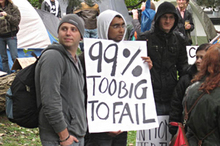
- From New Left Project, an interview with Erik Olin Wright on Occupy Wall Street and transformational strategy.
- Eric Johnson on how right-wing libertarians, John Birchers and conspiracy freaks are trying to hijack the Occupy Movement.
- Smack in the middle of the holidays, on a Wednesday night in very late December, about 150 people — philosophy professors and graduate students — gathered in a hotel conference room in Washington, DC, for a panel called, “Thinking Occupation: Philosophers Respond to Occupy Wall Street”.
- The forgotten prophets of the Occupiers: A fascinating Canadian book urges "political action for the 99%" — it was written in 1943.
- C. S. Herrman on social contract theory for Occupiers: what law, culture and history tell us.
- Reza Fiyouzat submits to the Occupy movement the idea of "Direct Representation for Taxation".
- From Socialist Viewpoint, two issues on Occupy Wall Street.
- From Ship of Fools, what would Jesus occupy?
- A look at what lies behind the Occupy phenomenon, what may lie ahead, and what the recent spate of protests across the political spectrum portends for the republic.
Subscribe to:
Comments (Atom)